FOCACCIA WITH CHILE AND COTIJA CHEESE

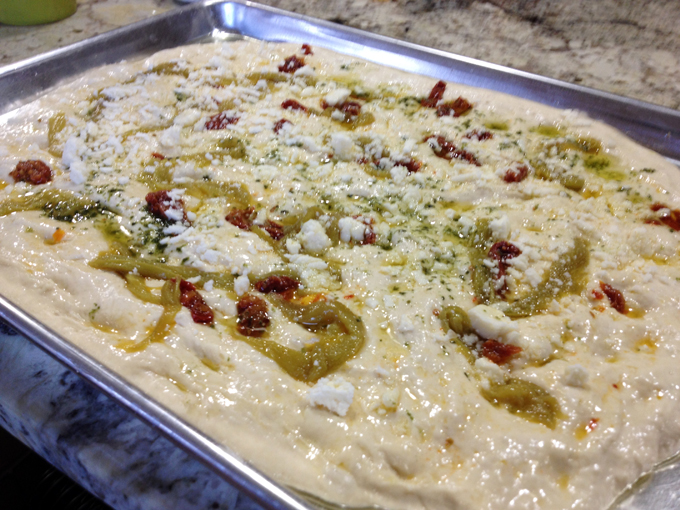
A while ago – June 2013, to be precise – I made a type of Italy-meets-Mexico-focaccia using a sauce with tomatillos. It turned out so tasty that I wanted to re-visit the same type of fusion cuisine again. It took me a while, but here is my second take on the subject.  I used my default recipe for the dough, topped with a mixture of olive oil, avocado oil, New Mexico chiles, and Cotija cheese. Some sun-dried tomatoes for a bit of concentrated sweetness, and voilà…

IMG_6521FOCACCIA WITH CHILE AND COTIJA CHEESE
(from the Bewitching Kitchen)

1 recipe of focaccia dough
Green New Mexico chiles, thinly sliced
Cotija cheese, crumbled (you can use feta, or even Mozzarella)
sun-dried tomatoes
olive oil
avocado oil
salt & pepper

Open the dough on a well-oiled baking dish, stretching with your hands, and making plenty of dimples all over its surface.

Add a good coating of olive and avocado oil, mixed about 50:50. Distribute the slices of chile, cheese, and sun-dried tomatoes all over the dough.  Season with salt and pepper.

Bake as directed in the original foccacia post.

Cut in slices and serve.

ENJOY!

I am not offering a printable version, since the main recipe for the dough is from a previous post. The toppings don’t really need any type of precise measurement, so add as much or as little of each component you feel like. Black olives could be wonderful too, by the way…

prebaked
For the chiles, I used the brand featured in this post, a gift from our friends V & K. They have amazing flavor, and of course go very well with Cotija cheese, one of those matches made in heaven.  Like V & K.

♥♥♥♥♥♥♥♥♥♥♥♥♥♥

The focaccia squares freeze well, I like to wrap 3 to 4 squares in small packages and enjoy them for weeks. Simply remove from the freezer 30 minutes before your meal, and heat them in a low oven until warm and fragrant.

I am submitting this post to Susan’s Yeastspotting event…

ONE YEAR AGO: Crispy Chickpea and Caper Spaghetti 

TWO YEARS AGO: Leaving on a jet plane

THREE YEARS AGO: Crispy Herb-Crusted Halibut

FOUR YEARS AGO: Almond Butter Cake

FIVE YEARS AGO: Bonjour!

KEN FORKISH’S WARM SPOT SOURDOUGH

First bread post of 2015!  Not the first bake of the year, because this was made for Phil’s birthday on the last week of December. He chose the whole menu, which consisted of oysters on the half-shell as a first course, and clam chowder as the main dish. Also according to his request, no dessert to keep things moderate.  Perfect for me.  The bread was all that bowl of chowdah needed to shine in its creamy glory!

Warm Spot Sourdough1

WARM SPOT SOURDOUGH

I am not going to share the full recipe (from Ken Forkish’s book Flour Water Salt Yeast), but you can find it online with a visit to Karen’s site. And don’t just limit yourself to that recipe,  look around and be amazed by her talent. Just a recent example: she tackled Pretzel Rolls, the traditional Laugenbrötchen. That is on my mile-long list of things to try this year. Now, back to my sourdough…

A little walk through the method… The bread takes three days to prepare, but don’t let that intimidate you. It is worth your time. The interesting twist in the recipe is keeping your sourdough starter at a higher temperature of fermentation, around 85 F. During the winter that can be a challenge, but I am the lucky owner of a bread proofing box. Problem solved. Because the starter ferments at a higher temperature you will need to refresh it more often than usual, but as I mentioned in my previous sourdough post, Ken is particularly helpful in laying out a nice schedule for each of his recipes.

After the bulk fermentation, in which I gave four folding cycles to the dough, the bread is shaped, and retarded in the fridge overnight. From the fridge it goes straight into the hot oven, no need to bring it to room temperature.

One of the things I did differently in this bake was to flour my banetton, cover it with plastic wrap (Saran Wrap type), flour the plastic and place the shaped dough for its final proof, seam side UP (going against Ken’s usual method).  Next morning, I inverted the bread on parchment paper, slashed the surface and baked it with my normal method of steam (Dutch oven covered with a wet lid).  Ken likes to allow his breads to open naturally, so he proofs the shaped loaf with the seam side down, then simply inverts it on the baking sheet without slashing. I did this on my first time making this recipe a couple of months ago, and even though the bread tasted as good as this one, it failed to open in a more dramatic way.  Take a look:

FirstLoaf

Maybe it is just a matter of personal preference, but I rather help the bread open in a more defined way.  One more remark before I go: I liked the use of the plastic wrap because it gave me extra confidence removing the bread from the banetton. I’ve had too many situations of dough sticking and compromising the shape of the loaf in the end.  I suspect my skills to shape the loaf and generate enough surface tension need improvement. Until then, I will be using this trick, and if you had problems with dough sticking give it a try…

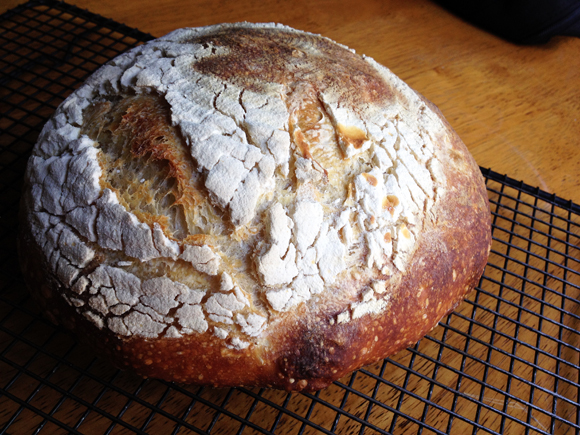
The bread had good oven spring, the crust was just the way we love it!

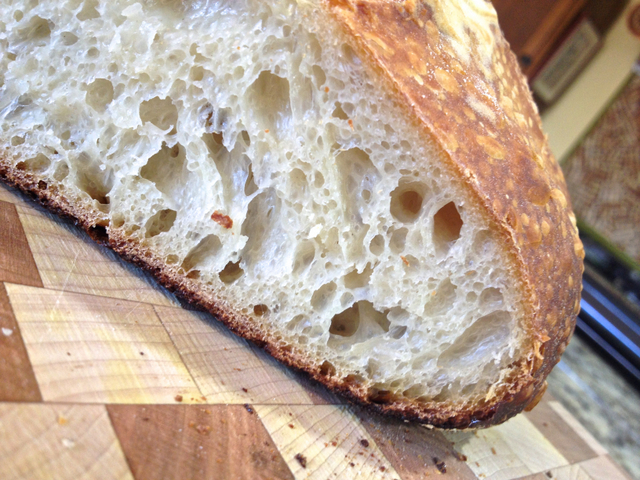
CrumbCRUMB SHOT

So there we have it, another birthday celebration, with good music, juicy oysters, delicious bread, and a warming bowl of soup, all in the comfort of our home!  Life is good…

I am submitting this post to Susan’s Yeastspotting event…

ONE YEAR AGO: Bran Muffins, Rainbows, and a wonderful surprise!

TWO YEARS AGO: Cider-Marinated Pork Kebabs

THREE YEARS AGO: Golden Age Granola

FOUR  YEARS AGO: Mushroom Souffle for Two

FIVE YEARS AGO: Stollen

KEN FORKISH’S PAIN AU BACON

PainAuBacon2It’s been a while since I baked a loaf of sourdough bread. A quick browse through my archives proves this sad turn of events: October 13th was my last adventure in the Land of the Wild Yeast. But, with so much going on, trips, busy schedule, I was forced to let my starter sleeping in the freezer a lot longer than I expected.  Finally, the second weekend of December shaped up as a perfect opportunity to resume bread baking. The weekend schedule seemed flexible enough – just a cocktail party Saturday night – and the perfect weather to crank the oven up all the way to 450 F.  Sometimes a tropical being is forced to find positive aspects in outside temperatures falling below 60 F.  I sat down next to our fireplace with quite a few of my bread cookbooks, and went through the very elaborate process of choosing which recipe to work on.  Keep in mind that if I have to dress up for a party, my outfit is decided in 5 minutes, accessories included. But choosing a sourdough bread takes me hours. And I mean  hours  in the strict sense of the term, in which 1 hour equals 360 seconds.  After intense mental struggle, I picked a winner from Ken Forkish’s book “Flour Water Salt Yeast“.   It was worth all the pacing back and forth, the many stick-it notes, and the snide remarks of the husband asking if I needed another couch to spread some more cookbooks. Very uncalled for. Obviously, I can only endure this type of treatment because I am an easy-going, serene, and forgiving human being. PainAuBacon1PAIN AU BACON
(recipe reprinted with permission from Ken Forkish)

Makes one loaf.

for the levain:
50 g mature active sourdough starter
200 g unbleached all-purpose flour
50 g whole wheat flour
200 g lukewarm water

for the final dough:
432 g unbleached all-purpose flour
8 g whole wheat flour
343 g water (warmed to about 90 degrees F)
10 g fine sea salt
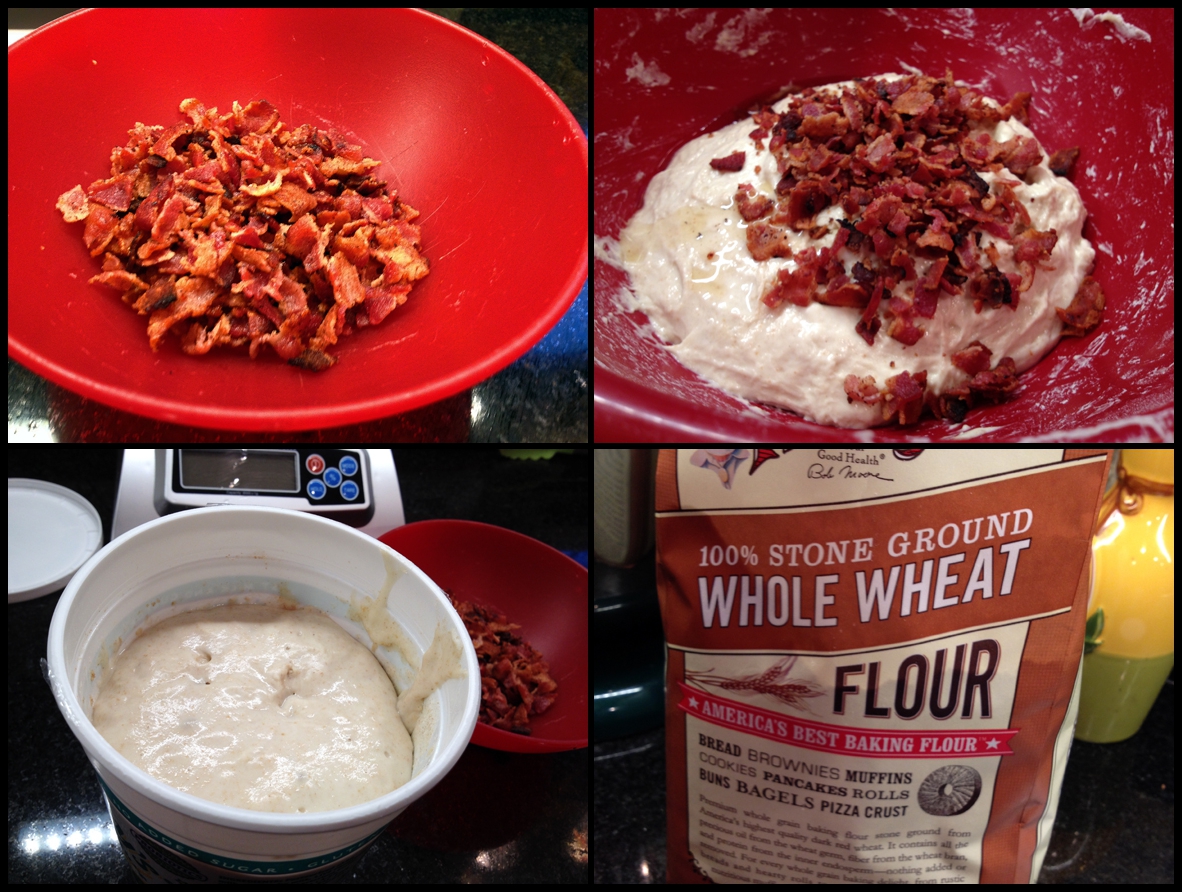
250 g (about 1/2 pound) bacon, fried to crispy, and then crumbled
1 T reserved bacon fat
108 g of the levain
.
Mix the levain ingredients in a medium bowl, cover with plastic wrap, and let sit for about 10 hours, until bubbly. In a large bowl mix the flours and water by hand until just incorporated. Cover and let it rest for 20 to 30 minutes (that is the autolyse step).
.
Sprinkle the salt all over the flour mixture, then add the levain.  Using wet hands to prevent the dough from sticking, mix the dough by pinching it to distribute the salt. Cover and rest for 10 minutes.
.
Spread the bacon fat over the dough and add the crumbled bacon. Using the pincer method alternating with folding, mix all of the ingredients in the bucket. Cover the dough with plastic wrap, and let it sit for 30 minutes. In the next 2 hours, stretch and fold the dough 4 times, every 30 minutes. Cover and let rest at room temperature for 12 hours, until about tripled in volume.

Gently shape the dough into a loose boule. Flour a banneton,  shape the dough into a medium tight ball and place it seam side down into the proofing banneton. Cover with oiled plastic wrap. Let the loaves proof for about 4 hours, depending on the room temperature.

About 45 minutes before baking, heat the oven to 475 degrees F with an empty covered Dutch oven placed on the middle rack.

Remove the Dutch oven from the oven and remove the lid. Place a piece of parchment over the banneton with the proofed bread inside, and a flat baking sheet over it. Flip the dough over, remove the basket, and place the shaped boule in the Dutch oven using the parchment to help move it. The paper can stay in during baking.  Cover the Dutch oven and place it in the hot oven.  Wet the lid of the Dutch oven, and quickly use it to cover it. Alternatively, you can use your own favorite method to generate steam during baking.

Bake covered for 30 minutes, and then uncover it and bake it for 15 to 20 minutes more, until the interior of the bread reaches 205 to 210 degrees F and the bread is a deep brown.

Cool on a rack completely before devouring it…

ENJOY!

to print the recipe, click here

composite1

Comments:  After such a long time away from my starter, I get a little anxious when baking a loaf like this.  I was particularly worried about leaving the dough to ferment at room temperature for 12 hours, something I had never done before.  But, the dough behaved exactly as Ken mentioned in the book.  Take a look at these couple of shots:

Before…
Before

After…
After

A very nice, soft, bubbly dough, quite easy to work with and shape as a boule.
Proofing

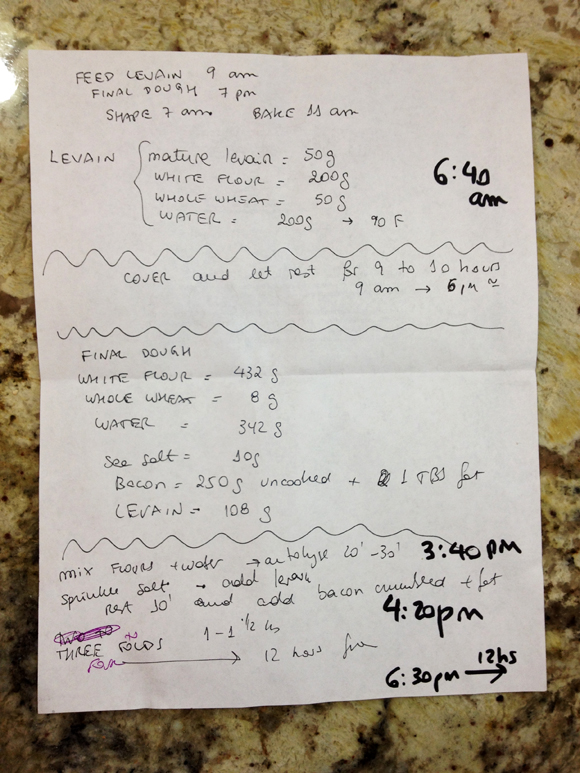
One of the things I love about Ken’s book, is that he offers a sample timeframe for all recipes. Just for fun, I include my notes, prepared the night before. On top you see his suggestion of timing, and as I move along, I jot down my actual timing, adapted to fit my schedule. If you have the book, you may notice I actually halved the recipe to make a single loaf instead of two.

Notes(click to enlarge, if so desired)

The subtle smell of bacon while the bread baked was wonderful!  I made this bread especially to share with my youngest stepson and our great friends from Oklahoma who were coming to visit us the following weekend. So, the bread cooled completely over a rack, rested for a day, and the following morning I sliced it and froze the slices, in small packages.  It is a perfect way to have bread as good as freshly baked at a moment’s notice.

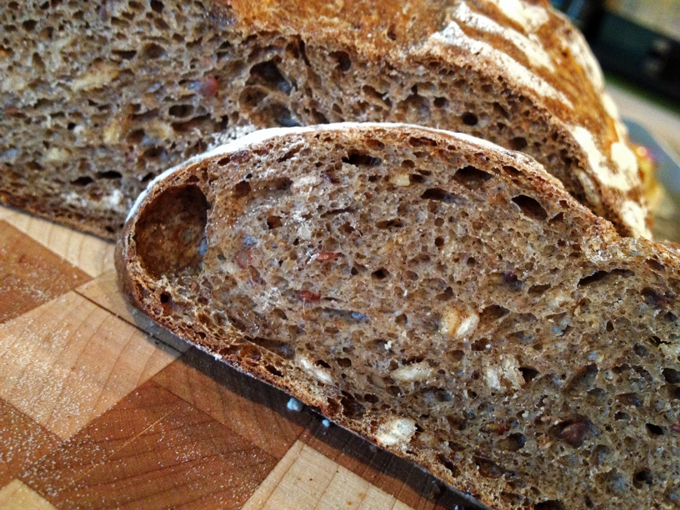
Here is the mandatory crumb shot…
CrumbShot

And the slices on their way to the freezer…

Bagged

This was a superb loaf of bread!  In fact, when we served it – alongside a hearty pasta with Bolognese sauce – it was hard to believe that bacon was the only ingredient added. It tasted very complex, almost as if a mixture of nuts were also incorporated into the dough. Salty, spicy, and smoky at the same time.

Ken, thank you for allowing me to publish the recipe for one of the most flavorful loaves of bread I ever made!I am submitting this post to Susan’s Yeastspotting event…

HAPPY HOLIDAYS, EVERYONE!

maracujaDad and son enjoying a nice passion fruit “caipirinha”…

ONE YEAR AGO: Carrot and Cumin Hamburger Buns

TWO YEARS AGO: Potato Galettes a l’Alsacienne & Book Review

THREE YEARS AGO: Caramelized Carrot Soup

FOUR YEARS AGO: Miso-Grilled Shrimp

FIVE YEARS AGO: Pain Poilane


SOURDOUGH RYE BREAD WITH FLAXSEEDS AND OATS

This is that type of bread that begs for mindful eating. No sitting down in front of the TV grabbing one piece here, another there, or sharing it with friends in the middle of a loud party.  No, this is a bread that deserves attention. It is dense without being overly heavy, and its flavor is quite complex due to the use of assertive flours and flax seeds. The recipe was created by Rosa, from Rosa’s Yummy Yums, a food blog that not too long ago celebrated its 9th anniversary!  Nine years.  No small feat, folks, considering that each of Rosa’s post is a masterpiece: carefully composed text (with recipes in two languages, English and French), matched with her incredibly beautiful photography. Hers is the type of blog that just like this bread, deserves full attention.

Rosa Yum Yum BreadMade July 26th; Blogged October 13th

WHOLE-WHEAT AND RYE SOURDOUGH WITH FLAX SEEDS AND OATS
(from Rosa Mayland’s blog)

(for one round loaf; check her site for full version that makes 2 loaves)

1 heaping tablespoon of flax seeds 1/2 Tbs Flax seeds
150g whole-wheat flour
100g white flour
35g rye flour
35g buckwheat flour
100g active sourdough starter

188-200 g/ml lukewarm water
A pinch of dry yeast
1 heaping tablespoon of olive oil

20g Rolled oats
7g fine sea salt

Put the flax seeds in a small bowl and add 63g/ml of boiling water (this will make them slimy). Stir and leave to cool.

In the bowl of your stand mixer put the flours, sourdough, water, yeast, olive oil, flax seeds (+soaking water).  Mix until all the ingredients are just combined. Let the dough rest (autolyse) for 2 hours.

Add the salt as well as the oats and continue mixing for about 5-8 minutes (add a little flour if the dough is too wet), until the dough reaches medium gluten development.  Transfer the dough to a slightly oiled container and cover with plastic wrap. Let the dough ferment/rise, at room temperature, for about 2h30 (or until doubled in size), folding at 50 and 100 minutes.

Shape it as desired (sandwich loaves, boule, bâtard, banneton, etc…). Sprinkle your loaves with flour and cover them with plastic wrap let proof for about 90 minutes or until doubled in size.

Bake at 230° C (450° F) using your favorite method to generate steam during the initial 20 minutes of baking. Total baking time will be approximately 40 minutes.  Leave the bread in the oven for 5 minutes with the door ajar once you turn the oven off.  Cool it completely on a rack before slicing it.

ENJOY!

to print the recipe, click here

crumb
Now, if that crumb doesn’t make you sigh, there is something wrong with you… This was a very nice baking project, perfect for a weekend in which we had nothing planned, no social commitments, no need to go to the lab, just taking each hour as the hour shaped up.   If you stop by Rosa’s original post, you’ll see that she coupled this recipe with a text about the importance of slowing down, a praise for idleness. Food for thought, as usual for her posts. It is nice to be able to take a step back and do nothing. Or, if doing nothing seems like too much of a shock for  you 😉  grab your flours and make this bread. Then, slowly slice it, and close your eyes when you taste it.   Yes, it is that wonderful!

Rosa, thank you for a great recipe, and above all, for the effort you put into your blog, a pleasure to visit every single time!  See you around the blogosphere 😉

I am submitting this post to Susan’s Yeastspotting event…

ONE YEAR AGO: Apricot-Raspberry Sorbet: A farewell to Summer

TWO YEARS AGO: Marcela’s Salpicon

THREE YEARS AGO: Pork Kebabs

FOUR YEARS AGO: Fondant au Chocolat

FIVE YEARS AGOGot Spinach? Have a salad!

STAR-SHAPED CHOCOLATE BRIOCHE BREAD

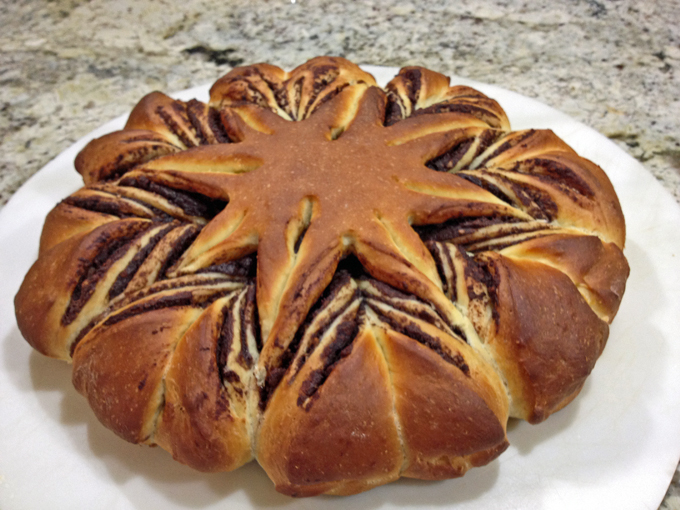
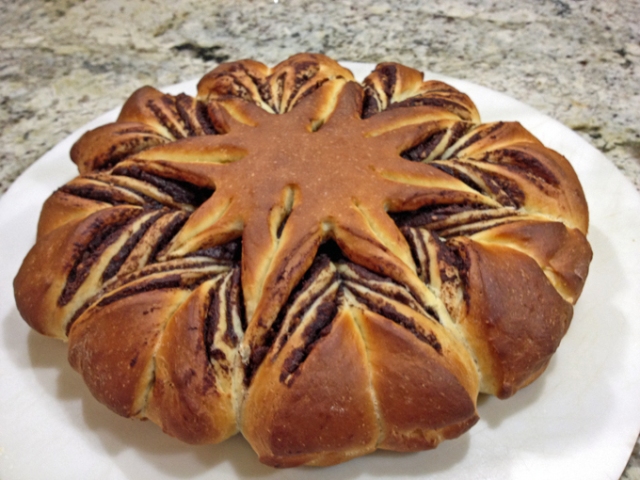
Every once in a while I fall in love with a recipe, and cannot wait to make it. Last week I logged into Facebook, and by pure chance there on the top of the Artisan Bread Bakers page I saw a gorgeous bread, worthy of the cover of a Breads Illustrated Swimsuit Issue – if there was such a thing. Except that, contrary to what seems to be the case for many supermodels, no Photoshop tweaking was involved. The bread was naturally stunning. I wasn’t sure I would be able to make it, as it involved a shaping technique I had never seen before. But, it all worked well. It’s bread after all, not cake.  😉
Star-Shaped Brioche1

STAR-SHAPED CHOCOLATE BRIOCHE BREAD
(from  Lindarose at Instructables)

for the dough:
500g all-purpose flour
2 eggs
60g sugar
180ml room temperature milk (3/4 cup)
80g room temperature butter
7g active dry yeast
8g salt
peel from one orange

for the chocolate cream:
35g cocoa powder
75g sugar
250g ricotta ( about 1 cup)
30g hazelnuts

Put the flour in the mixer and add the yeast, milk, sugar and eggs. Start mixing on low, as the ingredients start to incorporate, add the butter in small pieces, the salt, and the orange peel.  Keep mixing until very smooth (about 5 minutes on a Kitchen Aid type mixer). Remove the dough to a lightly floured surface and finish kneading it by hand, to make sure all butter is uniformly distributed. The dough should be slightly tacky, resist the urge to add more flour. Form a ball, and let it rise in a bowl in a warm spot until double in size, about 2 hours, depending on the temperature of your kitchen.

While you wait for your dough to rise, prepare the chocolate cream.

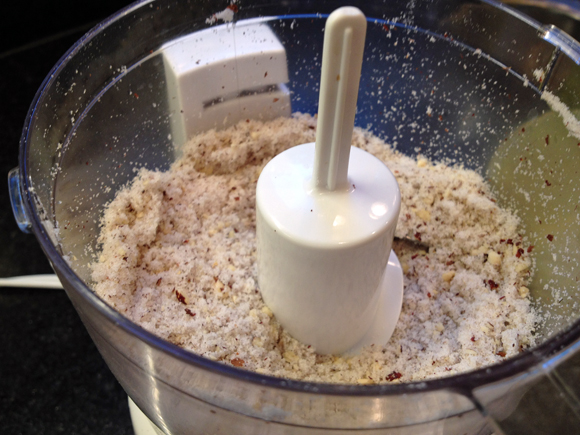
In a food processor, mix the sugar and hazelnuts together until you obtain a powder. It’s ok if there are still some big pieces in it. Transfer to a bowl, and sift the cocoa powder on top of it.   Add the ricotta and mix everything together with a hand mixer until your mixture becomes a cream.

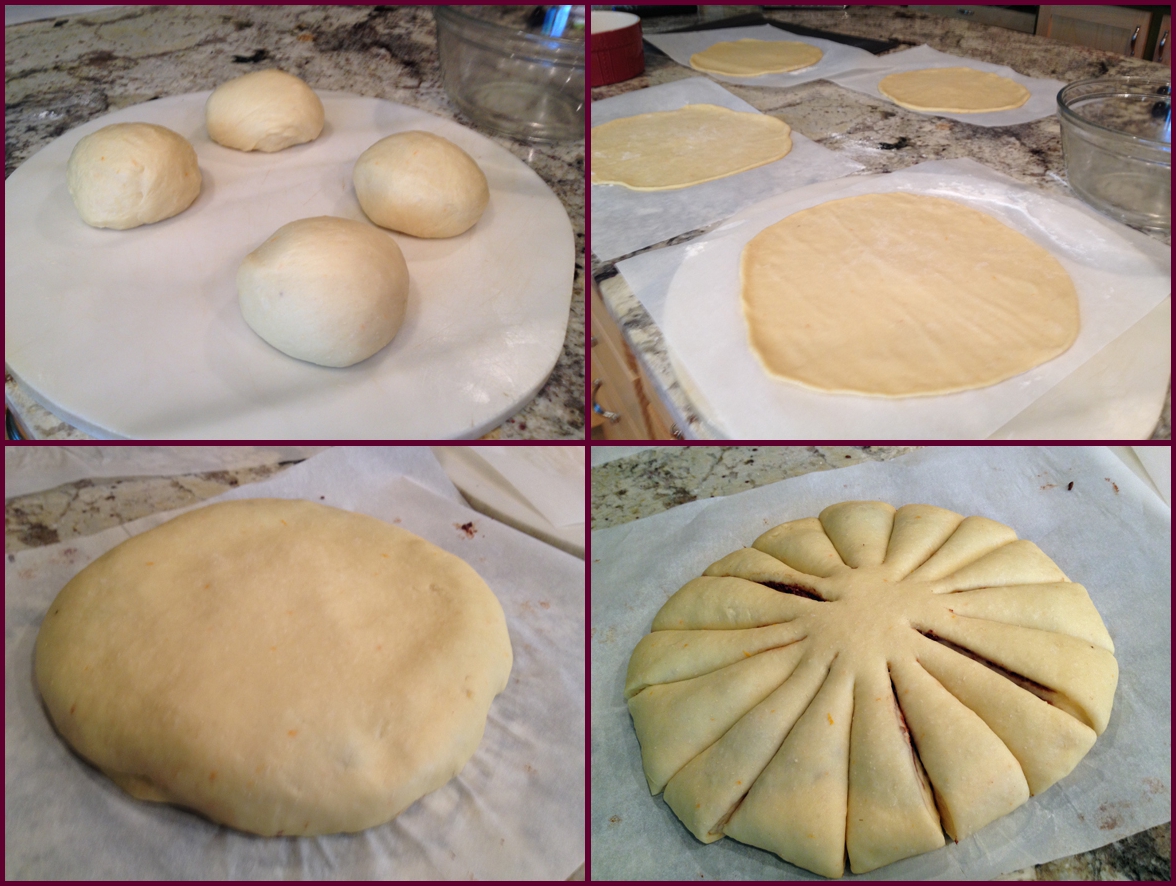
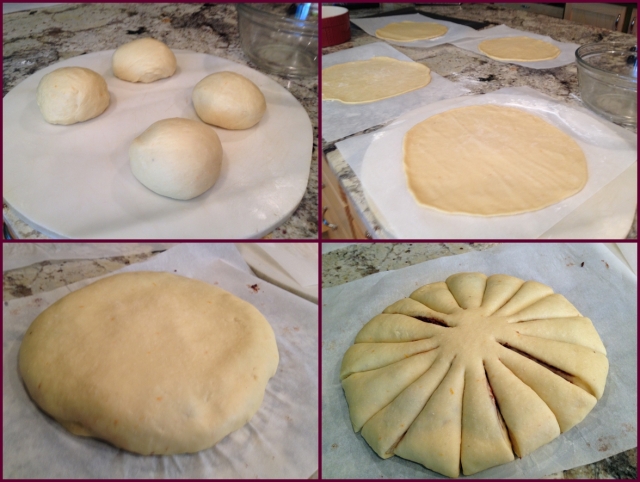
Once your dough has risen, divide it in 4 equal pieces and make 4 separate balls. Make a disc with each of the 4 balls using a rolling-pin. The most important thing is that the discs are all the same size.

Place the first disc on a piece of parchment paper and spread some chocolate cream on it, making sure to leave about half an inch of free border all around. Lay the second disc on the first one and press the border with your fingers to join them together. Now spread some other chocolate cream on the second disc (always leaving a free border), add the third disc and close it with your fingers. Do the same on the third disc and close it with the last disc, but don’t spread the chocolate on it this time. The 4th disc is the top of the bread.

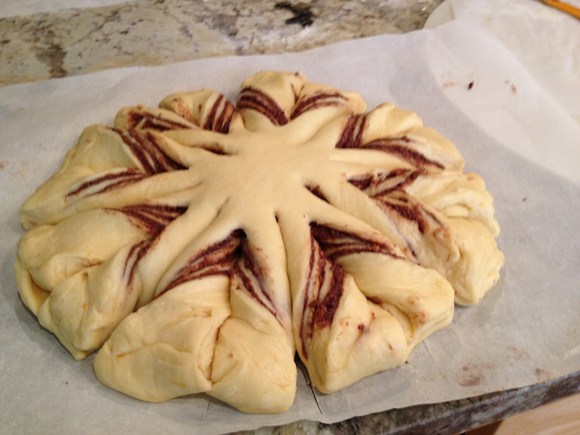
Using a knife, divide the dough in 4 with 4 cuts. It’s  crucial for the shaping that you don’t cut the center of the disc (see pictures). Now make other 4 cuts between the others, for a total of 8, always leaving the center free. Finally, make 8 cuts between the ones you already made, just like the others. You will have a total of 16 sections now.

Consider 2 sections that are next to each other: lift one with one hand and the other with the other hand and twist each of them towards the outside. This means that the piece you are holding with your right hand will be twisted to the right and the one you are holding with your left hand will be twisted to the left. Do this for all the sections. Your bread will look like a snowflake. Put it in the baking sheet with the help of the parchment paper (don’t remove it) and let it rest and rise for another hour. As the bread rises, turn your oven to 350 F.

Bake at 350°F (180°C) for 25 to 30 minutes. Let it cool on a rack.

ENJOY!

to print the recipe, click here
balls-checker

I woke up very early on Labor Day to bake this bread. Long before sunrise. Mixed the dough and went for a run with Phil, while the streets were still completely dark. Come to think of it, “with Phil” is not a correct statement. Let’s say we start together and within five minutes I am begging for mercy,  slow down my pace and see him move farther and farther ahead.  The sun started to rise midway through our run, in such a magical experience, the subtle change in light, slow and beautiful. By far my favorite kind of run. A day that started so perfectly had  to be a good baking day. And indeed it was.
hazelnutpowder

This dough is wonderful to work with.  As you can see in the instructions, the most important thing to keep in mind is dividing the dough in equal parts – use a scale, don’t just eye-ball it.  Once the dough is divided, it rolls out very nicely, use just a little bit of flour on top of the parchment paper so that you can release it easily. I rolled all four balls of dough, but if you prefer, roll one at a time, spread the chocolate cream, move to the next one. Before you cover the bread with the last disk of dough, wash your hands of any chocolate to keep the surface of the bread clean.
shaped

Slicing the dough in 16 sections and twisting the sections for the final shaping is not as hard as it may seem.  I have a lot of trouble with spacing things regularly, and was a bit nervous handling the knife, but even if my cutting was not perfectly uniform,  the bread turned out ok.  Maybe not worthy of the cover of Breads Illustrated, but not bad for a first time.

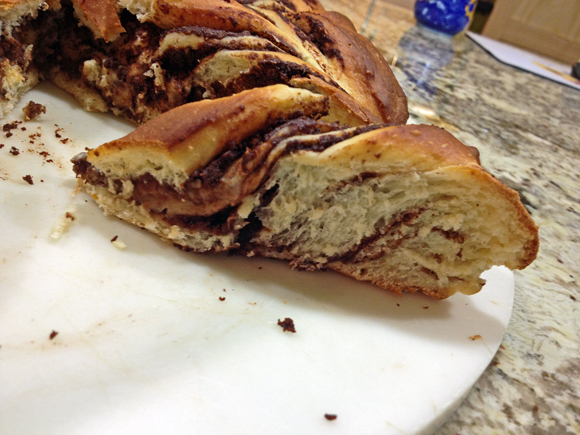
This star-shaped bread reminded me of the classic Chocolate Babka, which I’ve never made, but saw Peter Reinhart demonstrate in a lecture in Dallas many years ago. In fact, my friend Marilyn said this bread looked like “Babka’s wealthy cousin”.  I suppose that defines it quite well.

The filling can be anything you like. Some bakers from the Facebook group used pesto and cheese, others used cinnamon cream, or a mixture of different nuts with chocolate. Pretty much anything goes with the exact same dough and shaping.  Be creative and impress your friends and family, it is a show-stopper of a bread.
Sliced

I am submitting this post to Susan’s Yeastspotting event…

ONE YEAR AGO: Blueberry-Banana Bread 

TWO YEARS AGO: Into the Light Again

THREE YEARS AGO: Five Grain Sourdough Bread

FOUR YEARS AGO: The Nano-Kitchen

FIVE YEARS AGO: Kaiser Rolls