LEMON LAYER CAKE WITH DULCE DE LECHE FILLING

This post is dedicated to my friend Margie
(she will understand why).

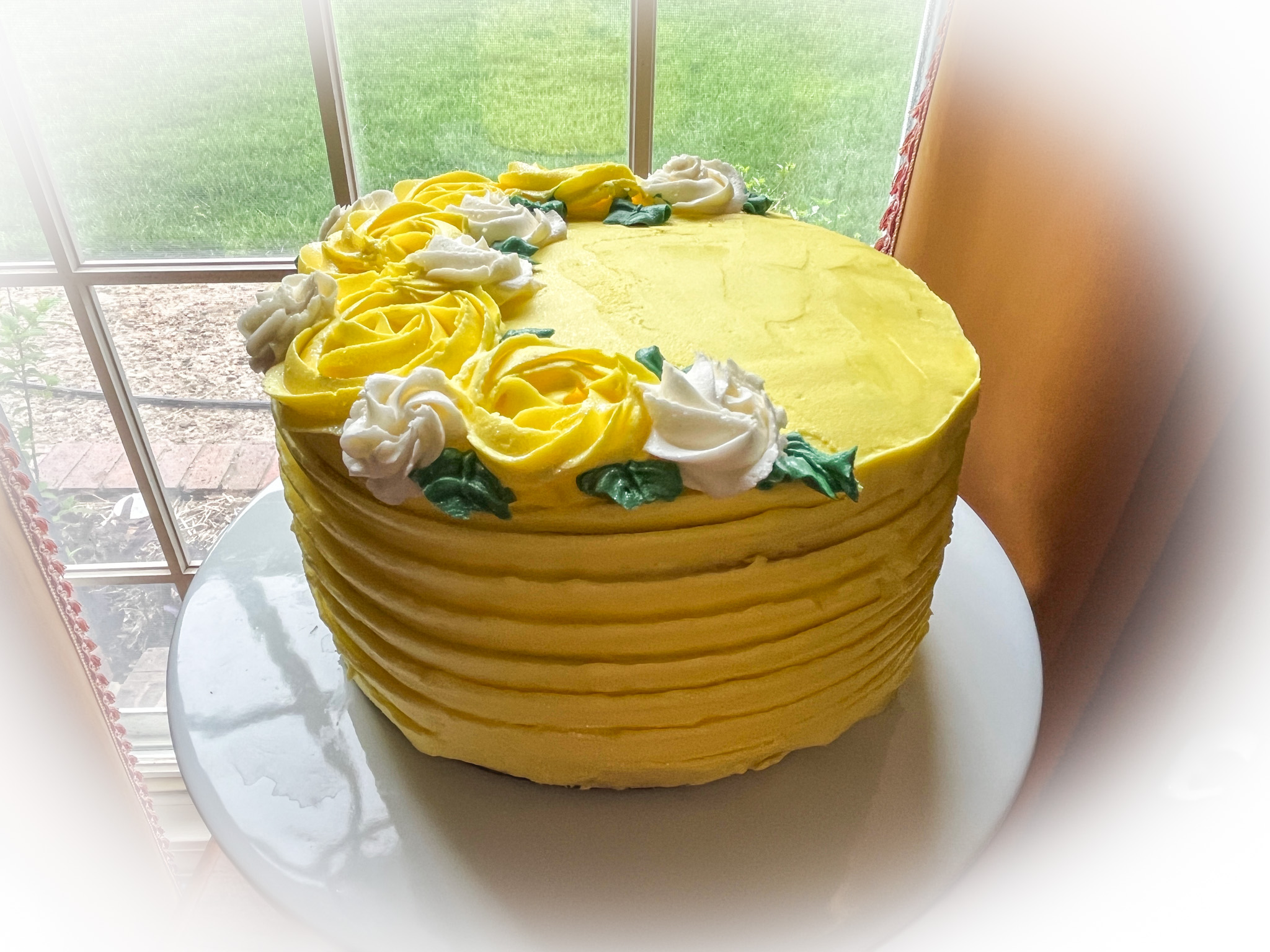
I’ve been making layer cakes every other week to donate on Fridays. A couple of weeks ago I was trying to decide which cake flavor to make and my beloved husband told me “I’ve got one for you!” He then showed me a recipe published in the New York times. It sounded really good and I decided to go for it except that I changed the filling and the frosting. Layers had store-bought dulce de leche and I used Swiss meringue buttercream as the frosting because I’ve been having so much fun making it. The cake turned out with the springtime feel I was hoping for and I heard that everybody loved it. A win-win situation for sure!


LEMON LAYER CAKE WITH DULCE DE LECHE FILLING
(adapted from The New York Times)

¾ cup/170 grams unsalted butter, softened
3 cups/385 grams all-purpose flour
2 cups/400 grams granulated sugar, divided
3 medium lemons
1½ cups/360 milliliters whole milk
2 teaspoons baking powder
½ teaspoon baking soda
1½ teaspoons kosher salt
¼ cup/60 milliliters neutral oil (I used grapeseed)
4 large eggs, at room temperature

1 can of La Lechera dulce de leche (you won’t use the full amount)

1 recipe for Swiss meringue buttercream, starting with 400g butter (details here)

Heat oven to 325 degrees. Spray three (8-inch) cake pans with baking spray and line each with parchment paper.

Make the cake: Add 350 grams of the granulated sugar to the bowl of a stand mixer fitted with the paddle, then zest the lemons directly into the sugar. Use your fingers to rub the zest into the sugar until it looks moist and sandy.

Juice the zested lemons into a small bowl. Transfer ¼ cup of juice to a large measuring cup and stir in the milk. Let it sit while you prepare the rest of the cake, reserving the remaining juice for the lemon syrup.

To the bowl with the lemon sugar, add the flour, baking powder, baking soda and salt, and mix on low to combine. Add the softened butter to the bowl all at once. Mix on low until the butter is evenly distributed and the mixture looks sandy. Add the oil and eggs to the measuring cup with the milk mixture and mix with a fork to combine. With the mixer on low, slowly stream in the milk mixture. When the batter is moistened, stop the mixer and scrape the bottom and sides of the bowl to ensure there aren’t any dry pockets. Adjust mixer speed to medium and mix for 1 minute more. Divide the batter among the prepared pans, spread evenly and tap the pans on a countertop to release any large air bubbles.


Bake the cakes until slightly risen and a toothpick inserted in the center comes out clean, 20 to 25 minutes. Set the pans on a wire rack and let the cakes cool for about 15 minutes. Then, run a thin knife along the edges of the pan and carefully turn the cakes out onto the rack to cool completely.

While the cakes cool, make the syrup: Measure ¼ cup lemon juice from the remaining reserved juice. Combine the juice and the remaining 50 grams sugar in a small saucepan and bring to a boil over medium-high, stirring occasionally. Cook until the sugar has dissolved, then pour into a heat-safe container to cool.

Make the Swiss meringue buttercream. Reserve 1/3 of the amount without any dye. That will be used as a crumb layer and for the white flowers. Dye a small amount green for the leaves. Dye the rest of the batter yellow.

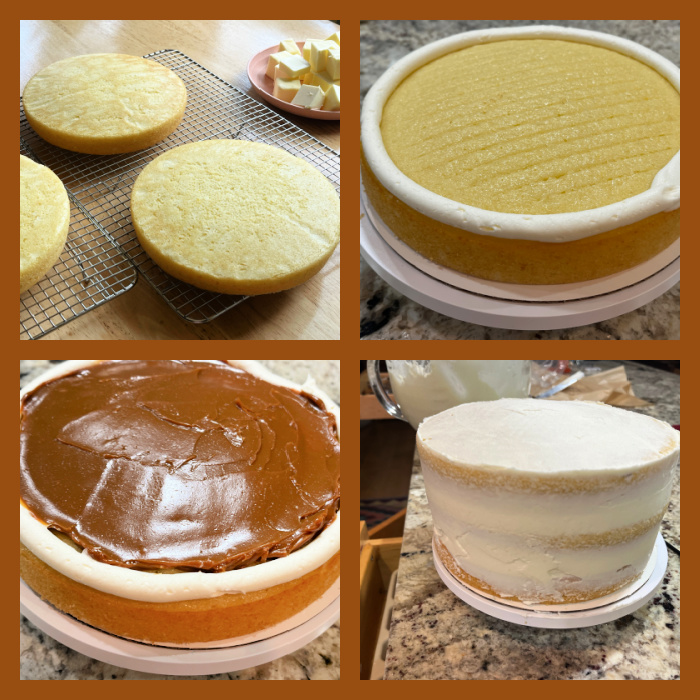
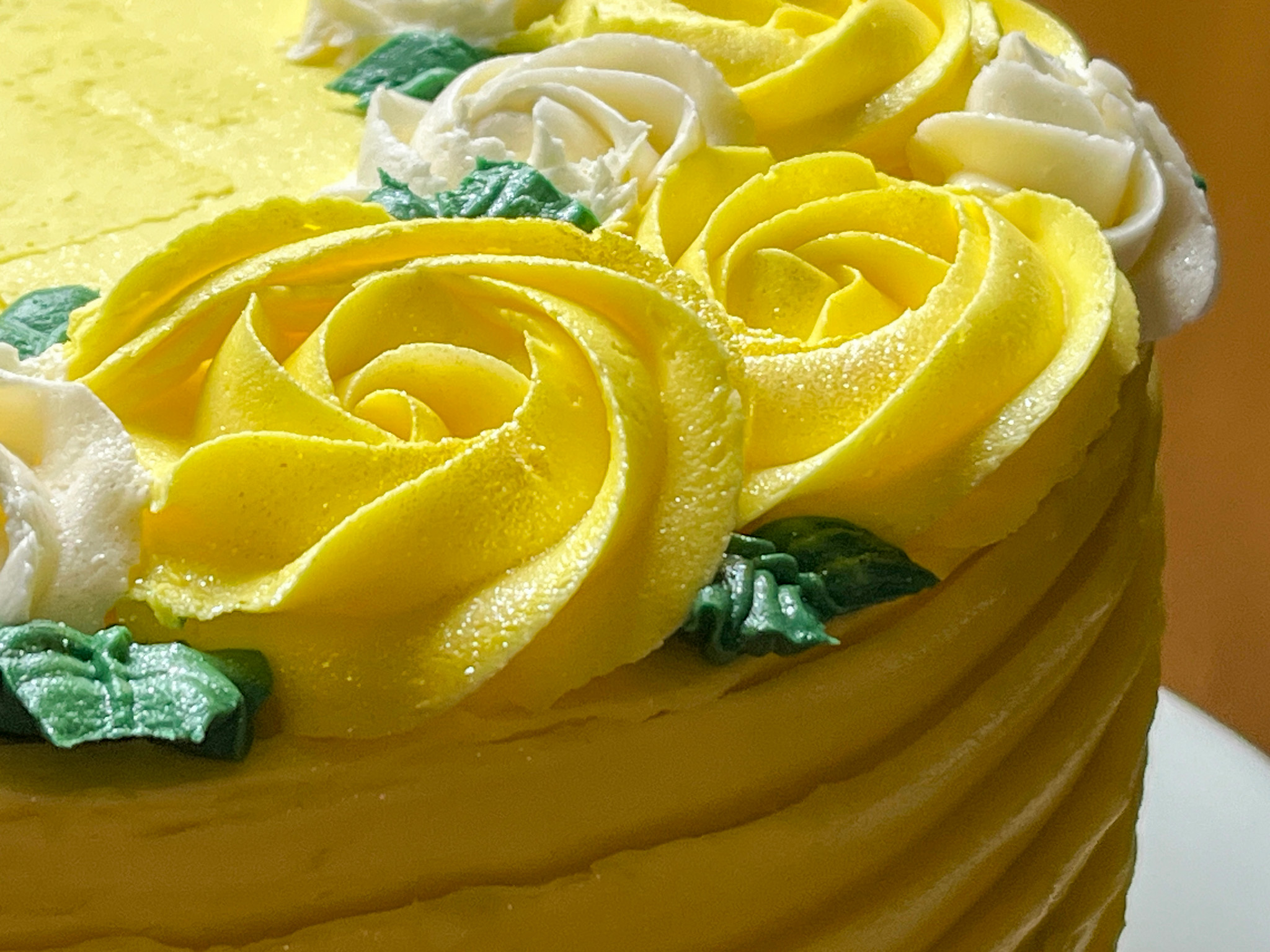
Assemble the cake: Place one layer of cake onto a serving plate, top side up. Brush the cake with lemon syrup. Spread dulce de leche over the top of the cake. Repeat with the second layer on top of the filling, top side down, and press gently. Add the final layer. Brush the cake with syrup, then cover the top and sides of the cake with a thin layer of frosting. Refrigerate until firm, about 30 minutes. Frost the cake with yellow buttercream, add details on the sides wiht a comb if so desired. Pipe roses and leaves. A little pumping of gold luster powder is optional but nice…

ENJOY!

to print the recipe, click here
Comments: The layers baked like a dream, flat and beautiful. Cake smelled amazing, I really wish we could have sampled a small slice. Oh, well… I used my little electric turntable to frost it and again loved the process. Makes life very easy. Thank you, Phil! Your gifts are always perfect! The only thing I would change if I was to make this cake again, is use a lighter green for the leaves. Well, there is one more thing I would change. I would actually brush the layers with the lemon syrup instead of forgetting all about it and staring at the syrup sitting at the countertop next to the fully frosted cake.
.

If you have a special occasion to celebrate now that Spring is in full swing, think about this cake…
ONE YEAR AGO: A Duet of Springtime Macarons

TWO YEARS AGO: Fiesta Bakes for Cinco de Mayo

THREE YEARS AGO: Thai-Meatballs Over Wilted Bok-Choy

FOUR YEARS AGO: Asparagus with Gunpowder Masala

FIVE YEARS AGO: The Home Bakers Collective, April Project

SIX YEARS AGO: Asian-Style Eggplant Meatballs

SEVEN YEAR AGO: Uzbek Flatbread

EIGHT YEARS AGO: First Monday Favorite – Black Sesame FOUR

NINE YEARS AGO: Chocolate Orange Mini-Cakes

TEN YEARS AGO: In My Kitchen, May 2015

ELEVEN YEARS AGO: P90X3, a Review of Tony Horton’s Latest Fitness Program 

TWELVE YEARS AGO: Pasta and Mussels in Saffron Broth

THIRTEEN YEARS AGO: Triple Chocolate Brownies

FOURTEEN YEARS AGO: Shanghai Soup Dumplings

FIFTEEN YEARS AGO: Bite-sized Chocolate Pleasure
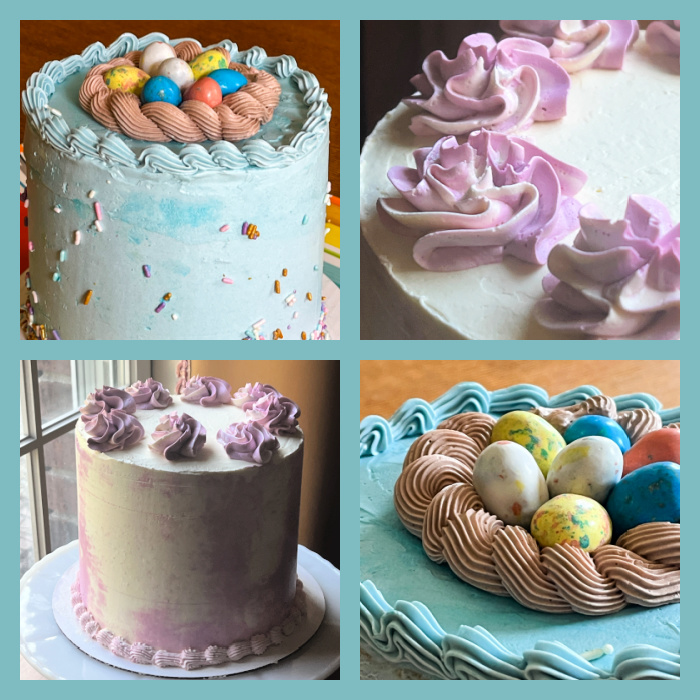
CAKES TO CELEBRATE EASTER


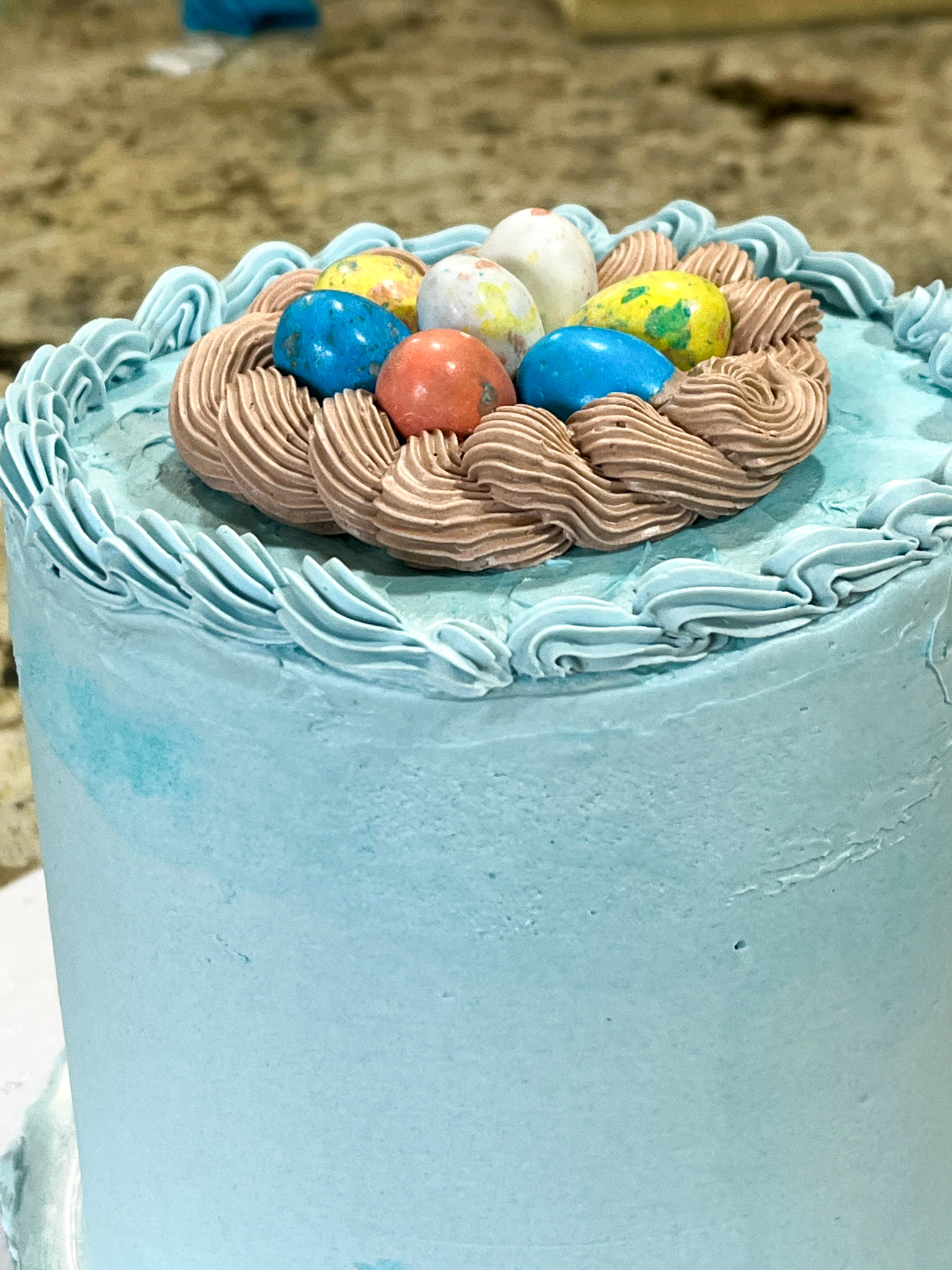
I am thrilled to share these because they were my first cakes frosted using my electric turntable, a wonderful gift from my hubby last month (check it out at my last In My Kitchen post). Amazing how much easier it was to get a smooth frosting! Without further ado, here is the first cake, fully dressed for an Easter Party.

.

VANILLA-ALMOND CAKE WITH RASPBERRY FILLING
(from The Bewitching Kitchen)

345 grams (3 cups) cake flour
2 teaspoons)baking powder
½ teaspoon baking soda
½ teaspoon salt
226 grams (2 sticks) unsalted butter, softened
375 grams (1 + 3/4 cups) granulated sugar
2 teaspoons vanilla extract
1 teaspoon almond extract
160 grams egg whites (about 5 eggs)
170 grams (¾ cup) sour cream
170 grams (¾ cup) whole milk
Swiss meringue buttercream for frosting
seedless Raspberry jam for filling

Prepare three 6-inch round cake pans lining them with parchment and spraying with baking spray.

Heat oven to 350F.

Sift together the cake flour, baking powder, baking soda and salt. Reserve. Mix the sour cream and milk together, making sure they are at rom temperature and well incorporated. Reserve.

n the bowl of a stand mixer fitted with the paddle attachment, combine the butter and sugar. Cream together on medium speed until very light and fluffy, about 5 minutes. Stop the mixer and scrape down the sides and bottom of the bowl halfway through mixing. Slowly pour in the egg whites while the mixer continues running.

Alternate adding the dry ingredients into the bowl in three additions with the milk/sour cream mixture in two additions, starting and ending with the dry ingredients. Mix on medium speed between additions until almost fully incorporated. Finish mixing by hand with a spatula.

Transfer the batter into the prepared pans. Bake for about 25 minutes, until a tester comes out clean or with just a few moist crumbs attached. Cool the cakes in their pan completely on a cooling rack before turning out of the pan.

SWISS MERINGUE BUTTERCREAM

Basis formula: 1X egg whites + 2X sugar + 2X butter

For the three layer 6-inch cake I started with 200g egg whites. The magic is all in the temperature control.

Start by dicing your butter and placing at room temperature for at least a couple of hours before making the buttercream. The reason for that is the closer the temperature of the egg whites/sugar and the butter match each other, the smoother the whole preparation will go. All problems with Swiss meringue buttercream happen when there is a sharp difference between those temperatures.

Mix sugar and egg whites and whisk well, then over a bain-marie bring them to 140 F minimum. I take it to 149F because I find it makes a nicer emulsion to work with. Place in a KitchenAid type mixer fitted with the whisk attachment and whisk on high speed for about 10 minutes. You want a stiff meringue.

Most recipes will tell you that it will be enough to bring the mixture to room temperature level, or not feeling warm if you touch the bowl. However, if you measure the temperature inside the bowl you will notice it will probably still be at mid 90’s Fahrenheit, way above the butter that is waiting to be incorporated.

My advice is to turn the mixer off and walk away. Come back in 10 minutes, give it a 20 sec mix, check, the temperature. Still a bit too high? Walk away and repeat the process. I find that if the egg white mixture is around 80F it will be ok to incorporate with the butter, which might be around 72F or so.

Now start incorporating the butter with the mixer running, you can squish it with your fingers as you drop them to help incorporate even better. Once all the butter is added, whisk at high speed for a couple of minutes, change to the paddle attachment and mix for another couple of minutes to smooth out air bubbles.

Two problems might happen if the temperature was not a real good match: buttercream will be grainy (butter too cold), or soupy (meringue too hot). Both can be fixed by either warming the bowl (hair-dryer works great), or placing it in the fridge for 15 minutes and whisking again. Contrary to popular belief, Swiss meringue is not that tricky and can always be salvaged even if it looks like Armageddon in a bowl.

For the layers I added a circle of white buttercream on the perimeter of the cake, filled the center with raspberry jam, and repeated that for the upper layer. I crumb coated with white frosting, then dyed most of the buttercream with Sky Blue (just a couple of drops), and the tiniest amount of black to mute the tone. A small portion was dyed brown for the nest. Malted chocolate eggs and sprinkles finished the decor.

ENJOY!

to print the recipe, click here

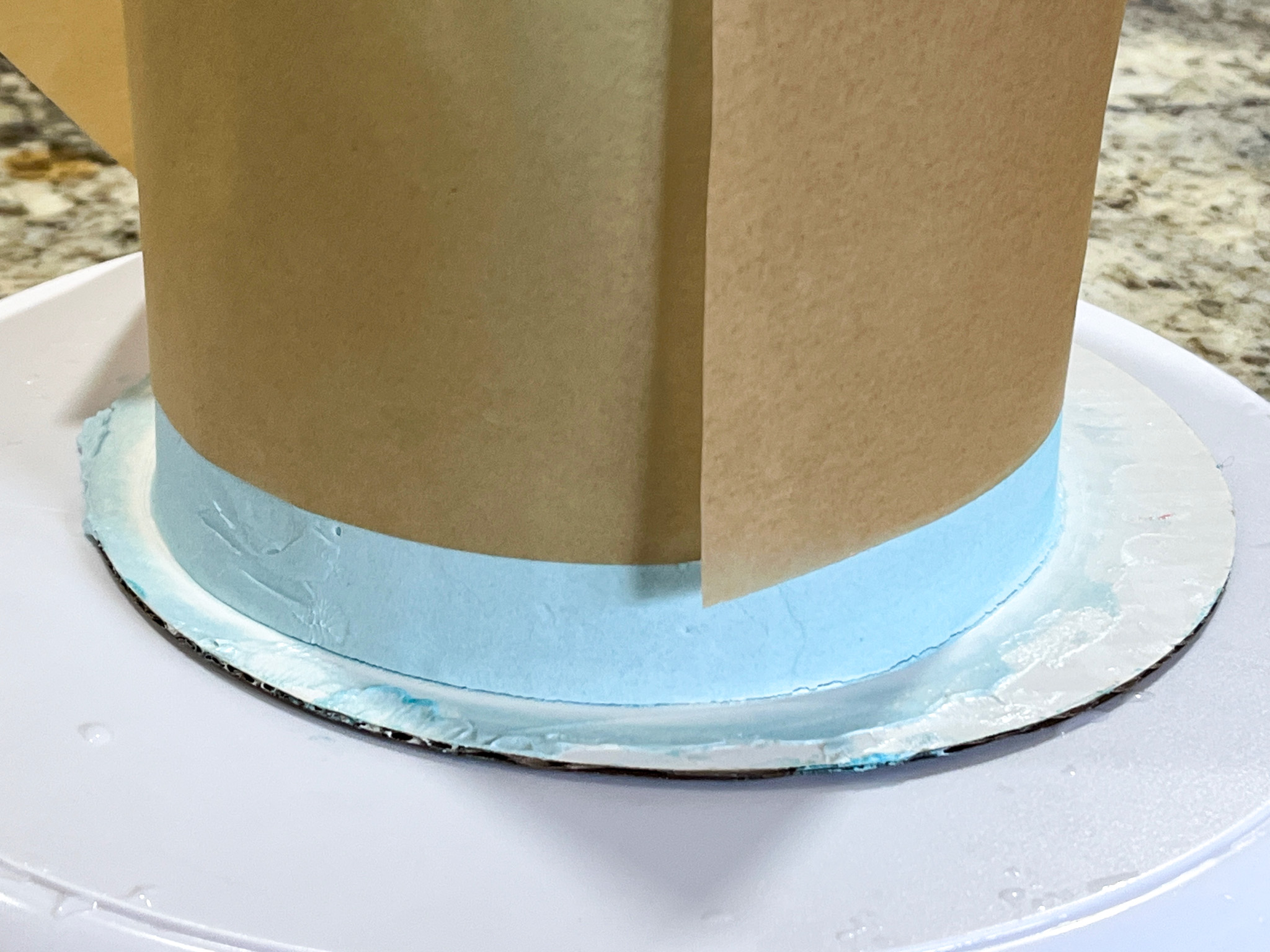
Comments: This is pretty much like a wedding type cake, very white because you omit using egg yolks. It is delicate and moist, truly one of my favorites for layered cakes. I adapted the recipe from versions that call for more sugar, I prefer the cake a little less sweet. Sugar is important for structure so there is a limit of how much you can reduce, but this formula works great. My rookie mistake was to use parchment paper to add the sprinkle border at the bottom, and it took me so long to do it, that the buttercream warmed up and the paper got stuck at places. All my hard work to get the smooth surface was a bit compromised, but nothing that strategically placed sprinkles would not fix!

Feedback on the cake was wonderful, I cannot show you the cut cake as I dropped it whole and it was cut later in the evening. But I hope it looked ok inside…

Moving on…

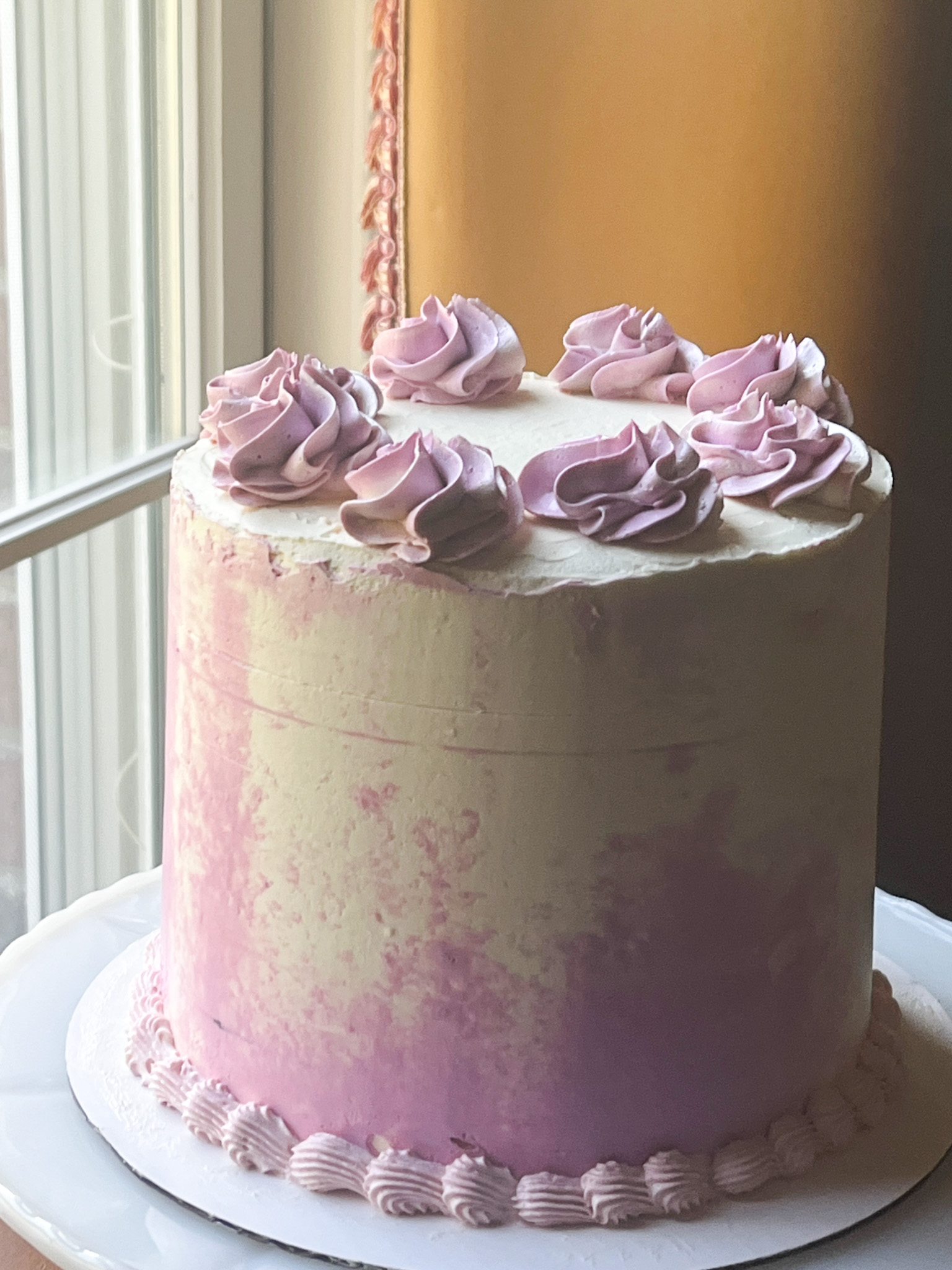
LEMON POPPY SEED LAYERED CAKE WITH BLACKBERRY FILLING

I cannot share this recipe because it is copyrighted from a very interesting book called “I’LL BRING THE CAKE” by Mandy Merriman. It is unusual in the sense that all cakes start from a boxed mix, but they are heavily doctored. If you are totally against boxed mixes, the book is not for you, but I wanted to give those a try and her cakes are quite delicious.

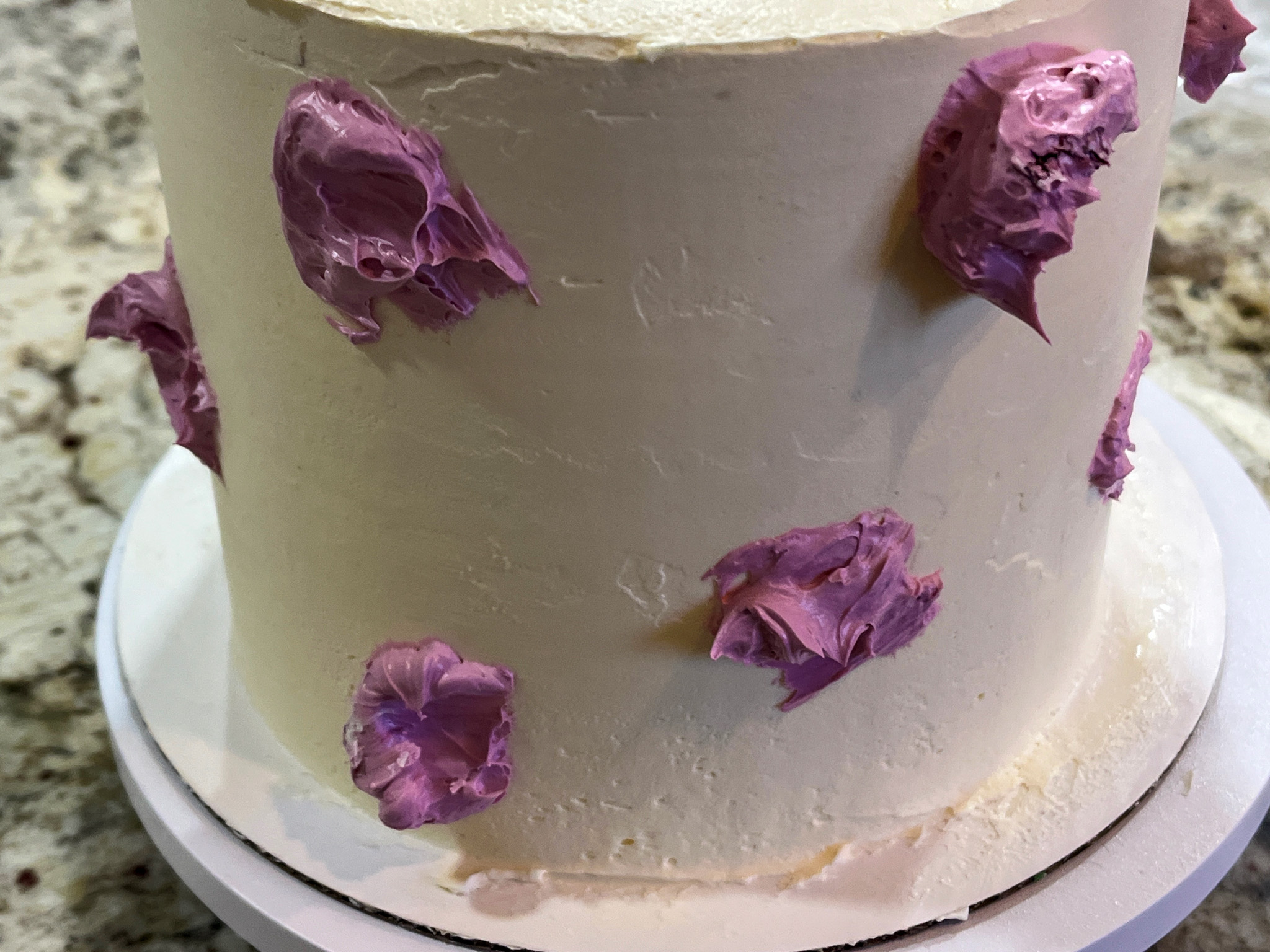
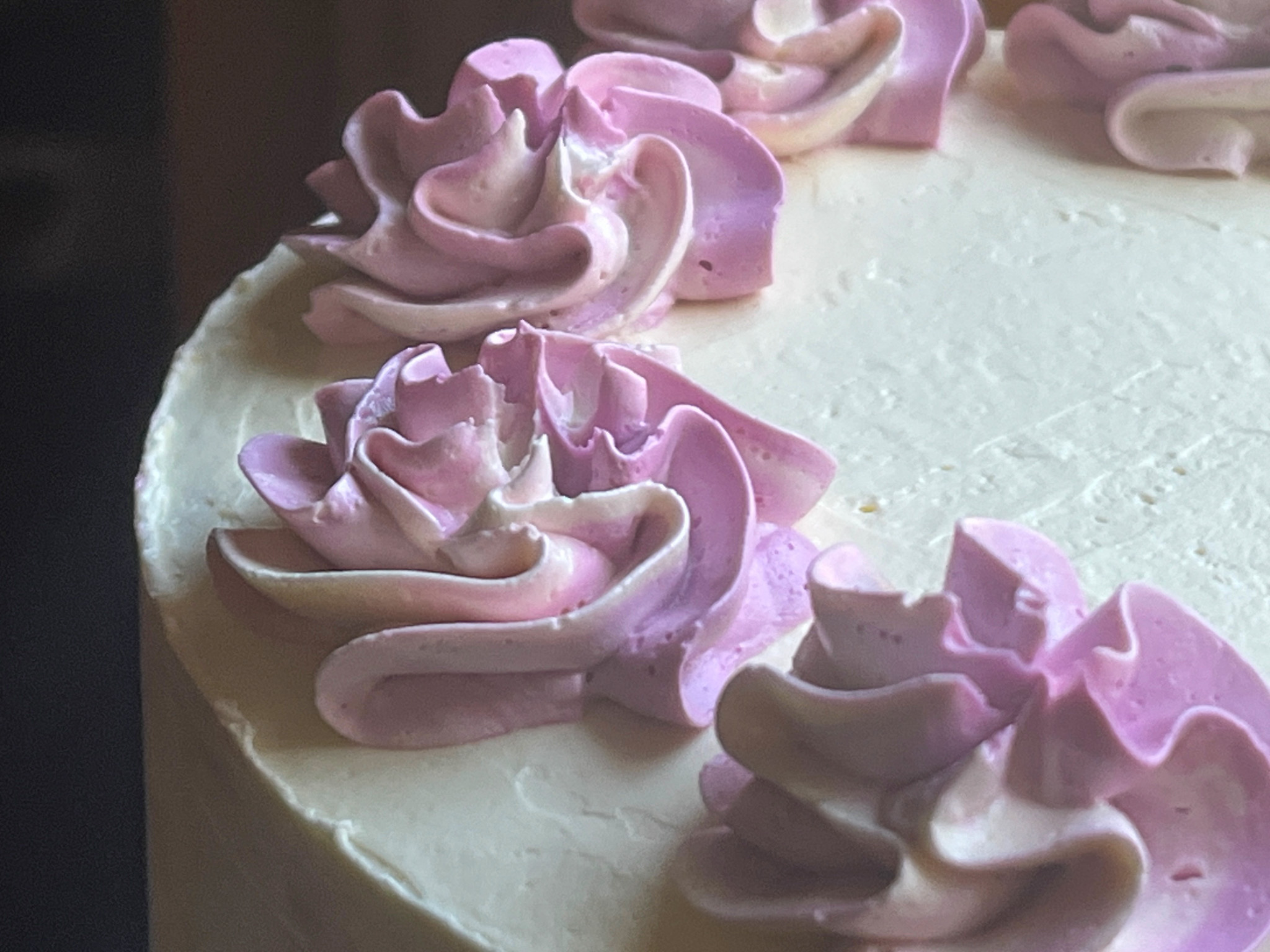
This was my very first cake using the turntable, and I opted for a watercolor effect, which started by adding blotches of darker color all over the frosted cake.

Then you just turn the cake and allow the color to mingle with the background until you are satisfied. For the decorations on top I mixed the white with the mauve-dyed buttercream and used the trusty 1D tip for rosettes.

I hope you found some inspiration for your Easter festivities with this post!

ONE YEAR AGO: Flower Stencil Sourdough

TWO YEARS AGO: Happy Easter!

THREE YEARS AGO: Mini-Blueberry Cakes

FOUR YEARS AGO: Wood Plank Cookies, Learning from the Best

FIVE YEARS AGO: OMG Spinach Pies

SIX YEARS AGO: Avgolemono Soup, My Way

SEVEN YEARS AGO: Sourdough Chocolate Twist Bread

EIGHT YEARS AGO: Dan Lepard Times Three

NINE YEARS AGO: Turkey Portobello Burger

TEN YEARS AGO: Raspberry Ricotta Cake

ELEVEN YEARS AGO: In My Kitchen, April 2014

TWELVE YEARS AGO: Whole-Wheat Pasta with Lemony Tomatoes and Spinach

THIRTEEN YEARS AGO: Blood Orange Duck: A work in progress

FOURTEEN YEARS AGO: Grilled Mahi-mahi with citrus marinade

FIFTEEN YEARS AGO: Memories of Pastéis

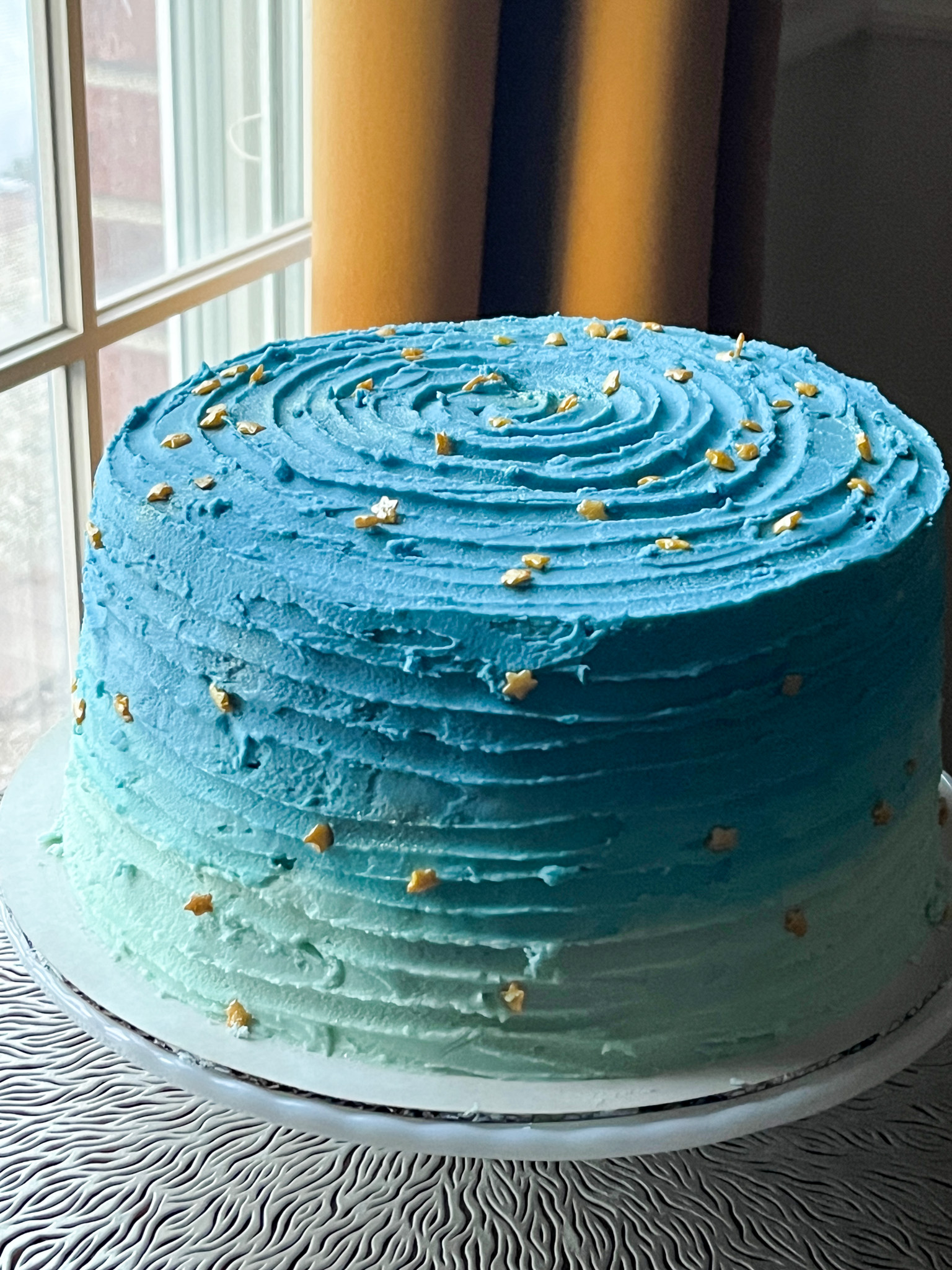
NIGHT SKY OMBRÉ CAKE

Inspiration from this cake came from a book I’ve had for many years: Cake Decorating for Beginners, by Rose Atwater. It is a wonderful book, full of cute ideas, some pretty simple, some a bit more involved. I love ombré style cakes, having done some in the past.


NIGHT SKY VANILLA CAKE WITH CHOCOLATE GANACHE FILLING
(inspired by Rose Atwater)

for the cake:
1 +1/2 cups whole milk 
1/4 cup heavy whipping cream 
2 + 1/2 cups all-purpose flour 
1 cup cake flour 
2 teaspoons baking powder 
1 cup (2 sticks) unsalted butter, at room temperature
2 + 1/2 cups sugar
½ teaspoons salt 
2 tsp buttery vanilla emulsion (from Lorann) 
3 large eggs

Heat the oven to 325 degrees. Grease and flour three 8 x 2 inch round cake pans, line bottom with parchment paper. Reserve.

In a small bowl, mix together the milk and heavy cream. In a medium bowl, sift together the two types of flour and baking powder. Set aside. Cream the butter using a stand mixer and the paddle attachment on medium speed until it’s soft and light, about 2 minutes. Add the sugar and salt and mix until the mixture is light in color and fluffy, about 2 minutes. Add the vanilla, and mix until just combined. Add the eggs, one at a time, mixing for 20 seconds after each egg, scraping down the sides of the bowl as needed.

Turn the mixer speed to low, then add one-third of the flour mixture and mix until just combined. Add half of the milk mixture and mix until just combined, then add another third of the flour mixture. Repeat with the remaining milk and flour mixtures. Divide the batter between the prepared pans and spread it out evenly. Bake for 35 to 40 minutes, until a toothpick or cake tester inserted into the center of each cake comes out clean.

for the ganache filling:
230g dark chocolate, cut in pieces
240g heavy cream

Heat cream until simmering, pour over chocolate in a large bowl. Allow to sit for 5 minutes than whisk gently until smooth. Let it cool for 15 minutes then place in the fridge for 90 minutes. Use a hand held mixer to whip the ganache until lighter and fluffier. Use to fill the two layers of the cake. 

for the frosting:
1 cup (2 sticks) unsalted butter, at room temperature
1 cup vegetable shortening
2 teaspoons pure vanilla extract
3 to 4 tablespoons milk
¼ teaspoon salt
2 pounds (approximately 8 cups) powdered sugar
food gel dye, Americolor Royal Blue and Diamond Black

In a large bowl, use a stand mixer with the paddle attachment, and beat together the butter, shortening and vanilla until smooth and creamy.

Add 2 tablespoons of the milk, the salt, and half the powdered sugar and mix just until combined. Scrape down the sides of the bowl. On low speed, gradually add in the remaining sugar. Add more milk as needed to achieve the desired consistency.

Divide the frosting in three bowls, and one drop of blue to the first bowl, two drops to the second, and 2 drops blue + 1 drop black in the last. 

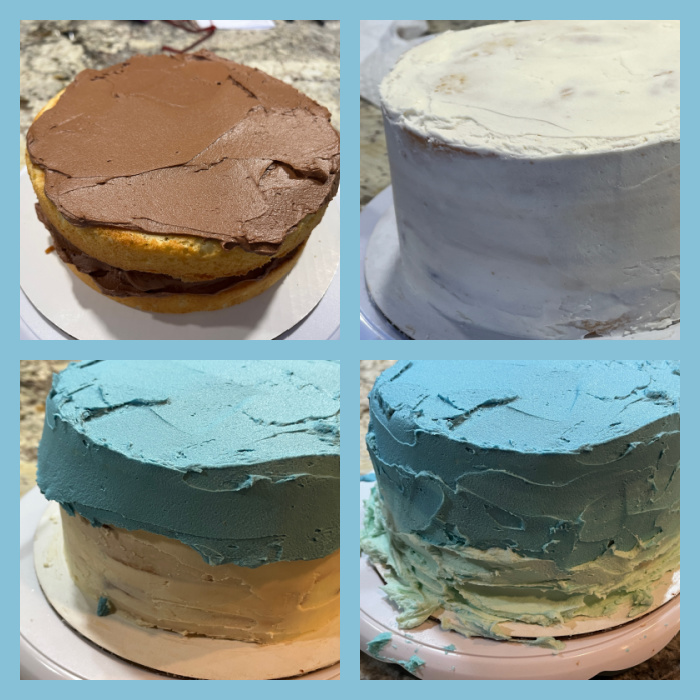
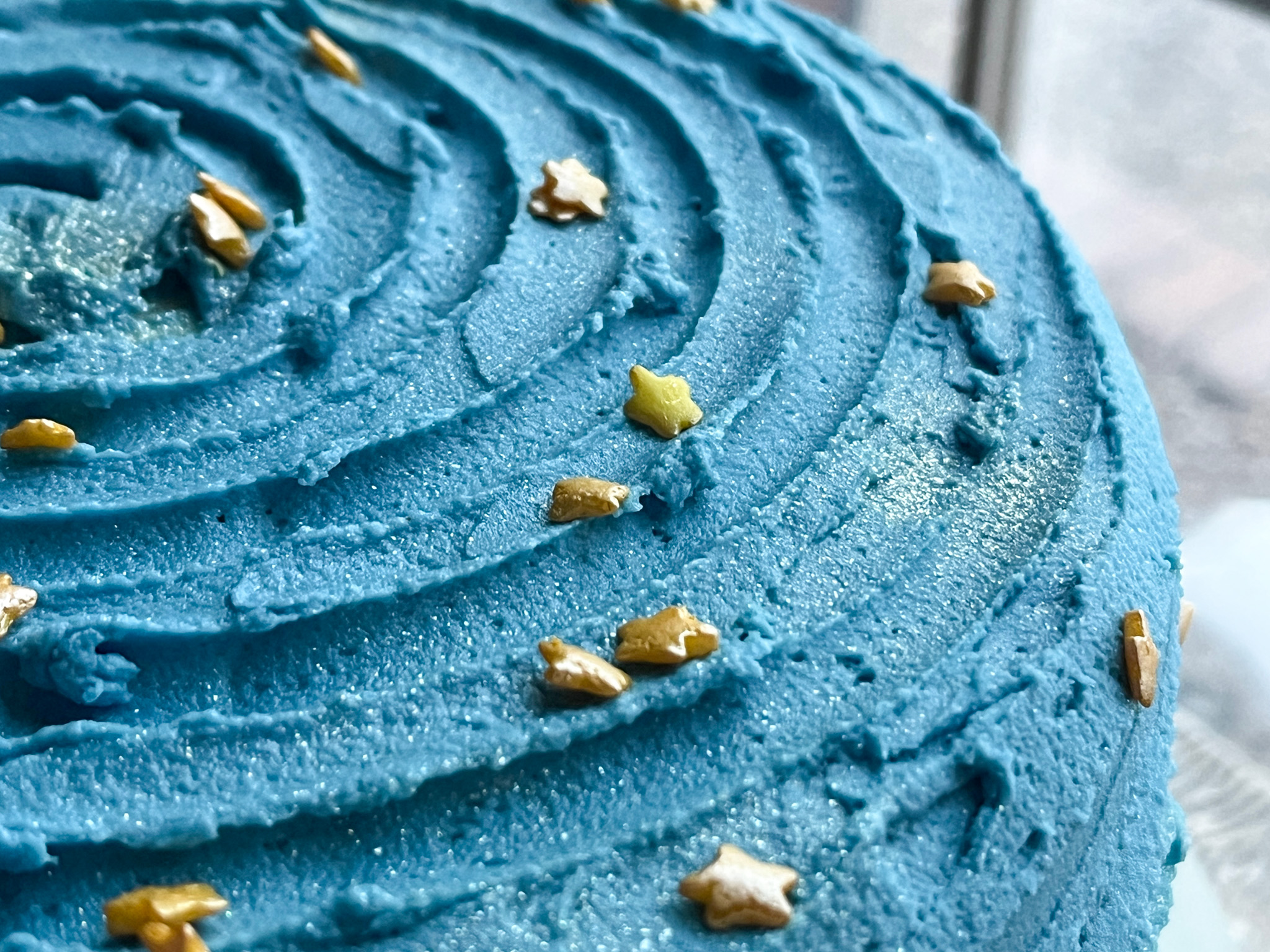
Assemble the cake: Place the first cake on a board, add ganache as a smooth layer on top. Place second cake over ganache, repeat the process. Add last round of cake and press gently. Frost with a thin layer of frosting in the lightest color (or do it before adding any dye to the buttercream). Let the cake cool in the fridge for an hour or more. Frost with the dyed buttercream: cover the top and 1/3 of the height from top to bottom with the darkest color of blue. Add the medium tone to the second third of the cake, and the lightest color to the bottom. Use a scraper to smooth the layers. Add texture with a little spatula as you turn the cake. Add star sprinkles.

ENJOY!

to print the recipe, click here

Comments: I wish I could report on taste and looks as it was sliced, but I donated the cake whole, so my fingers are crossed that the recipients liked it… At any rate, it is hard to go wrong with vanilla and chocolate ganache, right? The buttercream is simple to prepare and crusts nicely in case it needs to sit for hours at room temperature. I love the effect of the different colors. Of course, I had to add some gold dust because I cannot help it… I bet you are not surprised!

ONE YEAR AGO: Veronica Gowan, The Macaron Queen!

TWO YEARS AGO: Almond Raspberry Sandwich Cookies

THREE YEARS AGO: Cole-Slaw with Almond Dressing

FOUR YEARS AGO: Busy Bee Sugar Cookies

FIVE YEARS AGO: Mincemeat Pies, when the third time is a charm

SIX YEARS AGO: Shibari Bread]

SEVEN YEARS AGO: Incredibly Simple Times Four – January 2018 

EIGHT YEARS AGO: Two Salads and a Blog Award!

NINE YEARS AGO: When Three is Better than Two

TEN YEARS AGO: Somebody Stop Me!

ELEVEN YEARS AGO: Zucchini Pasta with Cilantro-Cashew Pesto

TWELVE YEARS AGO: Bran Muffins, Take Two

THIRTEEN YEARS AGO: Brown Butter Chocolate Chip Cookies

FOURTEEN YEARS AGO: Mogo Mojo

FIFTEEN YEARS AGO: Slow-Roasted Chicken Thighs: an Ice-Breaker

THE BEWITCHING KITCHEN TURNS 14!

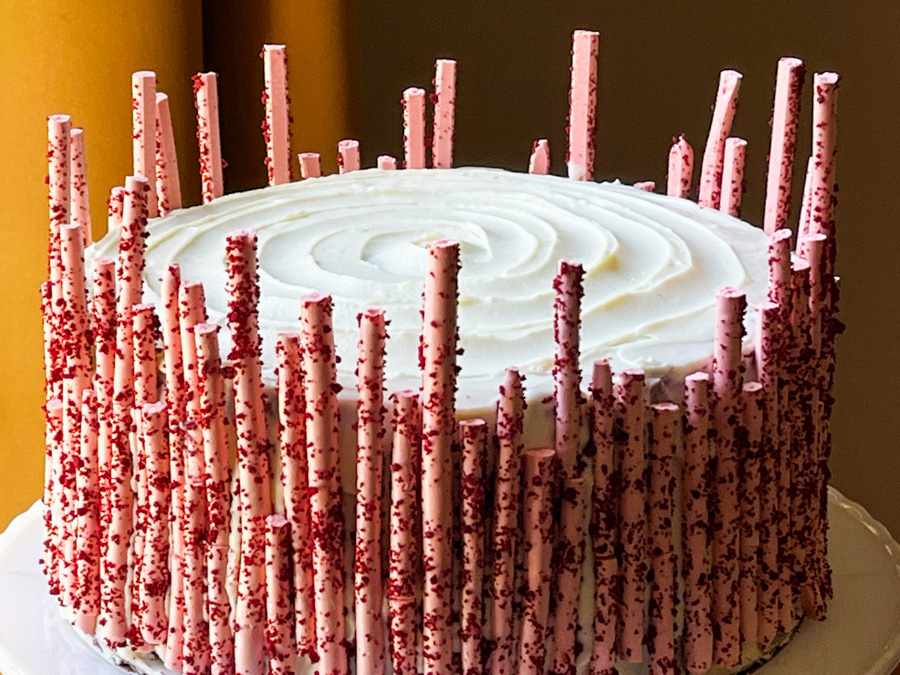
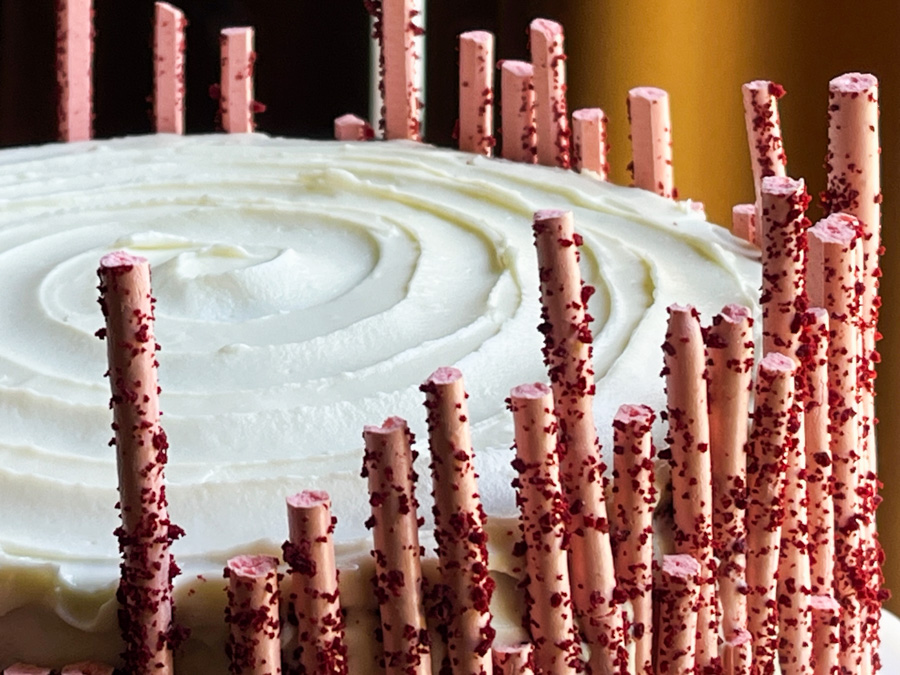
Fourteen years. One thousand, six hundred and thirty eight posts published. I confess this is the first anniversary that finds me with a little less gas in the tank. Am I going to stop? No, not yet. I still love sharing recipes and little bits about our life, the kitchen, the pups. So I am committed to one more year to make it to fifteen, and will re-evaluate at that point. To celebrate this day, I offer you a cake: Red Velvet with White Chocolate Cream Cheese Frosting. Made a little more special by decorating it with meringue sticks, not too complicated to make, and so striking to look at! Recipe from Kirsten Tibballs at Savour Cooking School.

RED VELVET CAKE WITH CREAM CHEESE FROSTING
(from Kirsten Tibballs)

Recipe is copyrighted and I did not get permission to publish it, so you need to be a member of Savour School to obtain it. Click here for details.

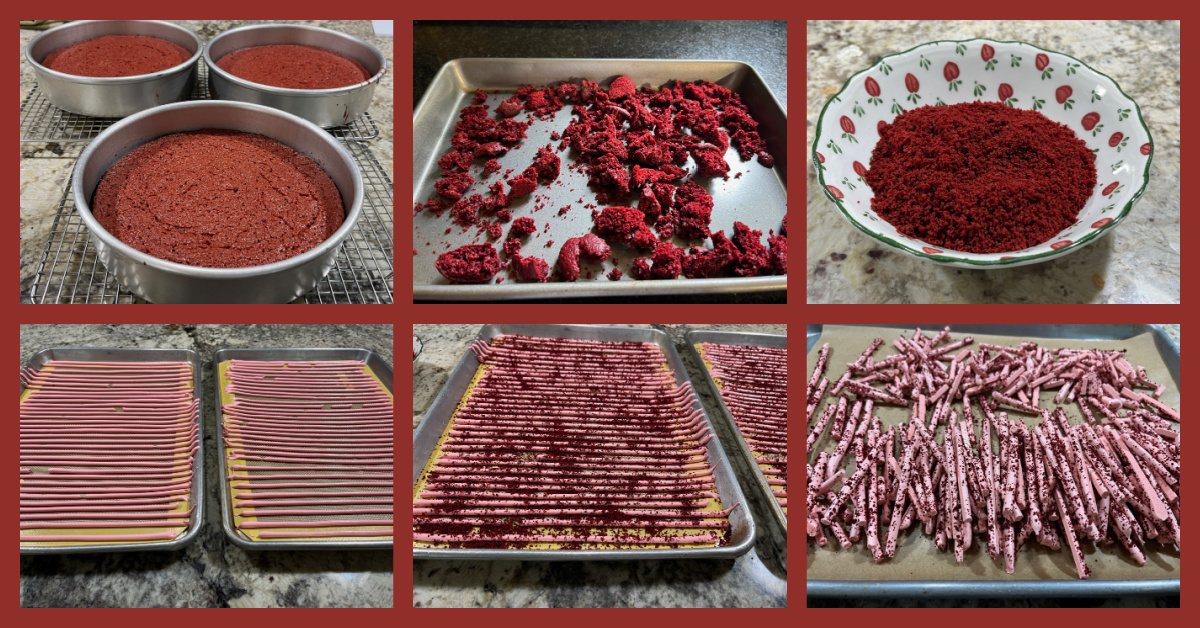
Comments: The cake is actually quite simple to put together. You can definitely use any red velvet cake recipe you are fond of, they are pretty similar with all the usual suspects. Make three cakes, 8 inch in diameter. When you trim the top of the cakes, use that part to make cake crumbs (I dried mine in a very low oven for 3 hours).

I loved making the meringue sticks, with a simple Swiss meringue method. A piping bag with a 4mm round tip is used to pipe lines that get coated with cake crumbs and baked for 2 and a half hours at low temperature, like required for meringues. Once the cake is iced, just glue the sticks of varying size all around.

.

Without further ado, let’s start the journey into my 15th year of food blogging!

ONE YEAR AGO: The Bewitching Kitchen turns 13!

TWO YEARS AGO: The Bewitching Kitchen Turns 12!

THREE YEARS AGO: The Bewitching Kitchen turns 11!

FOUR YEARS AGO: The Bewitching Kitchen Turns 10, and a Giveaway…

FIVE YEARS AGO: The Bewitching Kitchen turns 9!

SIX YEAR AGO: The Bewitching Kitchen turns eight!

SEVEN YEARS AGO: The Bewitching Kitchen Turns Seven!

EIGHT YEARS AGO: Bewitching Kitchen Turns Six!

NINE YEARS AGO: The Bewitching Kitchen turns Five!

TEN YEARS AGO: The Bewitching Kitchen turns Four!

ELEVEN YEARS AGO: The Bewitching Kitchen Turns Three! 

TWELVE YEARS AGO:  The Bewitching Kitchen turns Two!

THIRTEEN YEARS AGO:  Bewitching Birthday!

FOURTEEN YEARS AGO: Welcome to my blog!

THE DOBOS TORTE


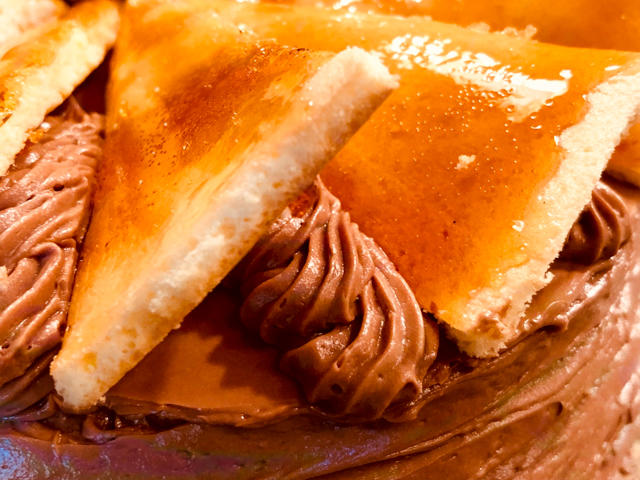
Several years ago I saw a recipe for Dobos Torte in a website and the image of those thin cake layers joined together with chocolate buttercream, plus the interesting crown of caramelized cake made me wish I could taste a piece right then through the screen. I said to myself I would be making it really soon. Days turned into weeks, weeks into months, and I swear it’s been at least 3 years if not more in my plans. Finally, I went for it, and it was one of the most rewarding experiments in our kitchen. I enjoyed the preparation of each component, and loved how they came together nicely. But what really makes this cake is the decoration on top. You must get the caramel dark enough so that it will stay hard on the cake, otherwise it might start to weep and you lose the textural contrast. This is definitely a cake fit for a special occasion. Like a gray Monday early in November that brought with it unexpected snow showers.

THE DOBOS TORTE
(adapted from a recipe from Chef Wilhelm Wanders)

for the sponge cake layers:
140 g egg yolks
120 g granulated sugar, divided (60 + 60g)
2 g salt
1 tsp vanilla paste
210 g egg whites
120 g all-purpose Flour
40 g unsalted butter, melted and cooled

for the chocolate buttercream:
250g granulated sugar
250 g whole eggs
550 g unsalted butter at room temperature
200 g dark chocolate (I used Lindt 70%)

for the caramel:
150 g granulated sugar
50 g water
10 g fresh lemon juice
1/2 tsp coffee extract

to decorate:
crispearls or shaved chocolate

Heat the oven to 375 F. 2. Prepare six sheets of parchment paper drawing a circle with 8 in diameter in the center. Flip the parchment, so that the pencil drawing is in the bottom. Reserve.

Important: weigh the bowl you will be using to make the cake batter and write down that number. 

Whisk the egg yolks with  half of the sugar (60g), salt and vanilla using a KitchenAid type mixer fitted with the wire whisk. You must whisk until the mixture is thick enough to form a ribbon when the batter drips from the whisk. It might take more than 8 minutes to get there, be patient.

In a clean mixing bowl with the whisk attachment, whip the egg whites and remaining 60 g of sugar on high speed to soft peaks. Fold the egg whites into egg yolk mixture, then fold the flour (sifted on top). Remove a small amount of the batter and mix with the melted, cooled butter. That makes it easier to incorporate the butter homogeneously into the cake batter. Fold the butter into the cake batter.  Weight the bowl and calculate exactly how much batter you have. Divide by six to get the exact amount you’ll need to spread on each parchment paper. In my case I played conservative, and although the calculations gave me 104 g of batter per circle, I used 100 g only.

Spread onto the parchment lined baking sheets within the circles. Bake for about 10 minutes, in my oven I could do two sheets at a time. The other circles can wait as you bake.  Remove from oven and transfer the baking sheet to a cooling rack.

Make the chocolate buttercream. In a clean metal mixing bowl, warm the sugar and eggs over a water bath to 140 F. Whisk in a KitchenAid at medium-high speed for 5 minutes, so that the mixture will cool almost to room temperature.  Add the butter (room temperature, preferably as close as possible as the temperature of the egg/sugar mixture) in small pieces, then the melted chocolate, and mix until homogenous and a spreadable consistency.

Make the caramel:  Stir the sugar, water, and lemon juice and melt in a saucepan over medium heat. Prepare an off-set spatula by coating it lightly with oil. Cook the sugar until the caramel turns amber. Pour the caramel onto one of the cake layers and spread with an oiled offset spatula.  Wait 30 to 60 seconds. With a well-oiled chef’s knife score the caramel-coated cake layer into twelve even pieces slices. Use scissors to cut neatly the 12 triangle shaped slices.  Set aside to cool in the fridge. Add 1/4 cup water and coffee extract to the pan with the leftover caramel, gently heat and make a simple syrup to use as a soaker for the cake slices.

Place the first sponge layer on work surface. Soak the sponge layer with simple syrup. Evenly spread a thin layer of buttercream filling on the cake layer. Repeat until five cake layers have been filled with equal amounts of buttercream filling. Frost the cake and decorate the sides using a cake comb.  Score the cake into 12 pieces.

Pipe decoration on each piece using a star-shaped piping tip. Place caramel sponge decoration on each cake piece and decorate the center with crispearls or shaved chocolate.  Cool for buttercream to set, but if possible bring to room temperature before serving.

ENJOY!

to print the recipe, click here

Comments: One of the best advices I’ve seen lately for baking in general is to weigh the bowls you use most often and write down that number someplace. I actually stuck a tape on my Kitchen Aid with the magical number 1,045. That is how much the bowl weighs.  Whenever I make cake layers I don’t need to think twice. Just weigh the bowl with the batter, subtract the magical number and work from there. If I  need to divide the batter in 2, 3, 4 pans, I do it on the scale and know exactly how much to pour.

In the case of the Dobos, it’s really important that the layers get uniform in thickness. Next time I will also weigh the amount of buttercream added to the first layer, so that I can make sure all others are exactly the same. I had a little too much enthusiasm filling one of the layers and it is evident in the sliced photo that you’ll see later. Finally, I think it could be also good to spread the cake batter slightly bigger than 8 inches in diameter and then use a cake ring to cut them all exactly the same size. Details like this will make the final product more polished.

I cannot praise enough that caramel coated-decoration. In fact, I think one could make cake-cookies just like that. I had to control myself not to go to the mail room in our department and steal all the decorations. But truth is I always send a picture of the dessert as a group email on Sunday, so it would be hard to explain how its crown would be all of a sudden absent.

The cake is obviously very rich but a small slice is more than enough. I’ve seen Dobos Tortes showcasing 8 or even 9 layers, so if you feel particularly brave and indulgent, make more cake batter and go for it. But you will need extra buttercream also, the recipe as written had enough to fill, cover and make the piped decorations with a small amount leftover. I have also seen variations without the cake layers fanned on top and using sugar work instead. I urge you to stick to the classic method. I hate to be repetitive, but… those caramelized pieces? You need to get up close and personal with them…

ONE YEAR AGO: Coffee-Caramel Entremet Cake

TWO YEARS AGO: Fennel Soup with Almond-Mint Topping

THREE YEARS AGO: Eataly

FOUR YEARS AGO: Spaghetti Squash Perfection

FIVE YEARS AGO: Skinny Eggplant Parmigiana

SIX YEARS AGO: Supernova Meets Wok

SEVEN YEARS AGO500 Posts and The Best Thing I ever made

EIGHT YEARS AGO: Back in Los Angeles

NINE YEARS AGO: White House Macaroni and Cheese

TEN YEARS AGO: Korean-Style Pork with Asian Slaw