Not too long ago I got notification of a new blog post by my friend Karen. You can check her post here. She mentioned the yudane method, a kind of tahgzhong on steroids. I am familiar with tangzhong and love it, but yudane was new to me. I could not wait to give it a try. I ended up following this recipe that was linked at the end of Karen’s post.
In the tangzhong method, part of the flour is gently cooked until a paste forms. To make yudane, you boil water and mix with the flour, then place in the fridge for 4 to 24 hours. That gets incorporated into the bread dough. Fascinating, Mr. Spock, fascinating…
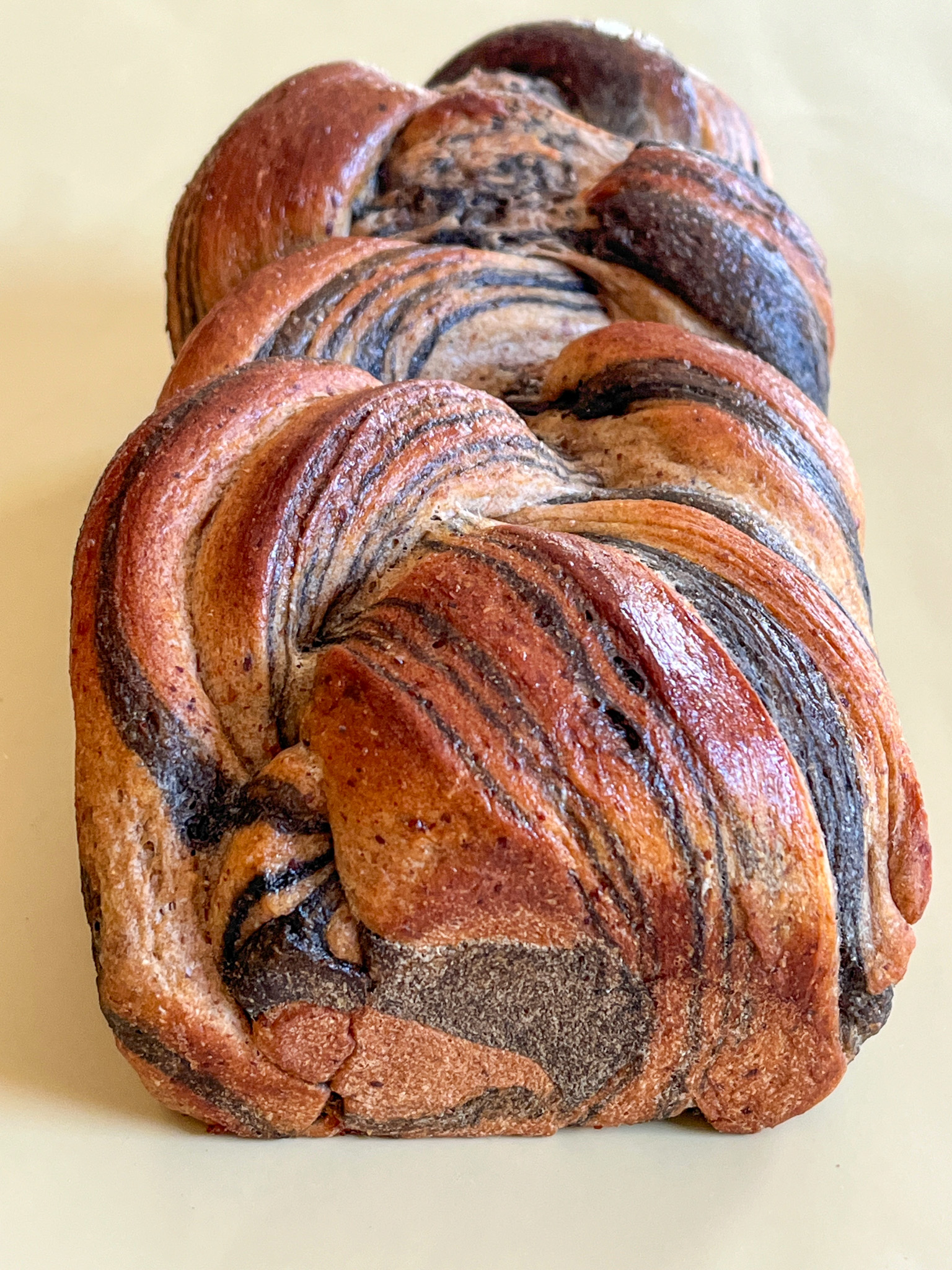
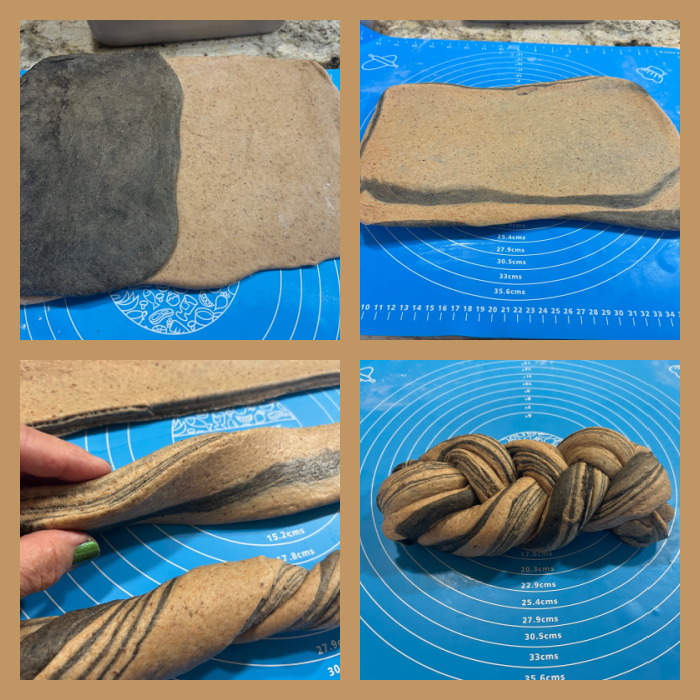
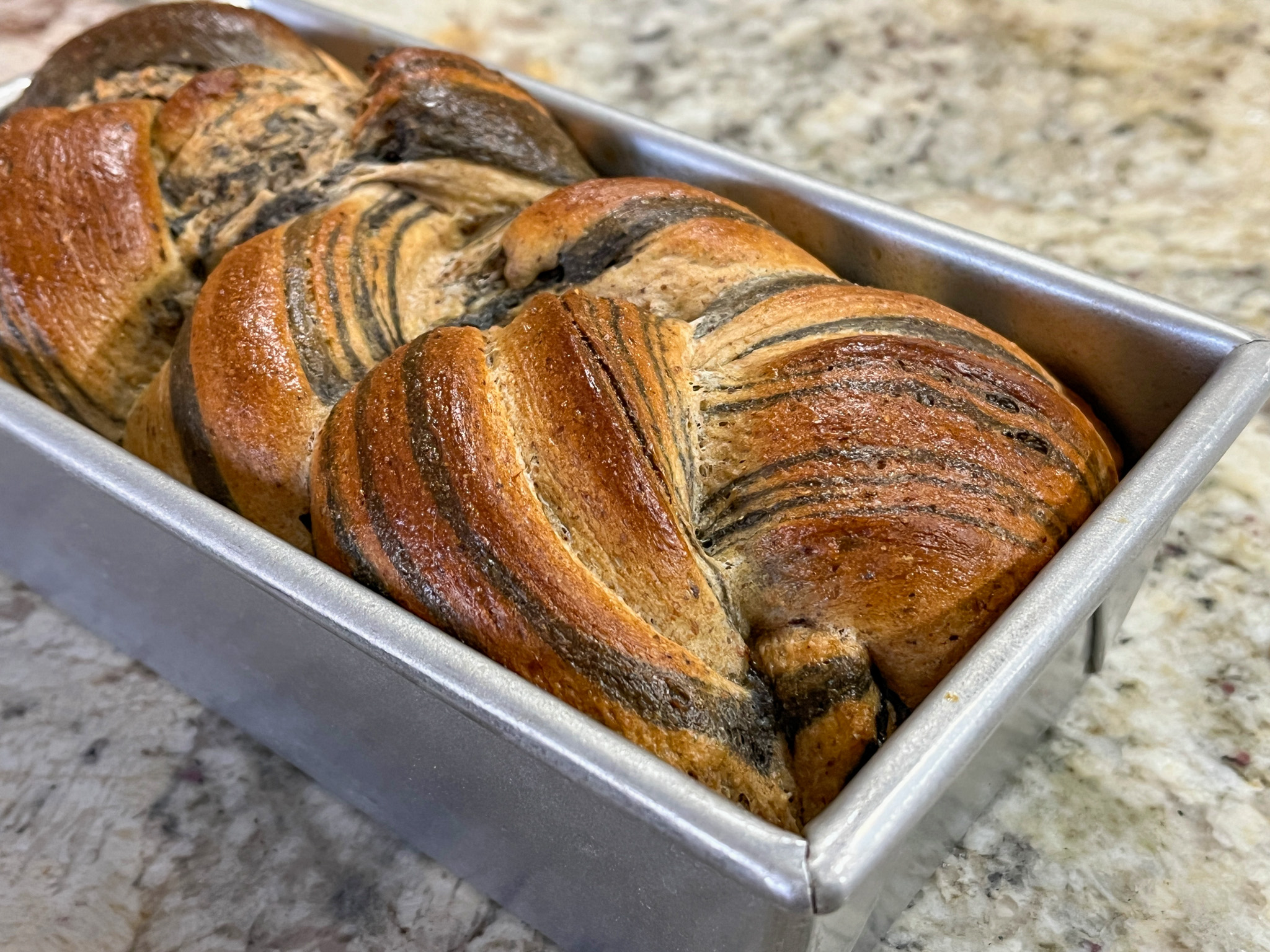
I loved making this bread. For the full recipe, please visit Bread Experience (click here). My modifications were just a few: I did not have white whole-wheat, and did not have kamut in the pantry, so I used the full amount of regular whole-wheat, King Arthur’s brand. For the liquid component I used oat milk. Finally, I used store-bought black tahini, just eye-balled about 2 tablespoons and got a nice dark color. The dough is a pleasure to work with, and the marbling worked perfectly!
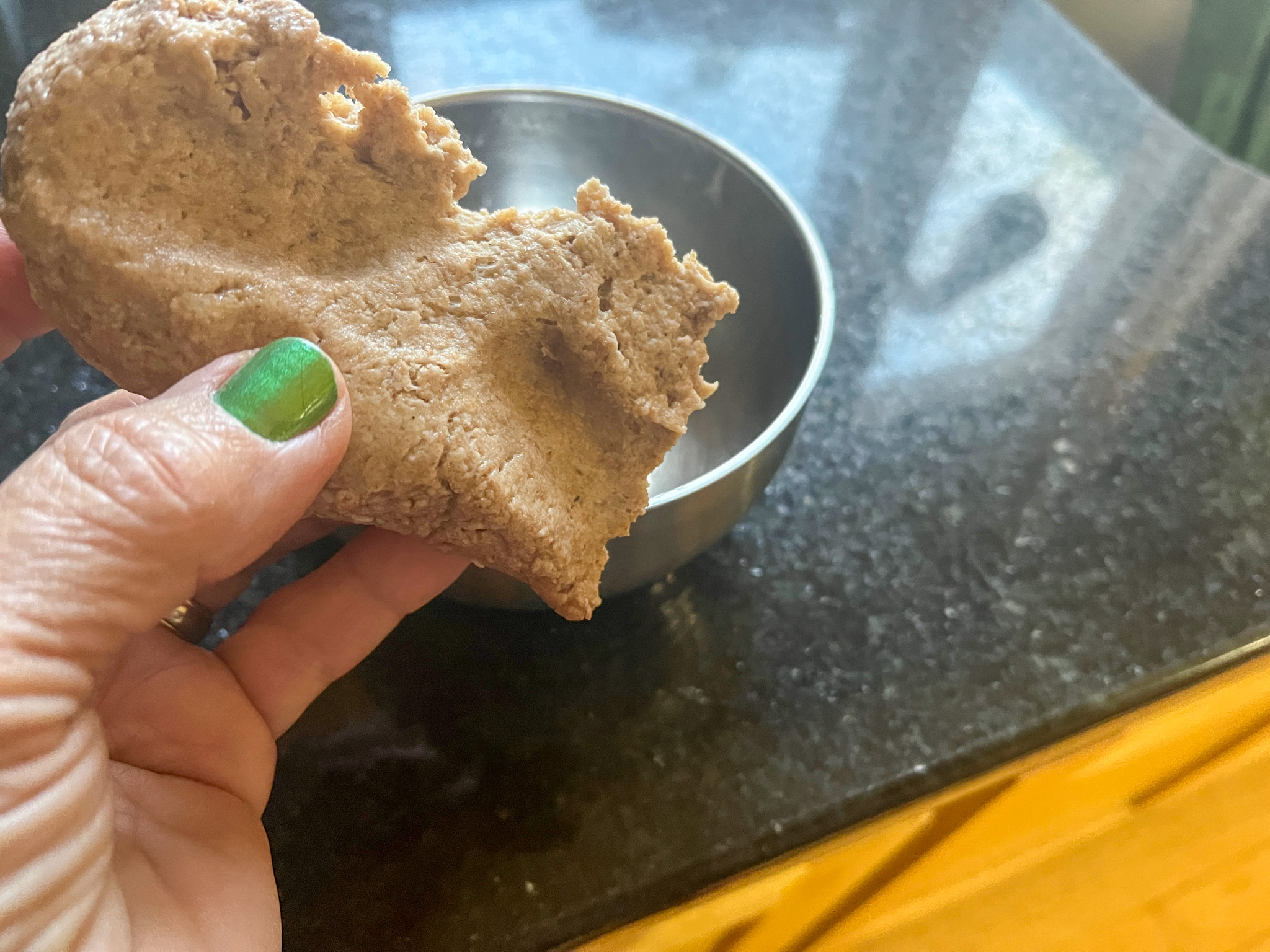
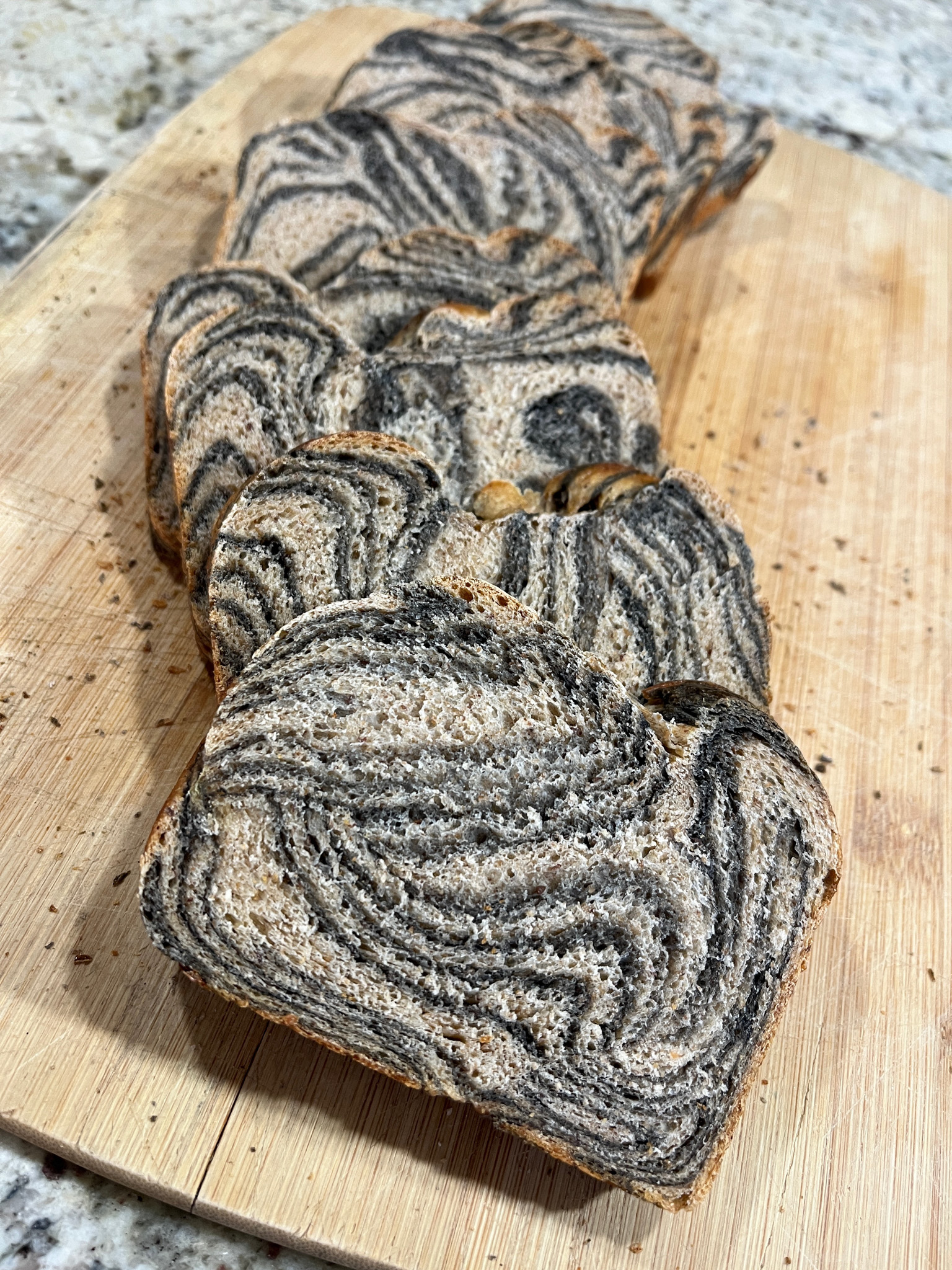
The crumb is soft, tender, and the bread is absolutely delicious with a hint of sesame taste. I highly, highly recommend you give yudane a try. This is what it looks like…
Just don’t forget it in the fridge, make sure to grab it when you are ready to make the dough! (Yes, I almost forgot about it).
And look at that crumb!
I hope you give yudane a try, the bread stays soft and moist for at least a couple of days. After that I sliced and froze for later.
THANK YOU, KAREN AND CATH FOR THE BREAD INSPIRATION!
Back in December last year I had a lot of fun playing with ube, the Filipino ingredient that was new to me. Today I share two ways to make sourdough bread incorporating ube. The basic recipe is the same, but in the first version I substituted some of the flour with ube powder. The second version incorporates 1/4 tsp ube extract in the dough. The one with the ube powder got a super light purple tone and the texture and structure of the bread was slightly different from a regular sourdough. If you are looking for color impact, definitely go with ube extract. A little goes a long way, and the taste is very mild.
UBE SOURDOUGH – VERSION #1
UBE SOURDOUGH, TWO WAYS (from the Bewitching Kitchen)
480g white bread flour 20g ube powder 10g salt 350g water 75-90g sourdough starter at 100% hydration
Make the levain mixture about 6 hours before you plan to mix the dough. It should be very bubbly and active.
When you are ready to make the final dough, place the water in the bowl of a KitchenAid type mixer and dissolve the starter in it, mixing with a spatula briefly, then add the flour, ,ube powder and salt. Turn the mixer on with the hook attachment and knead the dough for 4 minutes at low-speed all the time. You will notice the dough will gain quite a bit of structure even with just 4 minutes in the mixer. Remove from the machine, and transfer to a container lightly coated with oil, cover lightly with plastic wrap and allow it to ferment for 4 hours, folding every 45 minutes or so. Because the dough is already a bit developed from the initial time in the mixer, you should get very good structure after 3 and a half hours, or even sooner than that.
After four hours bulk fermentation, shape the dough as a ball, and place, seam side up, in a lightly floured banetton. Leave at room temperature one hour, and then place in the fridge overnight, from 8 to 12 hours.
Next morning, heat the oven to 450F.
Place a parchment paper on top of the dough, a flat baking sheet, and invert the dough, flipping it out of the banneton. Flour the surface of the dough, add the stencil and air-brush if so desired. Score with a razor blade.
Bake at 450F for 45 minutes, preferably covered for the first 30 minutes to retain steam. Cool completely over a rack before slicing.
FOR VERSION #2 Use 500g bread flour and add 1/4 tsp ube extract to the dough, following the same method to prepare and bake the bread.
Comments: You will notice that the crumb is tighter than usual for a sourdough, and also the color purple is super subtle, quite light. Version #2, with ube extract got a lot more color.
UBE SOURDOUGH – VERSION #2
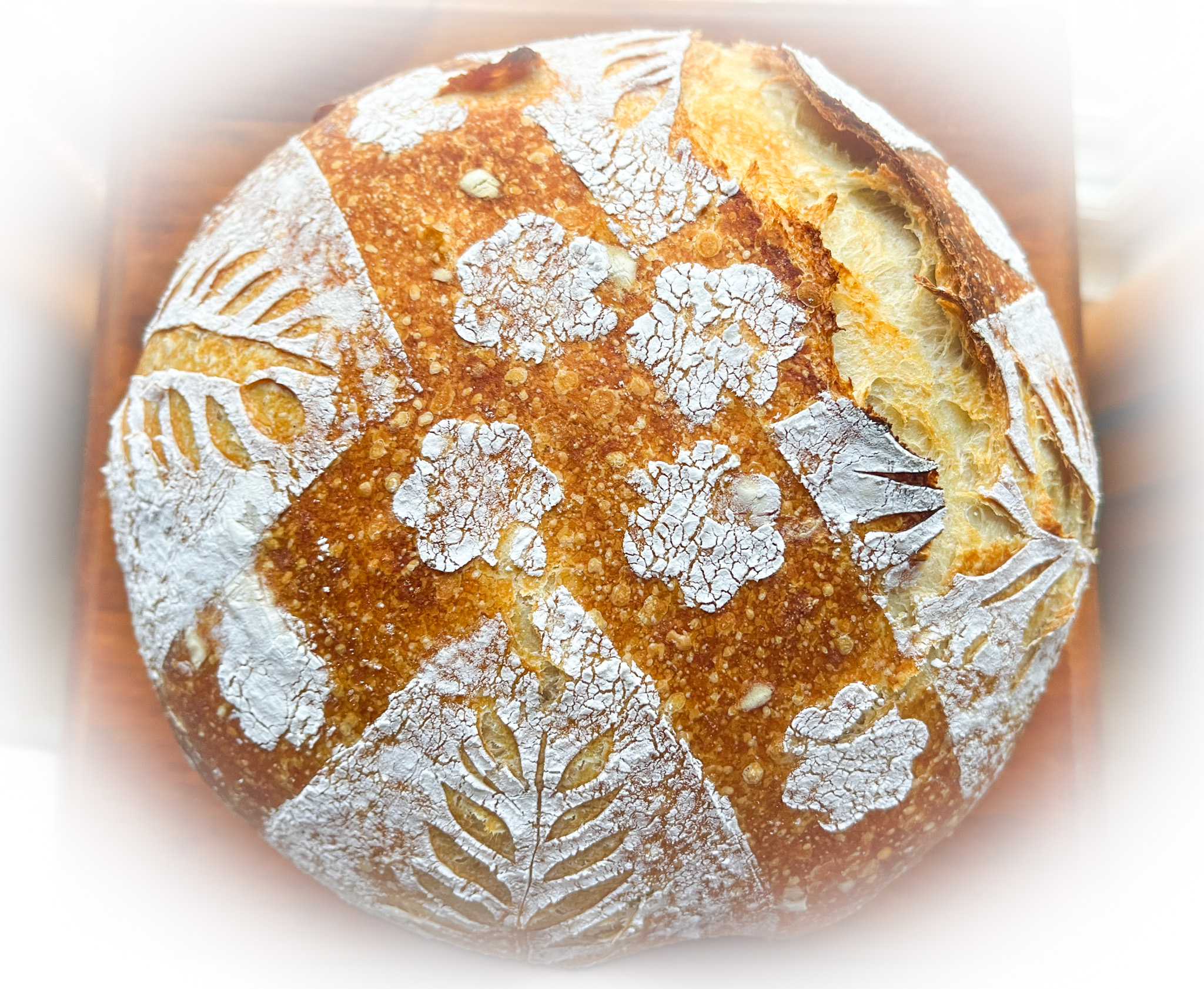
I used a different method to decorate it, with oats to form little flowers and black sesame seeds in the center. Just wet the surface of the dough a little bit and that acts like a glue.
It was a bit time-consuming to do, so I ended up forming just 4 little flowers. Maybe next time I can go for full-coverage…
The crumb was open and super purple!
So, if you like to play with this ingredient, I would recommend the extract, because I felt the dough was quite affected in its structure when some of the flour (therefore gluten) was removed and replaced with the powder. Also, the color that the extract provides is quite spectacular and stayed unchanged with baking. Flavor is very subtle.
Valentine’s Day is almost here! Some don’t care for it, some enjoy each minute. Whatever team you are on, here are some bakes that you can try this week, or anytime love is on your horizon… Without further ado, one recipe and eight ideas for you. Read on…
. BLUEBERRY CURD SWISS ROLL CAKE (filling adapted from Caroline’s blog)
for the decoration: 50g butter, softened 50g powdered sugar 50g egg whites 50g all-purpose flour black and red gel colors
for the cake: 130g cake flour 1 teaspoon baking powder 5 large eggs, at room temperature 200 g granulated sugar Zest of 1 lemon 1/2 teaspoon lemon extract 1/2 teaspoon vanilla extract ¼ teaspoon kosher salt 2 tablespoons butter, melted and cooled
Make the piping decoration by beating the butter with powdered sugar in a small bowl until fully combined. I used a hand-held electric mixer. Add the egg whites and beat for a couple of minutes. Add the flour and mix by hand with a spoon, divide in one small portion to dye black, one larger portion to dye red.
Make a diamond pattern with a Sharpie pen on parchment paper, and add heart shapes. Flip the paper so that the writing is at the bottom, and pipe the outline black. Freeze for 10 minutes. Quickly fill the hearts with red paste. Freeze again while you make the cake.
Heat oven to 350°F. Sift the flour and baking powder into a small bowl. Reserve. Place the eggs and sugar in the bowl of a standing mixer fitted with the paddle attachment. Beat until the mixture form ribbons, about 12 minutes. Add the lemon zest, lemon extract and vanilla. Beat until combined. Sift the flour mixture over the beaten eggs, fold gently. When the flour is mostly incorporated, add a little bit of the mixture to the melted butter, whisk well. Pour that into the cake batter, whisk gently to disperse. Pour over the frozen parchment paper placed in a half baking sheet, and smooth the surface.
Bake the cake until it begins to pull away from the sides, 12 to 17 minutes.
Transfer the pan to a cooling rack, cover the cake with a towel and let it cool for 10 minutes. Remove the towel, sift a little powdered sugar over the surface and flip it over parchment paper. Gently peel off the paper with the design, flip the cake again over a clean towel. Starting with a short side of the cake, roll the cake gently, using the towel to support the cake as you go. Let the cake cool all rolled up in the towel, seam side down.
Carefully unroll the completely cool cake, spread the blueberry curd filling, then roll it again. Wrap the cake in plastic and refrigerate for at least 3 hours, overnight is best. When ready to serve, slice a small piece of each of the ends, so that it looks more polished.
Comments: I haven’t made a patterned roll cake in a while, so I really enjoyed this little adventure. I messed up while making the curd (sorry, Caro!), did not cook it enough, so after 10 hours in the fridge it was still too loose. Lesson learned. I made a gelatin mass with 1 tsp gelatin + 5 tsp water, warmed it to dissolve in the microwave. I heated up the curd to about 60 C and added the melted gelatin. Mixed well and allowed it to cool slowly, then placed in the fridge overnight. It was perfect to use next morning. Huge thank you to my friend Gary for the advice to deal with the curd. I added a very small amount of pink gel dye to the cake batter, but that is optional. I did not include in the recipe, as the cake will look perfectly ok without it.
The cake was moist and tender, the blueberry curd absolutely delicious! The combination of orange and blueberry is a real winner, thank you Caro!
And now, time to share a few ideas, you can use any recipe you like, or some that are already in my blog
.
CHOCOLATE-COVERED OREOS
I used white Wilton candy melts to cover Lemon-flavored golden Oreos, and once that was set I made the heart decoration with Royal icing. First piped the black outline, let that set a bit and flooded the center with pink.
.
COMIC-STYLE HEART COOKIES
Comic-style, so popular these days! I followed a recent tutorial from Amber (join her club here) to make these babies. Some steps shown below.
.
POLKA-DOT HEART COOKIES
Super simple design, just flood, air-brush with a stencil and add some Royal icing transfers. A little bead border is of course more than welcome…
.
ZENTANGLE HEARTS, TWO WAYS
For a modern look, just flood with any color of your choice, and then use a food safe pen to draw the design…
For a modern but romantic look, just play with flowers…
.
BICOLOR HEART COOKIES
For those who do not care for icing, these will be a huge hit. Just mix two recipes, chocolate and plain, cut shapes and mix-and-match the centers. Bake and you are done!
.
MINI-BONBONS WITH MARSHMALLOW FILLING
I used candy melts to coat tiny silicone molds with heart shapes (available here). Placed a mini-marshmallow in the center and covered the molds with melted chocolate. Once that set, I un-molded the bonbons and drizzled white chocolate for the decoration, adding a little sprinkle heart on some of them.
.
POLKA-DOT HEART SOURDOUGH
For the recipe, check my blog post with a click here.
I hope you’ve found some inspiration in this post for your future bakes, and please enjoy the weekend ahead, particularly if you are a football fan!
Super excited to share these! Hubby loves them and always gets a bag at the grocery store, so I was tempted to bake them from scratch. My first attempt got over-baked and the crust was not as soft as the commercially available, but my second batch was pretty close to perfect, even if I say so myself… This is a very easy bread, made with instant yeast. From start to finish, about 3 hours.
1 ½ cups warm water, plus more for steam baking 2 ¼ teaspoons active dry yeast (1 package) 1 tablespoon granulated sugar 500g all-purpose flour (about 4 cups) 2 teaspoons salt 2 tablespoons avocado oil (or another neutral oil) vegetable oil spray (I used olive oil)
Prepare the yeast. Mix the water and sugar with the instant yeast. Let it stand for 5 minutes until it gets foamy. Prepare the dough. In the bowl of a stand mixer whisk together the all-purpose flour and salt.
Attach the dough hook to the mixer. Drizzle the oil over the yeast-water mixture, whisk a bit and with the machine running in low-speed, add the whole mixture to the bowl. Knead on the same low-speed for 7 minutes. The dough will be slightly sticky. If it seems too sticky, knead in 1 tablespoon of additional flour at a time until smooth and elastic. If it’s too dry, add a little water and keep kneading for another minute.
Place the dough in a slightly oiled bowl and cover with plastic wrap. Proof at room temperature for about 90 minutes, when it should double in size. Line a large baking sheet with parchment paper. Divide the dough in 6 equal pieces (I used a scale, they were about 148 g each), shape each as a little oblong bread, trying to mimic the shape of the bolillo as you form it.
Spray the surface lightly with olive oil. Cover with plastic loosely and let it rise for 45 minutes at room temperature. Meanwhile, heat the oven to 420F and 15 minutes before you bake the rolls, place a 9 x 13 pan in the bottom rack and add 10 cups of hot water inside. That will generate steam for the baking.
Slit the dough in the center, spray the rolls with a little water and bake for about 30 minutes. If they are darkening too much, reduce the temperature to 400F and cover the surface with foil. Bread is baked if internal temperature reaches 205F.
Let them cool for at least 20 minutes before serving.
Comments: Such a fun little bread to make! Just make sure to not bake them too long, because the crust will get very dark and hard if you do. It is still great but not like the original. Here you see my first bake maybe you can tell the crust got a little too baked, but the crumb was still very nice, just a bit harder than the second batch.
I urge you to make these, they go well with so many fillings, and even just a smear of olive oil and balsamic if you like to keep it simple. I know I will keep making batches to have some in the freezer at all times, just like I do regularly with sourdough. It is just a different style of bread.
One of my default recipes that I go back to every time is the old Fine Cooking food processor’s pizza dough (click here for post from 2009!). It always works, it is fast, convenient, and I have it memorized, so whenever I want pizza, I mix the dough early in the morning, stick it in the fridge and come back hours later. I might change slightly the composition of flour, adding spelt or whole wheat if I feel like it but the basic procedure is the one from the blog. It got me thinking that the same approach could work for a slightly more complex type of dough, one that includes yogurt, but does not quite go into the direction of the Indian naan. I am super happy with the outcome, and urge you to give it a try…
FOOD PROCESSOR FLATBREAD WITH SESAME SEEDS (from The Bewitching Kitchen)
250 grams (about 2 cups) bread flour 1½ teaspoons instant yeast 1/2 teaspoon salt ¾ cup plain, full-fat yogurt 2 teaspoons agave nectar 1/4 cup of water (you might not need the whole amount) olive oil, za’atar, Herbes de Provence, sesame seeds (to taste)
Mix the yogurt with the agave nectar and reserver.
In a food processor, combine the flour, yeast and salt, then process until combined, 2 to 3 pulses. Add the mixture of yogurt with honey, process, and with the machine running, drizzle the water. Stop when the contents in the bowl start for form a cohesive dough. Process for about 60 seconds, adjust with more flour or water if needed. Ideally the dough should be slightly sticky.
Remove the dough from the processor, form as a smooth ball, and leave it to proof at room temperature for 90 minutes.
Heat the oven to 450F and place a baking stone on a rack to heat. Divide the dough in two equal portions, then stretch them into oval shape on a piece of parchment paper. Brush with some olive oil, sprinkle your spice mixture of choice, then sesame seeds. Transfer the flatbread into the oven, still on the parchment paper, and bake until puffed and golden, about 15 minutes.
Remove to a cooling rack, and enjoy once it cools down a bit.
Comments: I made a small batch, with only 250g flour, because I was testing the food processor method, but it ended up really perfect for the two of us. Even four people could be happy with the two flatbreads, although in that case I guarantee you won’t have leftovers. I liked the za’atar version the most, hubby preferred the one with Herbes de Provence. Your kitchen, your choice!