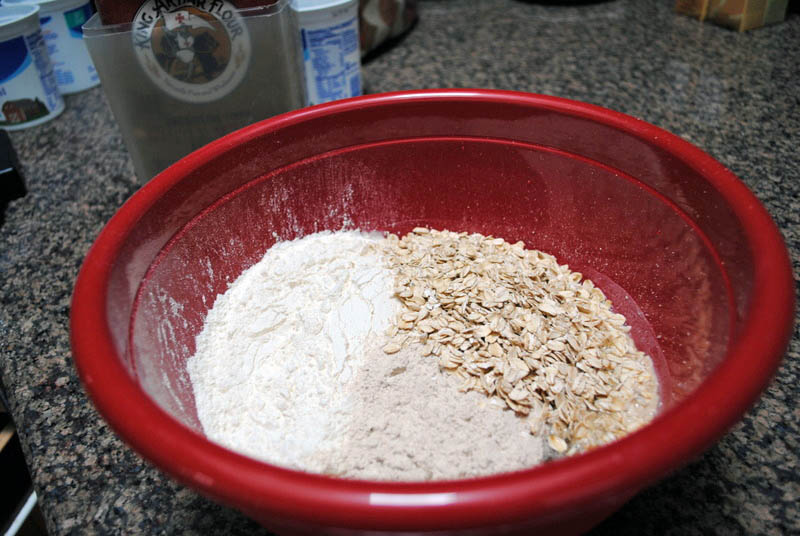
CODRUTA’S ROLLED OAT SOURDOUGH BREAD

I can read Portuguese, English, and French.  Stretching my brains a little I can get by in blogs written in Italian or Spanish, as the grammar and many words are similar to those from my native language.  Reading Romanian is another story altogether, but Codruta’s blog is on my blogroll list and will not be leaving anytime soon! Through Google Translate and a few email exchanges with her, I can profit from the bread masterpieces she regularly posts on “Apa. Faina. Sare”.   Agua. Farinha. Sal.  Water. Flour. Salt.  The basic ingredients for great bread, once you add the magic of wild yeast.

When she posted her own formula for a sourdough bread with flaky oats in the dough, I wanted to make it right away, as it involved a technique new to me: cold fermentation of the starter and dough until final proofing of the shaped bread.  Plus, it combined two different starters, one made with rye flour.  Indeed, not a bread for beginners, but I decided to take a leap of faith and play with the grownups. 😉   What do you think?
CODRUTA’S ROLLED OAT SOURDOUGH
(reprinted with permission, from Apa. Faina. Sare)

Makes one very large loaf or two medium-sized loaves.

for pre-ferment:
50 g very active starter made with regular flour (100% hydration)
50 g very active starter made with rye flour (100% hydration)
100 g bread flour
50 g water

for final dough:
all pre-ferment (250g)
450 g white bread flour
150 g whole wheat flour
130 g rolled oats (rolled thick is better)
470 g cold water
17 g salt

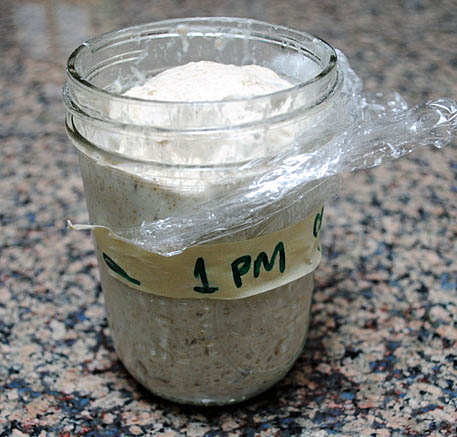
Prepare the pre-ferment by dissolving both types of starters in water, then add the flour. Stir and cover the container, placing it immediately in the refrigerator.  It is better to use a tall and narrow pot, transparent, so you can mark the level of your starter mixture as you place it in the fridge. Let it sit there 18-24 hours, until the yeast bubble grows up. You have a margin of a few hours to use for the yeast bubble will remain within, then begins to collapse.  Ideally, you should catch it when it’s almost doubled in bulk, as you can see in this photo.

When the starter is ready to be used, mix in a bowl the flours, rolled oats and cold water, let it sit 40 to 60 min (the autolyse step). Sprinkle salt on top, add the fermented starter straight from the fridge. Blend all ingredients together. Knead by folding directly into the bowl, a few minutes, until the dough comes off the fingers and the vessel walls. The dough will be quite dense, but do not add more water. Cover the pot, wait 15 minutes, and repeat the kneading by folding (one complete rotation of the vessel is sufficient). Cover and wait 15 minutes.

Transfer the dough in a greased rectangular dish with oil, make a set of stretch and fold (SF), wait 45 minutes, repeat the set of SF and place dough in the refrigerator.  Let dough in refrigerator for 15 to 18 hours.

Remove dough from refrigerator and leave it at room temperature for 1 hour. Divide the dough in two, and shape each half as a round or oval loaf.  Place the shaped loaves in a banetton or another appropriate container, with the seam up. Cover the pot with a light fabric, and then with plastic wrap. Let the dough proof at room temperature for 2 hours and 30 minutes.

Heat your oven 45 minutes before baking time. Have a baking stone inside and your method to generate steam planned. Bake at 460 F  for 45 min, with steam for the initial 15 min. Reduce temp to 440 F  if the bread seems to be browning too much.

Cool it completely before slicing.

ENJOY!

to print the recipe, click here

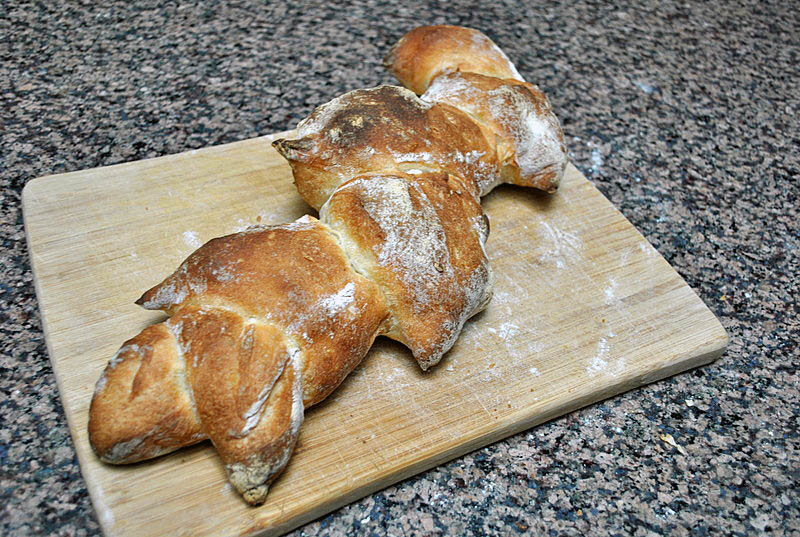
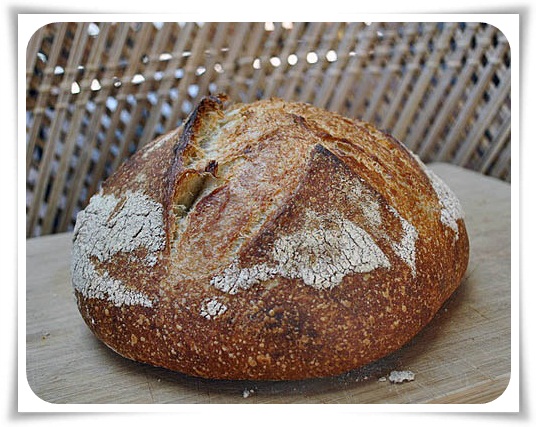
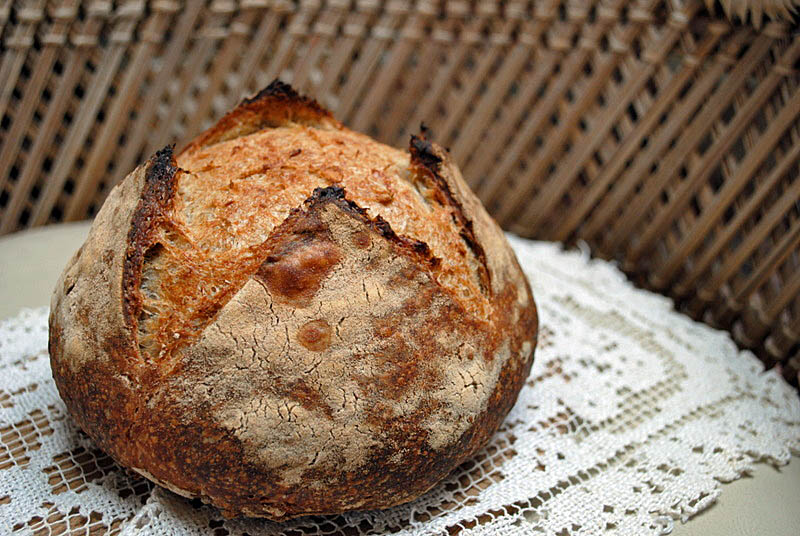
With this bread, I tried to work on shaping a batard, but next time I will divide the dough in uneven portions, making a slightly smaller batard and bigger “boule”.  I need a bit more practice with this shape of bread, but I feel I’m slowly making progress…  I was hoping for a shorter bread, with more pointed ends.  It will happen.  I know it will…  😉

The bread was absolutely delicious! The oats, although not previously soaked, more or less disappear into the dough, contributing flavor and a very slight hint of texture. Perfect! More and more I lean towards bread with whole wheat flour and grains or seeds inside, I find that they are very satisfying and more flavorful than white bread.

Unfortunately, I had a small problem with my camera – pilot error – and lost all my photos of the crumb.   Mine was not as perfect as Codruta’s bread, but no one who tried the bread seemed to mind…  Make sure to stop by her blog and marvel at the structure of her bread,  with a beautiful pyramidal shape, which is a sign of perfect handling of the dough.

Codruta, thanks for a great recipe,  I now only have about 8 others from your blog waiting in line!   😉

I am submitting this post to Susan’s Yeastspotting event…

ONE YEAR AGO:  Roasted Corn and Tomato Risotto

TWO YEARS AGO: Light Rye Bread

Add to FacebookAdd to DiggAdd to Del.icio.usAdd to StumbleuponAdd to RedditAdd to BlinklistAdd to TwitterAdd to TechnoratiAdd to Yahoo BuzzAdd to Newsvine

AWARD-WINNING SOURDOUGH BAGUETTES

It was bound to happen.   Once I felt comfortable shaping baguettes, I went on the pursue of a recipe for a sourdough version. My number one source of inspiration for all things related to bread is Susan’s Wild Yeast, and this recipe charmed me right away.  Award-winning sourdough baguette version?  I am sold!   First thing I did was to drop an email to Samuel Fromartz, the writer-turned-baker behind the recipe,  asking for permission to publish his very detailed method.  To my delight, he replied within a few minutes, and we exchanged a few messages, in which I got great tips to improve steaming during baking  (I will test his method this weekend).   Sam Fromartz is currently working on a book about grains, bakers and bread for Viking/Penguin. So, if you are like me, and cannot have enough info on the subject, check his website for the development of his project.  I know I will…  😉

FROMARTZ BAGUETTE TRADITIONAL
(recipe published with permission from Samuel Fromartz)
(read original article at Chewswise blog)

Makes four baguettes

90 grams sourdough starter (at 100% hydration)
420 grams water
590 grams flour (I used King Arthur Organic All Purpose Flour)
10 grams whole wheat flour
13 grams sea salt
2 teaspoons instant dry yeast (I used  SAF Instant Yeast)
Olive oil to grease bowl
cornmeal to dust cutting board

FIRST DAY
Pour starter and yeast into bowl and add water, mixing until the starter breaks up a bit.  Add flours and salt and mix for a couple of minutes. The dough will be heavy and shaggy. Let it rest for 5 or 10 minutes, covered with plastic.

Rub the surface where you will knead the dough with a tiny amount of olive oil to prevent the dough from sticking (great tip originally from Dan Lepard).  Use a scraper to move dough onto the counter and begin to knead by stretching and folding dough, trying to use your finger tips.

After kneading for 5 minutes, scrape mass into a clean bowl or plastic bin. Cover and let rest for 20 minutes.

Oil the counter again if necessary and remove dough to counter. Stretch it until 1-inch thick then fold top and bottom in thirds like a letter. Do the same type of folding, coming from left to right. Put dough back in the bowl, cover, let it  rest for 20 minutes.

Remove from bin, fold again, and put back in a covered bowl for 20 minutes.

Remove from bin, fold again for the third and final time. Clean the bowl, oil lightly (with 2 tsp olive oil), and put dough back inside. Cover and place in refrigerator for 12 to 24 hours.

SECOND DAY
Place baking stone or quarry tiles in middle of oven. Place a thick rimmed cookie sheet or cast iron pan on oven floor or lower shelf. Heat oven to 470F (245 C).

Put a little olive oil in your palm and oil a 20-by-20 inch (50 x 50 cm) section of the counter. Remove dough from container. Cut dough in half. Put half back in container and into refrigerator. Cut dough into two rectangular pieces (about 250 grams each) and gently stretch into rectangles 5-by-7 inches (13-by-18 cm) with the long edge facing you.  Cover with light towel and let rest for 5 minutes.

While dough is resting, cut parchment paper large enough to fit your baking stone. Dust paper with flour. Dust  a couche (or kitchen towels) lightly with flour.

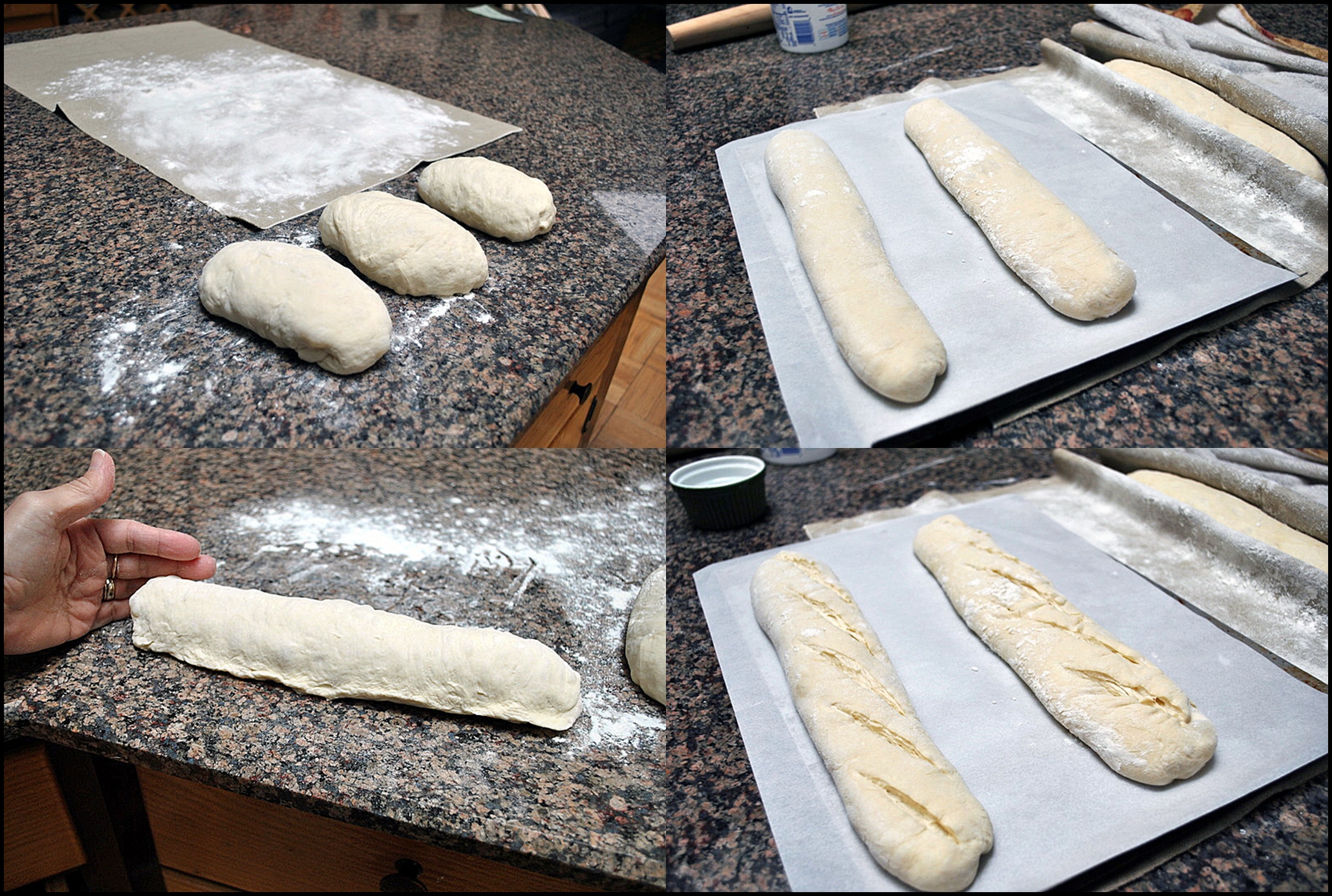
Shape dough into a log by folding top and bottom of rectangle toward middle and gently sealing the seam with thumb. Then fold top to meet the bottom and seal seam. You should have a log about 1.5 to 2 inches thick (4 to 5 cm). Gently roll and stretch into a 14-inch loaf (36 cm) or just under the size of your baking stone.

Place each loaf on parchment paper about six inches apart, seam side down. Place one rolled up towel underneath the paper between the loaves and one under each other edge, supporting their shape.  Cover with light kitchen towel and let rise for 45 minutes to 1 hour.

Put 2/3 cup water in measuring cup and bring to a boil in the microwave.

Carefully move the paper with the loaves onto a flour-dusted overturned cookie sheet or cutting board. Dust top of loaves very lightly with flour. Use a bench scraper to gently adjust the loaves and straighten them out.

Make four cuts on the top of the loaf with a razor blade, 1/4-inch deep, running lengthwise on the dough. A swift slash at a sharp 20-degree angle works best. Take cutting board and slide parchment paper with baguettes onto hot baking stone. Shut oven door. Open door, and carefully pour 2/3 cup water onto cookie sheet or cast iron pan. Be very careful if using boiling water. Shut door. Do not open the oven again while baking.

Check baguettes after 18 to 20 minutes. They should be dark brown and crusty. If pale, continue baking for 1 to 2 minutes. Let cool for 20 minutes on rack before eating. They are best eaten within 6 hours.

While baguettes are baking, form the remaining dough into loaves or leave for up to 24 hours and make fresh loaves the following day.

ENJOY!

to print the recipe, click here

for a streamlined version, click here

Comments:  To read the fascinating story behind perfecting  this recipe, check Sam’s write up about it here.

If you are a novice in baking bread, baguettes can be tricky, but you can find very detailed discussions about this particular recipe in his blog about it.  Don’t forget to read the comments, because they contain a lot of useful, additional information.  Sometimes little details we read  en passant  might mean the difference between failure and success.

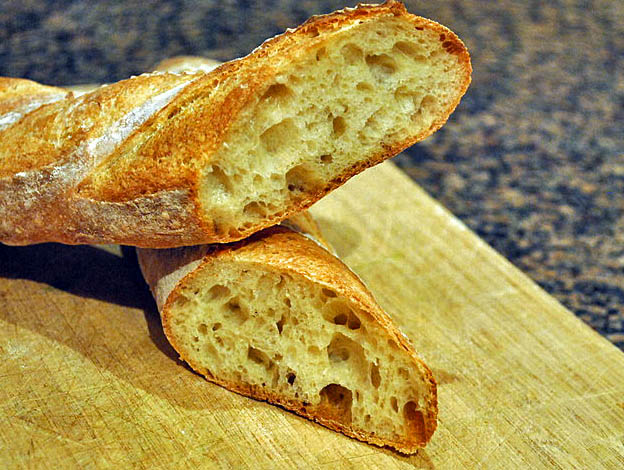
I absolutely loved this recipe!   Handling a dough from the fridge is quite a bit easier than at room temperature (about 78 F), I had no problems shaping the loaves and going for their final stretch.   I will be playing with this recipe for a while,  using it to practice my slashing technique (just got a new blade, per my friend Gary’s recommendation), and baking with steam.  The baguettes had a complex “feel”,  with very delicate sourdough flavor, open crumb, and a hearty crust.  I know that when I overcome the steaming problem they will be even better… stay tuned, friends… stay tuned…

This slideshow requires JavaScript.

I am submitting this post to Susan’s Yeastspotting event….

ONE YEAR AGO: Meet our Lab (Lab = laboratory, not Labrador Dog… ;-))

TWO YEARS AGO: My New Favorite Tomato Sauce

Add to FacebookAdd to DiggAdd to Del.icio.usAdd to StumbleuponAdd to RedditAdd to BlinklistAdd to TwitterAdd to TechnoratiAdd to Yahoo BuzzAdd to Newsvine

VOILA’ LES BAGUETTES!

Second chapter on Cooking Projects 2012!

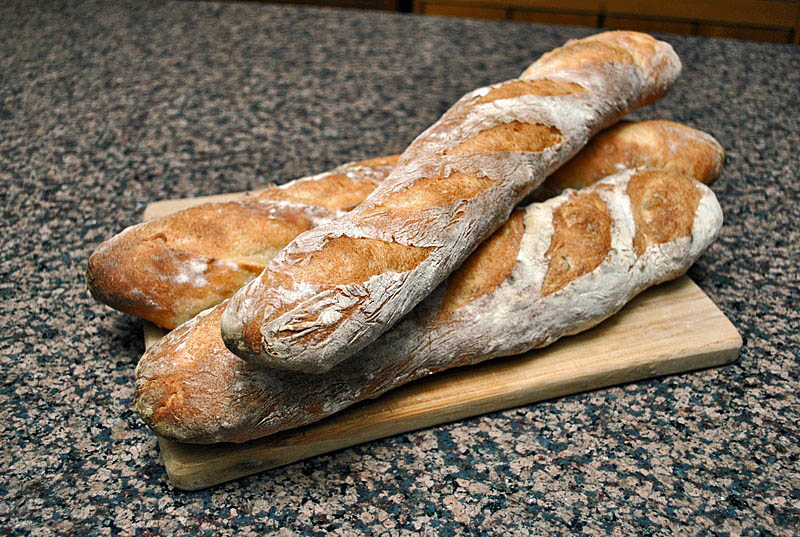
Five weekends. One hundred and twenty six ounces of flour. Blood. Sweat. A few tears. But, I am not afraid of shaping baguettes any longer. Is there room for improvement? No doubt, but the goal now shifts from shaping to baking: I must find a way to optimize the generation of steam.  Apart from that, I am pretty happy with my babies…
UN-KNEADED, SIX-FOLD FRENCH BREAD
(from Jeffrey Hamelman, Bread)

2 pounds + 4.5 oz  bread flour (8 + 1/4 cups)
1 pound + 10.6 oz water (3 + 3/8 cups)
3 + 1/2 tsp salt
1 + 1/4 tsp instant dry yeast

Place all the ingredients in a large bowl, and using your hands or a plastic scraper, bring them together forming a very shaggy mass.  The best way to do it is working the scraper down the sides of the bowl, and then rotating the bowl as you bring it up, and fold that part of the mixture on top. Do this movement about 20 times, which should mix everything together reasonably well at this stage.  Do not worry about how smooth the dough is, it will feel and look very “rough”.

Set a timer to go off every 30 minutes. You will fold the dough every thirty minutes, for a total of six times (at that point you will be 3 from the start).  At each cycle, fold the dough on itself using a scraper, for a total of 20 times,  either removing the dough to a surface, or folding it inside the bowl.  After the sixth folding cycle, leave the dough undisturbed for 30 minutes, then divide it in 12 ounce pieces (from the start,  you will be at the 3 hour and 30 minutes mark).  One full recipe makes 5 long baguettes.

Gently form each piece into a cylinder shape, and let it rest for 15 minutes (very important to relax the gluten, don’t skip this step).  Shape as a baguette, then roll the baguettes to stretch them to their final size (make sure they will fit over your baking stone or the surface you intend to bake them on).

Let the baguettes rise (preferably using a couche well coated with flour) for 1 to 1 and a half hours at room temperature (ideally at 76 F).  Score the baguettes and bake in a 460 F oven, with initial steam, for a total of 22 to 25 minutes. Cool completely before slicing.

ENJOY!

to print the recipe, click here


Comments:   I like to do the first four of the six kneading cycles using a different technique:  I coat the granite counter top with a very light amount of olive oil,  and slam the dough on it 15 to 20 times.  You can see the technique demonstrated in this video.  The last two cycles I omit the “slamming”,  and simply fold it, so that the airy structure is not disturbed.   Phil insists that I should let him make a video of my “slamming technique”, but so far I resisted the idea.  Maybe one day… 😉

As to the shaping, I will be forever grateful to Gary, my friend and baker extraordinaire, who went through the trouble of mailing me a DVD of Chef Jeffrey Gabriel CMC, from Schoolcraft College. Gary made the video during his class on French baguettes, and I watched it over and over… and over!   The main difference between Chef Gabriel’s technique and this one, is that he is not too concerned with where the seam of the baguette ends up.   On my initial attempts, I was so worried about keeping the seam up for the final rise, that I ended up manipulating the baguettes too much and messed up their final shape.   Gary’s method is much more user-friendly, and once you score the baguettes and bake them, the seam position seems to have no influence on the final look of the bread.

A few important pointers for success:

1.  Coat the surface where the baguettes will rise (after the final shaping) with flour.   They WILL stick if you forget this step, leading to intense grievance.

2. Allow the dough to rest for 15 minutes before shaping.  You need that or the gluten will keep fighting back like an elastic band.

3. The better you get at shaping the baguettes, the longer they will be.  If you want to bake them covered to create steam, this could be a problem.  Consider making shorter baguettes – not authentic, but easier to bake in a home oven.

4. Baguettes are scored  with an odd number of slashes. Usually 5 or 7.   Some advise you to wet the blade to do it, I prefer to use a dry blade, as I like the “spiky” look of the slashes.

5.  The baker’s blade is sharp.  Make sure you cover it with the protective plastic cap when you are done, or, if using a blade with no cap, put it away. Leaving it sitting on the counter top is a recipe for disaster.   (sigh)

After practicing several weekends in a row, I now settled on making half this recipe, and shaping either 3 long baguettes or 4 medium-sized.   The tricky part is baking them: I can bake two at a time, so the last one must go through a longer rise.  Sometimes it seems to be slightly over-proofed, and the resulting baguette is a bit flat.  However, the taste is spectacular, this recipe produces a very creamy crumb, with a flavor that transported us to the 7eme arrondissement in Paris.  Not a bad virtual trip to take!   😉

I am submitting this post to Susan’s Yeastspotting

ONE YEAR AGO: Cornmeal English Muffins

TWO YEARS AGO: Cornish Hens for a Sunday Dinner

Add to FacebookAdd to DiggAdd to Del.icio.usAdd to StumbleuponAdd to RedditAdd to BlinklistAdd to TwitterAdd to TechnoratiAdd to Yahoo BuzzAdd to Newsvine

PROJECT 2012: ROMANIAN FLATBREADS

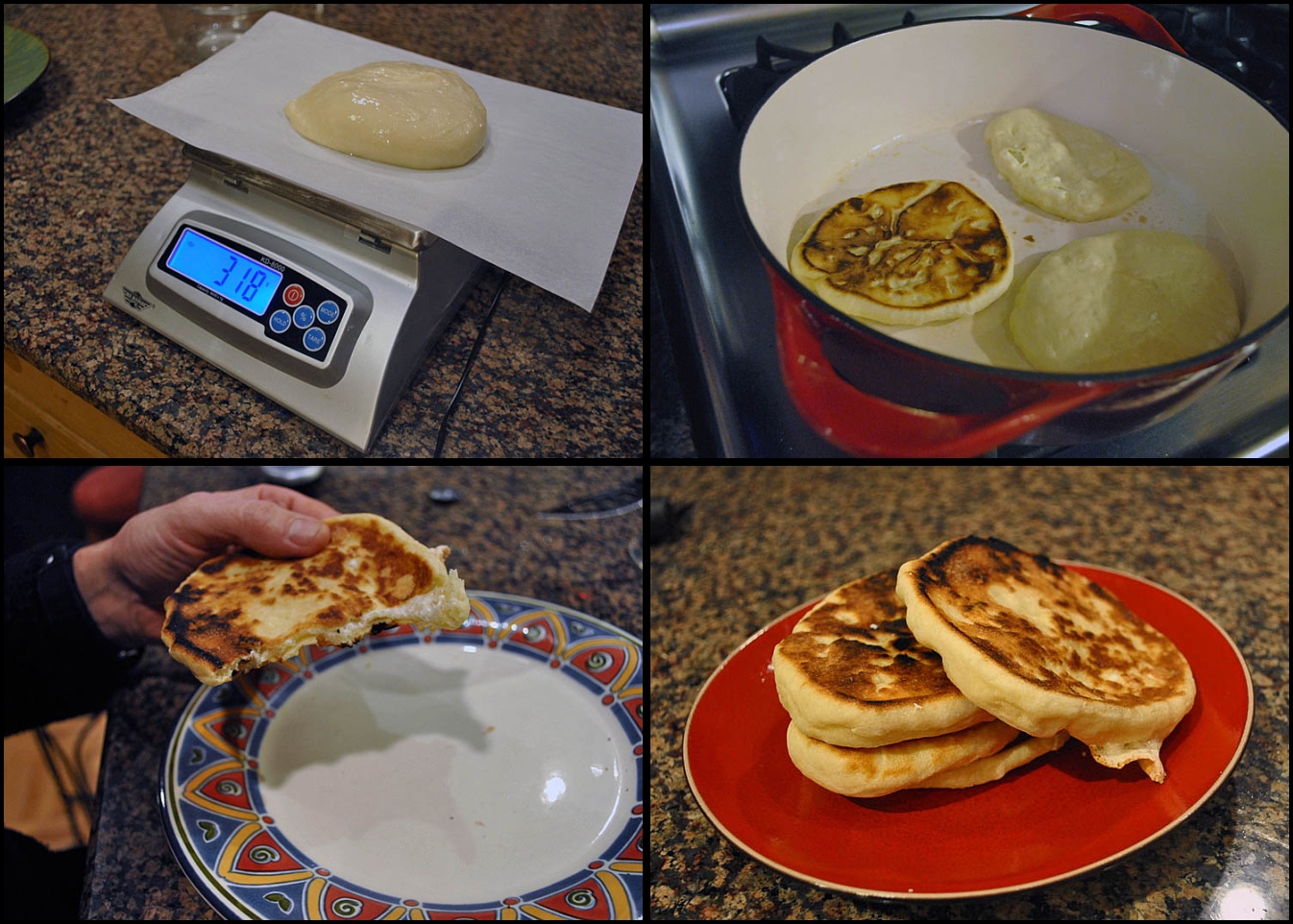
Last month I posted a few of the culinary projects I had in mind for the near and not so near future.   The first one I tackled was Codruta’s flatbreads, made with a sourdough base, and filled with cheese.  One bite is all it takes to fall in love with them.

The story behind the bread is the stuff of fairy tales you maybe read as a kid, and the images stayed with you forever.  Picture yourself as a young boy, going for a hike in the forest with a group of buddies and a few supervising adults. Their goal is to visit breathtakingly beautiful caves in Romania.  But, his guide  decided to wander apart from the rest of the group, and the two of them took what was supposed to be a shortcut to the caves.   You see where this is going… 😉  They got hopelessly lost.  They walked, and walked some more.  They searched around for hours, through a dense fog that unexpectedly came down, and made everything much worse.  It got cold, rainy, and dark.  The boy was wearing just a light t-shirt and ended up shivering, all wet from the rain. They finally stumbled upon a little house in the middle of the woods, and decided to take a risk and knock on the door, having no idea who could be living in such a place.   A nice couple welcomed them inside. The old woman was cooking flatbreads, they smelled amazing.  She offered some to the boy, and that was by far the best thing he’d ever tasted in his almost 10 years of life!  And they told them exactly how to get to the caves and reunite with their group…

Pestera Scarisoara - Sala Biserica

(Pestera Scarisoara Cave, image from Wikimedia Commons)

Thirty years went by.  The boy is now a grownup man, and his girlfriend a gorgeous woman, whose passion for cooking lead her to try and recreate the flatbread of her partner’s childhood.   And I am lucky enough to take a ride on their journey, and sample the delicious cheesy bread that warmed a little  boy’s heart and soul.

CODRUTA’S CHEESE FLATBREAD
(from Apa. Faina. Sare)

60 g  (2.1 oz) sourdough starter (100% hydration)
70 g  (2.5 oz)    water
60 g  (2.1 oz) yoghurt
2 eggs (about 100g / 3.5 oz)
315 g all purpose flour
6 g  (0.2 oz) salt
30 g (1 oz) sunflower oil

Dissolve the sourdough starter in the water, mixing gently.  Add the yoghurt and beat well, then whisk the eggs in the mixture.   Add the flour, stir, and let the dough sit for 20 minutes at room temperature.

Add salt and knead with an electric mixer until the gluten starts to develop (about 6 minutes).  If the dough seems to soft, add a tablespoon of flour.  Add the oil in small amounts, continuing to mix, until the dough absorbs all the oil.   At this point, the gluten must be very well developed, and the dough quite elastic and smooth.

This amount of dough is enough for 12 to 15 flatbreads. If you want to make fewer, simply store in the refrigerator the dough not used. Next day it will have even better flavor.   Place the dough you want to use on the same day it is made in a warm place and let it rise for 4 to 5 hours.

Pick the fillings of your choice: crumbled sheep’s cheese with herbs, or sautéed cabbage, or go for a sweet version using grated apples and cinnamon sugar.

When you want to make the flatbreads,  tear pieces of 45-50 g of dough and stretch over a surface lightly coated with oil (a smooth plate works great, or a granite countertop) until it forms a circle about 15 cm  (6 inches) in diameter.   Place the filling in the center, and fold all edges over the filling, sealing well and making sure no big air bubbles are trapped inside.  Carefully roll the circle as thin as you are able to, without tearing the surface.  You can try and make it around 20-22 cm (8 inches) in diameter, but it takes a bit of practice.

As you roll each one, place it on a skillet coated with a light spray of oil (well seasoned cast iron, or non-stick), and fry each flatbread until nicely browned on both sides.  Transfer it to a plate and proceed to cook the next one.   Or, if you roll them a little smaller, fry as many as you can fit in your pan, but don’t allow them to touch.

ENJOY!

to print the recipe, click here

Comments:  When Phil took the first bite of the bread, he immediately remembered the cheese breads from Brazil, and the feeling he had the first time he had one: pure bliss!   We can testify that you won’t need to be lost in a forest to appreciate these babies, they are awesome!

Now, please go to Codruta’s blog, and check her photos to see how she made them a lot thinner than mine.  I was afraid to do it, but I know next time I’ll be more daring.  The dough is very forgiving, there’s enough fat in it to make it pliable.   I used a Mexican type cheese (Cotija),  but next time I’ll crumble it in smaller pieces, that will help stretching the dough thinner too.  Because it was just the two of us enjoying the flatbreads, I halved the recipe and used a food processor to do the kneading, as the amount of dough was too small for my Kitchen Aid.  Simply put the dough in the bowl of the processor and turn it on for about 20 seconds.  See if it’s smooth and maybe process 10 more seconds.  The dough will feel warm, don’t worry about it.  It will be fine.  😉

Next time I want to make these flatbreads filled with sauteed shredded cabbage, as Codruta told me it’s one of her favorite flavors.  But, the possibilities are endless, you can even make them without any filling, and just sprinkle some spices on the dough before enclosing and stretching.   A great use for your sourdough starter!

Note added after publication:  I apologize for spelling Romania incorrectly at first.  My Brazilian nature interfered, and I used the spelling from Portuguese. It’s all corrected now, but if you happened to catch the first version, sorry!  😉

I am sending this post to Susan Yeastspotting

ONE YEAR AGO: When Life gives you (Meyer) Lemons

TWO YEARS AGO:  Blasted Broccoli, Stove-top version

Add to FacebookAdd to DiggAdd to Del.icio.usAdd to StumbleuponAdd to RedditAdd to BlinklistAdd to TwitterAdd to TechnoratiAdd to Yahoo BuzzAdd to Newsvine

A SOURDOUGH EXPERIMENT

Would you like to bake bread with wild yeast, but the thought of   keeping a starter is too intimidating?  If that’s the case, I urge you to read this great post by Joanna, from Zeb Bakes. She will make you feel absolutely at ease with keeping the starter going, minimizing your work and the use of flour. She will also show you a simple schedule to bake bread on a weekly basis.  Awesome read! Sourdough baking made simple and easy, as it should be.

Now, time for some fun with it.  Remember the proofing bread box I gave myself for Christmas?   Well, I put it to the test, by making a batch of sourdough bread and dividing the dough in two.  Half went into the cozy environment of the box (78 F), half stayed outside in my kitchen kept (at this time of the year) at around 70F.  The recipe I chose for such a ground-breaking experiment comes from a great baker, who blogs at Breadcetera.  You can learn a ton of stuff from him, make sure to bookmark his site and visit often.   He developed this technique called “double flour addition,”  with the goal of maximizing the amount of air bubbles trapped in the dough from the very beginning of mixing.  These tiny air bubbles, created by whisking the very loose mixture of flour and water, later generates the pockets of air that every baker searches for in this type of rustic loaf.

SOURDOUGH BREAD WITH DOUBLE FLOUR ADDITION
(from Breadcetera)

680 g bread flour
90 g whole wheat flour
455 g water
15 g salt
300 g sourdough starter (at 100% hydration)

Combine the flours in a large bowl and lightly mix them with a whisk.

Add the water and the sourdough starter to the bowl of a Kitchen Aid mixer, and use the whisk attachment to work them together at the lowest speed for a minute or so.  At this point, you only need to combine them and have the starter dispersed through the water.    Add just 75g of the flour mixture, and increase the speed of the mixer to level 3. Whisk until the mixture seems quite aerated (about 3 to 4 minutes).

Remove the whisk attachment and place the dough hook in place. Add the rest of the flour, and knead for a couple of minutes, until the flour forms a shaggy mass.  Cover the bowl with plastic wrap and let it rest for 20 to 30 minutes.

Sprinkle the salt over the dough, and mix on speed 3 for 6 minutes.  Place the dough in an oiled bowl, cover and let it ferment for 2 hours, without any folding or kneading.  Divide the dough in two equal pieces, and lightly give it a round shape.   Let it rest for 15 minutes for the gluten to relax,  and do a final shaping, creating surface tension by pulling the sides of the dough up as you gather it all in the “boule” shape.   Place the balls of dough, seam side up, in a floured round container (such as a brotform), cover with plastic, and let it ferment for 3 hours at 78 F.

Invert the dough on a peel, score, and bake at 425 F for 40 minutes, with steam during the first 15 minutes.  Let it completely cool before slicing.

ENJOY!

to print the recipe, click here

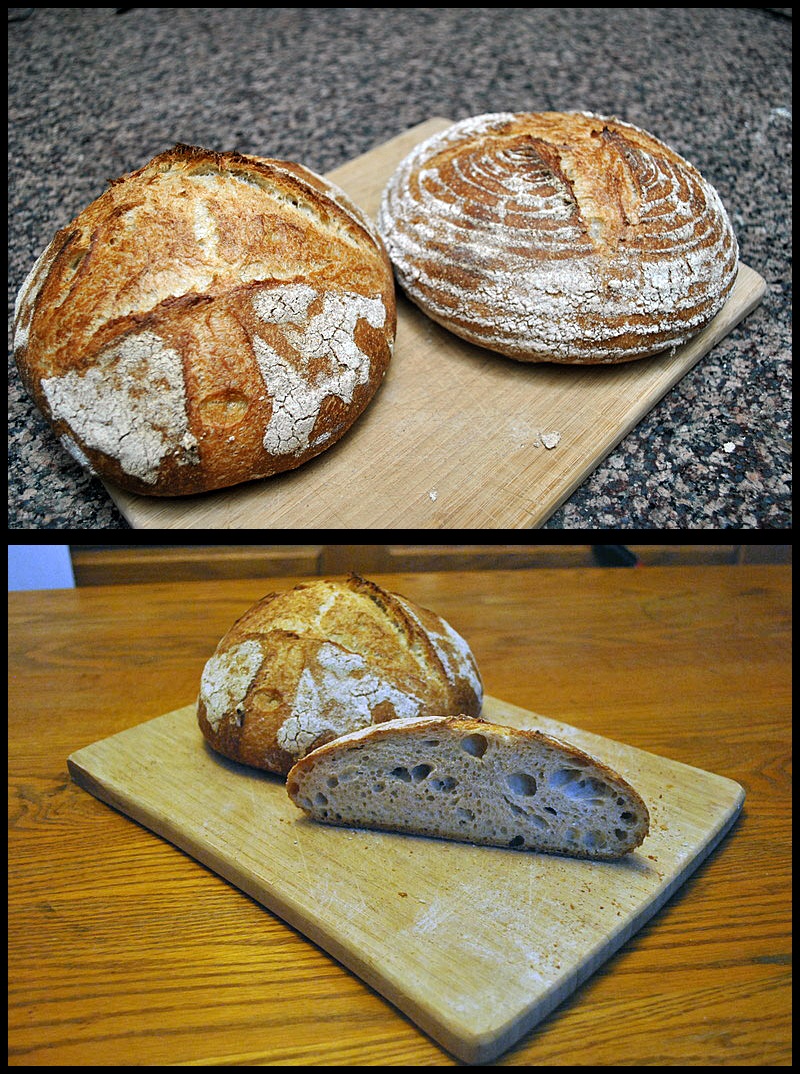
For my experiment, I divided the dough in two right before the first fermentation, and placed one half in the proofing box.   That dough stayed in the box until baking time, the other one stayed over the kitchen table, protected from drafts.  The difference in the dough itself was pretty dramatic, but I could not get a picture that was good enough to show it. However, once the bread was baked, the one from the proofing box had much better oven spring, the other one was a bit on the flattish side.   Both were delicious, and the crumb had a nice structure, but one bread looked a lot “healthier.”   Here they are…

You can see that the taller bread, with a more round shape, had better oven spring, bursting through the slashing with greater power. Sorry, no photos of the crumb, we froze that baby for later and by the time we got to enjoying it, I forgot to grab the camera.


The bread proofing box not only optimizes the temperature, but also provides the correct amount of humidity, thanks to the small dish that sits at the bottom of the box, with some water in it.  No need to worry about a skin forming on the loaf in the final proofing, no need to use plastic to cover it.  A very well designed machine, that is getting constant use in our home.

I am submitting this post to Susan’s Yeastspotting

ONE YEAR AGO: Shrimp and Fennel Casserole

TWO YEARS AGO:  Tuscan Bread

Add to FacebookAdd to DiggAdd to Del.icio.usAdd to StumbleuponAdd to RedditAdd to BlinklistAdd to TwitterAdd to TechnoratiAdd to Yahoo BuzzAdd to Newsvine