LACE-DECORATED SOURDOUGH: A WORK IN PROGRESS

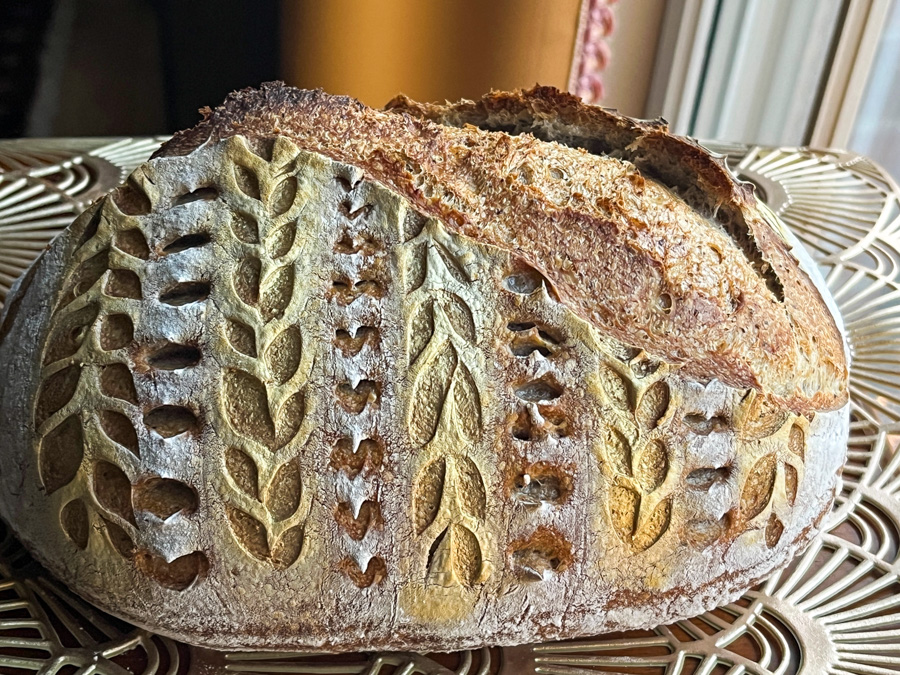
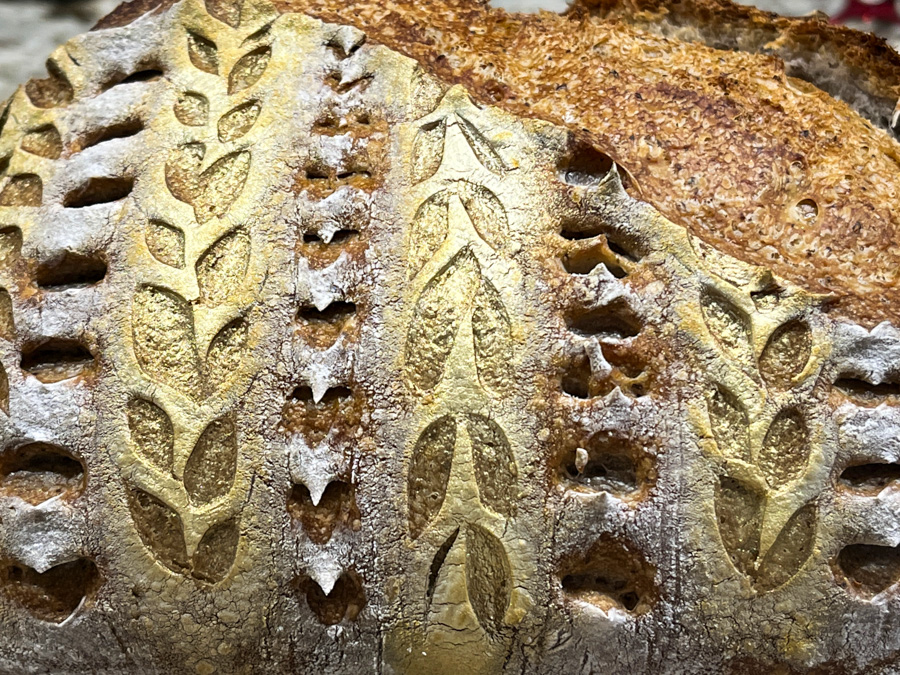
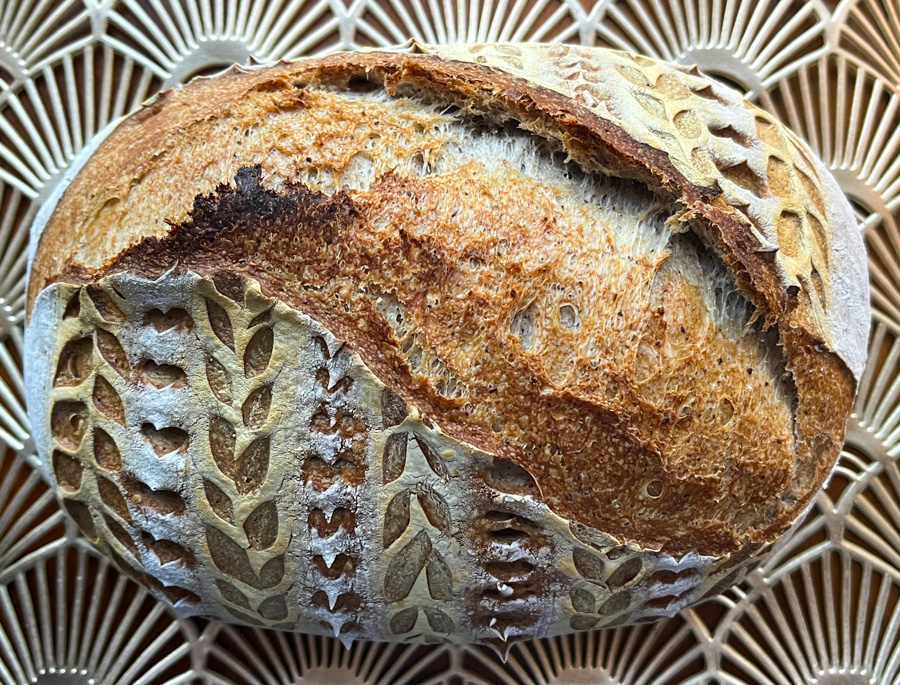
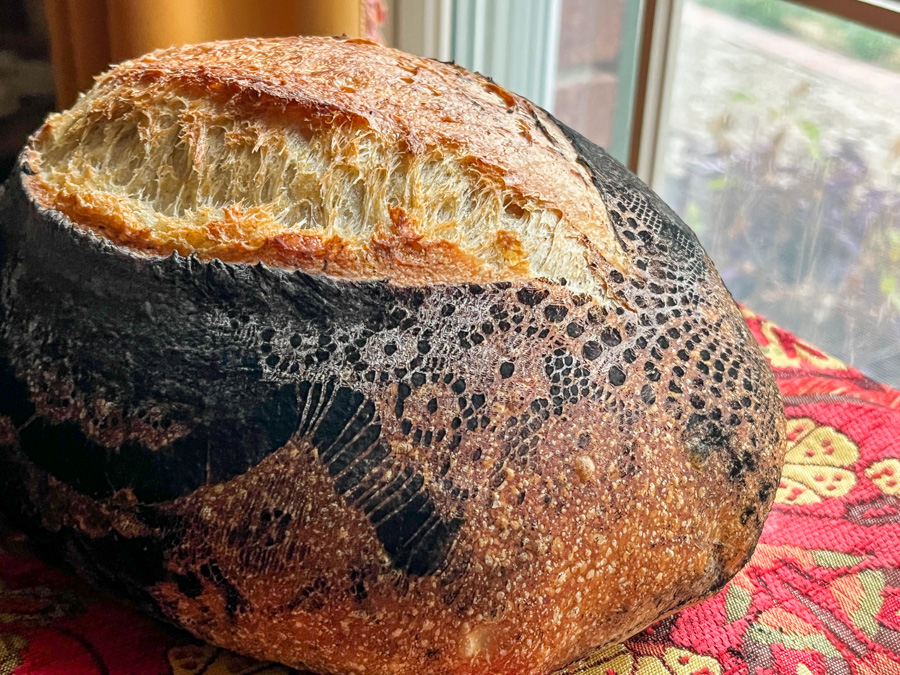
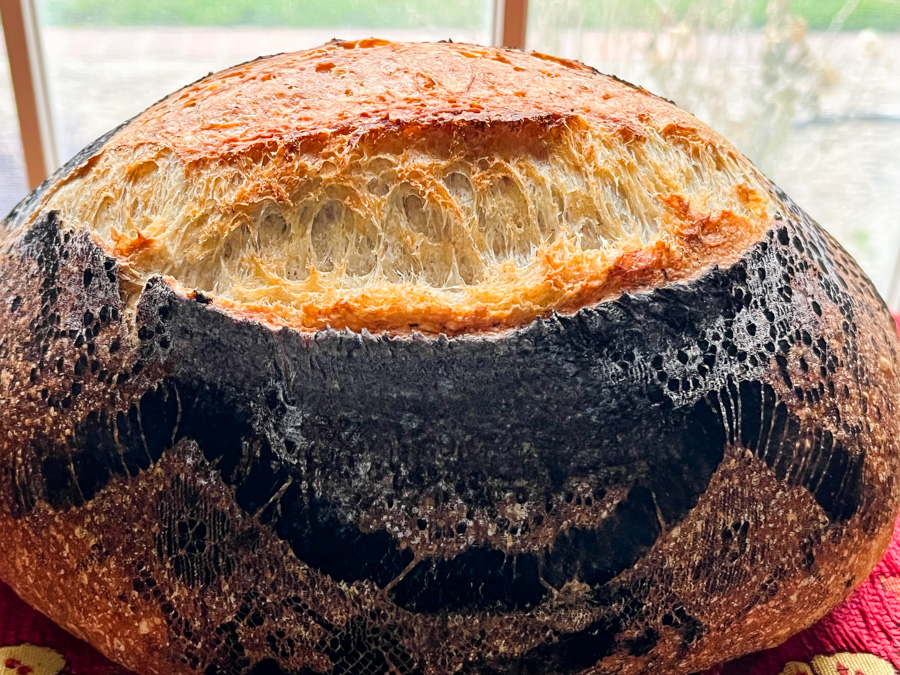
Friends, this has been a bit of an ordeal to get to work. The basic idea is to use lace and rub charcoal-activated powder on top of it to create a design. A few posts and reels on Instagram guided me, but it quickly became obvious that every single detail matters and can make or break the outcome. The variables are many: what kind of fabric, how open the design is, and most important, how to make the lace glue to the bread but not too much. I have not hit Nirvana yet, but with this third loaf, I feel good enough to share it with you. Stay tuned for future experiments in which I hope to get all the details optimized.

You can use any sourdough recipe you are fond of. For this particular loaf I used my basic formula described in this post, adding 1 tsp Garam Masala to the dough.

From what I saw in Instagram, the favorite method is to add the lace to the bottom of the banneton, leave it there overnight in the fridge for final fermentation, then rub charcoal, pull the lace and score the top, in a way that the design won’t be too compromised. When I did that, I had two different outcomes, none of them very nice. In the first, I rubbed too much flour over the surface of the dough, and that prevented the charcoal from staying well enough. The second time, I skipped the rubbing of white flour before inverting the dough on the lace, and that was a catastrophic move: the lace glued to the bread, and when I pulled it, it ripped the surface, ruined the design, it was a complete and utter mess.

This time I allowed the bread to sit in the fridge overnight in the banneton, inverted it over parchment paper, placed the lace on top and pressed it as best as I could. Next I added charcoal and rubbed it in. My mistake was to mist the surface with water, a bit too much water went on top, and made the charcoal sip underneath the lace. So the top did not reveal the design, and got way too dark. I think it is easy to fix next time, so I am sharing with you this version and maybe you can play with it and hit the jackpot on you first attempt! Go ahead, make me proud!

The bead had great oven spring, so if I had managed to get the design imprinted all over, it would have been pretty awesome… But, this is much better than my previous two attempts. My advice to you is, try this method if you like it, but don’t expect it to work on your first time, you might have to tweak things depending on the fabric you have, and the design itself. But no matter what, the bread underneath will always taste great, no major harm done if you don’t get it right. This is really a super fun technique and with a ton of possibilities…. Stay tuned for more soon!

ONE YEAR AGO: Incredibly Simple Carrots

TWO YEARS AGO: Sarah Bernhardt’s Cookies

THREE YEARS AGO: A Really Big Announcement

FOUR YEARS AGO: Stir-Fried Chicken in Sesame-Orange Sauce

FIVE YEARS AGO: Monday Blues

SIX YEARS AGO: A New Way to Roast Veggies

SEVEN YEARS AGO: Two Takes on Raspberries

EIGHT YEARS AGO: Spice Cake with Blackberry Puree

NINE YEARS AGO: Own Your Kitchen with Cappuccino Panna Cotta

TEN YEARS AGO: Chicken Parmigiana, the Thriller

ELEVEN YEARS AGO: Wild Mushroom Risotto

TWELVE YEARS AGO: Tartine Bread:  Basic Country Loaf 

THIRTEEN YEARS AGO:  Pugliese Bread

POILANE-STYLE BREAD, A SIMPLIFIED VERSION

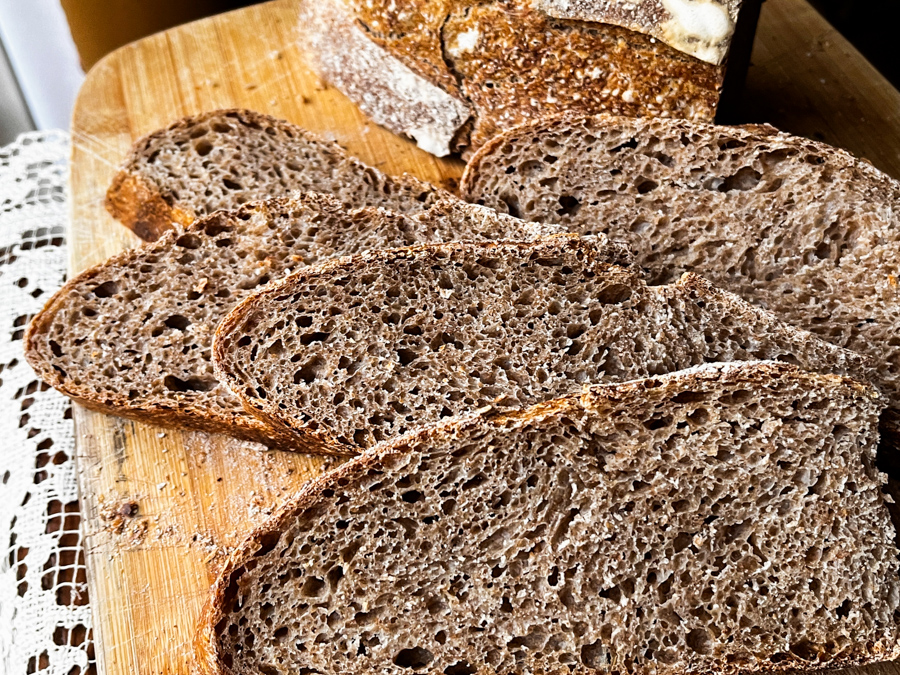
Pain Poilane might very well be one of the most famous breads made in France. The process to make it is convoluted and slow. The bread has a crumb that is not very open, with deep, complex flavor. All in all, a super hearty bread. I’ve made a few versions since I started playing with sourdough 15 years ago, but today I share one of the simplest ways, in which time does most of the work for you. Handling the dough is reduced to a bare minimum. If you are searching for a light tasting bread with very open crumb, this is not it. It is a superb bread to make Croque Monsieur or to enjoy with toppings such as smoked salmon or the very best ham you can find. 

POILANE-STYLE BREAD
(adapted from several sources)

for the fermented sourdough component:
200g water
120g sourdough starter (at 100% hydration)
240g whole-wheat flour

for the dough:
275g water
85g light rye flour
170g spelt flour
250g bread flour
12g salt

If you have a chance to turn your regular sourdough into a rye-based, you can do that by feeding it for about 3 days with rye flour instead of regular white flour. If you don’t have any, just use your regular sourdough.

In the evening, mix all the ingredients for the fermented component in a medium-size bowl. Leave it at room temperature for 12 hours. It won’t rise much, but you should notice fermentation next day.

On the morning of the next day add the water to your starter and mix well. Add all the flours and salt, and knead with the KitchenAid for about 3 minutes. Remove from the KitchenAid, place in a large bowl, and leave at room temperature for 90 minutes. Knead by hand for a couple of minutes at the 30 minute and 90 minute mark. Cover and place the dough in the fridge overnight.

Remove the cold dough from the fridge, form into a ball, and place in a lightly floured banneton, with the seam side up. Leave at room temperature for 5 to 6 hours. Heat the oven to 450F, invert the dough on parchment paper, score the surface and place in a Dutch oven, with the lid on. Bake for 30 minutes, remove the lid and bake for further 20 to 25 minutes.

Allow the bread to cool completely before slicing, preferably overnight.

ENJOY!

to print the recipe, click here

Comments: Contrary to regular sourdough, this version that contains so much whole-wheat and rye flour, is not appropriate to fold and stretch. It is – if I am to be honest – not very nice to handle. There is a harshness associated with the coarser nature of the whole-wheat component, which in this case is a pretty substantial part of the formula. So, instead of folding, I opted for minimal kneading, a technique Dan Lepard is quite fond of. It is actually the basis for all his breads in The Handmade Loaf, which was my personal introduction to sourdough baking. This bread turned out super flavorful! It was a huge hit with the husband, who already requested that slices of “Poilane” be found in the freezer at all times…

ONE YEAR AGO: Broccoli Salad with Pomegranate Seeds and Tahini Dressing

TWO YEARS AGO: Turkey-Spinach Meatballs with Cardamon-Tomato Sauce

THREE YEARS AGO: British Baps, a Technical Challenge

FOUR YEARS AGO: Japanese-Style Cupcakes with Cherry Blossom Icing

FIVE YEARS AGO: Quick Weeknight Soups

SIX YEARS AGO: Sourdough Loaf with Cranberries and Walnuts

SEVEN YEARS AGO: Sichuan Pork Stir-Fry in Garlic Sauce

EIGHT YEARS AGO: Our Green Trip to Colorado

NINE YEARS AGO: Ditalini Pasta Salad

TEN YEARS AGO: Celebrate Wednesday with a Thai Seafood Curry

ELEVEN YEARS AGO:  Post-workout Breakfast

TWELVE YEARS AGO: Semolina Barbecue Buns

THIRTEEN YEARS AGO: Lavash Crackers

FOR THE LOVE OF SOURDOUGH


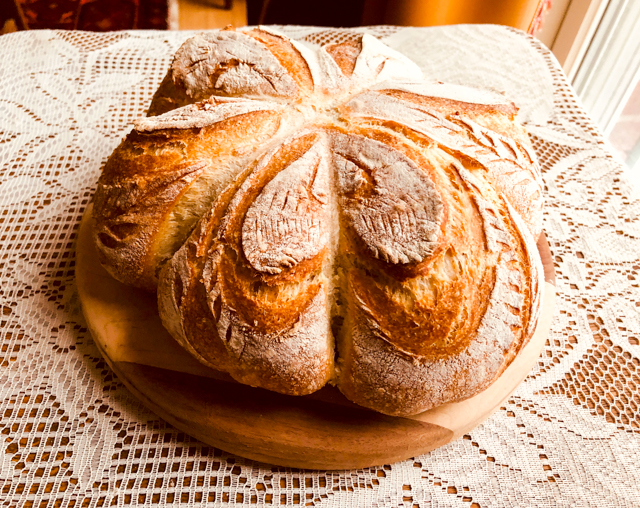
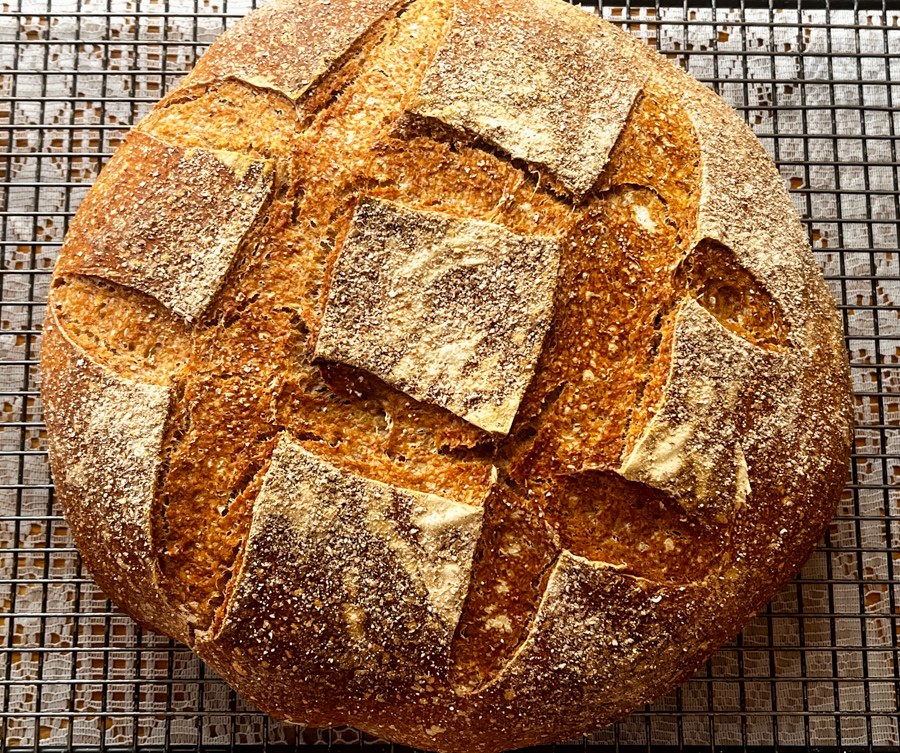
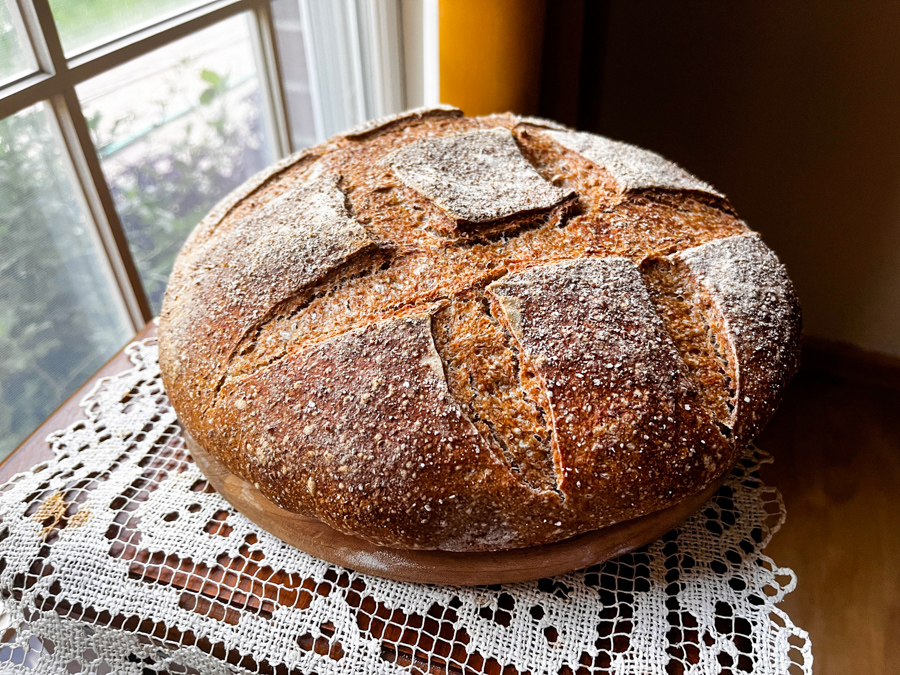
Playing with different scoring styles for sourdough… The only new recipe is Pecan Flour Sourdough (top left). I had a bag of pecan flour hanging around, and did a little sourdough experiment with it. Pecan flour brings flavor and some fat to the party, but no gluten, so it’s not a good idea to add too much to your basic bread formula. We loved the texture of the crumb, the delicate flavor, and the slight purple tone it contributed. The bread lasts longer at room temperature without drying. And of course, it freezes beautifully, like any sourdough does.


PECAN FLOUR SOURDOUGH
(from the Bewitching Kitchen)

480g bread flour
20g spelt flour
20g pecan flour
10g salt
370g water
80g sourdough starter at 100% hydration

Make the levain mixture about 6 hours before you plan to mix the dough. It should be very bubbly and active.

When you are ready to make the final dough, place the water in the bowl of a KitchenAid type mixer and dissolve the starter in it, mixing with a spatula briefly, then add the three types of flour, and the salt. Turn the mixer on with the hook attachment and knead the dough for 4 minutes at low-speed all the time. If the dough is too sticky, add 1/4 cup flour, you want the dough to start clearing the sides of the bowl, but still be sticky at the bottom.

Remove from the machine, and transfer to a container lightly coated with oil, cover lightly with plastic wrap and allow it to ferment for 4 hours, folding every 45 minutes or so. After four hours bulk fermentation, shape the dough as a ball, and place, seam side up, in a lightly floured banetton. Leave at room temperature one hour, and then place in the fridge overnight, from 8 to 12 hours.

Next morning, heat the oven to 450F. Invert the dough over parchment paper, sprinkle tapioca flour over it for a very light coverage. Next, use a brand new razor blade to score the design.

Bake at 450F for 45 minutes, preferably covered for the first 30 minutes to retain steam. Cool completely over a rack before slicing.

ENJOY!

to print the recipe, click here
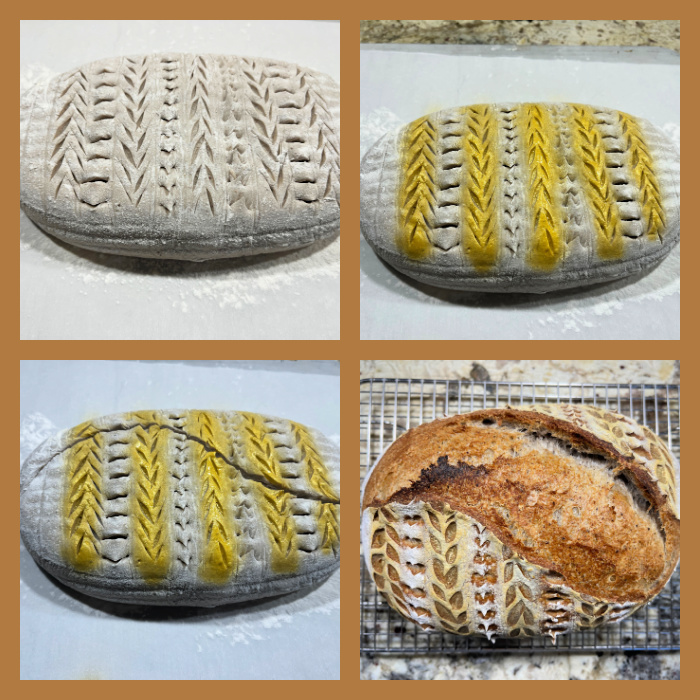

Comments: The picture did not really show the color too well. In real life, there was a very very light hint of purple. The bread is delicious, with a complex flavor, not clearly associated with pecans. I wanted to keep just the flour in this version, but adding pieces of toasted pecan to the formula will be happening in the future.


ONE YEAR AGO: Re-Visiting Hamburger Buns

TWO YEARS AGO: Nutella Time, one cookie, three decorations

THREE YEARS AGO: Marshmallow Macarons

FOUR YEARS AGO: Sprinkled Meringues

FIVE YEARS AGO: Incredibly Simple Times Three

SIX YEARS AGO: Dan Lepard Simple White Loaf

SEVEN YEARS AGO: Maureen’s Fabulously Fudgy Brownies

EIGHT YEARS AGO: Wheat Berry Caraway Bread

NINE YEARS AGO: Mexican Focaccia 

TEN YEARS AGOSunny Kamut Salad with Roasted Lemon Vinaigrette

ELEVEN YEARS AGO: Pane de Casa & Crostini

TWELVE YEARS AGO: Down-home Dig-in Chili

THIRTEEN YEARS AGO:  Cinnamon Rolls

KAREN’S BRAIDED LEMON BREAD WITH BLACKBERRIES

She posted. I read the post while away on a trip. Could not wait to get home to bake it. As far as enriched bread goes, you cannot get much better than this. Think brioche loaded with a tangy lemon cream and luscious blackberries. As I said, cannot get much better. THANK YOU, KAREN!

BRAIDED LEMON BREAD WITH BLACKBERRIES
(from Karen’s Kitchen Stories)


For the Sponge:
3 ounces warm water (95 to 105 degrees F)
1 teaspoon sugar
1 1/2 teaspoons instant yeast
30 grams unbleached all purpose flour

For the Final Dough:
All of the sponge
85 grams vanilla yogurt, room temperature (I used plain and added 1/2 tsp vanilla)
56 grams softened unsalted butter
1 large egg, beaten
50 grams sugar
1 teaspoon salt
1 teaspoon vanilla
300 grams unbleached all purpose flour
one beaten egg for the egg wash
pearl sugar for topping (optional, but nice)

For the Filling:
85 grams cream cheese, at room temperature
25 gram sugar
29 grams sour cream (I used creme fraiche)
1 tsp lemon juice
15 grams all-purpose flour
100 grams lemon curd
Handful of blackberries


Combine the sponge ingredients in a small bowl, stir, and cover with plastic wrap. Let it sit for 15 minutes.
In your stand mixer bowl, combine the sponge, yogurt, butter, egg, sugar, salt, vanilla, and flour. Mix with the dough hook for about 8 minutes. Place the dough in an oiled dough rising bucket or bowl, cover, and allow to rise for one to two hours, until doubled (mine took 2 hours and 30 minutes).

Mix the cream cheese, sugar, sour cream, lemon juice, and flour until smooth. Cover and set aside.
Line a cookie sheet with parchment paper. Place the risen dough not the parchment, and press or roll it into a 10 inch by 15 inch rectangle. Mark the dough lengthwise into thirds by pressing a ruler into the dough. Spread the cream cheese mixture onto the middle third, leaving about an inch uncovered at the top and the bottom. Spread the lemon curd on top of the cream cheese mixture. Top with the blackberries.

Cut the outer sides into strips. Cut off the strips from the four “corners” of the dough, leaving a flap at the top and bottom. Fold up the bottom flap and fold the strips over the filling alternating in a braid pattern. Fold the flap over the top before finishing the braid. Cover loosely with oiled plastic wrap.
Preheat the oven to 360 degrees F.


Let the dough rise for about 45 minutes. When the dough is ready, brush it with the egg wash and sprinkle it with the sugar. Bake for 25 to 30 minutes until a deep golden brown. Cool on a cooling rack for at least 20 minutes. Slice and serve.

ENJOY!

to print the recipe, click here

Comments: Make sure to stop by Karen’s post because her pictures and explanations are very detailed and will help you with the shaping. The dough is a pleasure to work with, as enriched doughs always seem to be. You can make the filling while the dough rises, and use store-bought lemon curd to make your life easier. Next time I will add more blackberries, I was afraid they would contribute too much moisture and leak too much, but that was not the case.

This basic method can be used for savory breads, or use different sweet fillings. Karen has a lot of suggestions in her article, so pay her a visit.

ONE YEAR AGO: Bulgur-Pork Tomatillo Platter

TWO YEARS AGO: Baking through the blogosphere

THREE YEARS AGO: Chickpea Burgers, Vegan and Delicious

FOUR YEARS AGO: Macarons with Ganache Noisette

FIVE YEARS AGO: Quiche with Asparagus and Fennel

SIX YEARS AGO: Fakebouleh

SEVEN YEARS AGO: Yellow Squash Soup

EIGHT YEARS AGO: Grilled Chicken with Tamarind and Coconut Glaze

NINE YEARS AGO: Chicken-Apricot Skewers

TEN YEARS AGO:  Asparagus Quiche

ELEVEN YEARS AGO: Two-stage Pea and Prosciutto Risotto

TWELVE YEARS AGO: Mellow Bakers: Corn Bread

PAINTED SOURDOUGH

I consider this bread a work in progress, as the color is fading a bit during baking. Sugarprism stays very well on cookies (as I showed in the first cookie from this post), but I suppose 450F is a different story. However, this was only my second time doing it, and I already saw some improvement from the first attempt. Any sourdough recipe you are fond of will work. I opted for Elaine’s Herb and Olive Oil Sourdough, which I used as a teaser recipe in my recent review of her wonderful book (click here to read it, in case you’ve missed it). I like the way the olive oil in the dough seemed to tame a bit the crust explosion, and that worked well to keep the design untouched.

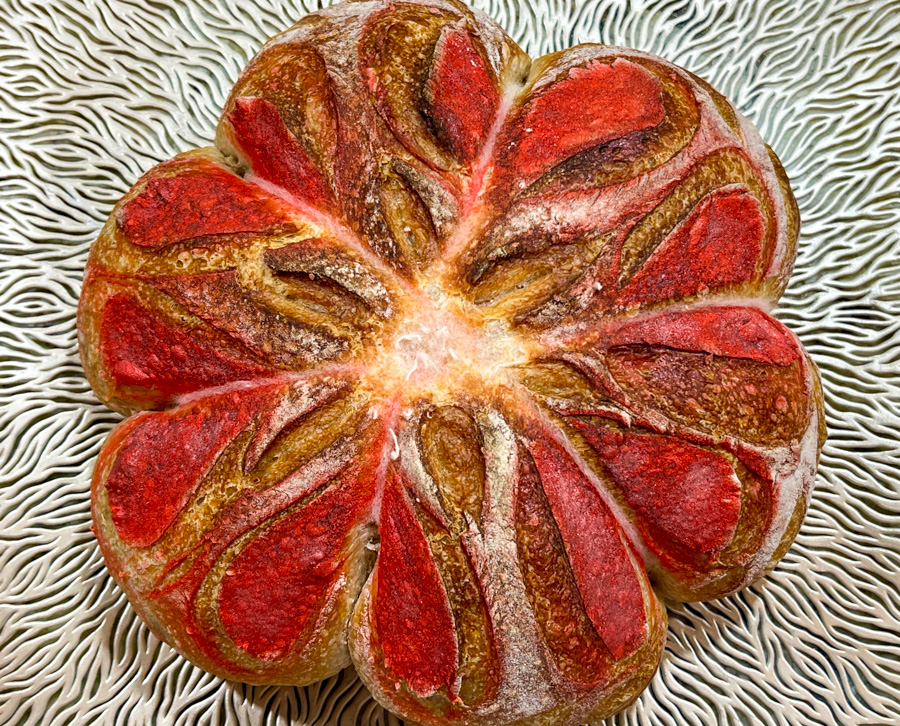
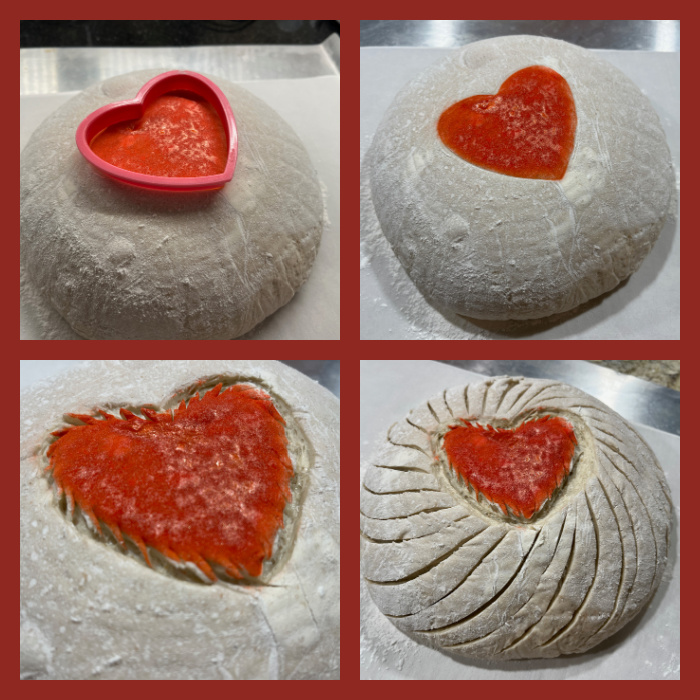
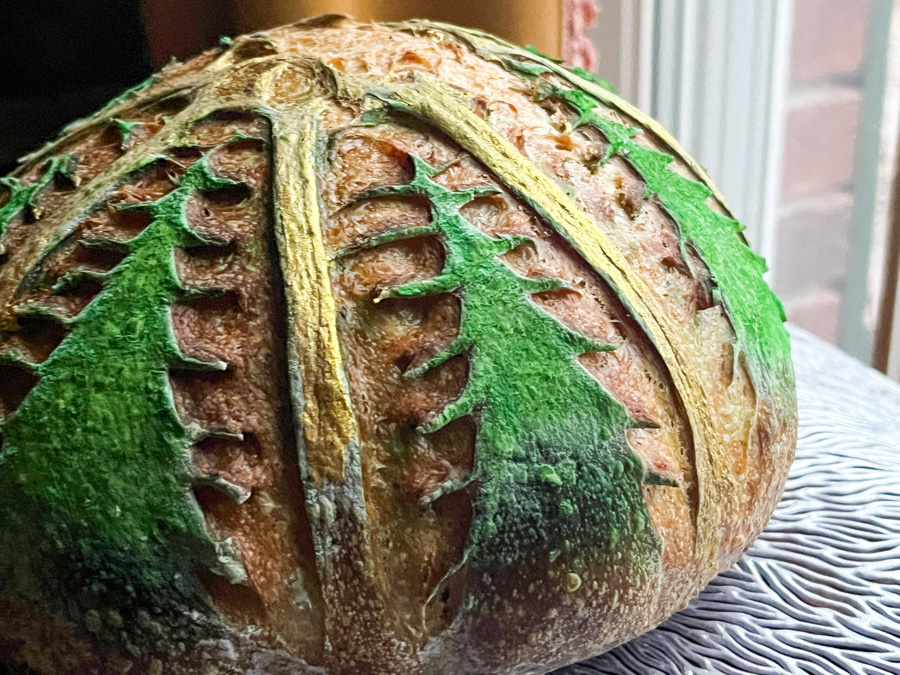
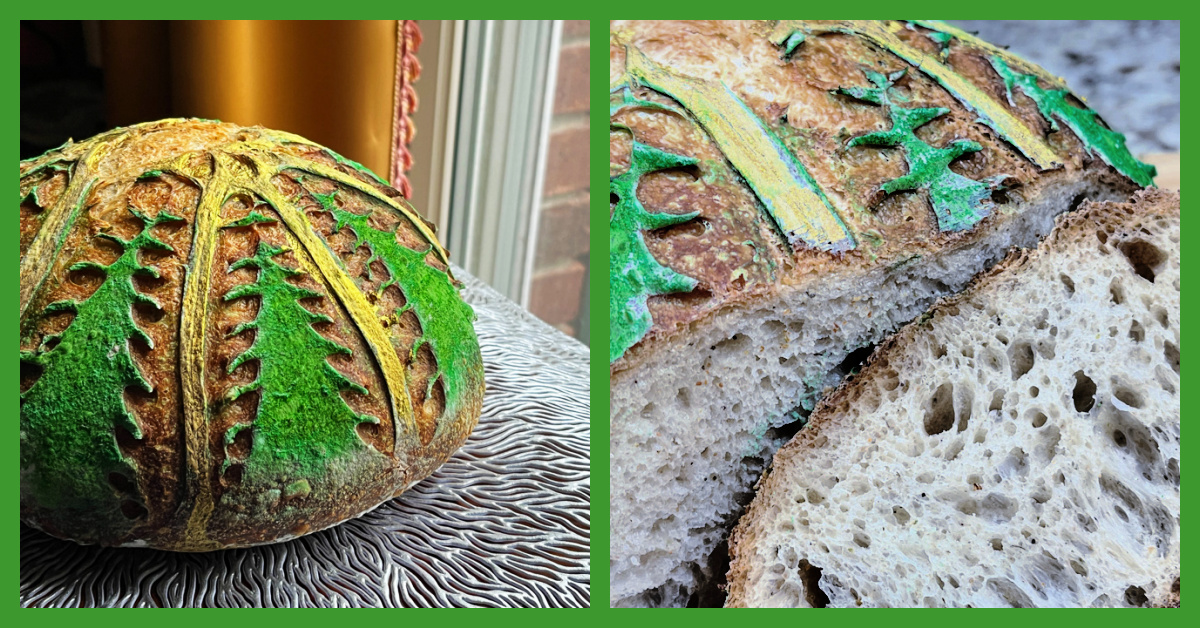
Basic things to consider when painting… minimize the amount of flour on the surface. When we do stenciling or even artistic slashing, a coating with flour is super important. In painting the dough, it makes things difficult and interferes negatively with the color. In today’s bread, for the outline I used black cocoa diluted with water. For the petals, Sugarprism in yellow and red. For the center of the sunflower, bronze luster powder diluted with vodka. As you can see, from the before pictures the bronze luster powder was the champion as far as keeping the color during baking. Black cocoa will always stay well, but if your goal is color, that cannot really help you much…

Just in case you are curious, below you see my first attempt painting sourdough. Two small issues happened: the dough had so much oven-spring that it lifted the design in ways that were not ideal. And I coated the surface with flour, which made the Sugarprism color interact with it and fade even more. The flour also gave a rough texture that made it impossible to spread the color nicely with a brush. In this case, I re-painted the bread the moment it came out of the oven to bring the color back. But my goal is to not have to do that, and get some method that retains the color during baking. Stay tuned then for my next adventure, in which I will use exclusively luster powder + vodka, hoping for a happy, very colorful ending…

ONE YEAR AGO: Over-the-Moon Blueberry Lemon Macarons

TWO YEARS AGO: Springtime Macarons Bake-Along

THREE YEARS AGO: Macarons for a Little Princess

FOUR YEARS AGO: Gilding the Sourdough Loaf

FIVE YEARS AGO: Lolita Joins the Bewitching Kitchen

SIX YEARS AGO: Cashew Cream Sauce

SEVEN YEARS AGO: Blood Orange Margaritas

EIGHT YEARS AGO: Smoked Salmon Appetizer

NINE YEARS AGO: Clementine Cake

TEN YEARS AGO: Springtime Spinach Risotto

ELEVEN YEARS AGO: The end of green bean cruelty

TWELVE YEARS AGO: Torta di Limone e Mandorle