COOKIES FOR THE HOLIDAYS: MACARONS

I admit that macarons per se might not be firmly associated with the holiday season, but one of the things I love about them is their versatility. Like fantastic actors, they can play any part, as long as you dress them properly. Today I share six versions with a festive winter aura.

BASIC MACARON RECIPE CAN BE FOUND IN THIS POST
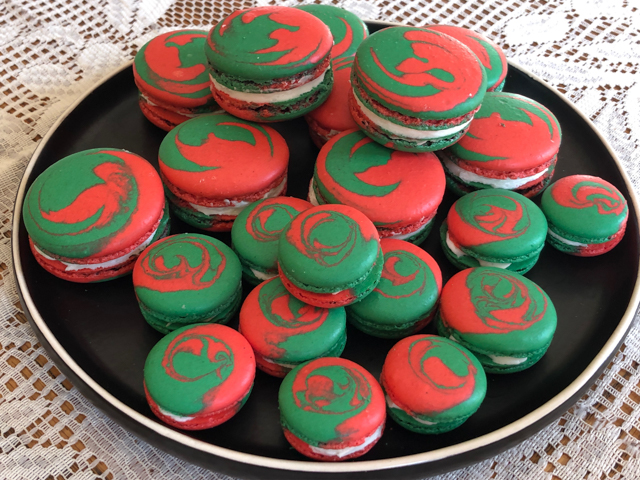
YIN & YANG PEPPERMINT MACARONS
(from the Bewitching Kitchen)

1 recipe from basic method, divided in two

For filling:
160g powdered sugar
57g unsalted butter, softened (4 tablespoons)
1 teaspoon peppermint extract
pinch of salt
heavy cream or milk to adjust consistency, if needed

When your macaron batter is starting to get homogeneous, divide it in two portions, dye one green and one red, and proceed to the end of macaronage. Place each batter in a separate piping bag, and then cut the tips and side them side by side into another bag (if you have two sizes, it is a good idea to use two smaller bags inside the larger one, but it is totally doable with bags of the same size).

Pipe shells and bake as specified in the recipe.

For the filling, use a hand-held electric mixer and whisk the butter until creamy. Add the powdered sugar, peppermint extract and salt. Whisk in low-speed at first, the increase speed and whisk until creamy and smooth. If needed, add a very small amount of milk or heavy cream.

Pipe the filling in shells, close them, and leave in fridge overnight to mature.

ENJOY!

to print the recipe, click here
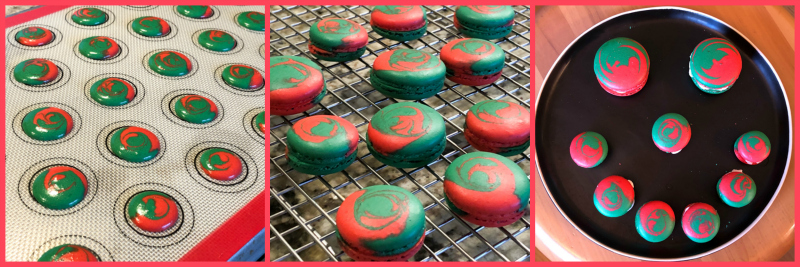
Comments: The amount of peppermint extract to use will depend on the brand you use, how strong it is, and of course, your personal taste. Next time I make them, I will include some crushed peppermint candy. I did not have any around at the time, and we are pretty strict with our rules. Grocery store twice a week, with a list in hand, in and out quickly. So I really did not want to break the rules to go get the candy. Instead, the macs were kept simple. As to the yin-yang design, you do need the batters in two separate bags, otherwise they mix too much during piping. The effect is also nice, but will be less dramatic.
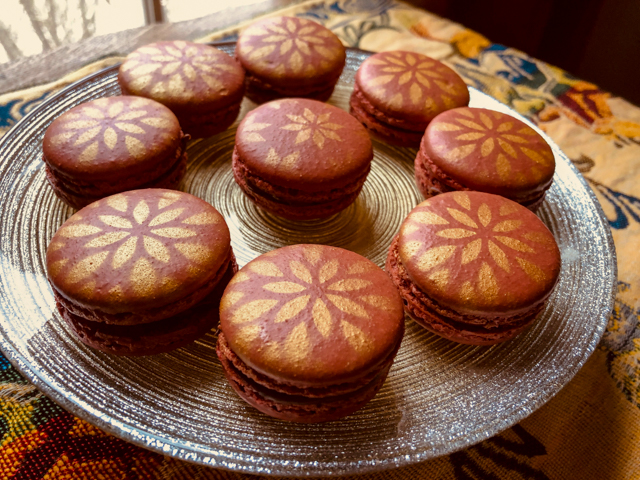
CARDAMON-GANACHE MACARONS
(from the Bewitching Kitchen)

1 recipe from basic method

for the filling:
100g heavy cream
100g milk chocolate
4 cardamon pods
10g butter)

Make the macaron batter dyed with a dark caramel color (I used Progel Chestnut). When shells are cold, decorate with air-brush using gold color and any stencil you like.

For the filling, heat the cream with cardamon pods, crushed. When almost boiling, close the pan and let it sit for 30 minutes. Pass the cream through a sieve to remove the cardamon, weigh the cream, adjust back to 100g, and heat to almost boiling then pour over the chocolate cut in small pieces. Let it sit for 5 minutes then whisk gently to dissolve the chocolate. Add the softened butter and whisk until smooth.

Let the ganache sit at room temperature until it reaches a consistency appropriate for piping. You can also whip the ganache if you like it to have more body, but don’t overdo it or it might get grainy.

Fill shells and let the macarons sit in the fridge overnight before serving.

ENJOY!

to print the recipe, click here

I adore cardamon, and made this ganache twice already. On my second time I added ground cardamon together with the pods, and used them to fill shortbread-type cookies. It was very very good.

SNOWFLAKE BLACK WALNUT MACARONS
(from the Bewitching Kitchen)

1 recipe from basic method

for the filling:
4 ounces cream cheese (half a regular package), softened
57g butter, room temperature
1/4 teaspoon black walnut extract
1/4 tsp cinnamon
1/8 tsp cloves
pinch of salt
225 g powdered sugar
1/4 cup ground Black Walnuts, lightly toasted

Add the cream cheese, butter and black walnut extract to a bowl and beat until very smooth with an electric hand-held mixer. Add cinnamon, cloves, and pinch of salt, then slowly add powdered sugar,  whisk until smooth and fluffy. Fold in the black walnuts.

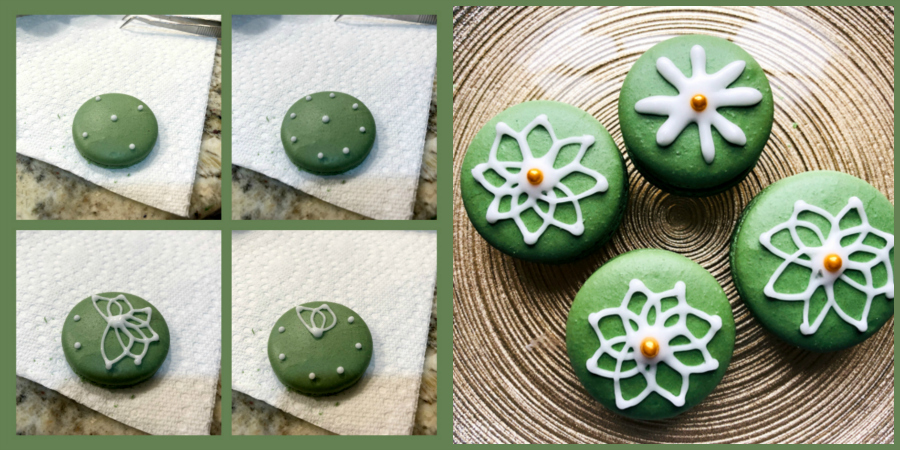
Fill the shells. If desired, decorate the top with royal icing to make patterns of snowflakes, or any other pattern you like.

ENJOY!

to print the recipe, click here

Comments: Snowflakes are everywhere in cookie decoration these days, and of course, it’s the perfect time of the year to showcase them. They are easy to draw, just 4 straight lines criss-crossed, and then go crazy with the little details. I’ve been practicing with tip-less bags, but for these drawings I found it easier to couple the bag with a very fine tip, number 1 from Wilton.

But you can also do other styles of piping like this little rosette. Just mark the center, 8 points around it, take a deep breath and pipe!
The black walnut filling was featured in the blog back in July, but this time I added cinnamon and cloves, inspired by Phil’s family recipe for “Cottage Cookies” which I must make to share with you at some point. In fact, he was surprised that it is not yet in the blog.

ORANGE AND CRANBERRY MACARONS
(from the Bewitching Kitchen)

1 recipe from basic method

For filling:
160g powdered sugar
57g unsalted butter, softened (4 tablespoons)
1/2 teaspoon orange extract extract
zest of half a large orange
pinch of salt
heavy cream or milk to adjust consistency, if needed
cranberry relish or jam (I used store-bought)

Make the macarons using orange gel food color.

For the filling, use a hand-held electric mixer and whisk the butter until creamy. Add the powdered sugar, orange extract, zest and salt. Whisk in low-speed at first, the increase speed and whisk until creamy and smooth. If needed, add a very small amount of milk or heavy cream.

Fill shells with a small dollop of cranberry jam in the center, surround it with a circle of orange buttercream. Decorate with Royal icing or air brushing, if so desired.

Leave macarons in fridge overnight to mature.

ENJOY!

to print the recipe, click here

For these macarons, I used two different styles of decoration, one with Royal icing concentric swirl, and another in which I sprayed the two sides of the shells with coral and orange dyes, trying to mimic the colors associated with the two flavors. Some candy melt drizzle and sprinkles for good measure…

I loved this combination of flavors, cranberry and orange is a real classic, so I highly recommend you try this one.

EGGNOG MACARONS
(filling from The Jam Lab)

1 recipe from basic method

For the filling:
4 tbsp unsalted butter, room temperature
½ teaspoon salt
½ teaspoon freshly grated nutmeg
2 tablespoons rum extract (or rum if you don’t mind the alcohol)
2 tablespoons heavy cream
3 ½ cups to 4 cups powdered sugar

Make macaron shells and dye with green gel color.

For the filling, use a hand-held electric mixer and whisk the butter until creamy. Add the powdered sugar, salt, spices and flavoring. Whisk in low-speed at first, the increase speed and whisk until creamy and smooth. Add heavy cream until the consistency is right for piping. Assemble shells with the filling, if desired you can air-brush with gold details using a stencil.

Keep the macarons in the fridge overnight before serving.

ENJOY!

to print the recipe, click here

Comments: Most recipes that call for eggnog use “the real thing” added to buttercream. We don’t drink eggnog, so I did not want to buy a big carton that would sit in the fridge. This recipe from JamLab is perfect. I used rum extract because my macarons are donated and alcohol is not allowed. If you want to do as I did, I recommend this extract.

GINGERBREAD MACARONS
(filling from Pies and Tacos)

for the filling:
160g powdered sugar
57g unsalted butter, softened
1/2 teaspoon vanilla extract
1 teaspoon molasses
1/4 teaspoon ground ginger
1/4 teaspoon ground cinnamon
1/4 teaspoon nutmeg
milk or heavy cream if needed

Make the shells and use a caramel food dye to color the batter.

For the filling, cream butter using a hand-held electric mixer until very creamy. Add the sugar, spices and flavoring, keep whisking at low-speed at first, then increase the speed. If needed, adjust consistency with heavy cream or milk.

Pipe filling on shells, and decorate with a band of gold luster. Stick little gingerbread-shaped sprinkles using small dots of royal icing. Leave macarons in the fridge overnight before serving.

ENJOY!

to print the recipe, click here

Comments: I loved the flavor of this filling. As to the decoration, I quickly realized that even if the gingerbread men looked quite cute on the shell, glueing them did not bring me joy. They are so delicate, and it was quite labor-intensive to adjust them with tweezers on top of the icing. I made a few and then switched to plan B. There is a limit to my Zen.

Of all the macarons from this post, the one that got the highest praise was…… drum roll…. drum roll….. the EGGNOG! I was surprised by how many of the testers said it was maybe the best ever from all the ones I’ve shared over the past few months.

I hope you enjoyed this series, featuring one of the concoctions I love to bake the most… Stay tuned for the final post on Holiday Cookies, in which I’ll feature Springerle.

ONE YEAR AGO: The Great American Baking Show

TWO YEARS AGO: Broccoli Souffle

THREE YEARS AGO: Panettone Time!

FOUR YEARS AGO: How the Mighty Have Fallen

FIVE YEARS AGO: Festive Night at Central

SIX YEAR AGO: The Perfect Boiled Egg

SEVEN YEARS AGO: Light Rye Sourdough with Cumin and Orange

EIGHT YEARS AGO: Homemade Calzones

NINE YEARS AGO: Plum-Glazed Duck Breasts

TEN YEARS AGO: Holiday Double-Decker

ELEVEN YEARS AGO: New York Deli Rye


SUGAR COOKIES FOR THE HOLIDAYS

Until my participation in a certain show, I was not too wild about decorating sugar cookies with Royal icing. Indeed, in the comfort of my kitchen I would always refer to that white, impossible to tame substance as Royal Pain in the Icing, which indicates how I felt about it. But those intense weeks of preparation for the different episodes of the show forced me into areas of baking I had happily ignored and avoided. Much to my own amazement, I now love everything about cookie decorating, from baking the base to planning the design and trying to make it happen. On that note, I highly recommend that you go through my trilogy of posts on the subject from last month and the detailed tutorials by Tanya which I shared at the time. For all the holiday cookies in this post, I went with a flavor that is deeply ingrained in the season: Fiori di Sicilia, the Italian magical potion that is the classic addition to panettone. As to the decorations, apart from the wet-on-wet which I find the most user-friendly, I will share three methods that were new to me, requiring just a tad more involvement: Crackled Gold Christmas Tree, Reindeer (a clever twist starting from a common cookie cutter), and Stained-Glass Cookies.

FIORI DI SICILIA SUGAR COOKIES
(from the Bewitching Kitchen)

360 g all-purpose flour (3 cups)
2 teaspoons baking powder
200 g granulated sugar
¼ tsp salt
227 g cup butter, cold and cut in pieces
1 egg
3/4 tsp Fiori di Sicilia extract
zest of 1 lemon
¼ tsp cardamom

Heat oven to 350F. Combine the flour, baking powder and salt, set aside. Cream the sugar and butter. Add the egg, Fiori di Sicilia, lemon zest and cardamom, mix well. Scrape the sides of the bowl. Add the flour mixture in two steps, and beat just until combined.

Dough can be rolled right away in between sheets of parchment paper. Roll to about 1/4″ thick, and cut into shapes. Place on parchment-lined baking sheets, freeze for 10 minutes. Bake for about 12 minutes. Transfer to cooling rack and cool to room temperature before icing.

(for Royal Icing, I used Tanya’s recipe, which you can find here)

ENJOY!

to print the recipe, click here

Comments: This is definitely my default recipe for sugar cookies because I adore Fiori di Sicilia and I do flips for cardamon. As far as extracts go, Fiori di Sicilia is not cheap, but it is hard to replace with something else. Some say that orange extract + vanilla does a good enough job playing its part. Your kitchen, your rules, feel free to flavor your cookies the way you like. Just make sure not to roll the cookies too thin. Thin sugar cookies don’t stand up to the icing.

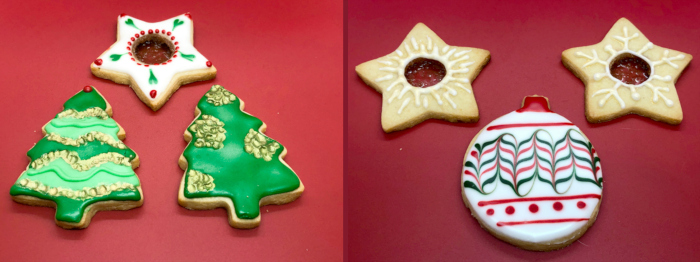
With the basic Christmas colors (red and green, plus white for flooding) you can do a lot…

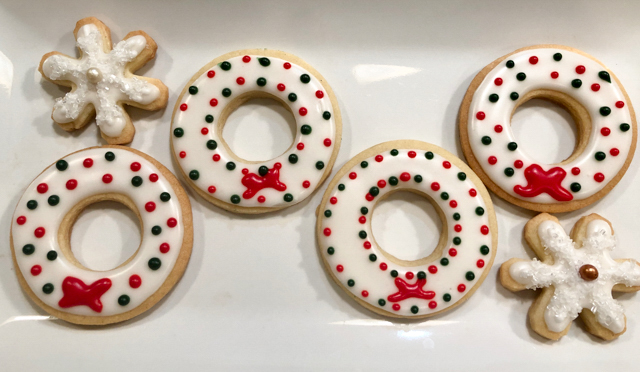
I used two cookie cutters, one for the basic shape, a smaller to cut a circle in the center, turning it into a wreath. From there, nothing fancy. Flooded with white, allowed to set for just 10 minutes and then a few green and red dots added on top. The little bow added in the very end. Yes, I realize that could be a lot better, and I intend to work on it.

A new cookie cutter I got this year stole my heart. I find it so cute and a bit unusual. A Christmas light bulb, which once again can be made quite simply with only two colors of icing and if you like to gild the lily, some luster gold painted on the “metal” part next day.

By bringing one more color – black – you can expand a bit more the horizons, so that Mr. Snowman has a nice hat and black, profound eyes. The baby deer are also super easy, flooding with white, waiting until it sets a bit and piping the details. The little snowflakes were flooded with white and immediately showered with white sparkling sugar. And one day I will understand why I seem to always type “spanking” sugar before getting it correctly (sigh).

And since there was black Royal Icing around… why not immortalize one of our faithful companions, who has been with us every step of the way in this crazy year? The black dots were placed before the white set (wet-on-wet), then the nose and the red collar were added later, just to have a bit of a 3D effect. Same process went into the snowflakes.

Holiday Baking is not complete without Christmas Trees…

Some of the designs were again wet-on-wet, but then I did something new that blew my little mind when I saw it on a tutorial on youtube. A technique called “Crackled Gold” and you can visualize better in this picture:

It is so cool, I cannot quite believe how creative people can be, figuring these little tricks. What you do is flood the cookie with the base color and wait until it starts to crust. Average will be 15 minutes. Then you use the handle of a painting brush, or what I used: a fondant ball-shaper. I have a set of several sizes and picked one to make the indentations that seemed most appropriate for the size of the tree. Press the ball gently to make a mark on the icing. Let it dry completely and if desired you can add details with gold luster. Or you can leave it without the gold accent, for a simpler look.

To see exactly how that is made, you can check the wonderful tutorial by The Graceful Baker in youtube clicking here. The “crackled gold” starts at 33 min and 10 sec. I already anticipate the same approach in other styles, like crackled heart shapes for Valentine’s…. Wouldn’t that be awesome?

Moving on…. another technique I learned from Stephanie on youtube, and you absolutely MUST check her site. What I loved about this one is the clever use of a cookie cutter that most people have in their little treasure box: a gingerbread man, any size will do. If you turn it upside down you can use it to make a Reindeer!

Am I adorable or what?

I swear, I love this little guy! I admit his ears ended a bit pathetic, and if you watch her video you’ll realize I forgot to add the hair on top of his cute head, but overall I am thrilled with the way he turned out. I will make some more again in the near future, hoping to do a better job.

The final details (eyebrows and smile) are made with a very fine food pen but if you can also try royal icing, I don’t dare going for such fine details using it. Poor Reindeer, he would look like roadkill.

Please make sure you visit Little Cookie co. youtube channel. I already have three different techniques on my list of projects to try soon, in fact it is quite likely that by the time you read this I will be already working on one of them….

And finally… a technique I’ve been flirting with for the longest time: Stained Glass Window Cookies. First time I did it, I was not very happy with the outcome. I liked the overall design but the stained component was not as I expected.

To have the stained glass effect, many recipes will tell you to simply crush hard candy in the color you want and make a little pile in the cut out part right before you bake. I found it hard to time the full melting of the candy with the cookie baking, and also the candy shrinks quite a bit and gets cloudy. Just not the type of effect I had in mind. I consulted with Tanya about it, and she advised me to use a totally different method, her favorite. Essentially you make the sugar syrup yourself, dye any color you want or leave it plain, and spoon it gently in the cut out part after the cookies are already baked. The result is so much better! Nothing like getting advice from a pro…

Here is the recipe I used, it makes enough for many many cookies, but it is hard to scale it down, so I advise you to keep the amounts as written.

SYRUP FOR STAINED GLASS COOKIES
(from The Honey Blonde)

100g sugar (1/2 cup)
3 tablespoons corn syrup
1/4 cup water
gel food color, if desired

Combine sugar, corn syrup, and water into a small sauce pan. Place over medium high heat and bring to a boil. Do not stir sugar while boiling. Continue to boil until mixture reaches about 290-300 degrees. Remove from heat and gently stir gel food color.

Place the cookies on a foil lined baking sheet lightly sprayed with oil, or use a non-stick foil. Spoon the candy into the center of the cookie, using the spoon the spread the candy into the edges of the cut out region.

Let set for about 10 minutes, or until candy is completely hardened.

ENJOY!

to print the recipe, click here

I hope you enjoyed this little collection of Holiday-inspired sugar cookies. Next I will share macaron ideas also inspired by this festive season. Stay tuned!

ONE YEAR AGO: Just a few hours to go!

TWO YEARS AGO: Broccoli Souffle

THREE YEARS AGO: Panettone Time!

FOUR YEARS AGO: How the Mighty Have Fallen

FIVE YEARS AGO: Festive Night at Central

SIX YEAR AGO: The Perfect Boiled Egg

SEVEN YEARS AGO: Light Rye Sourdough with Cumin and Orange

EIGHT YEARS AGO: Homemade Calzones

NINE YEARS AGO: Plum-Glazed Duck Breasts

TEN YEARS AGO: Holiday Double-Decker

ELEVEN YEARS AGO: New York Deli Rye
COOKIES FOR THE HOLIDAYS: GINGERBREAD

December. This is the time for baking cookies in all shapes and forms, but some are definitely more strongly associated with the holiday spirit. This posts opens a series of four chapters. I start with gingerbread, using a recipe from Tanya, tent-baker extraordinaire, aka The Gingerbread Queen. Subsequent posts will cover Sugar Cookies, Macarons, and Springerle. Gingerbread Cookies are not too hard as far as baking project goes, as long as you keep them as cookies instead of components of 3D sculptures (sigh). Because their flavor is so intense, they can be enjoyed with no decoration whatsoever, or with a very simple white Royal icing. So simple that you can even get by using a tip-less piping bag. And of course, sprinkles are always welcome. Always.

GINGERBREAD COOKIES
(very slightly modified from Tanya’s blog)

640 grams all-purpose flour
3 teaspoons ground ginger
1 + 1/2 teaspoons ground cinnamon
1 teaspoon allspice
1/4 teaspoon cloves
1 teaspoon baking soda
1/2 teaspoon salt
226 grams unsalted butter, at room temp
200 grams granulated sugar
Zest of 1 orange
1 large egg, at room temperature
120 mL (1/2 cup) honey
120 mL (1/2 cup) molasses
2 Tablespoons distilled white vinegar

Whisk together the flour, spices, baking soda, and salt in a large bowl. Set aside. In the bowl of stand mixer add the sugar with the orange zest and rub them well with your fingers, until fragrant. Add the butter, fit the machine with the paddle attachment and mix until well combined. Add the egg and beat on medium-high speed until light and fluffy. Scrape down the sides of the bowl at least twice during mixing. Add the molasses, honey, and vinegar and mix well.

Turn off the mixer and add about half of the dry ingredients. Mix on low just to combine. Add the rest of the dry ingredients and mix just until combined. Gather the dough together into a ball and then flatten the dough into two disks. Wrap each disk in plastic and refrigerate for about 3 hours or until firm enough to roll without sticking.

Heat the oven to 375°F. Line cookie sheets with parchment paper or silicone baking mats.
Roll the dough on a lightly floured surface to a 3/16-inch thickness. Cut out shapes, carefully transfer the cookies to the prepared cookie sheets and freeze for 5 minutes.

Bake until the cookies are firm to the touch and lightly browned around the edges. A three-inch round cookie will take about 8 to 10 minutes. Cool completely before frosting and/or assembling with royal icing.

ENJOY!

to print the recipe, click here

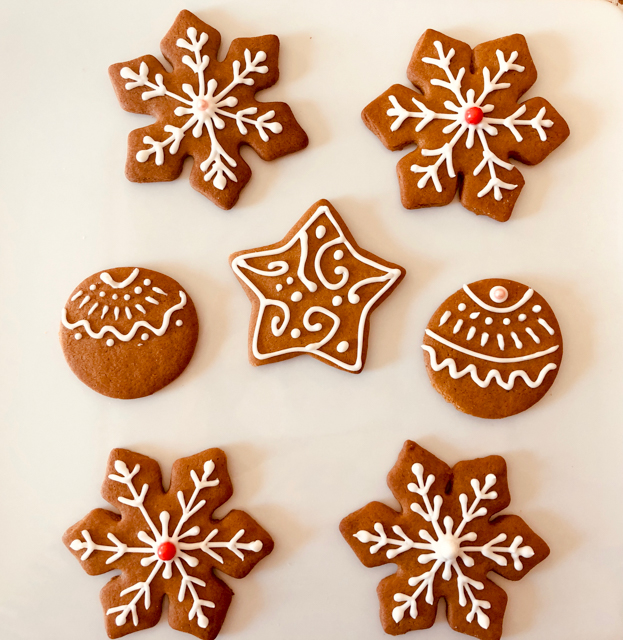
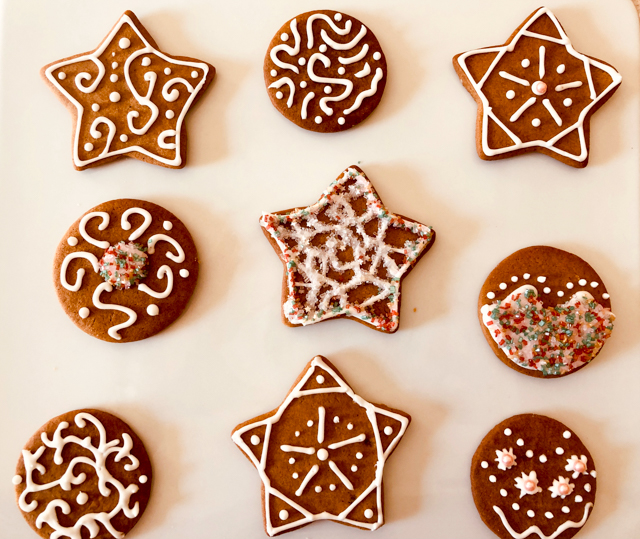
For most of my decorations, I used Tanya’s recipe for Royal Icing with very little water added. For gingerbread, I prefer not to fully cover the cookie, so instead of flooding them, I piped shapes and wanted them to stay firmly in place.

You can keep it all super simple….

or… while keeping it simple couple the design with some gold for a festive twist

The star was left fully white, the others were painted with gold luster diluted with lemon extract. It is a bit hard to see it in the middle ones, because the gold was just applied on the white decorations.

Even if I rather not completely cover a gingerbread cookie, sprinkles (in this case sparkling sugar) are hard to resist… Just add them before the icing hardens. Keep in mind that the thicker the icing, the faster it sets.

Now what if you dislike Royal icing with a passion? Here is a pretty sweet alternative (pun intended).

EASY NON-ROYAL ICING

1 cup powdered sugar
3 to 4 teaspoons milk
2 tsp corn syrup
1/4 tsp vanilla extract (or almond, or lemon)

Whisk whisk whisk whisk…. If it flows as a thick ribbon from a spoon, it will be ready to use. You can flood the surface or make thick ribbons. Leave as it is, or go crazy with….. SPRINKLES!!!!

to print the recipe, click here

This icing will crust well in a few hours, but just to be safe don’t mess too much with the cookies for 24 hours, especially if you are going to pack them for gifts or shipping.

Stay tuned for Sugar Cookies next….

ONE YEAR AGO: Incredibly Simple Times Four

TWO YEARS AGO: White Chocolate and Raspberry Mousse Cake

THREE YEAR AGO: Panettone Time!

FOUR YEARS AGO: Pistachio Creme Brulee

FIVE YEARS AGO: Fast and Furious Bison Chili

SIX YEARS AGO: In My Kitchen, December 2014

SEVEN YEARS AGO: Braised Fennel with Saffron and Tomato

EIGHT YEARS AGO: Revenge of the Two Derelicts

NINE YEARS AGO: Grilling Ribbons

TEN YEARS AGO: Peppery Cashew Crunch

ELEVEN YEARS AGO: Baked Shrimp and Feta Pasta


GREEN TEA RICE WITH EDAMAME & BUTTERNUT SQUASH

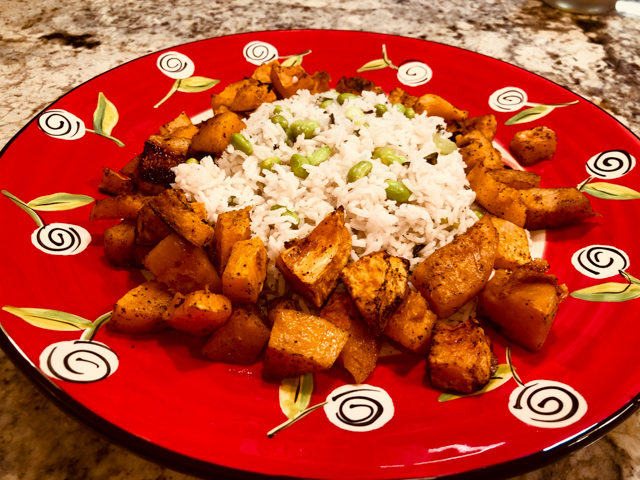
I drink tea every evening and often incorporate it in my cooking (and baking). Any green tea will work well for this recipe, but I used a very special kind, that goes by the beautiful name Thunder Dragon. I did not know, but that’s how people of Bhutan call their country… Bhutan: The Land of the Thunder Dragon. Isn’t that beautiful? The tea they produce is rarely exported, but not too long ago was available for sale by “In Pursuit of Tea”, and I got some. First time I made this dish, I brewed some tea and used it to cook the rice later, but if you don’t have a problem with the tea leaves staying around… this method is easier and delivers the same flavor.

GREEN TEA RICE WITH EDAMAME AND BUTTERNUT SQUASH
(from the Bewitching Kitchen)

for the rice:
1 cup Basmati rice, rinse and drained
1 tablespoon grapeseed oil
fresh ginger, minced (about 1 tsp, or to taste)
2 cups water
2 tsp green tea leaves (loose)
1/2 tsp salt
1/2 to 3/4 cup shelled edamame (frozen works great)

for the butternut squash:
1/2 butternut squash, cut in 1-inch pieces
olive oil to coat
salt, pepper and paprika to taste

Start by roasting the butternut squash. Heat the oven to 420F. Coat the pieces of squash with olive oil, season with salt, pepper and paprika. Place as a single layer on a baking dish lined with aluminum foil, sprinkle a bit of water (a tablespoon or so), and cover tightly with foil. Roast for 25 minutes, remove the cover and roast for 20 more minutes uncovered while you prepare the rice.

If using frozen edamame, remove it from the freezer and place on a baking dish to defrost while you make the rice. Heat the grapeseed oil in a saucepan, add the ginger, saute for a few seconds, and add the rice. Season with salt, and saute for a minute, until all grains are well coated with oil. Add the water, tea, and bring to a gently boil. Cover the pan and simmer for 20 minutes or until the water is absorbed. Place the edamame on top of the rice and cover the pan again. Leave for 10 minutes undisturbed, and when the butternut squash is ready, fluff the rice, mix the edamame with it, and serve with the squash around it.

ENJOY!

to print the recipe, click here

Comments: The rice can stand on its own as a side dish, but the color, texture and taste of the roasted squash was surprisingly good with it. I often do a very similar approach using frozen corn kernels instead of edamame. The residual steam as the rice is ready and waiting is enough to warm up the corn and it retains a very nice texture. If you ever want to perk your rice up, it’s a pretty easy way to do it. I might do a double feature next time, edamame and corn together, green and yellow, the colors of Brazil!

ONE YEAR AGO: Santa Hat Mini-Mousse Cakes

TWO YEARS AGO: Fun with Sourdough

THREE YEARS AGO: Pasteis de Nata

FOUR YEARS AGO: New Mexico Pork Chile, Crockpot Version

FIVE YEARS AGO: Chocolate on Chocolate

SIX YEARS AGO: Double Chocolate and Mint Cookies

SEVEN YEARS AGO: The Story of my first Creme Brulle’

EIGHT YEARS AGO: Sourdough Mini-rolls

NINE YEARS AGO: Focaccia with Sun-dried Tomatoes and Gorgonzola

TEN YEARS AGO: Mediterranean Skewers

ELEVEN YEARS AGO Fettuccine with Shrimp, Swiss Chard, and Tomatoes

FOR THE LOVE OF SOURDOUGH

It is amazing how a bread formula can be tweaked slightly and result in totally different outcomes. I share today nine versions of sourdough. They all start with the same composition (90% white bread flour; 10% whole-wheat, salt and sourdough starter). From this starting point, some get added flavor components, and the final outcome depends on how they were handled for scoring.

BASIC SOURDOUGH FORMULA
(from the Bewitching Kitchen)

470g white bread flour
30g whole-wheat flour (regular whole-wheat, spelt or rye)
10g salt
75g sourdough starter at 100% hydration
375g water

Make the levain mixture about 6 hours before you plan to mix the dough. It should be very bubbly and active.

When you are ready to make the final dough, place the water in the bowl of a KitchenAid type mixer and dissolve the starter in it, mixing with a spatula briefly, then add all flours and salt.  Turn the mixer on with the hook attachment and knead the dough for 4 minutes at low-speed all the time. You will notice the dough will gain quite a bit of structure even with just 4 minutes in the mixer. Remove from the machine, and transfer to a container lightly coated with oil, cover lightly with plastic wrap and allow it to ferment for 4 hours, folding every 45 minutes or so. Because the dough is already a bit developed from the initial time in the mixer, you should get very good structure after 3 and a half hours, or even sooner than that.

After four hours bulk fermentation, shape the dough as a ball, and place, seam side up, in a lightly floured banetton. Place in the fridge overnight, from 8 to 12 hours.

Next morning, heat the oven to 450F.

Invert the dough on a piece of parchment paper and score with a new razor blade, if so desired, or simply make a cut on the surface in the shape of a cross with a very sharp knife.

Bake at 450F for 45 minutes, preferably covered for the first 30 minutes to retain steam. You can generate additional steam by spraying the inside of the lid with water before closing the pan.  Cool completely over a rack before slicing.

ENJOY!

to print the recipe, click here

PANCH PHORON SOURDOUGH

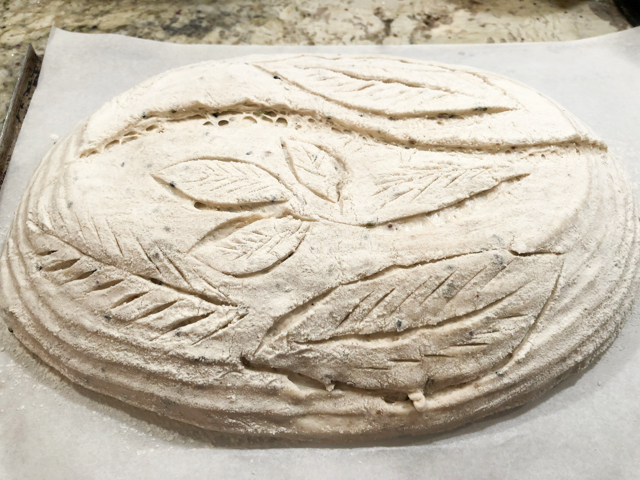
To the basic recipe above, add 1 to 2 tsp Panch Phoron, a five spice mixture from Eastern India, often used in Bengali cuisine. It is a mixture of equal parts of seeds of fenugreek, nigella, cumin, black mustard and fennel. I shaped this bread as an oblong loaf, and scored a pattern of leaves.

We loved this bread, in fact it was the first loaf that got us into a path of sourdough flavored with Middle Eastern spices.

VADOUVAN CURRY SOURDOUGH

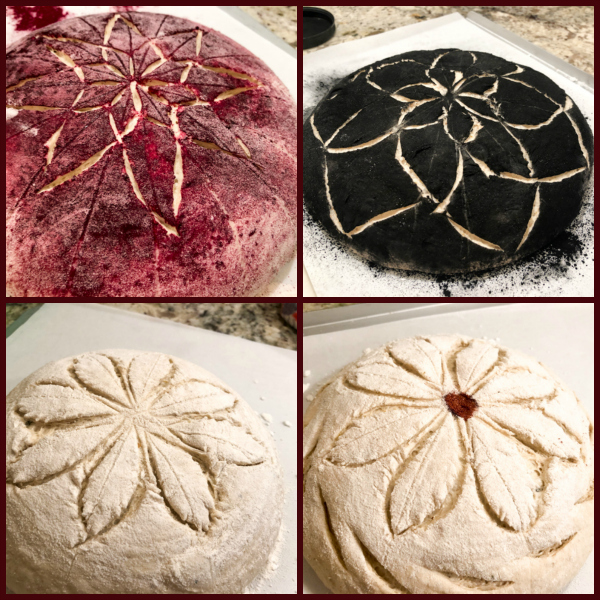
In these three loaves, 1 + 1/2 tsp of Vadouvan curry mix was added together with the flour and incorporated in the dough. The bread in the center had spelt as the minor flour component, the other two regular whole-wheat.

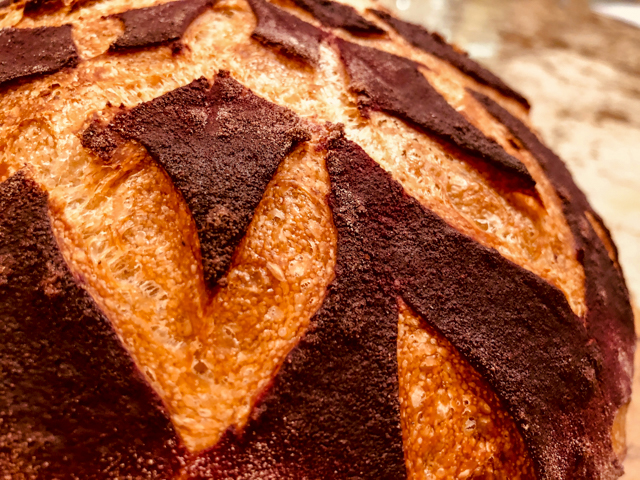
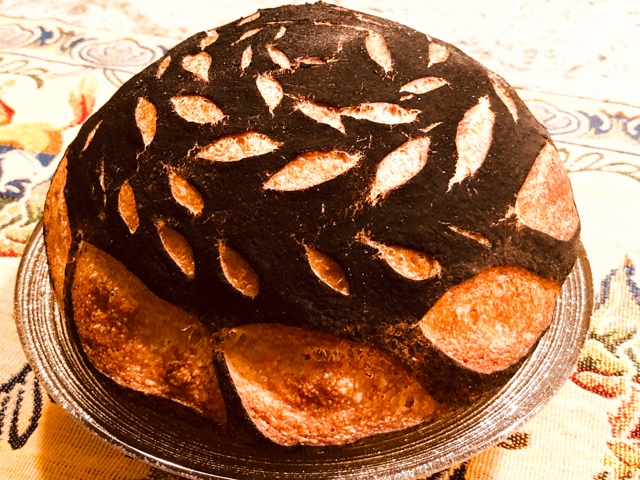
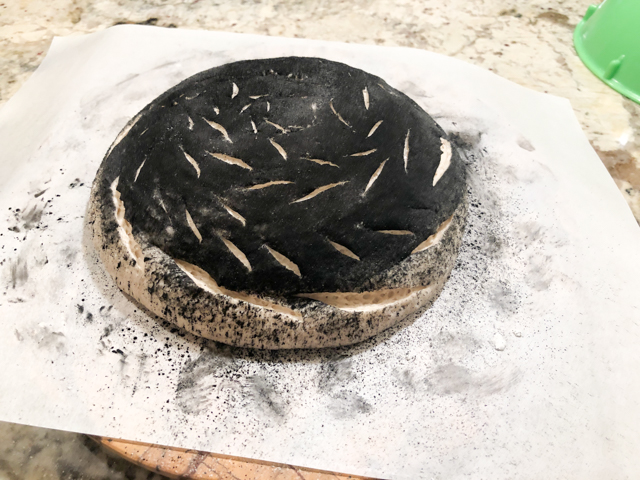
For the final decoration, I covered the first loaf with red beet powder, marked with a string a symmetry of 8 guide lines and then scored as shown. The beet color faded a bit during baking but still gave it a little hint of purple. The second loaf got a dusting with charcoal powder, the string marked 6 guide lines to create a slightly different type of design. Finally, the third loaf was dusted with flour, marked with 8 lines and scored as a flower. A little center of pearl dust was added but the color faded during baking (is that a recurring pattern for this baker?).

I love the charcoal and the beet powder effects, but be warned: they stain your fingers as you handle the bread, so when you cut a slice, make sure you don’t touch your face right after. No further questions on this subject. Please and thank you.

RAS-EL-HANOUT SOURDOUGH

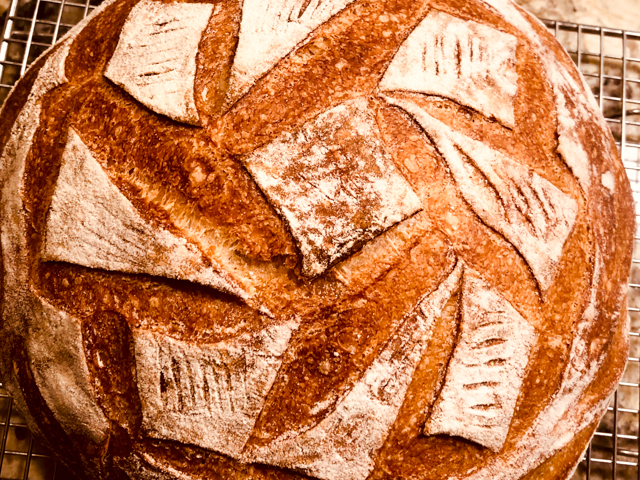
Exact same recipe using rye as the minor flour component, and 1+1/2 tsp Ras-El-Hanout in the formula. One of our favorite breads in this series. I should give credit to a baker from Israel who is a true magician with scoring. I follow him on Instagram (check him out here) and often try to make one of his cool designs. This is one example, that starts with a little square as shown below.

I am very fond of geometric-type scoring. I find it easier to do if I make a drawing on a piece of paper with the different steps because once that razor blade hits the surface of the bread… is game over! There is no “erasing” possible. Of course, during baking the design will be affected in unpredictable ways. I am still trying to figure out ways to minimize explosions.

ZA’ATAR SOURDOUGH

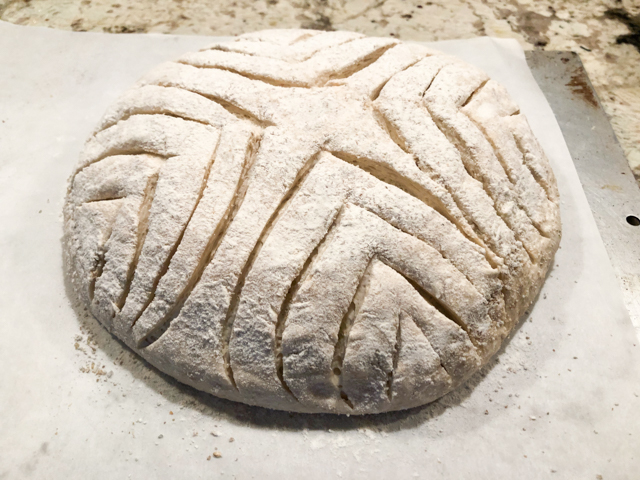
Basic recipe using spelt flour as the minor component and 1 + 1/2 tsp za’atar. The bread was coated with charcoal and I followed one of Mogi’s Dough Engineering scoring designs which he calls “reverse spiral”. Mine did not turn out as beautiful as his, but I still like it a lot. Here is what it looks like before baking.

He uploaded a video showing how to do it. It goes very fast, but after watching it (in awe) a few times, I felt ready to do it.

TAHINI SOURDOUGH

To the basic formula (with whole-wheat flour as minor component), I added 25g tahini, and adjusted the consistency with a little more flour after the initial mixing with the Kitchen Aid, as the tahini I used was reasonably fluid. The tahini gives a wonderful flavor. The scoring made the round loaf end up with a square shape after baking, pretty interesting.

You can see it starts pretty round, but the way the slashing opens up during baking substantially affects the final shape. I love using nut butters in sourdough, they bring a bit of fat to the composition and the crumb feels moist and tender. Along those lines I share another favorite version….

PEANUT BUTTER SOURDOUGH

Basic formula with spelt flour and 25g creamy peanut butter. This was one delicious bread, the smell during baking is something! The scoring was once again inspired by Mogi’s Instagram feed, and this time I used a powder red food dye that is fat-soluble (appropriate for chocolate work). That seemed to stand better during baking.

Very simple scoring, I used 8 guide lines made with a string, but you could definitely just improvise.

CELEBRATION OF LOVE SOURDOUGH

My final adventure following the footsteps of Mogi. This is a bread called Tu B’av (ט״ו באב), the Jewish holiday of love, similar to our Valentine’s Day. I made a simple sourdough with full white flour, and 1 tsp turmeric in the dough. The surface was dusted with white flour, a shower of turmeric, and the center was dyed with pitaya powder, which next time will be replaced by red dye powder. A round cookie cutter comes in very handy to contain the red dot. I am still struggling with how heavy a hand to use when adding colors, particularly the subtle ones as turmeric that might end up too similar to the crust. Once again my results are not as gorgeous as Mogi’s, but there is always next time!

So that’s all for now, my friends… This post, entitled For the Love of Sourdough, had to end with a bread to celebrate love, that feeling that keeps us together, staring at the future without fear.

ONE YEAR AGO: Brazilian Pao de Mel

TWO YEARS AGO: Stir-Fried Chicken in Sesame Orange Sauce

THREE YEARS AGO: Monday Blues

FOUR YEARS AGO: A New Way to Roast Veggies

FIVE YEARS AGO: Two Takes on Raspberries

SIX YEARS AGO: Spice Cake with Blackberry Puree

SEVEN YEARS AGO: Own Your Kitchen with Cappuccino Panna Cotta

EIGHT YEARS AGO: Chicken Parmigiana, the Thriller

NINE YEARS AGO: Wild Mushroom Risotto

TEN YEARS AGO: Tartine Bread:  Basic Country Loaf 

ELEVEN YEARS AGO:  Pugliese Bread