Back in July last year, I shared my first adventures with cake pucks (for a flash back, click here). I’ve made quite a few since then, some with boxed cakes and home-made buttercream, some with cakes crushed into crumbs while still warm, skipping the addition of buttercream. In my opinion, the texture of the cake component suffers a bit if you don’t use a little buttercream, but I am sure that is a matter of personal taste. Some bakers swear by the warm crumbled cake. Today I want to focus on a different recipe, one that uses a peanut butter fudge instead of cake for the center. And I also want to show you a new type of cake puck, made with a smaller mold. So, without further ado, let’s go over the peanut butter version.
2 cups granulated sugar 1 + 1/3 cup creamy peanut butter 1/2 cup milk 2 tsp vanilla dash of salt melting chocolate (such as candy melts)
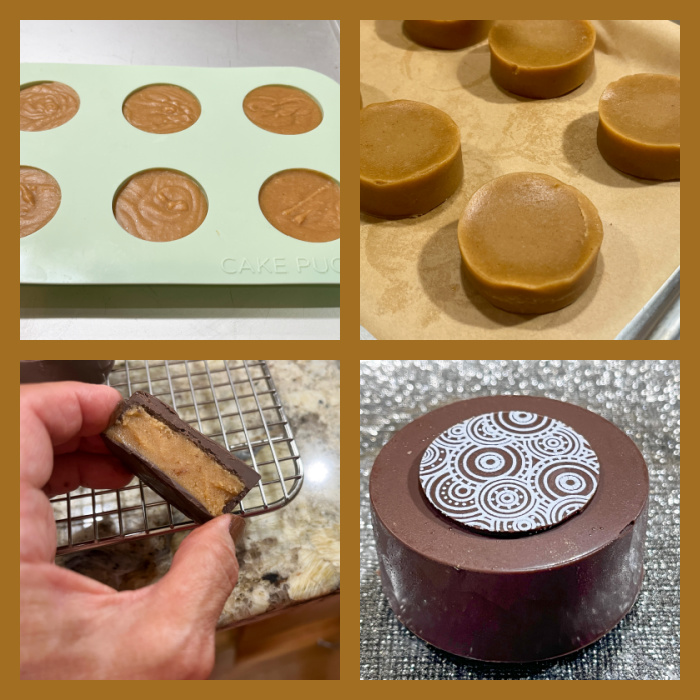
Bring sugar and milk to a boil over medium heat. Once boiling, whisk for 1-2 minutes. Add in vanilla, peanut butter and salt and mix until smooth. Working quickly, fill your small molds with the mixture. The peanut butter fudge should set up pretty quickly at room temperature, but I prefer to stick in the fridge for 30 minutes or so.
Melt 17 ounces chocolate and a spoonful of refined coconut oil gently in the microwave at 50% power. for 1 minute. Place larger mold (with the Benty Cakes logo on the bottom) on the plastic tray and fill one cavity half full with melted chocolate.
Place chilled center on melted chocolate. Gently apply even pressure as you slowly press the center down until chocolate comes up from the sides and covers the top of the center. Scrape off any excess chocolate. If there is not enough chocolate to cover the center. Add chocolate and scrape away excess. Tap the mold tray on the counter to eliminate air bubbles.
Let the pucks set in the fridge for 20 minutes or so, then gently un-mold. Decorate as desired.
Comments: If you are a peanut butter lover in desserts these will blow your mind! The texture is creamy and luscious, and of course, the peanut butter with the chocolate around it is a perfect match. I will now show you mini-pucks, which I find even better than the original ones because they turn out as a two-bite thing, one is enough and not too much. You can order the set of molds by clicking here. Below, a comparison in size between this new version and the original.
This batch of minis was also made with the peanut butter fudge center…
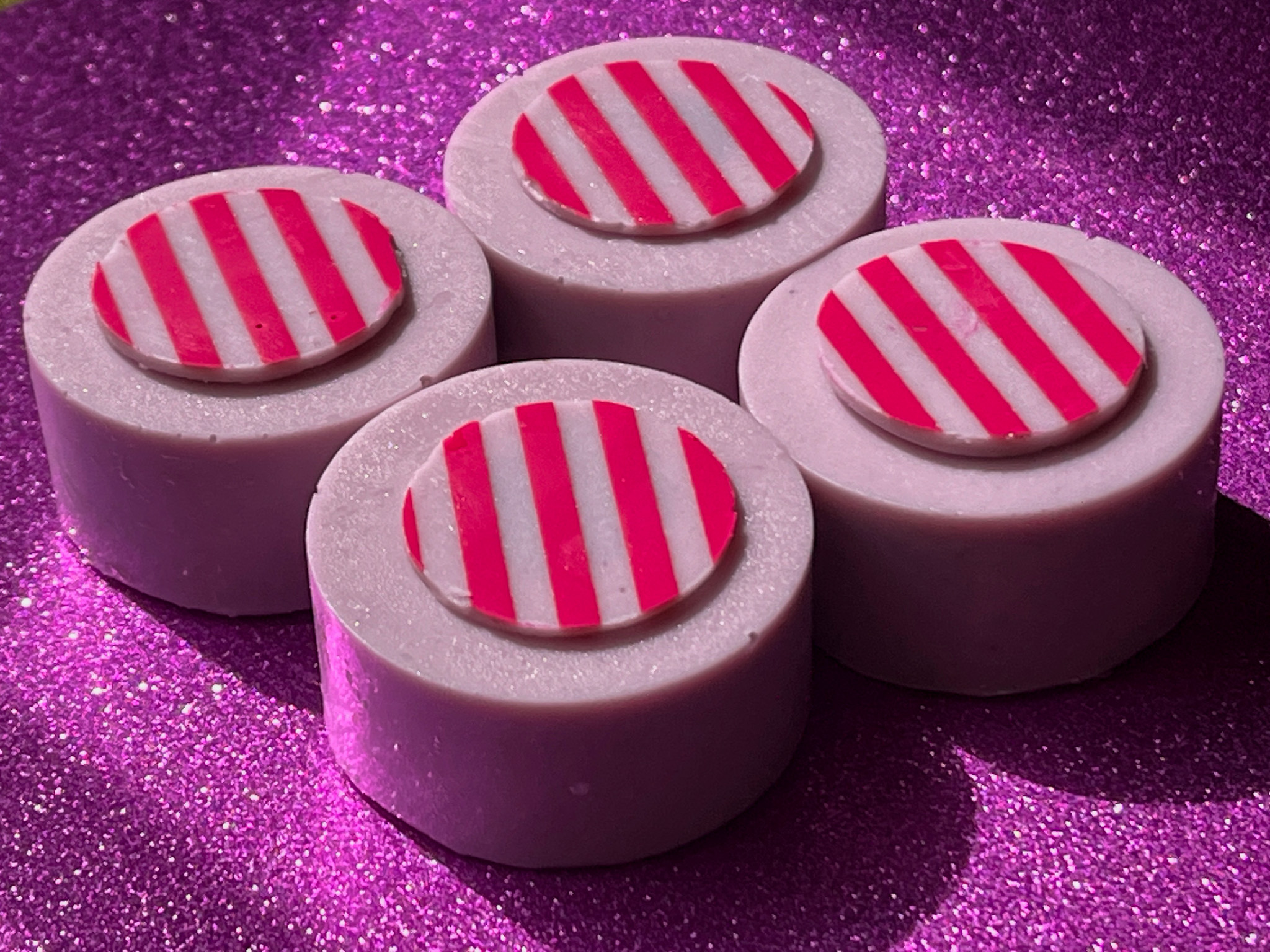
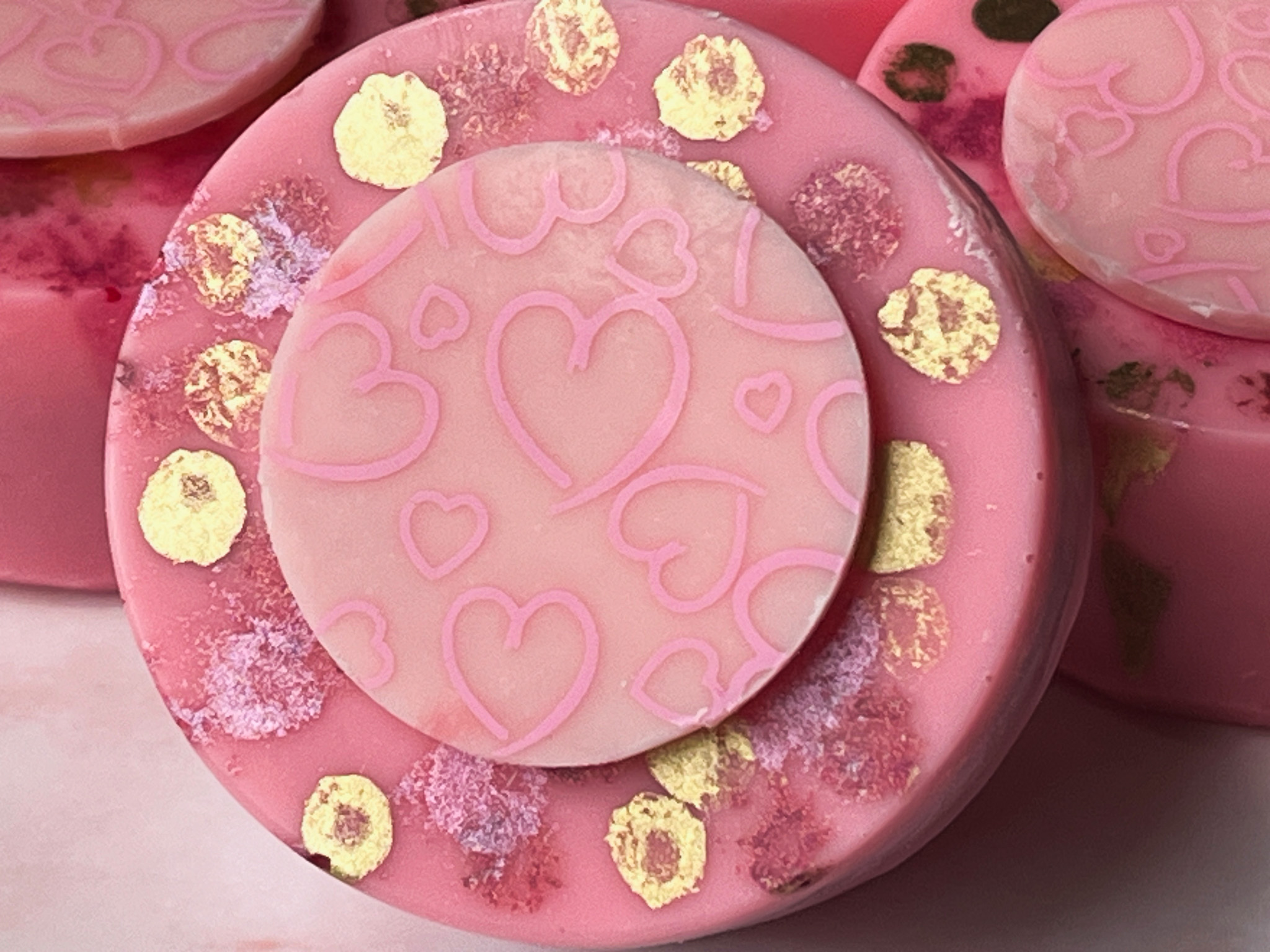
As to decorations, I’ve been using several different techniques, one of them which I really love is painting the bottom of the mold with luster colors, then adding the chocolate on top
I love the way the surface turns out…
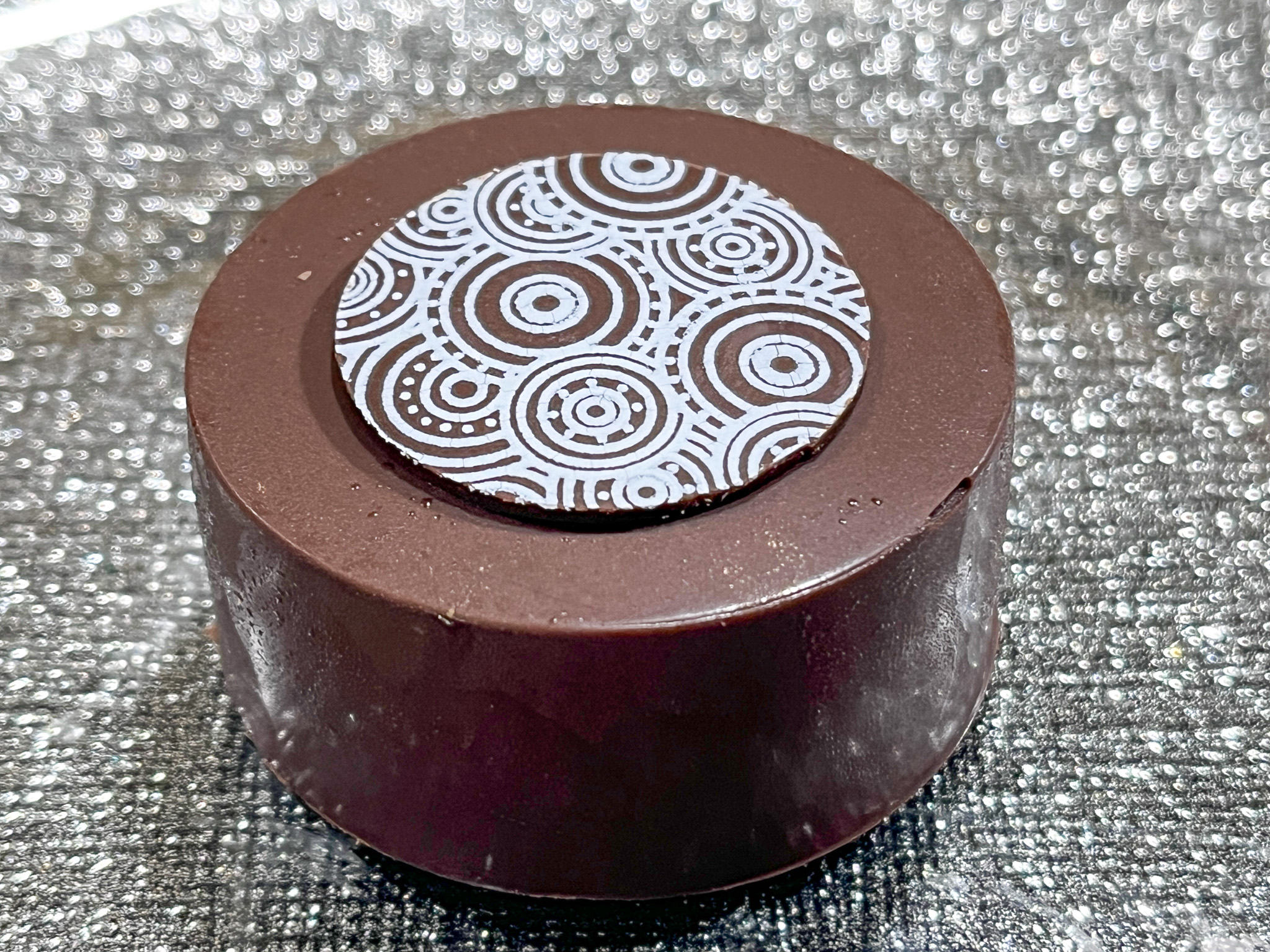
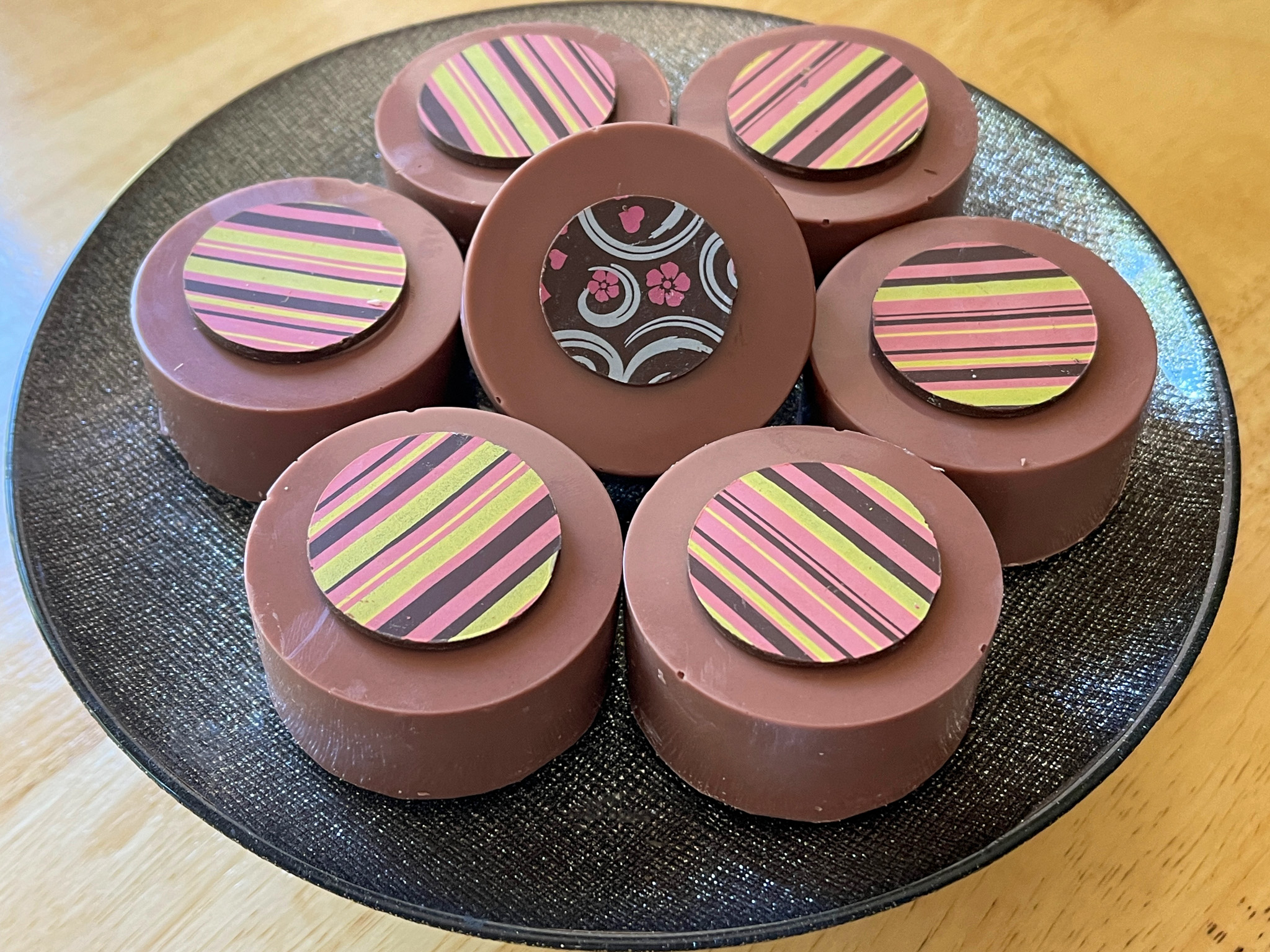
And using chocolate discs made with patterns using transfer sheets never gets old…
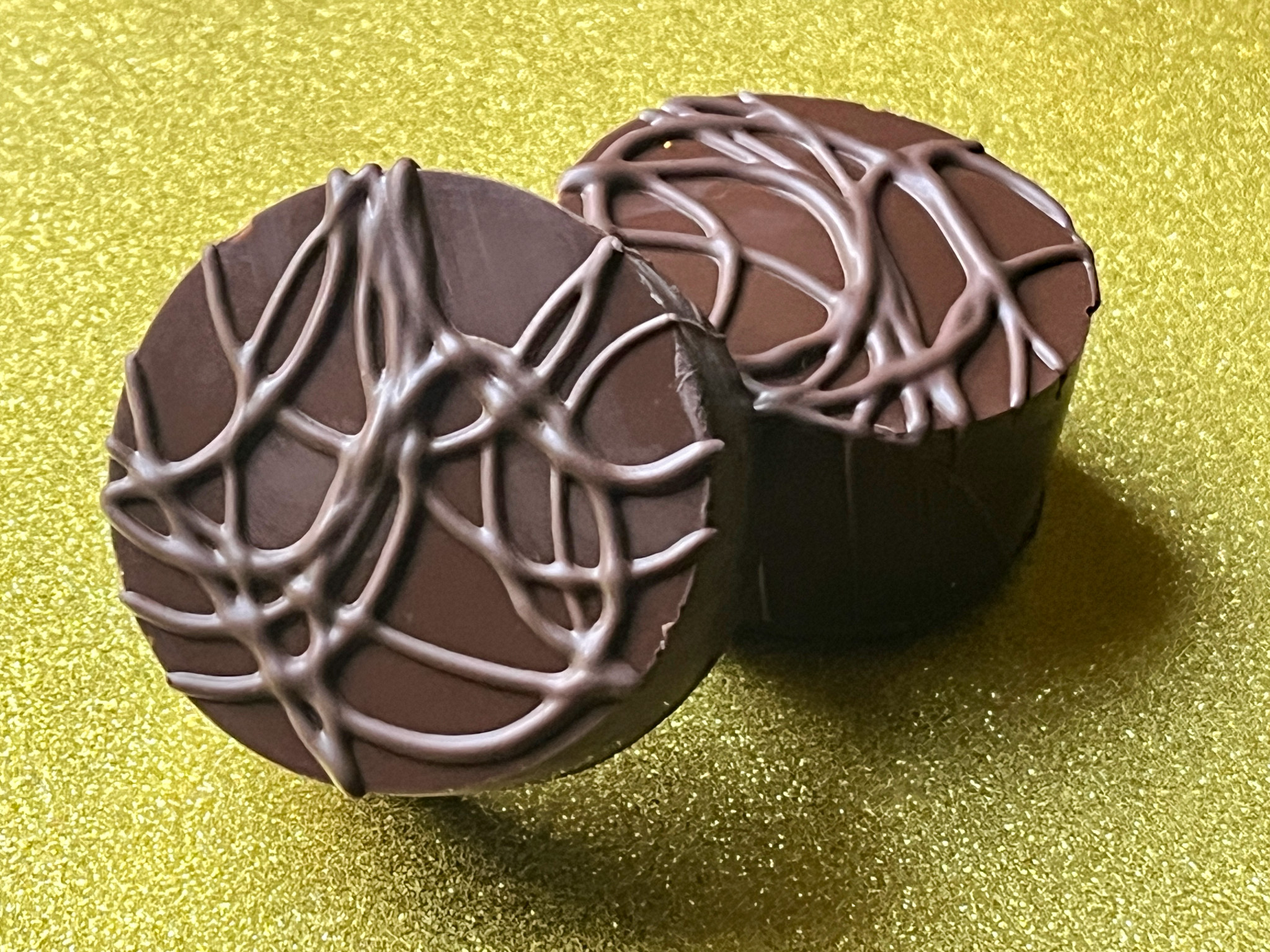
They also look pretty nice with just a drizzle of melted chocolate…
CHOCOLATE CUPCAKES WITH PEANUT BUTTER FROSTING (from The Bewitching Kitchen)
120 grams (1 cup) all-purpose flour 50 grams (1/2 cup + 2 Tablespoons) natural cocoa powder 225 grams (1 + 1/8 cups) granulated sugar 1 teaspoons baking powder 1/2 teaspoon baking soda 1/2 tsp Kosher salt 85 grams (about 1/2 cup) grapeseed oil 2 large eggs, room temperature 2 teaspoons vanilla extract 75 grams (1/3 cup) milk, room temperature 170 grams (3/4 cup) very hot water
Makes 12 cupcakes. Use paper liners in your pan.
Heat oven to 350F.
In a large mixing bowl, add the flour, cocoa powder, granulated sugar, baking powder, baking soda and salt. Whisk very well to fully combine the dry ingredients.
Add the oil into the mixing bowl and mix on medium speed with a hand mixer until well combined. Add the eggs and vanilla extract to the bowl and continue mixing until smooth.
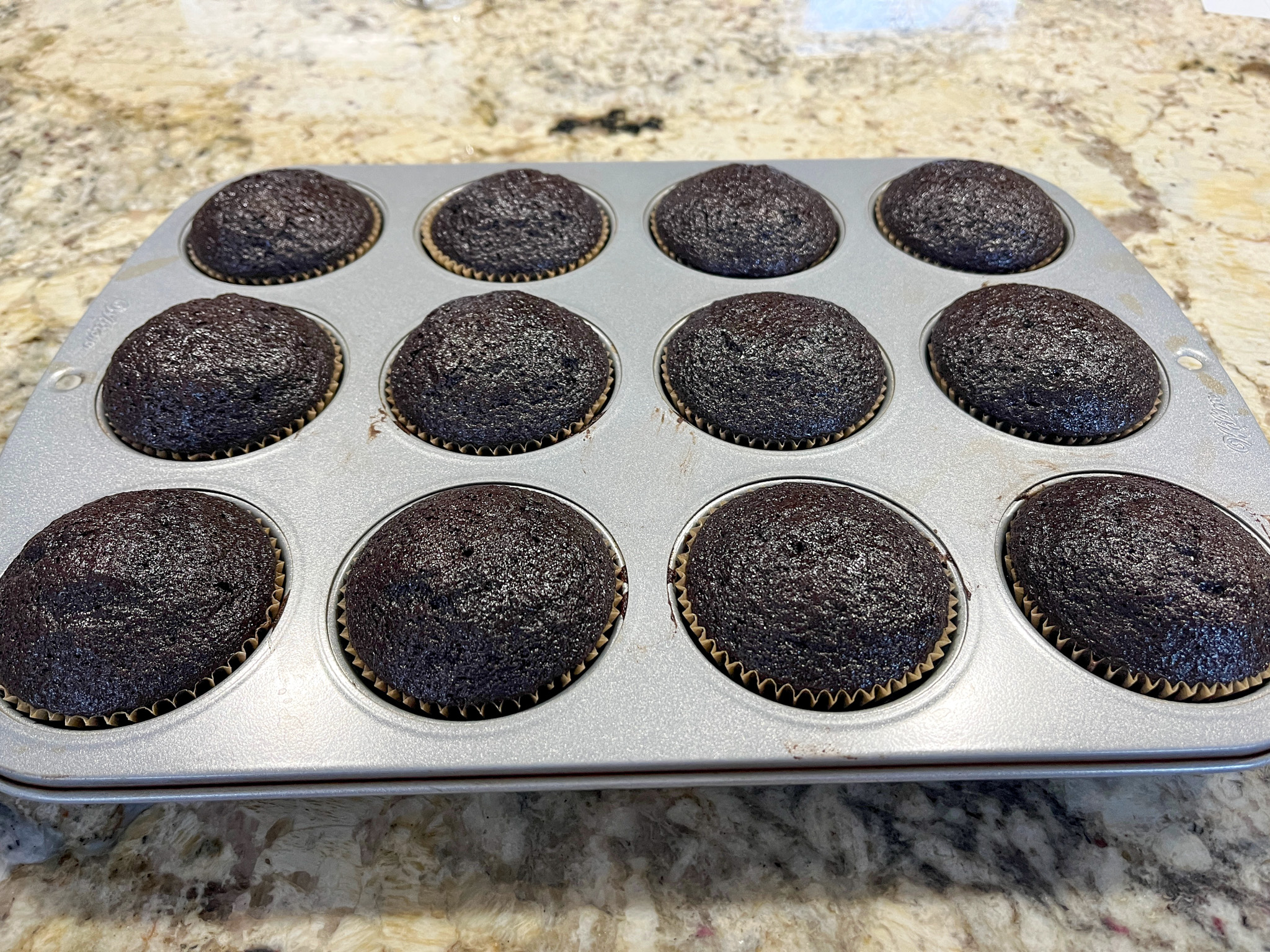
With the mixer still running, slowly pour in the milk and then the hot water. Continue mixing until everything is evenly incorporated, the batter will be super thin, do not worry about it. Place the batter in cupcake pan and bake until toothpick inserted in the center comes clean. This will take 20 to 25 minutes, but check a couple of minutes earlier. Cool completely before frosting.
PEANUT BUTTER FROSTING
113 grams (1/2 cup) unsalted butter, room temperature 175 grams (1/2 cup) smooth peanut butter (Jiffy works great) 210 grams (1 + 3/4 cup) powdered sugar 1 teaspoons vanilla extract 1/4 teaspoon kosher salt 2 to 3 tablespoons of milk to adjust consistency
In the bowl of a stand mixer fitted with a paddle attachment, beat the butter and peanut butter on medium speed for about a few minutes, until fluffy. Scrape down the sides and bottom of the bowl.
Add the powdered sugar and salt into the mixing bowl and start mixing on low until the sugar starts to combine with the butter. Turn the mixing speed up to medium-high and beat for about 3 minutes until the mixture is light and fluffy. Mix in the vanilla extract. Add milk to adjust the consistency. If not using immediately you can refrigerate for several days. Bring back to room temperature and whip again before using to frost the cakes.
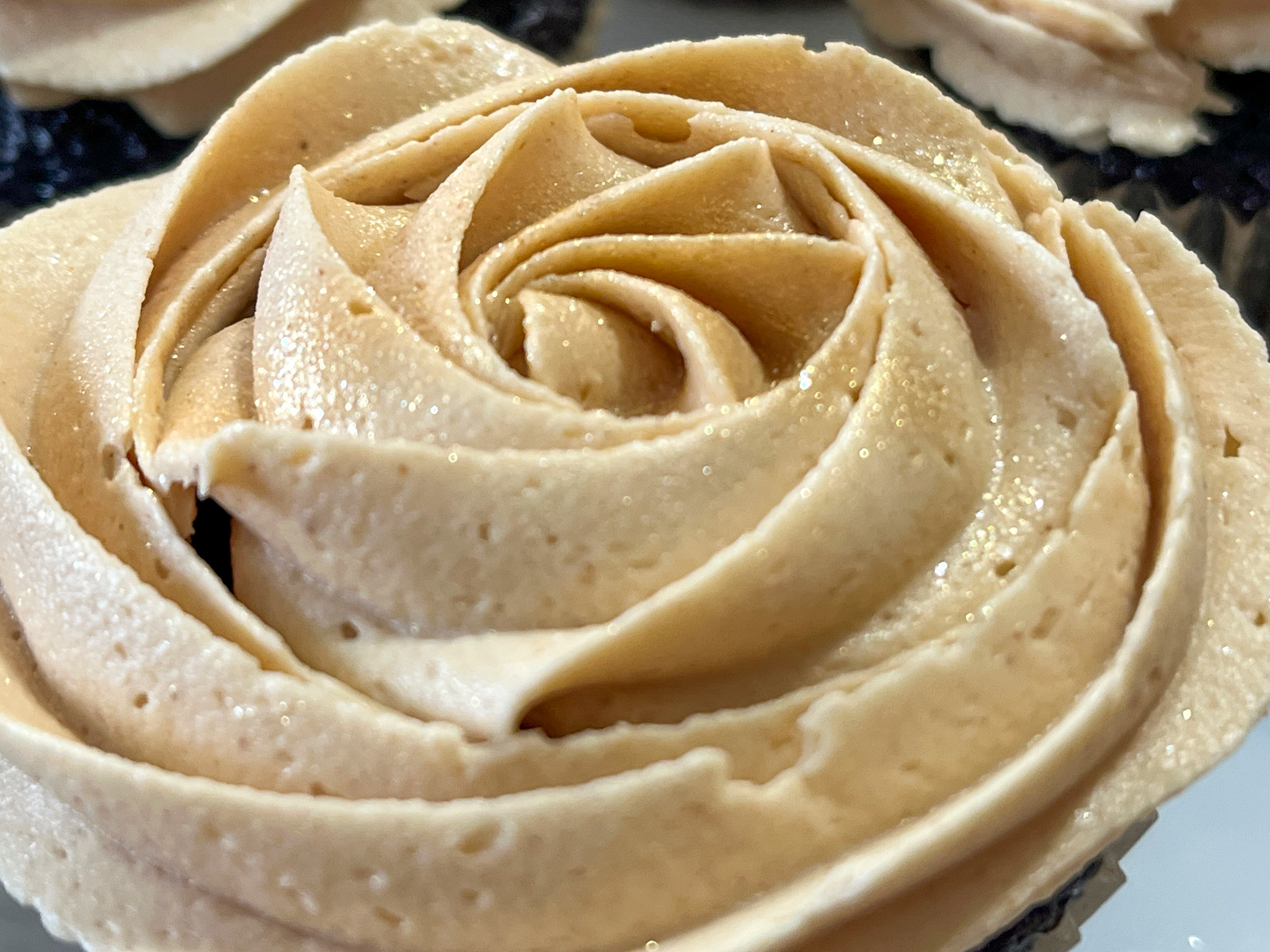
Use a piping tip like Wilton 1M if you like to make a rose pattern on top. Spraying gold is optional but nice…
Comments: I love this cake recipe so much because it is simple, straightforward and always works. You can use hot coffee instead of hot water, but I tend to simplify it and just grab water from the tap, as hot as I can get it. I know many people prefer Swiss buttercream frosting but I donate the cupcakes and not knowing how long they will sit waiting, I rather use a sturdier buttercream, which is also much simpler to prepare. If you are a peanut butter/chocolate lover, this cupcake is for you!
This is a sous-vide preparation, but you can change to regular cooking in any way you like to make pork tenderloin. The recipe was adapted from Melissa Clark, via The New York Times (click here for original post). I usually increase the cooking temperature because we dislike pork that is still pink in the center, no matter what the “experts” say. If you prefer it less done, set your sous-vide to 135F to 140F.
SOUS-VIDE PEANUT-GINGER PORK WITH CELERY SLAW (adapted from The New York Times)
for the pork: 3 tablespoons smooth peanut butter 2 tablespoons sesame oil 2 tablespoons soy sauce 2 tablespoons fresh lime juice 1 tablespoon finely grated ginger 2 teaspoons dark brown sugar 2 teaspoons Sriracha or chile-garlic paste 1½ teaspoons fish sauce 2 (1-pound) pork tenderloins, trimmed Extra-virgin olive oil, as needed
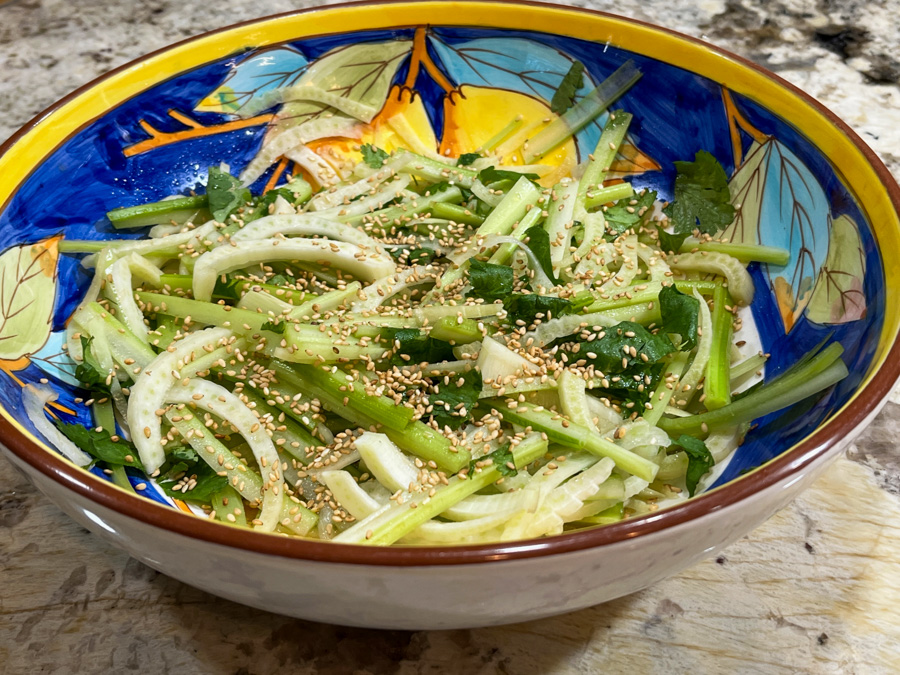
for the celery slaw: 2 teaspoons toasted sesame oil 2 teaspoons rice vinegar ½ teaspoon freshly ground black pepper ¼ teaspoon fine sea salt 2 small celery stalks, cut crosswise into thirds, then very thinly sliced lengthwise 1 cup thinly sliced fennel bulb fresh cilantro leaves Chopped roasted peanuts, for garnish sesame seeds for garnish
Fill a pot with water, add the sous-vide machine and set the temperature to 150 degrees.
Meanwhile, prepare the sauce: In a small bowl, whisk together peanut butter, sesame oil, soy sauce, lime juice, ginger, sugar, Sriracha, and fish sauce. Place pork in a sous-vide bag, then pour sauce all over meat. Lower bag into heated water, weighing the bag down if necessary, and cook pork for 3 hours. Heat broiler and place a rack 4 inches from heating element. Remove pork from sous-vide bag and transfer to a rimmed baking sheet. Pour remaining cooking liquid into a small saucepan. Bring sauce to a simmer over high and let cook until slightly thickened, about 2 minutes. Cover to keep warm, and set aside.
Drizzle pork with olive oil and broil until charred in spots, 2 to 3 minutes. Transfer to a cutting board and let rest, 5 minutes.
Make the celery salad: In a large bowl, whisk together sesame oil, rice vinegar, pepper and salt. Toss with celery, fennel and cilantro. Taste and add more salt, sesame oil and rice vinegar if needed. To serve, slice pork and drizzle with sauce. Top with celery salad, and peanuts. Garnish with cilantro leaves, and sesame seeds if you like.
Comments: The sauce is absolutely delicious, I am quite fond of peanut butter in savory preparations, in this particular case it goes well with the ginger and all other flavors. The way the recipe was published it called for 135F for 2 hours, but there is no way that would work for us. Do what you think is best. Whatever method you go for, make sure to incorporate the sauce reduction in the end and drizzle it over the meat. It takes the dish to a whole higher level. The slaw was good in terms of flavor, but the texture of the celery was a bit harsh, so next time I might just do the “microwave blanch”, in which I cook the veggie with a tiny bit of moisture (often just a damp paper towel will do) for 10 seconds or so. It is enough to just kill the raw texture. Plus, since it will be slightly warm it will incorporate the dressing even better. I don’t mind the raw fennel at all, so I would not “blanch” it.
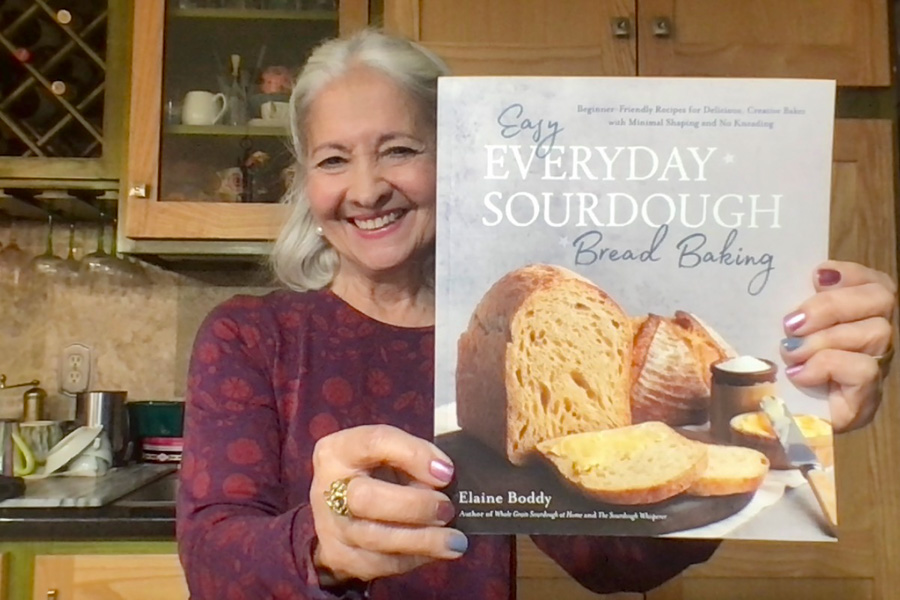
I am absolutely thrilled to share my review of a GREAT sourdough bread cookbook, published just this week by my friend Elaine! This is her third cookbook, I have reviewed her two first babies here and here. Let me tell you, this is her best one. I wanted to make every single one of her recipes, they all had some kind of intriguing twist, unexpected addition, or unusual shaping. But first, let me share the first recipe I made, the moment the book arrived at my doorstep. The husband is crazy for peanut butter and jelly, so of course that was an easy choice for me.
for the dough: 50 g active sourdough starter at 100% 350 g reduced-fat milk (I used full-fat) 500 g white bread flour 7g salt or to taste (up to 10 g)
for the filling: 50 g peanut butter, smooth or crunchy 100 g jelly of your choice (I used seedless raspberry)
In the early evening, mix all the dough ingredients in a large bowl until you have a rough dough. Cover with plastic wrap or a shower cap and leave in the counter for 2 hours. Perform a set of pulls and folds. The dough will be stiff at first, but will become smooth and come into a ball. At that point, stop, cover again and leave it on your center for one hour.
Perform one more set of pulls and folds, then leave over the counter at room temperature overnight (8 to 10 hours at around 68F). Our kitchen is warmer, but I had no issues with overnight fermentation.
Next morning place the bowl of the dough in the fridge, without touching it, for one hour. Prepare a 9 x 5 in loaf pan by spraying it with oil or lining it with parchment paper.
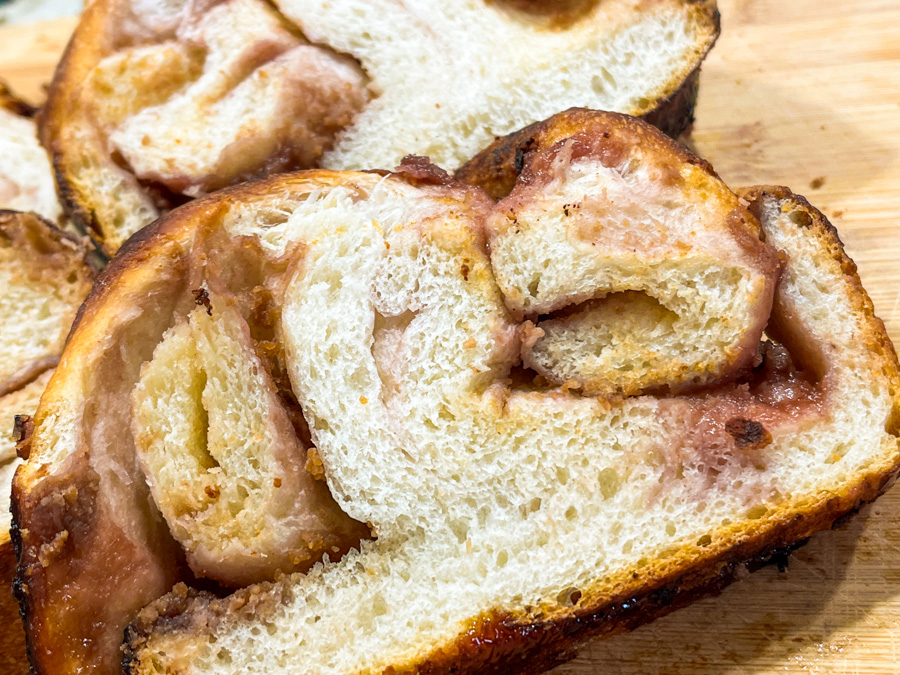
After one hour, sprinkle flour on the countertop and open the dough with your hands and/or a rolling pin to a dimension of 8 by 16 inches, making sure it has even thickness. Spread the peanut butter gently all over the dough, then the jelly. Roll up the dough from the shorter end. Once rolled, use a sharp knife to cut the sausage lengthwise down the middle in two equal pieces. Twist the two pieces together, then lift the dough and place it inside the prepared pan.
Allow the dough to proof again until it reaches the edge of the pan, 2 to 4 hours, depending on the temperature of the room. You can also proof in the fridge for up to 24 hours and bake straight from the fridge.
Bake at 400F for about 40 minutes, making sure to protect the surface with aluminum foil after about 30 minutes to prevent excessive darkening.
Remove the loaf from the oven and the pan, remove the paper, tap the base of the loaf and if it sounds hollow, it is baked, if not return it to the oven, out of the pan, directly into the oven rack to bake for a further 5 to 10 minutes. Allow it to cool before slicing.
Comments: The dough is a pleasure to work with. My only change was to use the KitchenAid for the initial mixing, just because I got so used to doing it that way for all my sourdough baking, that it became second nature. Of course, you can just mix by hand and it will be even simpler, less stuff to wash. Don’t worry about leaving the bread overnight at room temperature, it will be perfect. The amount of peanut butter and jelly is just right, don’t add more. Even though the peanut butter seemed to disappear once it baked, the taste was there, in the exact intensity needed. In the book Elaine gives alternatives to bake from cold oven, which is something she does often. In fact, every single one of her recipes offers the option of starting from cold oven.
The bread feels surprisingly rich, when you consider it has no butter or eggs in it. I love the texture, and because it has no sugar, you can definitely use the exact same formula and take it into savory territory with pesto, cheese, tapenade, or as Elaine herself did in her book with a surprising combo of flavors (check my summary of Chapter 2). I will definitely be doing that in the near future.
Of course, the husband loaded the bread with peanuts, because that’s what he does!
Now let’s dig into the review of Elaine’s beautiful cookbook shall we?
The book is divided into chapters, according to the general way, in which you will bake your breads and that in itself is unusual and fun. I will now go into each chapter and give you a few examples of the recipes you will find
Chapter 1: THE BREAD PAN COLLECTION In this set of recipes, you will be using a regular Dutch pan or enameled pan with the cover that if you are used to baking sourdough bread is pretty much the container of choice. She opens the chapter with her Easy Shape Crusty White Loaf, which is what she described as the archetypal sourdough loaf.
Many recipes called my attention, but my favorites would be Same-Day Chia Seed Boule, the Yogurt and Nut Boule, the Turkish-Style Seed-Topped Pide and her Cheesy Herby Pull Apart Rolls.
.
Chapter 2: THE LOAF TIN COLLECTION In the second chapter, you will be using loaf pans like the regular 9 x 5 in that is often used in bread baking. She will also bring into play the fun Pullman type pan, and will share formulas to get absolutley beautiful square loaves, that are so handy to make sandwiches. I wanted to bake pretty much everything! The chapter is divided in two sections, “Simplest” and “Flavored”. In the simplest section, the breads are made with seeds, ancient grains, or the super cool Whey and Honey Sandwich Loaf, that is calling my name really loud. In that recipe, the whey component can be the liquid that accumulates over yogurt. We consume A LOT of yogurt at home, so that is going to happen, trust me. The flavored section is unreal! The Peanut Butter and Jelly Babka I highlighted is from that part, but Elaine went wild on this brings all sorts of twists: Cheese and Ketchup Babka (I know this is a real winner because we talked about it when she first made it), Roasted Cumin, Coriander and Caraway Loaf, Dark Chocolate Chip, Hazelnut and Rye Loaf (be still, my heart!), Satay-Swirled Black Sesame Seed Loaf. Need I say more? The teaser recipe at the end of my post is also from this section.
.
Chapter 3: THE CAKE TIN COLLECTION She opens the chapter with a question: How many cake tins do you have? I have quite a few and I never bake cakes!
Well, I bake cakes and have more cake pans than I care to admit in public, so this chapter is dear to my baker’s heart. And we are not talking just big cake pans! Elaine makes these small cute loaves in circular 8 inch cake pans, so adorable! I a a bit lazy to adjust amounts to different sizes of pans, so it was nice to have it all laid down nicely for me. Also, she puts Bundt pans into the universe of sourdough baking. Yes you got that right Bundt pans are not just for cakes anymore! Many recipes tempting me, I give you just a few: Pumpkin Spiced and Shaped Loaf, Fast Coconut and Cherry Tea Loaf,Feta and Spinach Bundt Tin Loaf with Red Onion Topping,Holiday Chocolate Enriched Bundt Tin Loaf (!!!!), and wait for the last one… Gingerbread Cookie Enriched Bundt Tin Loaf (wow, just wow!).
.
Chapter 4: THE MUFFIN TIN COLLECTION Ok, now I really have to tell you, I was in Nirvana with this chapter. The whole idea is to use your muffin pan to bake sourdough in all kinds of cute shapes and flavors. Apple and Apricot Enriched Sourdough “Roses”, Sweet Potato Apple and Cheese Roll Ups, Stuffed Pizza Rolls (OMG), Sweet Potato, Za’atar and Tahini Rolls. And the last one almost took my breath away (the picture is amazing): Falafel-Spiced Chickpea Bites.
.
Chapter 5: THE OVEN TRAY COLLECTION This chapter lists a series of recipes you can bake in a simple, humble baking sheet. Same-Day Cheats Baguettes, Seeded Pide with Cheese, Red Pepper and Baked Eggs (the picture made me drool), Butternut Squash, Pecan and Fall Spiced Focaccia, Spiced Cheese Sandwich Crackers. After this chapter, what she calls a bonus recipe: Air-Fryer Pitas. Needless to say, that goes into my list to bake very very soon. .
The photography of the book is simply outstanding! Every single recipe has a picture, they are stylish, beautiful, and since I know Elaine personally, I realize that they convey her style perfectly. The method behind her recipes is the same of he previous books: simple, straightforward, instead of feeling intimidated by a bunch of parameters and temperatures and factors you need to control, she makes you feel confident and ready to go to the kitchen and play. A perfect book if you are a beginner and a total delight if you are an experienced sourdough baker.
and now, for the teaser recipe….
FAST SPELT, DRIED FRUIT, NUTS AND SEEDS LOAF (page 86)
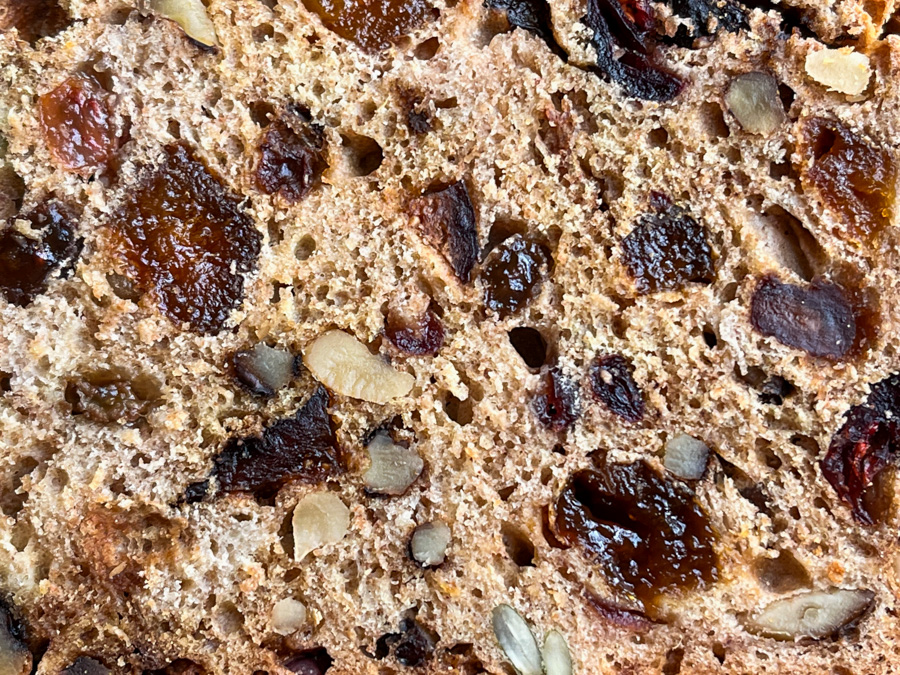
I am going to tell you something pretty major: this was one of the tastiest breads I’ve made. It is ready in less than 2 hours, essentially you mix all the ingredients, sourdough starter, baking powder and baking soda, and bake. It is rich, loaded with nuts, seeds and dried fruits (figs, apricots, cranberries, raisins), and OMG SO SO GOOD! If you can wait until it is totally cool and slice it thinly, place it in the toaster and you will have a ticket to Nirvana. Absolutely wonderful!
Elaine, thank you so much for allowing me to publish one of the recipes in my blog! You outdid yourself with this cookbook, and I know I will have a blast making more recipes from it!
If you follow my cookie blog, maybe you’ve read a recent post in which I played with Chocolate Royal icing? I used fat-free cocoa powder (click here to get some) and they worked extremely well not only in icing but as I show today, to make cocoa-flavored macaron shells.
CHOCOLATE PEANUT BUTTER MACARONS (adapted from this post)
For the shells: 200g Icing/powdered sugar 115 g ground almonds/almond meal 7g fat-free cocoa powder 115 g egg whites at room temperature (approx. 4 eggs) 1/8 tsp of cream of tartar (optional) 100 g granulated sugar ¼ tsp vanilla paste or extract 1 drop brown food gel 1 drop red food gel
Line 3 heavy baking sheets with parchment/baking paper or Silpat mats. Layer the powdered/icing sugar, ground almonds/almond meal, and cocoa powder in a food processor. Pulse until the mixture looks like fine meal, about 12 pulses. Pass through a sieve and transfer to a small bowl or to a sheet of parchment/baking paper. Set aside.
Place the egg whites and cream of tartar in the bowl of a stand mixer fitted with the whisk attachment. Make sure that the bowl and the whisk are impeccably clean. Starting on medium speed, whip the whites with the cream of tartar until they look like light foam. The whites should not appear liquid. The foam will be light and should not have any structure.
Slowly rain in the granulated sugar in five additions, trying to aim the stream between the whisk and the side of the bowl. Turn the speed up to high. Continue to whip the meringue until it is soft and shiny. It should look like marshmallow creme (marshmallow fluff). Add the vanilla. Whip the egg whites until the mixture begins to dull and the lines of the whisk are visible on the surface of the meringue. Add the drops of food color and continue whisking. Check the peak. It should be firm. Transfer the whites to a medium bowl.
Fold in the ground almond/almond meal mixture in two increments. Paint the mixture halfway up the side of the bowl, using the flat side of a spatula. Scrape the mixture down to the center of the bowl. Repeat two or three times, then check to see if the mixture slides slowly down the side of the bowl. Put the mixture in a piping bag fitted with your choice of piping tip (round, ¼ or ½ inch in diameter or 6 – 12 mm). If you don’t have a macaron mat, draw circles on baking/parchment paper about 2inches/5cm in diameter & turn the paper over before placing on the baking sheets. Pipe shells, I like to count numbers in my head and use the same count for each shell so they end up similar in size.
I pipe inside the circles to about 1 ¾ inches/4.5cm but you can go to 1 ½ inches (3.8cm) & the macarons will spread & fill the circle while drying.
Slam each sheet hard four to six times on the counter/worktop. Let the unbaked macarons dry until they look dull but not overly dry. Drying time depends on humidity. In a dry climate, the macarons can dry in 15 to 20 minutes; in a humid climate, it can take 35 to 40 minutes.
While the macarons are drying, heat the oven to 300 F (150 C/130C Fan oven/Gas Mark 2). Bake one sheet at a time on the middle rack. Check in 11 minutes. If the tops slide or move (independently of the ‘feet’ when you gently twist the top), then bake for 2 to 3 more minutes. Check one or two. If they move when gently touched, put them back in the oven for 1 to 2 more minutes until they don’t move when touched. Let the macaroons cool for 10 minutes before removing from the pan. The macarons should release without sticking.
Assemble the macarons: find two macarons similar in size and add a good amount of filling to the bottom of one of them. Place the other on top and squeeze gently to take the filling all the way to the edge. Store in the fridge for 24 hours for perfect texture.
PEANUT BUTTER BUTTERCREAM
65g smooth peanut butter (Jiffy is fine) 50g cream cheese, room temperature 30g butter, room temperature 250g powdered sugar milk or heavy cream to adjust consistency, if needed
Place the peanut butter, cream cheese, and butter in the bowl of an electric mixer. Cream until light, about 2 minutes. Add the powdered sugar and whisk on low-speed. Once the powdered sugar is incorporated, increase the speed to medium-high and whisk until very creamy. Adjust the consistency if needed with powdered sugar or milk. Place in a piping bag fitted with your choice of tip, and use to fill macaron shells.
Optional decoration: drizzle of Chocolate Royal icing or melted chocolate plus sprinkles of your choice.
Comments: In the past, more often than not I would get wavy shells when adding cocoa powder to the macaron batter. I was very pleasantly surprised by how smooth these turned out. And with a nice chocolate flavor. I did add a touch of brown and a touch of red because the amount of cocoa I added was not enough to darken the shells the way I wanted.
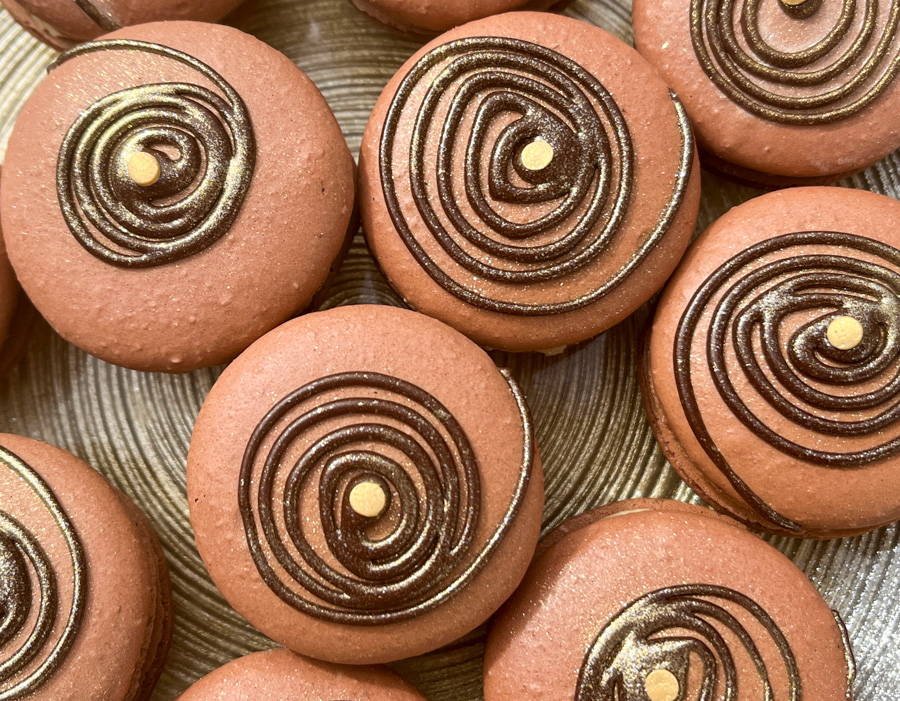
I thought it would be fun to couple the Chocolate Royal icing made with fat-free cocoa powder with the macarons made with the same product. I had some leftover from cookie decorating, so I just added a swirl, the a golden sequin type sprinkle, and while the icing was still soft, a dusting with gold.
The peanut butter filling was perfect for my taste. Using cream cheese cuts a little bit the sweetest, and the natural saltiness of the peanut butter takes it into a salted caramel territory I love. I highly recommend this recipe.












 Bewitching Kitchen