SUGAR COOKIES FOR THE HOLIDAYS

Until my participation in a certain show, I was not too wild about decorating sugar cookies with Royal icing. Indeed, in the comfort of my kitchen I would always refer to that white, impossible to tame substance as Royal Pain in the Icing, which indicates how I felt about it. But those intense weeks of preparation for the different episodes of the show forced me into areas of baking I had happily ignored and avoided. Much to my own amazement, I now love everything about cookie decorating, from baking the base to planning the design and trying to make it happen. On that note, I highly recommend that you go through my trilogy of posts on the subject from last month and the detailed tutorials by Tanya which I shared at the time. For all the holiday cookies in this post, I went with a flavor that is deeply ingrained in the season: Fiori di Sicilia, the Italian magical potion that is the classic addition to panettone. As to the decorations, apart from the wet-on-wet which I find the most user-friendly, I will share three methods that were new to me, requiring just a tad more involvement: Crackled Gold Christmas Tree, Reindeer (a clever twist starting from a common cookie cutter), and Stained-Glass Cookies.

FIORI DI SICILIA SUGAR COOKIES
(from the Bewitching Kitchen)

360 g all-purpose flour (3 cups)
2 teaspoons baking powder
200 g granulated sugar
¼ tsp salt
227 g cup butter, cold and cut in pieces
1 egg
3/4 tsp Fiori di Sicilia extract
zest of 1 lemon
¼ tsp cardamom

Heat oven to 350F. Combine the flour, baking powder and salt, set aside. Cream the sugar and butter. Add the egg, Fiori di Sicilia, lemon zest and cardamom, mix well. Scrape the sides of the bowl. Add the flour mixture in two steps, and beat just until combined.

Dough can be rolled right away in between sheets of parchment paper. Roll to about 1/4″ thick, and cut into shapes. Place on parchment-lined baking sheets, freeze for 10 minutes. Bake for about 12 minutes. Transfer to cooling rack and cool to room temperature before icing.

(for Royal Icing, I used Tanya’s recipe, which you can find here)

ENJOY!

to print the recipe, click here

Comments: This is definitely my default recipe for sugar cookies because I adore Fiori di Sicilia and I do flips for cardamon. As far as extracts go, Fiori di Sicilia is not cheap, but it is hard to replace with something else. Some say that orange extract + vanilla does a good enough job playing its part. Your kitchen, your rules, feel free to flavor your cookies the way you like. Just make sure not to roll the cookies too thin. Thin sugar cookies don’t stand up to the icing.

With the basic Christmas colors (red and green, plus white for flooding) you can do a lot…
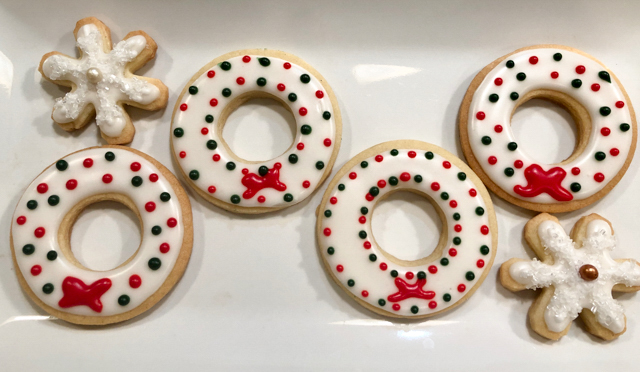
I used two cookie cutters, one for the basic shape, a smaller to cut a circle in the center, turning it into a wreath. From there, nothing fancy. Flooded with white, allowed to set for just 10 minutes and then a few green and red dots added on top. The little bow added in the very end. Yes, I realize that could be a lot better, and I intend to work on it.
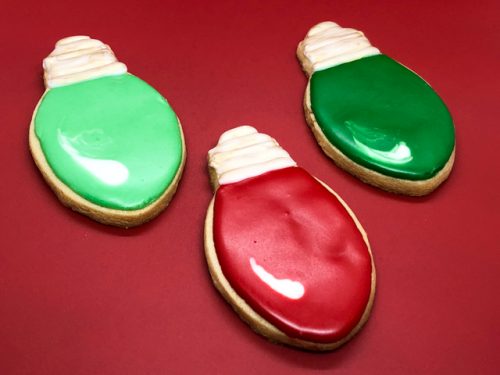
A new cookie cutter I got this year stole my heart. I find it so cute and a bit unusual. A Christmas light bulb, which once again can be made quite simply with only two colors of icing and if you like to gild the lily, some luster gold painted on the “metal” part next day.

By bringing one more color – black – you can expand a bit more the horizons, so that Mr. Snowman has a nice hat and black, profound eyes. The baby deer are also super easy, flooding with white, waiting until it sets a bit and piping the details. The little snowflakes were flooded with white and immediately showered with white sparkling sugar. And one day I will understand why I seem to always type “spanking” sugar before getting it correctly (sigh).

And since there was black Royal Icing around… why not immortalize one of our faithful companions, who has been with us every step of the way in this crazy year? The black dots were placed before the white set (wet-on-wet), then the nose and the red collar were added later, just to have a bit of a 3D effect. Same process went into the snowflakes.

Holiday Baking is not complete without Christmas Trees…

Some of the designs were again wet-on-wet, but then I did something new that blew my little mind when I saw it on a tutorial on youtube. A technique called “Crackled Gold” and you can visualize better in this picture:

It is so cool, I cannot quite believe how creative people can be, figuring these little tricks. What you do is flood the cookie with the base color and wait until it starts to crust. Average will be 15 minutes. Then you use the handle of a painting brush, or what I used: a fondant ball-shaper. I have a set of several sizes and picked one to make the indentations that seemed most appropriate for the size of the tree. Press the ball gently to make a mark on the icing. Let it dry completely and if desired you can add details with gold luster. Or you can leave it without the gold accent, for a simpler look.

To see exactly how that is made, you can check the wonderful tutorial by The Graceful Baker in youtube clicking here. The “crackled gold” starts at 33 min and 10 sec. I already anticipate the same approach in other styles, like crackled heart shapes for Valentine’s…. Wouldn’t that be awesome?

Moving on…. another technique I learned from Stephanie on youtube, and you absolutely MUST check her site. What I loved about this one is the clever use of a cookie cutter that most people have in their little treasure box: a gingerbread man, any size will do. If you turn it upside down you can use it to make a Reindeer!

Am I adorable or what?

I swear, I love this little guy! I admit his ears ended a bit pathetic, and if you watch her video you’ll realize I forgot to add the hair on top of his cute head, but overall I am thrilled with the way he turned out. I will make some more again in the near future, hoping to do a better job.

The final details (eyebrows and smile) are made with a very fine food pen but if you can also try royal icing, I don’t dare going for such fine details using it. Poor Reindeer, he would look like roadkill.

Please make sure you visit Little Cookie co. youtube channel. I already have three different techniques on my list of projects to try soon, in fact it is quite likely that by the time you read this I will be already working on one of them….

And finally… a technique I’ve been flirting with for the longest time: Stained Glass Window Cookies. First time I did it, I was not very happy with the outcome. I liked the overall design but the stained component was not as I expected.
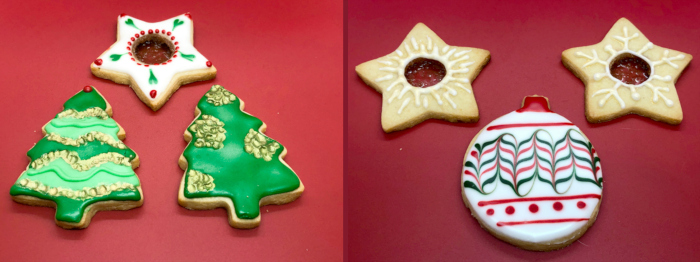
To have the stained glass effect, many recipes will tell you to simply crush hard candy in the color you want and make a little pile in the cut out part right before you bake. I found it hard to time the full melting of the candy with the cookie baking, and also the candy shrinks quite a bit and gets cloudy. Just not the type of effect I had in mind. I consulted with Tanya about it, and she advised me to use a totally different method, her favorite. Essentially you make the sugar syrup yourself, dye any color you want or leave it plain, and spoon it gently in the cut out part after the cookies are already baked. The result is so much better! Nothing like getting advice from a pro…

Here is the recipe I used, it makes enough for many many cookies, but it is hard to scale it down, so I advise you to keep the amounts as written.

SYRUP FOR STAINED GLASS COOKIES
(from The Honey Blonde)

100g sugar (1/2 cup)
3 tablespoons corn syrup
1/4 cup water
gel food color, if desired

Combine sugar, corn syrup, and water into a small sauce pan. Place over medium high heat and bring to a boil. Do not stir sugar while boiling. Continue to boil until mixture reaches about 290-300 degrees. Remove from heat and gently stir gel food color.

Place the cookies on a foil lined baking sheet lightly sprayed with oil, or use a non-stick foil. Spoon the candy into the center of the cookie, using the spoon the spread the candy into the edges of the cut out region.

Let set for about 10 minutes, or until candy is completely hardened.

ENJOY!

to print the recipe, click here

I hope you enjoyed this little collection of Holiday-inspired sugar cookies. Next I will share macaron ideas also inspired by this festive season. Stay tuned!

ONE YEAR AGO: Just a few hours to go!

TWO YEARS AGO: Broccoli Souffle

THREE YEARS AGO: Panettone Time!

FOUR YEARS AGO: How the Mighty Have Fallen

FIVE YEARS AGO: Festive Night at Central

SIX YEAR AGO: The Perfect Boiled Egg

SEVEN YEARS AGO: Light Rye Sourdough with Cumin and Orange

EIGHT YEARS AGO: Homemade Calzones

NINE YEARS AGO: Plum-Glazed Duck Breasts

TEN YEARS AGO: Holiday Double-Decker

ELEVEN YEARS AGO: New York Deli Rye
LESSONS FROM TANYA, THE FINAL CHAPTER

Third post of a series of three on Sugar Cookie Decorating

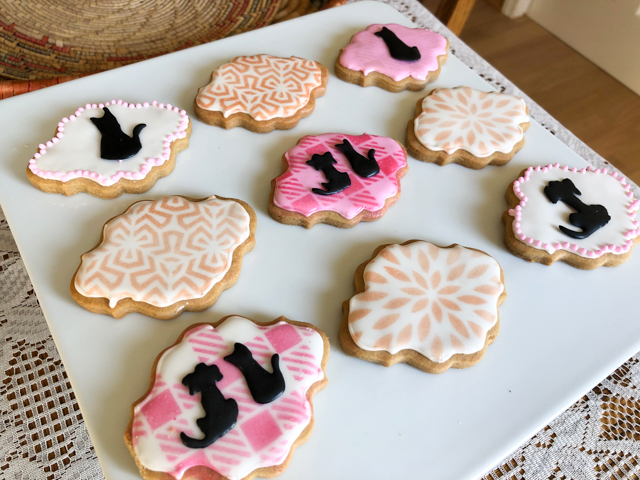
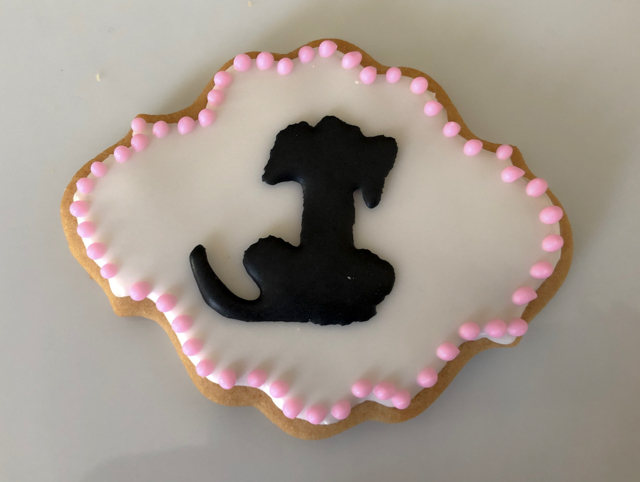
In this post, I won’t share a recipe, as I will be using the exact same one posted yesterday. I made another set of silhouettes because the pups were beyond upset by my use of felines as cookie decoration.

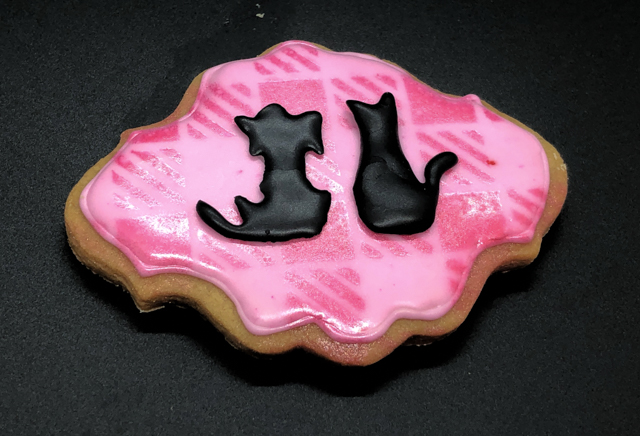
Please do not laugh of my pink dotted border. That is the one technique Tanya demonstrated and I simply could not succeed. She does the beaded border pulling the piping tip and dragging a bit alternating the direction, it looks soooo adorable. I’ve tried in two cookies, and they ended in my belly because I was forced to eat the evidence. So I just went with little dots and even that has plenty of room for improvement.

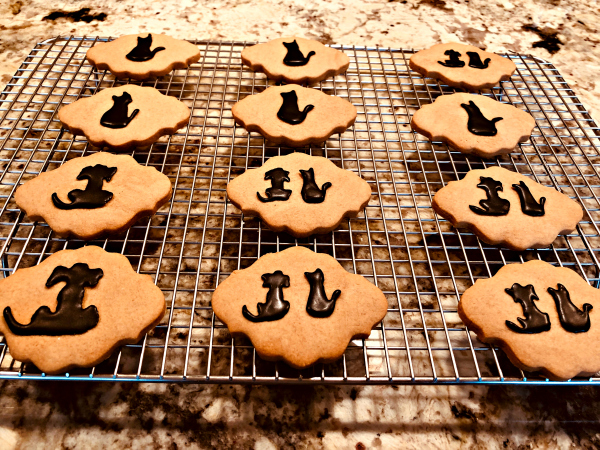
I made dogs and cats of two sizes, to either stand alone in a cookie or side by side as best friends. At least in the cookie world, such relationship is possible.

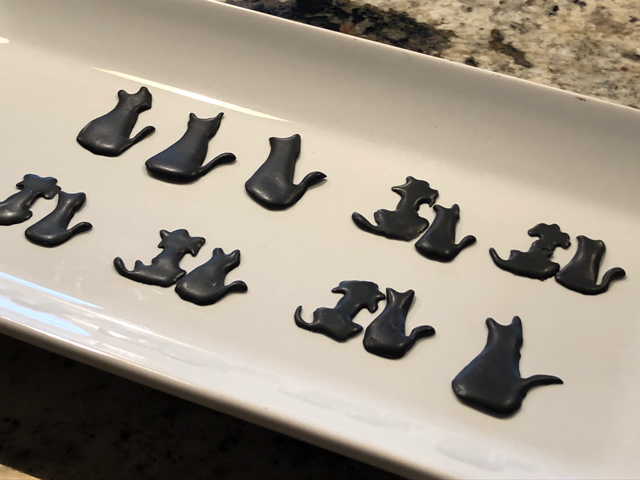
The planning stage…

In this batch of cookies, I brought my air-brush into play. So I started from the flooding technique, and allowed that to fully dry for 24 hours. Once the surface is truly solid, you can lay a stencil on top and air-brush any color and/or pattern you fancy.

After that, simply glue the silhouette, if using, or any other piping with Royal icing you feel like adding.

If you are new to air-brushing, I highly recommend this one. It has a cup that is bigger than other brands, and can also be used for cocoa butter for spraying bonbon molds (I intend to try that in the near future).

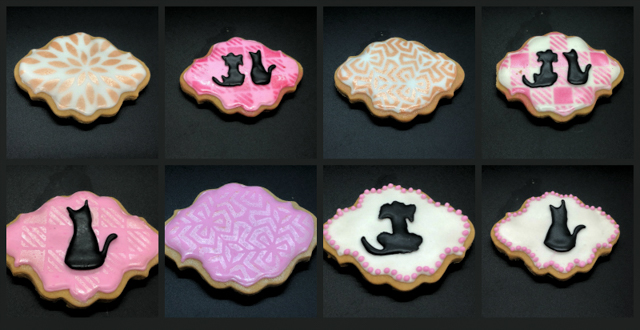
You will also need air-brush dyes, and my favorite brand is Cookie Countess. The most useful colors are the pearl types, white, gold, silver or my favorite: Rose’ Gold (which I used in the cookies without silhouettes in the group picture above).

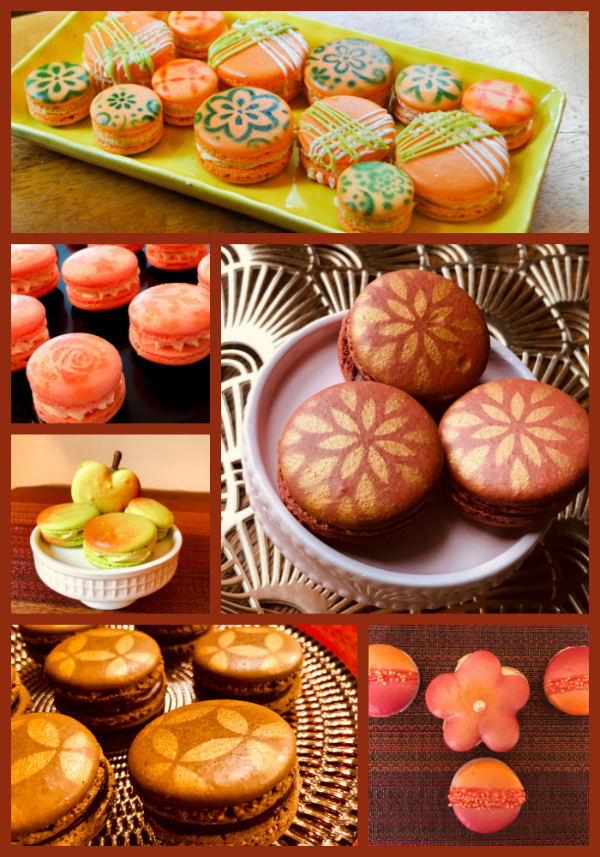
Below a little sampling of bakes from old posts and a few not yet blogged about, all decorated with air-brushing, some with stencils, some without. Speaking of stencils, etsy.com is a great source to get them.

It is really a very nice tool to play with, so if you are over the fence about getting one, consider this post a little encouragement…

I hope you enjoyed this little Trilogy of Sugar Cookies. Sugar Cookies and macarons are almost always part of my weekly bakes for Common Table meals, so I am constantly trying to find new ways to decorate them and new flavors to explore. Stay tuned for more in the near future…

LESSONS FROM TANYA: SUGAR COOKIE SILHOUETTES

Second post of a series of three on Sugar Cookie Decorating

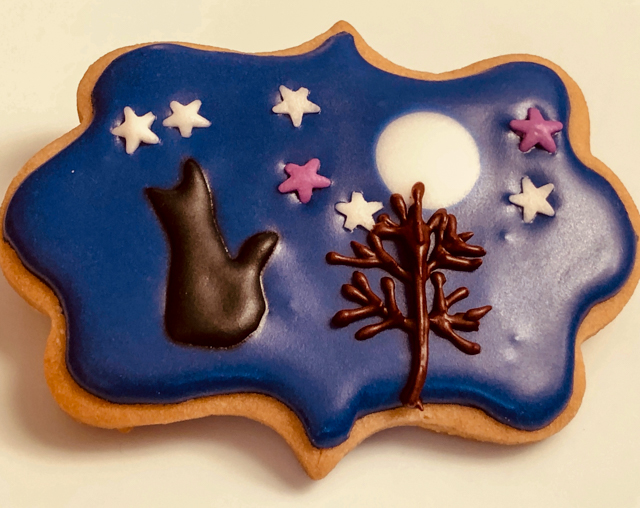
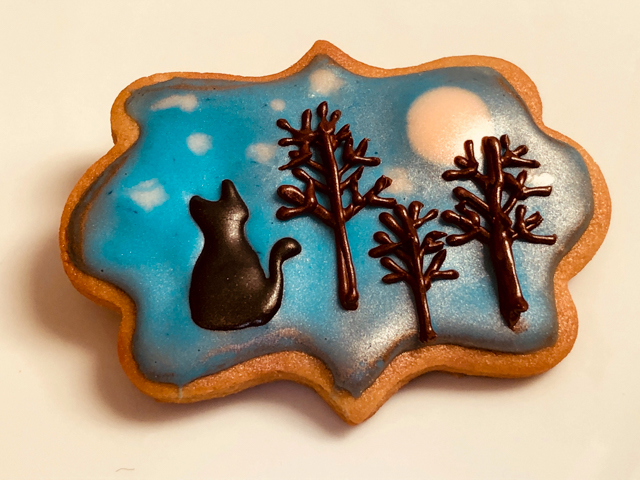
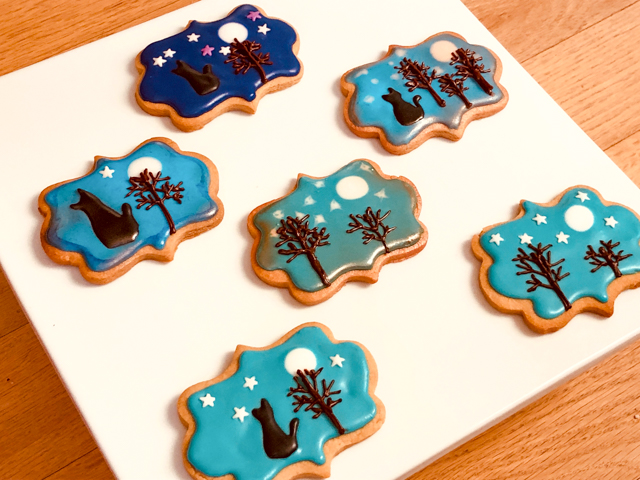
For one of her bake-along tutorials, Tanya showed how to make little silhouette details using Royal icing. They can be made way in advance (pretty much last forever) and saved to add to your cookies previously flooded and fully dry. The possibilites are endless, as you can imagine. And the great thing for us who cannot draw to save their lives, is that you can find clipart to download and print for free, adjust them to the size you want and use them to pipe your little decor. She demonstrated with a gorgeous deer’s head, I went first with a cat. She also demonstrated how to make a winter scene with a full moon and trees, so I joined both techniques in a single cookie.

BROWN SUGAR AND SPICES SUGAR COOKIES
(adapted from Bake at 350)

360g all-purpose flour
2 tsp baking powder
1/2 tsp cinnamon
1/4 tsp ginger
1/8 tsp nutmeg
1/8 tsp allspice
1/8 tsp cardamon
150g granulated sugar
50g brown sugar
226g butter, cut into chunks
1 egg
1/4 tsp salt

Heat oven to 350.

Whisk the flour, baking powder and spices, set aside.

Cream the sugars and butter. Add the egg and salt and mix until well-blended. Gradually add the flour mixture and beat just until combined. Roll on a floured surface to about 1/4″ and cut into shapes. Place on parchment lined baking sheets and freeze for 10 minutes.

Bake for 10-12 minutes, depending on the size of your cutter. Let sit a few minutes on the sheet, then transfer to a cooling rack.

Use Royal icing to decorate, recipe in previous post.

ENJOY!

Comments: There are countless sites that offer free downloadable templates for all sorts of drawings. You can then print them side by side and place a sheet of parchment paper on top of the printout. Using Royal icing with the consistency Tanya demonstrates in her tutorial and a very fine piping tip, carefully outline the drawing. Make more than you need, because they are obviously very fragile. They are best if allowed to dry overnight.

For the stars, in some cookies I used sprinkles… and in others I followed the technique demonstrated by Tanya, pulling small white dots with a needle.

That surface is allowed to dry overnight, and then the silhouette is glued, and the trees piped. In the cookie above, I used some silver air-brushing just for fun.

Here they are, all my babies! Before watching Tanya’s tutorials, I would never dream of making cookies with so many little details.

I will be back tomorrow with the final post about sugar cookies, using the same recipe (Brown Sugar and Spices). and a slightly different way to decorate them.

ONE YEAR AGO: Cherry-Chipotle Chicken Thighs

TWO YEARS AGO: White Chocolate Mini-Mousse with Sugared Cranberries

THREE YEARS AGO: You Say Ebelskiver, I say Falafel

FOUR YEARS AGO: Happy Thanksgiving!

FIVE YEARS AGO: Two Takes on Raspberries

SIX YEARS AGO: Spice Cake with Blackberry Puree & The Global Pastry Review

SEVEN YEARS AGO: Own Your Kitchen with Cappuccino Panna Cotta

EIGHT YEARS AGO: Chicken Parmigiana, the Thriller

NINE YEARS AGO: Wild Mushroom Risotto

TEN YEARS AGO: Tartine Bread:  Basic Country Loaf 

ELEVEN YEARS AGO:  Pugliese Bread

LESSONS FROM TANYA: APPLE CIDER SUGAR COOKIES

First post of a series of three on Sugar Cookie Decorating

One of the greatest benefits of being part of The Great American Baking Show was getting to know 11 baking addicts with no interest in treating their condition. A year later, we still exchange constant messages that often go beyond what is cooking in our ovens. Each of us has areas in baking we feel reasonably confident about, and areas we feel the need to improve. Tanya is amazing at gingerbread sculptures (insert a discreet tear here), and cookie decorating in general. Recently she made a series of video tutorials and by watching them and working with her favorite Royal icing recipe, I believe I improved my skills a bit. I still have issues with some techniques – those tricky beaded borders come to mind – but I will keep practicing. This is the time of the year that screams for sugar cookies and fun decorations, so visit Tanya’s site and join the spirit!

APPLE CIDER SUGAR COOKIES
(slightly modified from Global Bakes by Tanya)

226 grams unsalted butter, at room temperature
160 grams granulated sugar
1 large egg, at room temperature
1 Tablespoon vanilla extract
2 Tablespoons milk, any kind
375 grams all-purpose flour
42 grams (2 packets) Apple Cider Mix
3/4 teaspoon baking powder
1/2 teaspoon salt

In the bowl of a stand mixer, beat the butter and sugar on medium speed until smooth and creamy. Beat in the egg, vanilla, and milk until well blended.

Combine the flour, apple cider mix powder, baking powder, and salt in a medium bowl. Gradually add to the butter mixture on low speed until combined. Divide the dough in half and wrap in plastic wrap. Chill for 1 hour or for up to 3 days. The dough freezes well also.

Heat the oven to 350F. Roll one piece of dough at a time between two pieces of parchment paper (I did 4mm thickness). Cut dough with floured cookie cutters. Place 1-inch apart on silpat or parchment-lined baking sheets. Freeze for 10 minutes.

Bake until edges begin to brown, 10 to 12 minutes. Cool 2 minutes. Remove to wire rack to cool completely.

ROYAL ICING
(from Global Bakes by Tanya)

900 grams (2 pounds) powdered sugar
156 grams pasteurized egg whites
1/4 teaspoon cream of tartar
1 Tablespoon light corn syrup
Gel colors of your choice

In the bowl of a stand mixer, add the powdered sugar and cream of tartar and whisk together to combine. Add the egg whites and corn syrup and stir gently with a rubber spatula until the powdered sugar is moistened.

Put the bowl on the stand mixer and, using the paddle attachment, whisk for 1 to 2 minutes until smooth and bright white in color.
At this point, you can use the icing to assemble a gingerbread house. To outline shapes for flooding, put about 1 cup of the royal icing in a small bowl and add about ½ teaspoon water. Add another ½ teaspoon if needed to allow smooth piping. Stir until smooth.

To flood cookies inside the dried outline, put about 1 cup of the royal icing in a small bowl and add about 1 teaspoon of water. Add another ½ teaspoon water to allow smooth spreading. Stir until smooth and combined.

Add gel colors as needed for your planned decorations.

ENJOY!

to print the recipe, click here

Comments: This was the first time I managed to work with different consistencies of Royal icing and get them to behave the way I hoped. Tanya shares quite a few tips to judge the consistency and adjust it, so I highly recommend you to watch her videos, particularly the ones that she made for a Bake Along session last month.

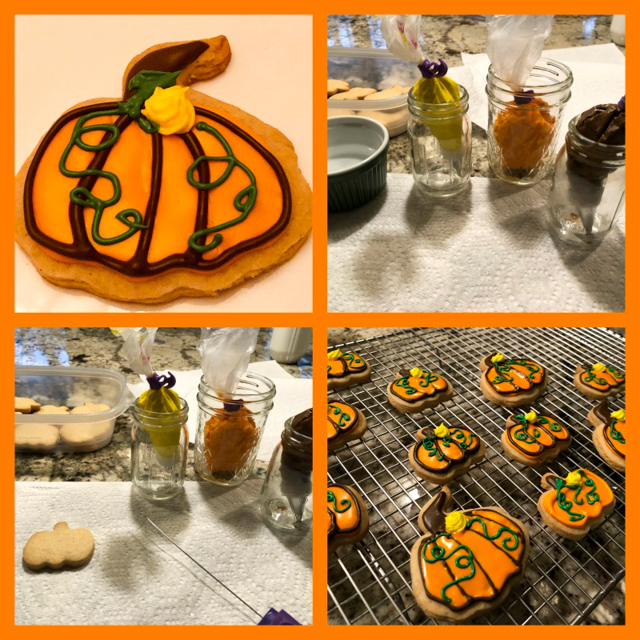
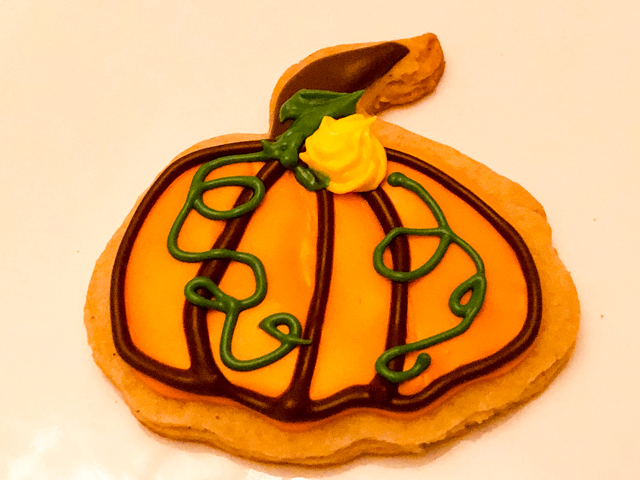
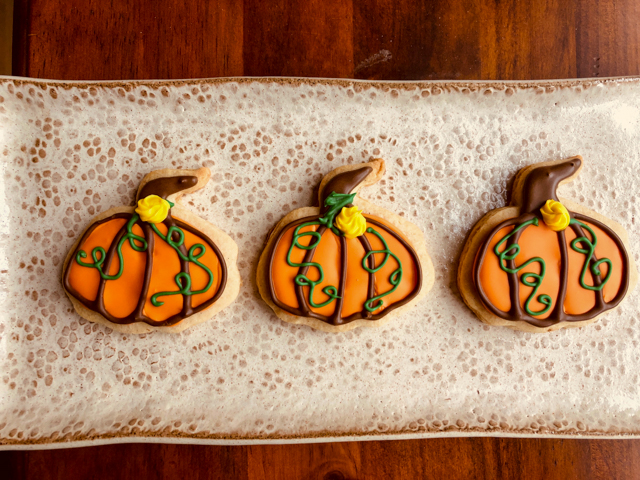
For this pumpkin, the yellow had a stiff consistency so that a rosette piped with a little open star tip would retain the ridges well. The green and brown were just a tad softer, and the orange more fluid (what is usually described as flooding consistency). The segments of the pumpkin are flooded independently so that they don’t join together. So for the example above, there are 4 sections, and just like Tanya demonstrates in her video, the idea is to flood area #1 and #3, wait about 10 minutes and flood regions #2 and #4. Ten minutes more and you will be ready to add the brown and a little later the final details in green and yellow.

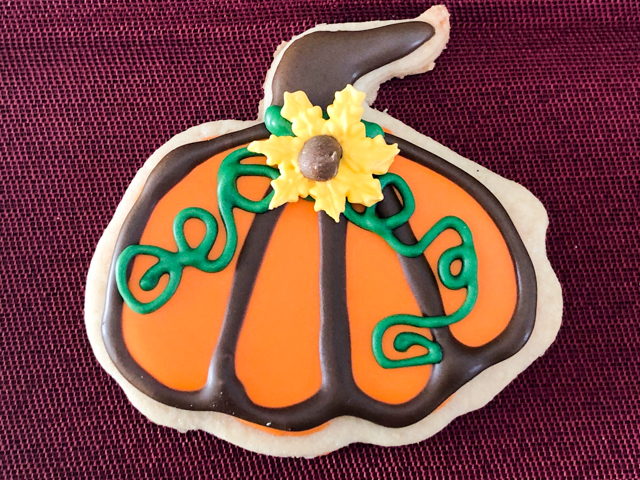
You can also make rosettes and let them fully dry, adding them to the cookie with a little drop of royal icing as glue. These rosettes had been made months ago (remember this post?) and I just brought them to play.

In her Bake Along tutorial, Tanya taught a pretty cool alternative style for a pumpkin cookie, and I loved her idea. Start with a white pumpkin, and go with piping dots for the details. How cute is that?

Once again, segments are piped independently (#1 and 3 first, #2 and #4 last) and once that sets a bit, the brown stem and the colorful dots are added.

If you watch Tanya in action and see her finalized cookies, you’ll see I need a lot more practice, but… baby steps are still steps, right?

That’s all for now. Tomorrow I will share two other techniques I learned from Tanya, so stay tuned!

ONE YEAR AGO: Cherry-Chipotle Chicken Thighs

TWO YEARS AGO: White Chocolate Mini-Mousse with Sugared Cranberries

THREE YEARS AGO: You Say Ebelskiver, I say Falafel

FOUR YEARS AGO: Happy Thanksgiving!

FIVE YEARS AGO: Two Takes on Raspberries

SIX YEARS AGO: Spice Cake with Blackberry Puree & The Global Pastry Review

SEVEN YEARS AGO: Own Your Kitchen with Cappuccino Panna Cotta

EIGHT YEARS AGO: Chicken Parmigiana, the Thriller

NINE YEARS AGO: Wild Mushroom Risotto

TEN YEARS AGO: Tartine Bread:  Basic Country Loaf 

ELEVEN YEARS AGO:  Pugliese Bread

A DIFFERENT KIND OF COOKIE SWAP

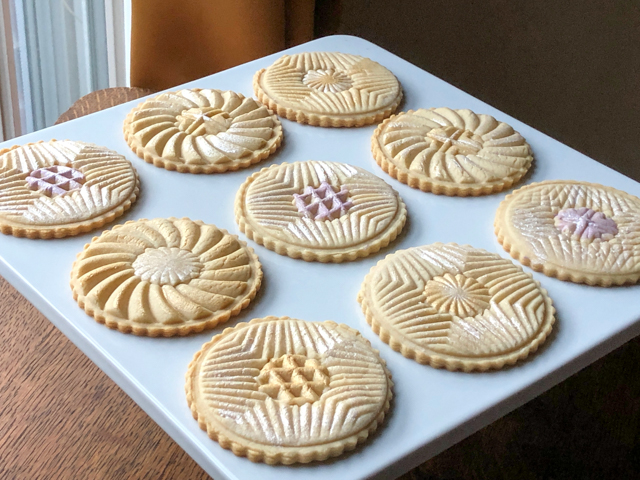
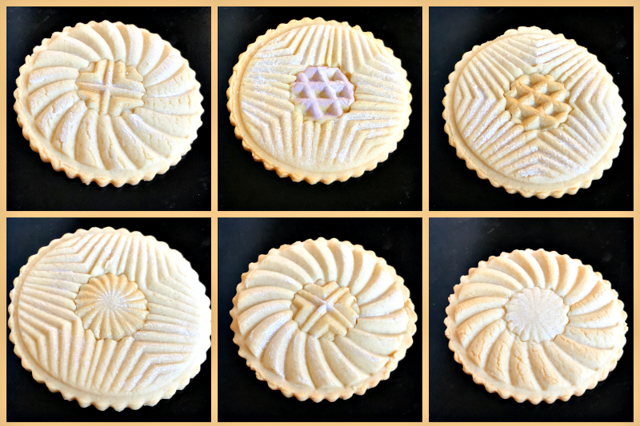
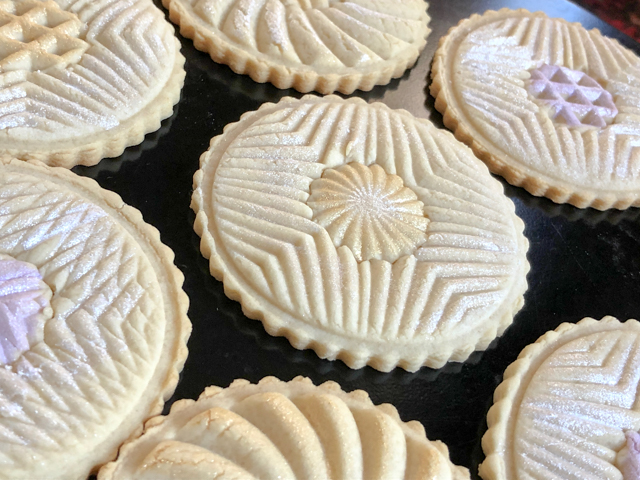
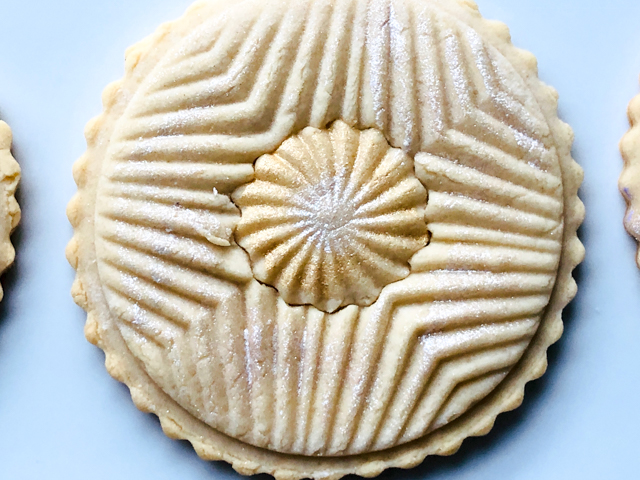
I like to keep the blog varied. Never two bread posts in a row. Never two savory recipes in a row. But never say never, as I am about to break my own rules. My latest post involved cookies, and here you have another one. But, but, but…. I got so excited about this, I cannot wait to share. A cookie swap that is not quite what you think: you swap portions of a stamped cookie dough, forming a totally new pattern. I keep thinking about all the possibilities of mixing and matching. Shapes, designs, colors, cookie formulas (think chocolate and vanilla for a shocking color contrast).

MIX-AND-MATCH LEMON SUGAR COOKIES
(inspired by several sources)

113g unsalted butter (1/2 cup)
30g egg (whisk one egg and measure the amount)
1/4 cup honey (about 60 mL)
zest of 1/2 lemon
1 teaspoon lemon extract
50g granulated sugar
1/8 teaspoon salt
320g all-purpose flour

to decorate (optional):
vodka or everclear or lemon extract
dust luster powder in gold, pearl white, or any desired color

Melt the butter and set aside to cool slightly, but do not let it get solid.

Beat the 30g egg in the bowl of a Kitchen Aid mixer bowl until the yolk and white are fully mixed.  Add the honey, and lemon flavoring. You can do this step by hand using a whisk.

In another bowl, mix the sugar with the lemon zest and rub the zest with your fingers to release all the oils. Add the salt, then incorporate the mixture into the egg using the flat beater of the Kitchen Aid in medium-speed. Beat well, then slowly add the melted butter, constantly mixing.

Add flour (reserve about 1/2 cup) in very low-speed and mix in until you have a dough that is solid enough to knead. Remove the dough from the Kitchen Aid and add the rest of the flour by hand, you may not need the full amount. Pat the dough into a disc, wrap in plastic and place in the fridge for 30 minutes.

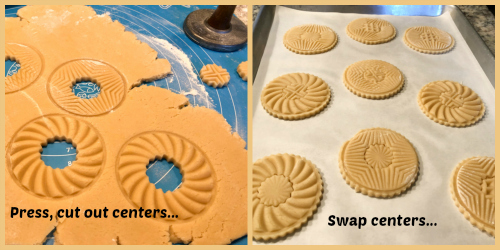
Roll it out to a thickness compatible with your cookie press, then press two or three patterns using any type of design you like. Using a small round cookie cutter remove the centers and swap them, as shown in this picture:

Freeze the cookies on a baking sheet lined with parchment paper for 15 minutes while you heat the oven to 350F. To avoid distortion of the cookies during baking, transfer the frozen cookies to a room temperature sheet, using the parchment paper to move them.

Bake for about 12 minutes, until edges start to get golden, but do not over bake. Let them cool for a few minutes on the baking sheet, than remove to a rack to cool completely.

If desired, use luster dust powder mixed with vodka or lemon extract to paint the surface.

ENJOY!

to print the recipe, click here

Comments: I am over the moon with these! You don’t have to go through the additional step of painting them, the pattern looks nice even if the cookies are kept plain, but I love working with luster dust. There is no need for precision, each cookie turns out a little different.

You can use any recipe that keeps the shape during baking, and always freeze the cut cookies before sticking in the oven. Another thing to keep in mind is to transfer the frozen cookies to a room temperature baking sheet, because sometimes baking them over a frozen cookie sheet might cause warping. By transferring to a room temperature surface, you avoid that problem.

I cannot take full credit for this idea. I am a member of a great cookie group on Facebook (Molded Cookies of the World) and the moderator (Dawn Williams) has been playing with different cookie molds, joining them together. I decided to try it with the cookie stamps from Nordicware. They are sturdy, wonderful to use, and every single swap I did worked perfectly.

I am already planning my next batch… and the one after that…

ONE YEAR AGO: Scary Good Recipes for your next Halloween

TWO YEARS AGO: Pumpkin Sourdough

THREE YEARS AGO: First Monday Favorite

FOUR YEARS AGO: Secret Recipe Club: Paalak Paneer, a Farewell Post

FIVE YEARS AGO: In My Kitchen, November 2015

SIX YEARS AGO: Helen Fletcher’s Oatmeal Cookies

SEVEN YEARS AGO: Thai-Style Pesto with Brown Rice Pasta

EIGHT YEARS AGO: Shrimp with Spicy Orange Sauce

NINE YEARS AGO:  A Simple Appetizer (Baked Ricotta)

TEN YEARS AGO: Sour Cream Sandwich Bread

ELEVEN YEARS AGO: Pasta with Zucchini Strands and Shrimp