CARROT AND CUMIN HAMBURGER BUNS

Hamburger Bun1
I’ve been baking bread for many years, and of course I’ve had my share of failures.  However, I have yet to meet one recipe from Dan Lepard that didn’t work.  Dan knows his way around all things yeast and sourdough, so whenever I’m in the mood to try something out of the ordinary he is my number one source of inspiration.  This recipe is from his book Short and Sweet, which I reviewed in the past.  I am always fond of anything with carrots, and thought that incorporating them in a soft bread perfumed with cumin would lead to something awesome.

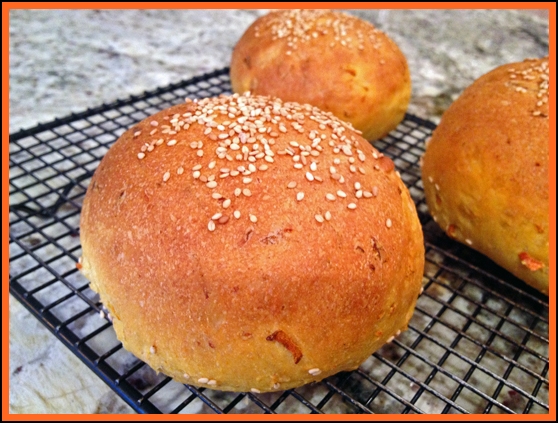
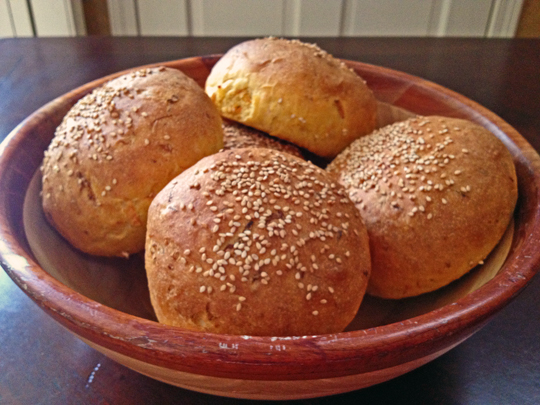
Look at these babies! Plump, golden, and so very fragrant…

Carrot and Cumin Hamburger Buns

If you want the recipe but do not own his book, you can find it at The Guardian website with a quick jump here. Or you can do even better and order your own copy.  😉

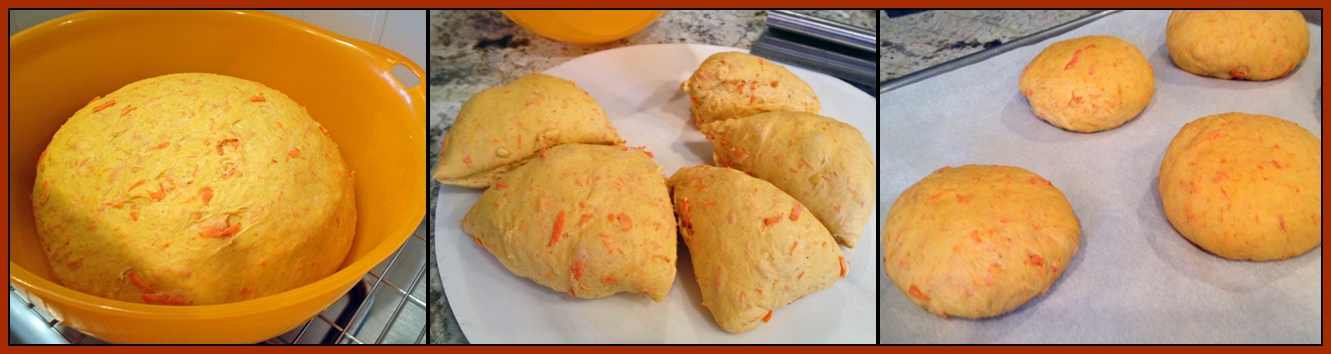
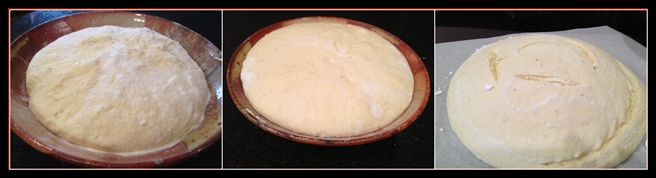
composite
I loved making these buns!  They flow in the opposite direction of a sourdough, as Dan uses fast-rising yeast for the dough.  The only tough part was grating the carrots, I think my box grater is getting a little old and dull. I don’t like to buy pre-grated carrots, I think they are too bulky and overly dry. Not the best option for this type of recipe.

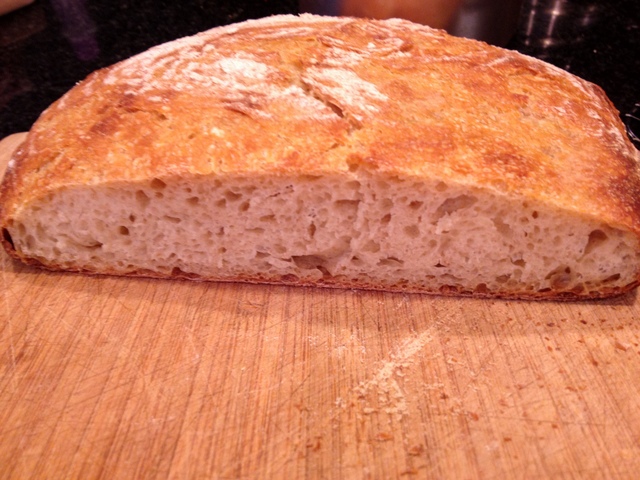
I made 5 buns, one of them larger than all others, as I wasn’t sure how much oven spring they would have.  Next time I will cut the dough into 6 equal pieces, the resulting size is perfect for a hamburger.

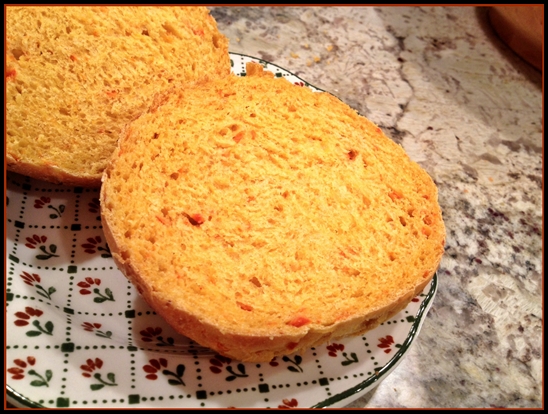
crumb

I am submitting this post to Susan’s Yeastspotting event…

ONE YEAR AGO: Potato Galettes a l’Alsacienne & Book Review

TWO YEARS AGO: Caramelized Carrot Soup

THREE YEARS AGO: Miso-Grilled Shrimp

FOUR YEARS AGO: Pain Poilane

LIGHT RYE SOURDOUGH WITH CUMIN AND ORANGE

Where are the virtual fireworks when I need them? After months of neglect, my sourdough starter was brought back to the kitchen! I actually tried baking bread once a few weeks ago, but when I attempted to revive the sourdough “chips” I had prepared, the resulting starter refused to cooperate: it was sluggish, slow, not at all vibrant. This time I went back to my frozen little balls of starter and they jumped right back into action. For my first bread made in the Supernova, I chose a recipe from TxFarmer, who runs two blogs, one in Chinese and another at The Fresh Loaf Forum. She is very creative and always pushes the boundaries of sourdough baking. Without further ado, this is the first bread born in the confines of our new oven…

Orange Cumin Sourdough

LIGHT RYE SOURDOUGH WITH CUMIN AND ORANGE
(slightly adapted from TxFarmer’s recipe)

*Makes 1 X 700g loaf

Levain
68 g  dark rye flour
54 g water
4 g rye starter at 100% hydration

Mix and rise at room temp for 12 to 16 hours.

Final Dough
386 g bread flour
9 g salt
grated orange peel from 1 large orange
fresh orange juice from 1 orange plus water to 245 g
1/2 Tbsp cumin powder
122 g levain mixture

Mix everything except for salt, autolyse for 40 min.  Add salt and knead in a KitchenAid type mixer at medium speed for 4 minutes.

Bulk rise at room temp (~78F) for about 2.5hrs, with stretch and fold  at 30, 60, and 90 minutes.

Pre-shape into a ball, let the dough rest for 10  minutes, then shape and place in a floured banneton for the final rise.

Proof until the dough springs back slowly when pressed. It took me 2 hours and 20 minutes.

Bake at 450F for 40 to 45 minutes, the first 25 minutes with steam. Let it cool completely on a rack before slicing.

ENJOY!

to print the recipe, click here

Comments: This is a bread that screams for a bowl of chili, and that is exactly what I made on a Sunday afternoon.  I used our favorite recipe that simmers on the stove top for hours, but we did not touch it until next day.  That chili is good on the day it is made, but it turns into spectacular the day after.  Plus, what can be better than arriving home from work on a chilly Monday, and have dinner basically ready and waiting for you?

withChili

TxFarmer description of this baby was spot on, by the way.  The orange gives it a slight hint of sweetness, but the sourdough character of this bread is there.  The cumin is the touch of genius that makes this loaf superb with a bowl of chili or any type of spicy stew.  I could not have chosen a better loaf to inaugurate our Supernova!

I am submitting this post to Susan’s Yeastspotting

loaf1

ONE YEAR AGO: Homemade Calziones

TWO YEARS AGO: Plum-Glazed Duck Breasts

THREE YEARS AGO: Holiday Double-Decker

FOUR YEARS AGO: New York Deli Rye

SEMOLINA SOURDOUGH BOULE

Having recently exorcised a few of my sourdough demons, I am happy as a clam baking bread every weekend.  This version is an adaptation of a formula that called for 100% durum semolina flour.  I took a small step back by including some regular flour in the mix, just a tad.  The dough is mixed the day before baking and rises for 12 or more hours in the fridge.   The semolina flour – which must absolutely be the correct type – gives the crumb a yellow hint, and takes the taste of the sourdough into a new direction.   A simple bread, with delicate flavor, but a hearty crust just like expected from a rustic sourdough.

loaf1

SEMOLINA SOURDOUGH BOULE
(adapted from Michele, at  The Fresh Loaf Forum)


to make the levain:
35 g sourdough starter at 100% hydration
140 g water
140 g  Semola  di Grano Duro Rimacinata
(you will use all the starter, make sure to save some of your leftover)

for final dough:
350 + 50 g water
4 g of diastatic malt powder
400 g semolina flour (Semola di grano Duro Rimacinata)
160 g bread flour
13 g salt

 Make the levain 10 hours before preparing the dough.  Mix all ingredients and leave at room temperature for 10 hours.

When the starter is ready, mix 350 g water with the malt and the starter (all of it).   When well combined, add the semolina, and the bread flour, mix until a shaggy dough forms.  Let it rest for 20 to 40 minutes.

Add the salt and the remaining 50 g water.  Mix well (you can use a Kitchen Aid type mixer for 2 to 3 minutes in low-speed if you prefer).

Let the dough ferment at room temperature for 2 hours, folding the dough every 30 minutes.  After the last folding, leave the dough undisturbed for 20 minutes.

Shape the dough as a ball and place in a floured round container.  Leave at room temperature for 20 minutes, then refrigerate for 16 to 20 hours.

Remove the dough from the fridge 1 to 2 hours before baking in a 450F with steam for 20 minutes, then reduce the temperature to 430F and bake for 25 minutes longer, until dark brown.

Cool completely on a rack before slicing.

ENJOY!

to print the recipe, click here

crumb2

Comments:  If you are new to sourdough baking, this bread could be a bit challenging.   The semolina flour makes the dough pretty soft and very moist, it could scare a beginner into adding too much flour during handling.  The original recipe called for only three cycles of folding, but I added one more. The dough asked for it, it had not developed enough “muscle” at the third folding cycle.    I’ve been having trouble with my bread sticking to the banneton in long rises, so this time I took a different path and placed it inside a ceramic bowl heavily coated with rice flour.

composite

It worked really well, the bread expanded a bit during the overnight stay in the fridge, and had a nice shape after baking.  I left it at room temperature for a little over 2 hours before baking.

I wish I knew how to score the bread to get the amazing “flower effect” that Michele obtained, but until I see some type of tutorial for it online, I’ll have to accept a more old-fashioned, rustic type scoring.   Take a look at Michele’s full post about it and marvel at his technique…  I suspect the blade needs to be almost parallel to the surface of the dough instead of slashing deeply into it.

__________________________________________________________________________________________________________________________________

I am submitting this post to Susan’s Yeastspotting

__________________________________________________________________________________________________________________________________

ONE YEAR AGO: Forgive me, for I have sinned

TWO YEARS AGO: Cracked Wheat Sandwich Bread

THREE YEARS AGOAu Revoir, my Bewitching Kitchen

FOUR YEARS AGO:  French Bread

SOURDOUGH BLUES

For the past few months the Bewitching Kitchen witnessed my silent struggles with bread baking.  Re-phrasing that, for the past few months the Bewitching Kitchen witnessed a full-fledged bread baking debacle!   Yes,  a few floured banettons flew across the Bewitching Kitchen.   Yes, the lives of several loaves quickly came to a violent end as crouton-material on the chopping board.  Yes, Phil received text messages stating that I would never ever EVER bake sourdough again, and I needed him back home so I could cry on his shoulder.  I was miserable, confused and frustrated, feelings  I normally associate with golf, not bread baking.  Life can be cruel.

The deterioration in my baking happened slowly.  A slightly less plump loaf here, a tighter-than-expected crumb there.   Then, suddenly, no matter what I did my boules became pancakes.   Flat, … they were flat!.  No oven spring to speak of, and scoring the surface was like make-up at the undertaker’s,  … it made no difference in the loaf.  The crumb below was actually one of my better “pancake-loaves.”  Most had a much tighter crumb, leaving me too upset and disgusted to even bother taking a picture.
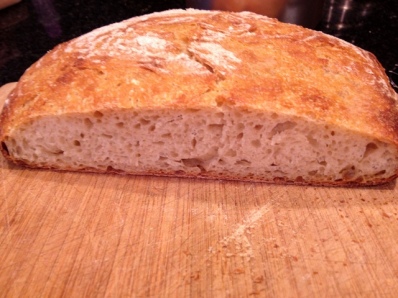
here

At a  loss,  I posted a message to Dan Lepard’s Appreciation Facebook page, and David W. came to the rescue.  Much like a therapist holding the hand of a patient, he listened to my saga and concluded that the problem related to storing my starter in the fridge.  Slowly, the complex microbial population in the starter had changed, leaving me with a less than ideal mixture to start bread with.  Several people advised me to discard the sourdough and start all over again, but I didn’t want to consider that route.  I’m too attached to Dan, the starter I captured and kept for four  and a half beautiful years.  That explains why I threw a massive fit at Phil when he insisted that a starter “is just flour and water“.  Can you imagine hearing THAT?  I know, it goes beyond insensitive.   But David provided the light at the end of the tunnel, with a  “revival protocol” for my starter.  Guess what happened on my first loaf?
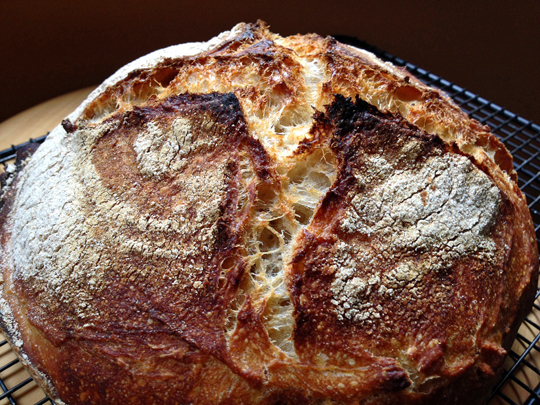
boule1White Levain Sourdough Bread, a classic recipe from Dan Lepard’s Handmade Loaf


SOURDOUGH STARTER RECOVERY

(from David, at Dan Lepard’s Appreciation Facebook page)

For 7-10 days, discard all but a small spoonful of the starter, and feed the starter by adding 70g organic rye flour + 100 g water.  Keep it out in the kitchen, not in the fridge.

After the 7-10 days, reverse the refreshment proportions to form a dough:  175g organic rye flour + 125 g water.   After 12 hours, bake with as much as you need, by either adjusting your bread recipe to compensate for the thicker starter, or refreshing it again at the hydration level called for in the recipe.  Freeze small portions of the thick starter for future use.

You can keep your dough-consistency starter at room temperature, refreshing it weekly, or thaw one of those small portions a couple of days before baking, refreshing it daily (always at room temperature).

_________________________________________________________________________________________________________________________________________________
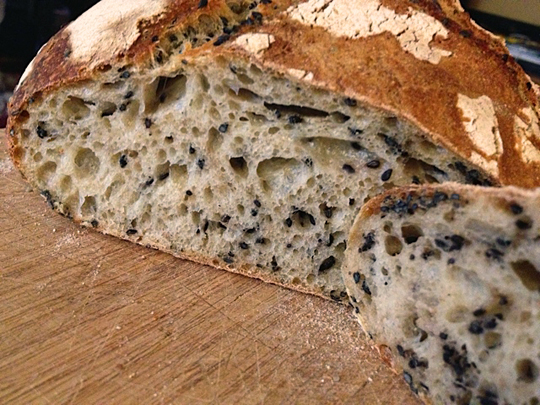
I was so excited about getting back my “sourdough mojo”, that the following day I baked another loaf, a recipe adapted from Tartine.

_________________________________________________________________________________________________________________________________________________

blacksesamecrumbCan you look at this crumb and not shed a tear or two of pure joy?


BLACK SESAME SOURDOUGH

(adapted from Chad Robertson Tartine)

For the starter:
50g  spelt flour
50g white flour
100g/ml water at 78-80F
1 Tbs active sourdough starter

For the dough:
375g/ml water at approximately 80F (divided in 350g + 25g)
100 g starter (you won’t use the full amount made)
440g white flour (good quality all-purpose is fine)
60g spelt flour
10g salt
1/3 cup black sesame seeds

In a large bowl, mix 350g of warm water with the starter (100g of it), and mix to dissolve. Add both types of flour, mix until all flour is mixed with water, without large dry bits present.  Let the dough rest for 25 to 40 minutes.

Add the salt and the rest of the water (25g), and incorporate by pressing the dough with your fingers. Fold the dough a few times, until if forms a homogeneous mass, but don’t try to knead it.  Leave it in the bowl, folding it again a few times – no need to remove it from the bowl – every 30 minutes, for the first two hours (you will be making 4 series of folds during this period).  Add the sesame seeds to the dough on your first folding, after all the water and salt has been incorporated.  After the last folding cycle, let the dough rest undisturbed for another full hour, for a total of 3 hours of “bulk fermentation.”

Remove the dough from the bowl and shape it gently as a ball, trying to create some surface tension (for a tutorial, click here).  Let it rest for 20 minutes, then do a final shaping, by folding the dough on itself and rotating it.  If you have a banneton, rub it with rice flour, line it with a soft cloth sprinkled with rice flour, and place the dough inside it with the seam-side up. If you don’t have a banneton, any round container – like a colander – will do. Let it rise for 3 to 4 hours at room temperature.  Twenty minutes before baking time, heat the oven to 450F.

Cut a piece of parchment paper that will completely cover a pie baking dish and place it on top of the banneton containing the bread dough.   Carefully invert the banneton  over the parchment paper, using the pie plate to support the dough.  The cloth will probably be sticking to the dough, so carefully peel it off.  Score the bread, and place the pie pan over baking tiles in the pre-heated oven.

Bake for about 45 minutes, covered during the first 20 minutes, remove the cover for the final 25 minutes.

Let the loaf cool completely on a rack before slicing.

ENJOY!

to print the recipe, click here

Comments: I’ve been working with bacteria for 30 years, and one of the things we know too well is not to store it in the fridge.  Some strains of E.coli develop a capsule, a heavy coating of polysaccharides once exposed to cold temperatures, and they become pretty tricky to work with, particularly if you study what we do: their outer membrane proteins.  We tell the students all the time to avoid keeping their plates in the fridge, if a strain is worth preserving it should be immediately frozen at – 70 C.  So, it was ironic that I never thought twice about keeping my sourdough starter in the fridge for years and years, without making a “backup” stock in the freezer.  Never again.

I hope that if you bake with sourdough, this post will help you out in case of problems.  Make a few balls of very thick sourdough starter and store it in the freezer. Label that bag, by the way… you don’t want to look at it months from now and decide it’s some unknown creature that got into your freezer when no one was paying attention.  And then proceed to toss it in the garbage!   😉

I am submitting this post to Susan’s Yeastspotting

ONE  YEAR AGO: Headed to Hawaii

TWO YEARS AGO: A yummy Brazilian cake: Bolo de Fuba’

THREE YEARS AGO:  Hidden Treasure

FOUR YEARS AGO: Avocado Three Ways

MEXICAN FOCACCIA

Recently I took the liberty of calling an avocado dip as “hummus”, and now I will push the envelope once more and share with you my Mexican focaccia.   If you’ve been around my blog for a while, you know I am crazy about all things bread. Focaccia is a favorite in our home, because it is so simple to put together: no kneading, no complex shaping, just a simple flat bread that you can cut in squares and bring to parties, potlucks, or save it all for yourself…  The inspiration for this twist on focaccia came when I had leftover tomatillo sauce from Marcela’s enchiladas suizas.  As to the basic focaccia recipe, you can find it here.

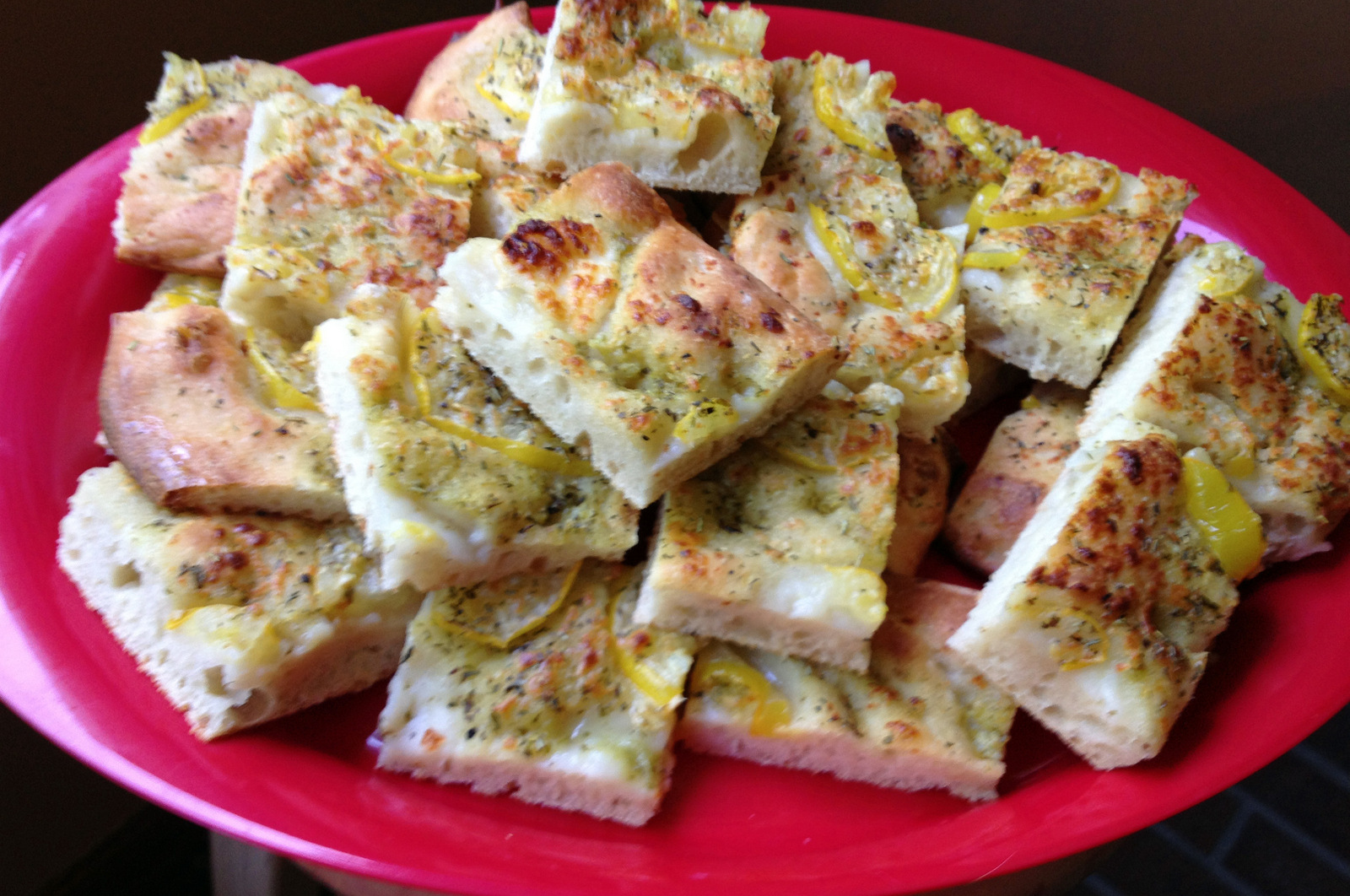
pieces

What you will need…

…. your basic focaccia recipe

…. good quality olive oil

…. tomatillo sauce a la Marcela Valladolid

…. yellow tomatoes, sliced thin

…. Mexican oregano

…. crumbled Cotija cheese

…. Maldon salt flakes

Once you make the dough and open it on the baking sheet, pour some olive oil on the surface, make indentations with your fingers.  Spread a nice coating of tomatillo sauce,  layer yellow tomatoes on top.  Sprinkle oregano, Cotija cheese, a little salt.   Bake as instructed in the original recipe.

Let it cool on a rack, cut in squares and ENJOY!!!!!   😉

served

I am submitting this post to Susan’s Yeastspotting

ONE YEAR AGO: Sunny Kamut Salad with Roasted Lemon Vinaigrette

TWO YEARS AGO: Pane de Casa & Crostini

THREE YEARS AGO: Down-home Dig-in Chili

FOUR YEARS AGO:  Cinnamon Rolls