THE DAISY: A BREAD WITH BRIOCHE ALTER EGO

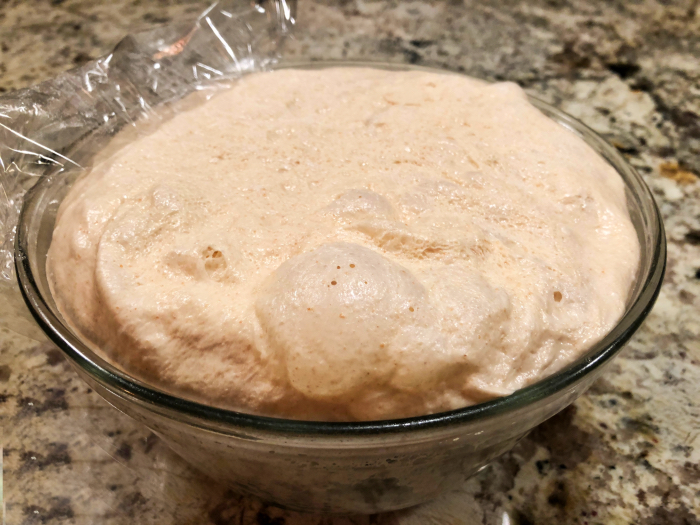
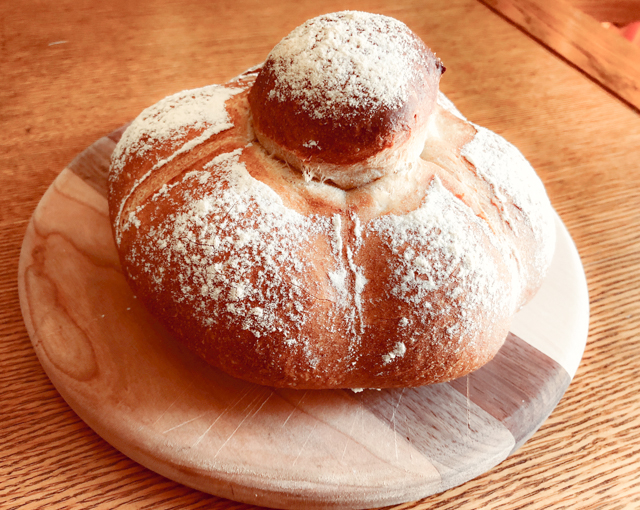
This bread is made with a very simple dough. No wild yeast, no extensive cycles of kneading, just your trusty commercial yeast, a few minutes in the Kitchen Aid, and a nice sleep in the fridge. It’s all about the shaping, that results in a flower-shaped bread. Think daisy. But both times I’ve baked it, the oven-spring was so spectacular that I thought I had made a brioche instead.
THE DAISY BREAD
(adapted from Craftsy online class by Ciril Hitz)

430 g bread flour
50 g spelt flour
320 g water
2.5 g instant yeast
10 g salt

Mix all the ingredients on low-speed in a stand mixer fitted with a dough hook. Start at low-speed for a couple of minutes, increase to medium-speed and mix for 6 minutes more.

Transfer the dough to a lightly oiled bowl, cover loosely with plastic wrap, and leave at room temperature for 30 minutes.  Place the bowl in the fridge overnight, but after two hours, punch the dough down, and cover again.

Next morning, remove the dough from the fridge and let it sit at room temperature for 30 minutes. Remove a small portion of about 35 g of dough and roll as a ball.  Shape the rest of the dough as a large ball.

Use a wooden dowel to press down the sections of a daisy flower. Add the small ball to the center.  Sprinkle a nice coating of flour, and let the dough proof for 60 to 90 minutes.

Bake at 470 F  in an oven with initial steam for 30 to 35 minutes. Cool completely before slicing.

ENJOY!

to print the recipe, click here
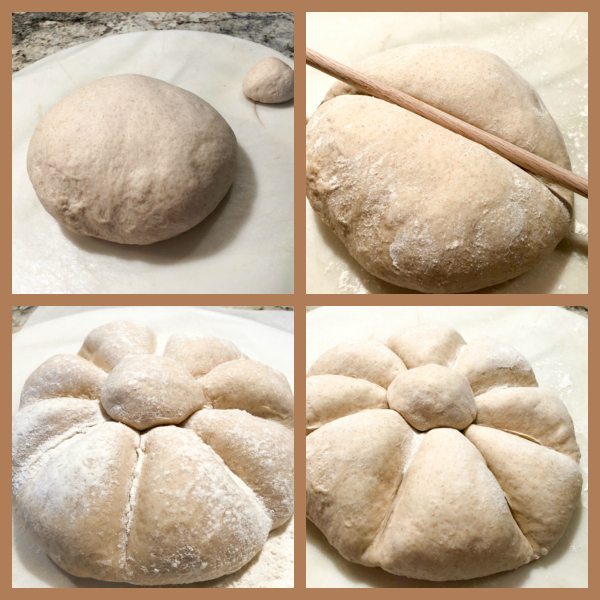
Comments: This is another nice shaping I learned taking the online class offered by Craftsy with Ciril Hitz (link under the recipe title, in case you missed it). I still have one more bread from that class to tackle, but that one is a bit more involved. The Daisy shaping is simple and fun. However, his bread was happy to be a flower, had no hidden intentions of imitating a brioche. He told me that perhaps a longer proofing after shaping would take care of that. I haven’t re-visited the issue. There are so many breads out there waiting for me…. But if you try it, keep that in mind.
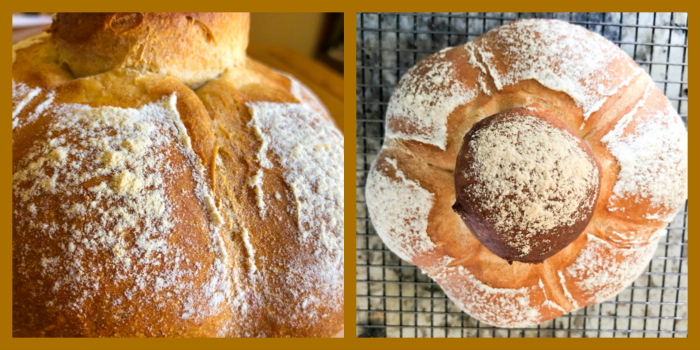
I love Ciril’s class, he has a very serene personality, which goes well with bread baking. Come to think of it, it’s a bit of a stretch to apply serene to my own self, but that might explain why you don’t see me making videos of what happens as I bake. If you are over the fence about getting Craftsy classes, give them a try.  I think they are fantastic. Just make sure you read the reviews about each one. Also, they often have specials with huge discounts. I wait for those before  indulging.

The crumb is on the tight side, as expected for a lower hydration dough. It is a delicate balance to achieve when you want to focus on shaping. Higher hydration bread gives you a lighter texture, but it will be tricky to make them hold the shape.  I think both kinds of bread have their spot in the kitchen. And, between you and me, a tighter crumb is perfect to grab the last bit of a lusciously flowing egg yolk…
ONE YEAR AGO: Pork Tenderloin, Braciole Style

TWO YEARS AGO: Raspberry Buckle

THREE YEARS AGO: Seafood Gratin for a Special Dinner

FOUR YEARS AGO: Cooking Sous-Vide: Sweet and Spicy Asian Pork Loin

FIVE YEARS AGO:  Farewell to a Bewitching Kitchen

SIX YEARS AGO: In My Kitchen. June 2012

SEVEN YEARS AGO: Goodbye L.A.

EIGHT YEARS AGO: 7-6-5 Pork Tenderloin


SaveSave

SaveSave

SaveSave

SaveSave

SaveSave

SaveSave

SaveSave

SaveSave

SaveSave

FRENCH STYLE BAGUETTES

I have never met any person living in France who worries about baking baguettes at home. Why would anyone do so, when they can walk a few steps from the front door and find the very best examples, fresh from the oven? But when you live in the US the situation is totally different. The stuff you see sold as “baguettes” could bring Paris back to 1789. Some, if held up, will fold. Wrap your mind around that. A baguette with such poor inner structure, with so much stuff added to the dough to prolong its sorry life, that it folds under its own weight. I have a few recipes for baguette in the blog already, but decided to bite the bullet and try America’s Test Kitchen version. I say bite the bullet because, as my friend Cindy always says, their recipes ensure that you will dirty every single pan, bowl, utensil you have. They don’t cut corners. They create them. In the case of their baguettes, the issue is not so much messing up stuff, but the timing and super detailed instructions. You can find the full recipe in their site, I will give just a very minimal overview, as I could not get permission to publish their method.

FRENCH BAGUETTES
(from America’s Test Kitchen)

¼ cup (1⅓ ounces) whole-wheat flour
3 cups (15 ounces) all-purpose flour
1 teaspoon instant yeast
1 teaspoon diastatic malt powder (optional)
1½ teaspoons salt
1½ cups (12 ounces) water

OVERVIEW OF THE METHOD

Make a dough with all ingredients by kneading with a mixer for about 7 minutes. Leave it at room temperature and knead by folding three times, letting the dough rest for 30 minutes in between folding cycles. Refrigerate overnight.

Remove dough from fridge, divide in half, work with half the dough at a time. Follow their precise measurements to obtain four portions of dough.


They will instruct you to pre-shape the dough, minimizing how much you handle it, and with a lot of waiting time in between each manipulation, including the final shaping and stretching to a size compatible with home ovens.

After a final rise of 45 to 60 minutes, the baguettes will be ready for a 500F oven, baked for 5 minutes covered with a disposable aluminum baking pan (excellent method to create steam), and uncovered for the final 15 minutes for proper browning.

for full recipe, visit this site

You will be able to bake two baguettes at a time. I did not bother retarding the two last baguettes in the fridge, as the baking takes a reasonably short time.  Overall, it is a good recipe, just pretty convoluted in terms of all the instructions given for handling the dough.

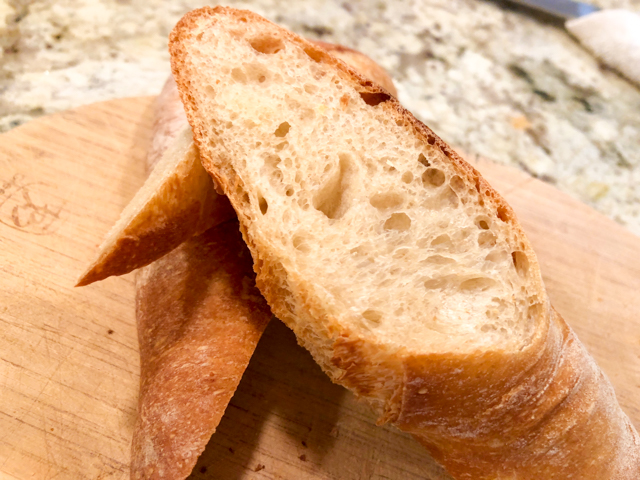
The inner crumb had the uneven holes that are the mark of a good baguette, but I expected a slightly more open structure. Taste was pretty spectacular, I think the proportion of whole wheat and all-purpose flour is perfect.  I will probably do a few changes in the way I shaped it, because I suppose a bit more surface tension could be better, two of the baguettes were not as round as I would like.

America’s Test Kitchen insists they should be consumed within 3 to 4 hours. I beg to differ, and find that they freeze quite well and a small visit in a toaster oven brings them back to life…

ONE YEAR AGO: Sad Times

TWO YEARS AGO: Slow-Cooker Carnitas Lettuce Wraps and Paleo Planet Review


SaveSave

SaveSave

SaveSave

SaveSave

SaveSave

SaveSave

SaveSave

SaveSave

SaveSave

SaveSave

SaveSave

SaveSave

UZBEK FLATBREAD

It is amazing how one can be a foodie (for lack of a better term) and still find “new” food items to dream about. Like the traditional bread from Uzbekistan, a fascinating country north of Afghanistan. A couple of months ago I stumbled on this blog post and could not stop thinking about the beauty of those flat breads. The dough can be very simple, although I found countless recipe variations for them. From type of flour to amount of yeast, duration of fermentation, type of fat added, it’s hard to find a common denominator. But the basic characteristic is the stamping of beautiful images on the dough right before baking. I found a beautiful bread stamp for sale at Etsy, and a few weeks later it joined our kitchen. I could not wait to try it!

LEPYOSHKA – UZBEK FLATBREAD
(adapted from this video)

1 + 1/2 cups water, at room temperature
1 cup yogurt, full-fat
1 tablespoon instant yeast
1 teaspoon sugar
2 cups whole-wheat flour (I needed to add quite a bit more)
1 tsp salt
2 tablespoons olive oil

Mix all ingredients in the order listed in a bowl. Knead by hand for 10 minutes, or if using a KitchenAid type mixer, knead at medium speed for 6 minutes. If the dough seems too slack, add more flour at this point. It should feel sticky, but hold together nicely.

Transfer dough to a clean bowl lightly brushed with oil. Cover and allow it to ferment at room temperature for 2 hours.

Divide the dough in 4 portions, shape each as a small ball. Cover and leave at room temperature for 5 minutes.

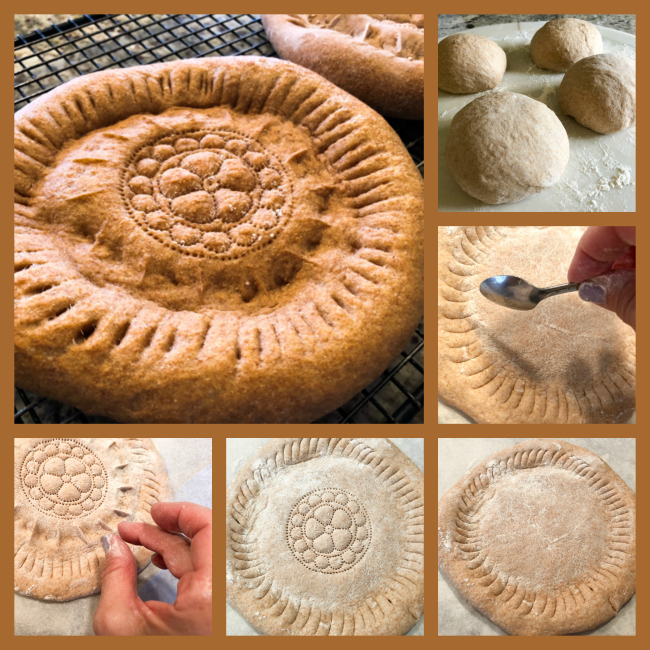
Flatten each ball into a round. Press the center, forming a thicker layer of dough all around the perimeter. Use a spoon and a bread stamp to decorate the surface.

Bake in a 375 F oven inside a Dutch oven for about 20 minutes. Remove the cover after 10 minutes. If you have a large enough Dutch oven, you can bake two at a time. If baking one at a time, leave the balls covered and make the decorations right before baking.

ENJOY!

to print the recipe, click here

Comments: The recipe I am sharing is in fact my second attempt at making Uzbek flat breads. For my first adventure, I had not found a detailed recipe, it was more a vague set of instructions, so I made my own formula and used the fermentation time suggested. It contained quite a bit of yeast, and the proof fermentation was short, only 40 minutes.  The result was a bread that rose so much during baking that the pattern of the stamp was lost.  Below you see before and after pictures.

I was a bit disappointed, even though the bread tasted pretty good. I wanted my pattern to show. I asked for help in a bread Facebook page, and got great advice. Including the link to that youtube video with the recipe I used.  Worked like a charm! For my next time I intend to use 75% white bread flour and 25% whole wheat or spelt. I think it would make a nice texture, and probably need a little less flour during kneading.

As to the decoration, you can do pretty much whatever you feel like it. I opted for the technique in the video. It uses a spoon all around the edge, then the stamp goes in the center. Next, you pinch the dough with two fingers around the stamp. But you can do several rounds of stamps in the center instead, leave the dough plain all around. I imagine that each family has their own way to decorate their bread.

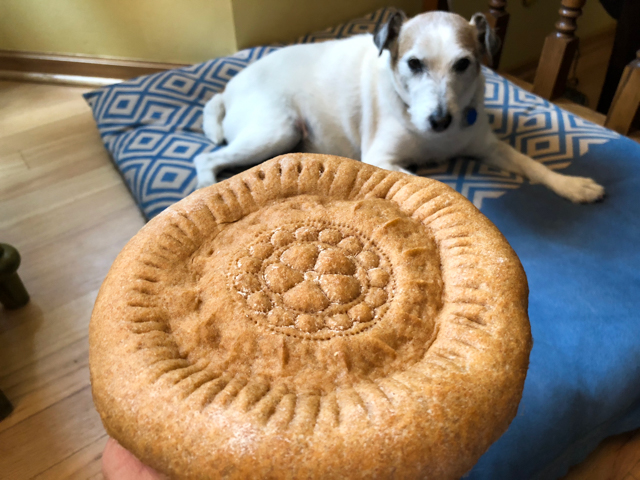
My design was approved by all members of our family… 

The bread was delicious with hummus, with goat cheese, and black olive tapenade. Sliced like a pita, it was fantastic to deliver fresh tomatoes juicy with a drizzle of olive oil and oregano.  Since learning about Uzbek flat bread, also called Lepyoshka, I’ve been fascinated by that country. You can find some nice pictures of Uzbekistan in this link.   

ONE YEAR AGO: First Monday Favorite – Black Sesame Macarons

TWO YEARS AGO: Chocolate Orange Mini-Cakes

THREE YEARS AGO: In My Kitchen, May 2015

FOUR YEARS AGO: P90X3, a Review of Tony Horton’s Latest Fitness Program 

FIVE YEARS AGO: Pasta and Mussels in Saffron Broth

SIX YEARS AGO: Triple Chocolate Brownies

SEVEN YEARS AGO: Shanghai Soup Dumplings

EIGHT YEARS AGO: Bite-sized Chocolate Pleasure

SaveSave

SaveSave

SaveSave

SaveSave

SaveSave

SaveSave

SaveSave

SaveSave

SaveSave

SaveSave

SaveSave

SaveSave

SaveSave

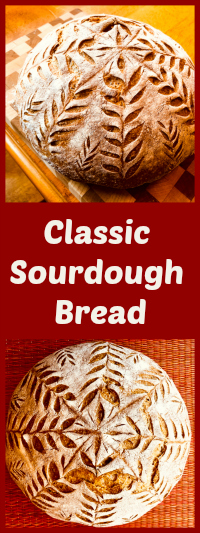
GILDING THE SOURDOUGH LOAF

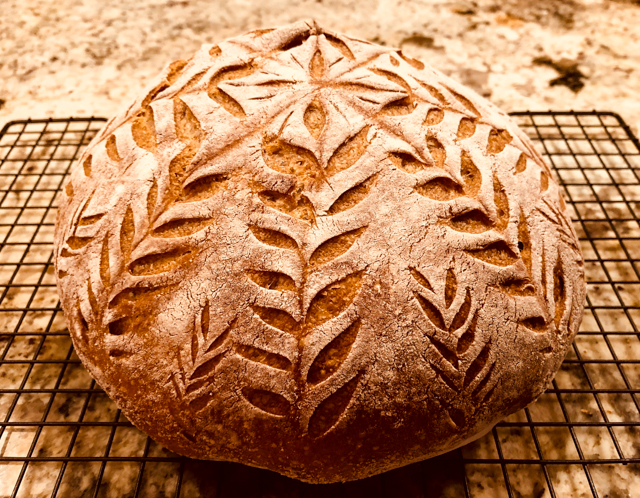
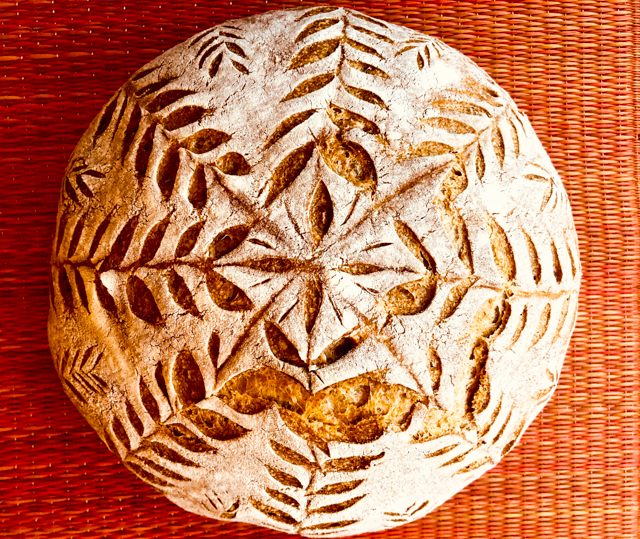
Two sourdough posts in a row! But this one brings back the subject to its most classic use: a rustic bread made less rustic with a razor blade and a ton of fun. Here is my baby, all dressed up for party!

CLASSIC SOURDOUGH BREAD
(adapted from Anna Gabur)

for the levain:
120g water
40g starter
40g whole-wheat flour
80g all-purpose white flour

for the final dough:
Half of the levain above (about 140g)
375g water
50g spelt flour
150g whole-wheat flour
300g bread flour
10g salt dissolved in 15g water

Make the levain mixture about 6 hours before you plan to mix the dough. It should be very bubbly and active.

When you are ready to make the final dough, dissolve half the prepared levain in water (375g), then add all flours. Save the remaining levain in the fridge for later.  Mix well with your hands until a shaggy dough forms.  Leave it at room temperature for 30 minutes.

Add the salt dissolved in the remaining water, and incorporate by folding repeatedly the dough over itself. Now let the dough ferment for a total of 4 hours, folding a few times every 40 minutes. You don’t have to be precise, but allow the full four hours fermentation to take place.

Shape as a round ball and place inside a banetton covered with a cloth and lightly floured. Keep it in the fridge overnight, from 8 to 12 hours.

Next morning, heat the oven to 450F.

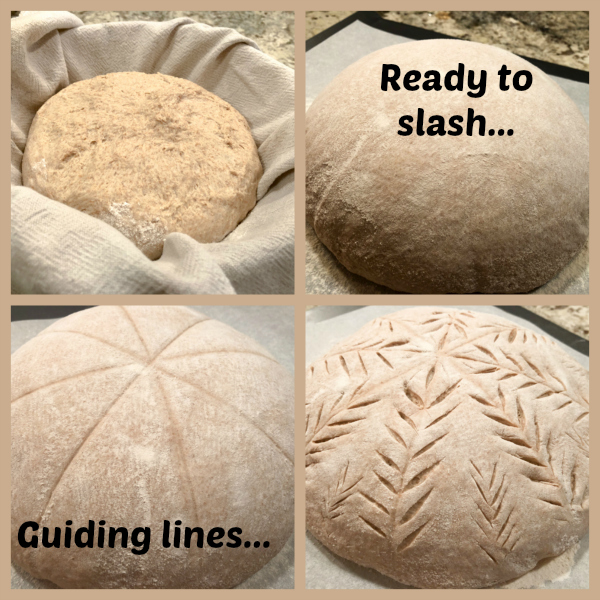
Invert the dough on a piece of parchment paper and lightly, very lightly coat it with flour, then rub all over the surface with the palm of your hand. Score the guiding lines according to the desired pattern, use a razor blade to slash the dough with firm, short slashes.

Bake at 450F for 45 minutes, preferably covered for the first 30 minutes to retain steam.  Cool completely over a rack before slicing.

ENJOY!

to print the recipe, click here

Comments: I love a rustic sourdough that is left untouched, opens up in the oven according to its own desire, or one that gets a very basic crisscrossed slash at the top to get things started. But I must admit it’s nice to work a little magic on the crust. However, my previous attempts failed to match my expectations. In other words, I had issues to transfer to the razor blade the image I had in my mind for the baked loaf.

A couple of weeks ago I found an online course taught by a gorgeous woman named Anna Gabur on artistic bread slicing. I asked myself, do I really need this? Not sure what happened, but before I could give an honest answer to that question, my paypal account was activated and the online class was playing on my screen. Very odd. Must be a computer virus or something. At any rate, I am very glad this odd phenomenon happened, because I loved the class, learned a lot and was very pleased with the results of my very first attempt. I followed her design very closely, but maybe at some point I’ll feel confident to come up with my own creations (fingers crossed).

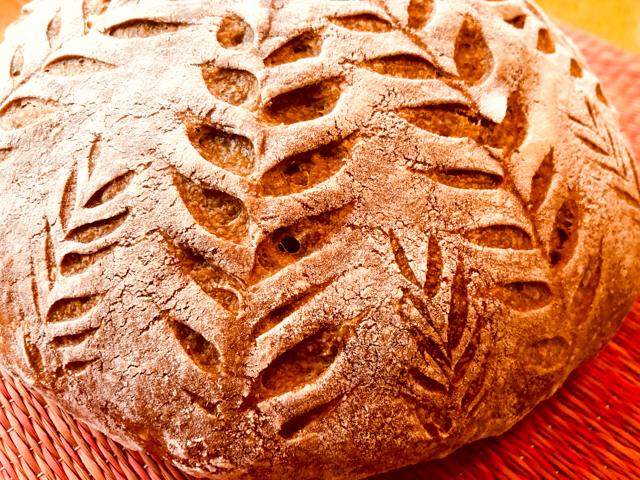
Between you and me, I can hardly believe this bread came out of our own oven… I was in total awe when I opened the lid and saw the oven spring, the pattern, the crust starting to get golden. A real baker’s thrill…

I highly recommend that you get Anna’s course if you are passionate about bread baking. You don’t need to make a sourdough, any bread formula will work, as long as it’s not very high in hydration. You need some structure to be able to slash it, so high-hydration formulas won’t work as well. Also, it helps a lot if the bread gets its final fermentation in the fridge, so that its surface is tight and easier to slash. My loaf went straight from fridge to pre-heated oven, it took me less than 10 minutes to finish the slashing, and I bet most people can do it much faster.  You’ll need a regular razor blade that you will hold between two fingers, not using a lame holder. And, according to Anna, one blade should last you for about 5 loaves. It needs to be truly sharp. She makes it seem so easy, it is a pleasure to watch her in real-time making a very elaborate design on the loaf. You can also marvel at all her photos on Instagram.

The bread had excellent taste and crust, the crumb was not super open, but that was expected from a bread with a lower hydration level.

Anna has quite a few articles about bread baking written on her blog, like this one that goes over basics of artistic slashing, and this one that shares her favorite bread formula. If you’d like to sign up for her online tutorial, follow this link.    She lives in Moldova, and often has to adapt her bread baking for the types of flour she can find. I often get a bit upset with “trendy” bread cookbooks that insist you must obtain the flour that was milled 4 days ago under a full moon, otherwise don’t bother making the recipe.   All you truly need is flour, water, a bit of yeast, a touch of salt, and the right amount of passion… Anna’s masterpieces prove this point!


ONE YEAR AGO: Lolita Joins the Bewitching Kitchen

TWO YEARS AGO: Cashew Cream Sauce

THREE YEARS AGO: Blood Orange Margaritas

FOUR YEARS AGO: Smoked Salmon Appetizer

FIVE YEARS AGO: Clementine Cake

SIX YEARS AGO: Springtime Spinach Risotto

SEVEN YEARS AGO: The end of green bean cruelty

EIGHT YEARS AGO: Torta di Limone e Mandorle

SaveSave

SaveSave

SaveSave

SaveSave

SaveSave

SaveSave

SaveSave

SaveSave

SaveSave

SaveSave

SaveSave

SaveSave

SaveSave

SaveSaveSaveSave

SaveSave

SaveSave

SaveSave

SaveSave

SaveSave

SaveSave

SaveSave

SaveSave

SaveSave

SaveSave

SaveSave

SaveSave

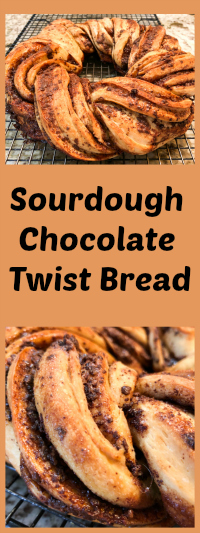
SOURDOUGH CHOCOLATE TWIST BREAD

Every once in a while, it’s nice to expand the horizons of the sourdough starter. I have yet to try sourdough croissants, a much more involved process, but when I saw a blog post joining bubbly starter with chocolate in a twisted shaping, I could not wait to try it.  It does take a little practice to get the braiding correctly, but I think this attempt turned out a little better than the one of years ago. Practice, practice, practice.

SOURDOUGH CHOCOLATE TWIST BREAD
(slightly modified from My Daily Sourdough Bread)

Starter
100 g water
100 g bread flour
1 tablespoon sourdough starter

Dough
all of the above starter
180 g warm milk (water can be used instead, for a less rich dough)
370 g bread flour
1 egg yolk
2 tablespoons of melted butter
1 tablespoon of sugar
6 g salt

Filling
100 g soft butter
60 g brown sugar
50 g grated chocolate (70% cocoa)

In the evening, first prepare your sourdough starter. Mix 100 g of white wheat flour, 100 g of water, and 1 tablespoon or your base starter. Leave it to ferment until risen, puffed, active and bubbly, so you will be able to mix it into the dough next morning.

In the morning, mix the dough. First, dissolve all of your starter in 180 g of milk (or water, if desired). Add egg yolk and melted butter. Next, add all of the flour (370 g), salt and sugar. Mix well, and knead the dough for 10 minutes until smooth. Shape it into ball and place it into a bowl. Cover with a plastic wrap and leave to ferment until doubled in volume, about 3 hours.

Prepare the filling mixing softened butter, sugar, and grated chocolate. Line a Dutch oven or another appropriate baking container with a piece of parchment paper.

Roll the dough into a 12×18 inch rectangle. Drop the filling across the rolled dough and spread it thinly, leaving about 1 inch clean border on all sides.  Roll the dough from the longest side, then tuck the ends underneath. Cut the rolled dough in half length-wise. Flip the cut halves outwards.

Start braiding two strands one over another. Tuck the ends together to form a circle. Place the twisted bread into Dutch oven and let it rise until doubled, about 1.5 hours.

Heat the oven to 375°F. When the dough is ready, put the Dutch oven into oven and bake it for 35 to 40 minutes. Cool on a rack before slicing. If desired, cover the bread with a sprinkling of powdered sugar.

ENJOY!

to print the recipe, click here

Comments: This was a fun weekend project, for sure. My only issue was that during baking, a lot of butter sipped out of the bread, forming a puddle on the bottom of the baking dish. I was not sure how to deal with it, so I ended up using one of those stainless steel bulb basters (like this one) to remove the butter a couple of times during baking. The bread tasted amazing, no major harm done on the bottom crust, all seemed fine. It was not overly greasy either.

We enjoyed some of it still a bit warm from baking. A deep silence ensued. You know how that goes sometimes.  Leftover wedges were wrapped in plastic and frozen. A few minutes in a low oven restored the bread to top-notch level, so rest assured, you won’t need to consume it all in one sitting. There’s a limit of how much aerobics a person can do…

This bread is a nice alternative for a pain au chocolat craving. Much easier to make and equally delicious.

ONE YEAR AGO: Dan Lepard Times Three

TWO YEARS AGO: Turkey Portobello Burger

THREE YEARS AGO: Raspberry Ricotta Cake

FOUR YEARS AGO: In My Kitchen, April 2014

FIVE YEARS AGO: Whole-Wheat Pasta with Lemony Tomatoes and Spinach

SIX YEARS AGO: Blood Orange Duck: A work in progress

SEVEN YEARS AGO: Grilled Mahi-mahi with citrus marinade

EIGHT YEARS AGO: Memories of Pastéis

SaveSave

SaveSave

SaveSave

SaveSave

SaveSave

SaveSave

SaveSave

SaveSave

SaveSave

SaveSave

SaveSave

SaveSave

SaveSave

SaveSave

SaveSave