CHARCOAL PEANUT SOURDOUGH

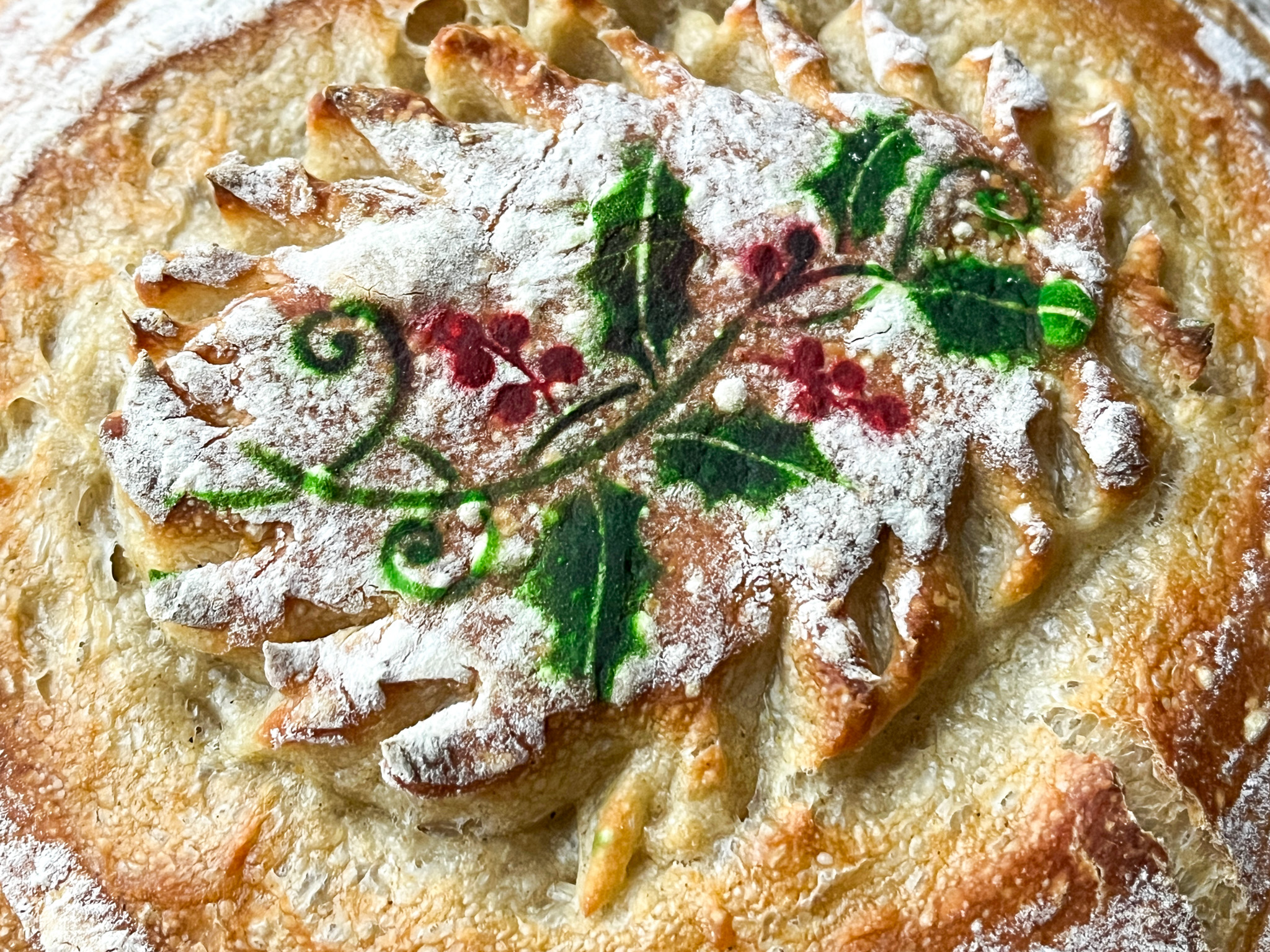
I’ve been struggling with bread stencils lately. My designs end up not as sharp as I hoped them to be, lack of contrast after baking, all sorts of annoying little disappointments. I finally figured out what I was doing wrong, after watching videos from bread guru Morgi. I will share a couple of tips today, in case you’d like to use this method to decorate your bread.

CHARCOAL PEANUT SOURDOUGH
(from the Bewitching Kitchen)

470g bread flour
20g spelt flour
10g peanut flour
7g charcoal powder
10g salt
370g water
100g sourdough starter at 100% hydration

Make the levain mixture about 6 hours before you plan to mix the dough. It should be very bubbly and active.

When you are ready to make the final dough, place the water in the bowl of a KitchenAid type mixer and dissolve the starter in it, mixing with a spatula briefly, then add the three types of flour, charcoal and salt. Turn the mixer on with the hook attachment and knead the dough for 4 minutes at low-speed all the time. You will notice the dough will gain quite a bit of structure even with just 4 minutes in the mixer. If the dough seems too soft, add a bit more bread flour. Remove from the machine, and transfer to a container lightly coated with oil, cover lightly with plastic wrap and allow it to ferment for 4 hours, folding every 45 minutes or so. Because the dough is already a bit developed from the initial time in the mixer, you should get very good structure after 3 and a half hours, or even sooner than that.

After four hours bulk fermentation, shape the dough as a ball, and place, seam side up, in a lightly floured banetton. Leave at room temperature one hour, and then place in the fridge overnight, from 8 to 12 hours.

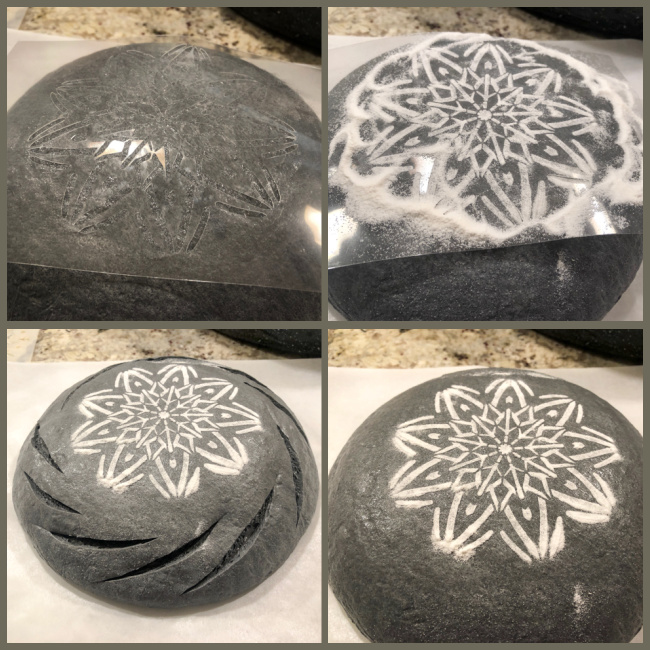
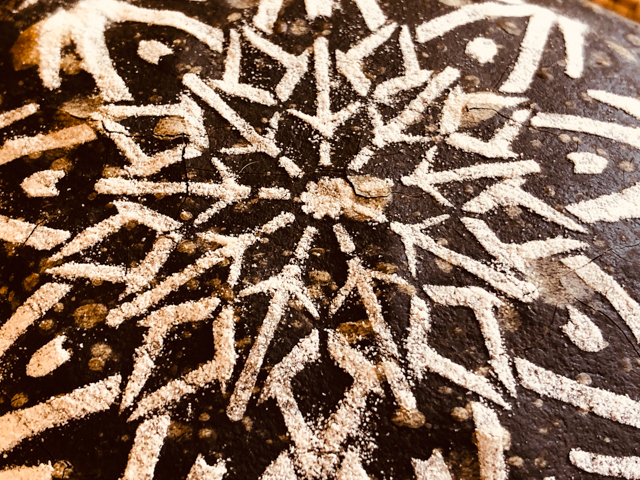
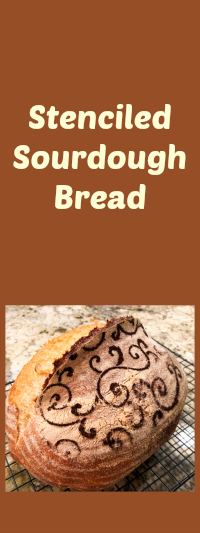
Next morning, heat the oven to 450F. Invert the dough over parchment paper, if the surface seems moist you can place the stencil right away on top of it. If it seems dry, spray lightly with water and position the stencil. Shower some white rice flour on the stencil and rub gently with the fingers of your right hand as you steady the stencil with your left hand (do the opposite if you are left-handed). The idea is to rub the flour on the surface through the openings of the stencil, so that you get a good pattern formed. Carefully lift the stencil and slash the bread around it, so that the bread will not open and compromise the image.

Bake at 450F for 45 minutes, preferably covered for the first 30 minutes to retain steam. Cool completely over a rack before slicing.

ENJOY!

to print the recipe, click here

Comments: If you use a banneton for the final rise of your shaped loaf and it glues to it when you try to invert it to bake, you know that can be VERY frustrating. Sometimes it even distorts the beautiful shape achieved slowly overnight in the fridge. I normally add quite a bit of flour to the banneton before the dough goes in, but when I want to do the stencil decoration, I prefer not to have too much flour on the surface to start with. My tip is simple: place a plastic wrap (like Saran-wrap or other brands) inside the banneton and THEN add your bread – it does not prevent the ridges from making that cute impression on the surface (although it will be slightly less evident) and you will have NO issues inverting the dough to bake.

For the image to be sharp and evident, the trick is to have a little moisture on the dough, and rub the flour, gently but firmly. Hold the stencil in place with one hand, and rub the flour with the other. Lift the stencil as delicately as humanly possible. Finally, whatever design you choose, slash the bread in ways that coach the opening away from the design. You can cut four deep slashes in a square shape with the design in the center, or do what I did, a circular series of small, deep cuts all around.

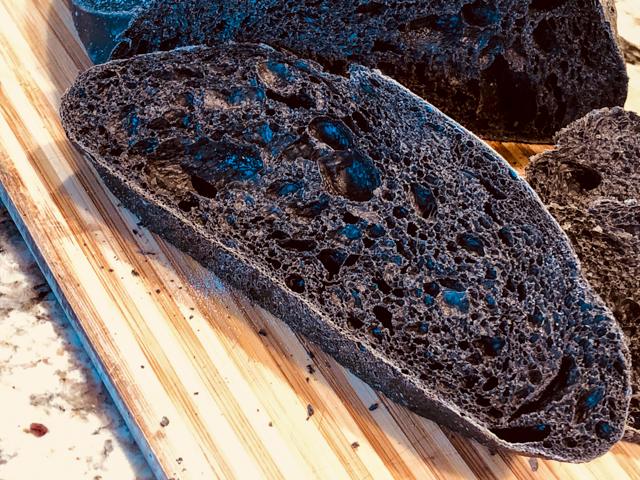
Peanut flour has no fat, but transfers the taste of peanuts quite well to the bread. It has a softer crumb than a straight sourdough with just bread and whole-wheat flours. And the charcoal contributes no taste. When we freeze slices after a couple of days, we like to cut one or two into croutons, because they look pretty amazing in that shocking black color.

ONE YEAR AGO: Chocolate Cake with Coconut Buttercream

TWO YEARS AGO: Berry Rebellion Tarts 

THREE YEARS AGO: Bergamot-Cherry Macarons

FOUR YEAR AGO: Roasted Veggies with Queso Cotija Dressing

FIVE YEARS AGO: Creamy Broccoli and Mushroom Casserole

SIX YEARS AGO: Maple Walnut Biscotti

SEVEN YEARS AGO: Barley Risotto with Peas

EIGHT YEARS AGO: Oatmeal Fudge Bars

NINE YEARS AGO: Cauliflower Steaks

TEN YEARS AGO: Soft Spot for Chevre

ELEVEN YEARS AGO: Quick sun-dried Tomato Crostini

FUN WITH SOURDOUGH

Bread baking can be intimidating, and if you take it into sourdough territory, things are potentially even more stressful. Truth is, when compared to “regular” bread made with commercial yeast, sourdough is very forgiving. In part because it is a slower process, and it offers a lot of flexibility in terms of timing, amount of starter, level of hydration. It is easier to accommodate to any working schedule, once you get used to the rhythm. I am set on mixing the dough from 5 to 9pm, shaping and retarding in the fridge the whole night, baking early next morning, straight from the fridge. The breads from this post were all made with the same simple formula, mostly white bread flour, a touch of spelt. After bulk proofing for 4 hours at room temperature, they were shaped and placed in the fridge to sleep and dream overnight. Then, the real fun started. I tried a few different things, as you will see. It’s great that the husband enjoys a slice of bread for lunch several days a week. Because the home bakery has been working overtime lately!

CLASSIC SOURDOUGH  BREAD
(from the Bewitching Kitchen)

100 g active starter (at 100% hydration)
375 g water, room temperature
450 g bread flour
50 g whole-wheat flour
10 g salt

Mix all ingredients for the bread in a large bowl, making a shaggy mass. Let it sit at room temperature for 30 minutes. Mix gently folding the dough a few times until smooth.

Allow it to ferment for 4 hours at room temperature, folding the dough 3 times during the four hours, no need to be precise about the spacing of folding cycles. Just make sure you fold it a few times.  At the end of four hours, shape it either as a round ball or a batard.

Transfer to a well floured banneton, seam-side up, and place in the fridge overnight, 8 to 12 hours, longer if needed.

Next morning, heat the oven to 450 F. Invert the shaped loaf, still cold from the fridge over parchment paper. Dust the surface with a little flour and slash to your liking. Or, dust with cocoa powder using a stencil.

Place in a cold Dutch oven, cover, and stick in the hot oven for 30 minutes with the lid on, and 15 more minutes with the lid off.  Allow it to cool completely before slicing.

ENJOY!

to print the recipe, click here

Comments: Cocoa powder is a nice way to create contrast without affecting taste. You will not detect any bitterness or cocoa flavor in the bread, don’t even worry about it. The sourdough nature will be pretty much unaffected by the thin layer of cocoa on top. Right before baking the bread, lay your stencil on top of the shaped dough, sift cocoa all over. Remove the stencil carefully, slash the bread and bake.

You have two options here, slashing right before adding the stencil, or after. I think slashing before might be better, and that’s what I’ll be doing from now on. The other thing to keep in mind is that you need to coach your bread to preserve the design as much as possible during baking. With that goal in mind, make one or several reasonably deep slashes around the perimeter of the design, so that – all things working as planned – the bread will burst around the design, not in the middle of it. But, of course, bread has a mind of its own, and part of its charm is that you just never know…

I did not expect to have such amazing oven spring, but Polaris, my newly named starter, is absolutely amazing!  I got it from Elaine, and you can get it too (as well as the gorgeous bread lame you can see in the composite photo) with a visit to her site here. She ships worldwide, by the way.

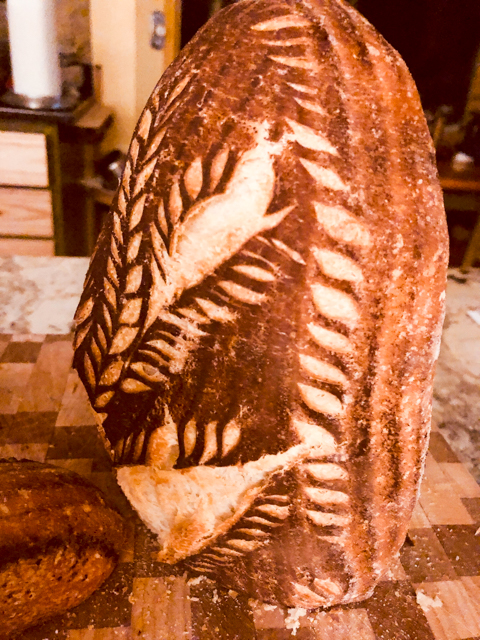
Another way you can use cocoa powder is coupling it with a more delicate slashing using a brand new razor blade (this is really important, it must be super sharp). Coat the bread with a fine dusting of cocoa powder (or you can use a mixture of regular bread flour with cocoa for a lighter tone), then slash the pattern you like.

As you can see, I made the mistake of not coaching the bread into opening someplace else rather than the middle of my design. It was still a pretty nice loaf, but just did not look the way I wanted. Next morning we noticed a scary monster waiting for us in the counter top…

Hello there! Come here often?

😉

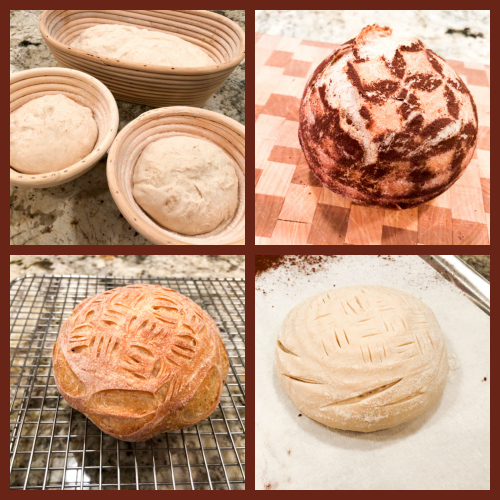
Now, to continue with the fun. For the following bake, I made a slightly bigger amount of dough (starting with 600 g flour and increasing all other ingredients proportionally), then shaped two small balls (using roughly 200 g dough for each). The remaining dough was used to make a batard. The small loaves were proofed in cute little bannetons, about 5 inches in diameter. This picture shows them next to the regular sized banneton.

So we had not only a scary monster in the Bewitching Kitchen, but also an alien. Never a dull moment, my friends. Never a dull moment.

One of the small rolls received a cocoa-stencil, the other got slashed in a basket-pattern. Exact same dough and time of fermentation, baked side by side in the Dutch oven. These would be excellent bread-gifts for the holidays, maybe with a special stencil design, like a small Christmas tree, stars, or bells. 

The bigger, batard, got just a straightforward slashing pattern, and upon baking, also showed its rebel personality… 😉

As usual, we enjoy a couple of slices on the day I bake, next morning the bread is sliced and placed in the freezer. Baking once or twice a month is enough to keep up with our bread consumption. But, I confess that the temptation to bake every week to try something new… is not negligible (sigh).

ONE YEAR AGO: Pasteis de Nata

TWO YEARS AGO: New Mexico Pork Chile, Crockpot Version

THREE YEARS AGO: Chocolate on Chocolate

FOUR YEARS AGO: Double Chocolate and Mint Cookies

FIVE YEARS AGO: The Story of my first Creme Brulle’

SIX YEARS AGO: Sourdough Mini-rolls

SEVEN YEARS AGO: Focaccia with Sun-dried Tomatoes and Gorgonzola

EIGHT YEARS AGO: Mediterranean Skewers

NNE YEARS AGO Fettuccine with Shrimp, Swiss Chard, and Tomatoes