SEMOLINA SOURDOUGH BOULE

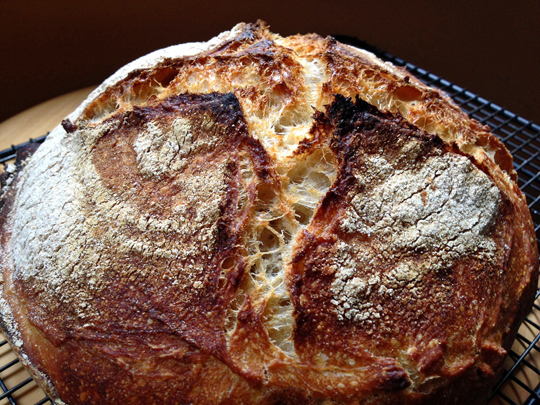
Having recently exorcised a few of my sourdough demons, I am happy as a clam baking bread every weekend.  This version is an adaptation of a formula that called for 100% durum semolina flour.  I took a small step back by including some regular flour in the mix, just a tad.  The dough is mixed the day before baking and rises for 12 or more hours in the fridge.   The semolina flour – which must absolutely be the correct type – gives the crumb a yellow hint, and takes the taste of the sourdough into a new direction.   A simple bread, with delicate flavor, but a hearty crust just like expected from a rustic sourdough.

loaf1

SEMOLINA SOURDOUGH BOULE
(adapted from Michele, at  The Fresh Loaf Forum)


to make the levain:
35 g sourdough starter at 100% hydration
140 g water
140 g  Semola  di Grano Duro Rimacinata
(you will use all the starter, make sure to save some of your leftover)

for final dough:
350 + 50 g water
4 g of diastatic malt powder
400 g semolina flour (Semola di grano Duro Rimacinata)
160 g bread flour
13 g salt

 Make the levain 10 hours before preparing the dough.  Mix all ingredients and leave at room temperature for 10 hours.

When the starter is ready, mix 350 g water with the malt and the starter (all of it).   When well combined, add the semolina, and the bread flour, mix until a shaggy dough forms.  Let it rest for 20 to 40 minutes.

Add the salt and the remaining 50 g water.  Mix well (you can use a Kitchen Aid type mixer for 2 to 3 minutes in low-speed if you prefer).

Let the dough ferment at room temperature for 2 hours, folding the dough every 30 minutes.  After the last folding, leave the dough undisturbed for 20 minutes.

Shape the dough as a ball and place in a floured round container.  Leave at room temperature for 20 minutes, then refrigerate for 16 to 20 hours.

Remove the dough from the fridge 1 to 2 hours before baking in a 450F with steam for 20 minutes, then reduce the temperature to 430F and bake for 25 minutes longer, until dark brown.

Cool completely on a rack before slicing.

ENJOY!

to print the recipe, click here

crumb2

Comments:  If you are new to sourdough baking, this bread could be a bit challenging.   The semolina flour makes the dough pretty soft and very moist, it could scare a beginner into adding too much flour during handling.  The original recipe called for only three cycles of folding, but I added one more. The dough asked for it, it had not developed enough “muscle” at the third folding cycle.    I’ve been having trouble with my bread sticking to the banneton in long rises, so this time I took a different path and placed it inside a ceramic bowl heavily coated with rice flour.
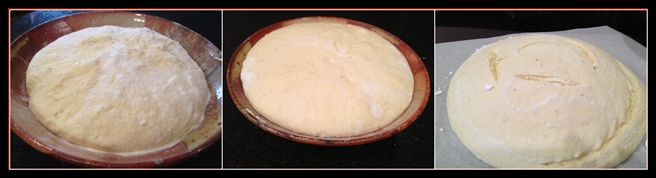
composite

It worked really well, the bread expanded a bit during the overnight stay in the fridge, and had a nice shape after baking.  I left it at room temperature for a little over 2 hours before baking.

I wish I knew how to score the bread to get the amazing “flower effect” that Michele obtained, but until I see some type of tutorial for it online, I’ll have to accept a more old-fashioned, rustic type scoring.   Take a look at Michele’s full post about it and marvel at his technique…  I suspect the blade needs to be almost parallel to the surface of the dough instead of slashing deeply into it.

__________________________________________________________________________________________________________________________________

I am submitting this post to Susan’s Yeastspotting

__________________________________________________________________________________________________________________________________

ONE YEAR AGO: Forgive me, for I have sinned

TWO YEARS AGO: Cracked Wheat Sandwich Bread

THREE YEARS AGOAu Revoir, my Bewitching Kitchen

FOUR YEARS AGO:  French Bread
SOURDOUGH BLUES

For the past few months the Bewitching Kitchen witnessed my silent struggles with bread baking.  Re-phrasing that, for the past few months the Bewitching Kitchen witnessed a full-fledged bread baking debacle!   Yes,  a few floured banettons flew across the Bewitching Kitchen.   Yes, the lives of several loaves quickly came to a violent end as crouton-material on the chopping board.  Yes, Phil received text messages stating that I would never ever EVER bake sourdough again, and I needed him back home so I could cry on his shoulder.  I was miserable, confused and frustrated, feelings  I normally associate with golf, not bread baking.  Life can be cruel.

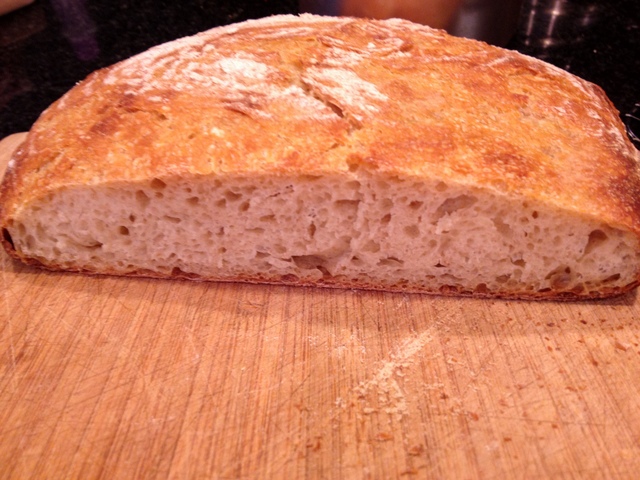
The deterioration in my baking happened slowly.  A slightly less plump loaf here, a tighter-than-expected crumb there.   Then, suddenly, no matter what I did my boules became pancakes.   Flat, … they were flat!.  No oven spring to speak of, and scoring the surface was like make-up at the undertaker’s,  … it made no difference in the loaf.  The crumb below was actually one of my better “pancake-loaves.”  Most had a much tighter crumb, leaving me too upset and disgusted to even bother taking a picture.

here

At a  loss,  I posted a message to Dan Lepard’s Appreciation Facebook page, and David W. came to the rescue.  Much like a therapist holding the hand of a patient, he listened to my saga and concluded that the problem related to storing my starter in the fridge.  Slowly, the complex microbial population in the starter had changed, leaving me with a less than ideal mixture to start bread with.  Several people advised me to discard the sourdough and start all over again, but I didn’t want to consider that route.  I’m too attached to Dan, the starter I captured and kept for four  and a half beautiful years.  That explains why I threw a massive fit at Phil when he insisted that a starter “is just flour and water“.  Can you imagine hearing THAT?  I know, it goes beyond insensitive.   But David provided the light at the end of the tunnel, with a  “revival protocol” for my starter.  Guess what happened on my first loaf?

boule1White Levain Sourdough Bread, a classic recipe from Dan Lepard’s Handmade Loaf


SOURDOUGH STARTER RECOVERY

(from David, at Dan Lepard’s Appreciation Facebook page)

For 7-10 days, discard all but a small spoonful of the starter, and feed the starter by adding 70g organic rye flour + 100 g water.  Keep it out in the kitchen, not in the fridge.

After the 7-10 days, reverse the refreshment proportions to form a dough:  175g organic rye flour + 125 g water.   After 12 hours, bake with as much as you need, by either adjusting your bread recipe to compensate for the thicker starter, or refreshing it again at the hydration level called for in the recipe.  Freeze small portions of the thick starter for future use.

You can keep your dough-consistency starter at room temperature, refreshing it weekly, or thaw one of those small portions a couple of days before baking, refreshing it daily (always at room temperature).

_________________________________________________________________________________________________________________________________________________

I was so excited about getting back my “sourdough mojo”, that the following day I baked another loaf, a recipe adapted from Tartine.

_________________________________________________________________________________________________________________________________________________

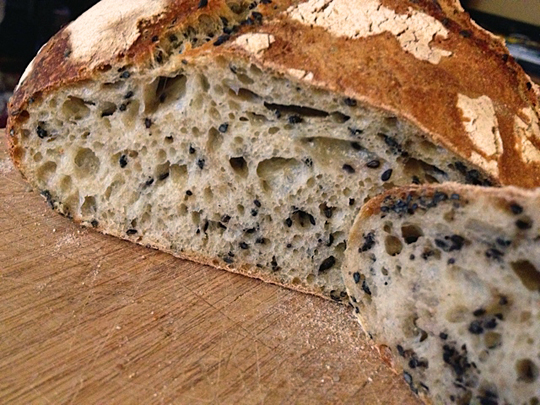
blacksesamecrumbCan you look at this crumb and not shed a tear or two of pure joy?


BLACK SESAME SOURDOUGH

(adapted from Chad Robertson Tartine)

For the starter:
50g  spelt flour
50g white flour
100g/ml water at 78-80F
1 Tbs active sourdough starter

For the dough:
375g/ml water at approximately 80F (divided in 350g + 25g)
100 g starter (you won’t use the full amount made)
440g white flour (good quality all-purpose is fine)
60g spelt flour
10g salt
1/3 cup black sesame seeds

In a large bowl, mix 350g of warm water with the starter (100g of it), and mix to dissolve. Add both types of flour, mix until all flour is mixed with water, without large dry bits present.  Let the dough rest for 25 to 40 minutes.

Add the salt and the rest of the water (25g), and incorporate by pressing the dough with your fingers. Fold the dough a few times, until if forms a homogeneous mass, but don’t try to knead it.  Leave it in the bowl, folding it again a few times – no need to remove it from the bowl – every 30 minutes, for the first two hours (you will be making 4 series of folds during this period).  Add the sesame seeds to the dough on your first folding, after all the water and salt has been incorporated.  After the last folding cycle, let the dough rest undisturbed for another full hour, for a total of 3 hours of “bulk fermentation.”

Remove the dough from the bowl and shape it gently as a ball, trying to create some surface tension (for a tutorial, click here).  Let it rest for 20 minutes, then do a final shaping, by folding the dough on itself and rotating it.  If you have a banneton, rub it with rice flour, line it with a soft cloth sprinkled with rice flour, and place the dough inside it with the seam-side up. If you don’t have a banneton, any round container – like a colander – will do. Let it rise for 3 to 4 hours at room temperature.  Twenty minutes before baking time, heat the oven to 450F.

Cut a piece of parchment paper that will completely cover a pie baking dish and place it on top of the banneton containing the bread dough.   Carefully invert the banneton  over the parchment paper, using the pie plate to support the dough.  The cloth will probably be sticking to the dough, so carefully peel it off.  Score the bread, and place the pie pan over baking tiles in the pre-heated oven.

Bake for about 45 minutes, covered during the first 20 minutes, remove the cover for the final 25 minutes.

Let the loaf cool completely on a rack before slicing.

ENJOY!

to print the recipe, click here

Comments: I’ve been working with bacteria for 30 years, and one of the things we know too well is not to store it in the fridge.  Some strains of E.coli develop a capsule, a heavy coating of polysaccharides once exposed to cold temperatures, and they become pretty tricky to work with, particularly if you study what we do: their outer membrane proteins.  We tell the students all the time to avoid keeping their plates in the fridge, if a strain is worth preserving it should be immediately frozen at – 70 C.  So, it was ironic that I never thought twice about keeping my sourdough starter in the fridge for years and years, without making a “backup” stock in the freezer.  Never again.

I hope that if you bake with sourdough, this post will help you out in case of problems.  Make a few balls of very thick sourdough starter and store it in the freezer. Label that bag, by the way… you don’t want to look at it months from now and decide it’s some unknown creature that got into your freezer when no one was paying attention.  And then proceed to toss it in the garbage!   😉

I am submitting this post to Susan’s Yeastspotting

ONE  YEAR AGO: Headed to Hawaii

TWO YEARS AGO: A yummy Brazilian cake: Bolo de Fuba’

THREE YEARS AGO:  Hidden Treasure

FOUR YEARS AGO: Avocado Three Ways

SOURDOUGH BREAD WITH WALNUTS AND DATES

Another example of inspiration coming from The Fresh Loaf.  David is a regular contributor to the forum, and every bread he makes is a work of art. He is the type of baker comfortable enough around sourdough starter to  devise his own recipes, having recently come up with a fig and walnut concoction.   David had access to fantastic figs, but when I went to the store I was not particularly impressed with what was available.  Since I am no longer afraid to improvise ;-), I used dates instead.   This bread is perfect to practice mindful eating. Don’t devour it. Instead, savor each bite as slowly as you can. Awesome bread, very complex taste.

crumbSAN FRANCISCO-STYLE SOURDOUGH WITH WALNUTS AND DATES
(adapted from David, at The Fresh Loaf forum)

for the stiff levain
41 g water
66 g sourdough starter
78 g all-purpose flour
4 g rye flour

for the final dough
337 g water
416 g all-purpose flour
46 g whole wheat flour
11 g salt
189 g levain
98 g dates, diced fine
98 g walnuts, diced and lightly toasted

Dissolve the starter in the water. Add the flour and mix thoroughly until the flour has been completely incorporated and moistened. Ferment at room temperature for 16 hours.

In a stand mixer, mix the flour and water at low-speed until it forms a shaggy mass. Cover and autolyse for 30 minutes. Coarsely chop or break apart the walnut pieces and toast them for 8 minutes in a 300ºF oven. Allow to cool. Coarsely chop the dates, rinse in cool water, drain and set aside.

Add the salt and levain to the autolyse, and mix at low-speed for 1-2 minutes, then increase the speed to medium (Speed 2 on a KitchenAid) and mix for 5 minutes. Add flour and water as needed. The dough should clean the sides of the bowl but not the bottom. Add the walnuts and the figs to the dough and mix at low-speed until well-distributed in the dough. (About 2 minutes).

Transfer to a lightly floured board, do a stretch and fold, and form a ball. Place the dough in a lightly oiled bowl and cover tightly. Ferment at 76º F for 2 1/2 to 3 hours with a stretch and fold at 50 and 100 minutes.  Shape as a large ball (or divide the dough in two and shape as two smaller loaves)  and place in banneton. Proof at room temperature (68-70º F) for 1-2 hours. Cold retard the shaped dough overnight.

The next morning, proof the dough at 85º F for 2-3 hours. Heat the oven to 480º F. Score the bread as desired, and bake with initial steam, reducing the oven to 460 F when the bread goes in. Bake for 40 to 45 minutes, and cool completely on a rack before slicing.

ENJOY!

to print the recipe, click here

boule1

I am still having issues with our oven, the temperature shoots up and down, making it hard to control proper baking.  At some point in the future we’ll change our kitchen appliances, but for the time being we dance according to the music. That’s the proper Zen attitude. Or so I am told…  😉

I am submitting this post to Susan’s Yeastspotting.

ONE YEAR AGO: Braised Brisket with Bourbon-Apricot Glaze

TWO YEARS AGO: The Real Vodka Sauce

THREE YEARS AGO: Pork Tenderloin and Blue Cheese

RED WINE SOURDOUGH BREAD WITH CRANBERRIES

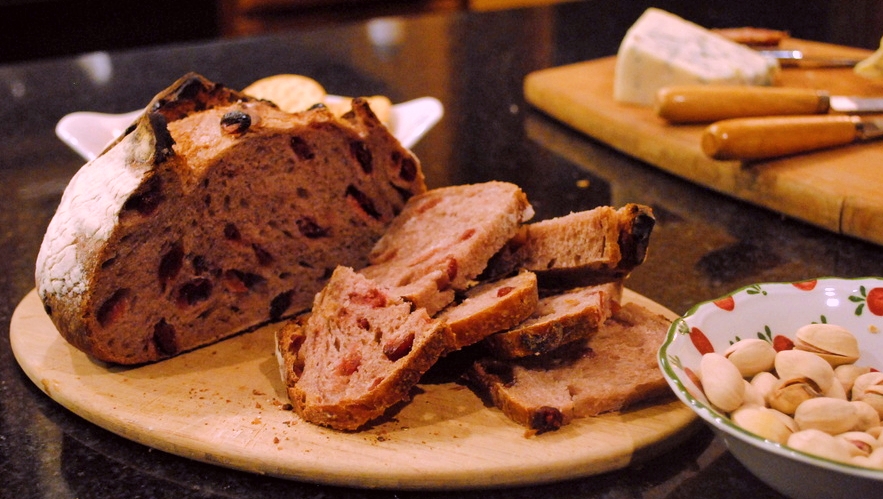
The Fresh Loaf Forum is a virtual paradise for bread bakers, as not only very experienced folks share their best recipes, but you can also get feedback in case problems arise with a recipe.  Last week I stopped by the site and the thread right at the top had the following title: Sourdough Wine Bread. That got my full attention.  I clicked on it, and was blown away by the gorgeous photos, and the unusual color of the bread’s crumb, given by the wine and the dried cranberries.  I revived my starter that same day, and started this bread on a Friday night.  Sometimes you  should not wait to chase a dream.loaf1RED WINE SOURDOUGH BREAD WITH DRIED CRANBERRIES
(adapted from The Fresh Loaf Forum, bread by Yuko)

102 g sourdough starter (at 100% hydration)
288 g  all-purpose flour
80 g water
123 g red wine
6.7 g Salt
80 g dried cranberries

In a bowl, mix flour, wine, and water roughly, cover it with plastic and keep for 12 hours in the fridge (autolyse).

Add sourdough starter and mix by folding dough in the bowl. Add  cranberries and mix by folding dough in the bowl. Add salt and slap & fold for 3 – 4 minutes or until the dough becomes a ball.  Bulk fermentation at room temperature, folding the dough every half and hour until it develops enough strength (I did 4 sets of folds).

Let it rise until the dough starts showing the yeast activity. It takes about 6 hours total depending on the temperature of your kitchen (I used my bread proofing box set at 78 F).  Shape the bread as a boule (or 2 baguettes), place in a banetton or other appropriate container, and let it proof in the fridge for 16 to 18 hours.

Pull it out of the fridge and leave it out for one to three hours (see comments).  Slash the bread and bake in a 450F oven with initial steam for a total of 40 minutes (for a boule), or 20 to 25 minutes for baguettes.

Cool on a rack before slicing.

ENJOY!

to print the recipe, click here

crumb

Comments:  Preparing this bread had me worried up until the point I finally sliced it. Something seemed terribly wrong, as I detected very little fermentation, even though I kept the dough for almost 7 hours at 78 F. The original recipe called for retarding the dough in the fridge and shaping it next day, but my dough seemed so…. slow!  I decided to shape it on the same day, and retard the dough in its final form, ready for the oven.  Ideally, you should remove the bread from the fridge and allow it to almost double in size.  That was not happening, so after a couple of hours I simply had to bake it.

Now, a little tangent.  I usually wake up several times during the night, and tend to think about our experiments while trying to go back to sleep.  Sometimes (unfortunately not that often),  when I wake up again an hour or so later, I have a new idea to solve a problem or at least approach it.  Almost as if during my sleep something goes to work “behind my back”…   😉  That Saturday night, I went to bed thinking about the red wine sourdough and why it seemed so weak.  Exactly at 2am I woke up with one word blinking in my mind: SULFITES!  All wine these days is preserved with sulfites! Maybe some batches have a higher concentration, maybe some of the bacteria or yeast in my starter was particularly sensitive to it.  At any rate, one thing is certain: when you add red wine to make the dough the pH will be lower (higher acidity) so that will affect the efficiency of fermentation.  Add to that the sulfites, and things can get trickier.   Discussing these points in The Fresh Loaf forum, one of the bakers mentioned that when he adds wine to the dough the crumb of his bread gets tighter (indicating lower production of gas). For that reason,  he normally tweaks his recipes to lower the alcohol and increase the water.  Since in this case we are hoping for a nice red tint in the crumb, compromise is in order.  I’d say keep the recipe as it is, and see how your starter behaves with it.  Just for fun, I’ll try to find an organic red wine for my next “experiment”. Organic wines cannot have extra sulfites added,  so the levels of the chemical will be low, ranging from 10 to 20 ppm (parts per million).  Non-organic red wines often reach 125 ppm of sulfites or higher.

Even if the fermentation was not at its peak, this bread was delicious!  I love the slightly sweetness given by the cranberries.  My favorite match for the bread was a Maytag blue cheese, sharp and salty.   Next day, slightly toasted, it seemed even better!

plattercheese

I am submitting this post to Susan’s Yeastspotting

ONE YEAR AGO: Award-Winning Sourdough Baguettes

TWO YEARS AGO: Country Rye (Tartine)

THREE YEARS AGO: Penne a la Vechia Bettola

AUVERGNE COURONNE FROM LOCAL BREADS

First bread post of 2013!

closeup

A change from the usual boule or batard, this bread is fun to make, beautiful to look at, and a pleasure to eat!   The recipe comes from Local Breads, by Daniel Leader (with Lauren Chattman), a book that any serious bread baker should own.  I actually have his first book too, Bread Alone, and keep both volumes together on the shelf as lovely siblings.  Bread Alone is an excellent starting point for beginner bread bakers as well as those who want to try their hands at baking with wild yeast. Local Breads is perhaps slightly more “advanced”,  lots of sourdough, with formulas that  focus on regional recipes that Leader collected through his  travels around Europe. Reading his books is like having a master bread baker giving you a private lesson, going through the details that make a difference between a so-so loaf of bread and one that makes you dream.

I wanted my first bread post for 2013 to be special, and this loaf surpassed my expectations. It is surprisingly simple, no special flours, no grains, no seeds.  Just a well-fed sourdough starter, the best quality flour you can find, and a little tender loving care to shape the dough and bake it.
bread2AUVERGNE CROWN
(formula from  Local Breads, published with permission from Daniel Leader)

Levain Starter (you will not use the full amount prepared):
45g levain starter, firm (about ¼ cup)
95g unbleached all-purpose flour
5g stone-ground whole wheat flour
50 g tepid water

for the bread:
500g  unbleached all-purpose  flour
340g water
125g levain (less than the amount prepared above)
10g sea salt

Prepare the levain: Pinch ¼ cup of your stiff levain and place in a bowl with 50 mL water.  Mash the levain with a whisk  until it dissolves, then add both types of flour and stir.  Turn the mixture onto a work surface and knead to fully incorporate the flour.  Place the levain in a covered container and let it sit at room temperature (70 to 76°) for 8-12 hours or until it has doubled in volume and the surface is domed.

Make the bread: Pour the water into a large mixing bowl or the bowl stand mixer. Combine the flours until all the ingredients are incorporated. Cover and let it rest for 20 minutes, while the flour hydrates.Uncover the dough, add the salt and the levain and incorporate with your hands or a spatula using a fw firm strokes.  Knead the dough with the dough hook by mixing on low-speed (2 on a KitchenAid) for a minute.  Increase speed to medium (4 on a KitchenAid) and knead until smooth and muscular; an additional 8 to 9 minutes. Transfer the rounded dough to a lightly oiled container, preferably clear, so you can mark the level of the dough with a masking tape.  Let the dough ferment until doubled in size, 3 to 4 hours at a temperature of 70 to 75 F.

Shape the crown.  Cover a surface with a little flour.  Place the risen dough over the counter and roll it very gently into a long fat rope, about 8 inches long and 3 inches wide. Connect the ends of the rope overlapping by about 4 inches. Press the ends together to seal. Dust a ring baking pan with flour and carefully drop the shaped dough inside.  Allow it to proof at 70 to 75 F until it looks “pillowy”,  1 to 1 and a half hours. When you press your finger tip into the dough, it should spring back slowly.  As the bread proofs, heat your oven to 425 F and place a large roasting pan, without the lid, inside.

Bake the bread. Once the bread is proofed, slash the outer edge of the round with a razor blade, and place the ring pan inside the roasting pan, and close with the lid slightly moist with tap water.   Bake covered for 30 minutes, uncover, remove the ring pan from the oven, carefully invert it to remove the bread, and finish baking the bread sitting on the oven rack, for 15 to 20 more minutes.

Let it cool completely on a rack before slicing through.

ENJOY!

 to print the recipe, click here

bread1
Comments: In the past, I’ve made a few loaves of ring-shaped breads, and had problems moving the bread to the oven after the final rise. I ended up deflating the dough too much and also messing its shape.  This time, I tried something a little different: after shaping the loaf, I placed it in a well-floured ring baking pan, and let the dough go through the final proofing in the pan.  When it was time to bake, I quickly scored the outside edge of the dough, and placed the pan and all inside a pre-heated, large roasting pan.   The next couple of photos should help explain my strategy, which, I am thrilled to inform, worked quite well!
doughbakingpan
After 30 minutes baking with the lid closed, I removed the lid, took the ring pan carefully out, inverted it quickly over the counter to release the bread, and placed the bread on the oven rack, without any baking sheet underneath, so that the crust would get a final roasting free of constraints.   I like to bake my bread until it’s really dark, because that’s when the taste of the crust delivers the punch I like, the one that transports me to a Parisian bakery…

ABOUT LOCAL BREADS: Ten years passed between Leader’s publication of his first book, Bread Alone, and Local Breads. During that period, he worked with many master bakers in Germany, Italy, and Eastern Europe. In the first chapter of his book, he talks about his bread journey and how he’s gained a special respect for simple but crucial details such as the choice of flour. After a couple of chapters devoted to general lessons on equipment and technique (a must read, by the way), he shares his many recipes in sections divided  according to region. He will take you from France to Italy, stop in Germany, Poland, Austria, and the Czech Republic, sampling some of their unique yeast concoctions.

If you enjoy baguettes, you’ll be happy to know that Leader offers recipes for French, Italian, and German baguettes, so you can bake them all and compare their “personalities”. He also shares his recipe for the famous miche from Pain Poilane in France, as well as German Rye Sourdough, two examples of bread that, in my humble opinion,  can be quite intimidating.  With his detailed instructions, you’ll feel ready to tackle any project, Pain Poilane included!  So, if you don’t have Local Breads on your shelf, correct this severe cookbook handicap with a simple click here.  😉

I would like to thank Dan Leader for his permission to publish this great recipe. This post goes straight to Susan’s Yeastspotting!

ONE YEAR AGO: Orange-Pomegranate Chicken

TWO YEARS AGO: The Getty Museum

THREE YEARS AGO: Crowd-Pleasing Pulled Pork