HOME IS WHERE THE HEARTH IS

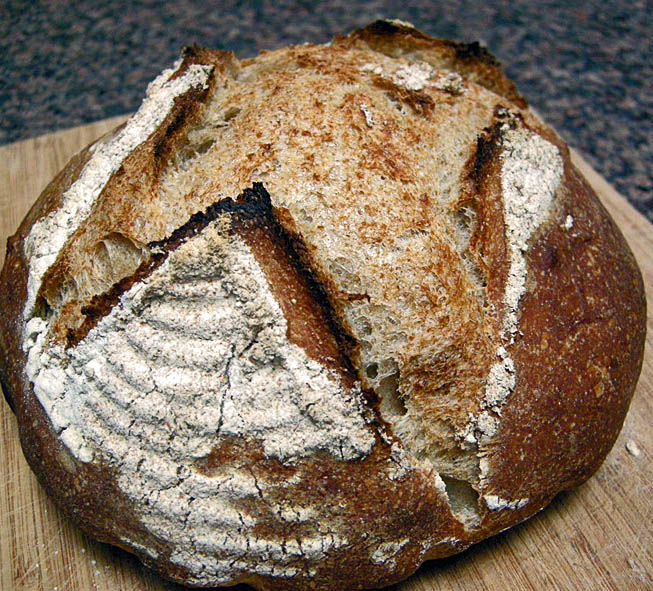
We spent last week in Oklahoma, which gave me the opportunity to bake bread in a normal oven.  After some severe brainstorming over the recipe, I settled on a country rye from Tartine, one of my favorite bread books.  It calls for a sourdough starter with a 50:50 mixture of white and whole wheat flours, and the dough itself has a small amount of rye. Usually I’d retard the loaf overnight in the fridge (as recommended), but this time I baked it just 3 hours after the final shaping.   The oven rise was impressive, the bread almost exploded out of the slashes!  It’s a vision that makes me so happy…   😉

COUNTRY RYE
(adapted from Tartine)

For the leaven (8 hours before making the dough):
1 Tbs sourdough starter, very active
140ml water
70g white bread flour
70g whole wheat flour

For the dough:
100g of leaven (save the rest)
400ml water at 75 F
415g bread flour
85g rye flour
10g salt

Pour the water in a large bowl, add the leaven (only 100g of it) and mix to dissolve.  Add the two different flours, mix with your hands to form a shaggy mass. Cover and let it sit at room temperature for 40 minutes.  Sprinkle the salt on top of the dough and knead to mix it.

Let the dough go through a bulk rise of 3 hours, folding the dough at every 30 minutes.  Pre-shape the dough as a ball, let it rest undisturbed for 20 minutes, then shape it in its final round shape, place it in a round container with the seam up for 3 hours  (you can also retard the dough in the fridge for 12 to 16 hours).

Bake for 45 minutes in a 450 F oven,  with steam during the first 25 minutes.  Allow it to completely cool before slicing.

ENJOY!

to print the recipe, click here
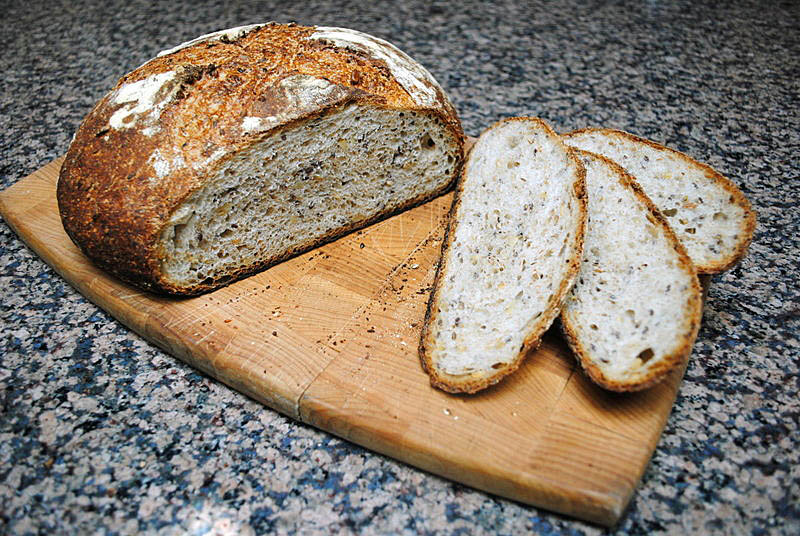
Comments: For the first time I baked this type of bread without weighing the ingredients, because my balance stayed in the nano-kitchen.  I was a bit nervous, but I used a conversion table and it worked just fine. The more I bake with wild yeast, the more convinced I am that technique trumps the proportions of ingredients. For example, folding the dough enough times during fermentation, and creating proper surface tension in the final shaping have a huge impact on the final product.   My advice is to practice, practice, and practice some more. I still struggle with scoring the bread, never feeling confident with the razor blade in my hand. What bothers me is that the scoring is so… final!  Once you slash the surface, you can only hope you did it right.  😉

The crumb was a little less open than that of a bread exclusively made from white flour,  and the taste reminded me of a Poilane miche, but less dense.  It’s a bread for a ham sandwich, or one with which you can mop up the juices of a hearty pot roast, or perfect to toast and enjoy with a little Brie cheese.

I am submitting this post to Susan’s Yeastspotting event… make sure to stop by and amaze yourself with all the tempting breads.

ONE YEAR AGO: My New Favorite Tomato Sauce

Add to FacebookAdd to DiggAdd to Del.icio.usAdd to StumbleuponAdd to RedditAdd to BlinklistAdd to TwitterAdd to TechnoratiAdd to Yahoo BuzzAdd to Newsvine

PIERRE NURY’S RUSTIC LIGHT RYE: BOUGNAT

I’ve browsed the pages of Leader’s “Local Breads” countless times over the past year, but taking part in “The Bread Baker’s Apprentice” challenge prevented me from indulging in many other bread books. Once the  challenge finished, I felt excited to attack other projects, but also somewhat paralyzed.   Not anymore: last weekend I dove into my first Local Breads recipe, a three-day project that led to a couple of delicious loaves of a rustic, toothsome bread.

PIERRE NURY’s RUSTIC LIGHT RYE
(from Local Breads)

Levain (sourdough starter)

45 g firm sourdough starter
50 g water
95 g bread flour
5 g whole wheat flour

Mix all the ingredients until they form a stiff dough, trying to incorporate all the flour into it. Place the dough in a container, marking its level with a tape or pen. Allow it to ferment at room temperature for 8 to 12 hours, until it doubles in volume. This recipe will make more levain than used in the bread.

Bread dough

400 g water
450 g bread flour
50 g rye flour
125 g levain
10 g salt

Pour the water into the bowl of a Kitchen Aid type mixer. Add the bread and rye flours, stir with a spatula until it begins to form a dough. Cover the bowl and let stand at room temperature for 20 minutes.

Uncover the bowl, add the levain (only 125 g of it) and the salt, and start kneading with the dough hook on medium speed for 12-14 minutes, or until you have good gluten development (do a windowpane test). Transfer the dough to a slightly oiled bowl and keep it at room temperature for 1 hour. Scrape the dough into a floured surface and fold it a couple of times to induce gluten development. You can see how to fold the dough by clicking here. Repeat the folding again after 1 more hour. After the second folding cycle, let the dough rise for 1 to 2 hours at room temperature until doubled in volume. Transfer to the refrigerator for 12 to 24 hours.

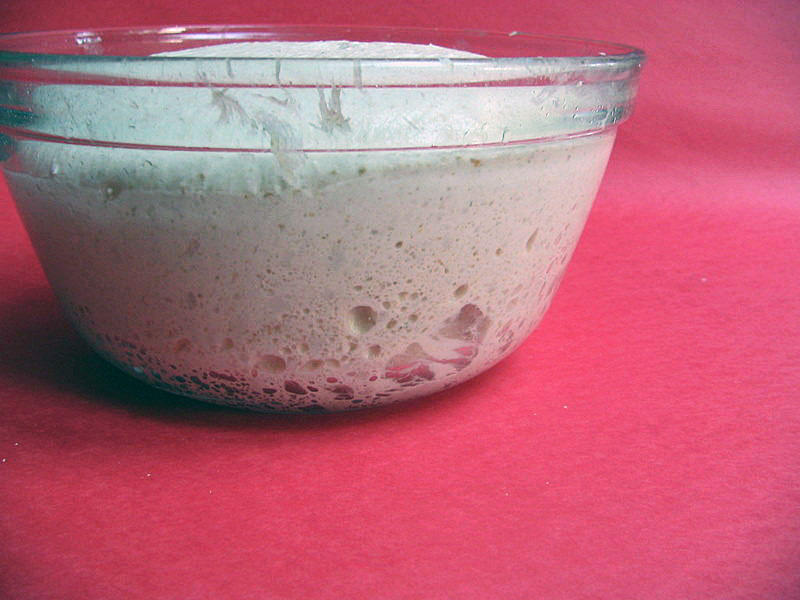
After 14 hours, my dough looked like this….

“Shaping” and baking
Remove the dough from the fridge 3 hours before baking. Heat the oven to 450F and place a baking stone (or tiles) on the middle rack.

Heavily dust the counter with flour, scrape the dough onto the counter, and open it gently into a 10 inch square shape, trying not to deflate it too much. I like to mark the dimensions on the flour, to have an idea of how much to open the dough.

Transfer each piece to a rimless baking sheet covered with parchment paper, stretching the dough to about 12 inches long. Let it fall naturally, without worrying about a precise shape. If baking both loaves at the same time, separate them by at least 2 inches.

Bake with initial steam for 20 to 30 minutes, until a dark walnut color develops on the crust. Let the loaves cool on a rack for at least an hour before slicing.

ENJOY!

to print the recipe, click here

for a detailed discussion on this particular bread, visit this link

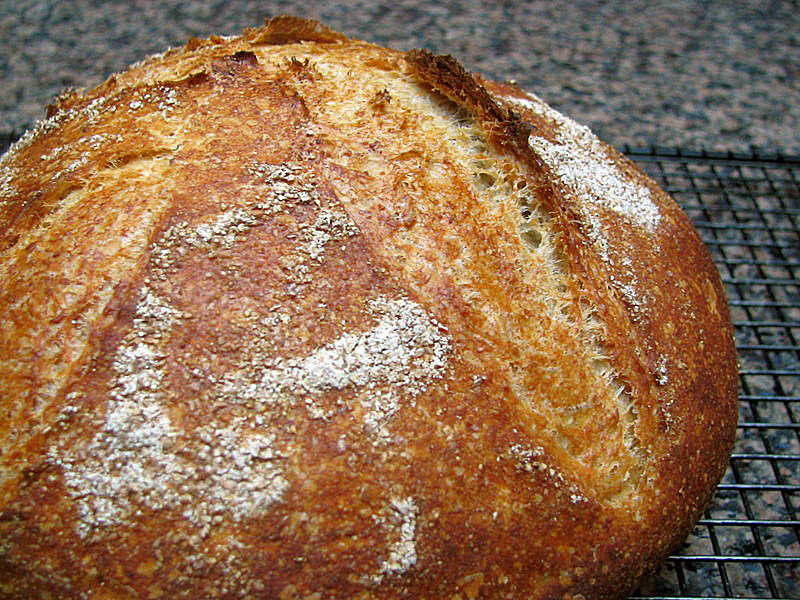
Comments: The recipe was quite involved and challenging, but the gods of Bread were on my side and things went smoothly.  A dough with this much water (in baker’s terms it’s called a high hydration ratio) is tricky to deal with, but extra flour on the work surface helps. As some of the bakers in The Fresh Loaf put it “it feels like you’re making pancakes” when transferring the “bread” to the baking sheet. It’s impossible to shape it, so don’t even try. Lift it, gently stretch it  (it will almost stretch itself as it’s lifted), place it on the baking sheet and transfer it to the oven.   It’s a delight to witness its impressive oven spring (yet another fancy term to indicate that the dough rises a lot during baking).

The crumb almost made me shed a few tears… I know, I know… it’s pathetic, but bread make’s me emotional!  (In a good way.)  😉

I am submitting this post to Yeastspotting….

Add to FacebookAdd to DiggAdd to Del.icio.usAdd to StumbleuponAdd to RedditAdd to BlinklistAdd to TwitterAdd to TechnoratiAdd to Yahoo BuzzAdd to Newsvine

MELLOW BAKERS: RUSTIC BREAD

Not sure what Mellow Bakers is all about? Click here to read about it.

I haven’t decided yet if I”ll make the bagels, which are part of the three breads listed for this month. While debating this extremely important issue, I baked Rustic Bread today (page 115 of Hamelman’s BREAD).

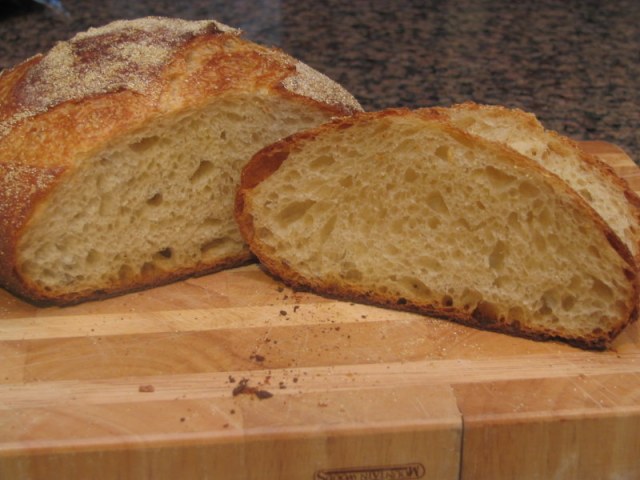
and the crumb was just the way we like it….

The bread takes a pre-ferment made the day before and allowed to rise for 12 to 16 hours at room temperature (around 70F). Next day, the final dough is mixed using a combination of regular, whole-wheat, and rye flour. The basic mixing and the folding method for kneading are very similar to that for Hamelman’s Vermont sourdough series, which happens to be my favorite way to handle bread dough. I did not need to adjust anything in the recipe, the dough came together beautifully.

Check the work of my mellow baker buddies by clicking here….

…. to bagel or not to bagel: that is the question! 😉

Add to FacebookAdd to DiggAdd to Del.icio.usAdd to StumbleuponAdd to RedditAdd to BlinklistAdd to TwitterAdd to TechnoratiAdd to Yahoo BuzzAdd to Newsvine

BARM BREAD

IMG_2236

IMG_2246

This is my second submission to Yeastspotting

The recipe for this traditional wheat bread from England comes from Dan Lepard’s book  “The Handmade Loaf”, that I mentioned before. I’ve made quite a few  breads  from it, and at first this one seemed a little too involved,  because it required not only a levain (sourdough starter), but also a barm .  But, I was inspired to try it after reading a wonderful post about it.

Lepard  came up with a nice strategy to duplicate the barm at home by taking  a bottle-conditioned beer, and adding to it a small amount of your own  levain.  It’s a simple bread once  the barm is ready and bubbly…

To make the barm….
IMG_2216

125g Chimay beer (or other beer containing live yeast)
25g bread flour
2 tsp white levain (commercial or made from scratch)

Heat the beer to 160F, remove from the heat and quickly add the flour. Transfer to a bowl and allow it to cool to 68F, then add your white levain. Leave it at room temperature overnight or until it is very bubbly (my barm fermented for 30 hours).

Waiting for it to cool to 68F….
IMG_2219

To make the bread dough…

ingredientslabel

75g barm
125g water at room temperature
250g bread flour
3/4 tsp fine sea salt

Mix the barm in a large bowl with the water to completely dissolve it, then add the flour and salt. Mix it all with your hands;  it will be pretty shaggy and you will doubt that it will ever become smooth…. don’t worry, just let the dough sit there for 10 minutes, covered.
IMG_2224

Now follow this timeline, kneading for 10 to 15 seconds (yes, seconds) at each timepoint:

10 minutes / 20 minutes / 30 minutes / 1 hour / 2 hours /3 hours / 5 hours

at the 30 minute timepoint the dough will already be quite smooth…
IMG_2230

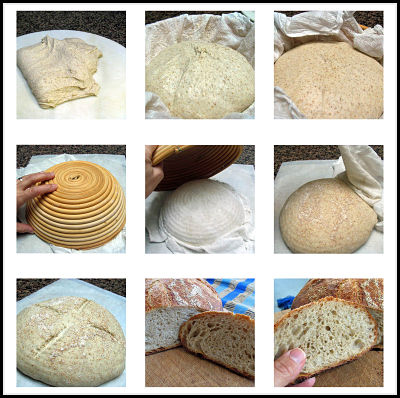
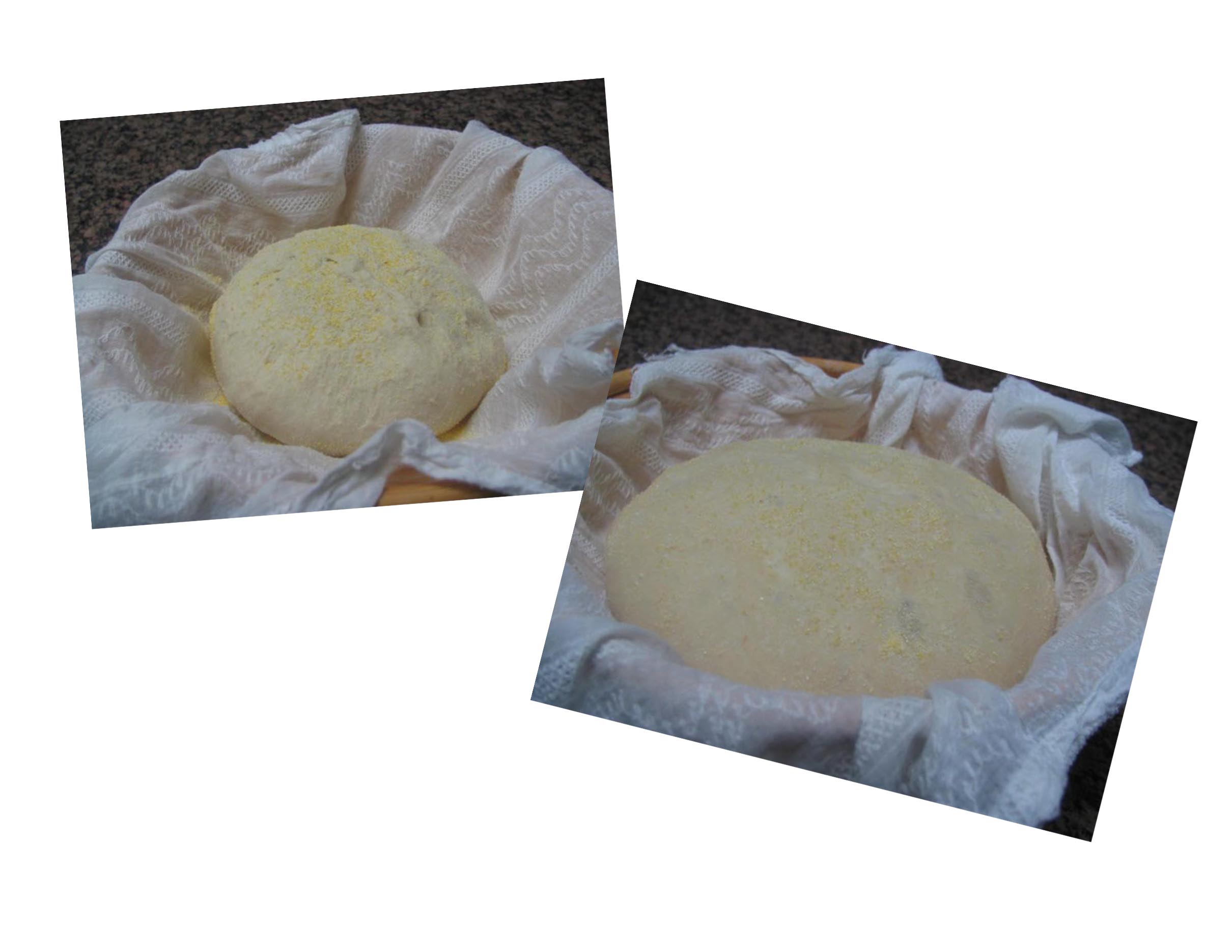
After 5 hours, knead it briefly again, allow the dough to relax for 10-20 minutes, and  shape it into a  “boule” (see one method here).  Gently transfer it to your vessel of choice for the final rise (about 4 hours) before baking. I used a banetton lined with a fine cloth, sprinkled with cornmeal.
beforeafter

The bread will rise to 1.5X  its initial volume; when you press it gently with a finger, it should feel airy and light. I baked mine in a clay pot at 430F for 30 minutes covered, and for 15 additional minutes with the lid off.

IMG_2241

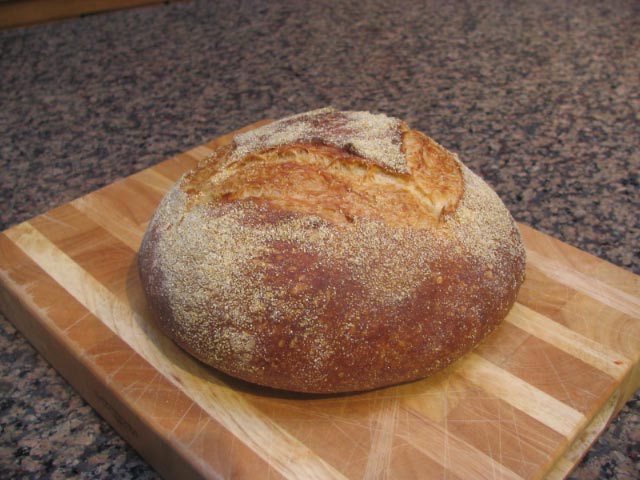
This bread is a winner in every way:  flavor, crust and crumb texture, and looks. The beer gives it a subtle sourness completely different from a regular sourdough, made with levain only. It is a perfect match for a ham sandwich, or to go along a hearty soup or salad.  I kept thinking about split pea soup while munching on the bread. I’ll definitely make it again, with different beers and flour mixtures, as advised in Lepard’s book.

jump for more comments….

Continue reading