WALNUT CRANBERRY SOURDOUGH BREAD

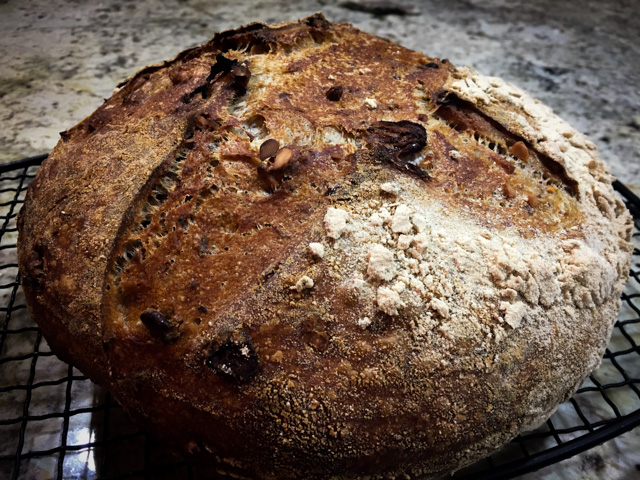
Not too long ago I shared with you The Best Sourdough Recipe, and in that post mentioned that a second bread from Maurizio’s site was undergoing fermentation. So, here I am to talk about that bread, probably one of the top ten best we’ve enjoyed in the Bewitching Kitchen. Considering how many loaves of bread I’ve baked through several years of blogging (almost seven, my friends), I wouldn’t take such a remark lightly…  Something about mixing a sweet and tart fruit with toasted walnuts, plus the complex flavor of the sourdough makes this loaf pretty spectacular.  It was superb with a nice Roquefort cheese, but toasted and enjoyed even without adornments it was a feast for the taste buds.

Cranberry Walnut Sourdough2

WALNUT CRANBERRY SOURDOUGH
(adapted from The Perfect Loaf blog)

for the liquid levain starter:
(make 12 hours before making the dough)
35 g liquid starter (at 100% hydration)
35 g whole wheat flour
35 g bread flour
70 g water

for the final dough:
400 g white bread flour
88 g whole wheat flour
12 g rye flour
440 g water at about 90 degrees F (divided, 400 g + 40 g)
10 g sea salt
100 g toasted walnuts, in pieces
70 g dried cranberries
125 g levain (made as above)

Build the liquid levain 10 to 12 hours before you want to make your final dough. Leave it at room temperature (around 72 F).

Next morning, mix flours and  400 g of water very well in a bowl and cover. Ensure all dry flour is hydrated. Leave it to autolyse for 1 hour.  Add the levain with the reserved water and hand-mix it into the dough until it is very well incorporated.  Leave it 30 minutes at room temperature, or if you have a proofer, set it to 78 F and keep the dough at this temperature all the way through. After 30 minutes, add the salt, and mix well.

After the salt is incorporated perform folds for about 2-3 minutes in the bowl. Grab under one side, pull up and over to the other side, then rotate the bowl a bit and repeat. Do this about 30 times or so (it goes fast and easy). At the end the dough should still be shaggy, but it will be a little more smooth and will slightly start to hold itself together more in the bowl. Now you are ready to start bulk fermentation.  If your home is at 78 to 82 F, bulk fermentation should last 4 hours.

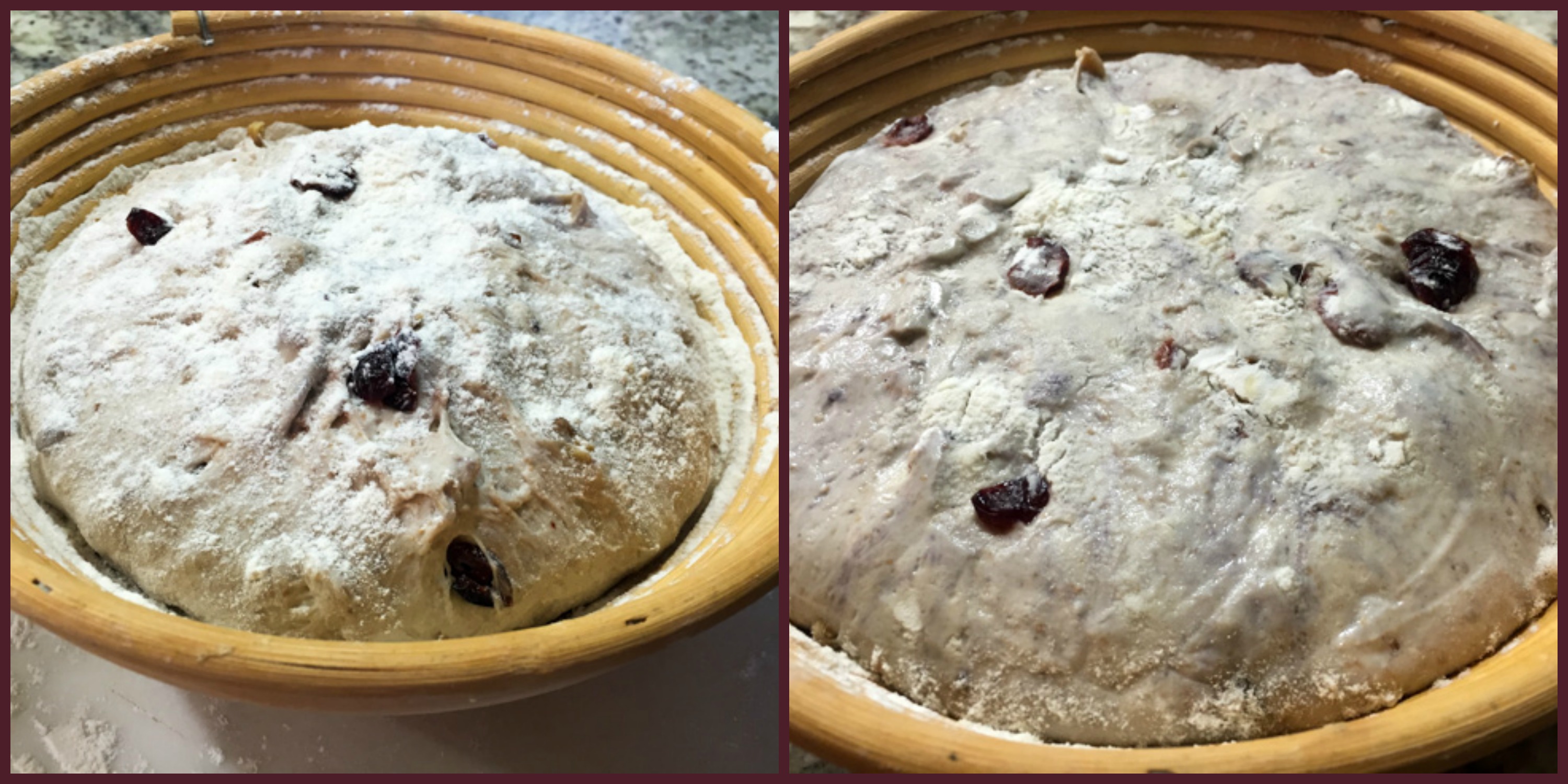
During fermentation, do 4 to 5  sets of stretch and folds (I did five), adding the walnuts and cranberries on the second cycle of folding. Perform the first three foldings at 15 minute intervals, the remaining ones at 45 minute intervals then leave the dough to ferment for a full hour undisturbed.  If your dough is too “weak”, seeming to lack structure, add one extra cycle of folding, then leave the dough undisturbed for another hour.

Lightly shape the dough into a round, cover with inverted bowl or moist towel, and let rest for 20 minutes.  After 20 minutes remove the towel or bowl and let the dough rest 5 more minutes exposed to air. This step helps dry out the dough just a bit so it’s not too sticky during shaping.  Lightly flour the top of your dough rounds and flour the work surface. Shape into a batard or boule. Place in a banneton very well floured, leave it at room temperature for about 20 minutes, then retard in the refrigerator  for 15-16 hours.

Heat oven at 500ºF. Bake 20 minutes at 500ºF with steam, and an additional 25-35 minutes at 450ºF, until done to your liking. Cool completely on a rack before slicing.

ENJOY!

to print the recipe, click here

doughcollage

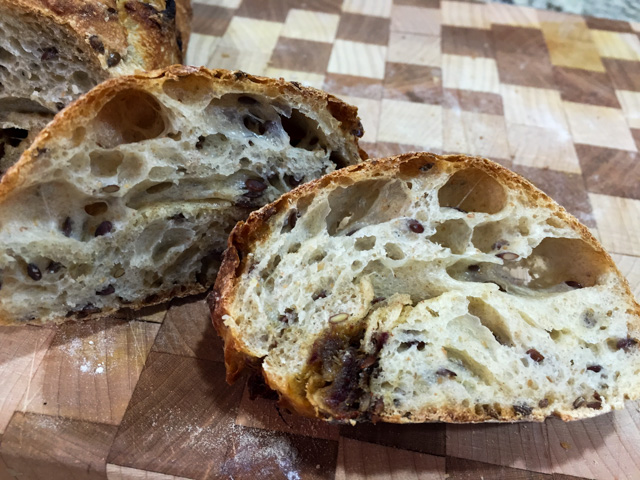
Comments: For a bread so heavy with goodies, the crumb turned out a lot more open than I expected. I decided to add one extra cycle of folding (for a total of five) because I felt the dough was asking for it. When the dough speaks to me, I listen.  This method of retarding the dough in the fridge overnight and baking early next morning is perfect. You can use this basic recipe and add other nuts, seeds, dried fruits, olives, just use it as a basic formula.  If your additions are heavy, wait for the second cycle of folding to incorporate them, because it will be easier.  The proportion of white, whole wheat and a touch of rye was perfect to our taste, I would not change it a bit.

Maurizio, thanks again for a great recipe!

crumb shot
ONE YEAR AGO: Ottolenghi in Brazil?

TWO YEARS AGO: Roasted Winter Vegetables with Miso-Lime Dressing

THREE YEARS AGO: 2012 Fitness Report: P90X2

FOUR YEARS AGO: Caramelized Bananas

FIVE YEARS AGO: Roasted Lemon Vinaigrette

SIX YEARS AGO: Whole Wheat Bread

SECRET RECIPE CLUB: RUSTIC CIABATTA AND MINI-MEATLOAVES

FOUR YEARS AS A MEMBER OF THE SECRET RECIPE CLUB!
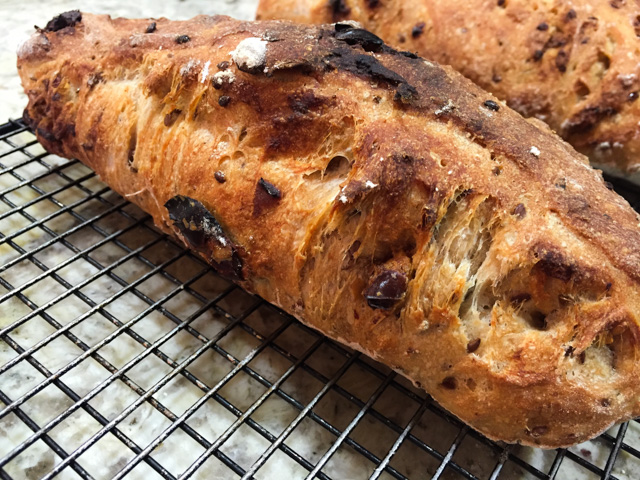
Rustic Ciabbata with Dates.
It’s that fun time of the month again, Reveal Day of The Secret Recipe Club, a virtual event in which food bloggers are assigned a site in secret, then blog about a chosen recipe at midnight of Reveal Day. In two words: incredibly awesome. But what is more awesome than that is the blog I got this month. I almost passed out from excitement, thrill, and joy. Why? Because my assigned site is one of my favorites in the whole food blogosphere: Karen’s Kitchen Stories. Just to make an analogy, if blogging was like acting, my Secret Acting Club assignment would be Meryl Streep. Yeap, that awesome!   I’ve been reading Karen’s blog forever, I consider her as one of my personal gurus in bread baking. She is the type of baker who is not afraid to push the limits, moving easily from tangzhong type breads to bialys, baguettes, all sorts of rustic sourdoughs, Pullman type loaves, really amazing what she can do with flour, water, salt, and yeast, often wild (the yeast, not her).  At my last count, she’s got 247 bread recipes in her blog. Two hundred and forty-seven. You can collect your chin off the floor now. I bookmarked so many recipes that it was not even funny. Just to give you a small sampling of the breads that tempted me: Cheese and Herb Happy Bread,  Cinnamon Swirl Pumpkin Rolls , Corn and Jalapeno Rolls (oh, my!), English Muffin Bread (I really need to make this one!), Tangzhong Whole Wheat Bread (very interesting method), Kesra Moroccan Flatbread, Hawaiian Style Sweet Rolls (reminds me of my childhood in Brazil), Stuffed Pretzel Bites (O.M.G.!). Of course, that doesn’t include the breads from her site I already made like the delicious Ka’Kat. or Forkish’s Warm Spot Sourdough. But of course there’s a lot more than bread in her blog. For instance, if you like stir-fries, she has a section on Wok Wednesdays that is a must-follow, holding so far 57 entries.  The bottom line is, I had no choice but to make two recipes from her site. A rustic ciabatta, because it would be almost rude not to choose a bread from Karen’s blog, and some mini-meatloaves because they looked so incredibly cute, I could not stop dreaming about them…
Ciabatta Dates Flax2

RUSTIC CIABATTA WITH DATES AND FLAX SEEDS
(from Karen’s Kitchen Stories)

for the soaker:
48 grams flaxseeds
72 grams (1/3 C) water
 .
for the poolish:
125 grams unbleached bread flour
125 grams (1/2 C) water
pinch of instant yeast
 .
for the final dough:
278 grams (~1 1/4 C) water
All of the poolish
300 grams unbleached bread flour
50 grams coarsely ground whole wheat flour
25 grams coarsely ground rye flour
10 grams (1 3/4 tsp) salt
2 grams (~ 3/4 tsp) instant yeast
All of the soaker
84 grams dried dates, seeded previously, cut into 1/2 inch pieces
 .
The night before baking day, mix the soaker and poolish in separate bowls. Cover both bowls with plastic wrap. Leave enough room in the poolish bowl for it to double in size.
.
The next day (about 12 to 16 hours later), measure the 278 grams of water into a large bowl or dough rising bucket. Add the poolish, and mix it into the water with your hand to break it apart. Add the flours, salt, and yeast, and mix the dough with your hands, stirring, pinching, and folding the dough to absorb all of the flour and dissolve the salt and yeast. When you pinch the dough, you should not feel any grit.
.
Once all of the ingredients are combined, mix in the soaker with your hand until evenly distributed. Add the dates, and mix to distribute. Cover the bowl with plastic wrap and let rise in a warm spot.
.
After 45 minutes, stretch and fold the dough over itself from all four “sides.” Repeat the 45 minute rest followed by a stretch-and-fold two more times (a total of 3 stretch-and-folds).  Let the dough rest for a final 45 minutes, covered, in a warm spot.
.
Scrape the dough out onto a lightly floured counter, and gently nudge it into a rectangle. Be careful not to deflate the dough. Using an oiled bench knife, cut the dough into three equal pieces. Pick each piece up with floured hands and place it on a floured couche or parchment lined baking sheet. Cover with the rest of the couche or oiled plastic wrap.  Let the dough rest for 20 minutes, while you heat the oven to 475 degrees F, and set it up with a steam pan on the lowest rack and a baking stone directly above it. Fill a spray bottle with water.
 .
When the oven is at the correct temperature, transfer the loaves to the baking stone (see notes above, or place the baking sheet with the loaves on it in the oven). Place a cup of boiling water in the steam pan (cover your oven’s window), and spray the oven walls with water. Quickly close the door.  Bake the loaves for 25 to 30 minutes, rotating halfway through. They are done when the internal temperature reaches 200 to 210 degrees F. Cool on a wire rack.
.

ENJOY!

to print the recipe, click here
.

ciabattacollage
.
Comments:
I made this bread in one of those perfect Saturdays!  Why? Because I woke up before 5am feeling super energetic, could hardly wait to get downstairs and play with my ingredients already measured since the evening before.  During the first 45 minutes rise I did a nice P90X yoga while the house was still dark, peaceful and silent…  As in a perfectly timed symphony, just as I finished my exercises, Phil woke up and made me a fantastic cappuccino…. the dogs immediately joined us in welcoming the weekend…Told ya: perfect Saturday!
.
Back to Karen’s ciabatta: the dough was a pleasure to work with, gaining strength at each folding cycle. In the composite photo above, the dough is shown after the last folding cycle, all plump and shiny.  I used whole flaxseeds, Karen used ground, but I followed the exact same method, including the volume of water to make the soaker. You can use whatever type of flaxseeds you have in your pantry.  Most important thing is not to deflate the dough too much as you coach it into the ciabatta shape. The less you mess with it, the better.  You will be rewarded with a ton of holes, a very airy bread, comme il faut.
.
Crumb shot
.

We both loved this bread! The dates offer a burst of sweetness that plays well with the almost sour nature of the dough given by the extended fermentation of the poolish.  Cut a slice, toast it very very lightly, top it with some Gorgonzola and you will have to tie yourself to your seat not to fly away in a magic carpet….   Awesome combo.

 +++++++++++++++++++++++++++++++++++++++++++++++
 .

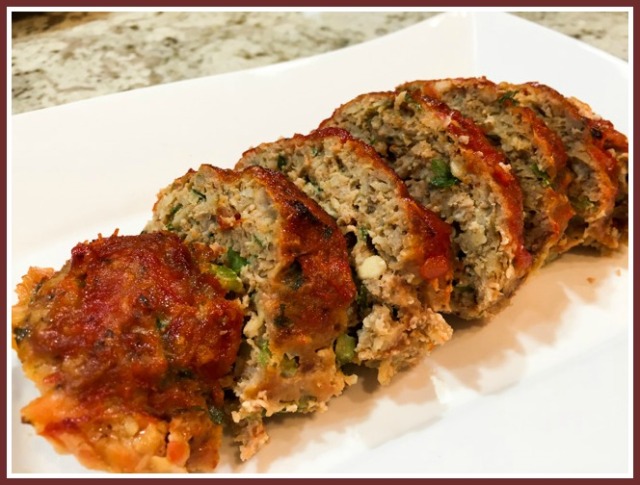
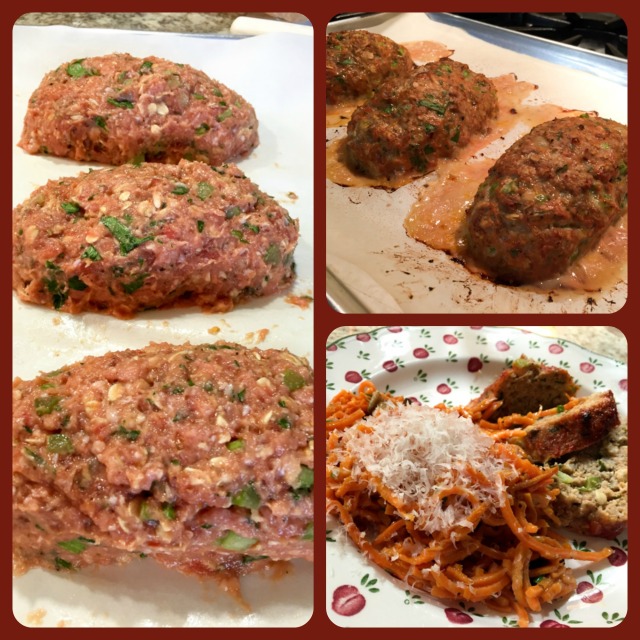
And now, for the bonus recipe from Karen’s site…  Adorable meatloaves in individual servings.  Her recipe used beef, I changed it slightly by using ground turkey.

miniloaves served11
.
INDIVIDUAL MEATLOAVES WITH CHILI SAUCE

(adapted from Karen’s Kitchen Stories)
.
1 shallot, coarsely chopped
1 rib celery, diced
1/3 cup packed flat leaf parsley leaves
4 slices of bacon, cut into 1/2 inch slices
2/3 cup rolled oats
1/4 cup boiling water
1 pound 85% lean ground turkey
1/4 pound ground pork
2 large eggs
1 1/2 tsp Kosher salt
3/4 tsp freshly ground black pepper
1 cup jarred chili sauce, such as Heinz
 .
Spray a half sheet pan with spray oil and heat the oven to 400 degrees F. In a food processor, pulse the shallot, celery, parsley, and bacon several times until well chopped.  In a large bowl, combine the oats and boiling water and stir. Add the mixture from the food processor and combine.
 .
Break up the ground turkey and pork and add them to the large bowl. Whisk the eggs and add them to the meat and oat mixture. Sprinkle with the salt and pepper. Add 1/4 cup of the chili sauce to the meat mixture. Mix with your hands until everything is well mixed.
 .
Divide the mixture into four equal parts and shape each into a small loaf, placing them onto the baking sheet. Take 1/2 cup of the chili sauce, and brush it over the four loaves.  Bake the loaves on the center rack for about 25 minutes. Remove the pan from the oven and brush the loaves with the rest (1/4 cup) of the chili sauce. Turn on the broiler, and place the pan back on the center rack. Broil for about 5 minutes, until the chili sauce just begins to brown.
.
ENJOY!
.

to print the recipe, click here

 .
PicMonkey Collage11

.
These meatloaves were sooooo good!  The chili sauce is a must, do not skip it. They turned out moist, flavorful, spicy but not overly so. I served them with sweet potato noodles that were recently published in my guest post over at Foodbod. The recipe made 3 loaves and we enjoyed them for dinner, then I had leftovers for my lunch a couple of days in a row. Heaven. Just heaven. If I may make a public confession, I had some slices straight from the fridge. Cold. Yeah, standing up, with a Jack Russell staring at me wondering how long it would take for Newton’s Law of Gravity to work its magic in his favor. HA!  Not a chance!

Karen, I hope you enjoyed your assignment this month. It goes without saying that I spent the past 4  weeks anticipating this Reveal Day, anxious to share the recipes I made from your blog. For my readers, if you don’t yet know Karen’s Kitchen Stories, stop right now and go pay her a visit.  Not only she is a great baker and cook, but a very cool person with great sense of humor and wit.  Plus, she is the Grandma of two beautiful boys, and lucky to live very close to them, so it’s easier for her to spoil them rotten.  I intend to follow her footsteps and do my best to spoil Greenlee at every chance I get…   Maybe one day I can teach Greenlee to bake a chocolate cake for her Dad too. Oops, did I just use “teach” and “bake a cake” in the same sentence?  Excuse me while I go grab a thermometer. I might be running a very high fever… (sigh)

ONE YEAR AGO: Green Rice

TWO YEARS AGO: Potato-Crusted Italian Mini-Quiches

THREE YEARS AGO: Beetroot Sourdough for the Holidays

FOUR YEARS AGO: Cod Filet with Mustard Tarragon Crust

FIVE YEARS AGO: Soba Noodles: Light and Healthy

SIX YEARS AGO: Potato-Rosemary Bread

KEN FORKISH’S PAIN AU BACON

PainAuBacon2It’s been a while since I baked a loaf of sourdough bread. A quick browse through my archives proves this sad turn of events: October 13th was my last adventure in the Land of the Wild Yeast. But, with so much going on, trips, busy schedule, I was forced to let my starter sleeping in the freezer a lot longer than I expected.  Finally, the second weekend of December shaped up as a perfect opportunity to resume bread baking. The weekend schedule seemed flexible enough – just a cocktail party Saturday night – and the perfect weather to crank the oven up all the way to 450 F.  Sometimes a tropical being is forced to find positive aspects in outside temperatures falling below 60 F.  I sat down next to our fireplace with quite a few of my bread cookbooks, and went through the very elaborate process of choosing which recipe to work on.  Keep in mind that if I have to dress up for a party, my outfit is decided in 5 minutes, accessories included. But choosing a sourdough bread takes me hours. And I mean  hours  in the strict sense of the term, in which 1 hour equals 360 seconds.  After intense mental struggle, I picked a winner from Ken Forkish’s book “Flour Water Salt Yeast“.   It was worth all the pacing back and forth, the many stick-it notes, and the snide remarks of the husband asking if I needed another couch to spread some more cookbooks. Very uncalled for. Obviously, I can only endure this type of treatment because I am an easy-going, serene, and forgiving human being. PainAuBacon1PAIN AU BACON
(recipe reprinted with permission from Ken Forkish)

Makes one loaf.

for the levain:
50 g mature active sourdough starter
200 g unbleached all-purpose flour
50 g whole wheat flour
200 g lukewarm water

for the final dough:
432 g unbleached all-purpose flour
8 g whole wheat flour
343 g water (warmed to about 90 degrees F)
10 g fine sea salt
250 g (about 1/2 pound) bacon, fried to crispy, and then crumbled
1 T reserved bacon fat
108 g of the levain
.
Mix the levain ingredients in a medium bowl, cover with plastic wrap, and let sit for about 10 hours, until bubbly. In a large bowl mix the flours and water by hand until just incorporated. Cover and let it rest for 20 to 30 minutes (that is the autolyse step).
.
Sprinkle the salt all over the flour mixture, then add the levain.  Using wet hands to prevent the dough from sticking, mix the dough by pinching it to distribute the salt. Cover and rest for 10 minutes.
.
Spread the bacon fat over the dough and add the crumbled bacon. Using the pincer method alternating with folding, mix all of the ingredients in the bucket. Cover the dough with plastic wrap, and let it sit for 30 minutes. In the next 2 hours, stretch and fold the dough 4 times, every 30 minutes. Cover and let rest at room temperature for 12 hours, until about tripled in volume.

Gently shape the dough into a loose boule. Flour a banneton,  shape the dough into a medium tight ball and place it seam side down into the proofing banneton. Cover with oiled plastic wrap. Let the loaves proof for about 4 hours, depending on the room temperature.

About 45 minutes before baking, heat the oven to 475 degrees F with an empty covered Dutch oven placed on the middle rack.

Remove the Dutch oven from the oven and remove the lid. Place a piece of parchment over the banneton with the proofed bread inside, and a flat baking sheet over it. Flip the dough over, remove the basket, and place the shaped boule in the Dutch oven using the parchment to help move it. The paper can stay in during baking.  Cover the Dutch oven and place it in the hot oven.  Wet the lid of the Dutch oven, and quickly use it to cover it. Alternatively, you can use your own favorite method to generate steam during baking.

Bake covered for 30 minutes, and then uncover it and bake it for 15 to 20 minutes more, until the interior of the bread reaches 205 to 210 degrees F and the bread is a deep brown.

Cool on a rack completely before devouring it…

ENJOY!

to print the recipe, click here

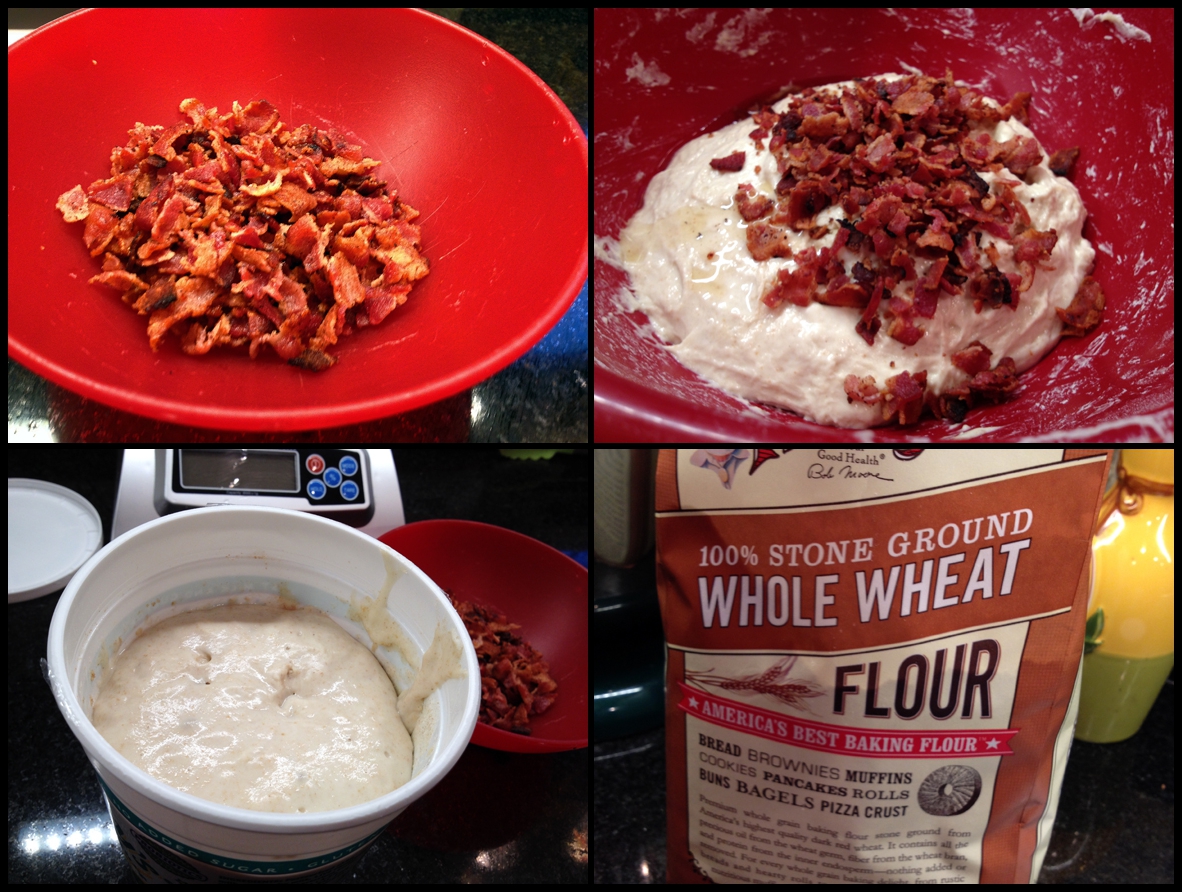
composite1

Comments:  After such a long time away from my starter, I get a little anxious when baking a loaf like this.  I was particularly worried about leaving the dough to ferment at room temperature for 12 hours, something I had never done before.  But, the dough behaved exactly as Ken mentioned in the book.  Take a look at these couple of shots:

Before…
Before

After…
After

A very nice, soft, bubbly dough, quite easy to work with and shape as a boule.
Proofing

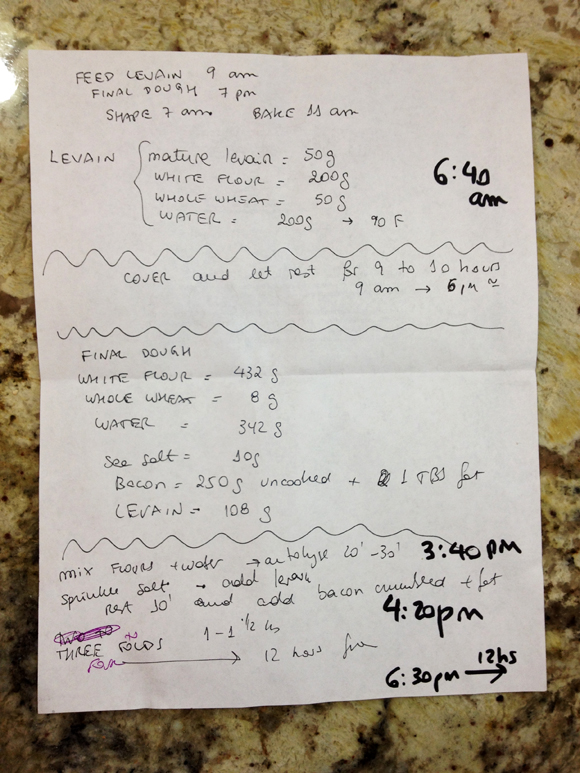
One of the things I love about Ken’s book, is that he offers a sample timeframe for all recipes. Just for fun, I include my notes, prepared the night before. On top you see his suggestion of timing, and as I move along, I jot down my actual timing, adapted to fit my schedule. If you have the book, you may notice I actually halved the recipe to make a single loaf instead of two.

Notes(click to enlarge, if so desired)

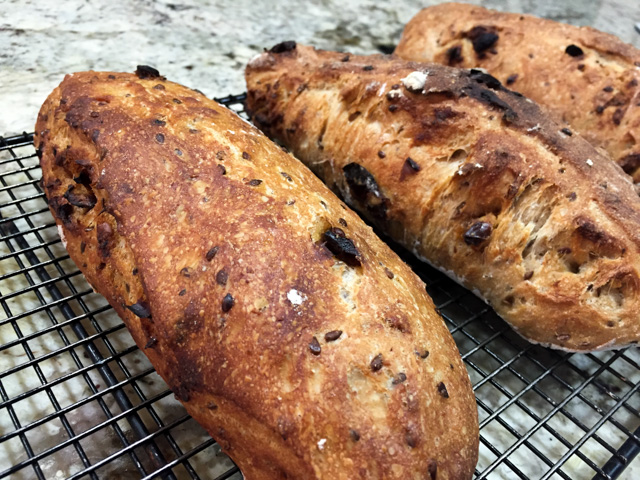
The subtle smell of bacon while the bread baked was wonderful!  I made this bread especially to share with my youngest stepson and our great friends from Oklahoma who were coming to visit us the following weekend. So, the bread cooled completely over a rack, rested for a day, and the following morning I sliced it and froze the slices, in small packages.  It is a perfect way to have bread as good as freshly baked at a moment’s notice.

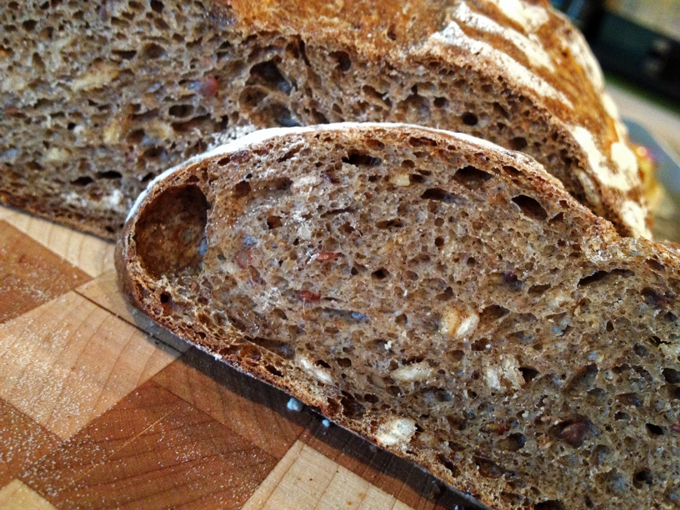
Here is the mandatory crumb shot…
CrumbShot

And the slices on their way to the freezer…

Bagged

This was a superb loaf of bread!  In fact, when we served it – alongside a hearty pasta with Bolognese sauce – it was hard to believe that bacon was the only ingredient added. It tasted very complex, almost as if a mixture of nuts were also incorporated into the dough. Salty, spicy, and smoky at the same time.

Ken, thank you for allowing me to publish the recipe for one of the most flavorful loaves of bread I ever made!I am submitting this post to Susan’s Yeastspotting event…

HAPPY HOLIDAYS, EVERYONE!

maracujaDad and son enjoying a nice passion fruit “caipirinha”…

ONE YEAR AGO: Carrot and Cumin Hamburger Buns

TWO YEARS AGO: Potato Galettes a l’Alsacienne & Book Review

THREE YEARS AGO: Caramelized Carrot Soup

FOUR YEARS AGO: Miso-Grilled Shrimp

FIVE YEARS AGO: Pain Poilane


SOURDOUGH RYE BREAD WITH FLAXSEEDS AND OATS

This is that type of bread that begs for mindful eating. No sitting down in front of the TV grabbing one piece here, another there, or sharing it with friends in the middle of a loud party.  No, this is a bread that deserves attention. It is dense without being overly heavy, and its flavor is quite complex due to the use of assertive flours and flax seeds. The recipe was created by Rosa, from Rosa’s Yummy Yums, a food blog that not too long ago celebrated its 9th anniversary!  Nine years.  No small feat, folks, considering that each of Rosa’s post is a masterpiece: carefully composed text (with recipes in two languages, English and French), matched with her incredibly beautiful photography. Hers is the type of blog that just like this bread, deserves full attention.

Rosa Yum Yum BreadMade July 26th; Blogged October 13th

WHOLE-WHEAT AND RYE SOURDOUGH WITH FLAX SEEDS AND OATS
(from Rosa Mayland’s blog)

(for one round loaf; check her site for full version that makes 2 loaves)

1 heaping tablespoon of flax seeds 1/2 Tbs Flax seeds
150g whole-wheat flour
100g white flour
35g rye flour
35g buckwheat flour
100g active sourdough starter

188-200 g/ml lukewarm water
A pinch of dry yeast
1 heaping tablespoon of olive oil

20g Rolled oats
7g fine sea salt

Put the flax seeds in a small bowl and add 63g/ml of boiling water (this will make them slimy). Stir and leave to cool.

In the bowl of your stand mixer put the flours, sourdough, water, yeast, olive oil, flax seeds (+soaking water).  Mix until all the ingredients are just combined. Let the dough rest (autolyse) for 2 hours.

Add the salt as well as the oats and continue mixing for about 5-8 minutes (add a little flour if the dough is too wet), until the dough reaches medium gluten development.  Transfer the dough to a slightly oiled container and cover with plastic wrap. Let the dough ferment/rise, at room temperature, for about 2h30 (or until doubled in size), folding at 50 and 100 minutes.

Shape it as desired (sandwich loaves, boule, bâtard, banneton, etc…). Sprinkle your loaves with flour and cover them with plastic wrap let proof for about 90 minutes or until doubled in size.

Bake at 230° C (450° F) using your favorite method to generate steam during the initial 20 minutes of baking. Total baking time will be approximately 40 minutes.  Leave the bread in the oven for 5 minutes with the door ajar once you turn the oven off.  Cool it completely on a rack before slicing it.

ENJOY!

to print the recipe, click here

crumb
Now, if that crumb doesn’t make you sigh, there is something wrong with you… This was a very nice baking project, perfect for a weekend in which we had nothing planned, no social commitments, no need to go to the lab, just taking each hour as the hour shaped up.   If you stop by Rosa’s original post, you’ll see that she coupled this recipe with a text about the importance of slowing down, a praise for idleness. Food for thought, as usual for her posts. It is nice to be able to take a step back and do nothing. Or, if doing nothing seems like too much of a shock for  you 😉  grab your flours and make this bread. Then, slowly slice it, and close your eyes when you taste it.   Yes, it is that wonderful!

Rosa, thank you for a great recipe, and above all, for the effort you put into your blog, a pleasure to visit every single time!  See you around the blogosphere 😉

I am submitting this post to Susan’s Yeastspotting event…

ONE YEAR AGO: Apricot-Raspberry Sorbet: A farewell to Summer

TWO YEARS AGO: Marcela’s Salpicon

THREE YEARS AGO: Pork Kebabs

FOUR YEARS AGO: Fondant au Chocolat

FIVE YEARS AGOGot Spinach? Have a salad!

TAKING A BREAK FROM THE WILD

I’ve always been fascinated by bread baking. For years I would read books and blogs, but get discouraged because the breads I fell in love with were all made with a sourdough starter. You know, that wild yeast thing.  I would close the book, click away from the site, telling myself “why can’t they bake bread with regular yeast, like normal people?”  It was so frustrating!  Of course, if you follow my blog, you’ll know that now I love to walk on the wild side…  😉   Like many bread bakers, using commercial yeast almost feels like cheating. But, a bread leavened just with instant yeast can be amazing too. In this recipe, 80% of the formula comprises flour fermented overnight with a small amount of yeast.  It comes from Flour Water Salt Yeast, by Ken Forkish.
ready

WHAAAT? NO RECIPE?

Here’s the deal: I sent a couple of messages to Mr. Forkish asking his permission to publish the recipe, but got no answer. Of course, it’s quite possible he never checks his Facebook account.  I know many people who don’t even remember having one!  😉   Without his permission, I don’t feel it is right to include the recipe. You can read more about this subject at the end of my post.

If you want to try his method, you can click here for a great variation on his recipe that includes barley flour in the formula. The technique is exactly the same, though. I intend to make it myself soon, as I am quite fond of barley flour.

photo(1)

Comments: Of all breads I’ve made, this one was by far the loudest singer.  The noises it made while it sat on the counter, cooling, were unreal!  Interestingly, Jane, the blogger behind The Wayward Oven, had this to say about her version of Forkish’s White Bread with 80% BIGA:

“It had a wonderful aroma and the crackling as it cooled was so loud I could – no exaggeration! –  hear it across the room.”

Yeah, that was exactly the case!   I also loved Forkish’s approach of letting the bread rise with the seam side down, and then invert it for baking, without scoring the crust. The bread opens in a natural,  more rustic-looking way.  This bread has a double personality:  the taste and crust of a regular sourdough, and a crumb with the softer texture usually found in breads made with commercial yeast.  Quite an interesting combination!

shot2_opt

I am submitting this post to Susan’s Yeastspotting

And now, for something completely different…

When I started blogging, I did not give too much thought about publishing recipes from cookbooks. I changed the wording around, gave credit, and felt it was good enough.  As time passed, my views on the issue started to change, in part because I learned that some cookbook authors are completely against having their recipes out in the blogosphere, even if proper credit is given.  Then, my virtual friend Joanna published a thoughtful article on her blog, and that pretty much did it for me.  Ever since I read her post, I decided not to transcribe a recipe from any cookbook here, unless I get permission from the author, which unfortunately is not always that easy.  

If I adapt a recipe, I will publish it and link to the “inspirational source”. In fact, that is a practice considered ok by copyright laws. A very good article on the whole subject was written by David Lebowitz and is available here.  As to recipes published in food magazines,  Fine Cooking editors told me they do not mind their recipes being published as long as a link is provided to the source.  And other magazines –  such as Food and Wine, Bon Appetit, Saveur, Cooking Light – have their content online for public access, so it is not a problem to blog on them.

ONE YEAR AGO: Zucchini-Spinach Soup

TWO YEARS AGO: Pollo en Mole en Cacahuate

THREE YEARS AGO: Thom Leonard’s Country French Bread