FOR THE LOVE OF SOURDOUGH

It is amazing how a bread formula can be tweaked slightly and result in totally different outcomes. I share today nine versions of sourdough. They all start with the same composition (90% white bread flour; 10% whole-wheat, salt and sourdough starter). From this starting point, some get added flavor components, and the final outcome depends on how they were handled for scoring.

BASIC SOURDOUGH FORMULA
(from the Bewitching Kitchen)

470g white bread flour
30g whole-wheat flour (regular whole-wheat, spelt or rye)
10g salt
75g sourdough starter at 100% hydration
375g water

Make the levain mixture about 6 hours before you plan to mix the dough. It should be very bubbly and active.

When you are ready to make the final dough, place the water in the bowl of a KitchenAid type mixer and dissolve the starter in it, mixing with a spatula briefly, then add all flours and salt.  Turn the mixer on with the hook attachment and knead the dough for 4 minutes at low-speed all the time. You will notice the dough will gain quite a bit of structure even with just 4 minutes in the mixer. Remove from the machine, and transfer to a container lightly coated with oil, cover lightly with plastic wrap and allow it to ferment for 4 hours, folding every 45 minutes or so. Because the dough is already a bit developed from the initial time in the mixer, you should get very good structure after 3 and a half hours, or even sooner than that.

After four hours bulk fermentation, shape the dough as a ball, and place, seam side up, in a lightly floured banetton. Place in the fridge overnight, from 8 to 12 hours.

Next morning, heat the oven to 450F.

Invert the dough on a piece of parchment paper and score with a new razor blade, if so desired, or simply make a cut on the surface in the shape of a cross with a very sharp knife.

Bake at 450F for 45 minutes, preferably covered for the first 30 minutes to retain steam. You can generate additional steam by spraying the inside of the lid with water before closing the pan.  Cool completely over a rack before slicing.

ENJOY!

to print the recipe, click here

PANCH PHORON SOURDOUGH

To the basic recipe above, add 1 to 2 tsp Panch Phoron, a five spice mixture from Eastern India, often used in Bengali cuisine. It is a mixture of equal parts of seeds of fenugreek, nigella, cumin, black mustard and fennel. I shaped this bread as an oblong loaf, and scored a pattern of leaves.
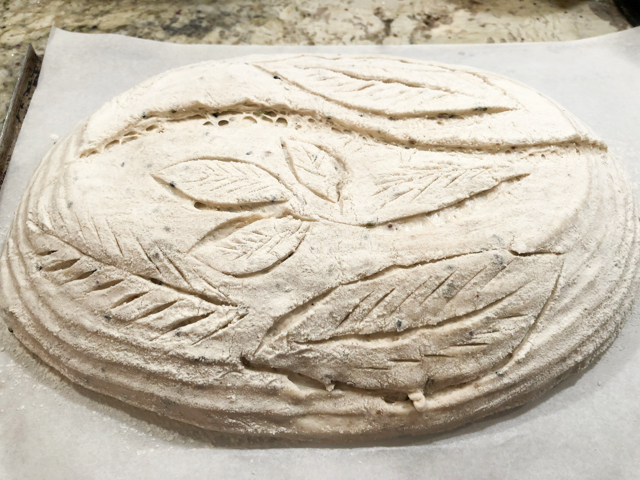
We loved this bread, in fact it was the first loaf that got us into a path of sourdough flavored with Middle Eastern spices.

VADOUVAN CURRY SOURDOUGH

In these three loaves, 1 + 1/2 tsp of Vadouvan curry mix was added together with the flour and incorporated in the dough. The bread in the center had spelt as the minor flour component, the other two regular whole-wheat.
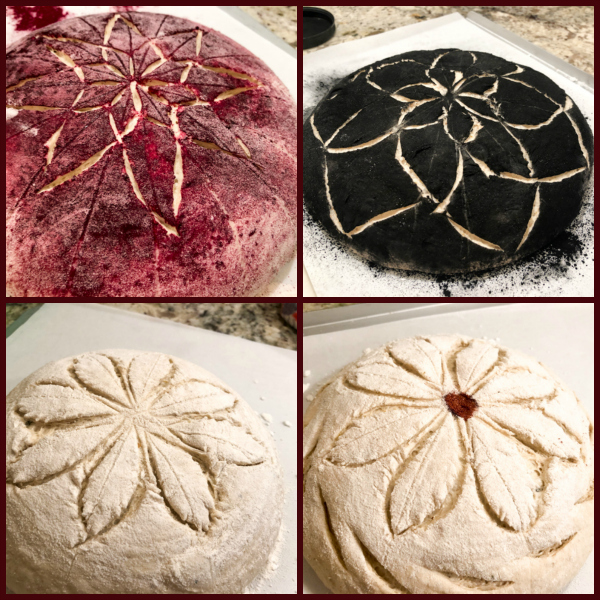
For the final decoration, I covered the first loaf with red beet powder, marked with a string a symmetry of 8 guide lines and then scored as shown. The beet color faded a bit during baking but still gave it a little hint of purple. The second loaf got a dusting with charcoal powder, the string marked 6 guide lines to create a slightly different type of design. Finally, the third loaf was dusted with flour, marked with 8 lines and scored as a flower. A little center of pearl dust was added but the color faded during baking (is that a recurring pattern for this baker?).
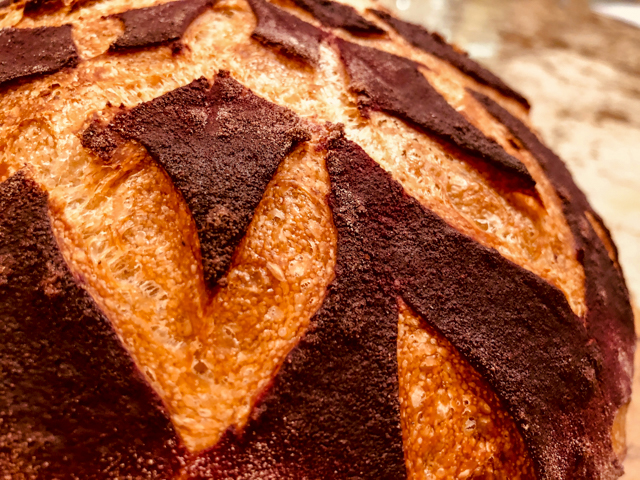
I love the charcoal and the beet powder effects, but be warned: they stain your fingers as you handle the bread, so when you cut a slice, make sure you don’t touch your face right after. No further questions on this subject. Please and thank you.

RAS-EL-HANOUT SOURDOUGH
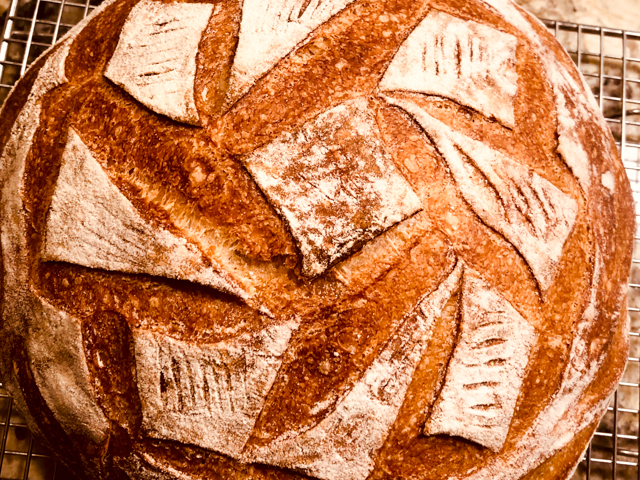
Exact same recipe using rye as the minor flour component, and 1+1/2 tsp Ras-El-Hanout in the formula. One of our favorite breads in this series. I should give credit to a baker from Israel who is a true magician with scoring. I follow him on Instagram (check him out here) and often try to make one of his cool designs. This is one example, that starts with a little square as shown below.

I am very fond of geometric-type scoring. I find it easier to do if I make a drawing on a piece of paper with the different steps because once that razor blade hits the surface of the bread… is game over! There is no “erasing” possible. Of course, during baking the design will be affected in unpredictable ways. I am still trying to figure out ways to minimize explosions.

ZA’ATAR SOURDOUGH
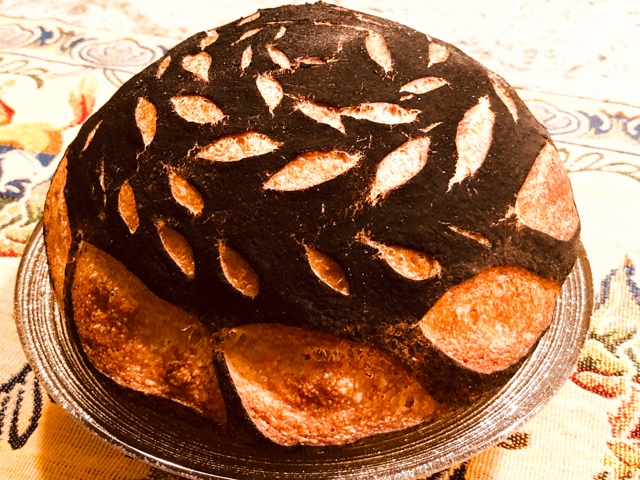
Basic recipe using spelt flour as the minor component and 1 + 1/2 tsp za’atar. The bread was coated with charcoal and I followed one of Mogi’s Dough Engineering scoring designs which he calls “reverse spiral”. Mine did not turn out as beautiful as his, but I still like it a lot. Here is what it looks like before baking.
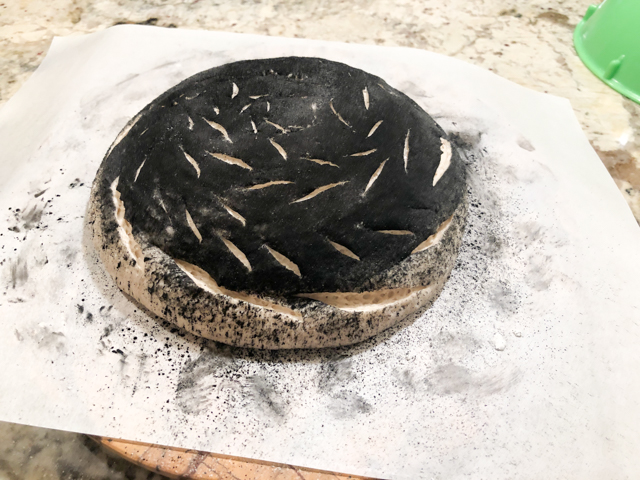
He uploaded a video showing how to do it. It goes very fast, but after watching it (in awe) a few times, I felt ready to do it.

TAHINI SOURDOUGH

To the basic formula (with whole-wheat flour as minor component), I added 25g tahini, and adjusted the consistency with a little more flour after the initial mixing with the Kitchen Aid, as the tahini I used was reasonably fluid. The tahini gives a wonderful flavor. The scoring made the round loaf end up with a square shape after baking, pretty interesting.
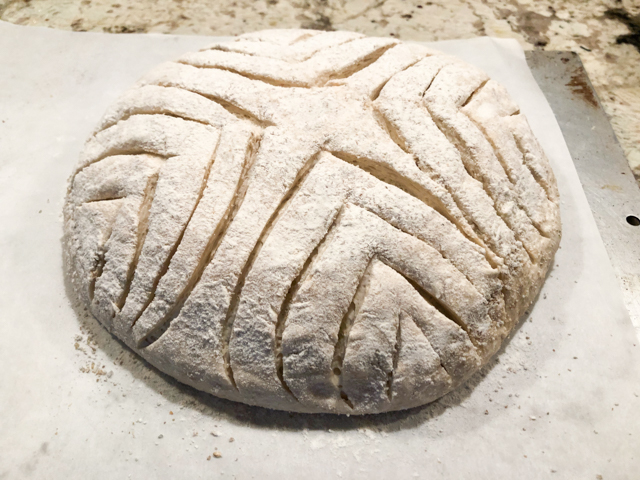
You can see it starts pretty round, but the way the slashing opens up during baking substantially affects the final shape. I love using nut butters in sourdough, they bring a bit of fat to the composition and the crumb feels moist and tender. Along those lines I share another favorite version….

PEANUT BUTTER SOURDOUGH

Basic formula with spelt flour and 25g creamy peanut butter. This was one delicious bread, the smell during baking is something! The scoring was once again inspired by Mogi’s Instagram feed, and this time I used a powder red food dye that is fat-soluble (appropriate for chocolate work). That seemed to stand better during baking.

Very simple scoring, I used 8 guide lines made with a string, but you could definitely just improvise.

CELEBRATION OF LOVE SOURDOUGH

My final adventure following the footsteps of Mogi. This is a bread called Tu B’av (ט״ו באב), the Jewish holiday of love, similar to our Valentine’s Day. I made a simple sourdough with full white flour, and 1 tsp turmeric in the dough. The surface was dusted with white flour, a shower of turmeric, and the center was dyed with pitaya powder, which next time will be replaced by red dye powder. A round cookie cutter comes in very handy to contain the red dot. I am still struggling with how heavy a hand to use when adding colors, particularly the subtle ones as turmeric that might end up too similar to the crust. Once again my results are not as gorgeous as Mogi’s, but there is always next time!

So that’s all for now, my friends… This post, entitled For the Love of Sourdough, had to end with a bread to celebrate love, that feeling that keeps us together, staring at the future without fear.

ONE YEAR AGO: Brazilian Pao de Mel

TWO YEARS AGO: Stir-Fried Chicken in Sesame Orange Sauce

THREE YEARS AGO: Monday Blues

FOUR YEARS AGO: A New Way to Roast Veggies

FIVE YEARS AGO: Two Takes on Raspberries

SIX YEARS AGO: Spice Cake with Blackberry Puree

SEVEN YEARS AGO: Own Your Kitchen with Cappuccino Panna Cotta

EIGHT YEARS AGO: Chicken Parmigiana, the Thriller

NINE YEARS AGO: Wild Mushroom Risotto

TEN YEARS AGO: Tartine Bread:  Basic Country Loaf 

ELEVEN YEARS AGO:  Pugliese Bread

SARAH BERNHARDT’S COOKIES

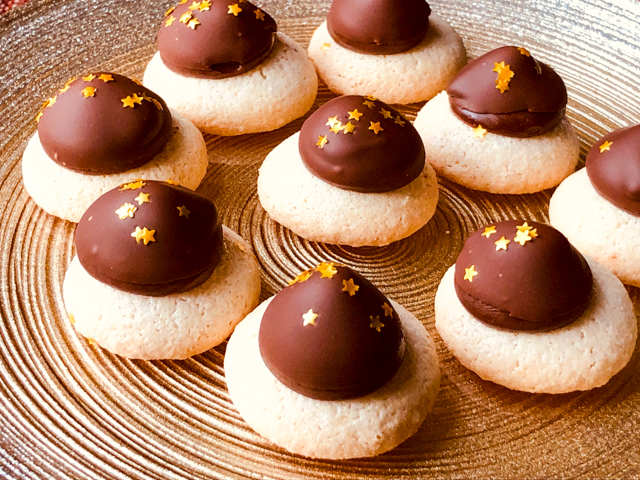
Don’t you love a cookie with a nice story behind it? Sarah Bernhardt was one of the greatest French actresses of the last century. During a trip to Denmark at the height of her career she had a cookie from an upscale bakery and fell totally in love. She was so passionate about that delicacy that in 1911, after her memoirs were published in Denmark, Chef Johannes Steen named this spectacular chocolate cookie after her. Read more about it here. You will find many versions around, but count on Helen Fletcher to bring you the authentic. The cookie joins an almond base, and a chocolate truffle enrobed in a chocolate shell. Many versions cover the whole thing in chocolate, but if you want to do the real thing, cover just the truffle. You should still see the cookie underneath and it will be much more elegant to eat. Worthy of a dame like Sarah Bernhardt.

SARAH BERNHARDT’S COOKIES
(from Pastries like a Pro)

for the cookie base:
100g almond flour
150g granulated sugar
2 large egg whites
1/2 teaspoon almond extract

for the chocolate truffle topping:
1/2 cup cream
2 tablespoons unsalted butter (28g)
2 tablespoons sugar (25g)
140g semisweet chocolate
1 teaspoon vanilla

to coat the truffle:
114g semisweet chocolate (114 grams)
1 tablespoon shortening
Gold Leaf, optional

Make the cookie base. Draw a template with 1 in diameter circles on parchment paper to pipe the cookies, flip the paper so that you can pipe on the back.

Combine the almond flour and sugar in the bowl of a food processor, and run it for a few seconds to combine. Add the egg whites and vanilla, process until a paste forms. Place the mixture in a piping bag fitted with a 1/2 in round tip. Pipe rounds of cookie batter on the parchment paper, going just to the circle drawn. They will puff up during baking. Leave the piped cookie sitting at room temperature while you heat the oven to 300F. Bake the cookies for 20 minutes or until they just start to get some color on the edges. Let cool completely on the paper before removing to a cooling rack.

Make the chocolate truffles. Heat cream, butter and sugar until the butter is melted and the sugar is dissolved. The mixture should be very hot, but not boiling. Submerge the chocolate under the cream and let sit for 4 or 5 minutes. Whisk gently until smooth. Add vanilla.

pour it into a rimmed baking sheet, cover the top with plastic wrap and let it sit at room temperature until it sets up. If it is too soft to pipe and hold a shape, refrigerate briefly until it can be piped.

If making up to a week ahead, pour into a container, cover the surface with film and chill store in the refrigerator. Bring to room temperature to pipe. Follow the instructions above if it gets too soft.

Fit a pastry bag with a 5/8 inch tip. Fill the bag the truffle mixture. Pipe a kiss shaped mound in the center on top of each macaroon about 1” high and within about 1/4″ from the edge. If there is a pointed tip, press it gently with your finger to smooth the surface out.

Place in the freezer to harden. If not finishing within a day or so, place these in a covered container and keep them frozen for a month or so until time to finish.

Finish the cookies. Combine the chocolate and shortening in a short, wide mouth glass or other small container and microwave at 50% power for 1 minute.  Stir to mix. If the chocolate isn’t completely smooth, microwave for 10 seconds at a time.  Do not let it get too hot.

Remove the cookies from the freezer. Dip them upside down to cover the kisses, just short of their bottoms. Let the excess chocolate drip off. The chocolate finish should cover the kiss but not touch the cookie base. The fact they are frozen will stop the chocolate from running. If the kisses start to warm, pop them back into the freezer. Right after coating, add golden leaf decoration or sprinkles.

Cookies should be kept in the fridge and be brought to room temperature for serving. They can sit at room temperature for a few hours.

ENJOY!

to print the recipe, click here

Comments: Helen’s post about these cookies is extremely detailed, so I recommend you visit her site if you’d like to bake a batch. She decorated them with gold leaf, I went the easier route and resorted to my trustworthy golden stars. You’ll need to work fast, because the chocolate coating sets almost immediately upon contact with the frozen truffle component.

These are festive and luscious, the type of cookie that will brighten up any holiday table. There is something about the contrast of the cookie base with the melt-in-your-mouth truffle that explains why Ms. Bernhardt went crazy for them.

ONE YEAR AGO: A Really Big Announcement

TWO YEARS AGO: Stir-Fried Chicken in Sesame-Orange Sauce

THREE YEARS AGO: Monday Blues

FOUR YEARS AGO: A New Way to Roast Veggies

FIVE YEARS AGO: Two Takes on Raspberries

SIX YEARS AGO: Spice Cake with Blackberry Puree

SEVEN YEARS AGO: Own Your Kitchen with Cappuccino Panna Cotta

EIGHT YEARS AGO: Chicken Parmigiana, the Thriller

NINE YEARS AGO: Wild Mushroom Risotto

TEN YEARS AGO: Tartine Bread:  Basic Country Loaf 

ELEVEN YEARS AGO:  Pugliese Bread

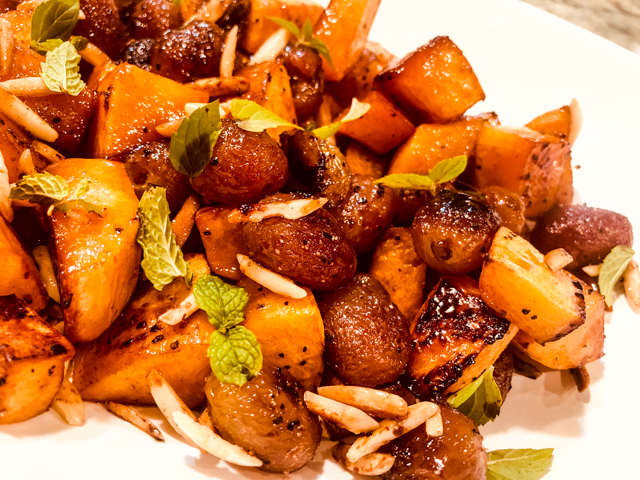
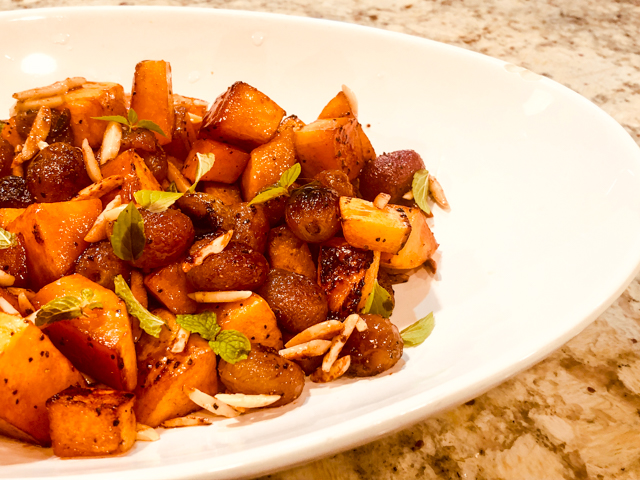
ROASTED BUTTERNUT SQUASH AND GRAPES WITH MAPLE POMEGRANATE GLAZE

You absolutely, positively, definitely, undoubtedly need this recipe in your life. I knew it would be tasty because Joanne raved about it, and she performs magic with vegetables. All. The. Time. I’ve only roasted grapes once for a focaccia (back in 2016!), but now I cannot stop thinking about other ways to incorporate them in savory dishes. They turn luscious.

ROASTED BUTTERNUT SQUASH AND GRAPES WITH MAPLE POMEGRANATE GLAZE
(adapted from Joanne’s Eats Well with Others)

12 oz red seedless grapes, removed from the stem
4 tbsp olive oil, divided
kosher salt
freshly ground black pepper
1 large butternut squash (about 2.5 lb), seeded and cut into 1-inch pieces
1 tbsp unsalted butter
⅓ cup pomegranate molasses
2 tbsp maple syrup
½ tsp ground cinnamon
¼ tsp five spice powder
1/4 cup slivered almonds (or more)
fresh mint

Heat oven to 425F. Line a large baking sheet with parchment paper or aluminum foil.

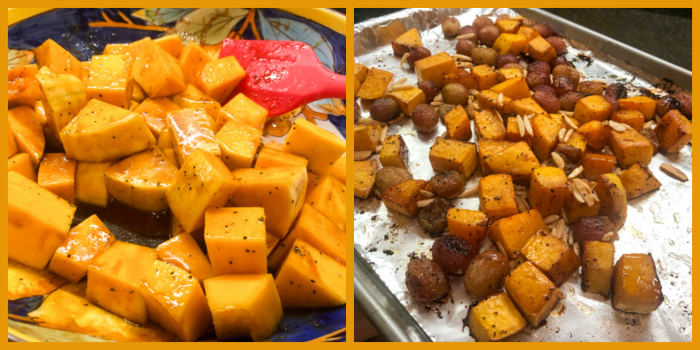
In a large bowl, toss the grapes with 1 tbsp olive oil. Season to taste with salt and black pepper. Place the grapes on the baking sheet and roast for 15 minutes. Meanwhile, in the same bowl toss the squash with 3 tbsp of the olive oil. Season to taste with salt and black pepper. Set aside.

In a small saucepan, combine the butter, pomegranate molasses, maple syrup, cinnamon, and five spice powder over medium-low heat. Heat for 3 minutes or until the butter is melted and the flavors can meld together. Toss the squash with a quarter of the sauce. Reserve the remaining sauce for later.

Add the squash to the pans with the roasted grapes, place the pan back in the oven and roast for another 20-25 minutes. When you have about 5 minutes left in the roasting time, sprinkle the almonds on top and mix them gently just to coat with the juices.

Remove the squash and grapes from the oven. Transfer to a large serving dish. Drizzle with the reserved sauce. Top with the mint leaves before serving.

ENJOY!

to print the recipe, click here

Comments: I sometimes find butternut squash already cut at the grocery store, but often they are cut in pieces that are a bit too small. For this recipe, I went the extra mile, risked the integrity of my fingers and cut the squash myself. I know, right? What won’t I do in the name of this blog? It is enough to bring tears to my own eyes.

If you’ve never used grapes in savory meals, please make that happen in your kitchen. I am sold. As to pomegranate molasses, I have used it coupled with rose harissa to roast squash, and it is fantastic, but this step of turning the molasses into a sauce that is drizzled at the end? It raises the ingredient to a whole new level. The sauce would be fantastic on a simple piece of grilled salmon. Yes, I am trying that soon.

Joanne, thank you for another winner of a recipe! Who needs cookbooks with a blog like yours to follow?

ONE YEAR AGO: A Really Big Announcement

TWO YEARS AGO: Stir-Fried Chicken in Sesame-Orange Sauce

THREE YEARS AGO: Monday Blues

FOUR YEARS AGO: A New Way to Roast Veggies

FIVE YEARS AGO: Two Takes on Raspberries

SIX YEARS AGO: Spice Cake with Blackberry Puree

SEVEN YEARS AGO: Own Your Kitchen with Cappuccino Panna Cotta

EIGHT YEARS AGO: Chicken Parmigiana, the Thriller

NINE YEARS AGO: Wild Mushroom Risotto

TEN YEARS AGO: Tartine Bread:  Basic Country Loaf 

ELEVEN YEARS AGO:  Pugliese Bread
LESSONS FROM TANYA, THE FINAL CHAPTER

Third post of a series of three on Sugar Cookie Decorating

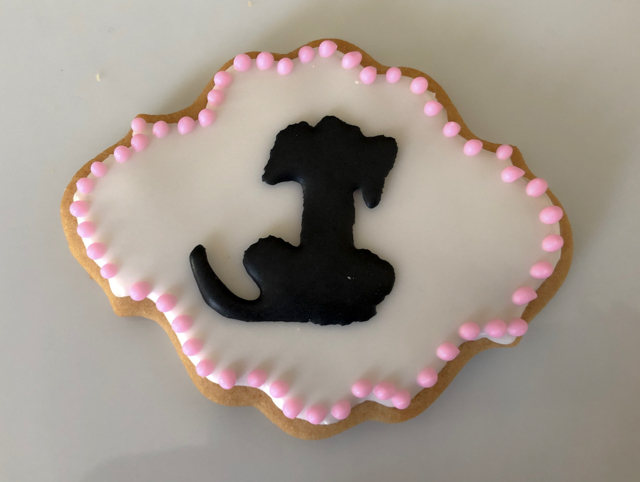
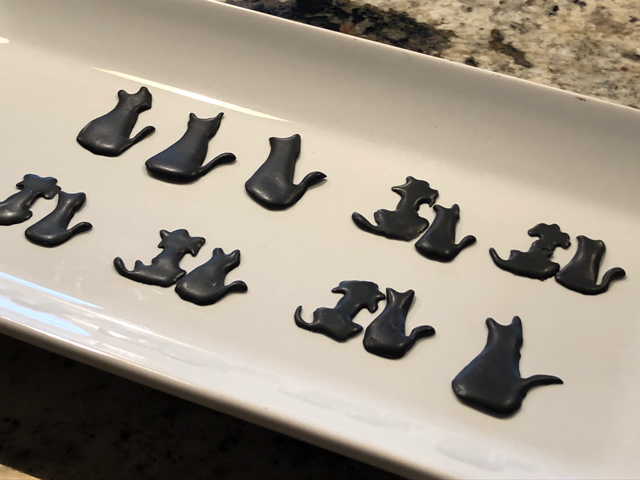
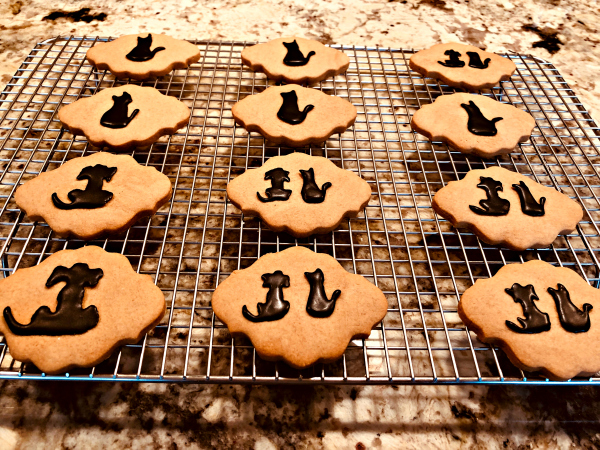
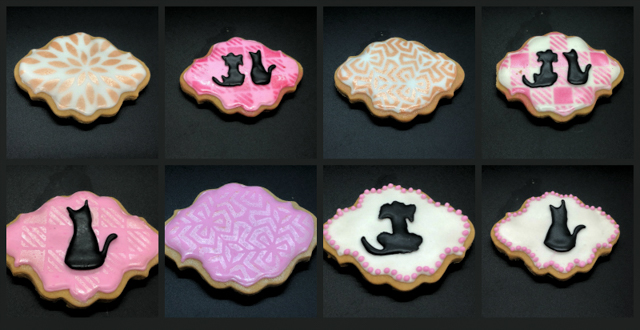
In this post, I won’t share a recipe, as I will be using the exact same one posted yesterday. I made another set of silhouettes because the pups were beyond upset by my use of felines as cookie decoration.

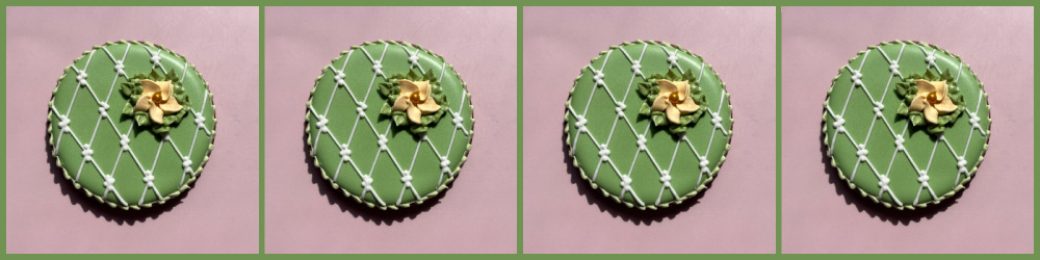
Please do not laugh of my pink dotted border. That is the one technique Tanya demonstrated and I simply could not succeed. She does the beaded border pulling the piping tip and dragging a bit alternating the direction, it looks soooo adorable. I’ve tried in two cookies, and they ended in my belly because I was forced to eat the evidence. So I just went with little dots and even that has plenty of room for improvement.

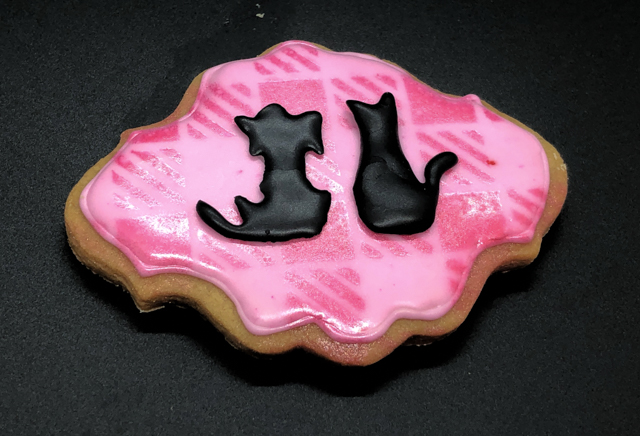
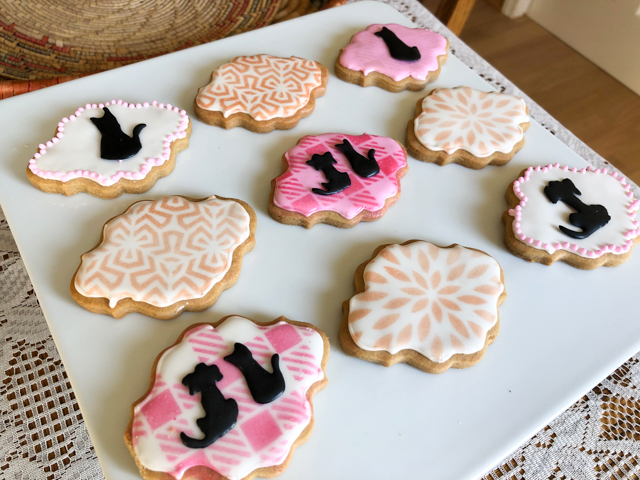
I made dogs and cats of two sizes, to either stand alone in a cookie or side by side as best friends. At least in the cookie world, such relationship is possible.

The planning stage…

In this batch of cookies, I brought my air-brush into play. So I started from the flooding technique, and allowed that to fully dry for 24 hours. Once the surface is truly solid, you can lay a stencil on top and air-brush any color and/or pattern you fancy.

After that, simply glue the silhouette, if using, or any other piping with Royal icing you feel like adding.

If you are new to air-brushing, I highly recommend this one. It has a cup that is bigger than other brands, and can also be used for cocoa butter for spraying bonbon molds (I intend to try that in the near future).

You will also need air-brush dyes, and my favorite brand is Cookie Countess. The most useful colors are the pearl types, white, gold, silver or my favorite: Rose’ Gold (which I used in the cookies without silhouettes in the group picture above).

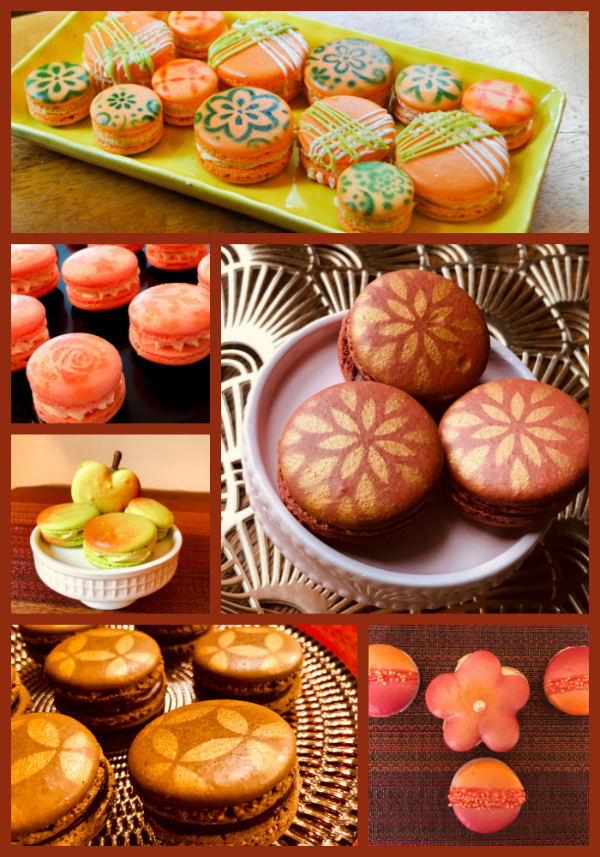
Below a little sampling of bakes from old posts and a few not yet blogged about, all decorated with air-brushing, some with stencils, some without. Speaking of stencils, etsy.com is a great source to get them.

It is really a very nice tool to play with, so if you are over the fence about getting one, consider this post a little encouragement…

I hope you enjoyed this little Trilogy of Sugar Cookies. Sugar Cookies and macarons are almost always part of my weekly bakes for Common Table meals, so I am constantly trying to find new ways to decorate them and new flavors to explore. Stay tuned for more in the near future…

LESSONS FROM TANYA: SUGAR COOKIE SILHOUETTES

Second post of a series of three on Sugar Cookie Decorating

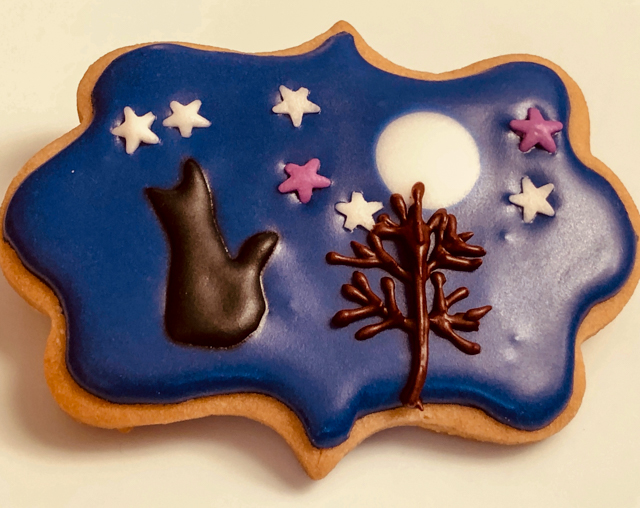
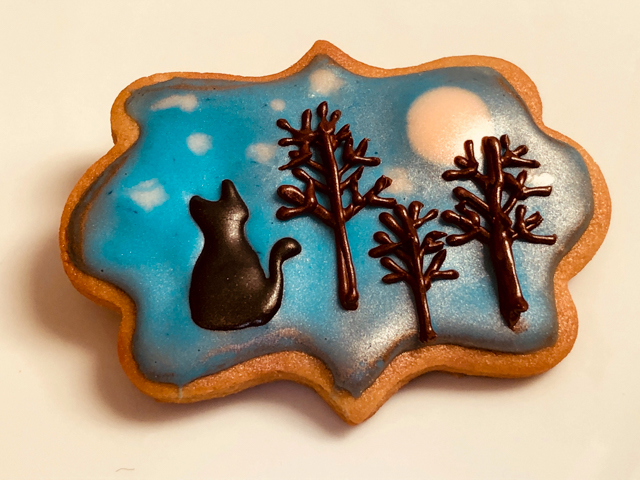
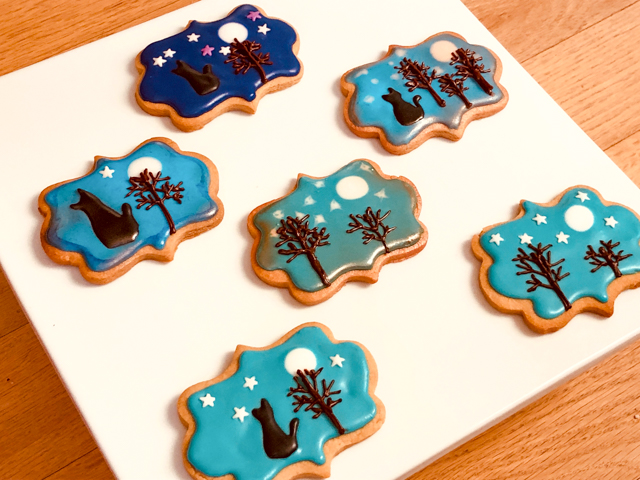
For one of her bake-along tutorials, Tanya showed how to make little silhouette details using Royal icing. They can be made way in advance (pretty much last forever) and saved to add to your cookies previously flooded and fully dry. The possibilites are endless, as you can imagine. And the great thing for us who cannot draw to save their lives, is that you can find clipart to download and print for free, adjust them to the size you want and use them to pipe your little decor. She demonstrated with a gorgeous deer’s head, I went first with a cat. She also demonstrated how to make a winter scene with a full moon and trees, so I joined both techniques in a single cookie.

BROWN SUGAR AND SPICES SUGAR COOKIES
(adapted from Bake at 350)

360g all-purpose flour
2 tsp baking powder
1/2 tsp cinnamon
1/4 tsp ginger
1/8 tsp nutmeg
1/8 tsp allspice
1/8 tsp cardamon
150g granulated sugar
50g brown sugar
226g butter, cut into chunks
1 egg
1/4 tsp salt

Heat oven to 350.

Whisk the flour, baking powder and spices, set aside.

Cream the sugars and butter. Add the egg and salt and mix until well-blended. Gradually add the flour mixture and beat just until combined. Roll on a floured surface to about 1/4″ and cut into shapes. Place on parchment lined baking sheets and freeze for 10 minutes.

Bake for 10-12 minutes, depending on the size of your cutter. Let sit a few minutes on the sheet, then transfer to a cooling rack.

Use Royal icing to decorate, recipe in previous post.

ENJOY!

Comments: There are countless sites that offer free downloadable templates for all sorts of drawings. You can then print them side by side and place a sheet of parchment paper on top of the printout. Using Royal icing with the consistency Tanya demonstrates in her tutorial and a very fine piping tip, carefully outline the drawing. Make more than you need, because they are obviously very fragile. They are best if allowed to dry overnight.

For the stars, in some cookies I used sprinkles… and in others I followed the technique demonstrated by Tanya, pulling small white dots with a needle.

That surface is allowed to dry overnight, and then the silhouette is glued, and the trees piped. In the cookie above, I used some silver air-brushing just for fun.

Here they are, all my babies! Before watching Tanya’s tutorials, I would never dream of making cookies with so many little details.

I will be back tomorrow with the final post about sugar cookies, using the same recipe (Brown Sugar and Spices). and a slightly different way to decorate them.

ONE YEAR AGO: Cherry-Chipotle Chicken Thighs

TWO YEARS AGO: White Chocolate Mini-Mousse with Sugared Cranberries

THREE YEARS AGO: You Say Ebelskiver, I say Falafel

FOUR YEARS AGO: Happy Thanksgiving!

FIVE YEARS AGO: Two Takes on Raspberries

SIX YEARS AGO: Spice Cake with Blackberry Puree & The Global Pastry Review

SEVEN YEARS AGO: Own Your Kitchen with Cappuccino Panna Cotta

EIGHT YEARS AGO: Chicken Parmigiana, the Thriller

NINE YEARS AGO: Wild Mushroom Risotto

TEN YEARS AGO: Tartine Bread:  Basic Country Loaf 

ELEVEN YEARS AGO:  Pugliese Bread