CORNMEAL ENGLISH MUFFINS

Or, as Dan Lepard described them, “traditional English muffins with a neat twist.” They have the exact same look of the regular English muffin, similar texture, but a slightly more complex taste due to the addition of cornmeal to the dough. Since they are leavened by commercial, fast acting yeast, you can have these tasty treats ready for brunch in less than 3 hours. Making bread first thing in the morning always makes me feel good, and gets the weekend started with a great vibe!

CORNMEAL ENGLISH MUFFINS
(detailed recipe found at The Guardian website)

The dough is made with soaked cornmeal, bread flour, yogurt, vinegar, and commercial yeast.

One important modification: I used only 350ml of water instead of the 425ml called for in the original recipe, after the advice of two friends (Celia and Joanna) who recently made these muffins and felt they did not hold their shape well if the full amount of water is added.

After three cycles of quick kneading, the dough rises undisturbed for an hour and a half, then is rolled 1/2 inch thick, and cut in circles. Initial cooking on a very hot griddle, 4 to 6 minutes per side, produces a beautifully golden crust on the surface…

They go into a 400F oven for 10 more minutes to make sure the crumb is fully set, and after patiently waiting for them to cool down, the baker might be lucky enough to hear her partner saying “can I make a little sandwich for you”?


I am submitting this post to Susan’s Yeastspotting….

ONE YEAR AGO: Cornish Hens for a Sunday Dinner

Add to FacebookAdd to DiggAdd to Del.icio.usAdd to StumbleuponAdd to RedditAdd to BlinklistAdd to TwitterAdd to TechnoratiAdd to Yahoo BuzzAdd to Newsvine

TIDY SOURDOUGH

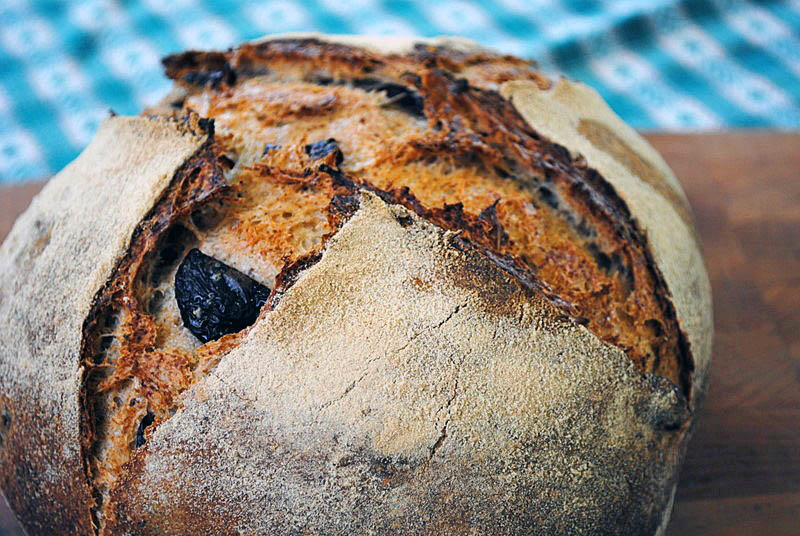
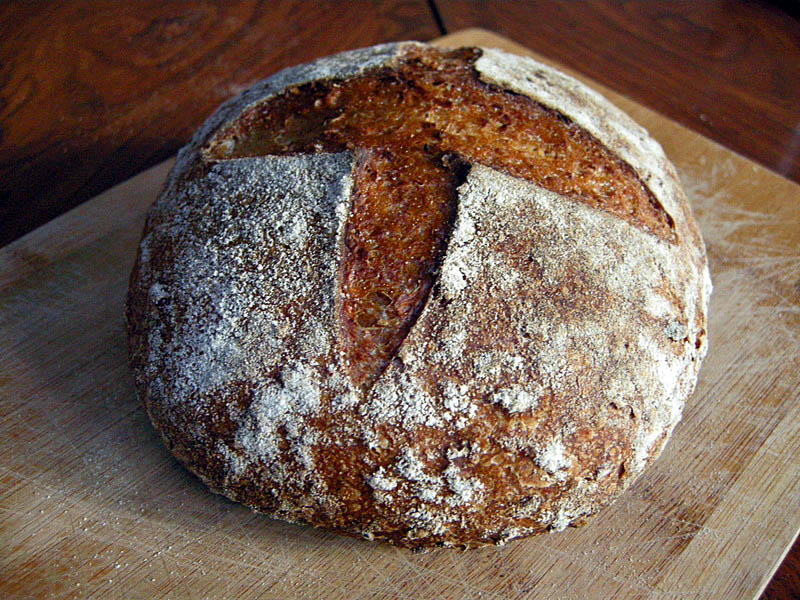
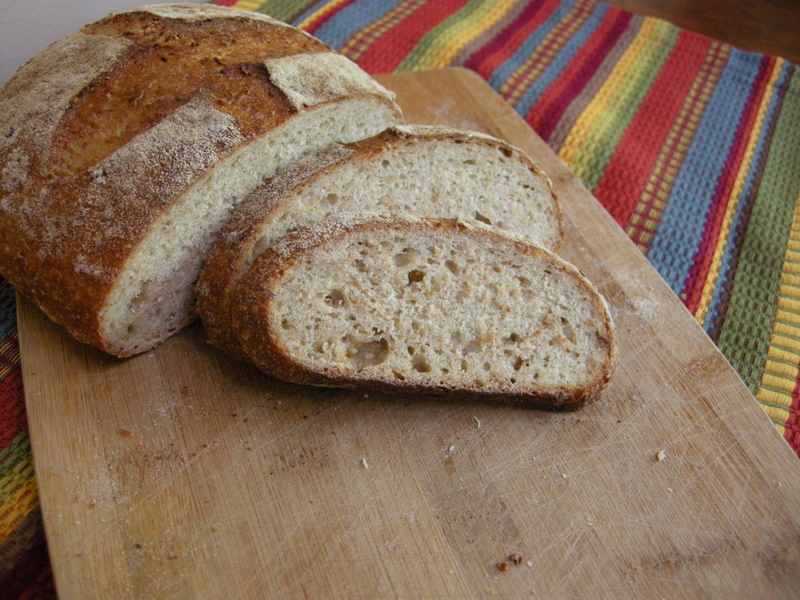
This bread closes a personal saga with a long-awaited happy ending.   Since we moved to LA I’ve been searching for a way to bake the bread we enjoy the most:  the rustic sourdough boule.  When you only have a small electric (toaster) oven, baking this bread becomes tricky,  to say the least.  After 11 unsuccessful attempts, I finally conquered my virtual Mt.Everest and stuck my flag  in the summit!

BREVILLE SOURDOUGH
(from the Bewitching Kitchen, adapted from several sources)

235 g active sourdough starter  (75% hydration)
275 ml water at room temperature
400 g bread flour
65 g whole wheat flour
10 g salt

Pour the water into a bowl, add the sourdough starter and dissolve it.  Add the flours and the salt, then roughly mix all the ingredients together to form a shaggy mass.  No need to incorporate it as a smooth dough at this point.  Cover the bowl and let it stand for 20 minutes at room temperature.  Remove the dough from the bowl and place it on a smooth surface rubbed with a small amount of vegetable oil.    Quickly knead the dough for 20-30 seconds, incorporating all the dried bits of flour that are clinging to it .   Wash the bowl or transfer to another, clean bowl, cover with a plastic wrap and leave at room temperature for 45 minutes.

Remove the dough from the bowl, add to the kneading surface (slightly coated with oil if needed), knead for 20 seconds (second kneading cycle).  Place the dough back in the bowl, leave it resting for 45 minutes more.  Proceed with a third kneading cycle, place the dough in the bowl for 1 hour.

Remove the dough from the bowl, shape roughly into a ball, let it rest 15 minutes, and form it into the final shape, making sure to generate good surface tension.  Place the ball, seam side up, in a well floured round basket and let it rise at room temperature for 3 hours.  Forty-five minutes before baking,  heat your oven to 450F with a round pizza stone inside.

Invert the dough over a piece of parchment paper on a peel or cookie sheet, slash the top with a razor blade, and place in the oven. Position a Dutch oven inverted on top of it (fill it with very hot water, then dump the water and use it to cover your bread).  Bake covered for 35 minutes, then CAREFULLY uncover the bread and bake for 25 to 30 minutes more (or until internal temperature is over 200F).  If the top browns too much lower the temperature to 425F, and cover the surface with aluminum foil.

Cool for at least one hour before slicing and…

ENJOY!

to print the full recipe, click here

to see my timetable for this bread, click here

to print your own timetable for future use, click here

Comments: I’ve baked many breads in the past 3 years, but none gave me the thrill of this one, because it was my very last attempt! I was ready to throw in the towel and conclude that a rustic sourdough cannot be done in the nano-kitchen. What made it possible was creating the correct enclosure to bake the bread for the first 30 minutes.  For our Breville, a round pizza stone and a Le Creuset-wannabe (found at a Ross store  a couple of months ago) served the purpose quite well.

Normally I’d add a small amount of rye flour to the dough, but I couldn’t  find it last weekend, so I used only regular whole-wheat.  This is probably the largest bread you can bake in a Breville, and I intend to try a slightly smaller version in the near future.  I used regular kneading for this bread, but made a second loaf a couple of days later folding the dough instead, with similar results.  You can use whatever technique you feel most comfortable with.

Variation: Follow this recipe to the point of the final shaping as a “boule,” then retard it in the fridge overnight.  Next day, bring it to room temperature 2 hours before baking.

I am excited to send this post to Susan’s Yeastspotting

ONE YEAR AGOVienna Bread

Add to FacebookAdd to DiggAdd to Del.icio.usAdd to StumbleuponAdd to RedditAdd to BlinklistAdd to TwitterAdd to TechnoratiAdd to Yahoo BuzzAdd to Newsvine

WEEKEND PITA PROJECT

I grew up enjoying one of my favorite breads,  pita, on a weekly basis.  In Brazil  it’s called “pao sirio” (Syrian bread).  As I’ve mentioned before,  Middle Eastern food is very popular in Sao Paulo, so my weekends often included visits to a particular spot that sold bags of freshly baked flat bread.  It was similar to what we call  “pita” here in the US,  and usually associate with Greek food.    The current bagged stuff at grocery stores pales in comparison to freshly baked pita, and it’s so easy to make that once you master this technique,  I doubt you’ll go back to the commercial versions.   Unless, of course, you’re lucky enough to have a Middle Eastern bakery right in your neighborhood…   😉

This recipe comes from Dan Lepard, and you can find it  by  clicking here. You can also read a discussion about it in his forum by following this link.

Dan’s method involves a simple dough (flour, yeast, sugar, olive oil, a little salt) prepared with his minimal kneading procedures, divided into 8 portions, and each one rolled into an oval or circle about 5mm (1/4 inch) thick.   The flat breads bake over a blazing-hot baking sheet for a few minutes, until they puff (or not, depending on how well you hit the correct thickness) and acquire a hint of color.

When you hit the jackpot – the slightly elusive, “just-right”  thickness,  you’ll be rewarded with a beautifully puffed up balloon in your oven!

Comments: Whenever I succeed in baking bread with my electric oven, I wear a smile and walk  on top of the world for a few days!  Baking 8 pita circles took some patience and fiddling with the oven.  Besides baking one at a time, I had to start with the rack in the center, and as the bread puffed up I quickly moved it to the lower position.  Against all odds, I didn’t burn myself!   It took me more than an hour to bake the full batch, which told me that the dough can sit at room temperature for a long time and still produced great pita!  😉

By the way, if your pita doesn’t inflate as a balloon, it will still be delicious.  In fact, I like to roll a few slightly thicker, because they produce a softer bread, with more crumb and a chewy texture.  It’s a nice change from the “pocket” version, that also re-heats a little better next day.

I am thrilled to submit this post to Susan’s Yeastspotting, my first this year!

ONE YEAR AGO: Tried and Tasted Round-up

SOURDOUGH FOCACCIA, WITH A TWIST

(version updated on Dec 28th, to correct a mistake in the recipe)

This past week I got a very special gift: a jar of homemade chili jam, made by my stepson’s girlfriend Carly, a gorgeous actress, who is also smart, witty, and a great cook.  Yeah, some people have it all!   😉 She made the jam by adapting a basic recipe from Nigella Lawson, that you can find here.  It is very flavorful, and looks quite dramatic as you hold the jar against the light revealing red speckles dispersed throughout the jam.  I wanted to make something special with it, and my first “experiment” turned it into topping for a sourdough focaccia.   A successful experiment all the way!

SOURDOUGH FOCACCIA WITH CHILLI JAM
(adapted from Chilli and Chocolate)

for the sourdough sponge:
195 g liquid starter (3/4 cup at about 100% hydration)
125 g warm water (1/2 cup)
25 g olive oil (2 T)
10 g honey (1 + 1/2 tsp)
50 g flour (1/2 cup)

for the final dough:
all the sponge made as described
50 g olive oil (1/4 cup)
200 g all purpose flour (2 cups)
1 tsp sea salt

to bake the focaccia:
4 T olive oil
herbs of your choice, minced
2 T chili jam, preferably homemade
coarse or flake salt

Mix all the ingredients for the sponge in a medium size bowl, cover and let it ferment at room temperature for 1-2 hours, until the surface is covered with small bubbles.

Add the ingredients for the final dough and mix until they form a shaggy mass. Let it rest for 15 minutes, then knead quickly folding the dough on itself 10 times (no need to remove from the bowl). Let the dough rest 15 minutes, and repeat this quick kneading process. Repeat for a total of 4 cycles of kneading, each with 15 minutes rest.  Shape the dough into a smooth ball, place in a lightly oiled bowl, and let it rise until almost doubled (1.5 to 2 hours).

Alternatively, place it in the fridge overnight, transferring to room temperature 2 hours before baking.

Cover a 9 x 13 baking sheet with parchment paper, and add 2 T olive oil to the paper, spreading it well.  Put the dough in the pan and press gently until it covers the whole surface.   If the dough is resisting your attempts to stretch it, wait for 5 minutes until the gluten relaxes, and do it again.  Cover lightly and let it rise for 30 minutes, while you heat the oven to 450F.

Using the tip of your fingers, make indentations all over the dough, spread the remaining 2 T of olive oil all over, sprinkle herbs of your choice on half the focaccia.  If your chili jam is too thick, thin it slightly with a little olive oil, and spread on the other half of the focaccia.   Add salt all over the dough, and bake until golden brown on top, about 25 minutes.   If the jam seems to be burning,
reduce the temperature slightly.

Let it cool over a rack before you slice it in squares, and…

ENJOY!

to print the recipe, click here

Comments:  I’ve blogged before about my favorite  focaccia, very quick to put together. This version,  leavened exclusively with wild yeast, takes longer to prepare, but the flavor is exactly what I was hoping for to go along with the chili jam.   I had a few unexpected commitments during the preparation, so the dough went to the fridge overnight,  no harm done.  The focaccia, even baked in our small electric oven, turned out delicious!    The chili jam (thank you, Carly!) is hot, but not overly so, and the contrast of the slight sourness of the bread with the sweet heat of the jam made this simple focaccia quite addictive.  Make sure to add salt on top right before baking, it will intensify all flavors.

By the way,  chili and chilli are both accepted spellings for the word.   Pick your favorite spelling, but whatever you choose, make this focaccia, it’s a winner!

I am submitting this post to Susan’s  Yeastspotting

ONE YEAR AGO: Merry Christmas!


Add to FacebookAdd to DiggAdd to Del.icio.usAdd to StumbleuponAdd to RedditAdd to BlinklistAdd to TwitterAdd to TechnoratiAdd to Yahoo BuzzAdd to Newsvine

FESTIVUS DINNER ROLLS

A post dedicated to all the Seinfeld fans…  😉

Sometimes in a meal a bread grabs the spotlight.  Think about the glory of a rustic sourdough boule beside a bowl of lentil soup, or a slice of pain Poilane beneath a golden cheesy layer of Croque Monsieur.  But during a Thanksgiving or Christmas dinner feast the breads accept a more humble place.  Small rolls, soft and unpretentious, are the best choice. This recipe was published in Fine Cooking magazine in 2001, with Abigail Johnson Dodge behind it, which means it is flawless. You can make and shape the dough a day beforehand, place it in the fridge, and bake it while entertaining your guests on even a very busy cooking day.

CLASSIC DINNER ROLLS
(Abigail Johnson Dodge, Fine Cooking 2001)

18 oz. (4 cups) all-purpose flour
1 package (2-1/4 tsp.) rapid-rise yeast
1/3 cup sugar
1 tsp. salt
1 cup milk
4 oz. (8 Tbs.) unsalted butter
3 large egg yolks

Place the flour, yeast, sugar and salt in the bowl of your KitchenAid type mixer, mix to combine. Put the bowl in the mixer stand and fit it with the dough hook.

Heat the milk and butter in a small saucepan, stirring gently until the butter melts, and the temperature reaches 115F to 125F. Pour the mixture over the dry ingredients in the bowl, add the egg yolks, and mix with the dough hook in low speed until everything forms a shaggy mass. Increase the speed to medium high and mix/knead for about 8 minutes.

Remove the dough from the bowl, shape it into a ball, grease the bowl lightly with oil, and place the dough back inside, covering with plastic wrap. Let it rise until doubled in size (45 minutes if using rapid-rise yeast, a little longer for other types of yeast).

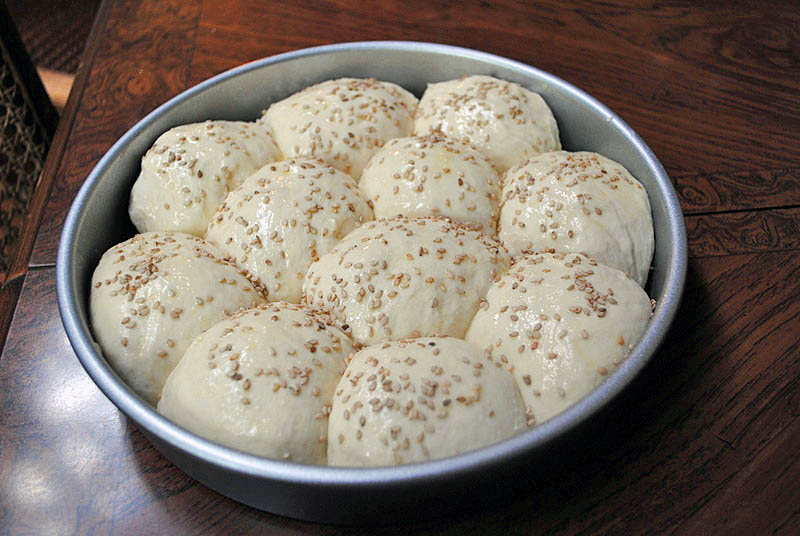
Lightly grease a 9×13-inch baking dish. Turn the dough onto a clean work surface (no need to flour; the dough is soft but not sticky) and gently press to deflate. Divide the dough into 16 equal pieces, form each into a ball, and place in the pan, with the seam side down.

Cover the pan with plastic and let the dough rise until almost doubled, about 30 min. Meanwhile, heat the oven to 375°F. Remove the plastic and bake the rolls until they’re puffed and browned, about 20 min. Serve warm.

ENJOY!

to print the recipe, click here

Comments: To make  this recipe in advance, cover the rolls with plastic wrap right after shaping and place them in the fridge.  Next day  remove the dish from the fridge, let it sit at room temperature for 2 hours, and then bake the rolls at 375 F.

I brushed the rolls right before baking with an egg wash (1 egg beaten with a couple of teaspoons of water), because I like the shiny look it gives to the bread.  However, you can also bake them without it, as the original recipe suggests.

Warm from the oven, these rolls are perfect to soak up that last bit of gravy on your plate. And they can return the next day sliced in half, for mini-turkey or prime-rib sandwiches, a holiday tradition in many American homes!

If you are hosting a big Christmas or New Year’s Eve dinner, these rolls will be a nice addition to your menu. They are very easy to make – even if you are a rookie bread baker – and absolutely delicious.

I am submitting this post to Yeastspotting.

ONE YEAR AGO: Lebanese Baked Kibbe (one of my favorite recipes ever!)

Add to FacebookAdd to DiggAdd to Del.icio.usAdd to StumbleuponAdd to RedditAdd to BlinklistAdd to TwitterAdd to TechnoratiAdd to Yahoo BuzzAdd to Newsvine