PAIN DE PROVENCE

As I mentioned before, I get a lot of inspiration for bread baking over at The Fresh Loaf Forum.  Browsing through their huge collection of recipes, one made me quite nostalgic, thinking about our good times living in France.  I absolutely had to make it: a “boule” loaded with herbes de Provence!  It cannot possibly get much better than that.   The recipe comes from Floyd, The Fresh Loaf’s host and a very accomplished bread baker. He got his inspiration from a recipe found in  Bernard Clayton’s Complete Book of Breads.  My copy, by the way, sits patiently at home, waiting for our return…   😉

I cut the recipe in half to make it easier to bake in my small Breville electric oven, but I’m posting the regular version, which will produce a larger loaf.  The dough requires an overnight poolish, but is very simple and straightforward to make.    Don’t be alarmed by the amount of herbs, they perfume the bread with just enough intensity to make you fall in love with it more and more at each bite.

PAIN DE PROVENCE
(adapted from Floyd’s recipe)

for the poolish (made 8 to 18 hours before the final dough):
1 cup bread  flour
1 cup water
1/2 teaspoon instant yeast

for the dough:
All the poolish made the day before
2 cups bread flour
1/2 cup Herbes de Provence
1 + 1/2 teaspoon instant yeast
1 teaspoon salt
1/4 cup orange liqueur such as Grand Marnier (I substituted orange juice)
1/4-1/2 cup water

The night before baking, make the poolish by mixing together 1 cup of flour, 1 cup of water, and 1/2 teaspoon of yeast to make a batter. Cover the container with plastic wrap and set aside for 8 to 18 hours until you are ready to make the final dough.

To make the dough, combine the remaining flour with the remaining yeast, salt, and herbs. Add the poolish, the liqueur, and 1/4 cup of the additional water. Mix the ingredients, and, if necessary, add more water or flour until the proper consistency is reached .

Mix by gentle kneading, and leave it undisturbed for 20  minutes in a lightly greased bowl.   Do three more cycles of gentle kneading (or folding)  every 30 minutes.  At the end of the last kneading (a little less than 2 hs of bulk fermentation),  let the dough rise undisturbed  for a full hour.

Remove the dough from the bowl and shape it into a ball or long loaf. Cover the loaf with a damp towel and allow it to rise again until doubled in size, which takes between 60 and 90 more minutes.

While the loaf is in its final rise, preheat the oven to 450F, with a baking stone inside, if you will be using it.   Just prior to placing the loaf in the oven, score the top of it with a sharp knife or razor blade.

Place the loaf in the oven and bake for 20 minutes at 450, then rotate it 180 degrees and reduce the oven temperature to 375 and baked it another 25 minutes. The internal temperature of the loaf should be around 200F.

Remove from the oven and allow to cool for at least a half an hour before serving.

ENJOY!

to print the recipe, click here
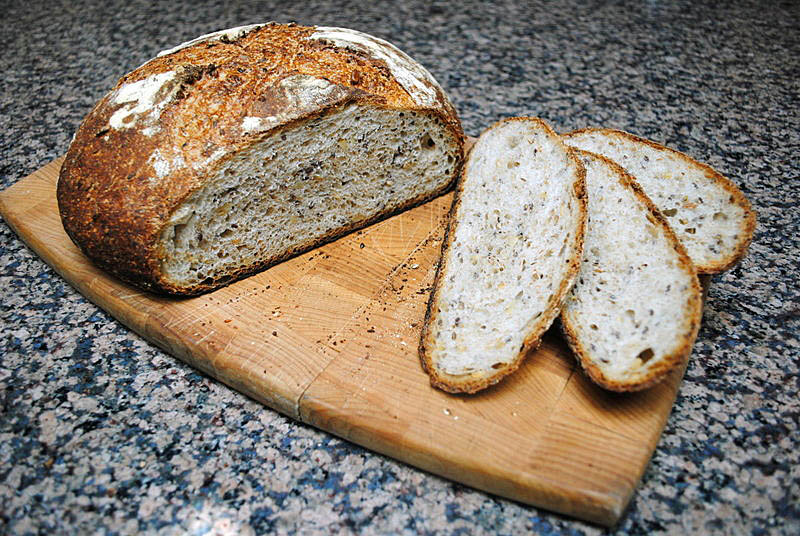
Comments: Of all the spices present in herbes de Provence, lavender is the one that I detect first and foremost.  I once visited that part of France at the time when the lavender fields were in full bloom, and the smell everywhere is simply unforgettable.   I thought the amount of herbs in the dough could be a bit excessive, but reading Floyd’s remarks about it gave me the reassurance to make it exactly as he did.  The aroma of the herbs is evident from the moment you mix the dough, but once the bread is midway through baking, you cannot wait to try the first slice.

The crumb is light and airy, and the bread is quite unique for its delicate herbal tones.  I have a special sandwich in mind for this bread,  but that is a story to be told another time…   😉

I am sending this to Yeastspotting….

ONE YEAR AGO:  Golspie Loaf

Add to FacebookAdd to DiggAdd to Del.icio.usAdd to StumbleuponAdd to RedditAdd to BlinklistAdd to TwitterAdd to TechnoratiAdd to Yahoo BuzzAdd to Newsvine

MAPLE-OATMEAL SOURDOUGH BREAD

Two of my favorite bread baking sites are Wild Yeast and The Fresh Loaf.  Every Friday, I look forward to Susan’s Yeastspotting event,  that showcases  breads baked during the previous week by folks all over the world.  And The Fresh Loaf is a discussion forum with help and advice for beginners as well as experienced bakers.  Through my visits to both sites over several years,  I got to know – virtually, at least  –  some amazing bread bakers like MC, who runs the blog with the cute name “Farine.”   Not too long ago she raved about a bread from Orchard Hill Breadworks, a bakery in New Hampshire owned by Noah Elbers.  During her visit to the bakery, she learned how to make one of their signature breads, with two flavors I am quite fond of:  oatmeal and maple syrup.

I won’t lie to you, the preparation is a bit involved: the day before you’ll need to bake the oatmeal, refresh your sourdough starter, and make a poolish with commercial yeast. But your hard work will pay off, big time…   😉

NOAH ELBERS’ MAPLE-OATMEAL BREAD
(reprinted from Farine‘s blog, with permission from Noah Elbers)

447 g all-purpose unbleached flour
151 g whole-wheat flour
151 g steel-cut oatmeal, baked
328 g water
151 g liquid starter
151 g poolish
121 g pure maple syrup
16 g salt
 
The day before baking the bread:
1. Refresh your sourdough starter, to make sure it is bubbly and active when you make the dough next morning. I do that about 12 hours before mixing the dough, by mixing 2 tsp of mature starter with 150g water and 150g flour.  Next morning remove the amount you need and keep the rest in the fridge.

2. Make the poolish by mixing 100g flour + pinch of instant yeast + 100 g/ml water recipe: Leave to ferment overnight. You will not use it all, weigh what you need for the recipe.

3. Bake the oatmeal.  Boil water, then mix it with the oatmeal in a baking dish (200g oatmeal + 200g/ml boiling water).  Cover the dish with aluminum foil and bake in a 400F oven for 40 minutes.  The mixture will turn into a brick.  Once it cools, break the bits of oatmeal with your fingers, and weigh the amount needed for the dough.

On baking day:
Mix all the ingredients in a large bowl (except the salt),  kneading briefly to form a shaggy mass.  Let the mixture resting for 30 minutes.    Add the salt and incorporate by gentle kneading.

Let the dough rest for 40 minutes.  Knead by folding the dough in itself 4-6 times.  Let the dough rest for 40 minutes more.  Knead it again by folding.
Let the dough rise for 40 minutes, do one final cycle of kneading, then allow it to sit undisturbed for a full hour  (total bulk fermentation will be about 3 hours).

Shape the dough as a large batard, or divide in two and shape as a small round (that’s what I did).  Let the shaped bread rise for 1 hour at room temperature, then retard it in the fridge for 12-15 hours.

Bring the bread to room temperature for 2 hours before baking in a 450F oven for 45 minutes (25 minutes under steam, covered, 20 minutes uncovered).  Cool the bread for at least one hour before indulging in it.

ENJOY!

to print the recipe, click here

Comments: Even though this bread takes oatmeal and maple syrup, it is not sweet.  I think its sourdough nature creates a nice counterpart to the sweetness, so that the bread is quite versatile:  you can enjoy it with peanut butter and jelly (like my husband did), or go for a bit of Brie or Camembert (my favorite take).

I highly recommend that you visit Farine website, and click on the video made in the bakery during the preparation of this bread.  It is amazing to see how those talented bakers handle a huge amount of dough, from mixing to shaping.   And while you are net-surfing, make sure to stop by the bakery website and read about how it all started, a fascinating story told by Noah himself.

I am submitting this post to Susan’s Yeastspotting

ONE YEAR AGO: Black Trumpet-Coffee Crusted Pork Tenderloin (one of my personal favorites!)

Add to FacebookAdd to DiggAdd to Del.icio.usAdd to StumbleuponAdd to RedditAdd to BlinklistAdd to TwitterAdd to TechnoratiAdd to Yahoo BuzzAdd to Newsvine

A DUTCH TIGER

Back in the 70’s, bakers in Netherlands realized that by coating bread dough with a thick paste made of rice flour, sugar, oil, and yeast, a crust would form during baking and develop cracks, giving each bread a unique pattern, akin to a tiger’s coat.  Tiger Bread, also known in the US as Dutch Crumb,  is a lot of fun to make and actually very easy, no wild yeast, no intense kneading.  A perfect recipe to make with kids, as they will have a blast with the changes in the bread as it bakes.  For my tiger rolls, I used the Vienna bread recipe made earlier during the  Bread Bakers’ Apprentice Challenge.   Peter Reinhart gives the option of the Dutch crumb at the end of that chapter, but not until folks at The Fresh Loaf forum raved about it I decided to re-visit it.

VIENNA BREAD WITH DUTCH CRUMB
(adapted from The Bread Bakers Apprentice)

Pate fermentee (made the day before)
140 g bread flour
2.5 g salt
1/2 teaspoon instant yeast and
100 g water at room temperature

Mix all ingredients, knead briefly and let it rise at room temperature for 1 to 2 hours. Place the mixture in the fridge overnight, remove from the fridge one hour before making the bread.

Dough:
185g  pate fermentee (you won’t use the full amount made)
170g unbleached bread flour
7g sugar
4.5g salt
2g instant yeast (3/4 tsp)
1/2 egg, slightly beaten
7g  unsalted butter, melted and slightly cooled
85-100 ml water, lukewarm (90 – 100 F)

Dutch Crumb Paste:
1 Tbs bread flour
3/4 cup rice flour
3/4 tsp. instant yeast
2 tsp. sugar
1/4 tsp. salt
2 tsp oil
8 tbsp water (or a little more) to make a thick paste.

Remove the pate fermentee from the refrigerator, cut it into 5-6 small pieces, cover and let it at room temperature for about 1 hour.

Stir together the flour, sugar, salt, and yeast in a large bowl. Add the pate fermentee pieces, the beaten half egg, butter, and 85 ml of the water.  Stir together with a large metal spoon, or with your hands, until the ingredients form a ball.  If too dry, add the rest of the water (I did). Let it rest for 20 minutes.

Knead by folding 3 times at 20 minutes intervals.  At the end of the third cycle of folding (at 1 hour fermentation), leave the dough covered, undisturbed, for another hour. Cut the dough into 6 equal pieces, pre-shape them as balls.  Let them rest for 15 minutes.

Make the topping layer by mixing all the ingredients for the Dutch crumb to form a thick paste. Shape each bread as rolls, being careful not to deflate the dough too much.  Place them on a floured surface without touching, apply a thick coating of crumb paste on the surface using a silicone brush or your fingers.  Let them rise for 60-90 minutes (they should not double in size).

Place the rolls (covered) in a 450F oven, turning the temperature down to 400F as soon as you start baking.  Remove the cover after 20 minutes, and continue baking them for a total of 30 to 35 minutes, until golden brown. Cool the rolls on a rack for one hour before eating.

ENJOY!

to print the recipe, click here

Comments: I made this bread twice on consecutive weekends, the first time I shaped it as a single loaf, but had some trouble to  fit it in my toaster oven.   This time I made small rolls and baked then in a tray of large muffins, covered with an improvised lid of heavy duty aluminum foil.  This was the only way I could bake them all at the same time in my small oven.  After 20 minutes baking, I removed the aluminum foil, quickly (and carefully) dumped the breads out of the muffin tin, and allowed them to continue baking sitting on the oven’s rack.

The crust is visually appealing, but what’s even better is its taste.   I actually had to control myself not to peel it off  leaving the naked roll behind.  😉  It is sweet and salty at the same time, crunchy, deliciously addictive.

The crumb is delicate, and the bread, thinly sliced, a perfect accompaniment to a bowl of soup, a simple salad, or a slice of Iberico cheese (one of our latest addictions).

I am submitting this post to Susan’s Yeastspotting

ONE YEAR AGO: Banana Bread (something I’ve been craving lately….)

Add to FacebookAdd to DiggAdd to Del.icio.usAdd to StumbleuponAdd to RedditAdd to BlinklistAdd to TwitterAdd to TechnoratiAdd to Yahoo BuzzAdd to Newsvine

PISTACHIO-WALNUT SOURDOUGH BREAD

The goal: to make a sourdough bread loaded – and I mean loaded – with nuts, a crumb not as open as my usual loaves, to enjoy with an assortment of cheeses, from  French Brie to Italian Gorgonzola, passing by Spain with its awesome Manchego.  My starting point was a recipe from Maggie Glezer’s Artisan Baking, adapted to include whole pistachios, and small pieces of walnuts.  I wanted the pistachios to be the main textural component in the bread, and the walnuts to impart mainly their flavor throughout the crumb.  According to my dear husband, I hit the jackpot with this bread, he absolutely loved it. It reminded us of a bread we used to buy in a street market in Paris on Saturdays, except for the fact that the French version included a lot of sunflower seeds. Now, that’s an interesting idea for a future baking adventure… 😉

PISTACHIO-WALNUT SOURDOUGH BREAD
(from the Bewitching Kitchen)

Levain (you will use only half of it):
1 Tbs firm sourdough starter
45 g  warm water
75 g  bread flour

Dough:
300 g  bread flour
25 g  rye flour
25 g whole wheat flour
228 g  warm water
8 g salt
80 g walnuts, lightly toasted, in small dice
50 g whole pistachios, roasted

Make the levain by mixing all the ingredients and kneading lightly to form a smooth dough.  Keep at room temperature for about 12 hours (it should at least triple in size).

Make the dough by combining the three types of flour with the water.  Cover and let the mixture rest for 30 minutes. Add the salt and the levain (half of it only!) and knead a few times until it forms a shaggy mass.  Add the nuts and knead briefly to incorporate them.  Let it rest for 30 minutes, knead for about 10-20 seconds, and let the dough rest for another 30 minutes.  Knead (or fold) a few times, and let the dough rest for 1 hour.  Knead (or fold)  a few times, and let it rise undisturbed for 2 hours.

Pre-shape the dough as a round ball, let it rest for 15 minutes, then shape it in its final form, placing it in a banetton or another appropriate, well floured container, with the seam side up.   Cover and let it rise for 3 hours. Invert the dough on parchment paper, slash the surface, place on a baking stone on a 425 F oven, covered for 30 minutes, then uncover and bake for 15 minutes more, until dark brown and the internal temperature is at least 205 F.

Let the loaf cool over a rack  before cutting.

ENJOY!

to print the recipe, click here

Comments:  Making this bread was a labor of love, because I shelled the pistachios myself. My finger tips had quite a workout, so next time I will buy shelled pistachios to make life a little easier, and I advise you to do the same. At any rate, this bread is a nut-lover’s paradise.  The pistachios shine like little jewels, and the walnuts become almost sweet during baking.  I could not be happier with it, as it turned out exactly as I hoped.  Plus, it was another  successful performance by our Breville toaster oven!

Who could resist having a second slice?  😉

I am submitting this post to Yeastspotting

Add to FacebookAdd to DiggAdd to Del.icio.usAdd to StumbleuponAdd to RedditAdd to BlinklistAdd to TwitterAdd to TechnoratiAdd to Yahoo BuzzAdd to Newsvine

HOME IS WHERE THE HEARTH IS

We spent last week in Oklahoma, which gave me the opportunity to bake bread in a normal oven.  After some severe brainstorming over the recipe, I settled on a country rye from Tartine, one of my favorite bread books.  It calls for a sourdough starter with a 50:50 mixture of white and whole wheat flours, and the dough itself has a small amount of rye. Usually I’d retard the loaf overnight in the fridge (as recommended), but this time I baked it just 3 hours after the final shaping.   The oven rise was impressive, the bread almost exploded out of the slashes!  It’s a vision that makes me so happy…   😉

COUNTRY RYE
(adapted from Tartine)

For the leaven (8 hours before making the dough):
1 Tbs sourdough starter, very active
140ml water
70g white bread flour
70g whole wheat flour

For the dough:
100g of leaven (save the rest)
400ml water at 75 F
415g bread flour
85g rye flour
10g salt

Pour the water in a large bowl, add the leaven (only 100g of it) and mix to dissolve.  Add the two different flours, mix with your hands to form a shaggy mass. Cover and let it sit at room temperature for 40 minutes.  Sprinkle the salt on top of the dough and knead to mix it.

Let the dough go through a bulk rise of 3 hours, folding the dough at every 30 minutes.  Pre-shape the dough as a ball, let it rest undisturbed for 20 minutes, then shape it in its final round shape, place it in a round container with the seam up for 3 hours  (you can also retard the dough in the fridge for 12 to 16 hours).

Bake for 45 minutes in a 450 F oven,  with steam during the first 25 minutes.  Allow it to completely cool before slicing.

ENJOY!

to print the recipe, click here

Comments: For the first time I baked this type of bread without weighing the ingredients, because my balance stayed in the nano-kitchen.  I was a bit nervous, but I used a conversion table and it worked just fine. The more I bake with wild yeast, the more convinced I am that technique trumps the proportions of ingredients. For example, folding the dough enough times during fermentation, and creating proper surface tension in the final shaping have a huge impact on the final product.   My advice is to practice, practice, and practice some more. I still struggle with scoring the bread, never feeling confident with the razor blade in my hand. What bothers me is that the scoring is so… final!  Once you slash the surface, you can only hope you did it right.  😉

The crumb was a little less open than that of a bread exclusively made from white flour,  and the taste reminded me of a Poilane miche, but less dense.  It’s a bread for a ham sandwich, or one with which you can mop up the juices of a hearty pot roast, or perfect to toast and enjoy with a little Brie cheese.

I am submitting this post to Susan’s Yeastspotting event… make sure to stop by and amaze yourself with all the tempting breads.

ONE YEAR AGO: My New Favorite Tomato Sauce

Add to FacebookAdd to DiggAdd to Del.icio.usAdd to StumbleuponAdd to RedditAdd to BlinklistAdd to TwitterAdd to TechnoratiAdd to Yahoo BuzzAdd to Newsvine