AUVERGNE COURONNE FROM LOCAL BREADS

First bread post of 2013!

closeup

A change from the usual boule or batard, this bread is fun to make, beautiful to look at, and a pleasure to eat!   The recipe comes from Local Breads, by Daniel Leader (with Lauren Chattman), a book that any serious bread baker should own.  I actually have his first book too, Bread Alone, and keep both volumes together on the shelf as lovely siblings.  Bread Alone is an excellent starting point for beginner bread bakers as well as those who want to try their hands at baking with wild yeast. Local Breads is perhaps slightly more “advanced”,  lots of sourdough, with formulas that  focus on regional recipes that Leader collected through his  travels around Europe. Reading his books is like having a master bread baker giving you a private lesson, going through the details that make a difference between a so-so loaf of bread and one that makes you dream.

I wanted my first bread post for 2013 to be special, and this loaf surpassed my expectations. It is surprisingly simple, no special flours, no grains, no seeds.  Just a well-fed sourdough starter, the best quality flour you can find, and a little tender loving care to shape the dough and bake it.
bread2AUVERGNE CROWN
(formula from  Local Breads, published with permission from Daniel Leader)

Levain Starter (you will not use the full amount prepared):
45g levain starter, firm (about ¼ cup)
95g unbleached all-purpose flour
5g stone-ground whole wheat flour
50 g tepid water

for the bread:
500g  unbleached all-purpose  flour
340g water
125g levain (less than the amount prepared above)
10g sea salt

Prepare the levain: Pinch ¼ cup of your stiff levain and place in a bowl with 50 mL water.  Mash the levain with a whisk  until it dissolves, then add both types of flour and stir.  Turn the mixture onto a work surface and knead to fully incorporate the flour.  Place the levain in a covered container and let it sit at room temperature (70 to 76°) for 8-12 hours or until it has doubled in volume and the surface is domed.

Make the bread: Pour the water into a large mixing bowl or the bowl stand mixer. Combine the flours until all the ingredients are incorporated. Cover and let it rest for 20 minutes, while the flour hydrates.Uncover the dough, add the salt and the levain and incorporate with your hands or a spatula using a fw firm strokes.  Knead the dough with the dough hook by mixing on low-speed (2 on a KitchenAid) for a minute.  Increase speed to medium (4 on a KitchenAid) and knead until smooth and muscular; an additional 8 to 9 minutes. Transfer the rounded dough to a lightly oiled container, preferably clear, so you can mark the level of the dough with a masking tape.  Let the dough ferment until doubled in size, 3 to 4 hours at a temperature of 70 to 75 F.

Shape the crown.  Cover a surface with a little flour.  Place the risen dough over the counter and roll it very gently into a long fat rope, about 8 inches long and 3 inches wide. Connect the ends of the rope overlapping by about 4 inches. Press the ends together to seal. Dust a ring baking pan with flour and carefully drop the shaped dough inside.  Allow it to proof at 70 to 75 F until it looks “pillowy”,  1 to 1 and a half hours. When you press your finger tip into the dough, it should spring back slowly.  As the bread proofs, heat your oven to 425 F and place a large roasting pan, without the lid, inside.

Bake the bread. Once the bread is proofed, slash the outer edge of the round with a razor blade, and place the ring pan inside the roasting pan, and close with the lid slightly moist with tap water.   Bake covered for 30 minutes, uncover, remove the ring pan from the oven, carefully invert it to remove the bread, and finish baking the bread sitting on the oven rack, for 15 to 20 more minutes.

Let it cool completely on a rack before slicing through.

ENJOY!

 to print the recipe, click here

bread1
Comments: In the past, I’ve made a few loaves of ring-shaped breads, and had problems moving the bread to the oven after the final rise. I ended up deflating the dough too much and also messing its shape.  This time, I tried something a little different: after shaping the loaf, I placed it in a well-floured ring baking pan, and let the dough go through the final proofing in the pan.  When it was time to bake, I quickly scored the outside edge of the dough, and placed the pan and all inside a pre-heated, large roasting pan.   The next couple of photos should help explain my strategy, which, I am thrilled to inform, worked quite well!
doughbakingpan
After 30 minutes baking with the lid closed, I removed the lid, took the ring pan carefully out, inverted it quickly over the counter to release the bread, and placed the bread on the oven rack, without any baking sheet underneath, so that the crust would get a final roasting free of constraints.   I like to bake my bread until it’s really dark, because that’s when the taste of the crust delivers the punch I like, the one that transports me to a Parisian bakery…

ABOUT LOCAL BREADS: Ten years passed between Leader’s publication of his first book, Bread Alone, and Local Breads. During that period, he worked with many master bakers in Germany, Italy, and Eastern Europe. In the first chapter of his book, he talks about his bread journey and how he’s gained a special respect for simple but crucial details such as the choice of flour. After a couple of chapters devoted to general lessons on equipment and technique (a must read, by the way), he shares his many recipes in sections divided  according to region. He will take you from France to Italy, stop in Germany, Poland, Austria, and the Czech Republic, sampling some of their unique yeast concoctions.

If you enjoy baguettes, you’ll be happy to know that Leader offers recipes for French, Italian, and German baguettes, so you can bake them all and compare their “personalities”. He also shares his recipe for the famous miche from Pain Poilane in France, as well as German Rye Sourdough, two examples of bread that, in my humble opinion,  can be quite intimidating.  With his detailed instructions, you’ll feel ready to tackle any project, Pain Poilane included!  So, if you don’t have Local Breads on your shelf, correct this severe cookbook handicap with a simple click here.  😉

I would like to thank Dan Leader for his permission to publish this great recipe. This post goes straight to Susan’s Yeastspotting!

ONE YEAR AGO: Orange-Pomegranate Chicken

TWO YEARS AGO: The Getty Museum

THREE YEARS AGO: Crowd-Pleasing Pulled Pork

MERRY CHRISTMAS!

For those who celebrate, we wish you a Merry Christmas!  In proper holiday spirit, I will share with you a recipe that has festive written all over it: Sourdough Popovers!  They were described quite appropriately in the King Arthur website as “High, Wide, and Handsome”    😉
baked222

SOURDOUGH POPOVERS
(from King Arthur website)

1 cup milk (full-fat, reduced-fat, or skim)
3 large eggs
1/2 cup sourdough starter, fed or unfed
3/4 teaspoon salt
1 cup unbleached all-purpose flour

In the microwave or in a small saucepan, warm the milk until it feels just slightly warm to the touch. Combine the warm milk with the eggs, sourdough starter and salt, then mix in the flour. Don’t over-mix; a few small lumps are OK. The batter should be thinner than a pancake batter, about the consistency of heavy cream.

Heat a muffin or popover pan in the oven while it’s preheating to 450°F. Carefully remove the hot pan from the oven, and spray it thoroughly with non-stick pan spray, or brush it generously with oil or melted butter. Quickly pour the batter into the cups, filling them almost to the top. If you’re using a muffin tin, fill cups all the way to the top. Space the popovers around so there are empty cups among the full ones; this leaves more room for expansion.  Bake the popovers for 15 minutes, then reduce the oven heat to 375°F and bake for an additional 15 to 20 minutes, until popovers are golden brown.

Remove the popovers from the oven and serve immediately.

ENJOY!

to print the recipe, click here

Comments:  Popovers might be the easiest thing in the world to make! In this case, the sourdough doesn’t act as the leavening agent, it is there exclusively for taste, so don’t worry if your starter is not at its peak of activity.  A big bowl, a wire whisk, and a few minutes of preparation is all you’ll need. The real magic happens in the very hot oven.  If you have kids around, let them peek as the popovers rise up and up and up, it’s fun to follow their baking.

Enjoy the popovers as soon as they are out of the oven, because they will deflate somewhat.  Break each one open, and dig in!
goodie111
They are perfect with roast meats.  We enjoyed these babies with roast turkey, gravy, and the most delicious cranberry sauce with dried Mission figs and Port wine.  Recipe to be featured soon, stay tuned… 😉
plateddd

I am submitting this post to Susan’s Yeastspotting….

ONE YEAR AGO: Merry Christmas!

TWO YEARS AGO:  Sourdough Focaccia, with a twist

THREE YEARS AGO: Merry Christmas!

LET’S BRAID IT ON!

Joanna from Zeb Bakes is a constant source of inspiration. She always comes up with the most amazing breads, just because she got up one day in the mood to play with an idea, or try to mimic something from a fancy bakery.  Not too long ago she shared with her readers a gorgeous bread with a crown, looking like a Roman Emperor, perhaps Julius Caesar on his golden days.  According to Joanna, the Emperor had indulged a tad too much on vino the evening before, so his crown was tilted to one side.  Granted, we’ve all had our days of overindulging, so let’s not be too critical.  Here is my attempt at crowning a sourdough:
boule1
HAIL CAESAR SOURDOUGH
(adapted from Joanna, at Zeb Bakes)

Mix together:
25 g of active sourdough starter
100 g  bread flour
125 g water

Leave for 12-16 hours in a cold kitchen;  6-10 hours in a warm one.

The following day, make the dough:
225 g of the above mixture
200 g water
175 g bread flour
150 g regular bread flour
75 g dark rye flour
1/2 tablespoon of dark malt dissolved in water
3 g dry yeast
10 g sea salt

Mix all ingredients together, except the salt.  Leave the mass of dough to rest for 20 minutes, sprinkle salt on top and knead it in for a couple of minutes until smooth. You can use a KitchenAid in low-speed if you like.

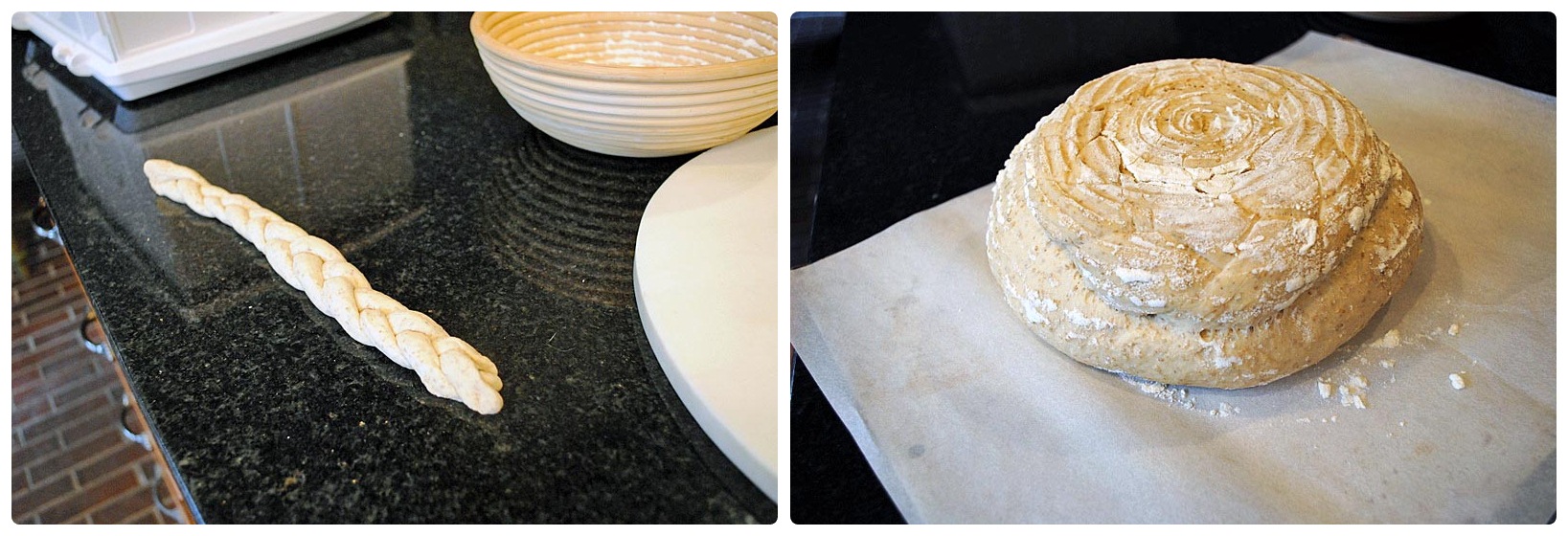
Ferment the dough for 3 hours, with two folds (at 60 and 120 minutes). Leave the dough rise undisturbed for the last hour.   Weigh the dough and separate a small amount roughly 10% of its weight for the braid.  Divide that portion in three, make long strands with it, and form a braid.   Place the braid at the bottom of a well floured banetton, form the remaining of the dough as a ball, and place it, seam side down over the braid.

Ferment the shaped dough for 2 hours, invert it on a piece of parchment paper, and bake in a 450 F oven with initial steam for 20 minutes, reduce the oven to 420 F and bake for 20 to 25 minutes more.  Cool completely on a rack.

ENJOY!

to print the recipe, click  here

composite

I loved making this bread!  When Joanna posted her article, she got a comment from the baker who originally designed this recipe, and he advised her to use less dough (5 to 8% from the total weight) to make the braids.  I used 10% because it already seemed like a very small amount, but I ran into some difficulties. I should have rolled my strands a little longer, and glued them better to the rest of the dough.  Still, it is a nice touch to embellish a sourdough boule. I will not lie to you, though.  My  Emperor was also vino-happy the previous night, as these (more revealing) shots will demonstrate. 😉

oops2oops

This was a nice loaf of bread, with the delicious flavor of rye, and a golden brown crust, boosted by the inclusion of malt. I baked it inside a large roasting pan with a lid, after a nice comment left by Donna on my sourdough mini-rolls post. It worked extremely well, thanks for the great tip, Donna!  I did not add any extra water inside the pan. I just poured some inside the lid, emptied it leaving a little water clinging to the surface, and inverted it quickly to close the roaster.  At the end of 20 minutes I opened the roasting pan and continued baking uncovered.

closeup

Joanna, thanks for another great recipe!  This one goes straight to Susan’s Yeastspotting

ONE YEAR AGO: In My Kitchen, December 2011

TWO YEARS AGO: Festivus Dinner Rolls

THREE YEARS AGO: 100% Sourdough Rye

CELEBRATE WEDNESDAY WITH HOMEMADE CALZONES!

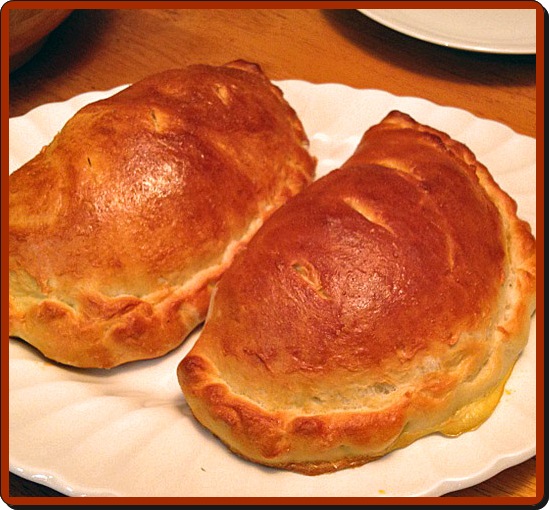
baked111Do you think it would be too hard to enjoy calzones made from scratch right in the middle of the week?  Trust me, it is doable with just a little bit of advance prep.  First, the day before (or early in the morning), make your favorite pizza dough.  Place it in the fridge.  Also the day before, prepare the fillings, and reserve in the fridge, right next to the dough.  When you arrive home from work,  take the dough off the fridge and let it warm a little as you heat the oven.   Roll the dough out, add the filling, close the calzone, and bake!
ingredients

SPICY CHORIZO CALZONES
(from The Bewitching Kitchen)

1 recipe for pizza dough (click here for my favorite)
3 chorizo sausages, casings removed
1 can (14.5 oz) diced fire roasted tomatoes
1/2 Tbs olive oil
1 box (10 oz)  frozen spinach, defrosted, squeezed dry
1 cup ricotta cheese
1 egg
salt and pepper
1 cup mozzarella cheese, grated
egg wash (1 egg beaten with a little water)
homemade tomato sauce to serve alongside (optional)

Prepare the dough the day before or early in the morning.  Place it in the fridge until dinner time.   Make the filling:  heat the olive oil, and add the chorizo sausage, crumbling it into pieces. Saute the sausage until it starts to get browned, drain the diced tomatoes, and add to the sausage.   Reduce the heat, cover the pan and cook for 5 minutes.  Let it cool, and place in the fridge.

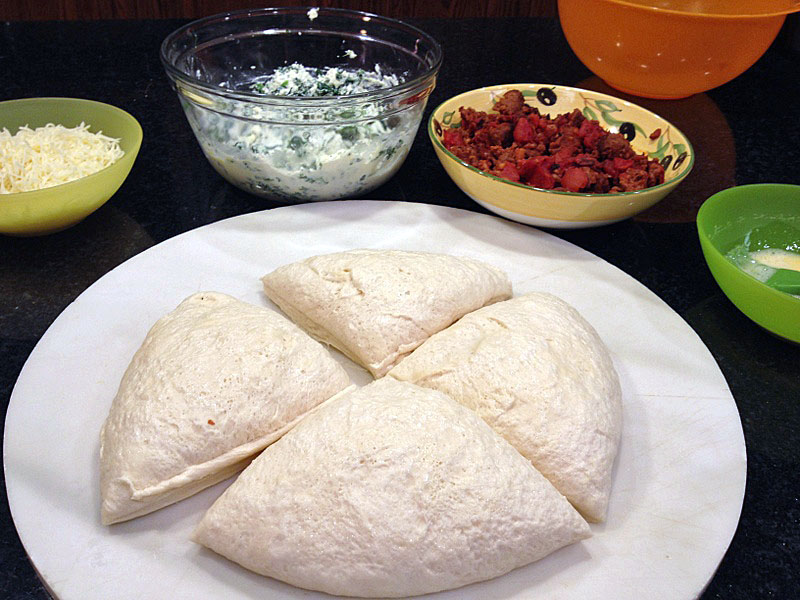
Remove the dough from the fridge, cut it in four pieces, and turn the oven at 400 F.  Squeeze as much water as you can from the spinach, add it to ricotta cheese, season with salt and pepper, add the egg and mix.

Roll out each ball of dough to a 7-inch diameter round.  Add a little bit of sausage mixture, the ricotta/spinach, and grated mozzarella.   Fold the dough over,  pinch the edges to seal, brush the surface with egg wash. Cut three slits with a sharp knife, place it in the oven.  Bake for  25 minutes until golden brown.   Serve with tomato sauce and a salad, and you are all set!

ENJOY!

to print the recipe, click here

composite

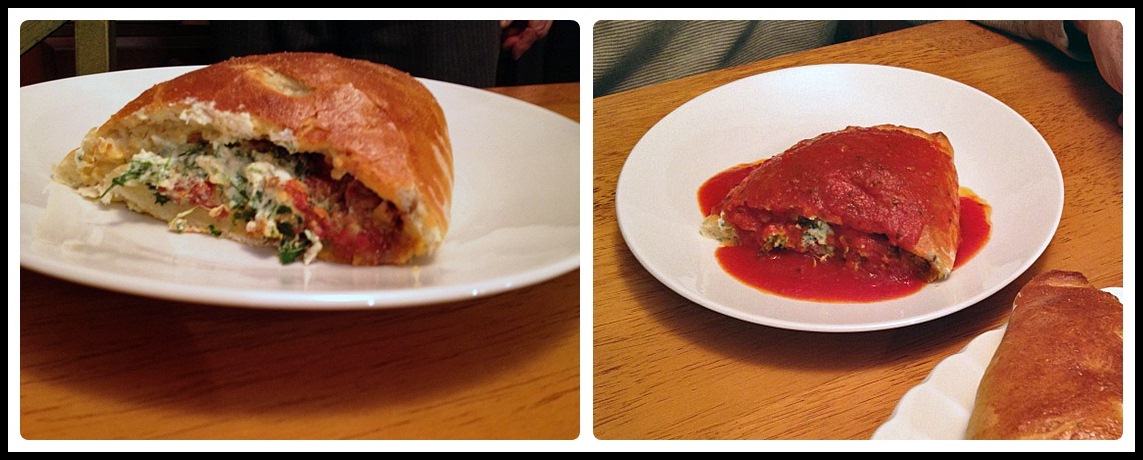
These will turn any dinner into something special and festive, and they are sooo easy to make!  I used a very spicy chorizo, but the ricotta mellowed it down quite a bit. Sometimes I do not add any egg to the ricotta, but in this version I did, to make sure the filling would have a bit more body. If the filling is too liquid, the bottom of the calzone might get soggy.  Of course, this is a perfect recipe to improvise, coming up with different ingredients: sautéed mushrooms, black olives, a little Gorgonzola cheese, artichoke hearts, anything goes!

doublet111I like my calzones either plain, or with a little bit of tomato sauce, but others are known to go for the kill… 😉

I am submitting this post to Susan’s Yeastspotting

ONE YEAR AGO: Plum-Glazed Duck Breasts

TWO YEARS AGO: Holiday Double-Decker

THREE YEARS AGO: New York Deli Rye

SOURDOUGH MINI-ROLLS

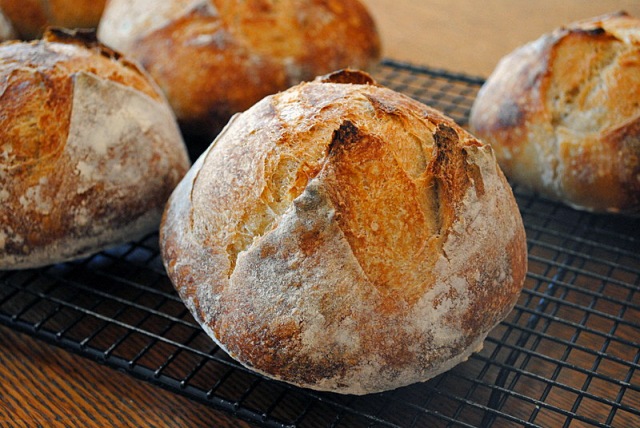
Those who follow my baking adventures know that my favorite type of bread is a sourdough boule, medium to large size.  For some odd reason, when I want to bake small rolls, I always opt for recipes that use  commercial yeast, and result in a softer, more buttery bread.  That is now changed.  I used one of my favorite basic sourdough recipes to bake 6 small rolls, shaped exactly like a large one, and similarly scored.   They turned out so good, I might switch to this type of format for a while. Plus, each roll can be frozen for later, brought to room temperature for a few minutes, then placed in a very low oven (250 F) for 15 minutes or so.  Perfect bread whenever you feel like it!  😉
mini1

SOURDOUGH MINI-ROLLS
(adapted from Hamelman’s Bread)

for starter mixture (make 12 hours in advance)
100 g bread flour
80 g rye flour
110 g water
40 g active sourdough starter (at 100% hydration)

for the bread:
all sourdough made as above
700 g bread flour
20 g rye flour
470 g water
15 g salt

Prepare your sourdough mixture about 12 hours before making the dough.  Heat the water slightly in a microwave until it is lukewarm, and place it in the bowl of a KitchenAid type mixer.  Add the sourdough into the water and mix with your hands to dissolve it. Add both flours, and mix at low-speed until the ingredients form a shaggy mass.

Cover the bowl and let the dough rest for 20 minutes.   Sprinkle the salt over, turn the mixer back on low-speed and knead for about 4 minutes.  Transfer the dough to an oiled bowl and let it rise for about 2 and a half hours, folding the dough every 50 minutes. For a more detailed explanation on folding, click here. You will do a first folding cycle at 50 minutes, another one at 1 hour and 40 minutes, then leave it undisturbed for additional 50 minutes, for a total of 2 and a half hours fermentation.

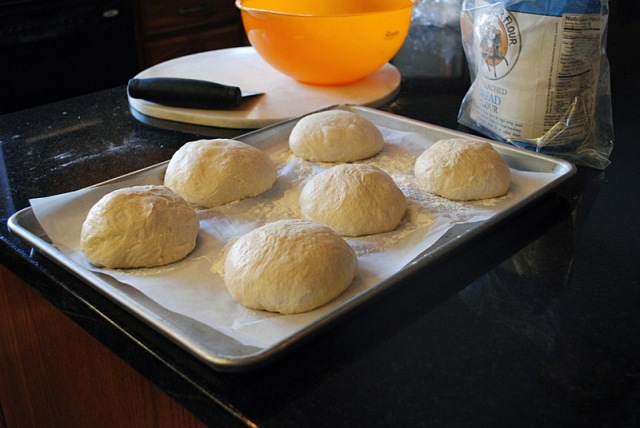
Heat your oven to 450 F. Divide the dough in 6 equal pieces.   Shape each one as a small boule.  Place over floured parchment paper on a baking sheet, flour the surface lightly and cover.  Allow the rolls to proof for 45 minutes.  Score the surface,  and bake for 25 minutes (with initial steam) or until golden brown and the internal temperature over 205 F.   Cool completely on a rack.

ENJOY!

to print the recipe, click here

risingComments:  Depending on the method of steam you use for your oven, these rolls can be a breeze to bake.  I decided to use my usual method of inverting a damp roasting pan over the rolls, and to do that I needed to bake three rolls at a time.  Let’s say it was a bit too convoluted and the second batch was slightly over-proofed.  Next time I might just go for a less complicated method, and use a baking pan with hot water at the bottom of the oven.  Whatever method you choose, the steam provides a nicer crust.
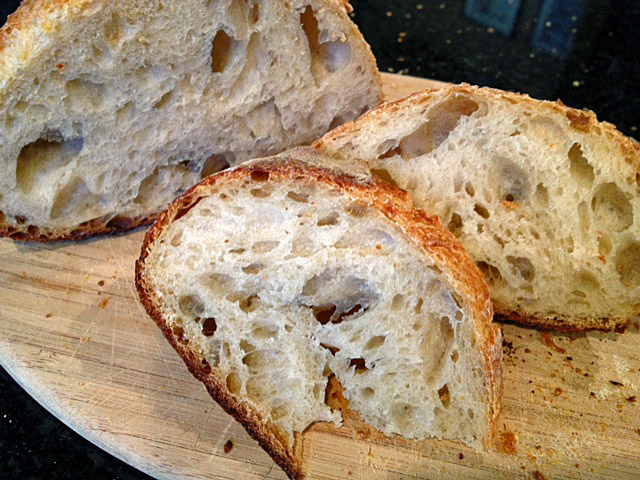
The crumb was moist and creamy, the way we like it, and the crust reminded us of the fantastic baguettes we used to enjoy while living in Paris…  What’s not to like?   😉
crumb

I am submitting this post to Susan’s Yeastspotting

ONE YEAR AGO: Do you eat your books?

TWO YEARS AGO: Mediterranean Skewers

THREE YEARS AGO Fettuccine with Shrimp, Swiss Chard, and Tomatoes