EMBOSSED CHOCOLATE-CHERRY SOURDOUGH LOAF

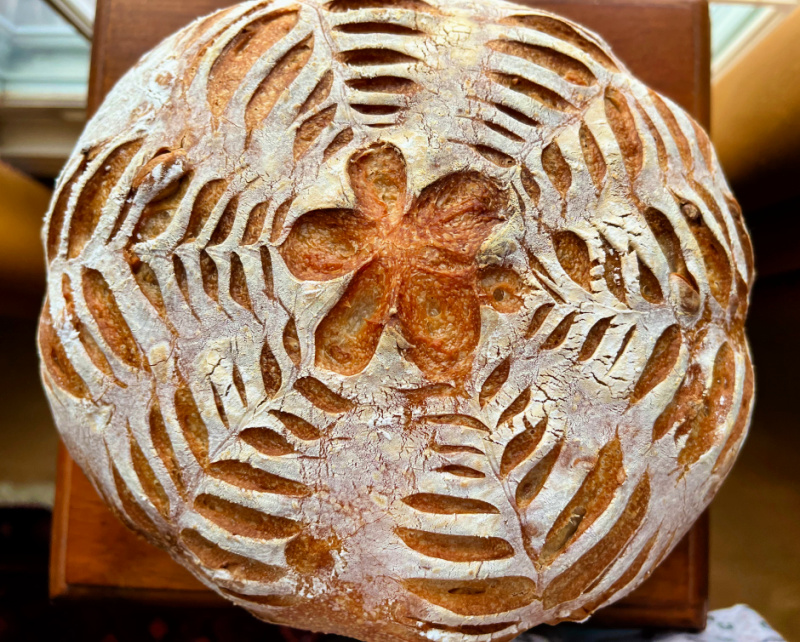
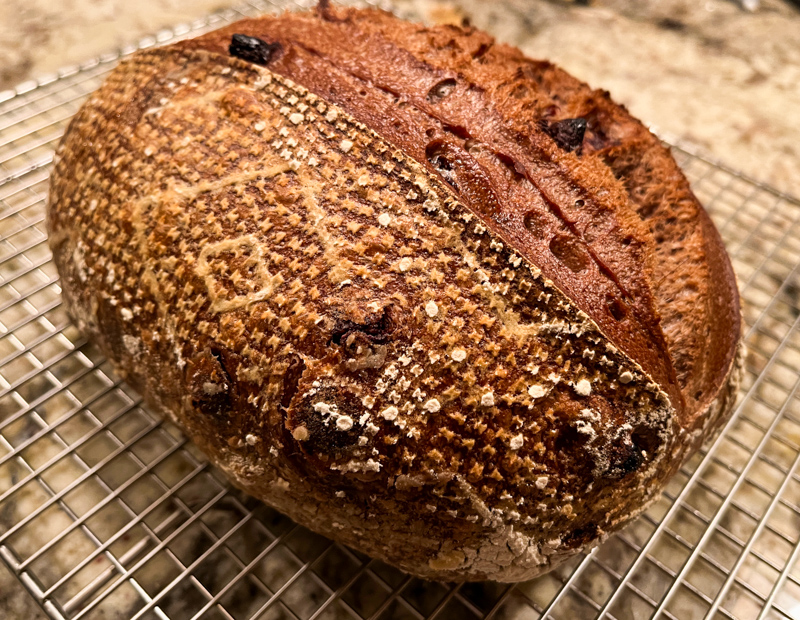
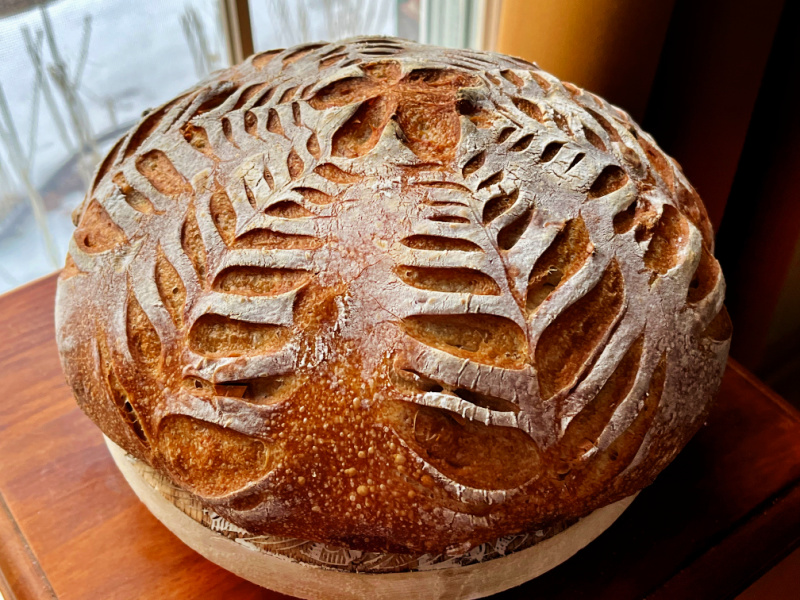
This bread is simply amazing. If you are not too sure about mixing chocolate with sourdough bread, let me tell you, it works! As the husband put it, this is dangerously good. He also said that “we” absolutely must make it again and have slices of this bread in the freezer at all times. I cannot take any credit for the basic formula, but I completely changed the method, and will explain my reasons in the comments. With this loaf, I tried a new way to decorate the surface, using paper towel to emboss a pattern. I definitely intend to explore this method further in the near future.
EMBOSSED CHOCOLATE-CHERRY SOURDOUGH LOAF
(modified from The Perfect Loaf)

260g water
80g active sourdough starter at 100% hydration
320g bread flour
40g spelt flour
12g cocoa powder 
12g canola oil 
60g dark chocolate chips
60g dried sour cherries
8g sugar
7g salt
additional flour for embossing effect (optional)

Bloom the cocoa. Heat the oil in a small saucepan. Add the cocoa and heat, stirring until it thickens slightly. Allow it to completely cool.

Place the water in the bowl of a KitchenAid type mixer and dissolve the starter in it, mixing with a spatula briefly, then add the two types of flour, and all other ingredients, except the chocolate chips and cherries.

Turn the mixer on with the hook attachment and knead the dough for 2 minutes at low-speed all the time. If the dough is too sticky, add 1/4 cup flour, you want the dough to start clearing the sides of the bowl, but still be sticky at the bottom. Add the chocolate chips and cherries, knead in the machine for 2 and a half minutes more.

Remove the dough from the machine, and transfer to a container lightly coated with oil, cover lightly with plastic wrap and allow it to ferment for 4 hours, folding every 45 minutes or so. If you intend to do the decorative embossing, rub all-purpose or bread flour all over the paper towel. Reserve.

After four hours bulk fermentation, shape the dough in any shape you like, and place, seam side up, in a lightly floured banetton. If embossing, the bread lays on top of the paper saturated with flour. Leave at room temperature one hour, and then place in the fridge overnight, from 8 to 12 hours.

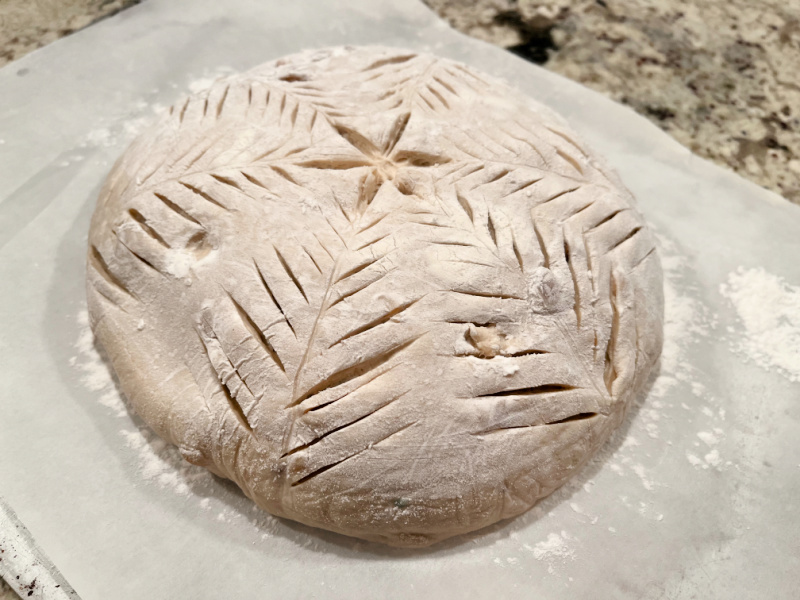
Next morning, heat the oven to 450F. Invert the dough over parchment paper, slash the surface with a sharp razor blade. Bake at 450F for 45 minutes, preferably covered for the first 30 minutes to retain steam. Cool completely over a rack before slicing.

ENJOY!

to print the recipe, click here

Comments: The technique to do the embossing is explained very well in this video from youtube. I was hoping for more staying power and contrast after baking, so on a loaf made a few days later I tried tapioca flour and rice flour, but they did not work. The tapioca behaved very oddly when rubbed in the paper, so I did not use it, and the rice flour never formed a pattern after overnight in the fridge. So, as far as my limited experience goes, it might be better to use regular white flour.
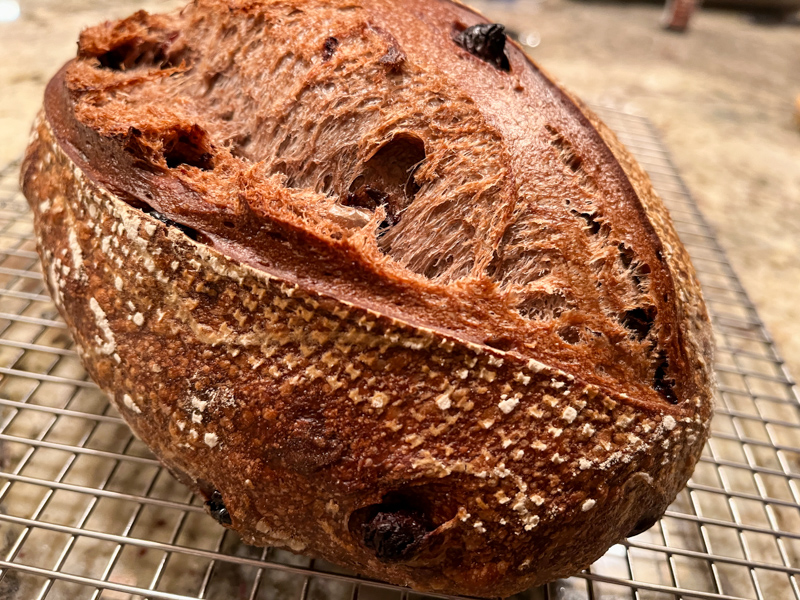
The bread had great oven-spring, and the smell was amazing as it baked. My modification of the method involved super-simplifying it. As I like to say, your kitchen, your rules. If you prefer to go along the path of autolyse, and adding water in different stages, go for it. I’ve been baking sourdough for 15 years pretty much non-stop, and I stick with the simplest way to do it. It works well for me. Would it be better if I did the autolyse and all the other convoluted tricks? Maybe, but honestly, I don’t really care. Some bakers go to the extent of measuring the temperature of the room, the water, the flour, adjust the number of revolutions per minute in the KitchenAid to get to the perfect increase in temperature by friction etc etc. I have zero interest in this type of precision. My default method works fine for all bread formulas I’ve tried so far. Quoting my dear friend Elaine (author of two bread cookbooks): “Keep It Simple.”
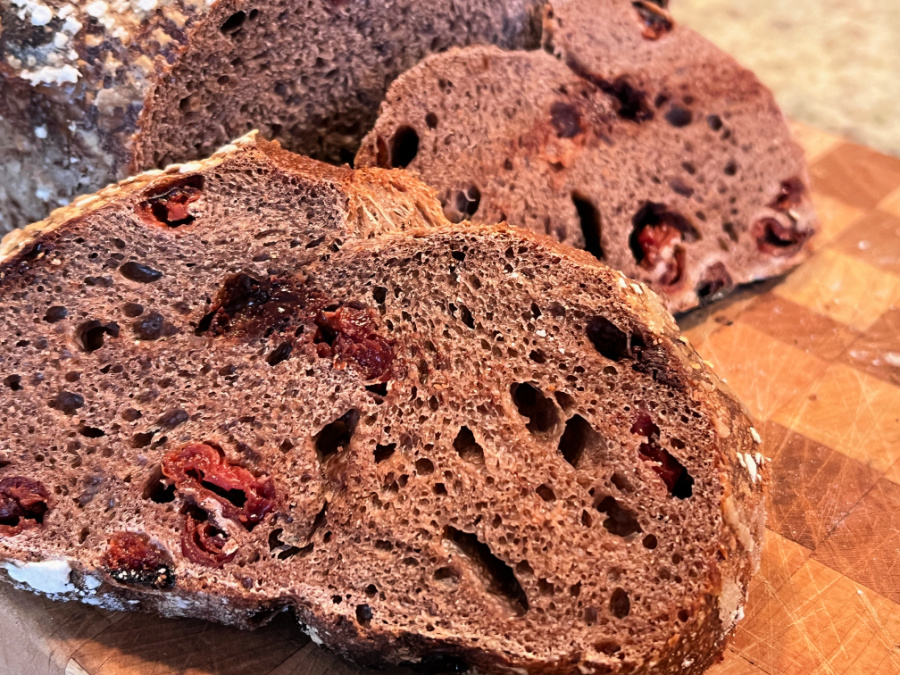
The flavor of this bread is hard to describe, but Maurizio really hit the jackpot with this one. It is not a sweet bread. Biting into the pieces of cherry around the crumb? Added bliss. Make it, and you might find yourself with a new favorite loaf of bread to keep around the house.

ONE YEAR AGO: Springerle Painting 101

TWO YEARS AGO: Mincemeat Pies, when the third time is a charm

THREE YEARS AGO: Shibari Bread]

FOUR YEARS AGO: Incredibly Simple Times Four – January 2018 

FIVE YEARS AGO: Two Salads and a Blog Award!

SIX YEARS AGO: When Three is Better than Two

SEVEN YEARS AGO: Somebody Stop Me!

EIGHT YEARS AGO: Zucchini Pasta with Cilantro-Cashew Pesto

NINE YEARS AGO: Bran Muffins, Take Two

TEN YEARS AGO: Brown Butter Chocolate Chip Cookies

ELEVEN YEARS AGO: Mogo Mojo

ELEVEN YEARS AGO: Slow-Roasted Chicken Thighs: an Ice-Breaker
DOUBLE PEANUT SOURDOUGH LOAF

Of all the nuts out there, the peanut is the ugly duckling. Simple, humble, affordable, available everywhere. It does not have that majestic feel of a macadamia, or the sexy aura of a hazelnut. Most sourdough breads include walnuts or pecans, leaving them once again neglected. Not in my kitchen, though. This bread gets a double load of peanuts. Peanut butter, and roasted peanuts joined together with flour, salt and a wild bunch of yeast and bacteria aka sourdough starter.

DOUBLE PEANUT SOURDOUGH LOAF
(from The Bewitching Kitchen)

370g water
70g active sourdough starter at 100% hydration
470g bread flour
20g spelt flour
10 g rye flour
30g peanut butter (smooth)
30g roasted peanuts, unsalted
10g salt

  • Place the water in the bowl of a KitchenAid type mixer and dissolve the starter in it, mixing with a spatula briefly, then add the three types of flour, the peanut butter and the salt.
  • Turn the mixer on with the hook attachment and knead the dough for 2 minutes at low-speed all the time. If the dough is too sticky, add 1/4 cup flour, you want the dough to start clearing the sides of the bowl, but still be sticky at the bottom.
  • Add the peanuts and continue kneading in low-speed for 2 and a half minutes more.
  • Remove the dough from the machine, and transfer to a container lightly coated with oil, cover lightly with plastic wrap and allow it to ferment for 4 hours, folding every 45 minutes or so.
  • After four hours bulk fermentation, shape the dough as a ball, and place, seam side up, in a lightly floured banetton. Leave at room temperature one hour, and then place in the fridge overnight, from 8 to 12 hours.
  • Next morning, heat the oven to 450F. Invert the dough over parchment paper, rub gently white flour on the surface. Score with any pattern you like.
  • Bake at 450F for 45 minutes, preferably covered for the first 30 minutes to retain steam. Cool completely over a rack before slicing.

ENJOY!

to print the recipe, click here

Comments: If you follow my blog, you know that my default method for sourdough involves the Kitchen Aid initial kneading and never heating the Dutch oven before dropping the bread inside, over parchment paper. Those two details make life a lot easier in terms of clean up of bowls, hands, and lack of burning marks in forearms and fingers…

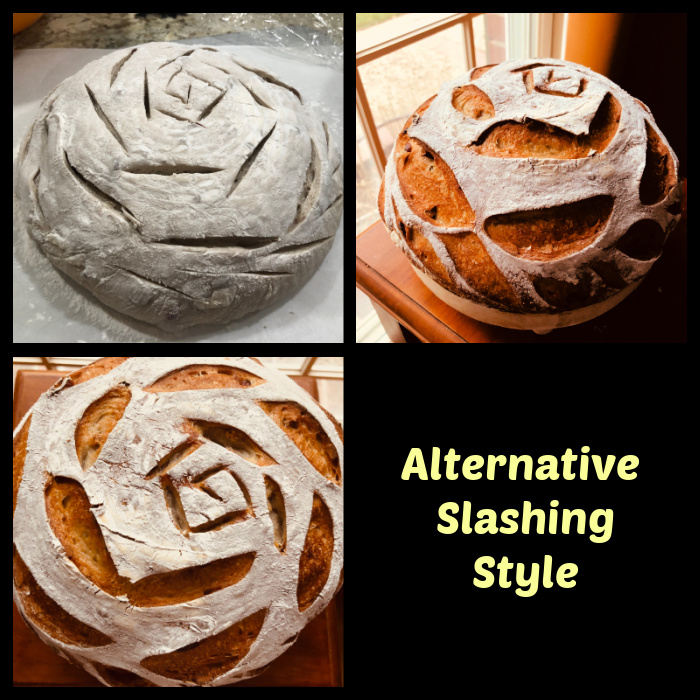
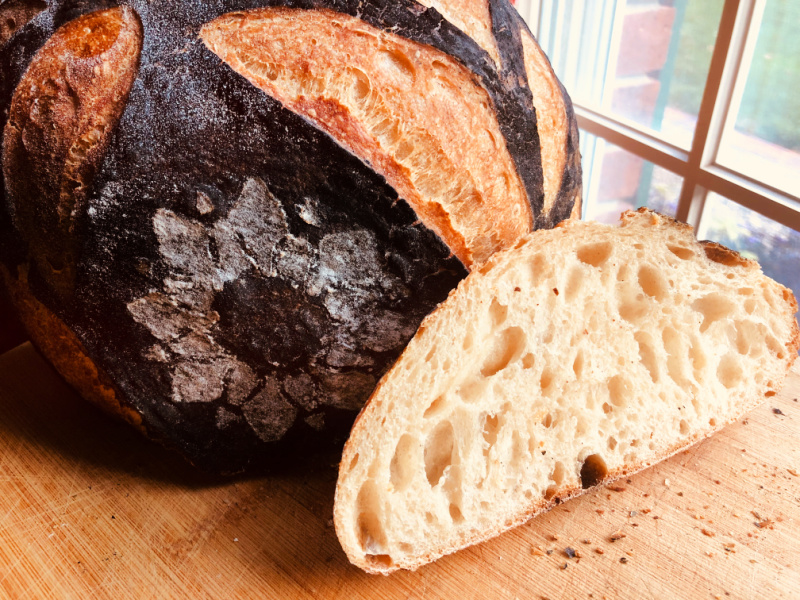
I add the peanuts after 2 minutes kneading with the KA, and run the machine for one additional couple of minutes or so. That is enough to incorporate the nuts in the dough, which will continue to happen during the subsequent foldings. You can slash the dough in patterns or just do a simple slash. Below I show you another type of pattern, a kind of geometric flower.

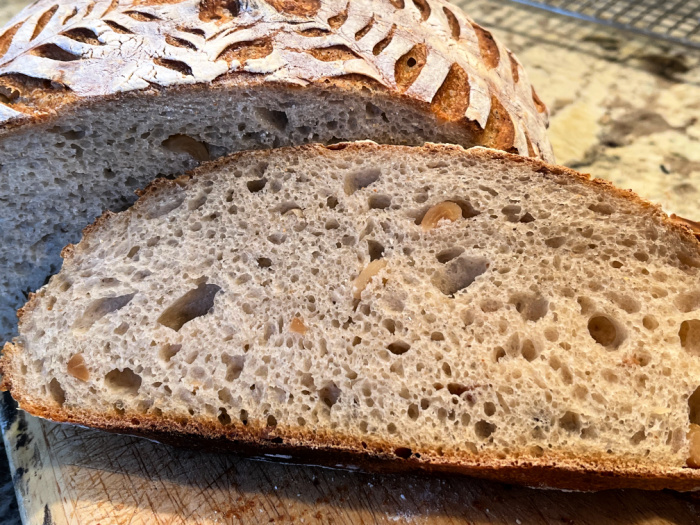
We loved the subtle peanut flavor of this bread, and biting into a little peanut here and there was also very nice. The peanuts will end up softer than other nuts normally used in breads.

ONE YEAR AGO: Fennel-Rubbed Shrimp in Light Coconut Sauce

TWO YEARS AGO: Puff Bread Balls, Two Salads and a Cookbook Review

THREE YEARS AGO: Pistachio-Caramel and Apple Mousse Cakes

FOUR YEARS AGO: La Couronne Bordelaise

FIVE YEARS AGO: A Special Birthday Dinner

SIX YEARS AGO: Duck Confit for a Special Occasion

SEVEN YEARS AGO: Tuscan Grilled Chicken and Sausage Skewers

EIGHT YEARS AGO: Celebrate Wednesday with Pork Tenderloin & Apples

NINE YEARS AGO: Salmon Wellington

TEN YEARS AGO: The Green Chip Alternative

ELEVEN YEARS AGO: Weekend Pita Project

TWELVE YEARS AGO: Let it snow, let it snow, eggs in snow

STAR-SHAPED SUNDRIED TOMATO BREAD

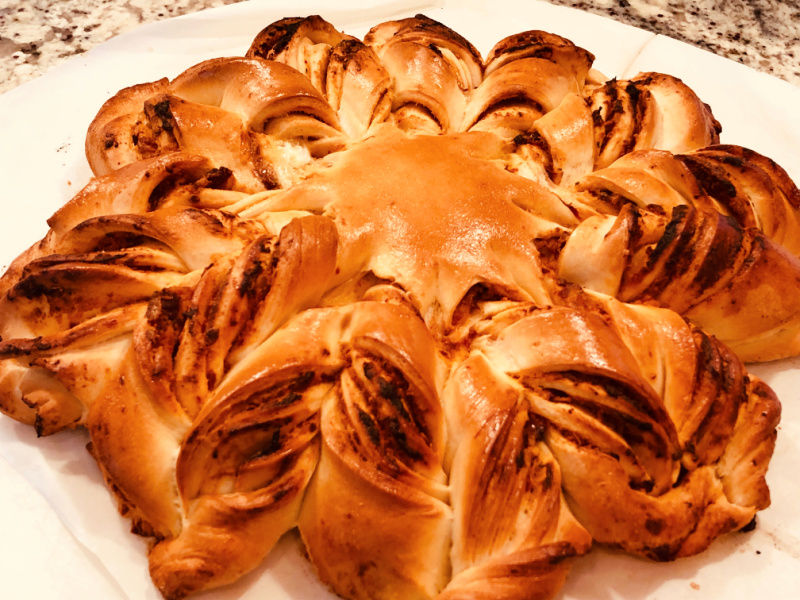
This is a type of bread we see often this time of the year, because it looks so festive, but it is actually quite simple to make. The filling can be sweet (think Nutella, caramel, raspberry jam) or savory. My version used sundried-tomato and cheese. You can take it in different directions, and it will always turned out great, with that visual impact we love so much, particularly during the holiday season.

STAR-SHAPED SUNDRIED TOMATO BREAD
(adapted from King Arthur Flour)

for the dough:
3/4 cup lukewarm milk
2 teaspoons active dry or instant yeast
360g all-purpose flour, divided
1 large egg
3 tablespoons olive oil
1 teaspoon salt

for the filling:
¾ cup shredded mozzarella
½ cup oil-packed sun-dried tomatoes
1/2 tsp herbes de Provence
½ teaspoon salt

1 egg for egg wash

To make the dough, place the milk, yeast, and 120g all-purpose flour in a large mixing bowl and stir to combine. Cover and let rest for 15 minutes.

Add the egg, olive oil, salt, and the rest of the all-purpose flour. Mix to make a soft dough, then knead for 6 to 8 minutes, until smooth and supple. Place in an oiled bowl, cover, and let rise for about 1 hour, until doubled.

Mix together minced sun-dried tomatoes, salt and herbes de Provence. Reserve.

Divide the dough into four pieces and shape into balls. Cover and let rest for 10 minutes.

Place one piece of dough on a piece of parchment. Roll it into a 10″ circle. Spread ⅓ of the sun-dried tomato mixture on the first layer of dough in an even layer. Sprinkle ⅓ of the cheese, leaving ½” around the outside edge uncovered. Roll out the second ball of dough to the same size as the first. Place it on top of the first circle and repeat the three layers of filling. Again, repeat with the third ball of dough and the last ⅓ of filling. Roll out the last ball of dough and place it on top.

Place a 2″ round biscuit cutter or drinking glass in the center of the dough to serve as a guide. Using a sharp knife, cut the larger circle into 16 equal strips, from the outside edge to the cutter/glass in the center, through all the layers. Using two hands, pick up two adjacent strips of dough and twist them away from each other twice, so the top side is facing up again. Repeat with the remaining strips of dough all the way around the circle. Remove the cutter/glass.

Pinch the ends of adjacent strips together all the way around the bread to create eight star-like points. Transfer the star on the parchment to a baking sheet. Cover with plastic wrap and let rise for about 45 minutes. Dough should look expanded and airy.

Heat the oven to 400F. Remove the plastic wrap and brush the star with a thin coat of the egg wash. Bake for 25 to 30 minutes, until nicely golden. Remove the bread from the oven and cool for 10 minutes before serving.

ENJOY!

to print the recipe, click here

Comments: This is a very rich dough, and a pleasure to work with. Even if you are a beginner at bread baking, the whole process is pretty forgiving. The circles of dough do not have to match precisely, it is all going to get twisted and any little gaps won’t affect the final product.

There are many videos available on youtube to show you how to shape the bread, like this one.

If you are still searching for a nice bread as a centerpiece for your holiday festivities, this is truly a great option…

ONE YEAR AGO: Cranberry White Chocolate Tart

TWO YEARS AGO: I dream of Madeleines and a Tower of Cheesecakes

THREE YEARS AGO: Dominique Ansel’s Chocolate Mousse Cake

FOUR YEARS AGO: Slow-Roasted Eye of the Round Beef

FIVE YEARS AGO: Steam-Roasted Indian-Spiced Cauliflower

SIX YEARS AGO: Creamy Zucchini-Mushroom Soup

SEVEN YEARS AGO: Ken Forkish’s Pain au Bacon

EIGHT YEARS AGO: Carrot and Cumin Hamburger Buns

NINE YEARS AGO: Potato Galettes a l’Alsacienne & Book Review

TEN YEARS AGO: Caramelized Carrot Soup

ELEVEN YEARS AGO: Miso-Grilled Shrimp

TWELVE YEARS AGO: Pain Poilane

PECAN-CRANBERRY BREAD

Absolutely perfect for this time of the year, this is a bread that does not require a sourdough starter, but uses a sponge instead, so you will need two days to make it happen in your kitchen. The recipe comes from a cookbook I am quite fond of, Pastry Love, by Joanne Chang. It is available online, so I will share that link and give you just a brief overview of the recipe.

CRANBERRY-PECAN BREAD
(from Joanne Chang’s Pastry Love, published in The Modern Farmer)

For the sponge, you will need to mix 140g flour with 1 cup water + 1/8 tsp yeast, leave 2 hours at room temperature then refrigerate overnight. Use that to make the dough as described in the site (it is the third recipe shared, scroll down to find it).

I made only half of the recipe, but the bread turned out so delicious, I regretted not going for the two loaves that it makes. It freezes super well also, so I strongly advise you to go for the full amount as published in the site I shared.

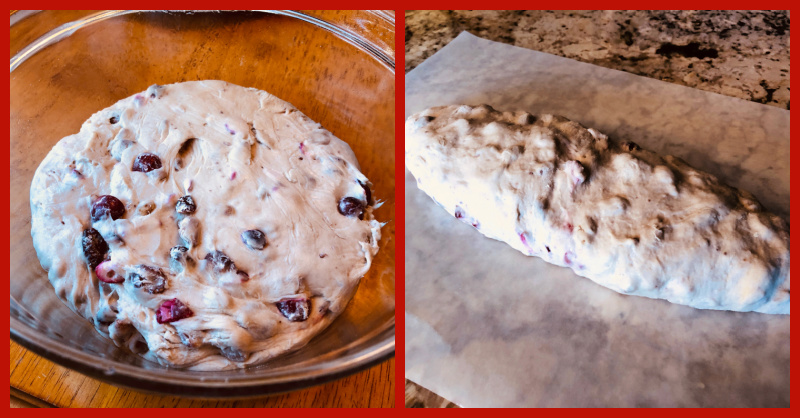
I don’t think the bread is particularly beautiful to look at, because all the goodies make for a rough, rustic look, but it compensates by far in the taste department. Absolutely wonderful with a little blue cheese.

I intend to make a sourdough version with the same flavors very soon, but for those who don’t keep a starter around, this bread has a very similar complexity of flavor, thanks to the sponge made the day before. Give it a try before the holiday season is over…

ONE YEAR AGO: Cookies for the Holidays: Macarons

TWO YEARS AGO: The Great American Baking Show

THREE YEARS AGO: Broccoli Souffle

FOUR YEARS AGO: Panettone Time!

FIVE YEARS AGO: How the Mighty Have Fallen

SIX YEARS AGO: Festive Night at Central

SEVEN YEAR AGO: The Perfect Boiled Egg

EIGHT YEARS AGO: Light Rye Sourdough with Cumin and Orange

NINE YEARS AGO: Homemade Calzones

TEN YEARS AGO: Plum-Glazed Duck Breasts

ELEVEN YEARS AGO: Holiday Double-Decker

TWELVE YEARS AGO: New York Deli Rye

CHARCOAL PAINTED SPELT SOURDOUGH

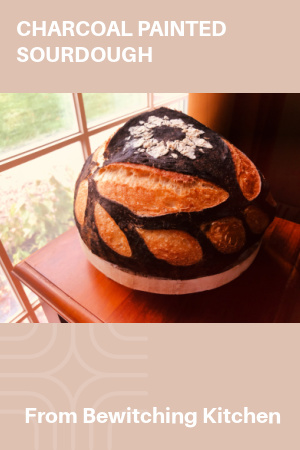
Something new that I’ve tried last week… Use any sourdough recipe you like, I am sharing my default version with a touch of spelt. Once the bread is ready to go into the oven, add some water to a little charcoal powder and brush the surface of the dough. While it’s still wet, place a stencil on top and shower it with white flour (all-purpose is fine). Rub it gently so that the design is as sharp as possible. Carefully lift the stencil, slash the bread and bake.

CHARCOAL PAINTED SPELT SOURDOUGH
(from the Bewitching Kitchen)

480g bread flour
20g spelt flour
10g salt
370g water
80g sourdough starter at 100% hydration
1 tablespoon activated charcoal powder
a little water
all-purpose flour for stencil detail

Make the levain mixture about 6 hours before you plan to mix the dough. It should be very bubbly and active.

When you are ready to make the final dough, place the water in the bowl of a KitchenAid type mixer and dissolve the starter in it, mixing with a spatula briefly, then add the two types of flour, and the salt. Turn the mixer on with the hook attachment and knead the dough for 4 minutes at low-speed all the time. If the dough is too sticky, add 1/4 cup flour, you want the dough to start clearing the sides of the bowl, but still be sticky at the bottom. 

Remove from the machine, and transfer to a container lightly coated with oil, cover lightly with plastic wrap and allow it to ferment for 4 hours, folding every 45 minutes or so. After four hours bulk fermentation, shape the dough as a ball, and place, seam side up, in a lightly floured banetton. Leave at room temperature one hour, and then place in the fridge overnight, from 8 to 12 hours.

Next morning, heat the oven to 450F. Invert the dough over parchment paper, make a paste with the charcoal powder and water, and paint over the surface. Immediately place a stencil on top, and shower white flour over it, rubbing it gently to get the design to stick well. Next, use a brand new razor blade to score around the design, to coach the bread into opening without ruining the pattern.

Bake at 450F for 45 minutes, preferably covered for the first 30 minutes to retain steam. Cool completely over a rack before slicing.

ENJOY!

to print the recipe, click here

Comments: I know that one should never complain about excessive oven-spring when bread baking, but for some designs it would be better to have a less “explosive” loaf… I intend to play with formulas with higher whole-wheat content to try and tame the loaves with patterns and more elaborate scoring. Still I like the way this turned out, and it is much better than rubbing the powder over the loaf.

You can brush the excess flour once the bread is cold. I need to play a bit with the placement of the stencil and the amount of flour to add to it, but overall I am quite pleased with the overall look.

ONE YEAR AGO: Lime-Ganache Bonbons

TWO YEARS AGO: The Dobos Torte

THREE YEARS AGO: Coffee-Caramel Entremet Cake

FOUR YEARS AGO: Fennel Soup with Almond-Mint Topping

FIVE YEARS AGO: Eataly

SIX YEARS AGO: Spaghetti Squash Perfection

SEVEN YEARS AGO: Skinny Eggplant Parmigiana

EIGHT YEARS AGO: Supernova Meets Wok

NINE YEARS AGO500 Posts and The Best Thing I ever made

TEN YEARS AGO: Back in Los Angeles

ELEVEN YEARS AGO: White House Macaroni and Cheese

TWELVE YEARS AGO: Korean-Style Pork with Asian Slaw