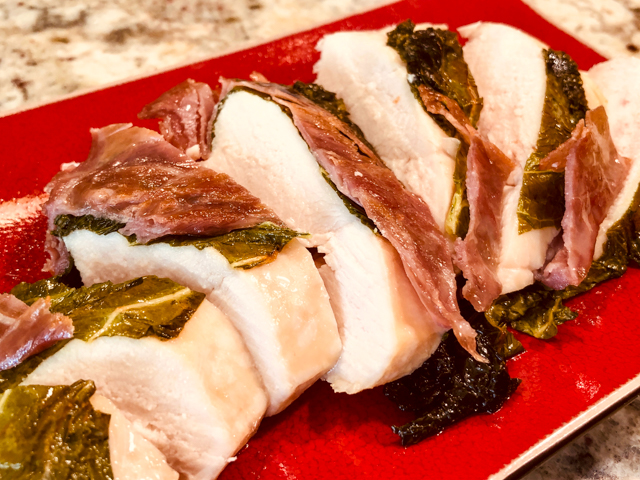
KALE AND PROSCIUTTO-WRAPPED CHICKEN BREASTS

Are you going to run away if I tell you this is a sous-vide recipe? No need, because you can make it on the stove. It will just require a little more hands-on attention so that the meat ends up properly cooked and still tender and juicy. With the sous-vide you can set it, forget it, and concentrate on making your side-dish, as the final preparation of the chicken takes literally minutes.

KALE AND PROSCIUTTO-WRAPPED CHICKEN BREASTS
(from the Bewitching Kitchen)

4 chicken breasts
kale leaves, tough stems removed
prosciutto slices
lemon juice
salt and pepper to taste
2 tablespoons olive oil

Set the sous-vide to 148F.

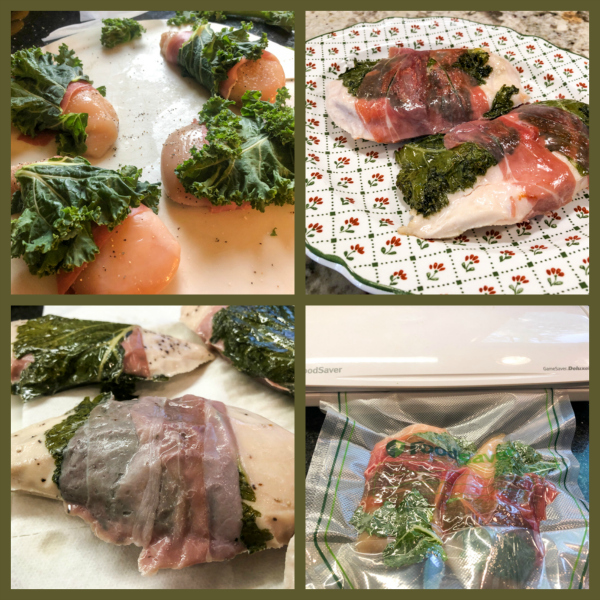
Season the chicken breasts with salt and pepper, rub a bit of lemon juice all over them. Wrap with kale leaves, then with prosciutto slices.  If using the sous-vide, no need to worry too much about wrapping it all tightly because it will firm up as you seal the packages.  If not using sous-vide, try to wrap as tightly and neatly as possible.

Seal the pieces of in a vacuum-bag and submerge in the water-bath for 2 hours (up to 4 hours will be ok). When the time is up, remove the chicken pieces from the bag, dry them well and sautee quickly both sides in olive oil, preferably using a non-stick skillet. Let it cool briefly and slice to serve.

If not using sous-vide, sear both sides of the chicken in olive oil, also using a non-stick skillet. When both sides are golden brown, add a little chicken stock to the pan, a squirt of lemon juice, reduce heat to a simmer, cover the skillet. Cook until the chicken is done to your liking, it will probably take around 15 minutes.

ENJOY!

to print the recipe, click here

Comments: Sous-vide does such a fantastic job for tender meats like chicken breast, and pork tenderloin, it’s truly hard to beat this method of cooking. I sometimes cook a few chicken breasts seasoned with salt, pepper, and lemon juice, and keep it in the fridge, still vacuum-sealed in the bag. They are ready to use in stir-fries, or curries, anything you feel like it. The first time I made this recipe, I wrapped the kale outside of half of the pieces. It also works, but I prefer the prosciutto outside, it gets a nice texture once you brown it. This recipe is now part of our regular rotation, husband refers to it as “that prosciutto chicken.”  We both loved it!

ONE YEAR AGO: Memories of Pasteis

TWO YEARS AGO: And now for Something Completely Different

THREE YEAR AGO: Parsnip, Coconut, and Lemongrass Soup

FOUR YEARS AGO: In My Kitchen, October 2016

FIVE YEARS AGO: Paleo Moussaka

SIX YEARS AGO: In My Kitchen, October 2014

SEVEN YEARS AGO: In My Kitchen, October 2013

EIGHT YEARS AGO: Crimson and Cream Turkey Chili

NINE YEARS AGO: Taking a break from the nano-kitchen

TEN YEARS AGO: Chocolate Chip Cookies


GIBASSIER

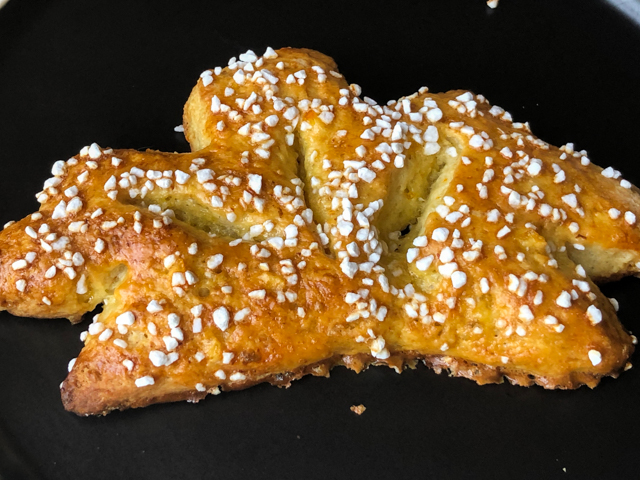
Those who follow my blog might be aware that I am a huge fan of Helen Fletcher. When she praises a recipe, I just know it will be awesome. Still, this one surpassed all my expectations. Gibassier is a little brioche-like delicacy from Provence, a place that enchanted me when I visited many years ago, right during lavender harvesting season. I will never forget the fields and the intense but delicate lavender aroma present everywhere. Helen’s recipe is a breeze to make  using the food processor, but she also gives detailed instructions to make it in a regular mixer.

GIBASSIER
(from Pastries Like a Pro)

Preferment (Biga):
140 g bread flour
1/2 cup warm milk (about 105°F)
Large pinch of instant yeast

Stir together in a small bowl.  Knead several times to make a smooth ball.  Let sit at room temperature for 12 to 18 hours.

Gibassier Dough:
385 grams bread flour
6 tablespoons unsalted butter, cold (85 grams)
100 grams granulated sugar or 3 1/2 ounces)
2 + 1/2 teaspoons instant yeast
3/4 teaspoon salt
Orange zest from l medium navel orange
All of preferment from above
2 eggs
1/3 cup olive oil
1/4 cup water, divided
1/4 tsp Fiori di Sicilia (optional)
2/3 cup candied orange rind

Place the flour in the processor and pulse several times.  Cut the cold butter into pieces and arrange in a circle over the flour. Process until the butter is no longer distinguishable.

Add the sugar, yeast, salt, zest, and Fiori di Sicilia.  Pulse to incorporate. Tear the preferment into pieces and add it processor.  Process to fully incorporate.

Combine the eggs, olive oil, and half of the water. Pour over the dry ingredients and process to mix completely.  Scrape down and rearrange the dough if necessary.  The dough should be very soft.  Add water a teaspoon at a time if necessary (I did not use additional water).  Add the candied orange rind.  Pulse briefly to mix.  Do not over mix or the  rind will be too small.

Let the dough proof at room temperature for 2 hours, then deflate the dough and transfer to the fridge overnight

Shape the Gibassier.  Line two half-sheet pans with parchment paper. Turn the dough out. Weigh your dough and do the math to find out how many grams you should use to form each little dough. You should have enough for 14 gibassiers. In my case, I used 80 grams per little ball.  Shape all the balls, cover, and refrigerate to make it easier to cut them.  Take two or three out at a time so they don’t soften too much. Take a ball and stretch it out with your fingers to make a rough torpedo shape. Turn it so the best side is up.  With the heel of your hand press the top of the dough upward from the middle. Again from the middle of the dough, with the heel of your hand press the dough downward to form a lemon shape.  Flatten the ends to match the center. It shoud be abut 2 1/2 ” high.

With a single edge razor blade, make a cut in the middle of the dough.Then one to the left. One to the right. Along the right side of the top of the dough cut in toward the center about 3/4” to 1”. Again on the other side. Last cut in the same amount on the right side. And on the left. As you pick it up to put it on the sheet pan, stretch it out to enlarge the holes.  Place 7 on a tray.

Cover them and allow them to rise for 2 to 2 1/2 hours until puffy.

Heat the oven to 350F. While the oven is heating brush 2 or 3 of the rolls with the egg wash and sprinkle heavily with sanding sugar or pearl sugar. Bake one sheet at a time on the middle rung for 18 to 22 minutes until golden brown and baked through.

Serve warm or room temperature.

ENJOY!

to print the recipe, click here

Comments: If you’d like to make Gibassier, I urge you to stop by Helen’s site because her step-by-step photos are perfect to understand what needs to be done. Explaining just with words is a bit tricky. If you make it in the food processor, it will be easy to make just half the recipe, as the processor will handle it without issues. Everything comes together super quickly, and I like the fact that I could use butter straight from the fridge.

Some people suggest using an old credit card to do the cuts on the dough, but Helen’s idea of getting those single edged razor blades is truly spot on. I advise you to allow the final proofing to reach the 2.5 hour mark or even a little big longer as enriched doughs tend to be a bit sluggish. The puffier they get at that stage, the lighter the rolls will be. I had to cut my final proofing a bit short for half of them, and the second batch was better.


This is the type of pastry that will transport you straight to a cafe in France, sitting outside, people-watching, as you sip a little hot chocolate, coffee, or whatever suits your mood…

Helen, thank you once again not only for the inspiration but for your detailed instructions that make it all so much easier to follow.

ONE YEAR AGO: Sundried Tomato Twist Bread

TWO YEAR AGO: And now for something completely different….

THREE YEARS AGO: Parsnip, Coconut, and Lemongrass Soup

FOUR YEARS AGO: In My Kitchen, October 2016

FIVE YEARS AGO: Paleo Moussaka

SIX YEARS AGO: In My Kitchen, October 2014

SEVEN YEARS AGO: In My Kitchen, October 2013

EIGHT YEARS AGO: Crimson and Cream Turkey Chili

NINE YEARS AGO: Taking a break from the nano-kitchen

TEN YEARS AGO: Chocolate Chip Cookies

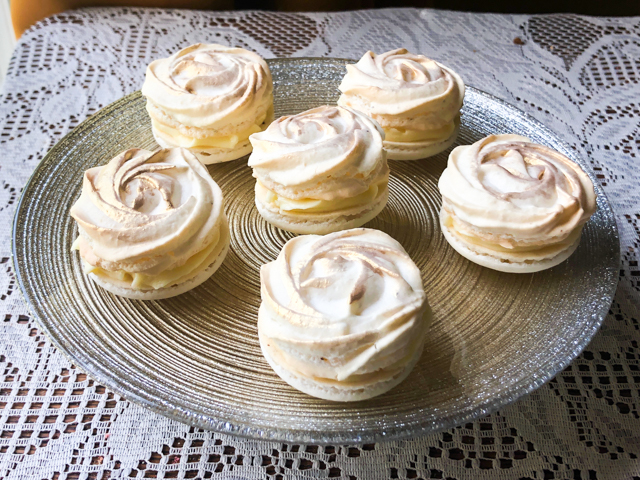
CHAI-MANGO ROSETTE MACARONS

Today I share a little departure on macarons, piped with a star tip (Wilton 1M). I followed my basic default recipe, but mixed a bit less than so that the batter gets just a tad denser. If you do the regular amount of “macaronage”, aiming at a smooth shell, it will not work here.  It can be a bit tricky to get it right, but it’s a fun technique to play with. Give it a try!
CHAI-MANGO ROSETTE MACARONS
(from the Bewitching Kitchen)

For the shells:
200g  Icing/powdered sugar
115 g Ground Almonds/Almond Meal
115 g egg whites at room temperature (approx. 4 eggs)
1/8 tsp of cream of tartar
100 g granulated sugar
¼ tsp vanilla paste or extract
1 bag double chai tea (Stash brand)

for the mango buttercream: 
6 tbsp unsalted butter, room temp
pinch of kosher salt
4 cups confectioner’s sugar
1 teaspoon pure vanilla extract
2 tbsp heavy cream
A pinch of cardamon
1/2 tbsp Amoretti mango flavor

to decorate:
gold dust + lemon extract
Candy melts + food gel dye + sprinkles

Make the shells:
Line 3 heavy baking sheets with parchment/baking paper or Silpat mats. Layer the powdered sugar, ground almonds and contents of the tea bag  in a food processor. Pulse until the mixture looks like fine meal, about 12 pulses. Pass through a sieve and transfer to a small bowl or to a sheet of parchment/baking paper. Set aside.

Place the egg whites and cream of tartar in the bowl of a stand mixer fitted with the whisk attachment. Make sure that the bowl and the whisk are impeccably clean. Starting on medium speed, whip the whites with the cream of tartar until they look like light foam. The whites should not appear liquid. The foam will be light and should not have any structure.

Slowly rain in the granulated sugar in five additions, trying to aim the stream between the whisk and the side of the bowl. Turn the speed up to high. Continue to whip the meringue until it is soft and shiny. It should look like marshmallow creme (marshmallow fluff). Add the vanilla. Whip the egg whites until the mixture begins to dull and the lines of the whisk are visible on the surface of the meringue. Check the peak. It should be firm. Transfer the whites to a medium bowl.

Fold in the ground almond/almond meal mixture in two increments. Paint the mixture halfway up the side of the bowl, using the flat side of a spatula. Scrape the mixture down to the center of the bowl. Repeat two or three times, then check to see if the mixture slides slowly down the side of the bowl.   Put the mixture in a piping bag fitted with your choice of piping tip (for rosette macarons, use a Wilton 1M type).  If you don’t have a macaron mat, draw circles on baking/parchment paper about 2inches/5cm in diameter & turn the paper over before placing on the baking sheets.  Pipe shells, I like to count numbers in my head and use the same count for each shell so they end up similar in size.

I pipe inside the circles to about 1 ¾ inches/4.5cm but you can go to 1 ½ inches (3.8cm) & the macarons will spread & fill the circle while drying.

Slam each sheet hard four to six times on the counter/worktop. Do not slam the sheets if you are making rosette macarons, just let them dry. Let the unbaked macarons dry until they look dull but not overly dry. Drying time depends on humidity. In a dry climate, the macarons can dry in 15 to 20 minutes; in a humid climate, it can take 35 to 40 minutes. Rosette macarons benefit from longer drying time.

While the macarons are drying, heat the oven to 300 F (150 C/130C Fan oven/Gas Mark 2). Bake one sheet at a time on the middle rack. Check in 11 minutes. If the tops slide or move (independently of the ‘feet’ when you gently twist the top), then bake for 2 to 3 more minutes. Check one or two. If they move when gently touched, put them back in the oven for 1 to 2 more minutes until they don’t move when touched.   Let the macaroons cool for 10 minutes before removing from the pan.  The macarons should release without sticking.

For the buttercream: 
In a stand mixer, fitted with a paddle attachment, add the butter and salt and whip until light and creamy about a minute. Add in the mango flavor and cardamon and mix to incorporate. Add the sugar and the heavy cream slowly, once you add everything mix for 2 minutes in high-speed. Adjust consistency with more cream if needed. Taste, and if you feel it could benefit from some sharpness, add a touch of lime juice (I did).  Place in a piping bag fitted with a star-shaped tip.

Assemble the macarons: match two shells similar in size and add buttercream to the bottom of one of them. If using rosette shells, they are going to be the top part. Place another shell on top and gently squeeze to take the filling all the way to the edge.

To decorate the rosette macarons, mix a little gold dust with lemon extract and paint over the details. Let it dry. To decorate the regular macarons, melt Candy Melts in the microwave, separate in three small bowls and dye them any color you like. Place in small piping bags and have fun making crazy patterns all over the macs. Add sprinkles before the candy melt hardens.

Store the macs in the fridge for 24 hours for perfect texture.

ENJOY!

to print the recipe, click here
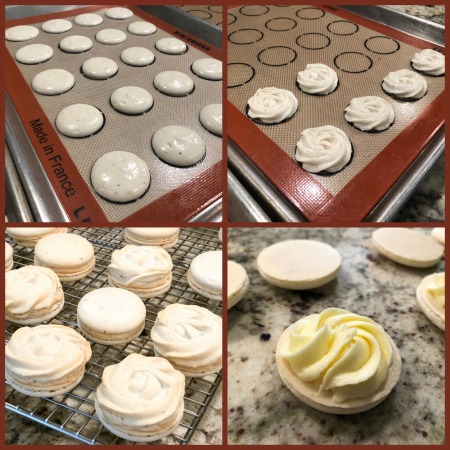
Comments: Stash Double-Chai Tea works very nicely to flavor the shells. I normally do not like to mess with the shell composition because it’s such a delicate balance, but I simply open the bag of tea and add it to the food processor when I grind the almond flour with the powdered sugar. The mango buttercream (with a touch of cardamon) was a very good complement.

I won’t lie to you, it is not easy to get the texture of the batter just right for piping. The very first time I made it (over a year ago), they worked perfectly, but I made the full batch as rosettes, and when you do that, it’s a bit tricky to sit them on a platter, for obvious reasons… they don’t sit flat.  So I never blogged about it, and to be honest I don’t even remember which flavor I used in the filling. I do remember the boys enjoyed their mandatory sampling of “one-shell-per-pup.”
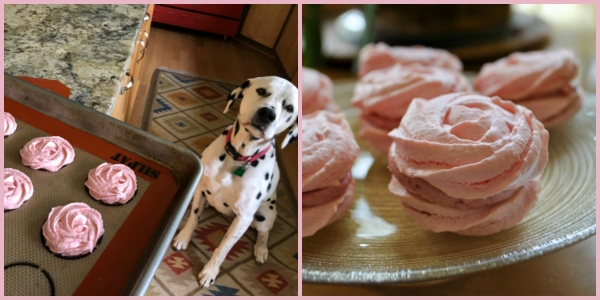
Ever since that time, I’ve been meaning to repeat them, but other mac temptations and projects got in the way. A couple of weeks ago I finally re-visited this super important issue, but that batch got a little over-mixed and the texture was not sharp enough.
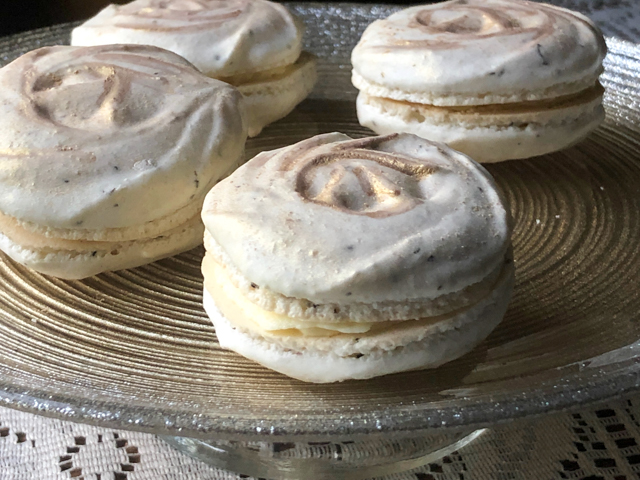
The definition of the piping was a bit lost. Adding lust duster is one way to make the design more evident, so if you run into the same issue, consider a little brushing with gold or other types of luster. But if you get the consistency right, you will be rewarded with sharper texture, for a more dramatic look.
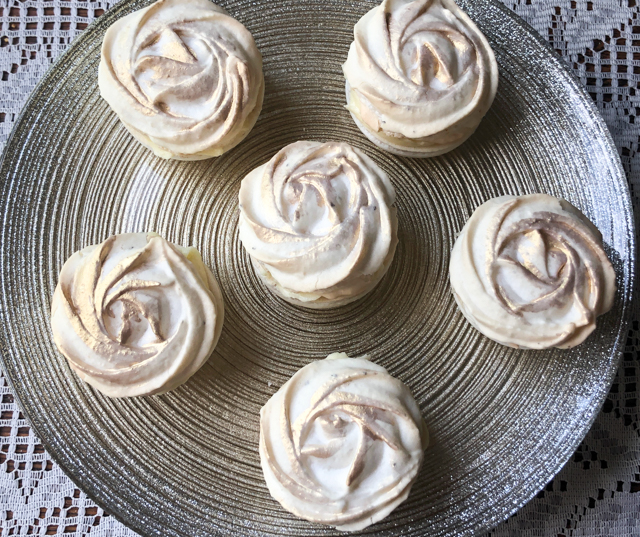
I think these would be very nice at a wedding party, or some milestone Birthday celebration. Perhaps to decorate a cake… Make sure to match a smooth shell for the base with the rosette top.

But, of course, you can take macarons in so many different scenarios. After pairing the smooth shells, I placed them over a rack and went crazy with three colors of Candy Melts and some sprinkles to boot.

No matter the mood,  the right macaron will always be waiting for you!
ONE YEAR AGO: Common Table, Something New in My Life

TWO YEAR AGO: The Daisy, a Bread with Brioche Alter-Ego

THREE YEARS AGO: Pork Tenderloin, Braciole Style

FOUR YEARS AGO: Raspberry Buckle

FIVE YEARS AGO: Seafood Gratin for a Special Dinner

SIX YEARS AGO: Cooking Sous-Vide: Sweet and Spicy Asian Pork Loin

SEVEN YEARS AGO:  Farewell to a Bewitching Kitchen

EIGHT YEARS AGO: In My Kitchen. June 2012

NINE YEARS AGO: Goodbye L.A.

TEN YEARS AGO: 7-6-5 Pork Tenderloin
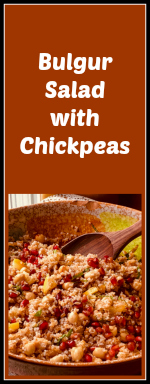
BULGUR AND CHICKPEA SALAD WITH POMEGRANATE SEEDS

I’ve been on a bulgur kick lately. It is such a nice grain, cooks in less than 10 minutes and you can enjoy it warm or cold. In the version I share today, it showed up as salad, with a very simple lemony dressing with fresh mint from our own garden. Disclaimer: I take zero credit for any fruits, legumes or herbs grown in our backyard. The husband is the gardener in charge, and for that I am forever grateful. I am a certified mint-killer.

BULGUR AND CHICKPEA SALAD WITH POMEGRANATE SEEDS
(from the Bewitching Kitchen)

1 cup bulgur
1/2 tsp salt
1 can chickpeas, drained and rinsed
1/4 tsp paprika
2 Tablespoons olive oil
juice of 1 lemon
fresh mint leaves
fresh pomegranate seeds
1/2 preserved lemon, cut in small pieces (optional)
salt and pepper for final seasoning

Cook the bulgur in a large volume of salted water for 8 to 10 minutes. Drain and rinse briefly with cold water. Reserve.

Place the drained chickpeas in a microwave-safe bowl, sprinkle some paprika and microwave for 15 seconds or so. Let them cool briefly.  Add the chickpeas to the bulgur in a serving bowl. Add mint leaves to taste, drizzle olive oil and lemon juice, mix everything well. Finally add pieces of preserved lemons (if using) and pomegranate seeds. Adjust seasoning, and serve.

ENJOY!

to print the recipe, click here

Comments: The little step of microwaving the chickpeas for just a few seconds with a touch of spice is absolutely worth it. I read about it a long time ago and now I just incorporate in every recipe that calls for canned chickpeas. It brightens up the flavor, and since it is such a short “cooking” time, it does not affect the texture. It exorcises  that “tinned” feel out of them.

I added preserved lemons because I made some from scratch back in April and this salad was a perfect opportunity to bring them to play. You can omit or add orange segments together with the pomegranate seeds. Leftovers keep quite well, in fact I think the salad was better at lunch next day. I added a squeeze of fresh lemon juice, and a touch of additional salt. This will be in our regular rotation, I am sure.

ONE YEAR AGO: Purple Star Macarons

TWO YEAR AGO: Smoked Salmon, Fait Maison

THREE YEARS AGO: Kouign-Amann, Fighting Fire with Fire

FOUR YEARS AGO: In My Kitchen, Yin and Yang

FIVE YEARS AGO: Chocolate Toffee Banana Bread

SIX YEARS AGO: In My Kitchen, June 2014

SEVEN YEARS AGO:  Strawberry Frozen Yogurt

EIGHT YEARS AGO: Baked Coconut and “The Brazilian Kitchen”

NINE YEARS AGO: Honey-Glazed Chicken Legs

TEN YEARS AGO: French-Style Rolls