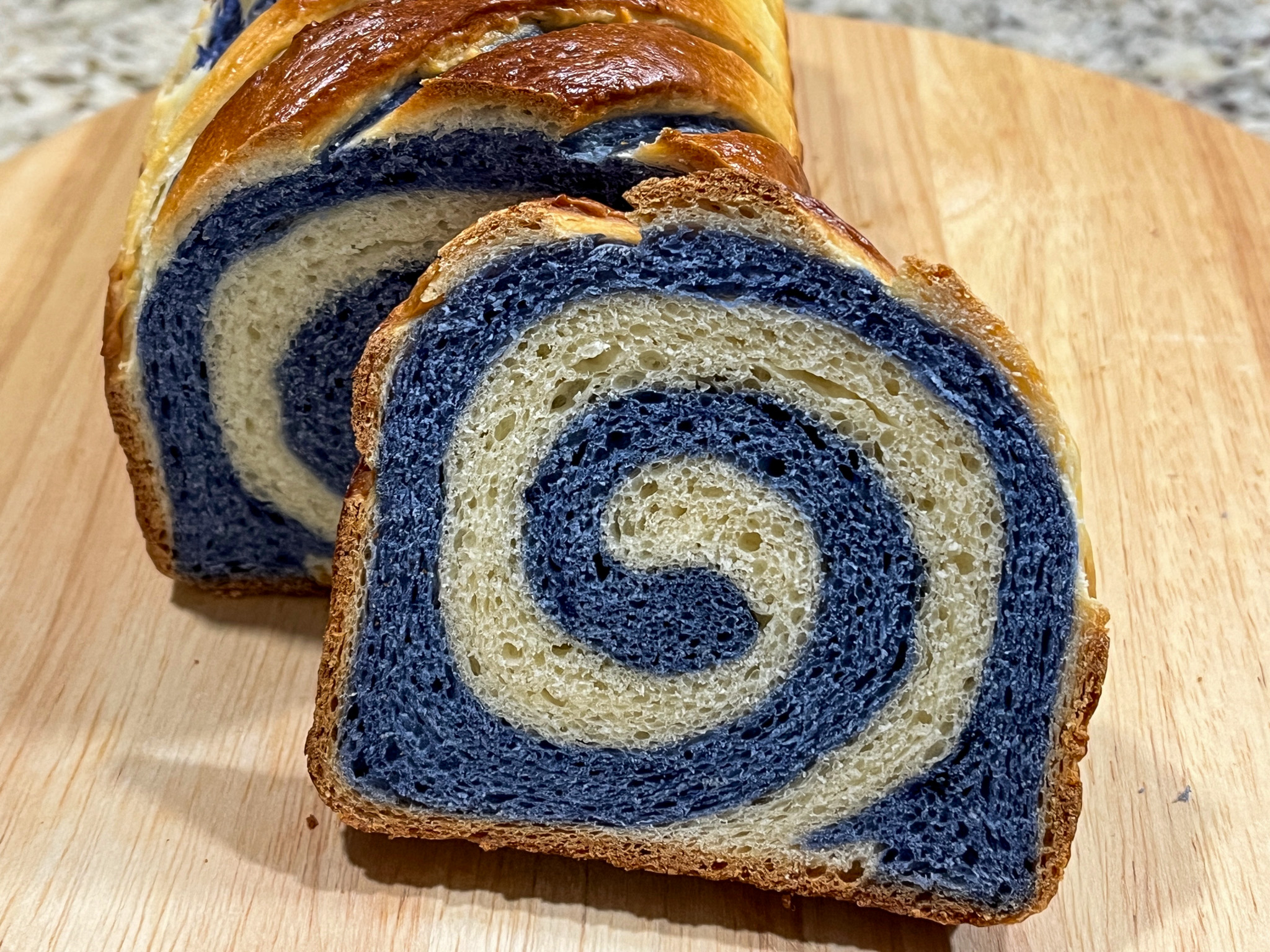
BUTTERFLY PEA FLOWER ACCORDION BREAD

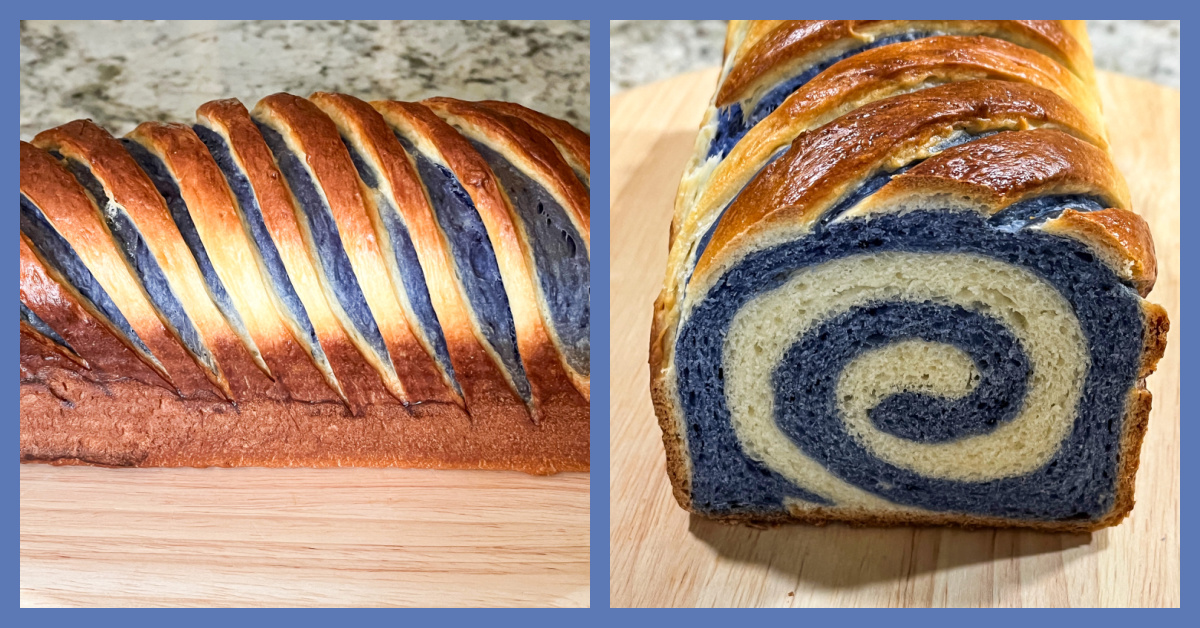
I am so thrilled with this recipe! You can use different ingredients to obtain the bicolor effect: charcoal powder, carrot powder, ube, sweet potato powder, just keep in mind that it needs to be concentrated enough not to mess up with the dough, so liquid things won’t work well. Stick to powder and thick pastes. I used butterfly pea flower powder from Selefina (click here for ordering info).

ACCORDION BREAD
(adapted from this recipe)

180 ml warm milk
4g instant yeast
375g bread flour
18g dry milk powder
7g salt
50g sugar
1 large egg
56g softened butter
5g butterfly pea flower powder dissolved in 2 tsp milk
Egg wash (1 egg + 1 tbsp milk)

Combine yeast, warm milk, and 5 g of the sugar in a small measuring cup or bowl. Stir and let it sit for 5-10 minutes.

In a stand mixing bowl fitted with the dough hook, add the flour, salt, milk powder, egg, yeast mixture, and knead on med-low speed until dough comes together and no dry flour is visible. Add in remaining 45g of sugar. Incorporate all the butter, little by little. Knead on med-high for 8-10 mins, or until dough is smooth and releases from the sides of the bowl.


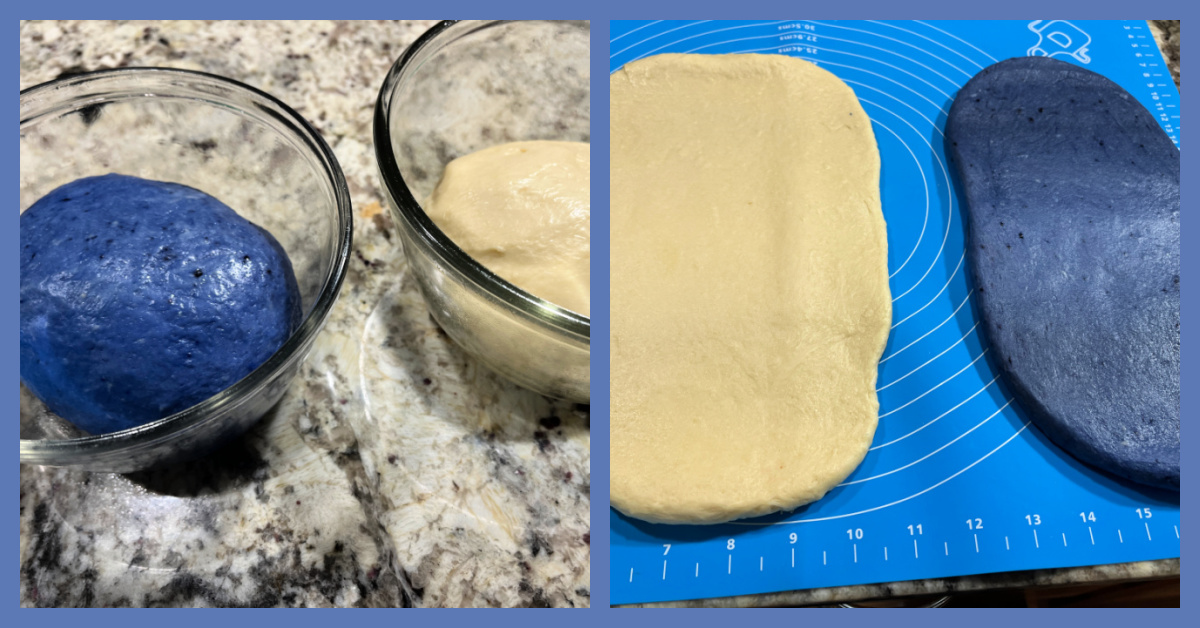
Split dough into two, placing one half the dough back in the mixer, adding the dissolved butterfly pea powder over it. Knead until color is well combined. Cover both doughs in clean bowls, and let rise 1.5 to 2 hours or until they have doubled in size.


Punch and degas doughs. Using a rolling pin, roll out each dough into an oblong shape. Layer the two doughs with colored dough on the top. Perform an envelope fold meeting both sides in the center. Wrap dough in cling wrap and chill in fridge for 15 minutes.
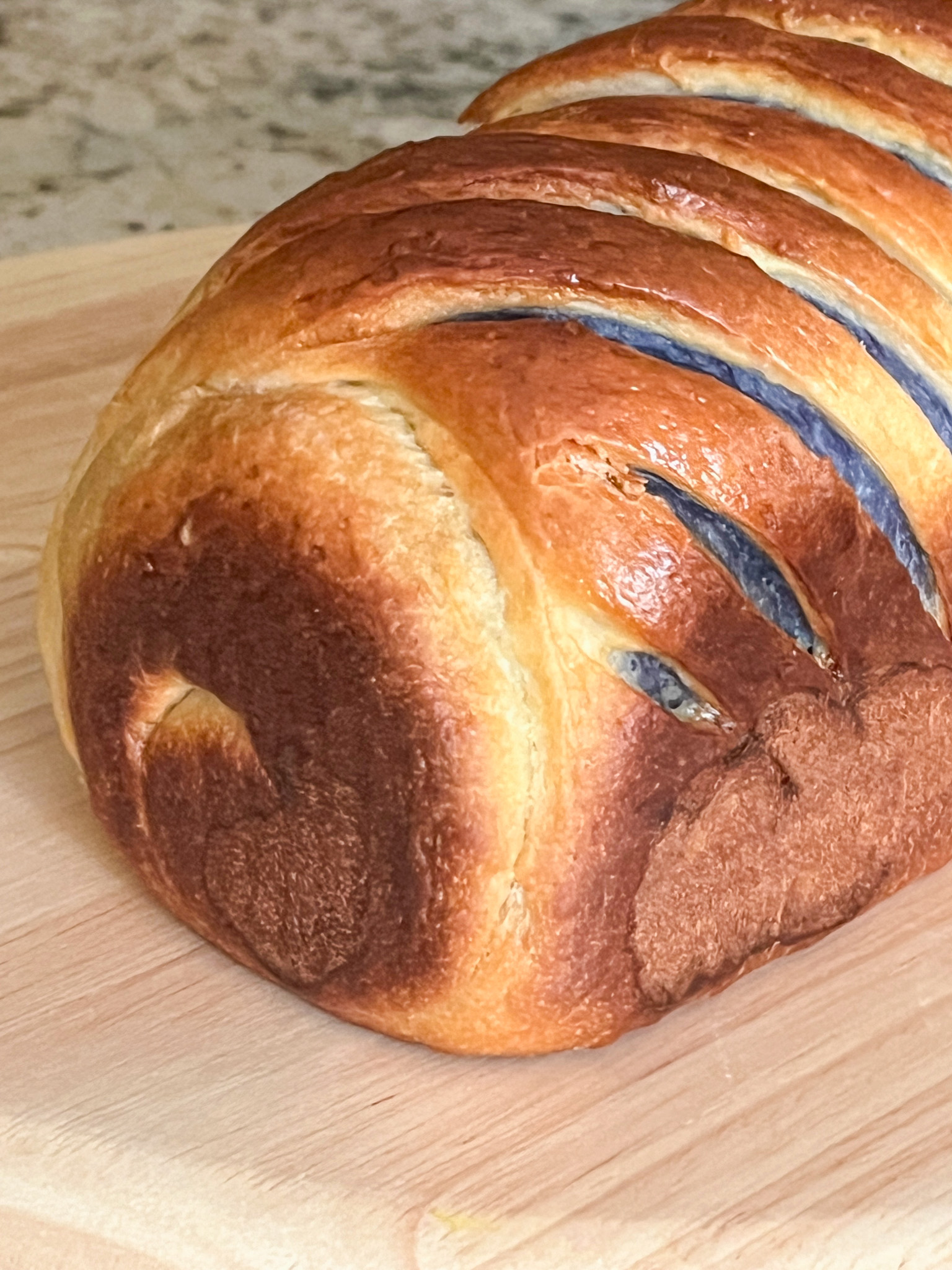
Unwrap dough and roll out into a long even rectangle. Staring from one end, roll in dough to create a swirl, making sure colored dough is inside while regular dough is facing out. Using a sharp blade or razor, score the dough evenly across the top to create “accordion” effect. Lines should be approx 1/4 inch apart and 1/8 inch deep to reveal the colored dough. Place in 450g Pullman loaf pan, cover, and let proof for 45 mins.

Heat oven to 355 F. Brush egg wash and bake for 40-42 mins until loaf is golden brown. Release bread from pan after 10 minutes, then cool completely on wire rack before slicing and smiling at the swirl…

ENJOY!

to print the recipe, click here

Comments: The dough, like most enriched doughs, is a pleasure to work with, rolls very easily and you can stretch it and adjust so that both layers sit perfectly on top of each other.

Make sure to slice the external layer with a sharp razor blade and all the way through to see the colored dough underneath. The sugar and milk in the recipe give it a nice brown color after baking.

But the best part? That swirl revealed once you slice through!

.

The bread has a very mild flavor, the butterfly pea flower does not contribute much in terms of flavor, just color. I will be making other versions for sure…

.

ONE YEAR AGO: Slow-Cooker Pineapple Carnitas

TWO YEARS AGO: Three Little Cakes

THREE YEARS AGO: From our Garden to You

FOUR YEARS AGO: Lady Bug Macarons

FIVE YEARS AGO: Five-Stranded Braided Bread

SIX YEARS AGO: Green Olive Salad

SEVEN YEARS AGO: Coffee Macarons Dressed up to Party

EIGHT YEARS AGO: Blogging Hiatus

NINE YEARS AGO: Tomato Tatin

TEN YEARS AGO: Headed to Colorado!  

ELEVEN YEARS AGO: Farofa Brasileira

TWELVE  YEARS AGO: Thai-Inspired Pork Tenderloin

THIRTEEN YEARS AGO: A yummy Brazilian cake: Bolo de Fuba’

FOURTEEN YEARS AGO:  Summer’s Tomatoes

FIFTEEN YEARS AGO: Leaving on a jet plane… 

FLOWER SHAPED DINNER ROLLS

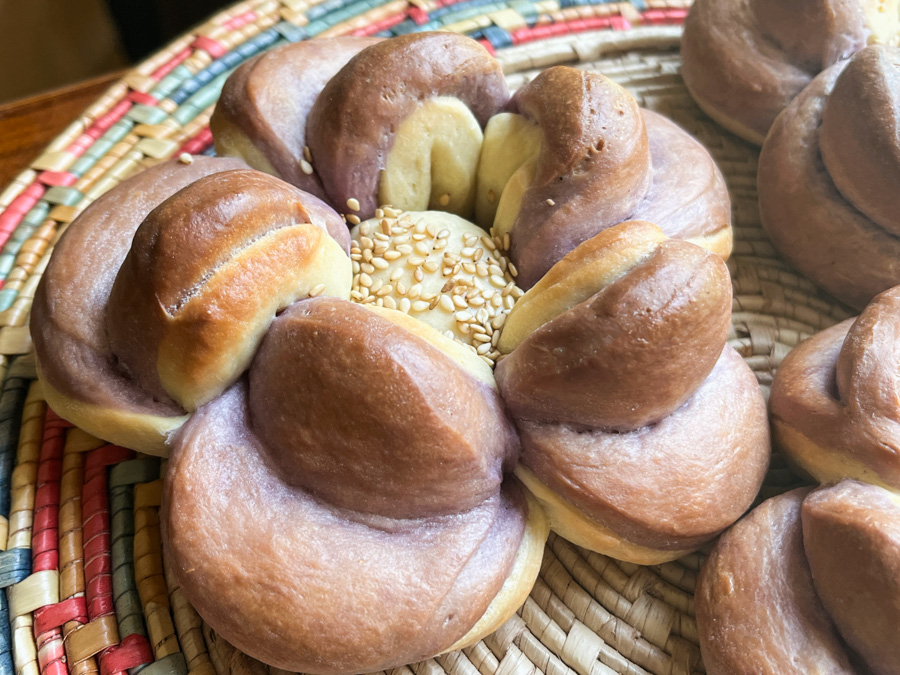
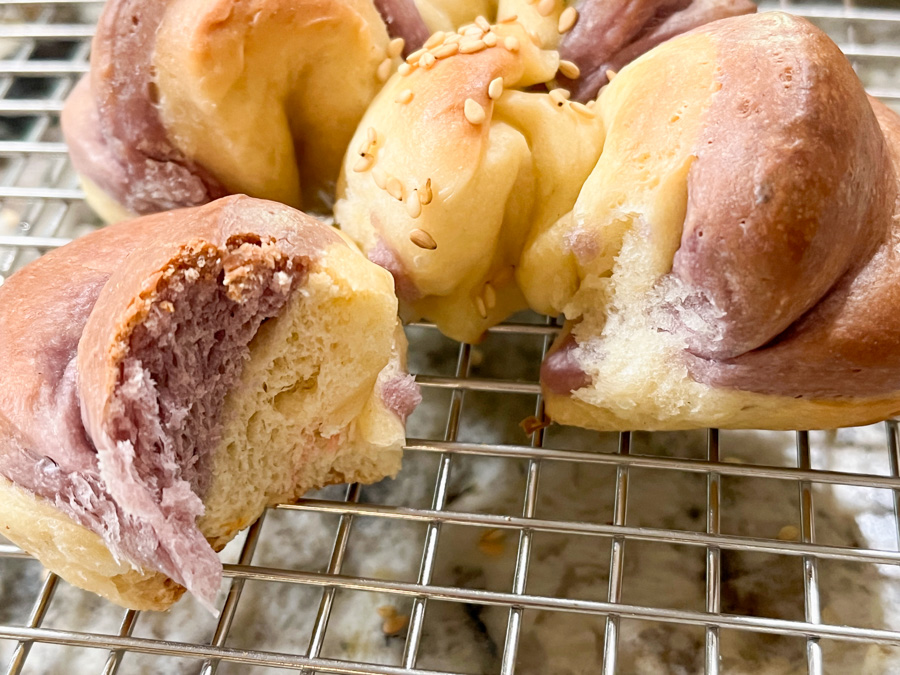
These adorable rolls popped on my Instagram feed, and I fell in love with them so hard that I mixed the dough right away. To be precise, 20 minutes after watching the reel (click here for it). I consider it a work in progress, for reasons I will discuss in the comments…

FLOWER-SHAPED DINNER ROLLS
(from Joyce Mrad)

325g flour
150mL slightly warm milk
1 egg
50g butter, softened
1 tsp instant yeast
30g sugar
1 tsp salt
purple carrot powder or any other natural food coloring, about 1 tsp

In a KitchenAid type bowl, add milk, sugar, yeast, egg, salt, and flour. Mix them together until they form a shaggy mass of dough. With the machine running (dough hook), add the butter in small pieces and knead until smooth. Split the dough in half. Color one half with your choice of natural dye.

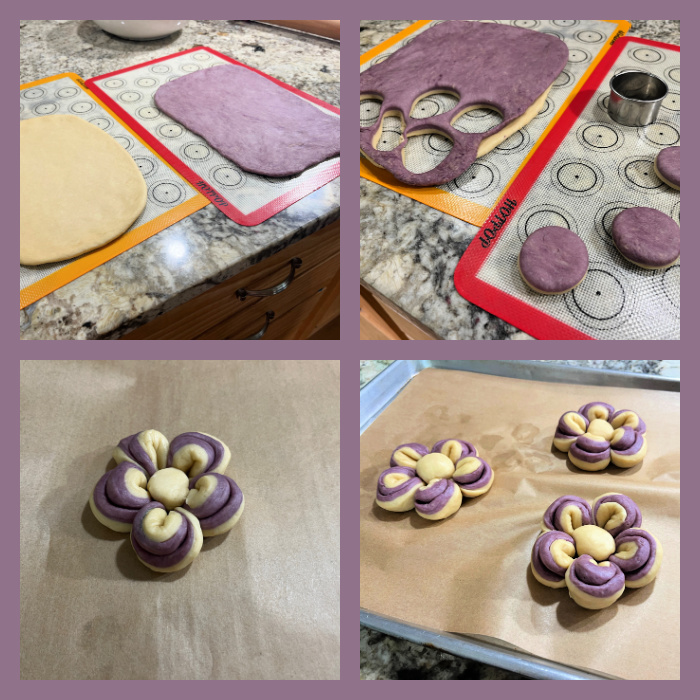
Place both dough portions in a warm spot and let them rise for approximately 2hours, or until doubled in size. Once the dough has risen, punch it down. Roll and flatten both dough portions into squares, layering the purple dough over the white dough.

Use a cookie cutter to cut small circles from the layered dough. Take each circle and fold it three-quarters, then fold it in half again, pinching the ends to form petals. When you make five petals add a small ball of dough in the middle. Repeat the folding and shaping process until all the dough is used.

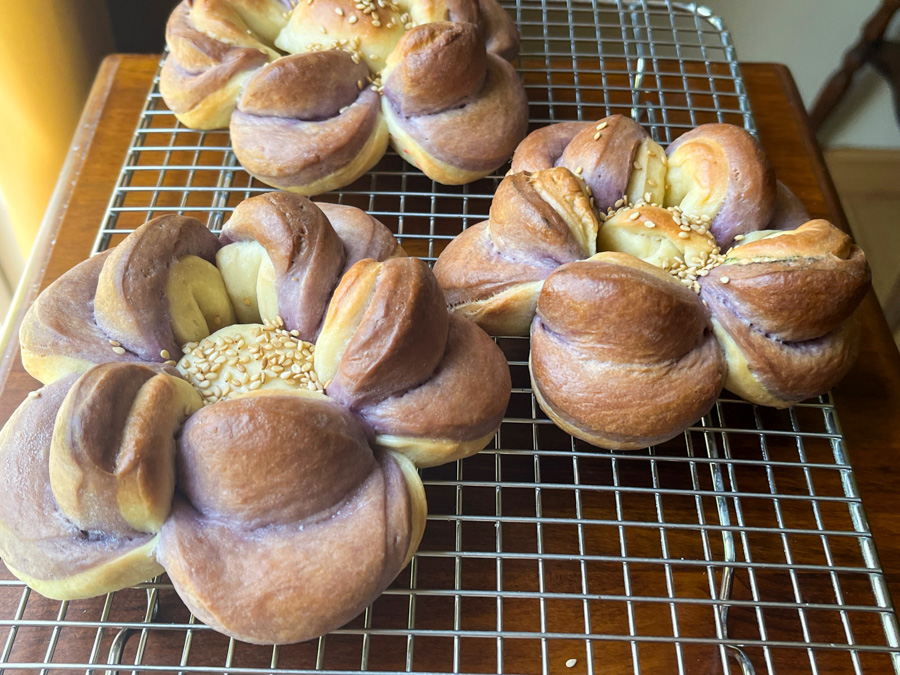
Cover the flower-shaped dinner rolls and let them rise again until doubled in size, about 1 hour. Brush the rolls with milk. Bake them in a 375F oven for 15-20 minutes, or until they turn golden brown. Once the rolls are baked, brush them with melted butter and sprinkle sesame seeds in the middle of each roll for decoration.

ENJOY!

to print the recipe, click here

Comments: I used ebony carrot powder which was very beautiful in the raw dough, but baked to a much less appealing color. I will use something different next time. Also, I believe the rolls will be better if made with a smaller cookie cutter, so that the petals are more delicate and the rolls smaller. The whole recipe gave me just three rose-shaped rolls, so smaller circles are going to work better for this.

The rolls work almost like a pull-apart bread, pretty cool! Not at all complicated to make, and you can always use a single dough for the shaping effect, which will still be nice.

ONE YEAR AGO: Pride Macarons

TWO YEARS AGO: Blood Orange Macarons

THREE YEARS AGO: One-Two-Three Macarons

FOUR YEARS AGO: Marshmallow Macarons

FIVE YEARS AGO: Fujisan Bread

SIX YEARS AGO: Air-Fried Tomatoes with Hazelnut Pesto & Halloumi Cheese

SEVEN YEARS AGO: Red Velvet Layered Cake

EIGHT YEARS AGO: Lemon-Lavender Bars

NINE YEARS AGO: Quinoa Fried Rice

TEN YEARS AGO: Carrot Flan with Greens and Lemon Vinaigrette

ELEVEN YEARS AGO: The Secret Recipe Club: Granola Bars

TWELVE YEARS AGO:  Awesome Broccolini

THIRTEEN YEARS AGO:  A Twist on Pesto

FOURTEEN YEARS AGO: Ciabatta: Judging a bread by its holes

KAREN’S BRAIDED LEMON BREAD WITH BLACKBERRIES

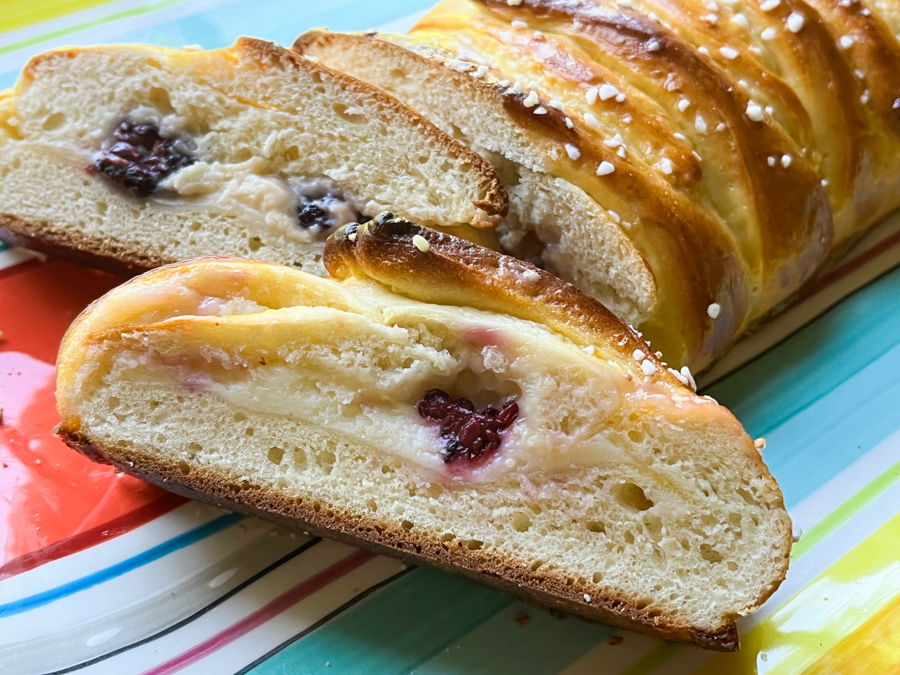
She posted. I read the post while away on a trip. Could not wait to get home to bake it. As far as enriched bread goes, you cannot get much better than this. Think brioche loaded with a tangy lemon cream and luscious blackberries. As I said, cannot get much better. THANK YOU, KAREN!

BRAIDED LEMON BREAD WITH BLACKBERRIES
(from Karen’s Kitchen Stories)


For the Sponge:
3 ounces warm water (95 to 105 degrees F)
1 teaspoon sugar
1 1/2 teaspoons instant yeast
30 grams unbleached all purpose flour

For the Final Dough:
All of the sponge
85 grams vanilla yogurt, room temperature (I used plain and added 1/2 tsp vanilla)
56 grams softened unsalted butter
1 large egg, beaten
50 grams sugar
1 teaspoon salt
1 teaspoon vanilla
300 grams unbleached all purpose flour
one beaten egg for the egg wash
pearl sugar for topping (optional, but nice)

For the Filling:
85 grams cream cheese, at room temperature
25 gram sugar
29 grams sour cream (I used creme fraiche)
1 tsp lemon juice
15 grams all-purpose flour
100 grams lemon curd
Handful of blackberries


Combine the sponge ingredients in a small bowl, stir, and cover with plastic wrap. Let it sit for 15 minutes.
In your stand mixer bowl, combine the sponge, yogurt, butter, egg, sugar, salt, vanilla, and flour. Mix with the dough hook for about 8 minutes. Place the dough in an oiled dough rising bucket or bowl, cover, and allow to rise for one to two hours, until doubled (mine took 2 hours and 30 minutes).

Mix the cream cheese, sugar, sour cream, lemon juice, and flour until smooth. Cover and set aside.
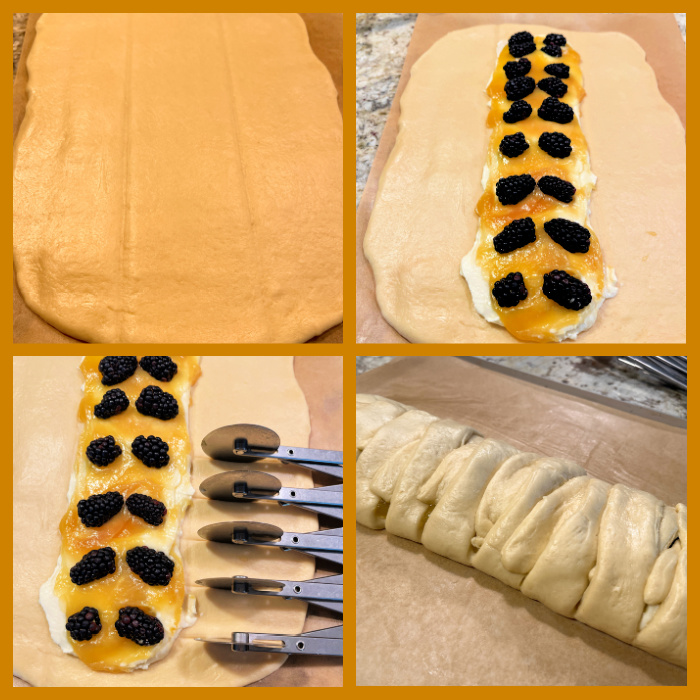
Line a cookie sheet with parchment paper. Place the risen dough not the parchment, and press or roll it into a 10 inch by 15 inch rectangle. Mark the dough lengthwise into thirds by pressing a ruler into the dough. Spread the cream cheese mixture onto the middle third, leaving about an inch uncovered at the top and the bottom. Spread the lemon curd on top of the cream cheese mixture. Top with the blackberries.

Cut the outer sides into strips. Cut off the strips from the four “corners” of the dough, leaving a flap at the top and bottom. Fold up the bottom flap and fold the strips over the filling alternating in a braid pattern. Fold the flap over the top before finishing the braid. Cover loosely with oiled plastic wrap.
Preheat the oven to 360 degrees F.


Let the dough rise for about 45 minutes. When the dough is ready, brush it with the egg wash and sprinkle it with the sugar. Bake for 25 to 30 minutes until a deep golden brown. Cool on a cooling rack for at least 20 minutes. Slice and serve.

ENJOY!

to print the recipe, click here

Comments: Make sure to stop by Karen’s post because her pictures and explanations are very detailed and will help you with the shaping. The dough is a pleasure to work with, as enriched doughs always seem to be. You can make the filling while the dough rises, and use store-bought lemon curd to make your life easier. Next time I will add more blackberries, I was afraid they would contribute too much moisture and leak too much, but that was not the case.

This basic method can be used for savory breads, or use different sweet fillings. Karen has a lot of suggestions in her article, so pay her a visit.

ONE YEAR AGO: Bulgur-Pork Tomatillo Platter

TWO YEARS AGO: Baking through the blogosphere

THREE YEARS AGO: Chickpea Burgers, Vegan and Delicious

FOUR YEARS AGO: Macarons with Ganache Noisette

FIVE YEARS AGO: Quiche with Asparagus and Fennel

SIX YEARS AGO: Fakebouleh

SEVEN YEARS AGO: Yellow Squash Soup

EIGHT YEARS AGO: Grilled Chicken with Tamarind and Coconut Glaze

NINE YEARS AGO: Chicken-Apricot Skewers

TEN YEARS AGO:  Asparagus Quiche

ELEVEN YEARS AGO: Two-stage Pea and Prosciutto Risotto

TWELVE YEARS AGO: Mellow Bakers: Corn Bread

OLIVE OIL BRIOCHE

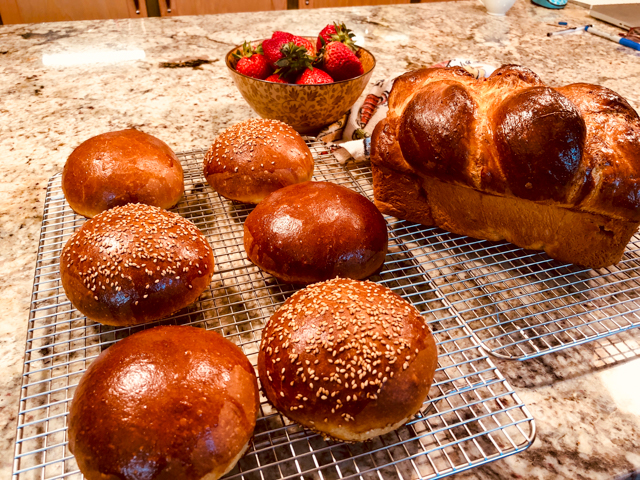
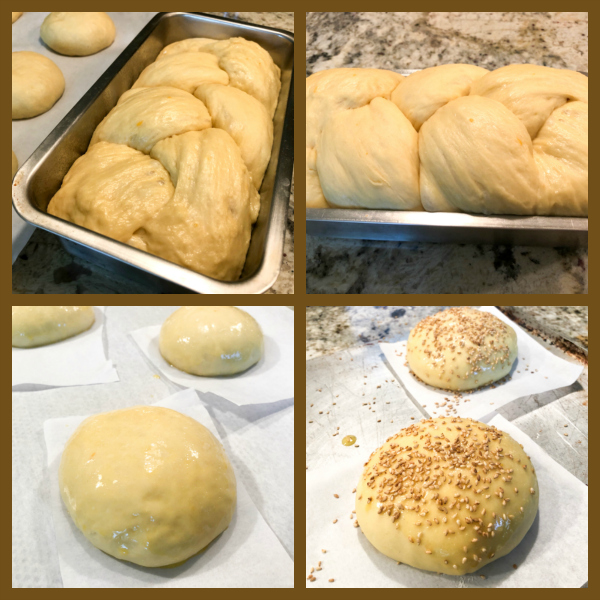
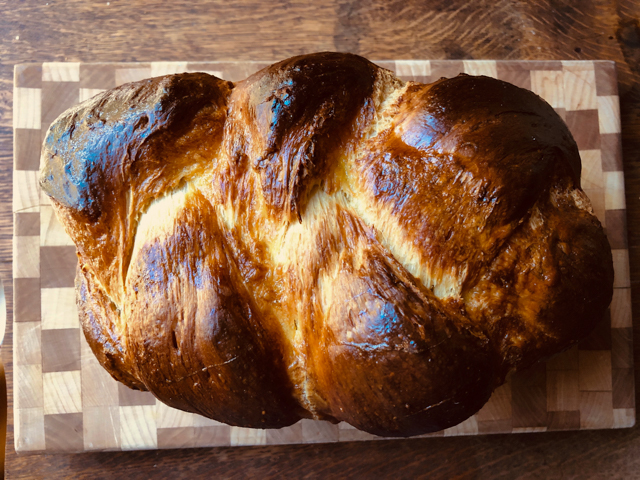
Karen from Karen’s Kitchen Stories is a source of endless inspiration for me. Particularly on anything related to bread, she finds the most unusual, exotic, unique recipes, and then bakes them like it’s no big deal at all.  Just to give you a recent example, look at this incredible concoction for which she used 12-ounce empty soda cans wrapped with foil as a baking “pan.”  Amazing, isn’t it? Today I share with you my adventure with her Olive Oil Brioche. I made only half the recipe and still had a ton of dough to play with. Enough for a large loaf and 6 buns. For reasons that will be discussed in the comments, if you make it, be ready to have one loaf and 8 buns. The amount for the loaf pan was a tad too much.

OLIVE OIL BRIOCHE
(slightly modified from Karen’s Kitchen Stories)

for the poolish:
100 grams all purpose flour
100 grams water
1.5 grams instant yeast

Mix the ingredients, cover with plastic wrap, and place in the refrigerator over night.

for the levain (Sourdough)
1 tablespoon starter
110 grams all purpose flour
110 grams water

Mix the ingredients, cover with plastic wrap, and let sit overnight at room temperature until bubbly.

for the final dough: 
200 grams poolish
150 grams levain
500 grams bread flour
12 grams salt
7.5 grams instant yeast
250 grams eggs
120 grams milk
80 grams honey
Zest of one Meyer lemon (optional)
25 grams water
220 grams extra virgin olive oil
For the egg wash: 1 egg plus one tablespoon milk

In a stand mixer, combine the flour, salt, yeast, eggs, milk, levain, poolish, honey, lemon zest, and water and mix on low for about 5 minutes. Cover and let rest for about 20 minutes.

Mix the dough with the spiral hook on medium to high speed for 8 minutes.
With the mixer running on medium,  add the oil slowly, pausing so that the oil is absorbed. I did it in three additions. Incorporation of the oil will take time, so exercise patience.  Add a sprinkle of bread flour to speed incorporation if you so desire, but do it only in the second and third addition. The dough should end up very smooth and not tear when  you stretch it.

Allow the dough to bulk ferment (in a large bowl covered in plastic wrap) for 2 hours at 70 degrees F. Do three stretch and folds during the first 90 minutes, one every thirty minutes.  When the dough is ready, remove three pieces of about 250g each and braid them. Place in a slightly oiled 9 x 5 loaf pan for final proofing. Divide the rest of the dough in 8 portions, shape as buns, and proof.

Heat the oven to 425 degrees F.  After the bread has been proofing for 1 and a half to 2 hours (until doubled), brush with egg wash and bake until golden brown, 30 to 40 minutes, until internal temperature is 200 F. You can sprinkle sesame seeds on the buns if you so desire.

Un-mold the large loaf and cool on a wire rack together with the buns.

ENJOY!

to print the recipe, click here

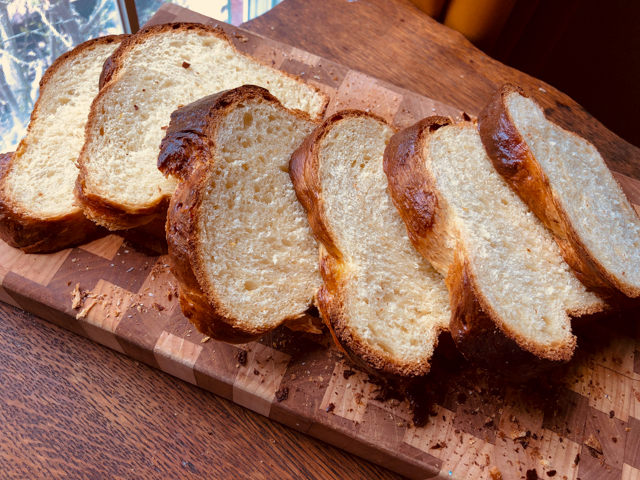
Comments: I will not lie to you, this is a project. The bread requires a sourdough starter, a poolish (fermented flour using small amount of commercial yeast and prepared the day before), and commercial yeast in the final dough. But it is a total pleasure to work with, rises like a rocket and the texture and taste? You will not miss the butter, that’s for sure. As Karen said, it keeps a lot better than the traditional version. And freezes beautifully too.

When you start adding the olive oil, you will be sure the whole thing is ruined, and might have a few rude thoughts directed at me. It seems impossible for the dough to come together. Have bread faith. And here is a little tip that might help: as you add the olive oil and the mixer is going and going, with a puddle of oil all around and looking hopeless, add just a sprinkle of bread flour on top. It will help things get in shape faster. But just a sprinkle, I say 1 tablespoon or so. If you add the olive oil in three additions, do that in the final two, when the dough will have more trouble incorporating it.

For a 9 x 5 loaf pan, I advise you to make three strands with about 250g of dough in each. Then divide the rest in 8 buns. When you do that, you will be able to let the shaped loaf proof for closer to 2 hours and it will not rip a bit like mine did. I had no choice but to bake after 1 hour and 10 minutes, the dough wanted to leave the pan and explore the kitchen. No bueno. That’s because I used 300g per strand, a bit too much. Don’t be put off by the complexity of this recipe, once you have the starter and the poolish prepared the day before, it is just a matter of weighing all other ingredients and having some fun.

Karen, thank you for the inspiration, I know I tell you this all the time but it’s so true… Your blog is a pleasure to follow!

ONE YEAR AGO: Coconut and Lime Macarons

TWO YEAR AGO: Flank Steak Carnitas

THREE YEARS AGO: Sesame and Poppy Seed Sourdough

FOUR YEARS AGO: Pecan-Crusted Chicken from Southern at Heart

FIVE YEARS AGO: Lamb Shanks en Papillote with Cauliflower-Celeriac Purée

SIX YEARS AGO: Chestnut Brownies and a Blog Award!

SEVEN YEARS AGO: Quinoa with Cider-Glazed Carrots

EIGHT YEARS AGO: Celebrate Wednesday: Heirloom Tomatoes Steal the Show

NINE YEARS AGO: Pain de Provence

TEN YEARS AGO: Golspie Loaf, from the Scottish Highlands

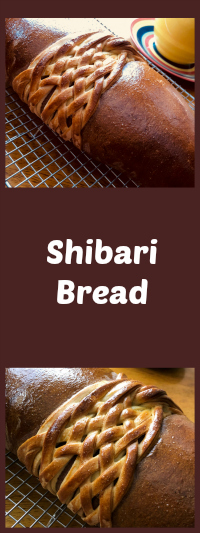
SHIBARI BREAD

I love a simple loaf of bread, mostly white flour, a touch of whole-wheat, good crust and crumb, nothing necessarily fancy. But I am always fascinated by what I call exotic bakes. Things that demand a little more attention, a little more work, and often a lot more patience. One site that never fails to amaze me is BakeStreet. Not only they show unusual, unique recipes, but they might include videos of the entire process, particularly when shaping is more elaborate. A couple of weeks ago I stumbled on their blog post on  Pan Shibari. They designed a bread recipe inspired by a classic Japanese knot (shibari is Japanese for knot).  The knot is quite an important symbol in Japan, and it’s easy to see why. It joins things, it carries a sort of sensual connotation, and it can be very artistic. I confess I was so mesmerized by that bread, I could not wait to try it myself. It was not easy. But, I’m happy with the way it turned out. My very first Shibari Bread!
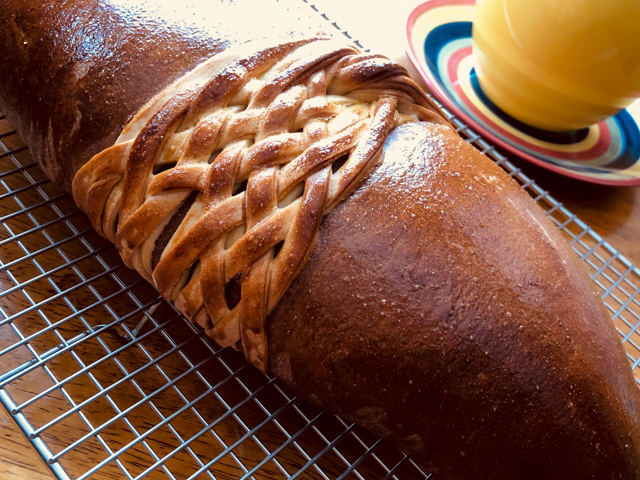
SHIBARI BREAD
(slightly modified from BakeStreet)

600 g of all-purpose flour
300 g of whole milk at room temperature
36 g of cocoa powder + 45 g of whole milk
5 g of instant yeast
1 egg L (55 g)
75 g of unsalted butter at room temperature
40 g of honey
3/4 teaspoon of natural chocolate extract
10 g of salt
olive oil for brushing bread
1 egg yolk
2 tsp milk
pinch of salt

Make the dough.  In the bowl of a Kitchen Aid mix the flour along with the milk, the egg and the dry yeast. Mix with the kneading hook for 5 minutes on low-speed, until it is homogeneous.

Add the honey and salt, continue mixing for at least 5 more minutes, until very smooth and silky.  Add the butter little by little, in small pieces, waiting for each piece to be incorporated before you add more. Continue kneading the dough until gluten development is complete (it will not tear when you stretch a small portion of the dough, instead it will form a thin membrane).

Divide the dough in two pieces, a small one with 200g, and a second one with the remaining portion, around 870g. Shape the small portion as a ball and place inside an oiled container. Cover and reserve. To the second portion, add the cocoa powder with the milk and chocolate extract. Knead to incorporate them well, and make a dough with homogeneous color. I find it easier to place back in the Kitchen Aid and let the machine do some of the work, then finish it by hand.  Form as a ball and place in a second oiled container.  Proof the two balls of dough for about 3 hours at room temperature. It should double in size.

Now is the perfect moment to swallow that Prozac.

Shape the bigger ball of dough as a batard, after de-gassing it lightly. Reserve, covered with plastic film as you work on the other ball of dough.  Roll the smaller ball as a rectangle of approximately 14 by 10 inches. Cut parallel strips with a thickness of 0.4 inches (1 cm).   You will need 15 strips, but you will have more than that, which is good, in case you get in trouble.

Place 3 strips laying horizontally on the center of the bread, as shown in the composite picture. Place 6 strips laying on top, forming a C shape facing one side of the bread. Use other 6 strips to form a bundle held in the center by the C-shaped group of strips you just placed. Braid according to the video. Start all over if necessary. Who am I kidding? It will be necessary. Several times. Keep calm (HA!), and braid on. Once the braiding is done…

stop sobbing, regain your composure…

and brush the surface of the bread with olive oil. Cover with plastic film and let it proof at room temperature for 2 to 3 hours.  It will almost double in size.  Meanwhile set the oven to 350 F.

When ready to bake, brush the surface with egg yolk whisked with milk and salt. Make sure to cover all the parts of the bread.  Bake for 40 to 45 minutes, until internal temperature is about 195 F.

Cool yourself completely and also the bread before slicing (slicing applies to the bread only).

Pat yourself on the back. You’ve done it!

ENJOY!

to print the recipe (without jokes), click here

Comments: Having recently made panettone, I can tell you that the dough for shibari bread has some similarities: inclusion of egg, milk and honey, and the butter being added at the end, after the dough is almost fully developed. The main bread takes quite a bit of cocoa powder, which gives it almost the feeling of a German rye bread. Quite interesting, when you consider that the formula involves exclusively white flour.

The braiding. Not. For. Sissies. Keep in mind, there were no written instructions or diagrams. Just a video. The woman knows what she’s doing, and she moves fast. One piece of advice, keep track of the time it takes you to braid, and take that as part of the  proofing. It took us 45 minutes to wrap this baby up in strands. Don’t judge us. Thank you.

I don’t know how many times I watched the video (it is mesmerizing), made drawings trying to number the strands and figure out which one is moved when and how. At some point I thought I “got” it, and said to myself, this will be totally doable. Famous. Last. Words. When I had the actual strands of dough and the shaped bread in front of me, things got very nasty very quickly.  Luckily, I made it on a holiday in which we were home, snowed-in. Hubby to the rescue. He had the video going, stopping at every step and guiding me. Still we had to start over four times, if you can believe it. All that as the shaped bread was rising right in front of my scared eyes. Strangely enough, we managed to do it, and what is even more amazing, we are still married. I recall the phrase “You are just impossible!” being used more than once. I tell you, if your marriage can take the The Elusive Shibari Test, you are tied for eternity. I am counting on it.

I think this basic method has a ton of potential. The double-color dough is very elegant, but one could just use a single dough and make the same braid on top. Or switch things around and make the braid with the cocoa-tinted dough, and keep the main loaf underneath as a white bread.  I also envision a savory type of bread, with sun-dried tomatoes and basil, for instance. The thing to keep in mind is that the bread must have a gentle rise in the oven, and the dough used for the braid must have a similar formula so that both components rise at compatible speeds. That all points in the direction of enriched breads, since they tend to have a more gentle oven rise. But I am speaking from intuition and could be totally mistaken. Worth a few experiments, I think…
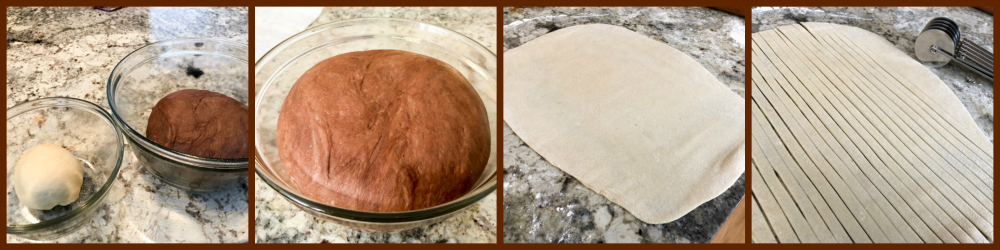
To make the dough strands I used my set of rolling cutters closed down to the tightest level. In that configuration they generate strands with almost exactly 1cm wide, and they end up quite uniform. In the video, the Bread Goddess does all the cutting free-hand, but if I tried to do that, I am not sure our marriage would survive. It would be a 50:50 thing, maybe. Perhaps 25:75. Hard to tell.

So there you have, the mandatory crumb shot. It is a moist and delicate crumb, but with a very assertive flavor coming from the cocoa powder. It pairs well with jams, but also with a nice slice of ham or a Roquefort type cheese.  I hope you enjoyed the post, and please take a look at that video. The real “fun” part starts at 3 minutes and 50 seconds, in case you are interested in the braiding process.  I had that song as an ear worm for a while…  Maybe I still do!  🙂

ONE YEAR AGO: Incredibly Simple Times Four – January 2018 

TWO YEARS AGO: Two Salads and a Blog Award!

THREE YEARS AGO: When Three is Better than Two

FOUR YEARS AGO: Somebody Stop Me!

FIVE YEARS AGO: Zucchini Pasta with Cilantro-Cashew Pesto

SIX YEARS AGO: Bran Muffins, Take Two

SEVEN YEARS AGO: Brown Butter Chocolate Chip Cookies

EIGHT YEARS AGO: Mogo Mojo

NINE YEARS AGO: Slow-Roasted Chicken Thighs: an Ice-Breaker