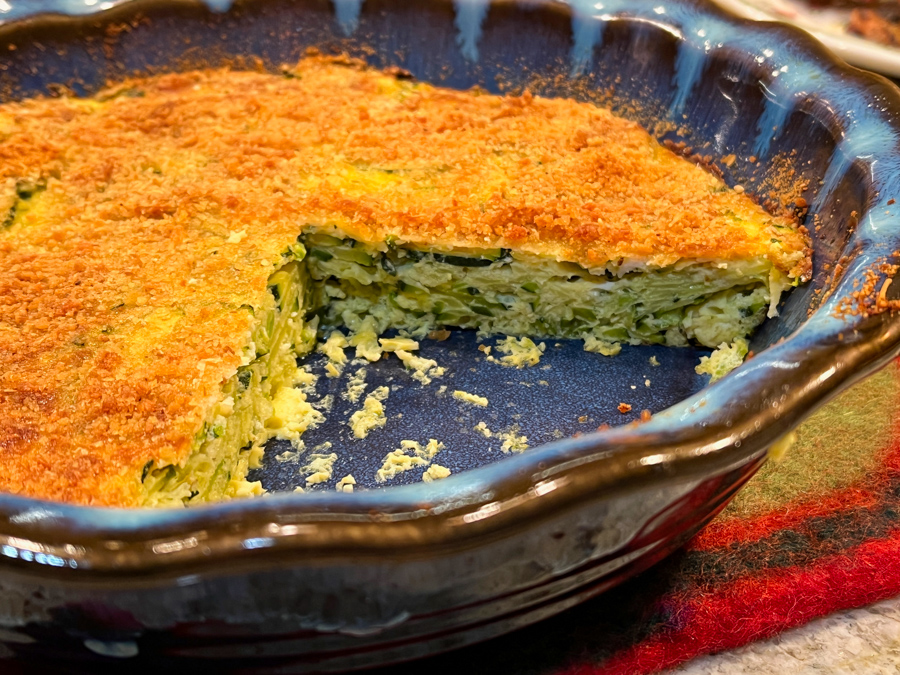
This is a recipe I used to make all the time and for some odd reason disappeared from our menu. The other day I was searching the blog for ideas, and fell on this post from twelve years ago! I made it twice, two in a row, and tweaked it slightly. This is a lower-carb version, and if you skip the breadcrumbs on the topping it can also be gluten-free.
LOW-CARB TORTA DI ZUCCHINI (from the Bewitching Kitchen)
4 zucchini, 2 grated, 2 thinly sliced 4 eggs zest of 1 lemon 1/2 tsp Herbes de Provence 1/2 tsp salt or to taste black pepper, to taste 1/4 cup almond flour plus more to sprinkle on plate 1/4 cup finely grated Parmigiano cheese topping: 1/4 cup breadcrumbs + 1/8 cup Parmigiano cheese drizzle of olive oil
Grease a pyrex pie dish with butter. Sprinkle some bread crumbs or almond flour to coat.
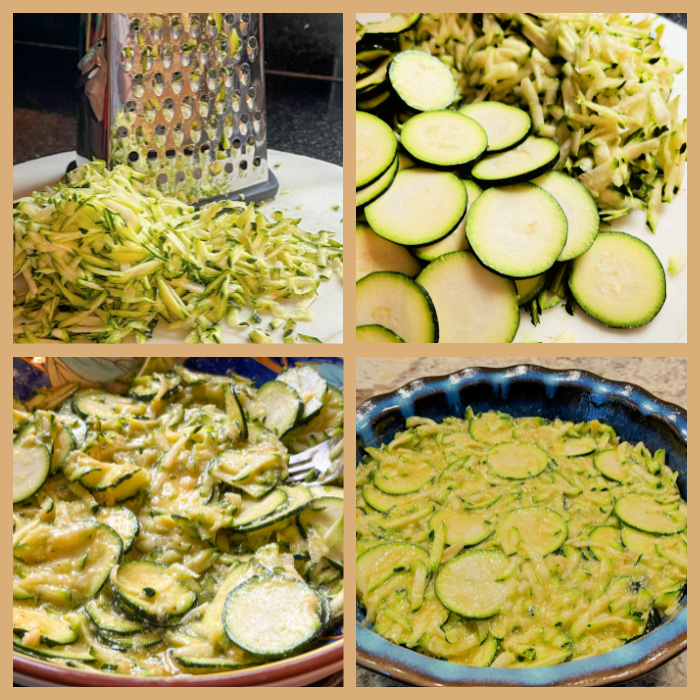
Mix the beaten eggs with the lemon zest, herbs, Parmigiano cheese, 1/4 cup of almond flour, salt and pepper. In another bowl, place the grated and sliced zucchini. Shake the dish carefully to distribute the slices more or less evenly. Add the egg mixture to it, mix gently, and pour into the prepared pie dish. Sprinkle the remaining mixture of bread crumbs (or you can use almond flour) and cheese on top, forming a very light coating. You may not need to use it all. Drizzle a bit of olive oil.
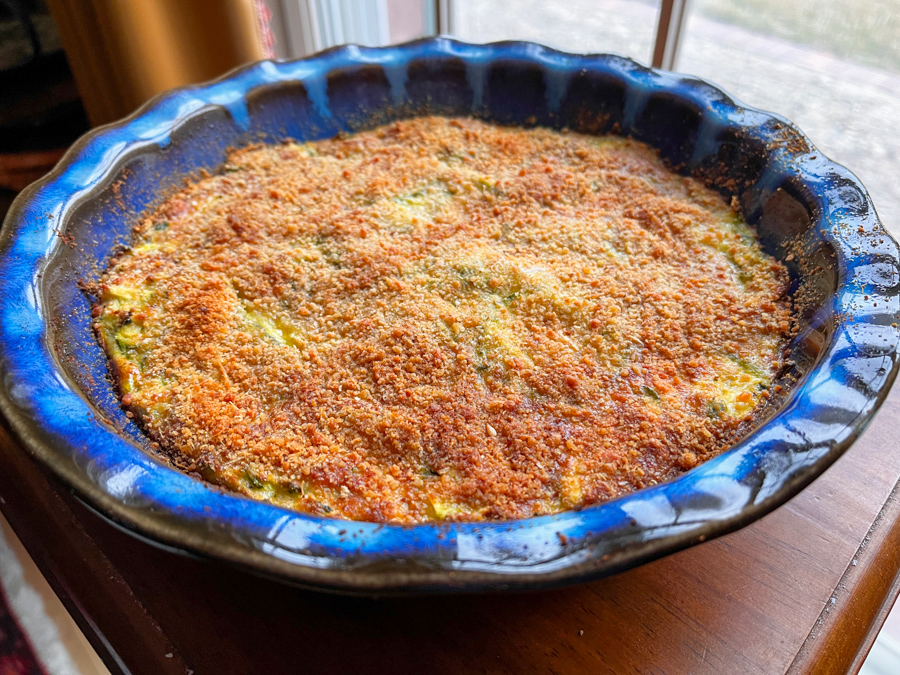
Bake in a 375F until set and golden on top, 25 to 30 minutes. Allow it to cool for at least 15 minutes before serving. Serve warm or at room temperature.
Comments: This is the type of recipe that makes the cook a bit nervous. As you put it together, it seems impossible to work. But trust me, it does. Normally recipes using zucchini tell you to squeeze the liquid, but this one does not. The mixture of grated zucchini with the slices is what makes the whole texture perfect. Think about a baked frittata, but without that intense eggy flavor that some people object to. I used almond flour in place of bread crumbs in the body of the recipe, but added some bread crumbs to the topping. You can just use almond flour instead for an even lower in carb concoction.
It is very important to let the torta rest for at least 15 minutes before slicing. I actually like to leave it for about half an hour and enjoy it barely warm. That’s when everything sets nicely. I don’t know why this delicious side dish left our rotation, but it is so simple and so tasty, I felt it was worth re-blogging, with the minor modifications I introduced in this version. I hope you give it a try… Next on my plans? To make a mixture of carrots and zucchini. Stay tuned!
Baking in silicone pans can be tricky, so my advice is to always use a good quality product. I stand by Silikomart, all the way. If you’ve been around my blog for a while, you know that I never accept products to review, and only recommend things I love. This little pan makes the cutest, two-bite size cakes. I share today four different bakes using it. The most important thing is to bake a little longer than you would in a metal baking pan, and allow the cakes to fully cool before trying to un-mold them. You can even let them come to room temperature and then place the pan in the fridge for 10 minutes to ensure a perfect release. For all these bakes I used the Silikomart Savarin Mold, medium. Available here. I always spray the inside very lightly with PAM baking spray.
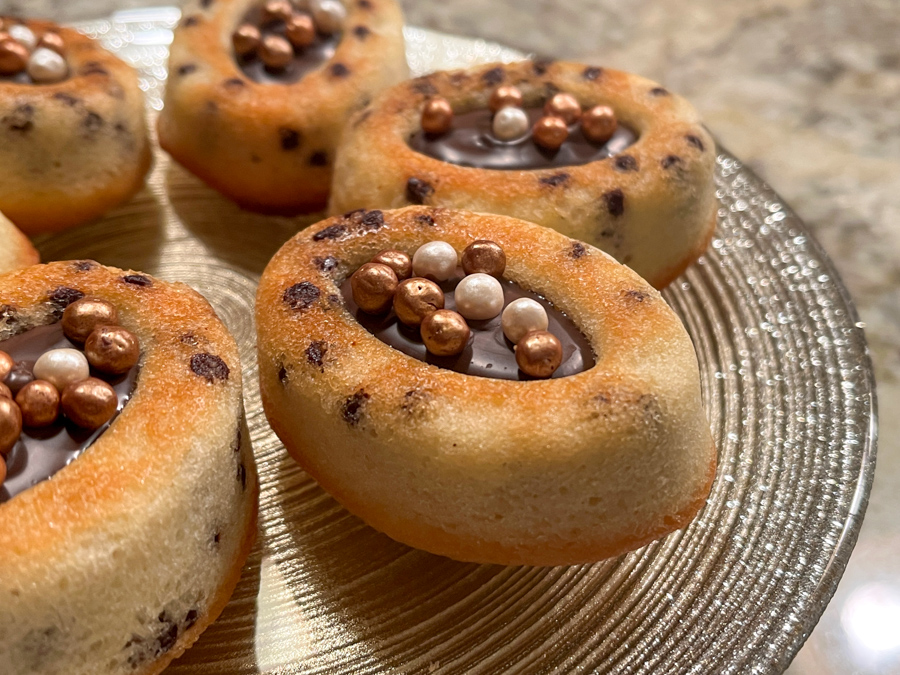
CHOCOLATE CHIP FINANCIER MINI-CAKES
CHOCOLATE CHIP FINANCIER MINI-CAKES (adapted from foodohfood)
80 g unsalted butter, diced 50 g almond flour 140 g powdered sugar 60 g all-purpose flour 1/2 tsp baking powder 1/2 tsp salt 150 g egg whites 50 g mini chocolate chips chocolate ganache, or melted chocolate and sprinkles for decoration
Heat oven to 360F.
Make the brown butter. Put the diced butter in a pan and melt it over low heat. Simmer the butter until the water is evaporated, it should get a light caramel color and a nutty smell. Pass it through a sieve and allow it to cool.
In a bowl, mix the almond flour, powdered sugar, flour, baking powder and salt. Mix on low speed with the electric mixer or with the leaf attachment and gradually add the egg whites and then cold brown butter. Finally, add the chocolate chips. The batter is quite liquid, so use a piping bag to distribute it in the pan, filling almost 3/4 height.
Bake until a toothpick comes out clean, 15 to 20 minutes, depending on your oven. Let it cool completely before un-molding. Fill the center with ganache or melted chocolate, or leave it plain. Decorate with sprinkles, if desired.
Comments: For the financier, filling not quite to the 3/4 height was perfect. I love the texture of these mini-cakes. You need tiny chocolate chips for this recipe (I’ve featured the ones I like in my last In My Kitchen post) If you don’t have it, cut regular chips in very small pieces. It is hard to pick a favorite, but these were truly delicious on all counts.
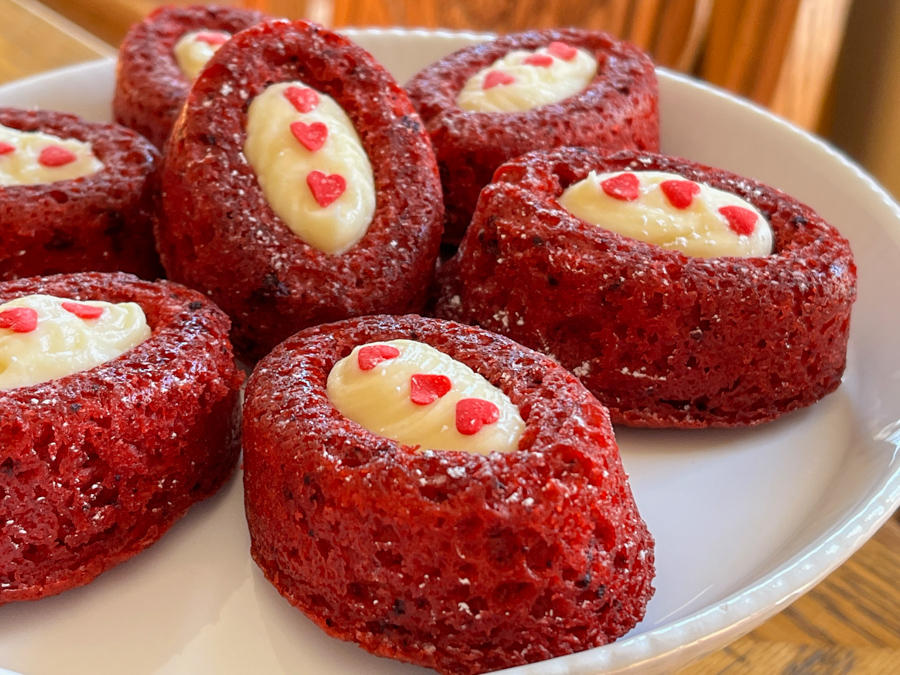
RED VELVET MINI-CAKES
Recipe used: America’s Test Kitchen Red Velvet as published in their book The Perfect Cake. I could not get permission to publish the recipe. If you have the book, my only change was to make half the amount. I still had batter leftover after making 10 mini-cakes, and that was enough for two regular size cupcakes. Recipe for the frosting below.
SMALL BATCH CREAM CHEESE FROSTING (adapted from several sources)
2 ounces cream cheese softened 2 ounces unsalted butter, softened 1/4 teaspoon vanilla extract 80g powdered sugar, or more if you prefer a stiffer frosting Pinch of salt
In a medium bowl, combine cream cheese, butter, and vanilla extract. Beat until well-mixed and fluffy.
Add powdered sugar and salt and continue to beat until sugar is completely incorporated and frosting is smooth and creamy. For a stiffer frosting, add more powdered sugar. Add the frosting to the cavity of the mini-cakes, and decorate with sprinkles, if desired.
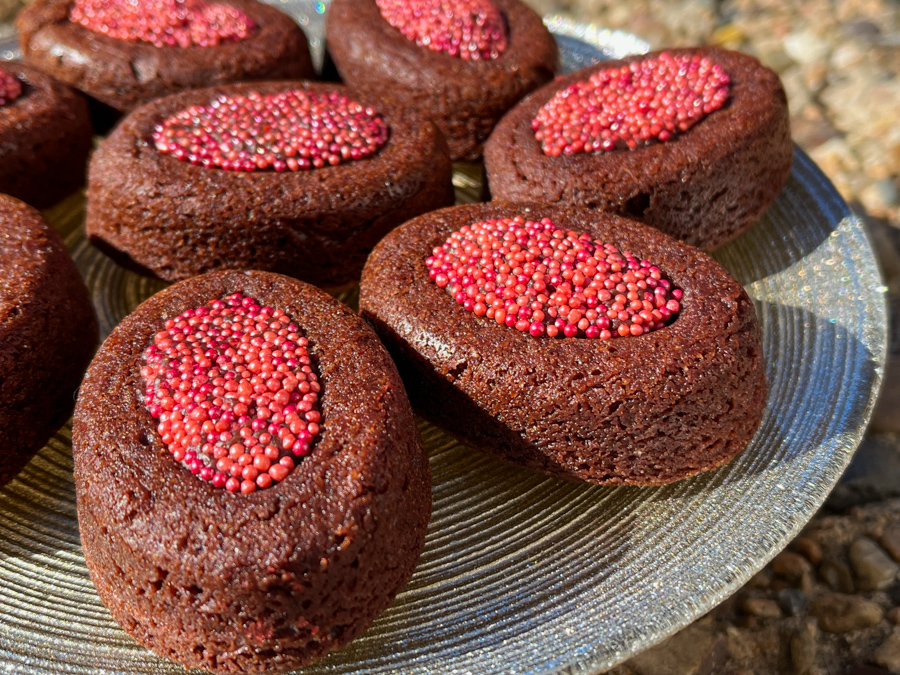
I used my default recipe for brownie cupcakes and it worked very well in this shape. I filled the center with ganache and added sprinkles, because as you know, sprinkles make life better.
Chop the chocolate and butter in pieces, place them in a microwave-safe bowl and melt at 50% power just until the chocolate is almost fully melted. Finish melting by whisking gently until smooth. Allow it to cool for 5 to 10 minutes.
In another bowl, mix flour, salt and baking powder. Reserve.
To the melted chocolate, add the sugar and mix with a handheld mixer, when the sugar is incorporated (it won’t be smooth), add the eggs, one at a time, then the vanilla extract. Whisk until smooth, for a couple of minutes medium-speed. Gently sift the flour mixture on top, whisk just until the flour is incorporated and no dry bits can be found.
Fill each cavity of the savarin mold a little less than 3/4 full. Bake for 15 to 20 minutes, until a toothpick inserted in the center comes out slightly moist. Cool completely before un-molding.
Any of the icings I shared in my original post will work for these cupcakes, just pick sprinkles that match the flavor. But, for a simpler bake you can just dust them with powdered sugar. The shape is beautiful no matter now you finish it.
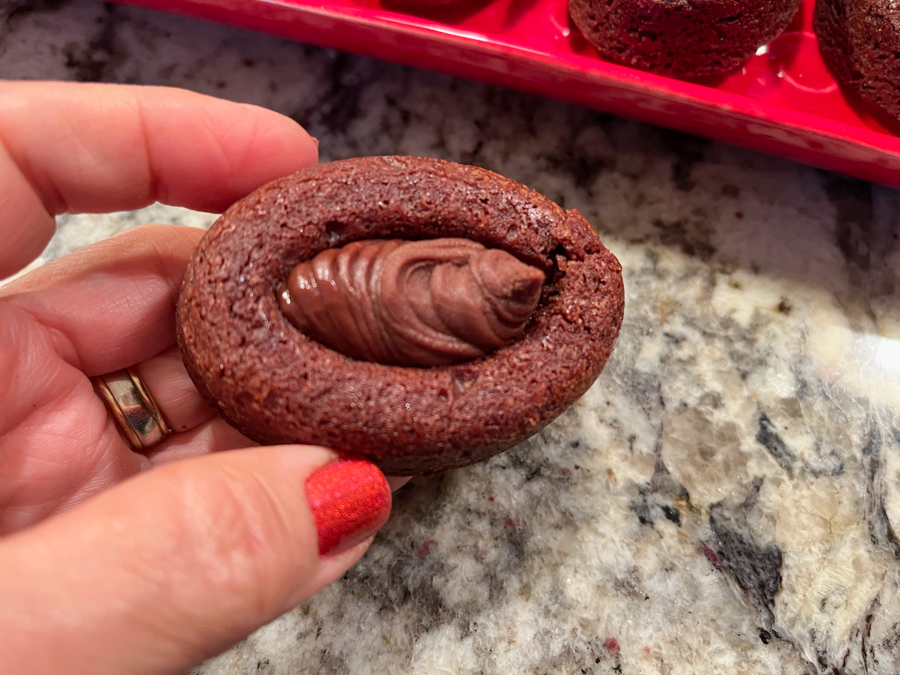
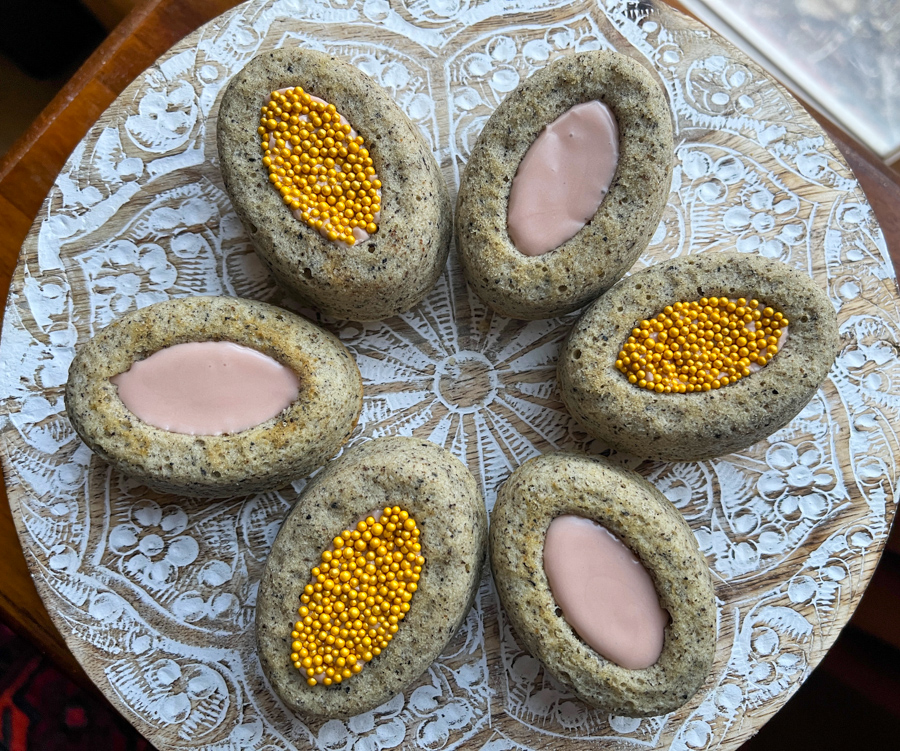
BLACK SESAME & CHAI MINI-CAKES
These cakes were made from a recipe found in the cookbook Masala and Meatballs, by Asha Shivakumar. I’ve had this book for several years and everything I made from it turned out excellent. I highly recommend it. For these mini-cakes, the batter takes black sesame paste, and I used my own icing from the Chai-Brownie Cupcake in this post. In Asha’s recipe, the icing was made with sweetened condensed milk as a base plus powdered sugar, so I opted for something a little less sweet.
I hope you’ll consider baking with little savarin molds, especially if you are sharing these with friends or co-workers. They are very small, and the format allows for just a little icing. I am always impressed by the beauty of iced cupcakes, but they can be quite over-indulgent. If you like to enjoy sweets but prefer some moderation, these have your name written all over…
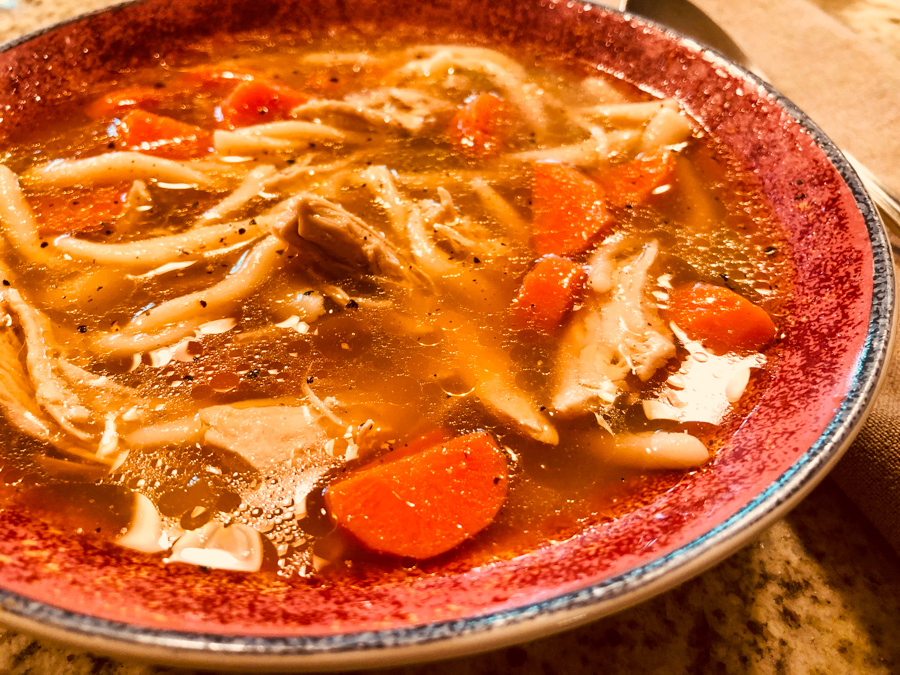
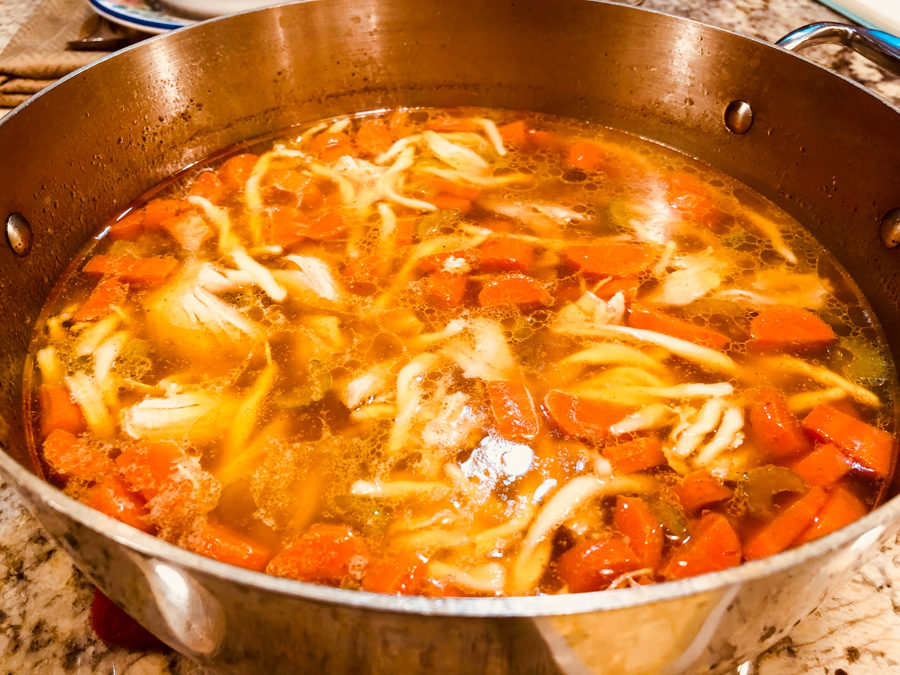
I use the pressure cooker a lot, pretty much the whole year. I wanted to make chicken soup under pressure (the soup, not the cook), so I started by checking a few cookbooks and websites. I shall name no names, but a very very reputable source gave me a recipe that disappointed on many levels. I used it as a very loose starting point. My version got two thumbs up from me and the man I’ve been happily married with for 21 years, 11 months and 3.5 weeks. Yes, almost anniversary time for us!
CHICKEN NOODLE SOUP (from the Bewitching Kitchen)
2 tablespoons olive oil 2 shallots, halved 6 medium carrots, 3 halved crosswise and 3 peeled and cut into half-moons 4 stalks celery, 2 halved crosswise and 2 cut into half-moons 10 black peppercorns 2 bay leaves 1 large chicken, cut into 8 to 10 pieces, with the skin removed, wings left with skin on 2 quarts water 1/4 cup soy sauce 1 piece ginger (about 1 inch) 2 tablespoons kosher salt Freshly squeezed lemon juice, to taste, optional Freshly ground black pepper, for serving noodles of your choice, amount to taste
Heat the oil in your pressure cooker, add the shallots, and the large pieces of carrots and celery, season lightly with salt and pepper. Sautee until fragrant.
Add the chicken pieces, but do not include the breast. Add water, peppercorns, soy sauce and ginger. Make sure the water covers all the pieces of meat. Close the pressure cooker, and cook under pressure for 30 minutes. Release the pressure by running cold water over the lid, or if using the Instant Pot, use the rapid release method.
Strain the liquid passing it through a fine sieve. Discard all solids. You should have at least 8 cups of stock, if you have less, add water to complete the volume. Place the liquid back in the pressure cooker, or use another large stockpot. Add the breasts to the stock, then the pieces of carrots and celery reserved earlier. Simmer very gently until the breast is cooked through – it might take 20 minutes, depending on the size of the breasts.
Cook the noodles al dente and rinse them in cold water. Reserve. You’ll need about 2 cups cooked noodles for the full amount of soup.
When the breast meat is cooked, remove to a plate and shred the meat with a fork. Add it back to the stock, and add the cooked noodles. Adjust seasoning with salt and pepper, and squirt a little lemon juice right before serving.
Comments: I made this soup three times during this winter. First time I was worried that the noodles would get too mushy if left in the broth for a day or two, so I was trying to add them to just the amount of soup we would consume in that meal. But, there’s really no need to do that. It turns out they hold pretty well in the fridge. I just try to cook them JUST to the al dente stage.
The pressure cooker does a beautiful job intensifying flavors, so the soup is very satisfying and has a bright flavor due to the ginger and lemon. I hope you give it a try, either with a pressure cooker or the Instant Pot.
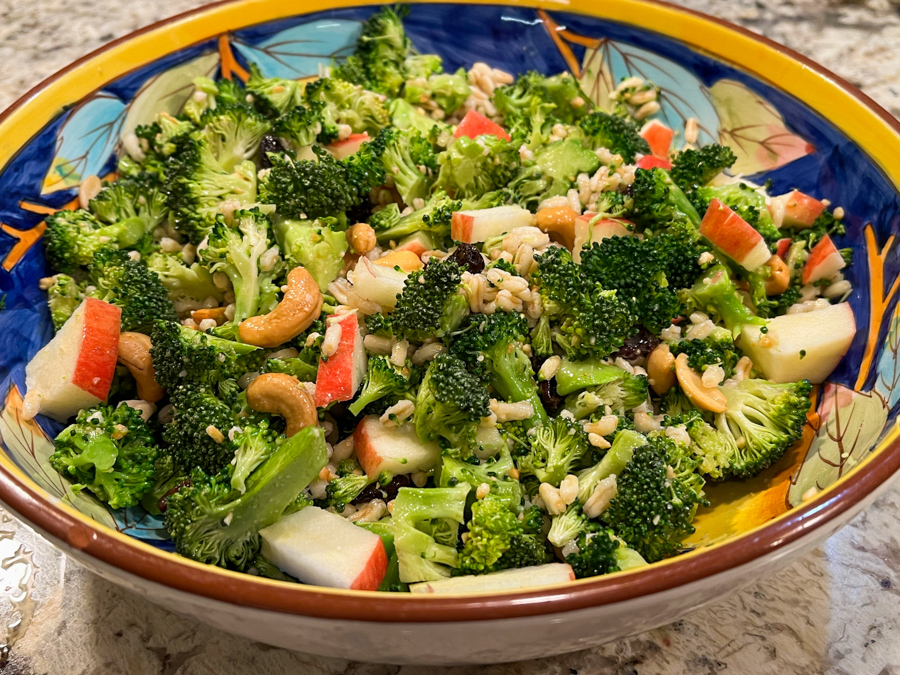
If I am going to have a salad, my preference is a salad with substance, and a variety of textures and colors. No need to go all the way into a Chicken Caesar or a Steak Salad, but the addition of grains is more than welcome. I used quick-cooking kamut, but any type will work, just pay attention to the timing. Also, any other will be fine: barley, cracked wheat, or the beautiful farro.
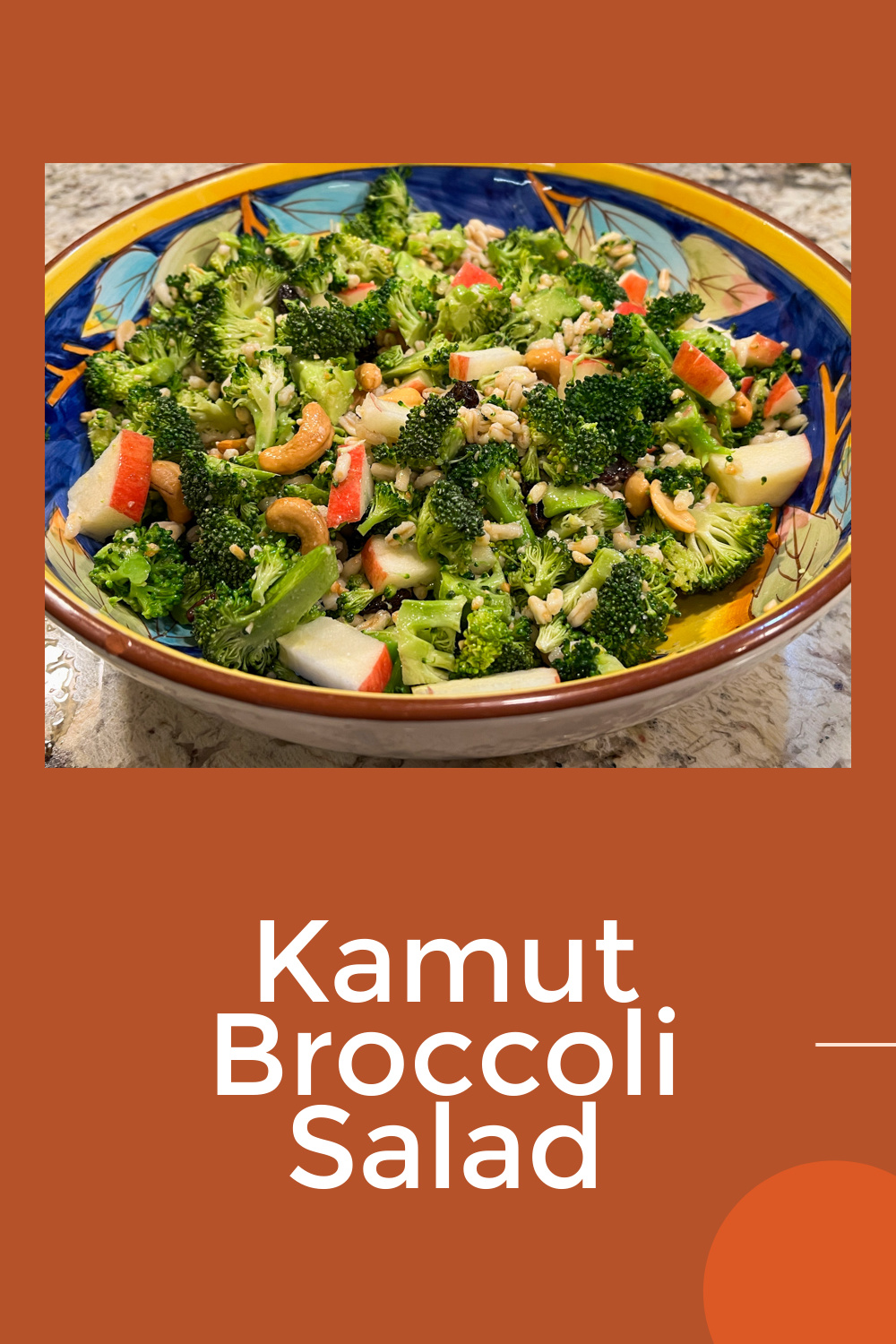
KAMUT & BROCCOLI SALAD (adapted from many sources)
1 cup cooked kamut, or amount to taste 2 broccoli heads, or amount to taste 1/2 cup roasted, salted cashews 1/4 cup raisins 1/2 apple, cut in pieces (I used Pink Lady) 1/4 cup olive oil juice and zest of 1 lemon grated ginger to taste salt and pepper to taste
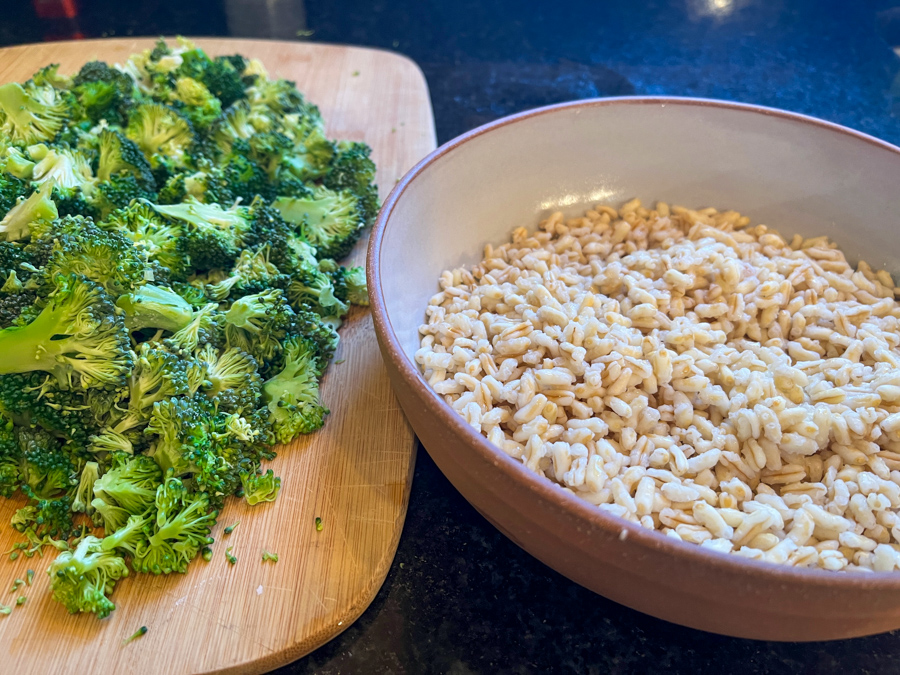
The kamut can be prepared a day in advance if you like. Make sure it is cold when you make the salad. If you make it in advance, drizzle just a touch of olive oil to prevent the grains from sticking together. Separate the broccoli into florets and steam them for 3 minutes. Immediately run very cold water to stop the cooking. Cut the steamed broccoli into pieces. Reserve.
Make the dressing by whisking the olive oil with lemon juice, add ginger, salt and pepper.
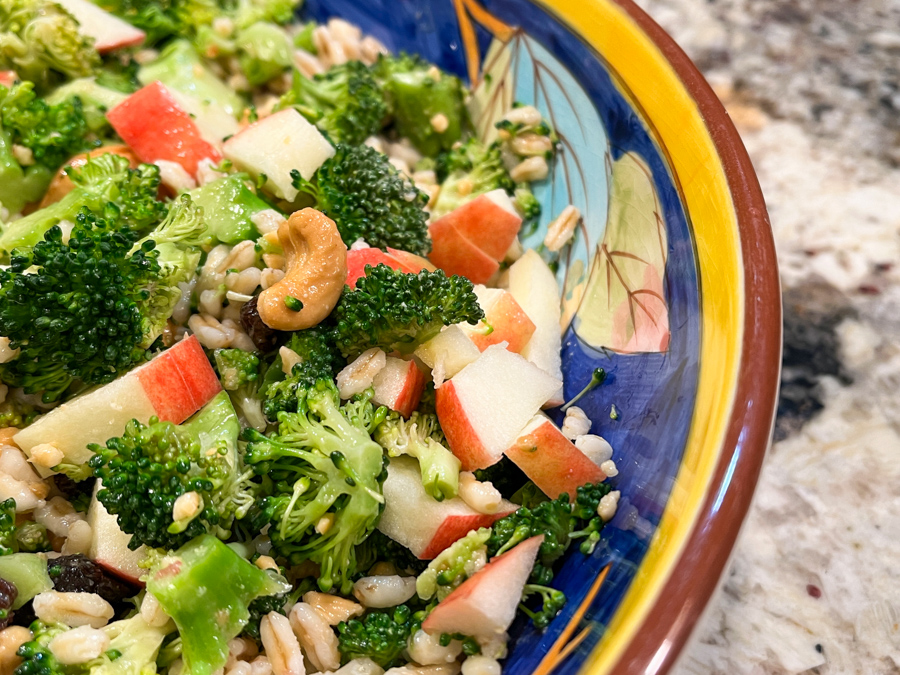
In a large serving bowl, add all the ingredients for the salad, pour the dressing and mix gently. Adjust seasoning with salt and pepper if needed. Allow the salad to sit for 30 minutes before serving, if possible.
Comments: The main inspiration for this recipe came from a cookbook I own, but that version served the broccoli raw and passed by the food processor. The pieces of raw broccoli were very small and lost in the middle of the grain, all acquiring the same green color. The way I chose to make it, was barely steaming the broccoli. This simple step tames its raw sharpness. Next, I cut the pieces with a knife, in small chunks. In my opinion, this makes the final product much more appealing not only visually, but as far as texture goes.
The apples and raisins are a must, and the cashews give that extra crunchiness that will leave you smiling… peanuts, walnuts, or pecans, can be used instead.
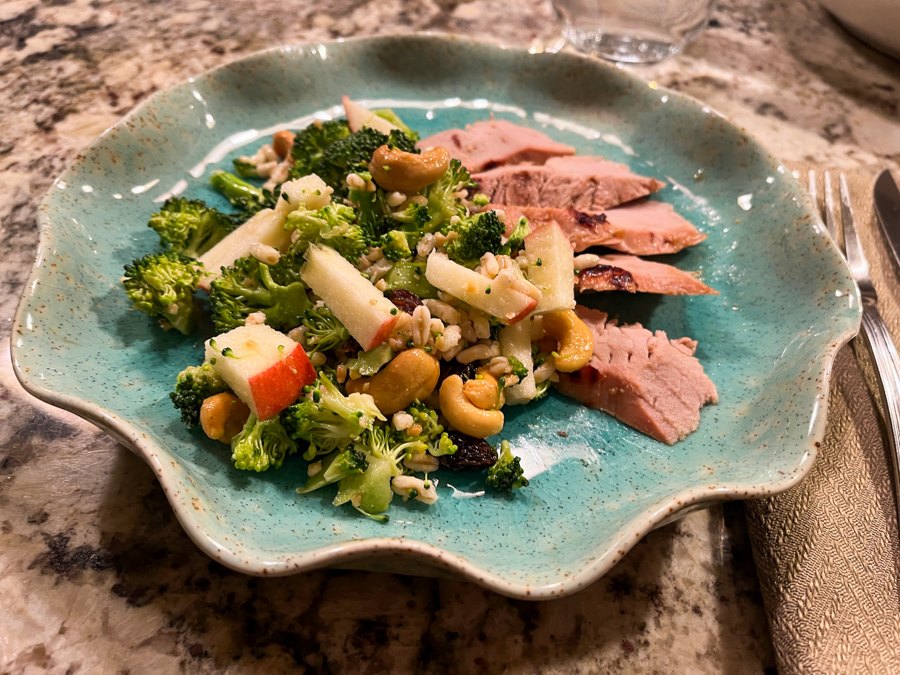
The added bonus of this salad: it holds quite well in the fridge. I made such a big portion that in fact it lasted two days, and on the second day I decided to warm it in the microwave for a minute. Perfect! A light lunch that needed absolutely nothing else to go with it.
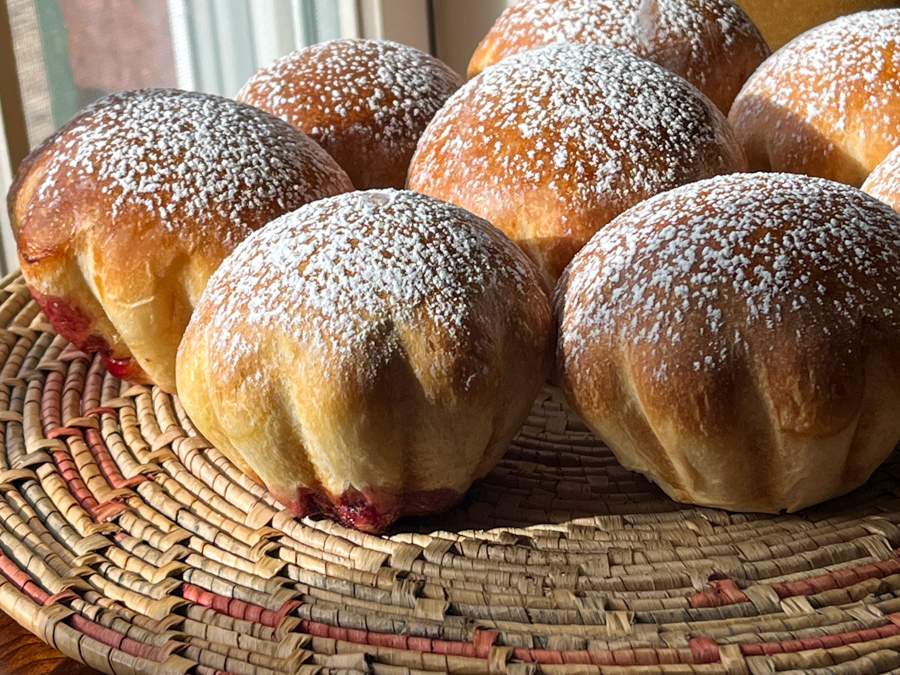
I am absolutely thrilled to share this recipe, fresh from the press, part of the second cookbook of my dear friend Elaine (click here for her sourdough site and here for her new book ordering info). Sourdough taken straight into brioche territory, with just the right level of sweetness, filled with your favorite jam. The recipe makes 16 rolls, I actually halved it and divided the dough in 8 pieces for shaping as rolls. To divide the egg, I just mixed one egg with the yolk, weighed that, and used half. It ended up being 30g egg mixture for half the recipe, in case you’d like to go that route.
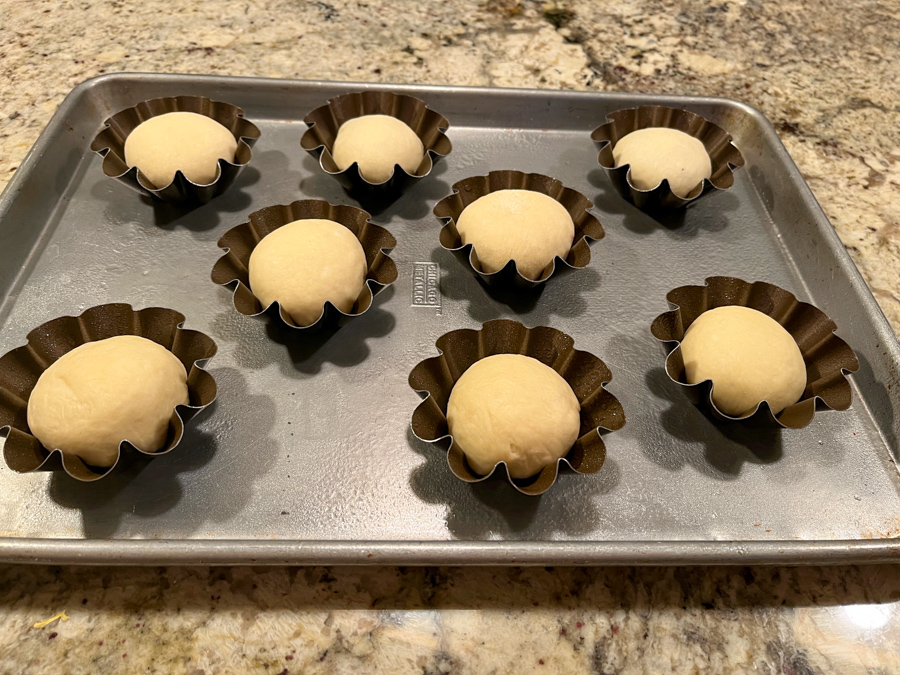
Either line a large baking or cookie sheet with parchment paper and sprinkle with rice flour, or prepare fluted baby brioche pans (3 1/8 inches [8 cm] in diameter and 11/4 inches [3 cm] deep), lined up ready to fill on a baking sheet.
Makes 16 snack-sized buns 50 g active starter at 100% hydration 270 g milk, cold or room temperature 1 large egg 1 large egg yolk (reserve egg white for brushing) 75 g butter, at room temperature 50 g runny honey 500 g strong white bread flour, plus more for dusting 7 g (1 tsp) salt, or to taste 200 g jam of your choice (about 2 tsp per roll) Powdered sugar, for sprinkling (optional)
In the early evening, in a large mixing bowl, roughly mix together all the ingredients, except the reserved egg white and jam. It will be a very sticky dough, and it may be easier to use a bowl scraper or spatula to mix it at this stage. Leave it roughly mixed, cover the bowl with a clean shower cap or your choice of cover and leave the bowl on the counter.
After an hour, perform the first set of pulls and folds on the dough. Lifting and pulling the dough across the bowl until it starts to come into a soft ball, then stop. The butter will not be fully mixed in yet; it will become more so as you work with the dough. Cover the bowl again and leave it to sit on the counter. During this first set of pulls and folds, the dough will still be sticky, but keep working with it.
Over the next few hours, perform three more sets of pulls and folds on the dough, covering the bowl after each set. The dough will remain sticky but nicely stretchy and will come together into a nice soft ball each time. Do the final set before going to bed. Leave the covered bowl on the counter overnight, typically 8 to 12 hours, at 64 to 68°F (18 to 20°C).
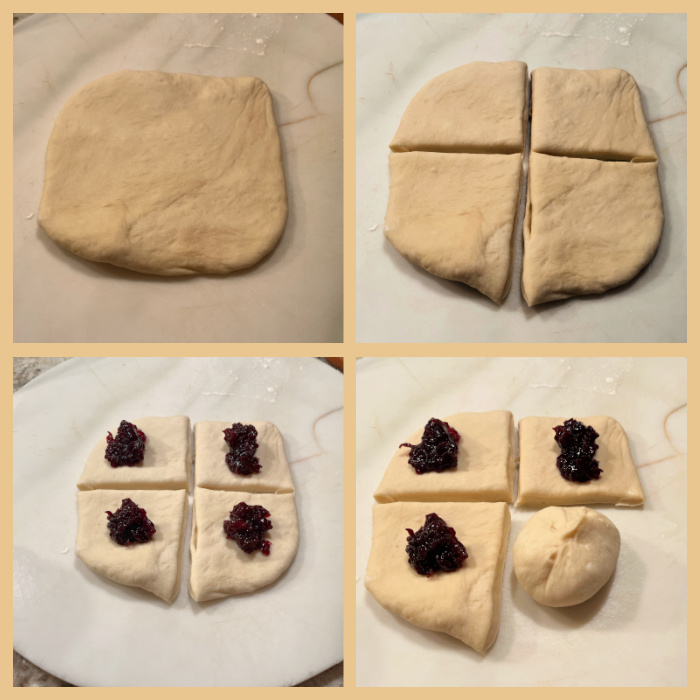
In the morning, turn the dough out onto a lightly floured surface and pull the dough into a 14-inch (35-cm) square that is an even thickness all over. Using a dough knife or pizza cutter, cut the dough into sixteen equal squares. Place a heaping teaspoon of jam in the middle of each square, pull the corners and edges of each square together and stick them together. Turn each parcel over and shape into a ball. Place each ball onto your prepared pan, allowing space between them to grow, or place them in your baby brioche pans. Cover the balls with a large plastic bag and leave on the counter for the rolls to proof again for 2 to 3 hours, or until doubled in size.
Heat the oven to 325F. Mix the egg white with a tablespoon of water and brush the top of each ball gently with it. Bake uncovered for 20 to 25 minutes. Remove from the oven and place the rolls directly on a rack to cool briefly. These are best eaten warm, with an optional sprinkle of powdered sugar.
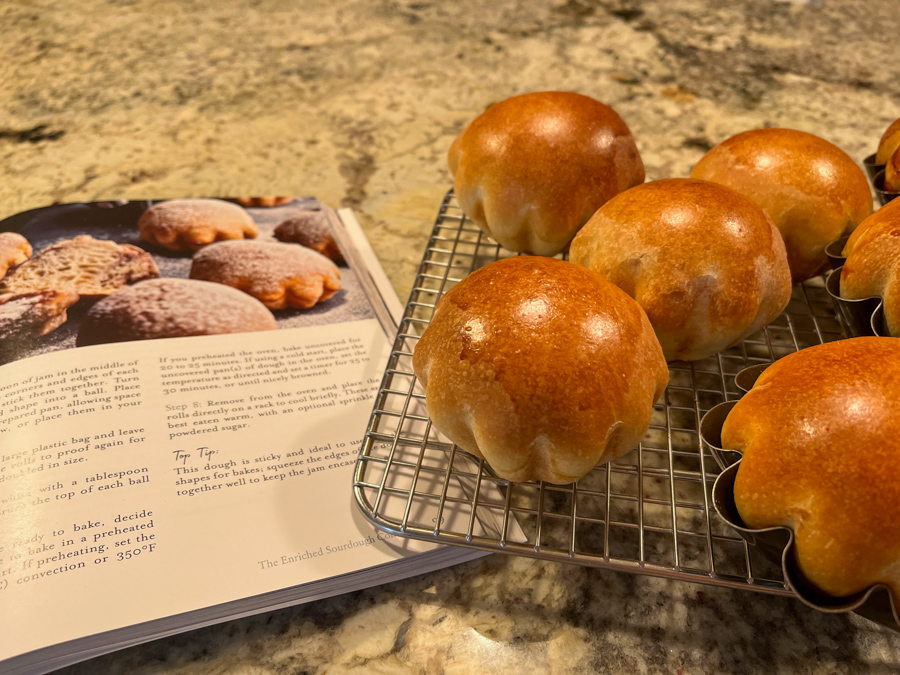
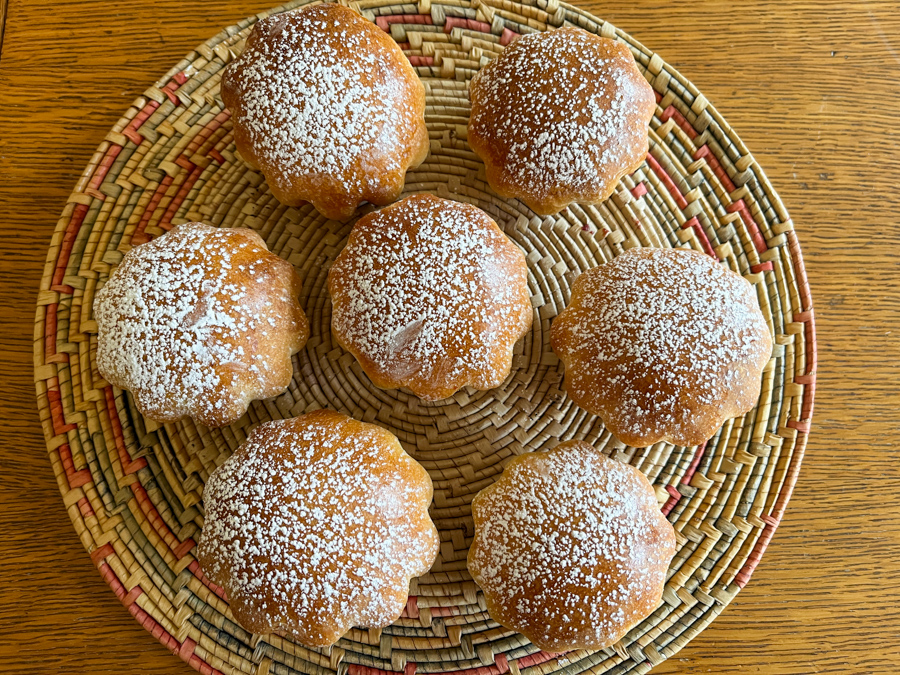
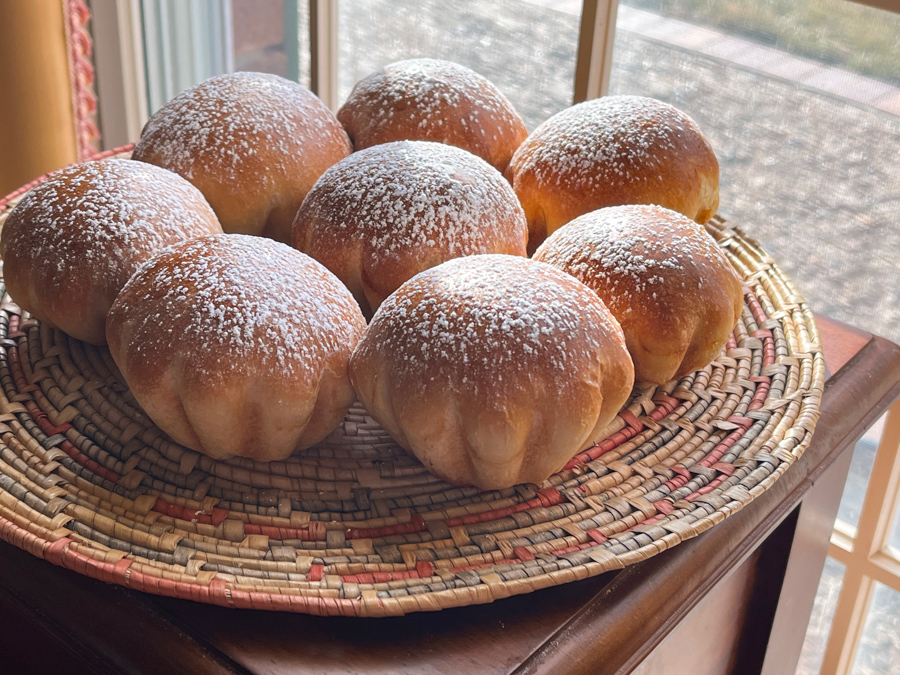
Comments: This dough is wonderful to work with… smooth, elastic, easy to shape. Do not be afraid of letting it sit overnight at room temperature, unless you live in a super warm climate without air-conditioning. This rich type of dough tends to proof a lot slower than regular sourdough. For the final proofing, I used these brioche pans. They are a bit pricey but excellent quality. Love the way they look… But as Elaine mentions in the recipe, you can simply shape them as round little balls instead.
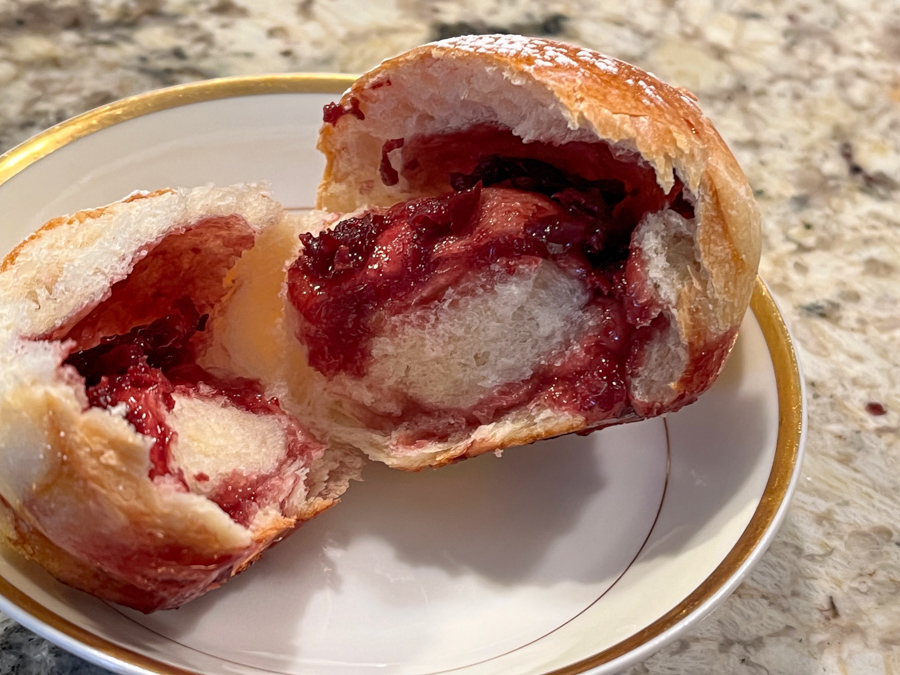
You can fill them with any jam you like. I used Morello Cherry preserves and it was absolutely delicious… A little bit leaked from the bottom of some of the rolls, but no harm done.
I don’t think I need to say much more, right? The picture is worth 1,000 words… They actually freeze well too. Just wrap them, and when you are ready to enjoy them, bring to room temperature for 20 minutes or so, then place in a warm oven to heat through. They will be as good as freshly baked!
Now let me walk you through Elaine’s new book, “The Sourdough Whisperer.” And in the end of this blog post you will see another bread I baked from her book, as a teaser recipe..
The book is organized in two parts, the first deals with everything you need to know about making sourdough: making a starter from scratch, maintaining it, ingredients, tools, her master recipe and timing your bread baking to suit your schedule. The essence of it all is exactly what we’ve seen in her first book: simplicity. I tell you one thing, in this first part she covers EVERY single question a baker might have as far as tweaking recipes, or changing proofing time and/or temperature. A must-read even if you are a seasoned sourdough baker.
Part Two is devoted to recipes, and you’ll find eight sub-chapters in it.
#1 – The Master Recipe Sourdough Collection. In this chapter she shows how versatile her Baby Master Recipe can be, adapting it to make different shapes, Wedge Rolls, Sandwich Loaf, a beautiful concoction using a Bundt Pan (yes, that is right, and the photo of that one is worth a prize), a Pullman Loaf, and she closes it with a cute little method to use up “ends of bags” of flour. Every single bread in the whole book has a picture, so keep that in mind. I love that.
#2 – The Enriched Sourdough Collection. I love this section! Normally I do a straight sourdough bread, so to me playing with enriched dough is not very common, which is one of the reasons why I chose the featured recipe. Elaine uses her default Enriched Sourdough in some formulas, and also offers a lighter alternative. The chapter opens with a total beauty, Enriched Sourdough Pesto Babka. Stunning! The Jam-Filled Rolls are part of that chapter, and I almost chose the Cinnamon and Raisin Enriched Bundt Pan Bake to showcase here.
#3 – The Spiced Sourdough Collection. I love bread with spices, if you follow my blog you’ve probably noticed. I definitely will be trying some of her versions like Smoked Paprika, Rosemary and Sun-Dried Tomato Master Loaf, and her Turmeric and Onion Seed Sandwich Loaf.
#4 – The Softer Sourdough Collection. Super interesting chapter. It centers on methods that will produce a sourdough with a much softer crust, something she achieves by adding milk into the formulas. She starts with a “Half-Milk, Half-Water Baby Master Loaf”, and moves to variations using different proportions and different liquids such as buttermilk (Buttermilk and Spelt Loaf with Pine Nuts and Oats, another thing of beauty). I made the teaser recipe from this chapter, “Olive Oil and Herb Master Loaf”, so check it out in the end of this post.
#5 – The Filled Collection. Maybe my favorite chapter, I just don’t know. In this section, she really shows her creativity, joining interesting ingredients together. First comes a Cheese, Fig and Walnut Sandwich Loaf, absolutely gorgeous and mouth-watering photo… Apricot and Almond Babka Loaf with very detailed pictures of the shaping. I absolutely MUST make the “Chickpea, Barberry and Lemon Pantry Loaf”.
#6 – The Flat Sourdough Collection. Elaine uses her master recipe to make focaccia, pizza, ciabatta, and fougasse. In other words, she covers all the classics. Pictures are wonderful, including once again quite detailed shots of shaping ciabatta, which can be tricky.
#7 – The Shaped Collection. Another super fun and creative chapter, she shares techniques for special shaping. Braided Loaf is the first example, but don’t think about challah, this braid decorates the top of the bread, super cool. Looks intimidating but the pictures show you exactly how to do it. A Chocolate and Nut Sourdough Crown follows, would be just amazing at a party. The one I intend to try soon is… Pull-Apart Sharing Sesame Sourdough. The chapter closes with baguettes, in my opinion the trickiest bread to shape correctly.
#8 – The Same Day Collection. Sometimes we want to speed things up, right? This series gives recipes to have sourdough prepared and baked the same day. It is all a play with amount of starter and proofing temperature. Sourdough Pizza and Pita are two examples, but my favorite might be Same Day Poppy Seed Sourdough Rolls. They are adorable.
If you bake sourdough bread, or if you flirt with the idea of venturing into it, you need this book. The tone is always friendly, supportive, positive, and again, reading the book and browsing through the wonderful pictures, I just wanted to stop and start baking right away. The mark of a captivating cookbook!…
And now, as I always like to do when reviewing cookbooks, I share…
A TEASER RECIPE
OLIVE OIL AND HERB SOURDOUGH
Isn’t that amazing? The crust is a lot softer than a regular sourdough, and the bread stays fresh longer. A pleasure to work with, great flavor with the herbs spread inside the crumb.






 Bewitching Kitchen