CHICKEN WITH PASILLA-PECAN SAUCE

Are you familiar with Mexican mole sauces? Well, this is not it. It goes in that direction, but it is much, much simpler. Moles are notoriously complex to make, requiring hours of simmering and a long list of ingredients. This sauce is very simple by comparison. I was inspired by a few recipes from Pati Jinich of PBS fame, and cooked it under pressure. You can use an Instant Pot or simply braise it for a longer time.

CHICKEN WITH PASILLA-PECAN SAUCE
(inspired by Pati Jinich)

2 tablespoons grapeseed oil
8 boneless, skinless chicken thighs
3 cups chicken stock
3/4 cup pecans
4 prunes
2 pasilla dried chilis, stemmed and seeds removed
1 medium shallot, peeled, cut in half
1 cup strained tomatoes (I used Pomi)
salt and pepper to taste

Start by making the sauce. Add the dried pasillas to a super hot skillet and dry cook them on both sides until they get soft and fragrant. Reserve. Broil the shallot or dry roast it in the pan together with the pepper.

Heat the chicken stock in a saucepan, add the pasillas, broiled shallots, pecans, and prunes. Season lightly with salt and pepper. Simmer gently for 10 minutes. Add the contents of the pan to a high-power blender (I used a Vitamix), and process until full smooth.

Heat the oil in your pressure cooker or instant pot, season the chicken pieces with salt and pepper, and brown them on both sides, four pieces at a time. Remove to a bowl as they are done. When they are all browned, remove the excess oil from the pan, leaving about 1 tablespoon behind. Add the chicken back to the pressure cooker, pour 1 cup strained tomatoes and 1 cup of the pasilla sauce. Close the pan, bring to full pressure and cook for 20 minutes. Release the pressure (quickly is ok), and if needed, simmer down the sauce. Adjust seasoning, and serve with your side dishes of choice, or shred the meat and wrap in tortillas.

ENJOY!

to print the recipe, click here

Comments: We both loved this take on chicken thighs. You can serve this with rice and beans, you can serve it with tortillas and some salsa, but I opted for a simple sweet potato puree and broccoli. The sauce is super flavorful, so it will go well with pretty much any side dish you want: couscous, rice pilaf, even pasta or polenta. Don’t worry, call it fusion cuisine. The pasilla-pecan sauce will make more than you need for this recipe, so you can freeze it for later.

If you don’t own a pressure cooker, just brown the meat, add the sauce, cover tightly and simmer gently until cooked through, probably 50 minutes or so, depending on how tender you like it. I have not tried it with chicken thighs on the bone and with the skin on, but if you brown the skin well, I don’t see any problems. It will have a lot more fat in the end, though.

ONE YEAR AGO: A Versatile Silicone Pan

TWO YEARS AGO: Buffalo Chickpeas

THREE YEARS AGO: Bi-Color Croissant and Pain au Chocolat

FOUR YEARS AGO: Lemon-Blueberry Entremet Cake

FIVE YEARS AGO: Walk Strong3: Jessica Smith’s latest workout program

SIX YEARS AGO: Pork Medallions with Black Berry Compote

SEVEN YEARS AGO: Indian-Spiced Chicken with Chickpeas and Spinach

EIGHT YEARS AGO: Curry Cardamon Cookies

NINE YEARS AGO: In My Kitchen, March 2014

TEN YEARS AGOBoeuf Bourguignon for a Snowy Evening

ELEVEN YEARS AGO: Chickpea Salad

TWELVE YEARS AGO: Soft Spot for Chevre

THIRTEEN YEARS AGO: Roasted Onion and Asiago Cheese Miche


SPANAKOPITA, CRACKERS & THE ADVENTURE OF PHYLLO DOUGH

Have I totally lost my mind? No, not answering that. It turns out that I’ve always wanted to try making phyllo from scratch. When I was preparing for the Great American Baking Show, I had this annoying suspicion that it could be a technical challenge, but once you get accepted there is absolutely NO WAY to try to bake anything apart from the required, known bakes (signature and showstopper for every single episode). So I put it on the back burner ever since. But my friend Caro sent me the perfect rolling pin for the job, and it was the little nudge I needed. I tell you one thing, making phyllo is not for sissies. But I managed to have quite a bit of fun that weekend…


PHYLLO DOUGH
(following this video tutorial from Shereen Pavlides)

353 grams all purpose flour (3 cups)
1 teaspoon kosher salt
1 teaspoon baking powder
1 tablespoon olive oil
2 teaspoons white distilled vinegar
3/4 cup – 15 tablespoons warm water
corn starch – to roll out and dust the dough

Make the dough by adding all ingredients and HALF the amount of water to a KitchenAid type mixer fitted with the dough hook.

Knead for a few minutes, then start adding the other half volume of the water, tablespoon by tablespoon until the dough starts to clean the sides of the bowl. Once a smooth dough forms, remove it from the machine, knead it by hand for a couple of minutes, form a smooth ball and place in a large oiled bowl for one hour.

Divide the dough into 20 equal pieces (mine were 28g each). Place each little ball over a parchment covered baking sheet. Leave for one hour at room temperature.

Start working the dough, first one little ball at a time, following her instructions on the video. My main change was to work with FOUR sheets at a time instead of TEN. I had too much trouble keeping them easier to separate, and decided ten was just too much for a first time. Four sheets at a time worked very nicely. That required 5 full cycles of rolling out to work on all 20 balls of dough. Another change I did was to separate each two sheets of phyllo fully rolled out with parchment paper, because I was afraid keeping them all together would result in severe sticking. I kept them in the fridge for a couple of hours before proceeding with the spanakopita and the crackers.


SPANAKOPITA
(adapted from several sources)

8 sheets of phyllo dough (if using commercial you probably get by with 6)
500 g spinach (preferably not baby spinach)
1 tablespoon olive oil
2 ribs of celery, finely diced
1 shallot, finely diced
salt and pepper to taste
nutmeg to taste
200 g full-fat ricotta cheese
100 g feta cheese, crumbled in large pieces
1 egg, beaten
olive oil spray

Boil water in a very large pan, add the spinach and press it down with a wooden spoon until the leaves wilt, 30 seconds or less. Drain into a large colander and place under running cold water to cool quickly. Drain well – squeeze out any excess water by pressing the spinach down with the wooden spoon, then squeezing with your hands. Using kitchen paper, pat the spinach dry into a compact shape, lay it on a board and roughly chop, then set aside.

Heat the olive oil in a large non-stick frying pan. Add the shallot, celery, and fry over a high-ish heat for 3-4 mins, stirring often, until softened and just starting to brown. Lower the heat, add the chopped spinach and stir for a few minutes to finish drying. Season with salt, pepper and nutmeg, and leave to cool.

Heat oven to 375F and put a baking sheet in to heat up. In a bowl, stir the ricotta into the beaten egg and season with pepper and a pinch of salt.

Lightly oil an 8 inch square baking pan. Lay one or two filo pastry sheets over the pan, spray with olive oil, and att two more, leaving a nice overhang on all sides. The pan should be completely covered, with a pastry overhang all round. Repeat the criss-cross layering with 2 more oiled filo sheets.

Stir the ricotta mixture into the spinach, then crumble in the feta. Lightly stir it in so you leave a few chunky pieces. Spoon this filling into the pan and level it. Bring the pastry sides up and over the filling, then brush a little oil over them. Add one or two more sheets sprayed with olive oil to top the spanakopita.

Bake for 30 to 35 mins until the pastry is crisp and golden. Leave to cool for 10-15 mins. Carefully remove from the pan, slice and serve.

ENJOY!

to print the recipes, click here

Comments: The most “traditional” way to roll out phyllo is going for a very large and thin sheet, patiently rolling and stretching the dough over a lightly floured cloth. I watched videos, read articles, and decided to go for a ‘beginner’s friendly” method, in which you divide the dough in small pieces and roll them thin, but to a smaller final size. The other change is that the sheets are stacked as you roll. The video advised to stack 10 sheets but I could not make it work. I went for 4 sheets at a time, and rolled them to 9 x 13 inches. Don’t expect to get phyllo as thin as the one you can buy at the store, particularly not on your first time. But I was pretty happy with the overall outcome. Very rewarding!

I also made crackers, using 4 of my precious sheets of home-made phyllo… Super simple. Stack the four sheets with a good spray of olive oil over each one. When you place the last sheet on top, brush some beaten egg white and add the toppings of your choice, so they will glue to the phyllo. I used black sesame seeds and Southwest spice from Penzey’s. Cut with a pizza roller and bake.

The crackers were absolutely delicious, and hubby thought I was a genius, crackers worth it of a Paul Hollywood handshake (allow me to dream, as I totally missed my chance, will you?)

I cannot lie to you, making phyllo from scratch is quite involved. I’ve found cornstarch in amazing places over the next couple of days. Things got wild, my friends… But how else can you have spanakopita made TOTALLY from scratch?

Caro, thanks so much for the thoughtful gift! I intend to make phyllo again, might even try the traditional approach and get a table cleared for the next adventure…

ONE YEAR AGO: Chicken Noodle Soup

TWO YEARS AGO: Floral Chocolate Stick Cookies

THREE YEARS AGO: Sally’s Spicy Mango and Coconut Macarons

FOUR YEARS AGO: Bouillabaise for a Chilly Evening

FIVE YEARS AGO: Bergamot-Cherry Macarons

SIX YEARS AGO: Roasted Veggies with Queso Cotija Dressing

SEVEN YEARS AGO: Creamy Broccoli and Mushroom Casserole

EIGHT YEARS AGO: Maple Walnut Biscotti

NINE YEARS AGO: Barley Risotto with Peas

TEN YEARS AGO: Oatmeal Fudge Bars

ELEVEN YEARS AGO: Cauliflower Steaks

TWELVE YEARS AGO: Soft Spot for Chevre

THIRTEEN YEARS AGO: Quick sun-dried Tomato Crostini

SUGARPRISM PAINTED LINZER COOKIES


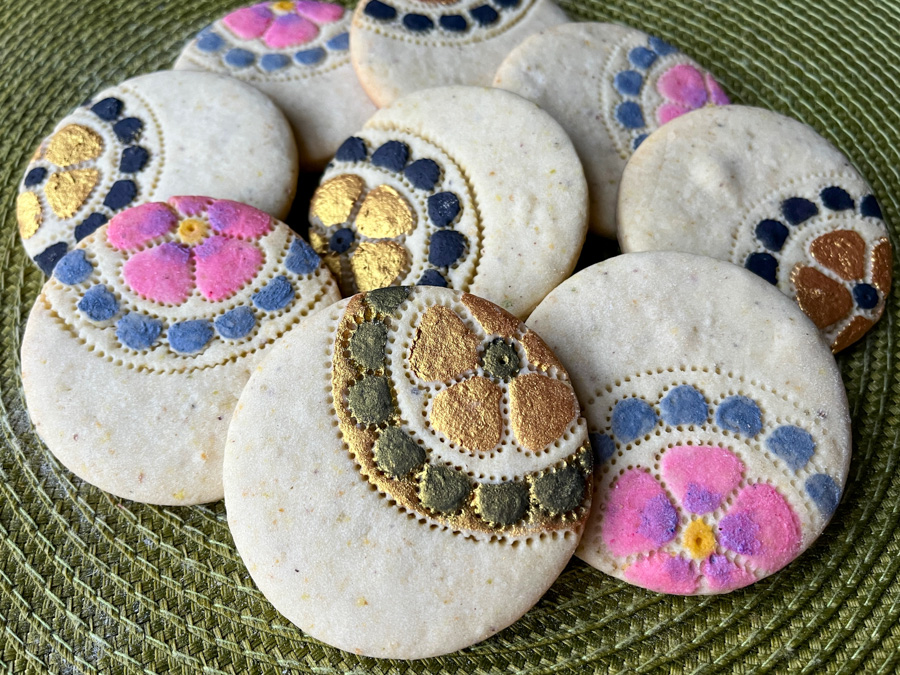
Linzer Cookies are one of my favorites and this recipe starts by toasting hazelnut flour. Do not skip this step, because it is a huge flavor boost to your cookies. Traditionally, they are finished with a dusting of powdered sugar, making them a little messy to eat. Inspired by Michele, the very inventor of Sugarprism, I skipped that and coupled Sugarprism in Red Lipstick color with a few stencils for a totally different look. I also used some air-brush gold from Chefmaster to create contrast, as my cookies were a little dark to start with.


SUGARPRISM PAINTED RASPBERRY LINZER COOKIES
(adapted from Food Duchess)

75 g hazelnut flour
160 g all-purpose flour
1/4 tsp salt
3/4 cup unsalted butter, at room temperature
100 g granulated sugar
1 tsp cinnamon
25 g egg yolk (about 1 large)
1 tsp vanilla
1/4 cup seedless raspberry jam

Sugarprism diluted to air-brush consistency in Lipstick Red (optional)
Chefmaster air-brush gold (optional)

Heat oven to 350°F. Cover a baking sheets with parchment. Evenly spread hazelnut flour onto the paper and bake for 5 to 10 minutes, moving it around often so that no spots get overly roasted. Remove the toasted flour from the oven and allow to cool for 30 minutes.

In a medium mixing bowl, whisk together the cooled hazelnut flour, all purpose flour, and salt. Set aside.

In a stand mixer fitted with the paddle attachment, beat together the butter, sugar, and cinnamon, until light and fluffy – about 3-5 minutes. Add egg yolk and vanilla, then beat again until well-combined. Add flour mixture to the stand mixer and beat until just combined and a crumbly looking dough has formed.

Remove dough from stand mixer and lightly form into a disk shape with your hands. Place dough-disk onto a heavily floured surface, and roll the dough out to about ⅛-¼” thick. Cut the cookies in you desired shape and size, cutting a hole in the center of half the cookies. Those will be the top. Bake for about 10 minutes, until the edges start to get darker. Remove from the oven and allow to cool before proceeding.

Use a stencil to add a pattern to the cutout cookies. Spread jam on the cookie base, top with the decorated cookie.

ENJOY!

to print the recipe, click here

Comments: I used 4 different stencils and coupled them either with a single color (Sugarprism Lipstick Red or Chefmaster gold) or with both combined, by moving the stencil to expose adjacent regions. It is hard for me to pick a favorite, but I might go with the one below…

It was fun to play with different patterns…


Another very easy way to give Linzer a new face, is simply spraying the top cookie with PME or Wilton pearl spray right on the baked cookie, before assembling.

The spray leaves no after-taste, so it won’t interfere with the cookie flavor. The possibilities of decoration are endless, so stay tuned for future important experiments on this subject…

ONE YEAR AGO: Kamut and Broccoli Salad

TWO YEARS AGO: Charcoal Peanut Sourdough

THREE YEARS AGO: Chocolate Cake with Coconut Buttercream

FOUR YEARS AGO: Berry Rebellion Tarts 

FIVE YEARS AGO: Bergamot-Cherry Macarons

SIX YEAR AGO: Roasted Veggies with Queso Cotija Dressing

SEVEN YEARS AGO: Creamy Broccoli and Mushroom Casserole

EIGHT YEARS AGO: Maple Walnut Biscotti

NINE YEARS AGO: Barley Risotto with Peas

TEN YEARS AGO: Oatmeal Fudge Bars

ELEVEN YEARS AGO: Cauliflower Steaks

TWELVE YEARS AGO: Soft Spot for Chevre

THIRTEEN YEARS AGO: Quick sun-dried Tomato Crostini

ZUCCHINI-CHICKPEA BAKED BITES

Yet another recipe that won’t win many votes in a beauty contest, but is so tasty and simple to prepare, I had to share with you. It happens to be vegan-friendly, because contrary to similar preparations, this one takes no eggs. All binding is given by processed chickpeas, straight from a can. It came from a Brazilian blog, but I modified it slightly to reduce the amount of carbs. Thank you to my niece Raquel for sending it to me, saying that the recipe “had my name written all over it.” I think she is right!


ZUCCHINI-CHICKPEA BAKED BITES
(inspired by this post)

200 g zucchini (1 large or 2 medium), grated on a large-hole grater
250 g canned chickpeas, well-rinsed and drained
basil leaves to taste
1/2 tsp salt + more to sprinkle on zucchini
1/2 tsp smoked paprika
1/8 cup almond flour
1/8 cup all-purpose flour
panko bread crumbs
olive oil spray

Heat oven to 420F.

Salt the grated zucchini lightly and allow it to sit on a colander for 10 minutes. Squeeze the zucchini dry preferably using a towel.
Add to a food processor together with the chickpeas, salt, paprika and basil. Process until fully smooth, stopping to clean the bowl with a spatula once. Add the two flours and process just to bind it all.

Form small patties, cover with panko bread crumbs on both sides. Place them separated over aluminum foil and spray the surface with olive oil. Bake for 10 minutes, turn them gently, spray more olive oil on the top. Bake for 10 to 15 minutes longer, until golden brown. Serve with you favorite sauce or plain.

ENJOY!

to print the recipe, click here

Comments: I was a bit skeptical that the little morsels would hold shape without the help of an egg, but although very fragile, I did not have problems. Just be gentle. If you want to fry them, you could still keep them vegan by using the liquid from the chickpea can to make a whipped “egg white substitute”, coat them with that and add bread crumbs. But I tend to avoid frying because I dislike dealing with the leftover oil. Air-frying could be also a good option but our fryer has a small basket and I would have to fry in batches, so I went with the baking option.

A bit of tomato sauce and grated Parmigiano is also a nice way to serve them, although obviously not vegan anymore. I will definitely make them again, and pair with a tahini sauce which I think will be another great serving idea.

ONE YEAR AGO: Slow-Cooker Hoisin Pulled Pork

TWO YEARS AGO: I Will Cracker you Up

THREE YEARS AGO: Pickling Ribbons

FOUR  YEARS AGO: Green Beans and Carrots with Spicy Almonds

FIVE YEARS AGO: Quiche 101

SIX YEARS AGO: Persian Butternut Squash Soup

SEVEN YEARS AGO: Walnut Cranberry Sourdough Bread

EIGHT YEARS AGO: Ottolenghi in Brazil?

NINE YEARS AGO: Roasted Winter Vegetables with Miso-Lime Dressing

TEN YEARS AGO: 2012 Fitness Report: P90X2

ELEVEN YEARS AGO: Caramelized Bananas

TWELVE YEARS AGO: Roasted Lemon Vinaigrette

THIRTEEN YEARS AGO: Whole Wheat Bread

BROWN BUTTER DULCE DE LECHE COOKIE CUPS

Once again I regret not having included the OMG FILES when I set up this virtual site of mine. I will admit that these are not the most beautiful cookies to look at, but I dare you eat one and stop. I baked a batch to donate and made the mistake of trying one. You know how it is, new recipe, I was curious to find out if all the hype was justified. Yes, it was. And in one particular week, a group of homeless people had two cookies less than expected. Sorry, really sorry.

BROWN BUTTER DULCE DE LECHE COOKIE CUPS
(from Tessa Arias’ Handle the Heat)

95g all-purpose flour
95g bread flour
1/8 teaspoon baking soda
1/2 teaspoon baking powder
1/2 teaspoon fine sea salt
113g butter (1 stick) unsalted butter
50g granulated sugar
125g dark brown sugar
1 teaspoon vanilla
1 large eggs, plus 1/2 egg yolk at room temperature
canned Dulce de Leche

Flaked sea salt, for finishing

Heat the oven to 350°F. Spray one 24 mini-muffin tin with nonstick cooking spray. In a medium bowl combine the flours, baking soda, baking powder, and salt.

In a small saucepan set over medium heat, melt the butter. Swirling the pan occasionally, continue to cook the butter. It should become foamy with audible cracking and popping noises. Once the crackling stops, continue to swirl the pan until the butter develops a nutty aroma and brown bits start to form at the bottom. Once the bits are amber in color, about 2 to 3 minutes after the popping stops, remove from heat and pour into a mixing bowl.

While the butter is still hot, stir in the granulated sugar and brown sugar. Let cool before adding in the vanilla and the egg and yolk, stirring well after each addition. Stir in the flour mixture until just combined.

Press a 1-tablespoon sized ball of dough into each muffin cup (about 20g per mini-muffin). Bake for 12 to 15 minutes, or until golden brown. Remove from oven and using the end of a wooden spoon, make 1-inch wide indentations into the center of each cookie.

Spoon a teaspoon of dulce de leche into each indentation. Sprinkle with sea salt. Let cool completely before serving.

ENJOY!

to print the recipe, click here

Comments: The recipe is available in Tessa’s book “The Ultimate Cookie Handbook“, which I own and love. However, it is also available online, so I felt ok to share here. I halved the recipe, that is why you’ll see 1/2 egg yolk as ingredient, I simply eye-balled it. I did not want to make 48 little cookies, plus I only have one tray of 24 mini-muffins.

My only modification for next time would be to use a piping bag to add the dulce de leche, I think it will look more polished, but I swear, these are AMAZING. And yes, I am using all caps. They look rustic, but don’t let the humble look prevent you from trying this recipe. One of the tastiest cookies I’ve made in a while.

ONE YEAR AGO: Chicken Poblano Tortilla Soup

TWO YEARS AGO: Kung Pao Chicken

THREE YEARS AGO: Galette de Rois

FOUR YEARS AGO: Sous-Vide Overnight Oatmeal

FIVE YEARS AGO: A Valentine’s Day Opera

SIX YEARS AGO: Incredibly Simple Times Four

SEVEN YEARS AGO: Walnut-Cranberry Sourdough Bread

EIGHT YEARS AGO: Ottolenghi in Brazil?

NINE YEARS AGO: Roasted Winter Vegetables with Miso-Lime Dressing

TEN YEARS AGO: 2012 Fitness Report: P90X2

ELEVEN YEARS AGO: Caramelized Bananas

TWELVE YEARS AGO: Roasted Lemon Vinaigrette

THIRTEEN YEARS AGO: Whole Wheat Bread