SOURDOUGH BLUES

For the past few months the Bewitching Kitchen witnessed my silent struggles with bread baking.  Re-phrasing that, for the past few months the Bewitching Kitchen witnessed a full-fledged bread baking debacle!   Yes,  a few floured banettons flew across the Bewitching Kitchen.   Yes, the lives of several loaves quickly came to a violent end as crouton-material on the chopping board.  Yes, Phil received text messages stating that I would never ever EVER bake sourdough again, and I needed him back home so I could cry on his shoulder.  I was miserable, confused and frustrated, feelings  I normally associate with golf, not bread baking.  Life can be cruel.

The deterioration in my baking happened slowly.  A slightly less plump loaf here, a tighter-than-expected crumb there.   Then, suddenly, no matter what I did my boules became pancakes.   Flat, … they were flat!.  No oven spring to speak of, and scoring the surface was like make-up at the undertaker’s,  … it made no difference in the loaf.  The crumb below was actually one of my better “pancake-loaves.”  Most had a much tighter crumb, leaving me too upset and disgusted to even bother taking a picture.
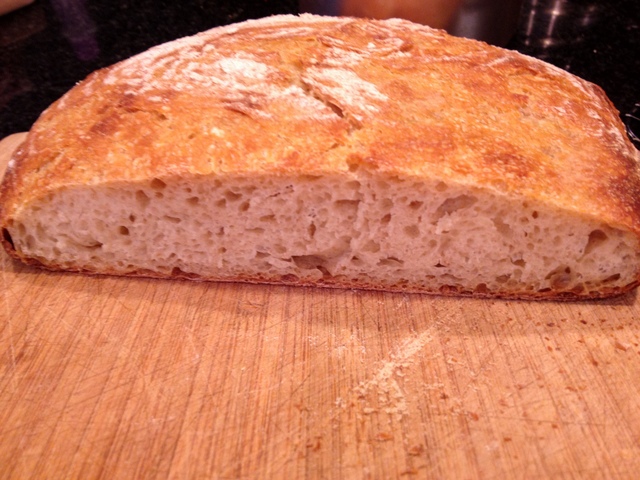
here

At a  loss,  I posted a message to Dan Lepard’s Appreciation Facebook page, and David W. came to the rescue.  Much like a therapist holding the hand of a patient, he listened to my saga and concluded that the problem related to storing my starter in the fridge.  Slowly, the complex microbial population in the starter had changed, leaving me with a less than ideal mixture to start bread with.  Several people advised me to discard the sourdough and start all over again, but I didn’t want to consider that route.  I’m too attached to Dan, the starter I captured and kept for four  and a half beautiful years.  That explains why I threw a massive fit at Phil when he insisted that a starter “is just flour and water“.  Can you imagine hearing THAT?  I know, it goes beyond insensitive.   But David provided the light at the end of the tunnel, with a  “revival protocol” for my starter.  Guess what happened on my first loaf?
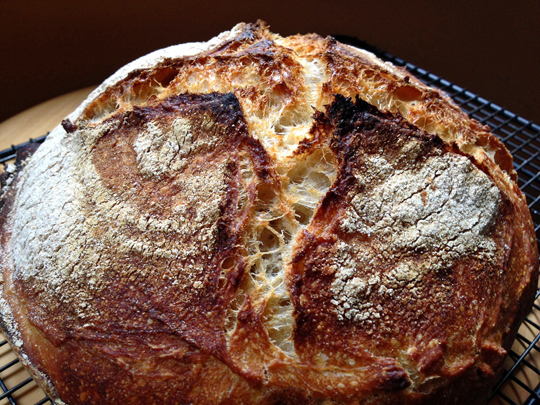
boule1White Levain Sourdough Bread, a classic recipe from Dan Lepard’s Handmade Loaf


SOURDOUGH STARTER RECOVERY

(from David, at Dan Lepard’s Appreciation Facebook page)

For 7-10 days, discard all but a small spoonful of the starter, and feed the starter by adding 70g organic rye flour + 100 g water.  Keep it out in the kitchen, not in the fridge.

After the 7-10 days, reverse the refreshment proportions to form a dough:  175g organic rye flour + 125 g water.   After 12 hours, bake with as much as you need, by either adjusting your bread recipe to compensate for the thicker starter, or refreshing it again at the hydration level called for in the recipe.  Freeze small portions of the thick starter for future use.

You can keep your dough-consistency starter at room temperature, refreshing it weekly, or thaw one of those small portions a couple of days before baking, refreshing it daily (always at room temperature).

_________________________________________________________________________________________________________________________________________________
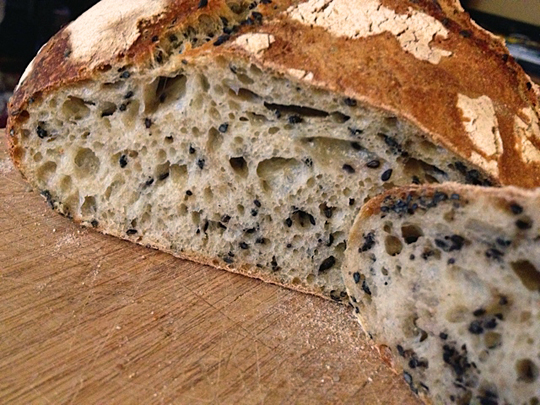
I was so excited about getting back my “sourdough mojo”, that the following day I baked another loaf, a recipe adapted from Tartine.

_________________________________________________________________________________________________________________________________________________

blacksesamecrumbCan you look at this crumb and not shed a tear or two of pure joy?


BLACK SESAME SOURDOUGH

(adapted from Chad Robertson Tartine)

For the starter:
50g  spelt flour
50g white flour
100g/ml water at 78-80F
1 Tbs active sourdough starter

For the dough:
375g/ml water at approximately 80F (divided in 350g + 25g)
100 g starter (you won’t use the full amount made)
440g white flour (good quality all-purpose is fine)
60g spelt flour
10g salt
1/3 cup black sesame seeds

In a large bowl, mix 350g of warm water with the starter (100g of it), and mix to dissolve. Add both types of flour, mix until all flour is mixed with water, without large dry bits present.  Let the dough rest for 25 to 40 minutes.

Add the salt and the rest of the water (25g), and incorporate by pressing the dough with your fingers. Fold the dough a few times, until if forms a homogeneous mass, but don’t try to knead it.  Leave it in the bowl, folding it again a few times – no need to remove it from the bowl – every 30 minutes, for the first two hours (you will be making 4 series of folds during this period).  Add the sesame seeds to the dough on your first folding, after all the water and salt has been incorporated.  After the last folding cycle, let the dough rest undisturbed for another full hour, for a total of 3 hours of “bulk fermentation.”

Remove the dough from the bowl and shape it gently as a ball, trying to create some surface tension (for a tutorial, click here).  Let it rest for 20 minutes, then do a final shaping, by folding the dough on itself and rotating it.  If you have a banneton, rub it with rice flour, line it with a soft cloth sprinkled with rice flour, and place the dough inside it with the seam-side up. If you don’t have a banneton, any round container – like a colander – will do. Let it rise for 3 to 4 hours at room temperature.  Twenty minutes before baking time, heat the oven to 450F.

Cut a piece of parchment paper that will completely cover a pie baking dish and place it on top of the banneton containing the bread dough.   Carefully invert the banneton  over the parchment paper, using the pie plate to support the dough.  The cloth will probably be sticking to the dough, so carefully peel it off.  Score the bread, and place the pie pan over baking tiles in the pre-heated oven.

Bake for about 45 minutes, covered during the first 20 minutes, remove the cover for the final 25 minutes.

Let the loaf cool completely on a rack before slicing.

ENJOY!

to print the recipe, click here

Comments: I’ve been working with bacteria for 30 years, and one of the things we know too well is not to store it in the fridge.  Some strains of E.coli develop a capsule, a heavy coating of polysaccharides once exposed to cold temperatures, and they become pretty tricky to work with, particularly if you study what we do: their outer membrane proteins.  We tell the students all the time to avoid keeping their plates in the fridge, if a strain is worth preserving it should be immediately frozen at – 70 C.  So, it was ironic that I never thought twice about keeping my sourdough starter in the fridge for years and years, without making a “backup” stock in the freezer.  Never again.

I hope that if you bake with sourdough, this post will help you out in case of problems.  Make a few balls of very thick sourdough starter and store it in the freezer. Label that bag, by the way… you don’t want to look at it months from now and decide it’s some unknown creature that got into your freezer when no one was paying attention.  And then proceed to toss it in the garbage!   😉

I am submitting this post to Susan’s Yeastspotting

ONE  YEAR AGO: Headed to Hawaii

TWO YEARS AGO: A yummy Brazilian cake: Bolo de Fuba’

THREE YEARS AGO:  Hidden Treasure

FOUR YEARS AGO: Avocado Three Ways
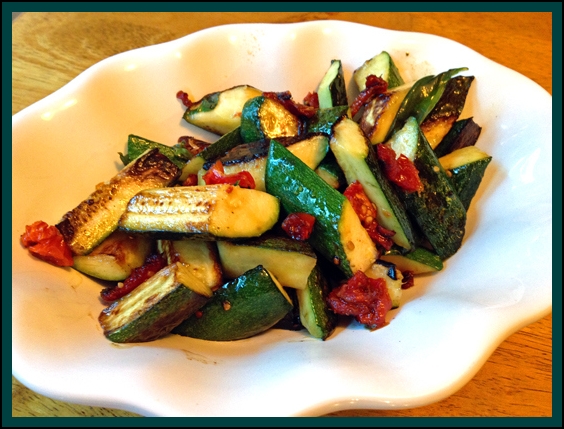
SAUTEED ZUCCHINI WITH SUN-DRIED TOMATOES AND BASIL

zucchinifc11
I’m always trying to find different ways to prepare zucchini, as we both love it so much. One of my favorite recipes is a simple stir-fry like this one, but the timing (and the size of your pan) must be just right, as a slight variation will result in overcooked, limp zucchini, with no bite whatsoever.  This recipe from Fine Cooking follows a totally different path to the stir-fry happy-ending.  Pieces of zucchini are lightly salted and sit for 10 minutes, a process that will draw out a lot of moisture and the bitterness that might turn some people off.  After that, you will be on your way to a tasty side dish.

SAUTEED ZUCCHINI WITH SUN-DRIED TOMATOES AND BASIL
(adapted from Fine Cooking magazine #65)

2 medium zucchini
1/2 tsp. Kosher salt + more for seasoning
2 Tbs. extra-virgin olive oil
1 clove garlic, smashed and peeled
3 oil-packed sun-dried tomatoes, drained and finely diced
6 fresh basil leaves, torn into large pieces
Freshly ground black pepper
1/2 lemon, juiced

Wash the zucchini and dry them with paper towels. Trim off the ends and quarter the zucchini lengthwise. Arrange the zucchini, cut side up, on a baking sheet lined with paper towels. Sprinkle with the salt and set aside for 10 minutes. Blot the quarters dry with the paper towels. Cut each quarter on the diagonal into 3/4-inch-thick pieces.

Heat a large skillet over medium-high heat for 1 minute. Pour in 2 Tbs. of the oil. When the oil is hot, add the zucchini and garlic, and sauté, stirring occasionally, until the zucchini browns and softens enough that you can cut through it with the side of a fork, about 5 min. Take the pan off the heat, toss in the sun-dried tomatoes and basil, and season generously with salt and pepper. Drizzle with the lemon juice and  serve immediately.

ENJOY!

to print the recipe, click here

composite111
Comments:  I have a bit of a troubled relationship with sun-dried tomatoes.  The ones that come packed in oil are often too greasy for my taste, but their texture is much better than the dry-packed ones. My approach is to buy the ones in oil, and before incorporating in the dish let them rest on a piece of kitchen paper to blot the excess oil away.

Fresh tomatoes would not deliver the same punch of flavor.  Sun-dried tomatoes are similar to red pepper flakes, instead of having their flavor uniformly diluted across the dish, they give you little spikes of heat.  Perfect!

This was a delicious way to prepare zucchini, yet another recipe that can be adapted in many ways.  Try adding roasted red bell pepper in place of sun-dried tomatoes, cilantro instead of basil, a bit of mint…  Don’t omit the lemon juice, though.  It is a must!

ONE YEAR AGO: Orzo with Heirloom Tomato Relish

TWO YEARS AGO:  Headed to Brazil!

THREE YEARS AGO: The Rhubarb Brouhaha: Revelation Compote

FOUR YEARS AGO: Love me tender…

JERUSALEM: PASTA WITH YOGURT, PEAS & CHILE

If you are a cookbook lover, chances are you have at least one of Yotam Ottolenghi’s books on your shelf. His book “Plenty” (released in 2011) was a huge success, but “Jerusalem“, which he wrote together with Sami Tamimi is probably the hottest cookbook published  last year.  Countless bloggers have been raving about  the recipes in Jerusalem, and even the Diner’s Journal of The New York Times devoted a special article to the cookbook.  As usual, I bookmarked way too many tempting concoctions to try, but when I read this review from Orangette, I knew this pasta would hit the spot with us.  Several things I like about it: the sauce is made with yogurt instead of cream or a bechamel; peas are incorporated in two ways; feta cheese gives it a sharp bite, and fresh basil does the magic that fresh basil always does.

forframe11
But, as if that symphony of flavors and textures was not enough, each serving is crowned with a spicy and nutty flavored oil, made by sauteing pine nuts and Aleppo pepper.  Oh, my!   Can you spell perfection?

forframe22
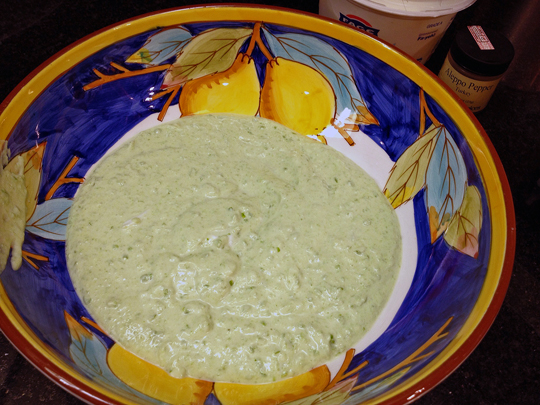
The two main components of the dish come together quite quickly. First, the yogurt-pea sauce, simply whirled in a food processor.  Beautiful light green color!

sauce
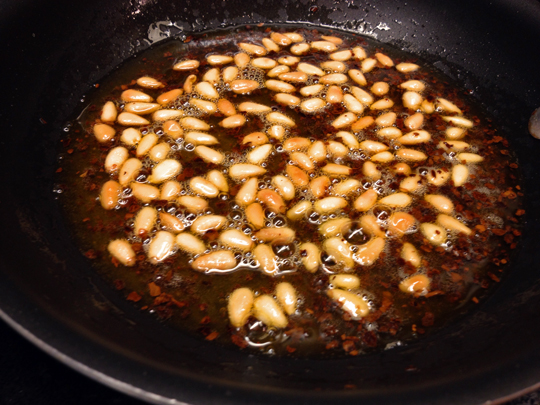
Then, the finishing touch, a flavored oil with pine nuts and Aleppo pepper. Red pepper flakes can be substituted, but I say go for a Turkish pepper if you can find it.

aleppo

The yogurt sauce is never heated, instead the hot pasta is added to it in small batches to prevent the sauce from separating.  Reminds me of pasta in fresh tomato sauce, a regular appearance at our table these days.

I must say this recipe was the best thing I cooked in a few months! I loved everything about it…  The original recipe used small shell-shaped pasta which might be even better to catch those cute little peas,  but any pasta will work.  If you have a dinner party coming up and would like to offer a vegetarian option, I say it will be hard to top this one…   😉

If you want the full recipe, you can buy the book (click here), or you can use the version published at Orangette

ONE YEAR AGO: Edamame Hummus in Cucumber Bites

TWO YEARS AGO:  Headed to Brazil!

THREE YEARS AGO: Twice-Baked Goat Cheese Souffle

FOUR YEARS AGO: Golly Moses: She’s  a Muffin!

SECRET RECIPE CLUB: LEMON POPPY-SEED MUFFINS

At the risk of repeating myself over and over and over, I must say the last Monday of each month makes me feel as happy as a kid in a toy store… Why? It is the day in which bloggers of my group at The Secret Recipe Club reveal which blog they were assigned to cook from, and post their recipes. This month, I could not be more pleased with my assignment. I got April’s blog, Angels Homestead. April is a very active participant of the club. You see, we have a Facebook group to discuss issues, make sure everyone is aware of what needs to be done (participation forms to be filled, upcoming Reveal Days), and April is always there with her very unique and personal touch. I was thrilled to cook from her blog! It took me just a few minutes to settle on a recipe, because right when I got the assignment I was wondering about something to bake and take to our department. Lemon poppy-seed muffins seemed perfect. And perfect they were! 😉

muffin1.
If you want to make a batch of muffins to cheer your co-workers early in the morning, here’s the way to do it:  before going to bed, measure the dry ingredients, place the flour in a large bowl, the baking powder and baking soda on small bowls next to it.  Get the two eggs ready to go, same for poppy seeds, sugar, and lemon.   Place paper liners in your muffin pan.  Measure the butter, the yogurt (or sour cream), and place both in the fridge. Marvel at your uncanny sense of organization, and go to sleep. Have pleasant dreams.

ingredients
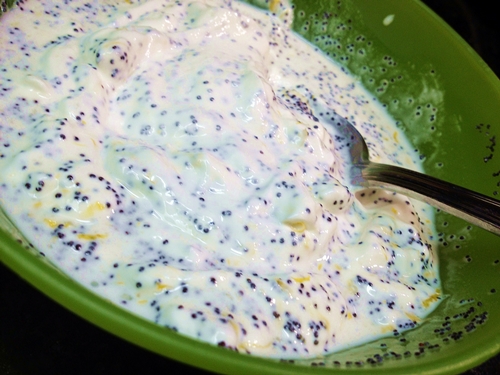
Next morning, turn the oven on.  Grab the yogurt from the fridge, zest and juice the lemon,  add the poppy seeds and mix them al together.

poppy
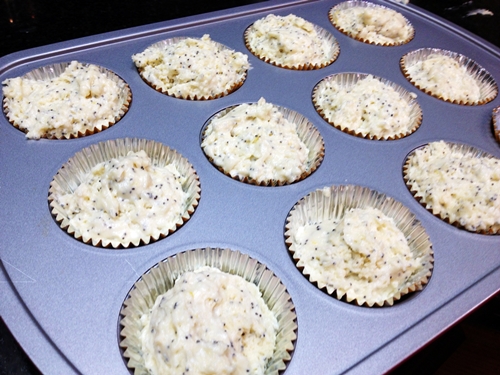
Beat the sugar with the butter and the eggs, add the poppy seeds mixture, incorporate all very well.  Add the dry ingredients and mix gently.  Add scoops of the batter to the muffin pan, trying to add the same amount to each paper liner.  If you are like me, at this stage of the day the caffeine has not kicked in yet, so your consistency won’t be stellar.  Oh, well…  Do your best.

unbaked
Now, all you have to do is bake those babies, and get ready to brighten up the morning of your colleagues.  If you can make that a Monday morning, even better…   😉

baked

for a printable version of the recipe, click here

For some serious fun with the productions of my fellow Secret Recipe members, click on the blue frog that is smiling at you at the bottom of the post. She is a bit cross-eyed, but still pretty adorable.

April, I hope you know how much I enjoyed getting assigned to your blog this month!  A real special treat…  😉

ONE YEAR AGO: Secret Recipe Club: Mascarpone Brownies

TWO YEARS AGO: Salmon Tacos

THREE YEARS AGO: Cinnamon Turban Bread

FOUR YEARS AGO: Summertime Gratin

GRATED TOMATO SAUCE, REVISITED

Almost three years ago I blogged on a fresh tomato sauce in which the tomatoes are grated instead of diced or processed. It is such a nice method that I feel it’s worth mentioning again for those who might be new to my site.  Something about its texture makes this sauce absolutely unique and very delicious…

served111
WHOLE-WHEAT SPAGHETTI WITH GRATED TOMATO SAUCE
(from the Bewitching Kitchen)

Whole-wheat spaghetti
4 large, ripe tomatoes or 6 medium, halved crosswise
1 tablespoon olive oil
1 tablespoon white balsamic vinegar
1 tsp dried mint leaves
2 tablespoons capers (or to taste)
salt and pepper to taste
fresh basil leaves, cut in chiffonade
Parmigiano-Reggiano for serving

Cook the pasta in a large pot of salted boiling water until al dente.

Meanwhile, in a large bowl, grate the tomatoes using a box grater with medium-large holes.  The skin of the tomato will protect your hand as it gets close to the grater.

To the grated tomatoes, add the olive oil, balsamic vinegar, mint, capers, salt and pepper.  Mix well.  Add the cooked pasta on top of the cold tomato mixture, and immediately add the basil.   Toss everything together gently, and serve right away with Parmigiano cheese.

ENJOY!

to print the recipe, click here

IMG_2292IT”S ALL ABOUT THE TEXTURE…

I make this type of pasta several times each summer, never get tired of it!  Since I learned from Louisa Shafia that dried mint should not be frowned upon, I’ve been using it a lot. In this pasta, it worked wonders together with the capers and the basil…   You can adapt this recipe in countless ways, just make sure to grate the tomatoes, it is amazing how a little change can bring so much to a simple recipe.

IMG_2299
The refreshing pasta next to a simple roasted chicken, adapted from an old favorite.

ONE YEAR AGO: A Taste of Yellow to Honor Barbara

TWO YEARS AGO: Gratin of Beefsteak Tomatoes

THREE YEARS AGO: Tour de France Final Stage: PARIS

FOUR YEARS AGO: Snickerdoodles with a Twist