CHOCOLATE TARTLETS WITH HONEY CARAMEL FILLING

Care to find out what’s my latest obsession? Afternoon Tea Cookbooks. Most are not available as Kindle books, so I tend to be very selective when inviting one into our home. Reviews must be absolutely stellar, and pictures must be included for most (if not all) recipes. One book that made the cut is Afternoon Tea At Home, by Will Torrent. It is absolutely wonderful. As I was browsing through its pages and trying to decide what to make first from it, I had this crazy idea and immediately acted on it. Handed the book to Phil and said “Here, pick a recipe, any recipe, and I’ll make it.”  I call that Self-Inflicted Technical Challenge. He needed less than 2 minutes. Of course, the recipe he chose involved a crust, a caramel filling, tempering chocolate, and using transfer sheets to decorate it. Me and my big mouth. When will I ever learn?

CHOCOLATE TARTLETS WITH HONEY CARAMEL FILLING
(adapted from Afternoon Tea at Home)

for the crust:
200g all-purpose flour
150g butter, cut in pieces, cold
90g powdered sugar
60g almond flour
20g cocoa powder
pinch of salt
4 egg yolks

for the filling:
1 cup (320 g) honey
½ cup (120 ml) heavy cream

¼ cup (60 ml) sweetened condensed milk
¼ cup (85 g) corn syrup
pinch of salt
2 tablespoons unsalted butter 

for the topping:
1 cup heavy cream
3 tablespoons powdered sugar (or to taste)
1 tablespoon skimmed dry milk
100g tempered dark chocolate
12 sugar bees

Make the crust: Put the flour and butter in the bowl of a Kitchen Aid mixer and mix until the butter gets into crumbs, coated by the flour. In a separate bowl mix the sugar, almond flour, cocoa powder and salt. Add this mixture to the butter/flour, mix on very low-speed to combine (you want to avoid developing gluten). When it is almost fully combined, add the egg yolks and again mix very gently.  Form a dough, flatten it, wrap in plastic and place in the fridge for 1 hour.

Turn the dough onto a floured surface and roll out to 1/8 inch thick. Cut 12 rounds that will fit a muffin pan, coming all the way to the sides. Chill in the fridge for at least 30 minutes before blind-baking at 325 F.  I like to use plastic wrap to enclose rice or pie weights, it is safe to bake at this temperature, as long as the plastic does not touch the metal surface of the tin. Bake for 10 minutes, remove the weight, and bake for 5 to 10 more minutes. The tartlets must be fully baked, as no more cooking will take place.  Cool in the pan.

Make the filling: Combine the honey,  cream, condensed milk, corn syrup, and salt in a saucepan. Stir over medium heat until the mixture reaches 240F. Remove from the heat and stir in the butter. Divide among fully blind baked shells and allow to cool to room temperature. 

Make the chocolate decoration. Temper the chocolate according to your favorite method. Spread over the transfer sheet (make sure to use the correct side of the sheet!), let it set for a few minutes, then stamp circles the exact size of the top of the tartlets. Once fully set, gently peel the chocolate off the transfer sheet. Marvel at the design, pat yourself on the back.

Make the whipped cream. Beat the heavy cream with sugar and powdered milk until it forms medium peaks, transfer to a piping bag with a simple round piping tip.

Assemble the tartlets. When the crusts are cold, fill them with the caramel, place in the fridge to speed cooling a bit. Once the surface is set, gently place the chocolate decoration on top. Pipe the whipped cream, and set a little sugar bee on top.

ENJOY!

to print the recipe, click here

Comments: This recipe, originally called Beehive Tarts, comes from David Girard, Head Pastry Chef from The Dorchester. I kept the crust and the chocolate decorations, but changed the filling and the topping. The filling was a honey caramel thickened with gelatin, but I worried that it would not set up enough to be neatly sliced in half. Since I take my bakes to the department, I prefer to offer a larger number of small portions, so more colleagues can enjoy them.  For this reason, I used a caramel adapted from a recipe I made a couple of years ago.  As for the topping, in the book he uses lemon curd (it did give a nice yellow color very cute with the little bee sitting next to it), but I love the combination of chocolate, caramel and whipped cream. I stabilized the whipped cream with powdered milk, a trick I learned from Anna Olson. It does stabilize it very well and is super simple to do, but I prefer the taste of whipped cream stabilized with gelatin (I will talk about it in the very near future).
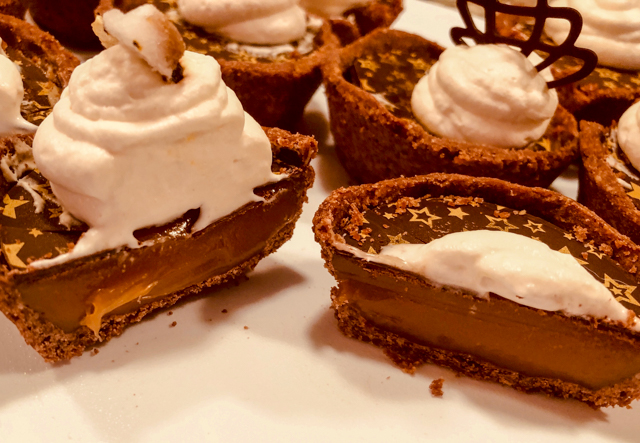
The chocolate disc decoration… Tempering chocolate is the number one culinary task that gives me hyperventilation. So many failures, it’s not even funny. Somehow this time things worked beautifully in the microwave/seeding method. Two basic changes in my approach: I grated the chocolate finely instead of keeping it in chunks, and used a microwave-safe plastic bowl instead of Pyrex, in very short cycles of heating, not more than 10 seconds at a time. I kept 1/4 of the chocolate grated at room temperature to use as “seed.”  Then I stirred, and stirred, and stirred some more, monitoring the temperature very carefully.  Once the chocolate was tempered, it was spread over the transfer sheet. I tried my best to do it as uniformly as possible.
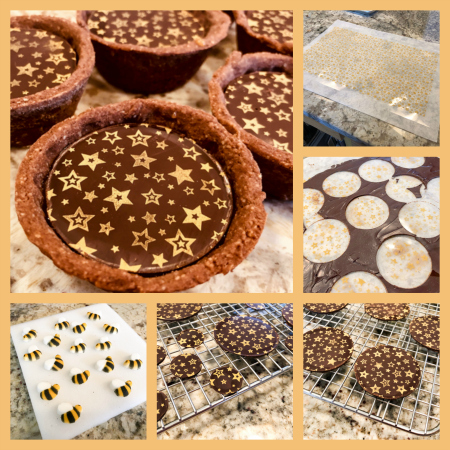
At that point, I waited for the chocolate to start setting, but did not allow it to fully harden. You have a good window of several minutes to work, no need to panic. You could panic, of course, but it’s not mandatory. Then using a cookie cutter, I pressed into the chocolate, and lifted the disc. That is what I call a rookie’s mistake. If you use this technique, press the cookie cutter, forming the edges as sharply as possible, but do not lift the disc yet. Wait until it is fully set. That will ensure that the pattern will efficiently transfer. My first discs clearly showed some variability in the pattern, weak at some spots, well-defined in others. But for a first time, I am pretty happy with the way it turned out.  The sugar bees? I bought them from amazon.  If you have artistic inclinations, you could make some with fondant, or modeling chocolate. I cringe to imagine what my bees would look like if I attempted to make them from scratch. Rotten mangos? Pineapples after a wild boar stampede?  Neither option would look right.
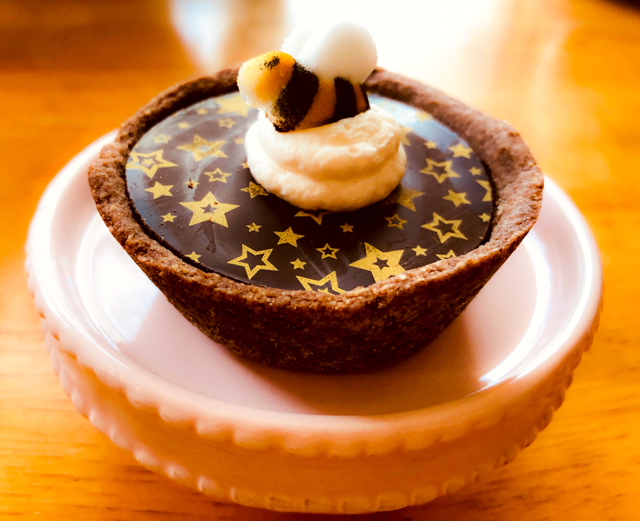
But the heart of the matter is: can Sally bake without drama? Sometimes yes, but not always. After I took the photos for the post, I placed my cute tartlets in a tray to take them to the fridge, where they would sit until Monday morning. A very unfortunate bump of my hand on the shelf of the fridge, and they slid off the tray, one fell all the way to the floor, some tumbled inside the fridge… Can you feel the pain? At first I thought they were all ruined, but luckily enough most were ok after I shaved off a bit of broken crust  here and there. I had to discard a few bees that were messed up when they got shoved into a puddle of whipped cream. I also had to remove all the cream very carefully, clean the tops and decorate them again. The tartlet that fell to the floor? You can guess who swallowed it before I could do anything to prevent that from happening. Yes, there was chocolate. Yes, he was totally fine and quite pleased with that twist of canine fate.  Never a dull moment, folks. Never a dull moment.

The tartlets are quite decadent, the little bees have a melt in your mouth texture, not hard as rock sugar. I was pleasantly surprised. Obviously you can skip that component, without compromising the dessert. I just felt like going the extra mile, because the person who requested the recipe deserves only the best…
ONE YEAR AGO: Zucchini Soup with Tahini

TWO YEARS AGO: Black Sesame Macarons

THREE YEARS AGO: Fine Tuning Thomas Keller

FOUR YEARS AGO: Cauliflower Tortillas

FIVE YEARS AGO: Majestic Sedona, Take Two

SIX YEARS AGO: Secret Ingredient Turkey Meatballs

SEVEN YEARS AGO: Swedish Meatballs and Egg Noodles

EIGHT YEARS AGO: Italian Easter Pie

NINE YEARS AGO: Black Olive Bialy


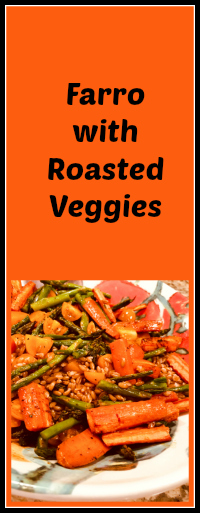
FRESH TAKE ON FARRO WITH ROASTED VEGGIES

Grains and roasted veggies are a classic combination, one that I like a lot and shows up at our table on a regular basis. But lately I’ve incorporated a small extra step into it, and it is a game changer.  Interesting expression, by the way. From my “foreign perspective”, it is not necessarily a good thing.  After all, if the game is going well, a game changer would ruin it.  But the term, adopted by the Oxford dictionary very recently (2012), always has a positive connotation. Which makes it perfect to describe the addition of fresh veggies right before serving this dish. Game-changing. I promise.

FARRO WITH ROASTED VEGGIES
(from the Bewitching Kitchen)

1 cup farro
5 carrots, peeled and cut in sticks
bunch of asparagus
drizzle of olive oil
1/2 tsp smoked paprika
salt and pepper to taste
yellow grape tomatoes, cut in half
fresh lemon juice to taste

Fill a large pot with salted water and bring to a boil.  Add the farro and cook (as if cooking pasta) until al dente. Cooking time will depend on many factors, start checking at 25 minutes, it might take 40 minutes or a tad longer. When cooked to your liking, drain and reserve.

Coat the carrots with a bit of olive oil, season with paprika, salt and pepper. Roast uncovered in a 420F oven for about 30 minutes. Meanwhile, prepare the asparagus. Lay they on a microwave-safe dish, season very lightly with salt and sprinkle with lemon juice. Add a paper towel on top to cover them lightly. Microwave for 2 to 3 minutes. Reserve.

When the carrots are almost done roasting, add the asparagus and gently mix them. If necessary, add a touch more of olive oil. Roast the two veggies together for a final 5 minutes. Immediately add the fresh tomatoes, toss all veggies together, and place in a serving dish together with the farro. Adjust seasoning and serve.

ENJOY!

to print the recipe, click here

Comments: First, let me say that cooking farro as if it’s pasta (freely swimming in a huge pool of water), is another game changer. The problem with farro is that if you go by a specific ratio of water to grain, sometimes you hit the jackpot (that is the grain is perfectly cooked when the water is absorbed), but sometimes it is either too hard or mushy.  This method takes all the guessing out of it, you cook, you test it as the cooking goes along, and when it reaches the level you like, it’s over. Drain it, and incorporate in any recipe you like.

As to the veggies, I realize this is a little more involved than roasting a bunch of them together and calling it a day. The thing is, I am not too fond of the woody texture that the asparagus gets when simply roasted. With braces, the situation gets even worse. So I use my favorite method of preparing them, a very brief encounter with the microwave, and then finalizing in the oven. It gets the best of both worlds.

Finally, the fresh component. The real game-changing bit. Amazing what that does to a roasted veggie concoction. It brightens up the flavors, and makes the whole thing taste quite a bit lighter. You can use tomatoes of any color, diced cucumber, radishes, kalamata olives, and guess what? Grapes! Seedless grapes, cut in half. You will be surprised how well they pair with roasted veggies. I intend to try strawberries next. Why not, right? With a little rose harissa just to take it truly over the top…

ONE YEAR AGO: Secret Recipe Club Reunion 2018

TWO YEARS AGO: Parsnip and Tomato Soup

THREE YEARS AGO: A Retro Dessert

FOUR YEARS AGO: Cauliflower Tortillas: Going low-carb and loving it!

FIVE YEARS AGO: Clementines in Cinnamon Syrup

SIX YEARS AGO: In My Kitchen, April 2013 

SEVEN YEARS AGO: Thrilling Moments

EIGHT YEARS AGO: Maple-Oatmeal Sourdough Bread

NINE YEARS AGO: Pork Trinity: coffee, mushrooms, and curry

MACARONS FOR A LITTLE PRINCESS

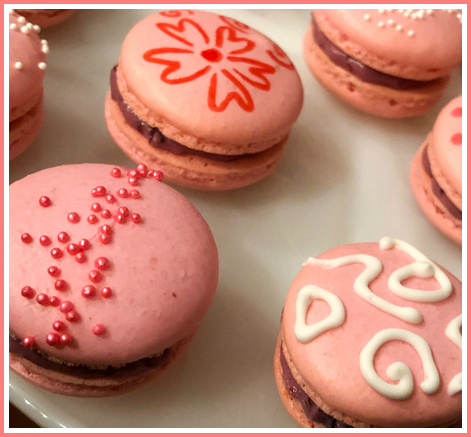
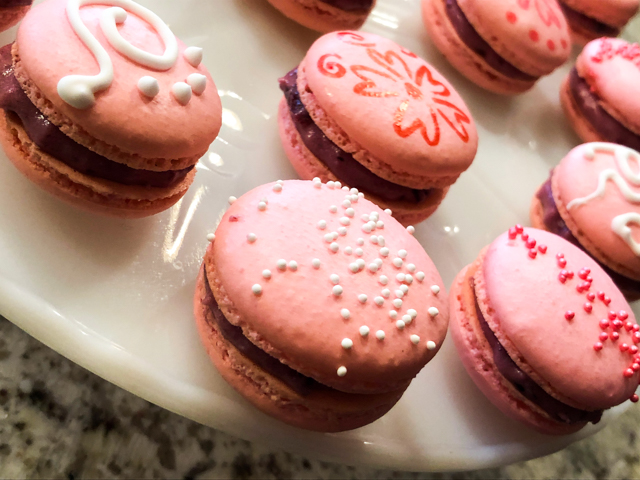
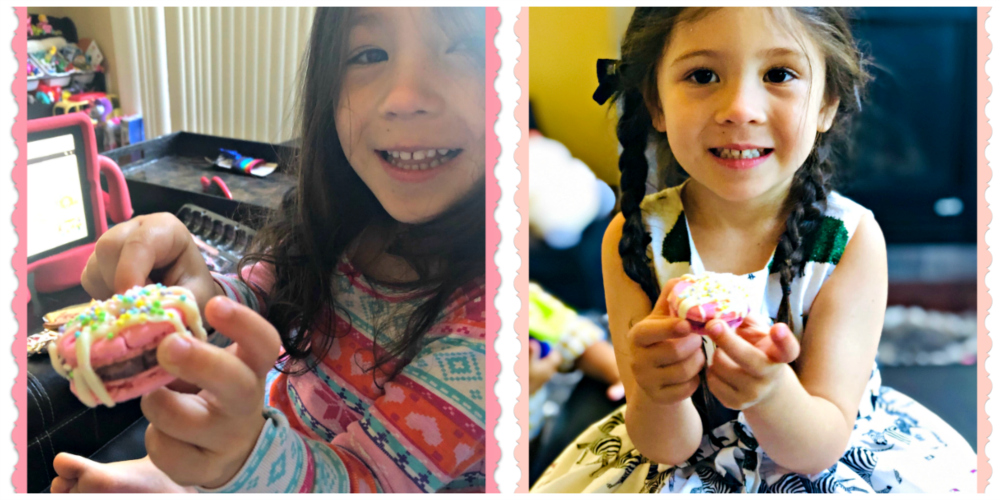
Time goes by way too quickly. Not too long ago we were thrilled with the idea we would be grandparents, and all of a sudden, that sweet little baby turned four years old!  To celebrate the occasion, we wanted to send her a box of pink macarons, as pink is her favorite color. I settled on blackberry filling, and decided to try a bunch of different decorations, so she could choose her favorite.

BLACKBERRY MACARONS
(from the Bewitching Kitchen)

for the shells:
198 g powdered sugar (I used Cherry Bakewell flavored)
113 g almond meal
113 g egg whites at room temperature
a pinch of cream of tartar
100 g granulated sugar
pink gel color from AmeriColor
2 drops vanilla extract

for the filling:
8 ounces white chocolate
1/2 cup blackberry jam
2 1/2 tablespoons heavy cream

to decorate:
Royal icing
sprinkles of your choice
edible marker drawings
melted white chocolate

Line 2 or 3 heavy baking sheets with parchment paper or Silpat mats. Layer the powdered sugar and almond meal   in a food processor. Pulse until the mixture looks like fine meal, about 15 seconds. Pass through a sieve and transfer to a small bowl. Set aside.

Place the egg whites and pinch of cream of tartar in the bowl of a stand mixer fitted with the whisk attachment. Make sure that the bowl and the whisk are impeccably clean. Starting on medium speed, whip the whites with the cream of tartar until they look like light foam. The whites should not appear liquid. The foam will be light and should not have any structure.

Slowly rain in the granulated sugar, trying to aim the stream between the whisk and the side of the bowl. Turn the speed up to medium-high. Continue to whip the meringue until it is soft and shiny. It should look like marshmallow creme. Add the gel color and the vanilla. Staying at medium-high speed, whip the egg whites until the mixture begins to dull and the lines of the whisk are visible on the surface of the meringue. Check the peak. It should be firm. Transfer the whites to a medium bowl.

Fold in the almond meal mixture in three increments. Paint the mixture halfway up the side of the bowl, using the flat side of a spatula. Scrape the mixture down to the center of the bowl. Repeat two or three times, then check to see if the mixture slides slowly down the side of the bowl. Put the mixture in a piping bag fitted with one of the tips listed above. Pipe on the prepared baking sheets.

Slam each sheet hard four to six times on the counter. Then fist bump each end of the sheet’s underside twice. If using sprinkles, add them now, before the shells dry. Let the unbaked macarons dry until they look dull but not overly dry. Drying time depends on humidity. In a dry climate, the macarons can dry in 15 to 20 minutes; in a humid climate, it can take 35 to 40 minutes.

While the macarons are drying, heat the oven to 300 F. Bake one sheet at a time on the middle rack. Check in 11 minutes. If the tops slide, then bake for 2 to 3 more minutes. The macarons should release without sticking. Check one or two. If they stick, put them back in the oven for 1 to 2 more minutes. Let the macaroons cool for 10 minutes before removing from the pan.

Make the filling: Place chocolate in a heatproof bowl and set over a pot of simmering water on low heat. Stir chocolate until melted. Remove from heat, and whisk in jam and heavy cream. Cover and chill 2 hours, or until cold. Whip it with a hand-held electric mixer until it reaches a good consistency for piping. Transfer ganache to a piping bag fitted with a 1/4-inch star tip.

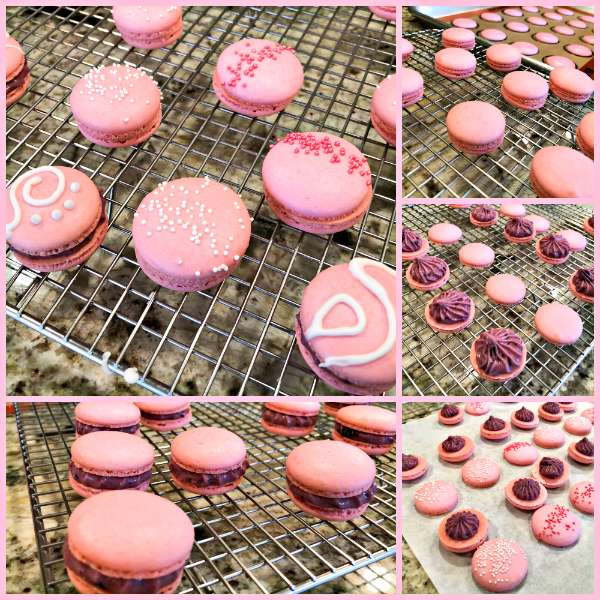
Assemble the macarons: find two macarons similar in size and pipe a good amount of filling to the bottom of one of them. Place the other on top and squeeze gently to take the filling all the way to the edge.  Decorate any way you want. Store in the fridge for 24 hours for perfect texture.

ENJOY!

to print the recipe, click here

Comments: The logistics of gifting macarons to someone living a thousand miles away is a bit complicated, but of course doable. Where there is a will, there’s a way, right?  Keeping in mind that macarons need to sit overnight in the fridge to “mature”, you must start the process a couple of days early.  The maturation process is essentially absorption of moisture from the filling into the shells. Macaron shells start pretty dry and crumbly, as you’ll notice if you bite into them right after they cool down. Once you add buttercream or ganache, the moisture slowly permeates into the shells and turns the cookie into perfect little morsels of sweetness, with the exact amount of chewiness. But anyway, back to the issue of gifting macs.

Her birthday fell on a Thursday, so we had to ship it overnight on Wednesday. You can conceivably do a 2-day shipping to save considerable cash, but this was a special occasion, so we splurged. With that in mind, baking day was set for Tuesday after work. I had my fingers firmly crossed for the Macaron Gods to smile on me, because that was it, I needed them to be perfect, no time to try again. Stars were properly aligned: success! By 22:45hs  they  were  going  into the fridge, and the baker into a warm bed…   😉  

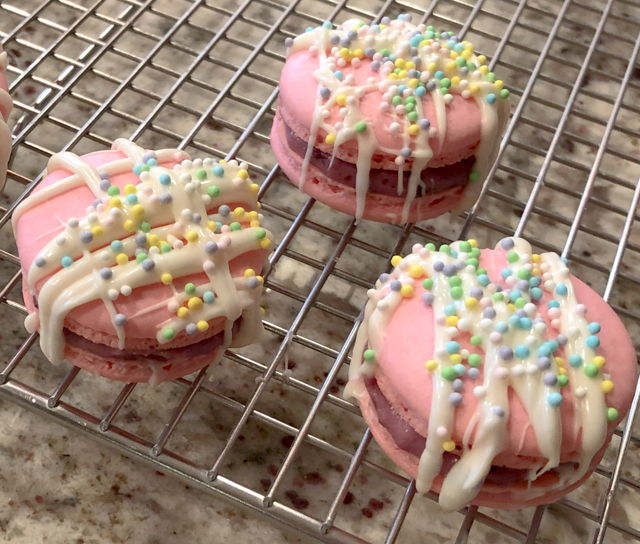
I used royal icing decoration in some of them, sprinkles in others, went Jackson Pollock in some, and even tried my hands at free drawing with edible markers (first time I dared doing it). The markers are from Chefmaster and have a very soft tip, you have to still use a light hand on the very delicate macaron shell, but trust me, if I could pull this, anyone can.

and her favorite….  DRUM ROLL!!!!!!!!!!


ONE YEAR AGO: Gilding the Sourdough Loaf

TWO YEARS AGO: Lolita Joins the Bewitching Kitchen

THREE YEARS AGO: Cashew Cream Sauce

FOUR YEARS AGO: Blood Orange Margaritas

FIVE YEARS AGO: Smoked Salmon Appetizer

SIX YEARS AGO: Clementine Cake

SEVEN YEARS AGO: Springtime Spinach Risotto

EIGHT YEARS AGO: The end of green bean cruelty

NINE YEARS AGO: Torta di Limone e Mandorle


AVGOLEMONO SOUP, MY WAY

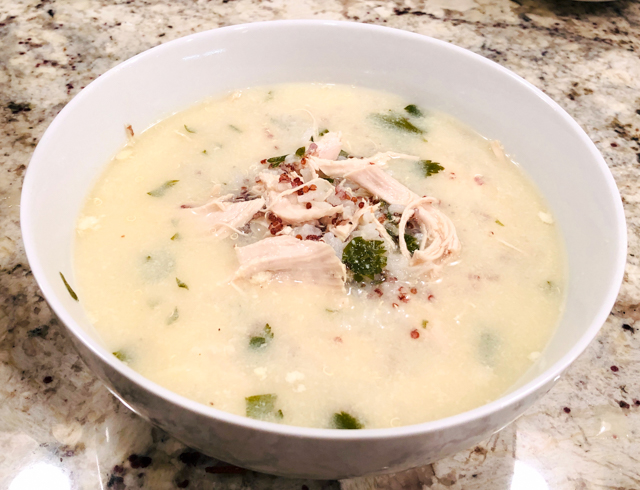
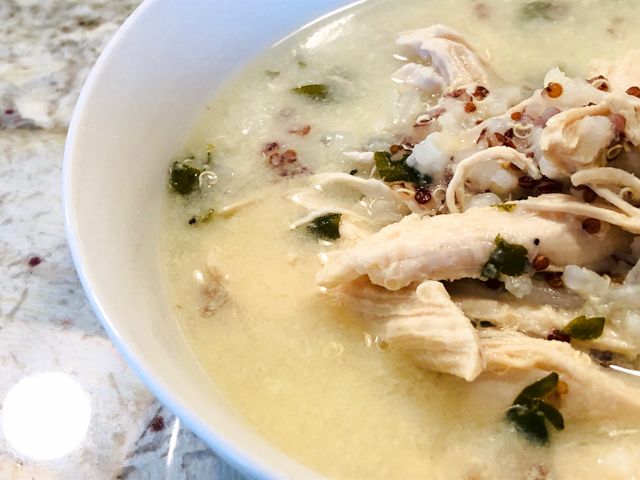
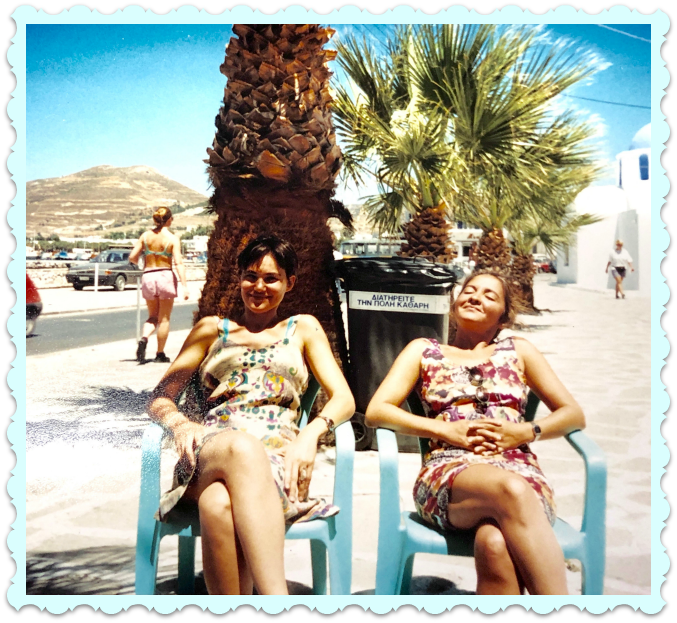
At the risk of being blocked from entering Greece, I share my version of this legendary classic. I took a few liberties with it, so be prepared. I hope they won’t confiscate my passport because Greece is one spot of this planet I want to go back to. My only visit was too long ago, back in 1994, with my very dear friend Gabi. That was one week that I can live to be 100 and will never forget. How fitting that this post is published on her day…  Happy Birthday, Gabi!

AVGOLEMONO SOUP
(inspired by Jeff Mauro’s The Kitchen)

2 quarts low-sodium chicken stock
3 boneless, skinless chicken breasts
1/2 cup rice
1/4 cup red quinoa
2 large eggs, separated
1 tablespoon lemon zest plus 1/2 cup fresh lemon juice
salt and freshly cracked black pepper
Chopped fresh parsley
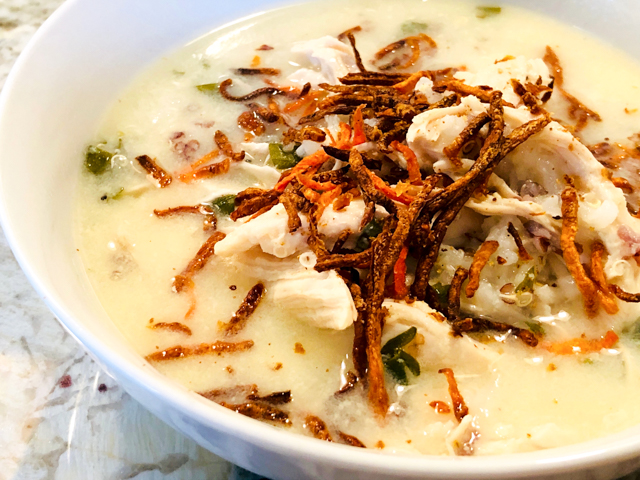
fried shoestring carrots for topping (optional)

In a large stockpot, bring the chicken stock to a boil. Add the chicken breasts and then lower to a simmer. Simmer until the chicken is just cooked through, 15 to 20 minutes; remove to a bowl. Once cooled, shred the chicken and reserve.

Add the rice and quinoa to the pot with the chicken stock and cook until al dente, about 10 minutes.

In a large bowl, whisk the egg whites to soft peaks. In a medium bowl, whisk together the egg yolks and most of the lemon juice, reserving some to add later. Fold the egg yolk mixture into the egg whites. Once combined, ladle in some hot stock to temper the egg mixture, whisking constantly and adding the hot liquid slowly. Very slowly, add the warm whipped egg/lemon mixture into the pot, whisking constantly to prevent any curds or clumps from forming. Continue to cook over medium-low to medium heat, whisking, until the soup thickens, about 5 to 8 minutes more.

Add the shredded chicken and any reserved juices to the soup. Add the lemon zest and season with salt and plenty of freshly cracked black pepper. Taste and add additional lemon juice if needed. Add parsley and serve with fried carrots on top, if so desired.

ENJOY!

to print the recipe, click here


Comments: This recipe was featured in a recent The Kitchen show, and I was intrigued by the fact that it is supposed to taste super creamy while being quite low in fat. The full amount of soup contains only two egg yolks. No butter, no cream, no sour cream, nothing. It is also very lemony, therefore the name avgolemono (egg and lemon) soup. The chicken and rice would almost be bystanders. Think of an egg drop soup, but one in which the eggs form a nice emulsion with the broth. Jeff Mauro started “messing” with the classic by adding orzo instead of rice. I say, if he can do it, so can I! Into mine went some red quinoa. But the real shocker came when I topped it with air-fried carrots.


This was so so good, I am glad I tried it. To be completely honest, credit should go to my beloved partner. I had planned to serve the carrots on the side just as added fun to our dinner. He grabbed a bunch and topped his soup with it. It looked interesting, and then his reaction made me do the same. Big wow moment!  If you have an air-fryer, consider preparing a bunch of these carrots to add to soups. Or salsas, or whatever. They are tasty, and addictive. Perhaps not as Greek as Pythagoras, but I bet he would have enjoyed them on top of his avgolemono…


ONE YEAR AGO: Sourdough Chocolate Twist Bread

TWO YEARS AGO: Dan Lepard Times Three

THREE YEARS AGO: Turkey Portobello Burger

FOUR YEARS AGO: Raspberry Ricotta Cake

FIVE YEARS AGO: In My Kitchen, April 2014

SIX YEARS AGO: Whole-Wheat Pasta with Lemony Tomatoes and Spinach

SEVEN YEARS AGO: Blood Orange Duck: A work in progress

EIGHT YEARS AGO: Grilled Mahi-mahi with citrus marinade

NINE YEARS AGO: Memories of Pastéis


SAKURA BUCHE DU PRINTEMPS

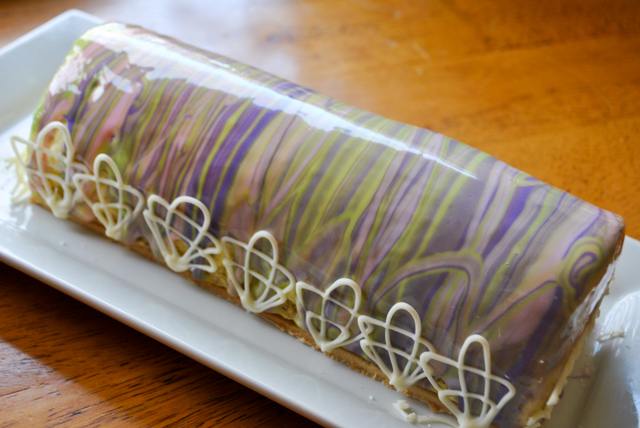
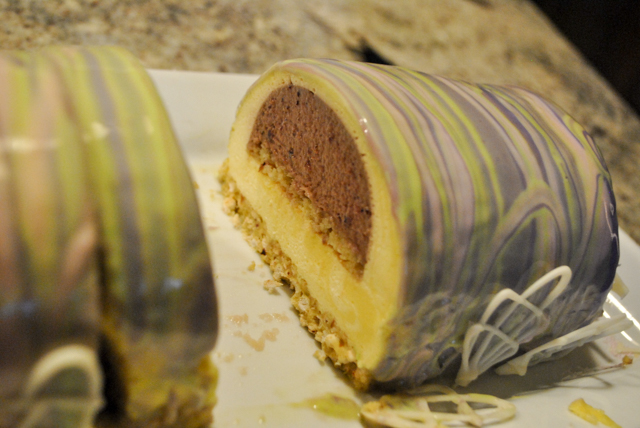
This past winter was so hard that I intend to keep celebrating the arrival of spring for as long as I can get away with it. Clearly, nothing says spring better than cherry blossoms. In this cake, my goal was to have a creamy sakura-flavored mousse involving a fruity center, as a red fruit compote. For the base of the dessert, I made a crusty layer with puffed quinoa, the new (to me) ingredient I mentioned in my last post. To finalize, a pastel-colored mirror glaze action, in pink, purple and green.  Why the French name?  Because it is irresistibly poetic, that’s why.

SAKURA BUCHE DU PRINTEMPS
(from the Bewitching Kitchen, inspired by many sources)

for the biscuit layer:
125 g eggs
90 g powdered sugar (I used Bakewell cherry flavored)
90 g almond flour
30 g flour
20 g melted butter
180 g egg whites
40 g sugar (superfine if available)

for the berry compote:
300 g pure of cherries and red berries
2 whole eggs
140 g honey
140 g whipping cream
6 g gelatin in sheets
60 g butter, at room temperature

for the quinoa-crisp:
113 g white chocolate
20 g pistachio paste
20 g puffed quinoa

for the Sakura mousse:
210 g milk
1/8 tsp sakura leaf powder (optional)
1/8 tsp cherry blossom essence
100 g egg yolks
110 g sugar
8 g gelatin sheets
210 g whipping cream

for the mirror glaze:
150 g glucose
150 g granulated sugar
150 g white chocolate, cut in small pieces
75 g water
100 g condensed, sweetened milk
9 g gelatin in sheets
1/2 tsp titanium oxide (optional, but worth it)
pink, purple, and bright green gel food dye

Two days before serving, make the biscuit and the cherry compote.

For the biscuit: In the bowl of a Kitchen Aid mixer fitted with the leaf blade, beat the eggs, sugar an almond flour together for 4 to 5 minutes. Transfer to a mixing bowl, and after thoroughly cleaning the bowl of the Kitchen Aid, whisk the egg whites until you can see if forming a trail as the whisk goes through them. At this point, slowly rain the fine sugar to form a soft-peak meringue.  Add the meringue to the egg-sugar-almond mixture previously made. Mix gently with a spatula. Add the flour gently, sifting it over the mixture. Finally, add a bit of the mixture to the melted butter, make a smooth emulsion with it, and pour it into the batter. Mix as gently as possible.

Spread the batter on a baking sheet lined with parchment paper as a layer a little over 1/2 inch thick, and bake for 12 minutes at 380 F.  Once the biscuit is cool, cut the rectangle needed to fit the smaller buche. While the biscuit cools, make the compote.

For the compote: Soak the gelatin sheets in a bowl of cold water for at least 10 minutes. Place the eggs, honey, fruit puree and heavy cream in a bowl and whisk with an immersion blender (or use a regular blender if you prefer). Pour the mixture in a saucepan and bring the temperature to 180 F, stirring constantly and never using too high heat. Remove the pan from the stove, add the drained gelatin, and mix. Let it cool for about 10 minutes and add the softened butter, mixing again until well incorporated. Pour into the mold, then gently add the biscuit on top, pressing gently. You don’t want it to submerge, just float on the surface. Wrap the top of the mold with plastic and freeze overnight.

Make the quinoa-crisp. Bake the puffed quinoa in a 325 F oven for 10 minutes.  Meanwhile, melt the white chocolate in a microwave very gently. Mix the melted chocolate with the pistachio paste.  Add the quinoa and spread  in a 4 mm (1/8 inch) thickness in between two sheets of parchment paper. It will be a little sticky, try to level it as best as you can. When it is cooled down a bit, cut the exact dimension of the bigger mold you will use for the dessert. Reserve.

Make the Sakura mousse. Soak the gelatin sheets in cold water for at least 10 minutes. Bring the milk to almost boiling and add the sakura leaf powder, mixing well to dissolve. Let it sit covered for 10 minutes.  In a small bowl, whisk the egg yolks with the sugar. Slowly add the hot milk infused with the sakura powder, whisking constantly. Transfer back to the pan and heat gently to 180 F. Do not let it go over or you will scramble the egg yolks. Transfer to a bowl, let it cool for a couple of minutes and add the drained gelatin and the Sakura extract. Reserve.

Whip the cold heavy cream to very soft peaks, do not over whip it. When the sakura custard is barely warm to the touch, add the whipped cream to form the final mousse, fold with a spatula until smooth. Pour the mousse into the large Buche mold up to 1/3 of its volume. Add the frozen insert made the day before, with the biscuit layer up. Complete the mold with mousse almost to the top, place the quinoa crisp on top, pressing gently. Wrap with plastic and freeze overnight.

Make the mirror glaze. Place the gelatin sheets inside a bowl with cold water for 10 minutes as you prepare the other ingredients. In a sauce pan, heat the glucose, sugar and water until boiling. Make sure the sugar is fully dissolved. Let it cool slightly, and add to a bowl with the white chocolate in small pieces. After a few minutes, use a spatula to dissolve the chocolate. Add the gelatin and the condensed milk, and mix gently, try to avoid incorporating air bubbles. Add the titanium oxide and emulsify the mixture with an immersion blender to get rid of bubbles. Divide the mixture in three bowls. Eyeballing is fine. Add the color and mix very gently with a spatula, do not use a whisk to avoid incorporating bubbles. Cover with plastic touching the surface and place in the fridge overnight.

To glaze, warm up the mixtures in the microwave for 30 to 40 seconds. Pass them each through a fine sieve to remove any residual bubbles. When the mixtures are at 98 F you can pour them in a tall pitcher, one color at a time, working fast so that the temperature does not drop too much. Glaze the frozen dessert allowing all colors to mix and mingle.  Thaw the cake in the fridge for a couple of hours before serving. Decorate the sides if you like, with tempered white chocolate or candy melts.

ENJOY!

to print the recipe, click here

Comments: The dessert was assembled in a set of Silikomart molds called “Buche.” They can be used either separately, or together in a way that the smaller mold makes a component that goes inserted in the bigger one.  When planning a dessert using two molds, the first thing to consider is the volume needed, keeping in mind that a great deal of space will be occupied in the larger mold by the insert previously made. The amounts I shared work well with the Buche set. The composite photo above shows the overall preparation of the insert (compote + biscuit), that I made on a Friday evening, and left to freeze until next day. You can use any type of freezer-safe container you want, as long as it allows for easy un-molding later. The biscuit recipe makes more than needed for the base, so I cut a few rounds to freeze for a future adventure.

Saturday morning I made the crusty layer using puffed quinoa. To do so, I drew a precise template of the bigger Silikomart mold, and used a sharp paring knife to cut it. It is easier to cut  while it’s still just a tad warm. While the layer cooled completely, I prepared the Sakura mousse.

The mousse is poured inside the larger buche mold, then the frozen insert carefully placed in the center, with the biscuit layer facing up. More mousse is used to fill the mold almost to the top, then the  crusty layer is gently pressed on top. It is important to wrap the mold in plastic wrap so that when the mousse freezes it gets nicely compacted around the insert and the quinoa top (which will become the bottom in the final presentation).

Mirror glazing is definitely the most exciting part, although still a bit nerve-wracking for me. Things can go wrong in this final step for two main reasons:  first, you can pour too fast and lose track of how much glaze is being used, how much is left to finish coating; second, the temperature might be slightly off, so either the glaze slides off the cake without sticking, or it might set too fast and compromise the beautiful, super smooth surface that is the goal. When using more than one color, it gets even trickier. All components have to be just right in consistency and temperature. The glazes are best made the day before, so I made them on Saturday, kept them all in the fridge.  A 30 to 40 seconds encounter with the microwave puts all glazes at around 110F. At that point they went inside my bread proofing box set at 98F, and the waiting game started. You must be patient, and remember that whisking a mirror glaze suspension is a capital sin in patisserie. Bubbles must be minimized at all cost. Allow the different colors to equilibrate to the same temperature, get your frozen dessert ready, and let your inner Monet fly.

So there you have it, the Sakura Buche du Printemps ready to be enjoyed!  The cherry blossom flavor is very unique, floral (obviously) but not overpowering, as long as you exercise caution when you add it. A little too much and the mousse will be ruined. I really liked the texture of the crunchy quinoa, an idea that I cannot take credit for. I found it in this blog post and simply “borrowed” it. I will be using it again and again. It is sturdy enough to support the mousse, but easy to cut without making a huge mess on the plate. The biscuit layer could conceivably be omitted to simplify preparation, but it does add a different texture in a sea of mousse and creamy fruit. I think it makes the dessert considerably more interesting.

Before you leave, grab a pin…

ONE YEAR AGO: Clay Pot Roast Chicken

TWO YEARS AGO: In My Kitchen, April 2017

THREE YEARS AGO: Secret Recipe Club: Chicken Korma and a Bonus Recipe

FOUR YEARS AGO: Josey Baker’s Olive Bread

FIVE YEARS AGO: Almonds, A Cookbook Review

SIX  YEARS AGO: Pomegranate-Molasses Glazed Carrots

SEVEN YEARS AGO: Codruta’s Rolled Oat Sourdough Bread

EIGHT YEARS AGO: Roasted Corn and Tomato Risotto

NINE YEARS AGO: Light Rye Bread