GIANT COOKIE MEETS MOUSSE

…and the Entremet Cookie is born! I cannot take credit for it, so before I even start talking about this delicious dessert, let me thank Maxime, from Empreintesucree.fr.  She is a professional pâtissière who shares very detailed recipes of her beautiful productions. If you are a bit intimidated by entremet type cakes, this one is an excellent starting point, especially if you simplify the decoration steps (see comments). I guarantee it will still impress your guests.

ENTREMET COOKIE
(slightly modified from Empreintesucree.fr)

for the cookie base:
80 g butter (at room temperature)
65 g muscovado sugar
a pinch of salt
1 egg (55 g)
120 g all purpose flour
2 g baking powder
90 g dark chocolate mini chips

for the chocolate cream:
1 egg yolk
10 g of sugar
100 g heavy whipping cream
38 g dark chocolate (I used Lindt 70%)

for the dark chocolate buttercream:
6 Tablespoons unsalted butter, softened
290 g confectioners’ sugar
90 g unsweetened cocoa powder
1/3 cup whole milk
2 teaspoons vanilla extract
1/4 teaspoon salt

for the chocolate mousse:
180 g Caramelia chocolate (or milk chocolate of  your choice) of milk chocolate
250 g heavy whipping cream

for the chocolate velvet spray (optional)
120 g milk chocolate (I used Caramelia)
80 g of cocoa butter

for decoration:
golden stars
chocolate Crispearls

Suggested timeframe: make cookie two days before serving time and freeze it. The day before serving make the mousse, and the chocolate cream. Assemble the cake and save the cream in fridge until cake is un-molded.  On serving day make the chocolate buttercream, and the chocolate spray suspension (if using).

Make the cookie base. Heat the oven to 350 F. Cover a cookie sheet with parchment paper  and place over it a 20 cm ring. Reserve.

In the bowl of a KitchenAid type mixer, cream the butter with the brown sugar and salt. Add the egg and mix again, then sift the flour with the baking powder and mix gently.  Add the mini chocolate chips, and spoon the batter inside the ring. (It is easier to just pour the batter over the parchment paper eye-balling the dimension, then sit the ring on top and use an off-set spatula to carefully spread it uniformly inside the ring).

Bake for about 15 minutes, until the edges start to get some color. Remove from the oven, and – using oven mitts – immediately make circles with the ring, which will make the cookie base shrink a little bit, as it is still hot. You just want to have the cookie a tiny bit smaller than the ring, so that the mousse will cover the edges fully.  Allow the cookie to cool completely before placing it in the freezer.

Make the chocolate cream.  Whisk the sugar and the egg yolk in a small bowl. In parallel, heat the cream in a small saucepan. Pour the cream over the sugar/yolk mixture to temper it, then transfer everything back to the saucepan. Cook the custard over low heat until 180 F.  Pour the cream over the chocolate until it is slightly melted and mix with a spatula.  Place a plastic film in contact with the cream and reserve it in the refrigerator. When ready to assemble, place in piping bag with a plastic adaptor and have two round piping tips ready, of different sizes.

Make the chocolate mousse. Melt the Caramelia chocolate gently in a double boiler.  Bring one third of the cream, about 80 g to a simmer in a saucepan. Pour the hot cream over the melted chocolate and mix with a spatula until fully smooth. Whip the remaining whipping cream until it gets the consistency of melted ice cream.  Pour half of the cream on your milk chocolate mixture and mix gently with a spatula. Add the remaining cream and mix again until you get a perfectly smooth chocolate whipped cream.

Assemble the dessert. Stretch a piece of plastic wrap on the 20cm circle ring, pulling it well to stretch it nicely.  Flip your circle over a baking dish that fits in your freezer and place a strip of acetate film on the inside to facilitate un-molding later. Pour all the mousse into the circle, then smooth roughly. Take the cookie out of the freezer and push it upside down into the foam (the smooth side of the cookie up). The mousse should be flush with the cookie, smooth over what is needed. Reserve the dessert in the freezer overnight.

Make the dark chocolate buttercream. In the bowl of a stand mixer fitted with the paddle attachment, beat the butter on medium speed until it is smooth. Turn the speed to slow, add the icing sugar and cocoa powder and beat until combined. Pour the milk and vanilla extract then add the salt and continue beating until well combined. Increase the speed to high and beat the frosting for a couple of minutes. Place in a piping bag fitted with a 1M tip or another star-shaped tip of your choice.

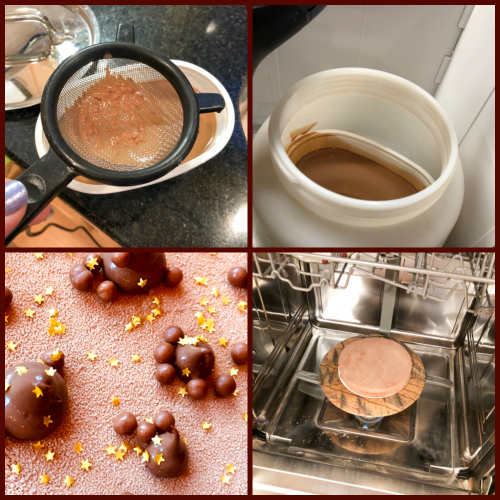
Make the chocolate suspension for velvet effect.  Melt milk chocolate and cocoa butter in a double-boiler. Filter and place the mixture into the tank of your sprayer. Temperature should be 98 F. Un-mold your dessert and immediately spray the chocolate on it. Ideally, do this inside a dishwasher with racks removed. Decorate the cake with the cream and buttercream, add sprinkles of your choice. Leave in the fridge to thaw for at least one hour before serving.

ENJOY!

to print the recipe, click here
Comments: Well, I do realize that it seems a bit of a stretch to post this recipe as simple and then come up with quite a few components to make it. As I mentioned, you can simplify it quite a bit. For instance, you can skip the two different types of piped decoration and do a drizzle of melted dark chocolate all over it. That would work well. A shower of golden sprinkles for fun and a bit of a dressed up look. The velvet spray is also optional. I find it fun to do, though, and it helps me deal with guilty feelings of having a sprayer sitting in the basement just for my patisserie adventures. It’s nice to put it to use.

On that note, three things are worth mentioning. First, you must strain the melted chocolate + cocoa butter before pouring it in the sprayer. If you look at my photo above, you’ll notice how much stuff gets retained in the sieve. That could conceivably clog the sprayer and you don’t want that at all. Second, if you are using a regular paint sprayer for chocolate work, the container is large, so what works very well is to place a much smaller plastic cup inside, so that you don’t need to make a huge amount of chocolate suspension. I used an empty Benecol container. And third, do the spraying inside an empty dishwasher, because it is a messy process and all you need to do after is turn the dishwasher on.

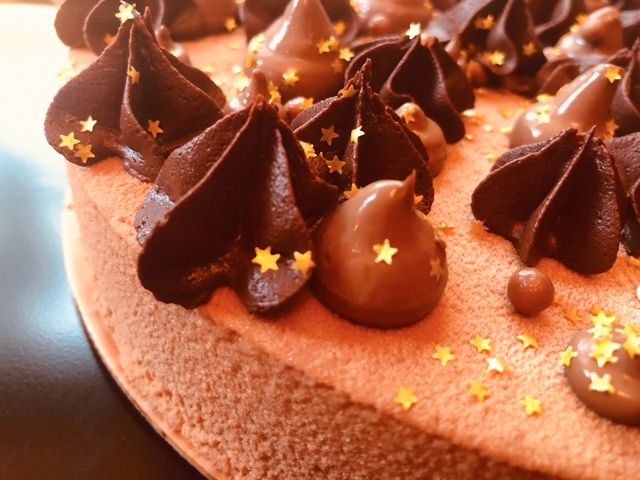
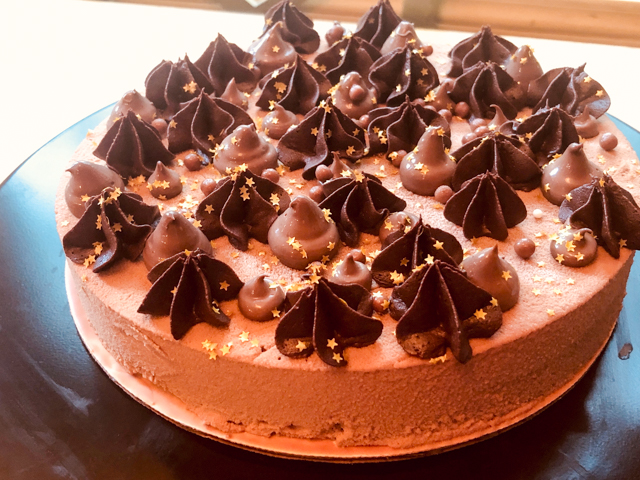
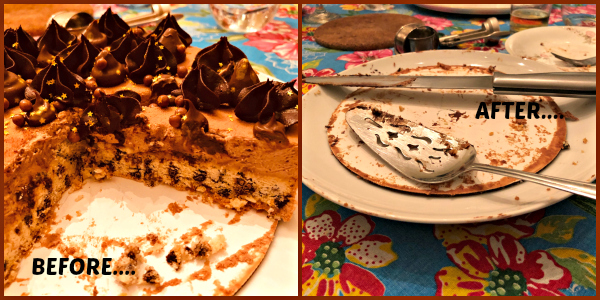
We took this cake to a dinner party at a friend’s home, so I snapped the pictures with my cell phone very quickly. I admit they are not prize-winning shots. At any rate, everybody raved about the dessert. The cookie component goes very well with the creamy mousse, and it had just the right thickness, don’t try to make it thinner because it won’t work the same way. I loved the contrast of the sharp cocoa buttercream with the milk chocolate cream and mousse, but the cake can shine with only one of the piped toppings.

Maxime, thanks for a lovely recipe, I am thinking of many variations in the future.

ONE YEAR AGO: The Brazilian Battenberg

TWO YEARS AGO: Salzburg Sourdough

THREE YEARS AGO: If I had One Hour

FOUR YEARS AGO: Apple Cinnamon Oatmeal Cake

FIVE YEARS AGO: Sourdough Rye Bread with Flaxseeds and Oats

SIX YEARS AGO: Apricot-Raspberry Sorbet: A farewell to Summer

SEVEN YEARS AGO: Marcela’s Salpicon

EIGHT YEARS AGO: Pork Kebabs

NINE YEARS AGO: Fondant au Chocolat

TEN YEARS AGOGot Spinach? Have a salad!


POP-TARTS WITH STRAWBERRY BALSAMIC JAM

Pop-Tarts were not part of my childhood, in fact I had no idea what they were all about until I was around my beloved husband’s kids in their teenage years. Of course, making them from scratch is a lot more fun than ripping a package open and sticking the little pastry in a toaster. And if that was not enough, you have to deal with another package to get the drizzle going. Granted, it takes longer to make it from scratch, but in my opinion, it is totally worth it.

POP-TARTS WITH STRAWBERRY BALSAMIC JAM
(jam from Pastries Like a Pro)

for pastry:
280 g all-purpose flour
38 g sugar
½ tsp kosher salt ¾ cup
172 g cold butter, cut in pieces
120 mL ice cold water

for strawberry jam:
1/3 cup balsamic vinegar
1/3 cup water
700 g sugar
575 g strawberries, hulled and sliced
1 teaspoon coarse ground black pepper

for glaze:
65 g powdered sugar, sifted
2 + 1/2 to 3 tablespoons heavy cream
sprinkles of your choice to decorate

Combine the flour, sugar and salt in the bowl of a food processor. Pulse a few times to combine the ingredients. Add the cold butter, pulsing until the mixture resembles coarse crumbs. Add the water to the flour-butter mixture and pulse until little clumps start to form. Turn the dough onto a lightly floured surface and press into a disk. Refrigerate while you make the jam.

Place all the ingredients for the jam in the order listed in a saucepan at least three times as large as the ingredients as it will rise up really high when it come to a rolling boil. Cook until it reaches 200 F, mashing the strawberries gently as they cook down. Refrigerate until needed.

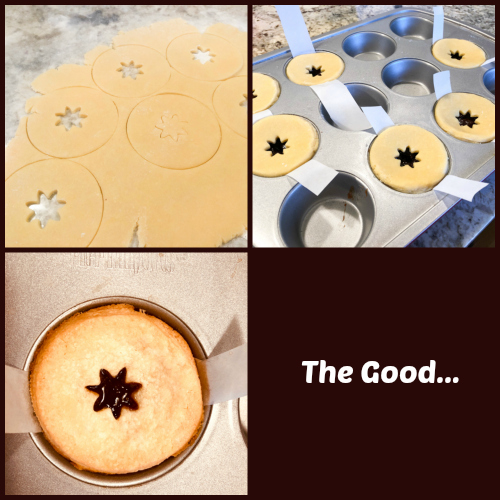
Roll the dough to ⅛-inch thickness, and cut into sixteen 3 x 4-inch rectangles. Line a baking sheet with parchment paper. Place 8 rectangles of pie dough on the baking sheet, top each rectangle with 1 tablespoon strawberry jam. Top with a second rectangle of dough, and crimp around all sides with the tines of a fork. Using a small, sharp knife, cut 3 small slits in the top of each pie. Place in the refrigerator for 15 minutes before baking, or for several hours.

Bak in a 425F oven until golden brown, about 20 minutes, depending on your oven. Allow to cool to room temperature. In a small bowl, whisk together the powdered sugar, heavy cream and vanilla until smooth. Frost the cooled pies with glaze and top with colorful sprinkles.

ENJOY!

to print the recipe, click here

Comments: This would be a perfect recipe to make for kids, you can change the filling, use chocolate, butterscotch, other types of jam, including store-bought if you want to make life a little easier.  The recipe for the jam makes a large amount, you can make half and still have enough with plenty of leftovers. It is delicious, it has a kind of gourmet aura with the balsamic (that you will notice) and the black pepper (barely there, but adds complexity).

Sprinkles are optional, but mandatory in the Bewitching Kitchen!

ONE YEAR AGO: Ptichye Moloko, a Russian Dessert

TWO YEARS AGO: Cheesy Low-Carb Zucchini Tarts

THREE YEARS AGO: Blogging Hiatus

FOUR YEARS AGO: Apricots, Three Ways

FIVE YEARS AGO: Up Close and Personal with Kale

SIX YEARS AGOBlack Berry Cherry Sorbet

SEVEN YEARS AGO: Asparagus Pesto

EIGHT YEARS AGO: Chocolate and Chestnut Terrine

NINE YEARS AGO: Under the spell of lemongrass

TEN YEARS AGO: Greens + Grapefruit + Shrimp = Great Salad!

A MODERN TAKE ON TARTE TATIN

It started with Shepherd’s Pie. It continued with Avgolemono Soup and Moqueca. Clearly, I’ve been taking liberties with classics and not acting ashamed. Tighten your seatbelt and be prepared for another wild ride. I share with you a modernized version of Tarte Tatin. It has no flaky crust. It is not cooked on the stove top. It does not have a thick, gooey layer of caramelized apples on top. But the overall concept is similar enough. Or so I say. A cookie base replaces the flaky crust, and a layer of apples slowly cooked in caramel sits proudly on top of it. Don’t skimp on the whipped cream. It adds a creamy and refreshing counterpoint that goes perfectly with the other components.

A  MODERN TARTE TATIN
(slightly modified from J’en reste Baba)

mold used: Silikomart Vague, but you can also use a 20cm ring or cake pan

for the caramel-apple:
5 Golden Delicious apples
65g of honey
40g of sweet butter
125g granulated sugar
60g of whipping cream
5g of gelatin in sheets (I used Platinum strength)

for the cookie base:
220g all-purpose flour
30g cornstarch
1 pinch of salt
40g ground hazelnuts (or hazelnut flour)
90g powdered sugar
130g softened butter
1 egg

for the stabilized whipped cream:
1 cup whipping cream (232 g)
14 g powdered sugar
1 tsp gelatin (powder)
1/2 tsp vanilla (I used clear extract)
golden sprinkles to decorate (optional)

Prepare the apple topping: Peel the apples, core them, and cut them in small pieces (as shown in the composite photo below).

Put the butter and honey in a pan and melt them together. Add the apple pieces to the pan and coat with honey and butter mixture. Cook the apple slices over low heat until soft and slightly translucent, then set aside. If they released any juices, drain the liquid.

Soften the gelatin sheets in cold water while you make the caramel. Heat the cream gently in a saucepan or in a Pyrex container using the microwave. Heat another small saucepan and pour the powdered sugar into it, one-third at a time, turning the pan after each addition so that the sugar mixes well and turns into caramel, slowly. Watch the sugar like a hawk, do not allow it to burn, keep moving the pan off the heat if necessary. Do not use a spoon, or you might set up a catastrophic crystallization reaction and will have to start all over.

Remove the pan from the heat and gradually add the hot cream (beware of splashing), stirring with a spatula as you gently pour it on the caramel. Mix everything well, allow it to cool to about 80C and add the drained gelatin.  Once the gelatin is well dissolved, pour the whole thing on the apples reserved. Gently combine caramel and apples, and add to your silicone mold, or to a ring (make sure you use some type of acetate or plastic wrap to facilitate un-molding later.

Pack the layer of apples well, because you want that component to lay fully flat on the cookie base. Freeze the apple-caramel overnight.

Make the cookie base: Sift together the flour, cornstarch, powdered sugar, and salt into the bowl of a KitchenAid type mixer with the flat beater. Add the hazelnut powder, turn the mixer on and combine all ingredients lightly.  Mix the egg gently with a fork inside a cup and add to the bowl. Give it a few turns in low-speed. Add the softened butter in pieces and mix gently until the dough starts to form a ball. At this point stop the mixer and turn the dough into a countertop, finish mixing by hand. You do not want to develop gluten.

You should refrigerate the dough for at least 30 minutes before rolling it out 4 or 5mm thick.  Cut a circle 3 cm bigger than the diameter of your mold. Silikomart Vague is exactly 20cm in diameter, I cut my dough a bit larger than 23cm. Refrigerate the disc for 30 minutes or place it in the freezer for 15 minutes before baking.

As the dough cools, turn the oven at 370 F. Once the pastry is cool, bake it for about 20 minutes, until the edges start to get golden, and the center is fully set. Remove from oven and place on a rack to cool completely. Cookie base can be made a few days ahead.

Make the whipped cream.  In a small saucepan, combine the powdered sugar and gelatin. Gradually stir in ¼ cup  of the cream. Bring the mixture just to a boil, stirring constantly. It will thicken slightly. Scrape the mixture into a small bowl and allow it to cool just to room temperature. Stir in the vanilla. In a chilled mixing bowl, whip the remaining cream just until traces of the beater marks begin to show. Add the cooled gelatin mixture in a steady stream, beating constantly. Whip  just until stiff peaks form when the beater is raised.

Assembly: remove the frozen topping from the freezer and carefully un-mold it. Place the cookie base on the serving platter, set the frozen apple insert centered on top. Spoon the whipped cream in a piping bag fitted with a 1M tip or any other star tip of your choice. Decorate the sides and the center of the tart with the cream. You will have whipped cream leftover.  If you like, decorate with golden sprinkles.

Keep 1 to 2 hours in the fridge to defrost before serving.

ENJOY!

to print the recipe, click here

Comments: I wish I could take credit for this interpretation of The Tatin, but all credit must to go to the food blog that originally featured it over a year ago: J’en reste Baba. I followed her recipe to a T, except for the whipped cream, which I opted to stabilize with gelatin. As I’ve mentioned before, my desserts are all made the day before they are enjoyed, as I take them to the department on Mondays. That “Mondays with Sweetness” thing. I am normally out of the house by 7:15am, so the idea of fiddling with whipping cream and piping bags earlier than that would be a bit too crazy. Stabilizing the whipped cream works well, and this method my favorite by far. The taste is unchanged and the texture perfect.

The tart can be served straight from the fridge once it de-frosts, but keeping it at room temperature for a while makes the texture of the topping even better, so consider that option if you make it.

This preparation could be used in different types of presentation, don’t let the lack of a Silikomart mold stop you. You can do a simple round insert, or even make individual portions, cutting circles of cookies and using a dome or flat circle for the apple. Just make sure to cut the cookie base with enough space around to allow for the whipped cream piping.

I had a bit of trouble using the 5 apples. At first it seemed to me there was too much fruit for not enough caramel. I might have left 3/4 of the last apple out of the mixture. After having made it, I’d say it would probably have been ok to add them all, but I was afraid that too much fruit would interfere with un-molding the topping. Kind of a tough call. Weighing the fruit could be a better way to go. But if you start with 5 medium apples and use your best judgment, I anticipate no problems.

The dry caramel is the trickiest component. I had never made dry caramel before and things can degenerate quite quickly once it gets going. It does give it a stronger taste and if you go overboard, it could end up bitter. If I make this dessert again (so hard to repeat things when I have that mile long list of things to try), I might try a “regular” caramel made from sugar-water as a starting point.

I really loved the combination of the cookie, the apples and the whipped cream, and the tart was gone by 10am, which I suppose is a good endorsement of this modernized Tatin…

ONE YEAR AGO: Minnie-Macarons, a Fun Project with a Happy Ending

TWO YEARS AGO: Nigella Lawson in the Bewitching Kitchen

THREE YEARS AGO: Walnut-Raisin Bran Muffins

FOUR YEARS AGO: Gingersnaps with White Chocolate Chips

FIVE YEARS AGO: Turkey Chili with Almond Butter

SIX YEARS AGO: Secret Recipe Club: Leek and Cheese Tart

SEVEN YEARS AGO: Secret Recipe Club; Triple Chocolate Brownies

EIGHT YEARS AGO: Shaved Asparagus Salad

NINE YEARS AGO: Indonesian Ginger Chicken


SAKURA BUCHE DU PRINTEMPS

This past winter was so hard that I intend to keep celebrating the arrival of spring for as long as I can get away with it. Clearly, nothing says spring better than cherry blossoms. In this cake, my goal was to have a creamy sakura-flavored mousse involving a fruity center, as a red fruit compote. For the base of the dessert, I made a crusty layer with puffed quinoa, the new (to me) ingredient I mentioned in my last post. To finalize, a pastel-colored mirror glaze action, in pink, purple and green.  Why the French name?  Because it is irresistibly poetic, that’s why.

SAKURA BUCHE DU PRINTEMPS
(from the Bewitching Kitchen, inspired by many sources)

for the biscuit layer:
125 g eggs
90 g powdered sugar (I used Bakewell cherry flavored)
90 g almond flour
30 g flour
20 g melted butter
180 g egg whites
40 g sugar (superfine if available)

for the berry compote:
300 g pure of cherries and red berries
2 whole eggs
140 g honey
140 g whipping cream
6 g gelatin in sheets
60 g butter, at room temperature

for the quinoa-crisp:
113 g white chocolate
20 g pistachio paste
20 g puffed quinoa

for the Sakura mousse:
210 g milk
1/8 tsp sakura leaf powder (optional)
1/8 tsp cherry blossom essence
100 g egg yolks
110 g sugar
8 g gelatin sheets
210 g whipping cream

for the mirror glaze:
150 g glucose
150 g granulated sugar
150 g white chocolate, cut in small pieces
75 g water
100 g condensed, sweetened milk
9 g gelatin in sheets
1/2 tsp titanium oxide (optional, but worth it)
pink, purple, and bright green gel food dye

Two days before serving, make the biscuit and the cherry compote.

For the biscuit: In the bowl of a Kitchen Aid mixer fitted with the leaf blade, beat the eggs, sugar an almond flour together for 4 to 5 minutes. Transfer to a mixing bowl, and after thoroughly cleaning the bowl of the Kitchen Aid, whisk the egg whites until you can see if forming a trail as the whisk goes through them. At this point, slowly rain the fine sugar to form a soft-peak meringue.  Add the meringue to the egg-sugar-almond mixture previously made. Mix gently with a spatula. Add the flour gently, sifting it over the mixture. Finally, add a bit of the mixture to the melted butter, make a smooth emulsion with it, and pour it into the batter. Mix as gently as possible.

Spread the batter on a baking sheet lined with parchment paper as a layer a little over 1/2 inch thick, and bake for 12 minutes at 380 F.  Once the biscuit is cool, cut the rectangle needed to fit the smaller buche. While the biscuit cools, make the compote.

For the compote: Soak the gelatin sheets in a bowl of cold water for at least 10 minutes. Place the eggs, honey, fruit puree and heavy cream in a bowl and whisk with an immersion blender (or use a regular blender if you prefer). Pour the mixture in a saucepan and bring the temperature to 180 F, stirring constantly and never using too high heat. Remove the pan from the stove, add the drained gelatin, and mix. Let it cool for about 10 minutes and add the softened butter, mixing again until well incorporated. Pour into the mold, then gently add the biscuit on top, pressing gently. You don’t want it to submerge, just float on the surface. Wrap the top of the mold with plastic and freeze overnight.

Make the quinoa-crisp. Bake the puffed quinoa in a 325 F oven for 10 minutes.  Meanwhile, melt the white chocolate in a microwave very gently. Mix the melted chocolate with the pistachio paste.  Add the quinoa and spread  in a 4 mm (1/8 inch) thickness in between two sheets of parchment paper. It will be a little sticky, try to level it as best as you can. When it is cooled down a bit, cut the exact dimension of the bigger mold you will use for the dessert. Reserve.

Make the Sakura mousse. Soak the gelatin sheets in cold water for at least 10 minutes. Bring the milk to almost boiling and add the sakura leaf powder, mixing well to dissolve. Let it sit covered for 10 minutes.  In a small bowl, whisk the egg yolks with the sugar. Slowly add the hot milk infused with the sakura powder, whisking constantly. Transfer back to the pan and heat gently to 180 F. Do not let it go over or you will scramble the egg yolks. Transfer to a bowl, let it cool for a couple of minutes and add the drained gelatin and the Sakura extract. Reserve.

Whip the cold heavy cream to very soft peaks, do not over whip it. When the sakura custard is barely warm to the touch, add the whipped cream to form the final mousse, fold with a spatula until smooth. Pour the mousse into the large Buche mold up to 1/3 of its volume. Add the frozen insert made the day before, with the biscuit layer up. Complete the mold with mousse almost to the top, place the quinoa crisp on top, pressing gently. Wrap with plastic and freeze overnight.

Make the mirror glaze. Place the gelatin sheets inside a bowl with cold water for 10 minutes as you prepare the other ingredients. In a sauce pan, heat the glucose, sugar and water until boiling. Make sure the sugar is fully dissolved. Let it cool slightly, and add to a bowl with the white chocolate in small pieces. After a few minutes, use a spatula to dissolve the chocolate. Add the gelatin and the condensed milk, and mix gently, try to avoid incorporating air bubbles. Add the titanium oxide and emulsify the mixture with an immersion blender to get rid of bubbles. Divide the mixture in three bowls. Eyeballing is fine. Add the color and mix very gently with a spatula, do not use a whisk to avoid incorporating bubbles. Cover with plastic touching the surface and place in the fridge overnight.

To glaze, warm up the mixtures in the microwave for 30 to 40 seconds. Pass them each through a fine sieve to remove any residual bubbles. When the mixtures are at 98 F you can pour them in a tall pitcher, one color at a time, working fast so that the temperature does not drop too much. Glaze the frozen dessert allowing all colors to mix and mingle.  Thaw the cake in the fridge for a couple of hours before serving. Decorate the sides if you like, with tempered white chocolate or candy melts.

ENJOY!

to print the recipe, click here

Comments: The dessert was assembled in a set of Silikomart molds called “Buche.” They can be used either separately, or together in a way that the smaller mold makes a component that goes inserted in the bigger one.  When planning a dessert using two molds, the first thing to consider is the volume needed, keeping in mind that a great deal of space will be occupied in the larger mold by the insert previously made. The amounts I shared work well with the Buche set. The composite photo above shows the overall preparation of the insert (compote + biscuit), that I made on a Friday evening, and left to freeze until next day. You can use any type of freezer-safe container you want, as long as it allows for easy un-molding later. The biscuit recipe makes more than needed for the base, so I cut a few rounds to freeze for a future adventure.

Saturday morning I made the crusty layer using puffed quinoa. To do so, I drew a precise template of the bigger Silikomart mold, and used a sharp paring knife to cut it. It is easier to cut  while it’s still just a tad warm. While the layer cooled completely, I prepared the Sakura mousse.

The mousse is poured inside the larger buche mold, then the frozen insert carefully placed in the center, with the biscuit layer facing up. More mousse is used to fill the mold almost to the top, then the  crusty layer is gently pressed on top. It is important to wrap the mold in plastic wrap so that when the mousse freezes it gets nicely compacted around the insert and the quinoa top (which will become the bottom in the final presentation).

Mirror glazing is definitely the most exciting part, although still a bit nerve-wracking for me. Things can go wrong in this final step for two main reasons:  first, you can pour too fast and lose track of how much glaze is being used, how much is left to finish coating; second, the temperature might be slightly off, so either the glaze slides off the cake without sticking, or it might set too fast and compromise the beautiful, super smooth surface that is the goal. When using more than one color, it gets even trickier. All components have to be just right in consistency and temperature. The glazes are best made the day before, so I made them on Saturday, kept them all in the fridge.  A 30 to 40 seconds encounter with the microwave puts all glazes at around 110F. At that point they went inside my bread proofing box set at 98F, and the waiting game started. You must be patient, and remember that whisking a mirror glaze suspension is a capital sin in patisserie. Bubbles must be minimized at all cost. Allow the different colors to equilibrate to the same temperature, get your frozen dessert ready, and let your inner Monet fly.

So there you have it, the Sakura Buche du Printemps ready to be enjoyed!  The cherry blossom flavor is very unique, floral (obviously) but not overpowering, as long as you exercise caution when you add it. A little too much and the mousse will be ruined. I really liked the texture of the crunchy quinoa, an idea that I cannot take credit for. I found it in this blog post and simply “borrowed” it. I will be using it again and again. It is sturdy enough to support the mousse, but easy to cut without making a huge mess on the plate. The biscuit layer could conceivably be omitted to simplify preparation, but it does add a different texture in a sea of mousse and creamy fruit. I think it makes the dessert considerably more interesting.

Before you leave, grab a pin…

ONE YEAR AGO: Clay Pot Roast Chicken

TWO YEARS AGO: In My Kitchen, April 2017

THREE YEARS AGO: Secret Recipe Club: Chicken Korma and a Bonus Recipe

FOUR YEARS AGO: Josey Baker’s Olive Bread

FIVE YEARS AGO: Almonds, A Cookbook Review

SIX  YEARS AGO: Pomegranate-Molasses Glazed Carrots

SEVEN YEARS AGO: Codruta’s Rolled Oat Sourdough Bread

EIGHT YEARS AGO: Roasted Corn and Tomato Risotto

NINE YEARS AGO: Light Rye Bread

EXTREME CHOCOLATE CUPCAKES

This is chocolate going where no chocolate has gone before. Total cocoa intensity. With each bite of these babies your mind will  buzz a little. A buzz of joy, that only real chocolate lovers will understand. If you join this cake with a good cup of java the world will be yours to conquer. Or at least it will feel like it.

SUPER-MOIST CHOCOLATE CUPCAKES
(slightly modified from Sally’s Baking Addiction)

3/4 cup (95g) all-purpose flour
1/2 cup (42g) natural cocoa powder (not Dutch-processed)
3/4 teaspoon baking powder
1/2 teaspoon baking soda 
1/8 teaspoon salt
2 large eggs at room temperature
1/2 cup (100g) granulated sugar
1/2 cup (100g) light brown sugar
1/3 cup (80ml)  canola oil
2 teaspoons vanilla paste  
1/2 cup (120ml) milk soured with a squirt of lemon juice (or commercial buttermilk)
frosting (recipe follows)
sprinkles to decorate (optional)

Heat the oven to 350°F. Line a 12-cup muffin pan with cupcake liners. If you have a second pan, line two more muffin tins, the recipe will likely make 14 cupcakes.  

Whisk the flour, cocoa powder, baking powder, baking soda, and salt together in a large bowl until thoroughly combined. Set aside. In a medium bowl, whisk the eggs, granulated sugar, brown sugar, oil, and vanilla paste until completely smooth. Pour half of the wet ingredients into the dry ingredients. Then half of the home-made buttermilk. Gently whisk for a few seconds. Repeat with the remaining wet ingredients and buttermilk. Stir until just combined; do not overmix.

Spoon the batter into the liners. Fill only halfway.  Bake for 18-21 minutes, or until a toothpick inserted in the center comes out clean. Allow to cool completely before frosting.

BLACKOUT CHOCOLATE FROSTING
(from Kara’s Couture Cakes)

1/2 cup butter 
2/3 cup black cocoa powder 
3 cups powdered sugar
a little less than 1/2 cup heavy cream
1 teaspoon vanilla paste
black gel food color (I used Chefmaster)

Melt the butter and stir in the cocoa with the paddle attachment on a stand mixer.
Add powdered sugar and mix on low-speed. Start with 1/3 cup heavy cream and add it to the mixer. Increase the mixer speed to medium. Add 2-4 tablespoons more heavy cream till you reach the desired icing consistency.
.
Add vanilla extract and black food color and turn the mixer to medium high and beat for 90 seconds.
.
Ice the cupcakes once they are completely cold. Have fun with sprinkles!
.
ENJOY!

to print the recipes, click here

Comments: Sally’s Baking Addiction is a fantastic site for bakers. I’ve mentioned before that one of my nieces in Brazil is a great cake baker, to the extent that for a while she was doing it professionally. She baked super fancy and decorated cakes for birthday celebrations, in a special-order kind of deal. One day we were talking about blogs and cookbooks, and she mentioned Sally’s blog (not mine, mind you) as one of her favorite sources exactly for the reason that her recipes are so reliable. It was fun to learn that we subscribed and faithfully the same site for years without knowing we both did. But I digress. Sally’s chocolate cupcakes deliver exactly what she promises: moist, decadent, and perfectly shaped little concoctions. The most important instruction in her recipe is to fill the muffin tins only halfway to the top. Not a teaspoon more. It will seem inadequate, but resist the temptation to add more batter.  They will bake perfectly, without a super inflated dome that always sinks in unflattering ways as the cake cools.


The frosting. Normally, I am not wild about American buttercream, but this is not your regular kind. For starters, the black cocoa powder is so intense, that it can stand up to the extra sugar. Also, the addition of heavy cream is a game changer. If you are counting calories or saturated fat, this is not your best option for dessert. But if your life-style allows some room for indulging, this might very well be your best option for dessert.  The cake with the dark cocoa icing is a match that will rock that world you are about to conquer.

I hope this photo conveys how deliciously moist this cupcake turns out. You can pile the icing higher if you dare, but I think a bit of moderation is in order. It is very rich and satisfying. As to decoration, I pretty much opened my box of sprinkles and had a blast with them. The dark background is friendly to so many color combinations! Pure white (those tiny marshmallows looked adorable on the cake), red, pink, coral, bright mixed colors, or you can use a color scheme geared to a particular occasion. Come to think of it, St Patrick’s Day could showcase some of these with green and white sprinkles…

I close this post with a daring statement. Ready? Here we go: these are the best chocolate cupcakes I’ve ever had. There. I said it. You must bake a batch…


ONE YEAR AGO: Sunflower Seed Kamut Sourdough

TWO YEARS AGO: The Joys of Grating Squash

THREE YEARS AGO: Auberge Pecan-Walnut Bread