BLOOD ORANGE ENTREMET CAKE


Entremets seem to be the rage at the moment. Originally, entremets were small portions of sweet concoctions served in between savory items in a multi-course banquet type meal. We are talking royalty stuff, from the Middle Ages to the overindulgence that was happening in France before 1789 (wink, wink). Nowadays, the term is applied to cakes that involve multiple layers with different textures and flavors. Basically it is a layer cake with severe superiority complex. My version was closely based on a Craftsy class taught by Kathryn Gordon, Contemporary Layer Cakes.  I don’t have permission to publish the recipe but will share an overview.

BLOOD ORANGE ENTREMET CAKE
Recipe Overview
(from Craftsy)

For the cake component, a Jaconde sponge is prepared using the following ingredients:
6 egg yolks beaten with 90g sugar
110g  almond flour sifted with 60g cake flour
a touch of vanilla and salt
60g melted butter
meringue made with 6 egg whites and 90g sugar

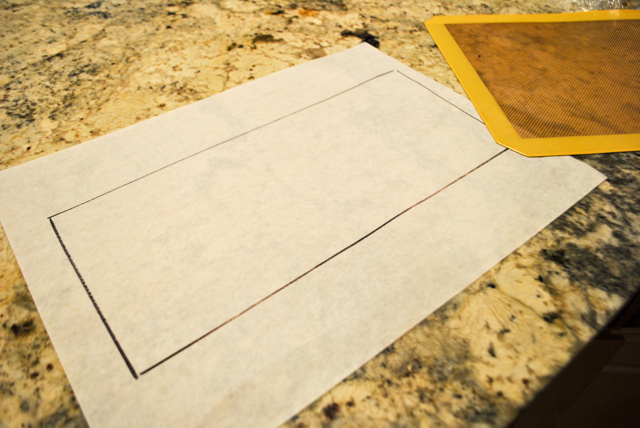
The cake batter will be enough to bake one round 8 inch cake and you will have leftover batter to spread as a thin rectangle for the sides (for lack of a better term) of the cake. The round cake will be halved crosswise so that you’ll have two layers for the entremet. To line the pan, make sure you will have 2 pieces that will cover its whole circumference. You can use the mathematical formula C = π x D or cut a piece of string that goes around the pan, and measure it. In any case, you will arrive at the need for two pieces of cake 13 inches long. The height depends on how tall your cake will be in the end. Make it around 6 inches so you have some flexibility. The top can be trimmed once assembled. I placed a Silpat on top of the paper and spread the cake batter on it, using the drawing underneath to guide me.
For the marble effect you have two options: paint some food color on the Silpat and pour the batter on top, or divide the batter in two portions, add orange food color to half, and pour the two batters together, spreading them gently so that the color is not fully distributed.  I prefer the second method because it gives a much more subtle effect.  But, if you are in a Pollock frame of mind, go wild with a brush.

In the center you see the full rectangle of very thin cake, that was split in half lengthwise and placed inside the ring. Those are technically called “sponge strips” and I thank Gary, patissier extraordinaire for enlightening me. Please keep in mind that the photos are not on the same scale. The cake is assembled inside an 8-inch ring. First the sides are set in place, with the swirl facing the outside. Then the bottom layer.

Filling components:
Blood Orange Cremeux:  cream made with 8 egg yolks tempered and cooked with 360mL heavy cream previously infused with the zest of two blood oranges and 3/4 cup of blood orange juice.  Once the mixture coats the back of a spoon, it is poured over 200g white chocolate and 6g sheet gelatin, softened in cold water.
Caramelized rice cereal: 1/4 cup sugar is heated in a heavy pan until amber. To that 1/2 cup popped rice cereal is added, quickly mixed and poured on a Silpat or parchment paper.
Caramelized blood orange segments: Make a syrup with 100g sugar and 4 tablespoons water. Heat until fully dissolved, then pour over the segments of one blood orange. Let the fruit sit in the syrup until cold, drain before using in the cake.

To the bottom cake layer, a little cremeux is added and spread. Then pieces of caramelized puffed rice. A bit more cremeux, caramelized orange segments, and more cremeux on top. The second piece of cake goes over it, pushing down to make sure it’s all well compacted.

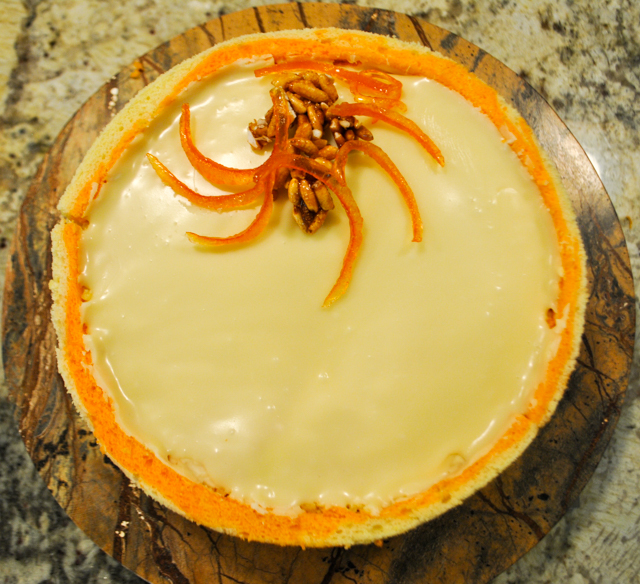
The top of the cake is brushed with a bit of melted white chocolate and oil, to seal the layer. The whole thing is frozen for several hours, then the cake is covered with a very thin layer of white chocolate mirror glaze, made with sugar (50g dissolved in 2 T water), heavy cream (2 T), corn syrup (1 T) and white chocolate (150 g). Kathryn explains exactly how to do it in a way that the top will be very smooth.

The cake is then removed from the ring, the top edge is trimmed, if so desired, and the top is decorated with bits of caramelized rice cereal and blood orange zest.
Comments: First of all, my apologies for not posting the full recipe, but without permission to do so, I cannot do it. You can find the basic method of preparing a Jaconde sponge, as well as all other components online. In fact, many different cake formulas and fillings will work to produce a similar entremet cake. All you need to keep in mind is a contrast of textures and flavors.

The blood orange cremeux turned out very refreshing, so even considering this is a rich, indulgent dessert, it had a light and bright quality to it. Rice puffed cereal is a good alternative to the famous Gavottes cookies that were part of my recent Gateau Royal. You can definitely caramelize it and  use it to add crunch to any layer cake. Those things are sold in huge bags, and we don’t eat puffed rice as a cereal, so I see a few aventures with this caramelized version in my future.

This Craftsy class by Kathryn is really wonderful, because not only she explains every single step of the recipe in real-time, but she encourages you to plan and make your own version of this elaborate cake. Although it might seem a bit too involved, each component can be made in advance. I actually baked the cakes and made the cremeux on a Saturday, the other components Sunday morning, assembled the cake, froze it, and added the mirror glaze in the end of the day. Piece of cake! (Literally).

Just like macarons are my favorite cookies, I suspect entremets are quickly becoming my favorite type of cake. The possibilities of cake, fillings, textures, and icing are endless.

ONE YEAR AGO: Flourless Chocolate Pecan Cake

TWO YEARS AGO: A Tale of Two Macarons

THREE YEARS AGO: Chocolate Chip Shortbread Cookies

FOUR YEARS AGO: Chicken in Green Pipian Sauce, Sous-vide Style

FIVE YEARS AGO: Classic Shrimp Gobernador Tacos

SIX YEARS AGO: A Walk Towards the Sunset

SEVEN YEARS AGO: In My Kitchen

EIGHT YEARS AGO:  Heavenly Home-made Fromage Blanc

NINE YEARS AGO:  A Perfect Sunday Dinner

SaveSave

SaveSave

SaveSave

SaveSave

SaveSave

SaveSave

SaveSave

SaveSave

SaveSave

SaveSave

SaveSave

SaveSave

SaveSave

SaveSave

SaveSave

SaveSave

SaveSave

APRICOT LINZER TORTE

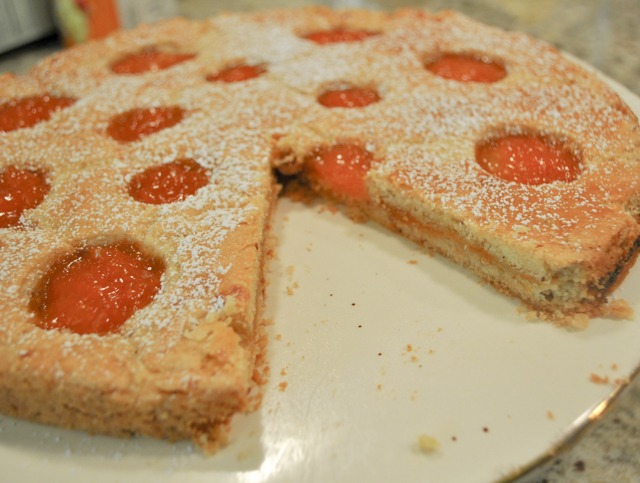
Do you know Anna Olson? I don’t remember how I got hooked into her shows, but I think it was one of those suggestions that pop in the amazon page. At any rate, she is big on Canadian Food TV. As far as I can tell, the Canadian food TV is far superior to our own. I watched every single episode I could find online. Basically a full season of “Sugar“, and a full season of “Baking with Anna Olson.”  They are organized by ingredient (chocolate, blueberries, pecans),  or basic component (say, pastry cream, or pie dough), and she usually shares three recipes with increasing level of difficulty.  I like her a lot. She is the type of baker who is clearly talented, but also down to Earth. Some professional bakers make you think that unless you can find the vanilla bean harvested on the Sava region of Madagascar under a moon 100% full, please don’t bother making the recipe. Not the case with Anna. You’ll feel less constrained and even encouraged to try something a little different. Sometimes she might even have a little powdered sugar flying moment in her KitchenAid, which in my mind just makes her even more special.  Of course, that type of moment is not a rare event in the Bewitching Kitchen, quite the opposite (sigh). When I watched her show on apricots, I knew I had to try her Linzer version. I am glad I did…

APRICOT LINZER TORTE
(from Anna Olson)

for filling:
2 cups fresh apricot, washed and pitted
⅔ cup apricot jam
¼ cup sugar
zest of one orange

for dough:
3 hard-boiled egg yolks
1 ¼ cup unsalted butter, room temperature
½ cup icing sugar
dash of vanilla extract
½ cup ground hazelnuts, lightly toasted
¾ tsp salt
¼ tsp baking powder
2 ¼ cups all-purpose flour
1 egg, mixed with 2 tbsp cold water

Cook all ingredients for the filling in a big saucepan until apricots are tender. Remove from heat, puree and cool completely before using.

Push cooked egg yolks through a sieve and set aside. Cream together butter and icing sugar until smooth. Stir in vanilla extract. Add hazelnuts and cooked egg yolks and blend in. Sift together salt, baking powder and flour and add to butter mixture. Blend until dough comes together (it will be quite soft). Divide dough into 2 discs, wrap and chill for at least one hour, until firm.

Heat oven to 350 F.

On a lightly floured surface, roll one disc of dough to 3/4- inch thick. Using the bottom of a 10-inch removable-bottom tart pan as your template, cut out a disc of pastry. Repeat this with the second disc of pastry.

Using the tart pan bottom as a lifter, transfer the first disc of pastry to a parchment-lined baking sheet. Spread the apricot filling over the entire surface of the dough. If the dough is very soft, I like to flash it in the freezer for 5 minutes, to make spreading the filling easier.

Using a 3/4 -inch round cutter cut decorative circles around the dough. Use a slightly smaller cutter to make a second series of smaller openings. While still on the cutting board, brush the top of the disc generously with egg wash. Place gently on top of apricot filling. Place ring of a springform pan around torte to help it hold shape while cooking.

Bake for 35-40 minutes, until a rich golden brown in colour. Allow to cool before cutting. If desired, sprinkle with a dusting of powdered sugar before serving.

ENJOY!

to print the recipe, click here

Comments: It was a lot of fun to make this recipe, it is a real soft though, and I decided to roll it out in between two sheets of parchment paper. Works much better for me that way. The filling is delicious, I had to hold myself back not to use it in macarons next day, it would be great added to some chocolate ganache, I think. Apricot and chocolate are a match made in heaven.

The dough is on the crumbly side as expected for a Linzer concoction. Her use of hazelnuts instead of almonds makes it quite unique and special. Everyone in the department loved this little treat, which brightened up one very summery Monday.


Make Sally happy, grab a pin!


ONE YEAR AGO: A Trio of Air-Fried Goodies

TWO YEARS AGO: Focaccia with Grapes, Roquefort and Truffled Honey

THREE YEARS AGO: Moroccan Carrot Dip Over Cucumber Slices 

FOUR YEARS AGO: White Chocolate Macadamia Nut Cookies

FIVE YEARS AGO: Cilantro-Jalapeno “Hummus”

SIX YEARS AGO: A Moving Odyssey

NINE YEARS AGO:
 Shrimp Moqueca

SaveSave

SaveSave

SaveSave

SaveSave

SaveSave

SaveSave

BRIGADEIROS FOR THE FOURTH OF JULY

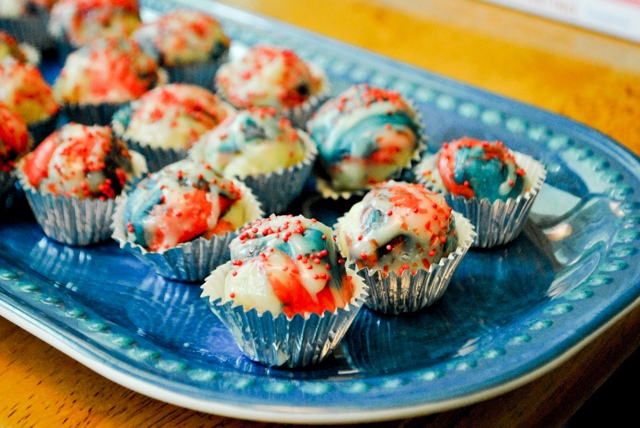
Brazil meets USA, big time! A traditional Brazilian delicacy dresses up in American colors for one of the biggest holidays celebrated here, Independence Day. We were invited for dinner and fireworks over at a friend’s home, and on a last-minute move, I prepared these babies to take with us. They are a departure of the classic Brazilian brigadeiros, made with cocoa powder. In this case, I flavored them with a touch of coconut extract, but probably should have added more than I did, the flavor was barely noticeable.


PATRIOTIC BRIGADEIROS
(from Easy and Delish)

2 (14-oz) cans sweetened condensed milk
1 1/2 Tablespoons unsalted butter
1 teaspoon pure vanilla extract (or substitute 1/2 teaspoon coconut extract)
food coloring (Red and Blue)
red/white/blue sprinkles (optional)
white chocolate ganache to drizzle (optional)

Combine sweetened condensed milk with unsalted butter in a wide, no stick pan over medium heat. Cook, stirring constantly, until smooth.
Mixture is ready when it thickens and starts to peel away or show the bottom of the pan when you scrape it with your wood spoon (about 10-15 minutes). The fudge mixture should be thick enough to reveal the bottom of the pan for a couple of seconds before the mixture levels out again.
When the fudge mixture is ready, remove from the stove top and stir in the vanilla or coconut extract. Next, spread 1/3 of the mixture in the center of a half-sheet pan coated with a little butter so that it won’t stick. 
Place another 1/3 of the mixture in a bowl and stir in  blue food coloring.  Place the remaining 1/3 of the fudge mixture in another bowl and stir in red food coloring. Transfer both the blue and red mixtures to the greased baking sheet, spreading them around side by side. Allow to cool completely.
Using a tablespoon as measurement, scoop out one spoon of the white/red/blue mixture (starting from the center to the edge of the plate) and with greased hands, roll out into balls. Place each little ball into a small paper liner  and decorate the way you want.  They can be kept in the fridge until serving time. 
ENJOY!
to print the recipe, click here

Comments: If you’ve never made traditional brigadeiros, or worse yet – have not even heard about them, please read my old blog post to fix this major gap in your culinary knowledge. It’s important. It was really fun to make these, I advise you to use two cans of condensed milk, so that you have enough to play with. With this amount, I made 26 brigadeiros. They are rich and sweet, so one or two is all you’ll need. But they bring me so many nice memories of my home country, I usually have a bit of a hard time stopping at two. So I accept my weakness, and move on. And jog on. Weight lift on. Kickbox on… you get the picture… damage control.

You can definitely use different colors to celebrate your favorite team, your school, your mood. Halloween Black and Orange brigadeiros might be the rage this year (wink, wink).

SaveSave

SaveSave

SaveSave

SaveSave

SaveSave

SaveSave

SaveSave

SaveSave

SaveSave

SaveSave

SaveSave

SPRINKLED MERINGUES

This is a fun recipe to make with kids. So simple! The idea was in a very nice cookbook, called Sweetapolita, which I very highly recommend for those who have been bitten by the Baking Bug. I haven’t asked for permission to share her recipe and method to make meringues (she has a few little tricks up her sleeve), but you can definitely use any meringue recipe out there. The secret is to bake them slow and low, and allow them to dry for a while inside the closed, turned off oven. I used a closed star tip to pipe mine, but you can go with a regular piping tip, or even just use a spoon.

For a classic meringue recipe using the French method click here.

After they are done, you melt some white chocolate, and add your favorite type of sprinkles into a small bowl. Dip the bottoms of the meringues in chocolate, then coat with sprinkles.  It is a bit tricky to get the amount just right, but no matter what you do, they will be a ton of fun to make and eat.

You can customize the color of your sprinkles too, of course. Maybe your favorite team is playing in the World Cup? Or your kid’s team will have a nice baseball match and you are the one in charge of loading them with sugar after?

Any kid will love these!

ONE YEAR AGO: Incredibly Simple Times Three

TWO YEARS AGO: Dan Lepard Simple White Loaf

THREE YEARS AGO: Maureen’s Fabulously Fudgy Brownies

FOUR YEARS AGO: Wheat Berry Caraway Bread

FIVE YEARS AGO: Mexican Focaccia 

SIX YEARS AGOSunny Kamut Salad with Roasted Lemon Vinaigrette

SEVEN YEARS AGO: Pane de Casa & Crostini

EIGHT YEARS AGO: Down-home Dig-in Chili

NINE YEARS AGO:  Cinnamon Rolls

SaveSave

SaveSave

SaveSave

SaveSave

SaveSave

FRAISIER CAKE: A CELEBRATION OF SPRING

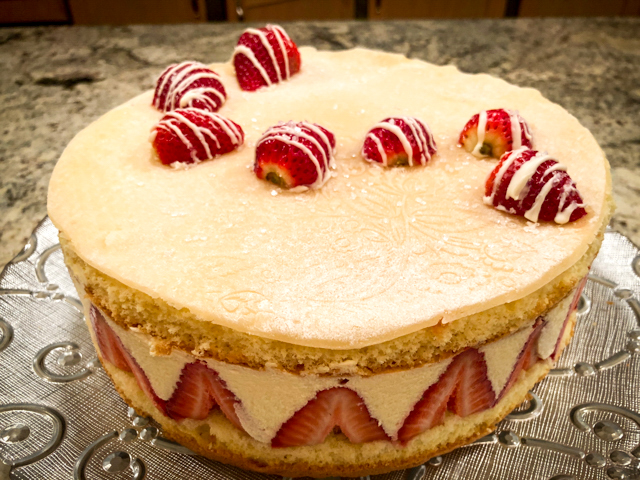
Fraisier is a classic cake in French patisserie. You will find countless versions for it. The cake can be round, square, rectangular, the topping also quite varied:  meringue, a thin layer of gelatin, or some marzipan. You can also go with a more rustic version topped with just a dusting of powdered sugar. The common denominator is two layers of cake, separated by a filling of strawberries in buttercream (preferably mousseline, which is buttercream on steroids). Some of the strawberries must be cut in half lengthwise and sit at the edge, so that they will be visible in the assembled cake.  What’s not to like? For my version I used a simple genoise brushed with Cointreau-syrup, a mousseline cream with a touch of white chocolate, and for the topping a thin layer of almond paste.

FRAISIER CAKE
(adapted from many sources)

for the cake:
6 eggs
5 tbs butter
1 cup (225g) sugar
1 + 3/4 cup (210g) flour
1/2 tsp vanilla paste

For simple syrup:
6 Tablespoons water
6 Tablespoons sugar
3 tsp Cointreau

For creme mousseline:
2½ cups (600ml) whole milk
1/2 tsp vanilla bean paste
3 large eggs
2 egg yolks
3/4 cup (150g) granulated sugar
1/2 cup (56g) corn starch
454g  butter, softened, divided
100 g white chocolate, melted and cooled

For decoration:
Hulled and halved strawberries for perimeter of the cake (I used 19 halves)
Diced strawberries for the filling (about 12 large strawberries)
100 g almond paste
powdered sugar for rolling

Equipment: One 10-inch round cake pan; one 9.5-inch cake ring or springform pan.

Heat the oven to 350 F. Prepare a 10 inch cake pan by buttering the interior. Then dust with flour and set aside.  

Place the butter in a small dish and cover then melt in the microwave. Set aside to let cool. Fill a pot with about 1 inch water over medium high heat. Once it starts to simmer, sit the bowl of a stand mixer over the pot. Put the eggs and sugar in the bowl and beat with a whisk until it warms up to a temperature between 130 to 140 degrees F. Return the bowl to the stand mixer with a whisk attachment. Whisk the mixture on high-speed. Continue to beat until the batter is cool to the touch. The end result should be a light batter that has tripled in volume.

Set aside 2 tbs of the batter in a small bowl. Add the flour to the large bowl of batter in increments, gently folding until no dry streaks remain. Blend together the 2 tbs of batter with the melted butter. Pour into the large bowl of batter and stir until incorporated. Fill the prepared cake pan with the batter. Place pan in oven and bake until cake springs back when lightly touched. Baking time should be about 30 minutes. Remove pan and invert cake onto a rack to cool.

While the cake is cooling, make the simple syrup by heating the water and sugar in a small saucepan. Once it comes to a boil, remove from heat and stir the Cointreau. Set aside to cool.

Make the mousseline cream by combining in a saucepan the milk and vanilla paste, then bringing to a simmer over low-heat. Do not let the milk come to a boil. Reserve. Place the eggs, egg yolks and sugar in a mixing bowl. Whisk vigorously until the mixture turns a light shade of yellow and becomes slightly thick and frothy, about 3 minutes. Add the cornstarch and whisk vigorously until completely incorporated.

Slowly pour about 1/4 cup of the warm milk into the egg mixture, and whisk continuously to temper the eggs.  Add the rest of the milk, always whisking. Once all the milk has been added to the eggs, pour everything back into the saucepan, and over low heat keep whisking until the cream comes to a full boil, but do it slowly. Keep removing from the heat and placing it back if you feel it is boiling too quickly. Do not stop whisking, and make sure to go over each little spot of the bottom of the pan to prevent the cream from scorching.

When large bubbles start coming to the surface, continue whisking for 15 seconds, then remove from heat, let it stand for a couple of minutes and add half of the butter, then the melted and cooled chocolate. Pass it through a fine sieve to remove any little lumps and place in the fridge for a couple of hours or overnight, with a plastic film on top to prevent a skin from forming.

When fully cold, remove from fridge, place in a Kitchen Aid and beat at full speed for 5 minutes or longer, to bring it to room temperature. Now add the other half of the butter, which must be softened.  Beat until fully smooth. The mousseline cream is ready to use.

Assemble the cake: Place a piece of acetate film against the inner surface of the cake ring. If needed, trim the top crust of the sponge cake, to level it. Split in half and place the bottom half (cut side face up)in a 9 1/1 inch cake ring set over a cardboard cake round of the same size. Brush with half of the Cointreau syrup.

Place each strawberry half upright inside the ring, forming an interior circle. The stem top should be face down and the cut side facing the inside of the flan ring. Smooth one cup of the mousseline cream over the split cake inside the flan ring. The cream should cover all exposed cake. Then place diced strawberries covering the center of the cake.  Fill all spaces with the mousseline cream by using a piping tip and covering until you reach the top of the flan ring. Then place the other cake half over the cream layer and brush the top with the remaining syrup. Refrigerate for 30 minutes.

Roll a piece of almond paste very thin, make a pattern on the surface if you have an embossing rolling-pin. Cover the cake with a very thin layer of mousseline cream, then set the rolled almond paste on top, with the pattern facing up. Decorate with strawberries, if desired.

Refrigerate until serving time.

ENJOY!

to print the recipe, click here

Comments: One thing that makes it easier to assemble a Fraisier is placing acetate film to line the  perimeter of the pan. I used my beloved elephant pins (a gift from my niece) to keep the acetate in place (see 2nd of the smaller photos in the composite above). The film makes sure that once you lift the ring the sides of the cake won’t be messed up, by smearing the cream or moving the strawberries in the process. Super clever.

Some recipes instruct you to cover the center of the cake with whole strawberries standing with the pointed end up, but I think that would make a bit harder to cut the cake in slices. I decided to dice the fruit instead and distribute the pieces more or less evenly on the surface. I like the way it turned out.

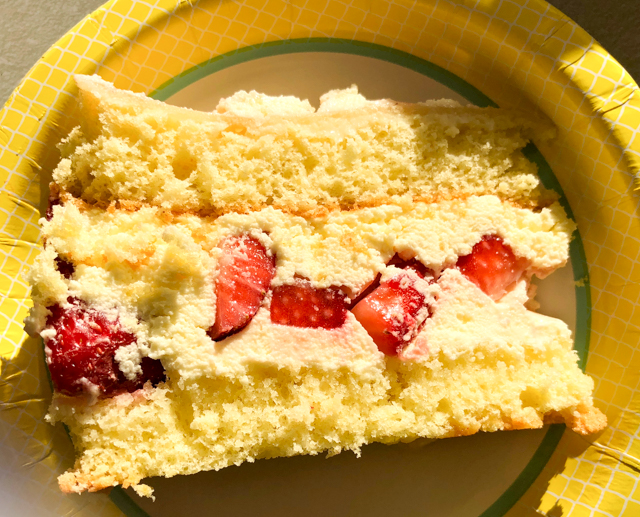
The sun shinning through the window, cast a bright yellow tone on the slice of cake I served in our department mail room. Interesting effect…

For the topping, my goal was to imprint a pattern on the thin layer of almond paste. I used a wooden rolling-pin, but unfortunately the effect was barely visible.

Points to consider in the future

Exchanging thoughts with Patissiers Extraordinaires Gary and Jennifer I realize a few things that could be improved. First, instead of baking a single round cake and slicing it in half, it would be nice to bake a cake in a sheet pan and cut two layers of the desired size. They could be any shape, circular, square, rectangular. The advantage of that method is that you don’t have to worry about slicing the cake horizontally and both layers would be absolutely equal in height.

As to the design on the almond paste, Gary suggests using a silicone mat instead of the rolling-pin. I think that is a great idea, and will definitely incorporate it on my next time. Perhaps even adding a bit of green food color to the paste, I’ve seen many examples that do so.

Another possibility that makes this cake even more appealing is to completely hide the cake when assembled. You achieve that by placing the strawberries outside the perimeter of the cake, which is then cut about one inch smaller than the ring. The mousseline will be outside, on the sides and top of the cake. You can see one beautiful example here.

All things considered, I am happy with the way my first attempt turned out. The almond paste layer gives a nice almond-y flavor to the cake, and the texture is not harsh at all, it gets quite a bit softer in contact with the mousseline cream underneath. No doubt there is room for improvement, but isn’t that the case for many things in life?

🙂


ONE YEAR AGO: Zucchini Frittata with Roasted Tomatoes and Goat Cheese

TWO YEARS AGO: Playing with Pectinase

THREE YEARS AGO: Poached White Asparagus with Lemon and Pistachios

FOUR YEARS AGO: Dan Lepard’s Saffron Bloomer

FIVE YEARS AGO: Fesenjan & The New Persian Kitchen

SIX YEARS AGO: Quinoa Salad with Roasted Beets

SEVEN YEARS AGO: Pasta Puttanesca

EIGHT YEARS AGO: Miche Point-a-Calliere

SaveSave

SaveSave

SaveSave

SaveSave

SaveSave

SaveSave

SaveSave

SaveSave

SaveSave

SaveSave

SaveSave

SaveSave

SaveSave

SaveSave

SaveSave

SaveSave

SaveSave

SaveSave

SaveSave

SaveSave

SaveSave

SaveSave

SaveSave

SaveSave