COOKIES FOR THE HOLIDAYS: SPRINGERLE

Springerle cookies have been around for more than 700 years, and just that thought brings me a smile. It fascinates me that after hundreds of years we still talk about them and so many bakers – particularly in Europe – preserve the tradition by baking batches and batches during the holiday season. The name translates from German as “little jumpers”. Some say that indicates the way they seem to jump in the oven when they bake. Others believe that in the beginning the images imprinted on the cookies showed men on horses, like little jumpers. We’ll probably never know for sure, but what we do know is that they are flavored with anise, leavened with a special ingredient (ammonium carbonate, aka Hartshorn), and the dough takes a large amount of eggs beaten for a long time. Back in the 1300’s, a baker not only had to make the cookies, but also carve the wooden molds they were shaped in. The reputation of a baker would rest not only on the cookies themselves, but in the complexity and beauty of the mold he had produced. Absolutely amazing. Disclaimer: I did not carve my own molds. Please don’t judge.

SPRINGERLE COOKIES
(scaled down from House on the Hill)

1/4 teaspoon baker’s ammonia (Hartshorn)
1 tablespoons milk
3 large eggs, room temperature
360g powdered sugar
57g (1/4 cup) unsalted butter, softened but not melted
1/4 teaspoon salt
1/4 teaspoon of anise oil
454g sifted cake flour (I used Softasilk)
grated rind of orange

to paint the cookies (optional):
powder luster (mine are from Oh Sweet Art)
vodka or lemon extract

Make the cookies: Dissolve baker’s ammonia in milk and set aside (avoid the temptation to take a sniff, you will regret it). Beat eggs until very thick, this will take from 10 to 15 minutes. Slowly beat in the powdered sugar, then the softened butter. Add the the mixture of baker’s ammonia and milk, salt, anise oil and orange zest.

Gradually beat in as much flour as you can with the mixer, then stir in the remainder of the flour to make a stiff dough. Turn onto floured surface and knead in enough flour to make a good print without sticking. Refrigerate for one hour, but keep in mind the dough can be refrigerate the dough for up to 3 days.

On a floured surface, roll dough depending on the depth of the carving in the cookie press you are using. Shallow carvings will need to be thinner while deeper carvings will need to be thicker. Flour your cookie mold for each and every pressing. Press the mold firmly and straight down into the dough, then lift, cut with the cookie cutter of your choice, and place the formed cookie onto a flat surface to dry.

Do not cover the cookies while they dry. The goal of drying is to set the design. Let the cookies dry at least for 24 hours. It is better to leave them alone for a couple of days, so the design will be better retained during baking.

On baking day, heat the oven to 255F to 325F (depending on the size of your cookie and how white you like to have them), for 10 to 15 minutes. Let the cookies cool and paint, if you so desire.

ENJOY!

to print the recipe, click here

Comments: I cannot lie to you, Springerle baking can be tricky. I only do it in December, because it is so deeply associated with this time of the year. In fact, it is quickly becoming a personal holiday tradition for me. First thing to keep in mind, you need the special leavening agent. It has a crystal, grainy structure and gives the cookie its unique texture. If you bake them with regular baking powder, you lose that component. Second, be patient. These cookies cannot be baked on the same day you shape them because the pattern needs to set by drying, sometimes it can take 3 days, depending on your environment. I never had to wait more than 48 hours.

most of my molds are from www.springerle.com

If they are not dry, when they go into the oven, the pattern will be quickly lost as the cookie expands. If they are fully dry but the oven a little too hot, they will form cracks and might even explode, like you can see on my first composite photo above. That brings me to my third advice: always, always, ALWAYS bake a test cookie. I normally place three, one large, one medium, one small, and see how they behave. The temperature that works best for me (for all cookie sizes, in fact) is 275F. It might be different for your oven.

Painting them is the part I enjoy the most. It is a good idea to get very fine brushes so that you can highlight details. I think pastel tones, silver, white and gold are my favorites, particularly to decorate more classic designs.

But this year I pushed the boundaries a bit and used more dramatic colors in some of my cookies…

I also used more modern shapes, that would quite likely horrify bakers from old Swabia…

These were bought from Fun Food Tools (at etsy.com). They definitely take Springerle into a totally new direction… My apologies to the purists. Since they were already such a dramatic departure, I went crazy with the colors also…

As you know, the main flavor of these cookies is anise, which not everyone is fond of. For real anise lovers, you can go one step further and bake them over a layer of anise seeds. I like the flavor, but don’t care for the texture of the seeds at the bottom, so I always skip this step.

I hope you enjoyed this final post on Holiday Cookies. Springerle baking will definitely be part of my end of the year routine. As to the other 11 months, I will practice baking molded cookies using regular baking powder and different flavors. Stay tuned!

ONE YEAR AGO: Bread – Episode 2 of Great American Baking Show

TWO YEARS AGO: Apple and Sobacha Caramel Dome Cake

THREE YEARS AGO: Cocktail Spiced Nuts

FOUR YEARS AGO: How the Mighty Have Fallen

FIVE YEARS AGO: Festive Night at Central

SIX YEARS AGO: The Perfect Boiled Egg

SEVEN YEARS AGO: Light Rye Sourdough with Cumin and Orange

EIGHT YEARS AGO: Homemade Calziones

NINE YEARS AGO: Plum-Glazed Duck Breasts

TEN YEARS AGO: Holiday Double-Decker

ELEVEN YEARS AGO: New York Deli Rye

COOKIES FOR THE HOLIDAYS: MACARONS

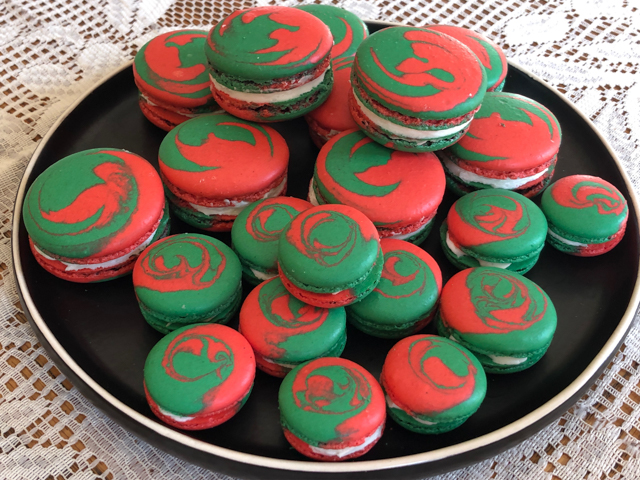
I admit that macarons per se might not be firmly associated with the holiday season, but one of the things I love about them is their versatility. Like fantastic actors, they can play any part, as long as you dress them properly. Today I share six versions with a festive winter aura.

BASIC MACARON RECIPE CAN BE FOUND IN THIS POST

YIN & YANG PEPPERMINT MACARONS
(from the Bewitching Kitchen)

1 recipe from basic method, divided in two

For filling:
160g powdered sugar
57g unsalted butter, softened (4 tablespoons)
1 teaspoon peppermint extract
pinch of salt
heavy cream or milk to adjust consistency, if needed

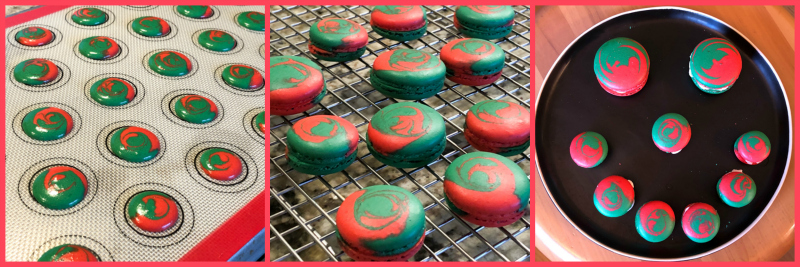
When your macaron batter is starting to get homogeneous, divide it in two portions, dye one green and one red, and proceed to the end of macaronage. Place each batter in a separate piping bag, and then cut the tips and side them side by side into another bag (if you have two sizes, it is a good idea to use two smaller bags inside the larger one, but it is totally doable with bags of the same size).

Pipe shells and bake as specified in the recipe.

For the filling, use a hand-held electric mixer and whisk the butter until creamy. Add the powdered sugar, peppermint extract and salt. Whisk in low-speed at first, the increase speed and whisk until creamy and smooth. If needed, add a very small amount of milk or heavy cream.

Pipe the filling in shells, close them, and leave in fridge overnight to mature.

ENJOY!

to print the recipe, click here

Comments: The amount of peppermint extract to use will depend on the brand you use, how strong it is, and of course, your personal taste. Next time I make them, I will include some crushed peppermint candy. I did not have any around at the time, and we are pretty strict with our rules. Grocery store twice a week, with a list in hand, in and out quickly. So I really did not want to break the rules to go get the candy. Instead, the macs were kept simple. As to the yin-yang design, you do need the batters in two separate bags, otherwise they mix too much during piping. The effect is also nice, but will be less dramatic.

CARDAMON-GANACHE MACARONS
(from the Bewitching Kitchen)

1 recipe from basic method

for the filling:
100g heavy cream
100g milk chocolate
4 cardamon pods
10g butter)

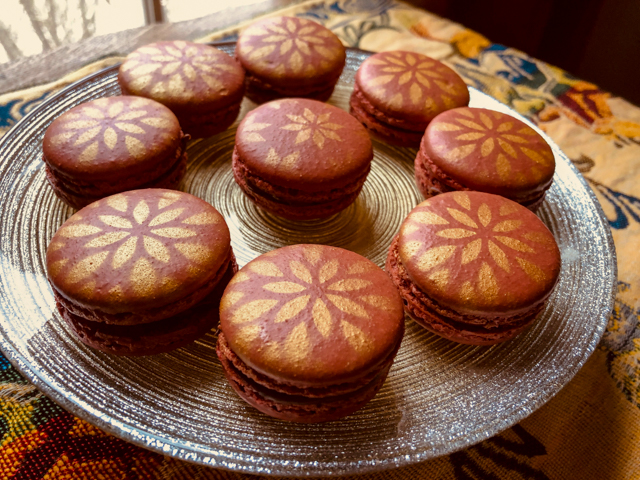
Make the macaron batter dyed with a dark caramel color (I used Progel Chestnut). When shells are cold, decorate with air-brush using gold color and any stencil you like.

For the filling, heat the cream with cardamon pods, crushed. When almost boiling, close the pan and let it sit for 30 minutes. Pass the cream through a sieve to remove the cardamon, weigh the cream, adjust back to 100g, and heat to almost boiling then pour over the chocolate cut in small pieces. Let it sit for 5 minutes then whisk gently to dissolve the chocolate. Add the softened butter and whisk until smooth.

Let the ganache sit at room temperature until it reaches a consistency appropriate for piping. You can also whip the ganache if you like it to have more body, but don’t overdo it or it might get grainy.

Fill shells and let the macarons sit in the fridge overnight before serving.

ENJOY!

to print the recipe, click here

I adore cardamon, and made this ganache twice already. On my second time I added ground cardamon together with the pods, and used them to fill shortbread-type cookies. It was very very good.

SNOWFLAKE BLACK WALNUT MACARONS
(from the Bewitching Kitchen)

1 recipe from basic method

for the filling:
4 ounces cream cheese (half a regular package), softened
57g butter, room temperature
1/4 teaspoon black walnut extract
1/4 tsp cinnamon
1/8 tsp cloves
pinch of salt
225 g powdered sugar
1/4 cup ground Black Walnuts, lightly toasted

Add the cream cheese, butter and black walnut extract to a bowl and beat until very smooth with an electric hand-held mixer. Add cinnamon, cloves, and pinch of salt, then slowly add powdered sugar,  whisk until smooth and fluffy. Fold in the black walnuts.

Fill the shells. If desired, decorate the top with royal icing to make patterns of snowflakes, or any other pattern you like.

ENJOY!

to print the recipe, click here

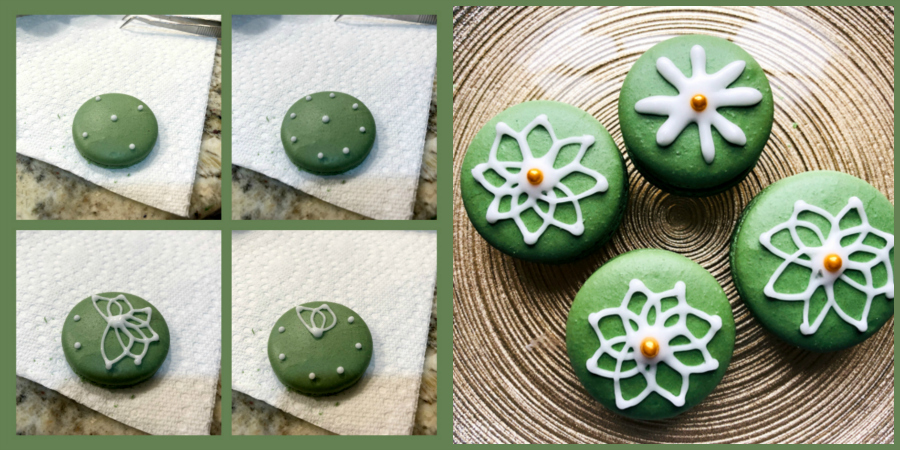
Comments: Snowflakes are everywhere in cookie decoration these days, and of course, it’s the perfect time of the year to showcase them. They are easy to draw, just 4 straight lines criss-crossed, and then go crazy with the little details. I’ve been practicing with tip-less bags, but for these drawings I found it easier to couple the bag with a very fine tip, number 1 from Wilton.

But you can also do other styles of piping like this little rosette. Just mark the center, 8 points around it, take a deep breath and pipe!

The black walnut filling was featured in the blog back in July, but this time I added cinnamon and cloves, inspired by Phil’s family recipe for “Cottage Cookies” which I must make to share with you at some point. In fact, he was surprised that it is not yet in the blog.

ORANGE AND CRANBERRY MACARONS
(from the Bewitching Kitchen)

1 recipe from basic method

For filling:
160g powdered sugar
57g unsalted butter, softened (4 tablespoons)
1/2 teaspoon orange extract extract
zest of half a large orange
pinch of salt
heavy cream or milk to adjust consistency, if needed
cranberry relish or jam (I used store-bought)

Make the macarons using orange gel food color.

For the filling, use a hand-held electric mixer and whisk the butter until creamy. Add the powdered sugar, orange extract, zest and salt. Whisk in low-speed at first, the increase speed and whisk until creamy and smooth. If needed, add a very small amount of milk or heavy cream.

Fill shells with a small dollop of cranberry jam in the center, surround it with a circle of orange buttercream. Decorate with Royal icing or air brushing, if so desired.

Leave macarons in fridge overnight to mature.

ENJOY!

to print the recipe, click here

For these macarons, I used two different styles of decoration, one with Royal icing concentric swirl, and another in which I sprayed the two sides of the shells with coral and orange dyes, trying to mimic the colors associated with the two flavors. Some candy melt drizzle and sprinkles for good measure…

I loved this combination of flavors, cranberry and orange is a real classic, so I highly recommend you try this one.

EGGNOG MACARONS
(filling from The Jam Lab)

1 recipe from basic method

For the filling:
4 tbsp unsalted butter, room temperature
½ teaspoon salt
½ teaspoon freshly grated nutmeg
2 tablespoons rum extract (or rum if you don’t mind the alcohol)
2 tablespoons heavy cream
3 ½ cups to 4 cups powdered sugar

Make macaron shells and dye with green gel color.

For the filling, use a hand-held electric mixer and whisk the butter until creamy. Add the powdered sugar, salt, spices and flavoring. Whisk in low-speed at first, the increase speed and whisk until creamy and smooth. Add heavy cream until the consistency is right for piping. Assemble shells with the filling, if desired you can air-brush with gold details using a stencil.

Keep the macarons in the fridge overnight before serving.

ENJOY!

to print the recipe, click here

Comments: Most recipes that call for eggnog use “the real thing” added to buttercream. We don’t drink eggnog, so I did not want to buy a big carton that would sit in the fridge. This recipe from JamLab is perfect. I used rum extract because my macarons are donated and alcohol is not allowed. If you want to do as I did, I recommend this extract.

GINGERBREAD MACARONS
(filling from Pies and Tacos)

for the filling:
160g powdered sugar
57g unsalted butter, softened
1/2 teaspoon vanilla extract
1 teaspoon molasses
1/4 teaspoon ground ginger
1/4 teaspoon ground cinnamon
1/4 teaspoon nutmeg
milk or heavy cream if needed

Make the shells and use a caramel food dye to color the batter.

For the filling, cream butter using a hand-held electric mixer until very creamy. Add the sugar, spices and flavoring, keep whisking at low-speed at first, then increase the speed. If needed, adjust consistency with heavy cream or milk.

Pipe filling on shells, and decorate with a band of gold luster. Stick little gingerbread-shaped sprinkles using small dots of royal icing. Leave macarons in the fridge overnight before serving.

ENJOY!

to print the recipe, click here

Comments: I loved the flavor of this filling. As to the decoration, I quickly realized that even if the gingerbread men looked quite cute on the shell, glueing them did not bring me joy. They are so delicate, and it was quite labor-intensive to adjust them with tweezers on top of the icing. I made a few and then switched to plan B. There is a limit to my Zen.

Of all the macarons from this post, the one that got the highest praise was…… drum roll…. drum roll….. the EGGNOG! I was surprised by how many of the testers said it was maybe the best ever from all the ones I’ve shared over the past few months.

I hope you enjoyed this series, featuring one of the concoctions I love to bake the most… Stay tuned for the final post on Holiday Cookies, in which I’ll feature Springerle.

ONE YEAR AGO: The Great American Baking Show

TWO YEARS AGO: Broccoli Souffle

THREE YEARS AGO: Panettone Time!

FOUR YEARS AGO: How the Mighty Have Fallen

FIVE YEARS AGO: Festive Night at Central

SIX YEAR AGO: The Perfect Boiled Egg

SEVEN YEARS AGO: Light Rye Sourdough with Cumin and Orange

EIGHT YEARS AGO: Homemade Calzones

NINE YEARS AGO: Plum-Glazed Duck Breasts

TEN YEARS AGO: Holiday Double-Decker

ELEVEN YEARS AGO: New York Deli Rye

SUGAR COOKIES FOR THE HOLIDAYS

Until my participation in a certain show, I was not too wild about decorating sugar cookies with Royal icing. Indeed, in the comfort of my kitchen I would always refer to that white, impossible to tame substance as Royal Pain in the Icing, which indicates how I felt about it. But those intense weeks of preparation for the different episodes of the show forced me into areas of baking I had happily ignored and avoided. Much to my own amazement, I now love everything about cookie decorating, from baking the base to planning the design and trying to make it happen. On that note, I highly recommend that you go through my trilogy of posts on the subject from last month and the detailed tutorials by Tanya which I shared at the time. For all the holiday cookies in this post, I went with a flavor that is deeply ingrained in the season: Fiori di Sicilia, the Italian magical potion that is the classic addition to panettone. As to the decorations, apart from the wet-on-wet which I find the most user-friendly, I will share three methods that were new to me, requiring just a tad more involvement: Crackled Gold Christmas Tree, Reindeer (a clever twist starting from a common cookie cutter), and Stained-Glass Cookies.

FIORI DI SICILIA SUGAR COOKIES
(from the Bewitching Kitchen)

360 g all-purpose flour (3 cups)
2 teaspoons baking powder
200 g granulated sugar
¼ tsp salt
227 g cup butter, cold and cut in pieces
1 egg
3/4 tsp Fiori di Sicilia extract
zest of 1 lemon
¼ tsp cardamom

Heat oven to 350F. Combine the flour, baking powder and salt, set aside. Cream the sugar and butter. Add the egg, Fiori di Sicilia, lemon zest and cardamom, mix well. Scrape the sides of the bowl. Add the flour mixture in two steps, and beat just until combined.

Dough can be rolled right away in between sheets of parchment paper. Roll to about 1/4″ thick, and cut into shapes. Place on parchment-lined baking sheets, freeze for 10 minutes. Bake for about 12 minutes. Transfer to cooling rack and cool to room temperature before icing.

(for Royal Icing, I used Tanya’s recipe, which you can find here)

ENJOY!

to print the recipe, click here

Comments: This is definitely my default recipe for sugar cookies because I adore Fiori di Sicilia and I do flips for cardamon. As far as extracts go, Fiori di Sicilia is not cheap, but it is hard to replace with something else. Some say that orange extract + vanilla does a good enough job playing its part. Your kitchen, your rules, feel free to flavor your cookies the way you like. Just make sure not to roll the cookies too thin. Thin sugar cookies don’t stand up to the icing.

With the basic Christmas colors (red and green, plus white for flooding) you can do a lot…

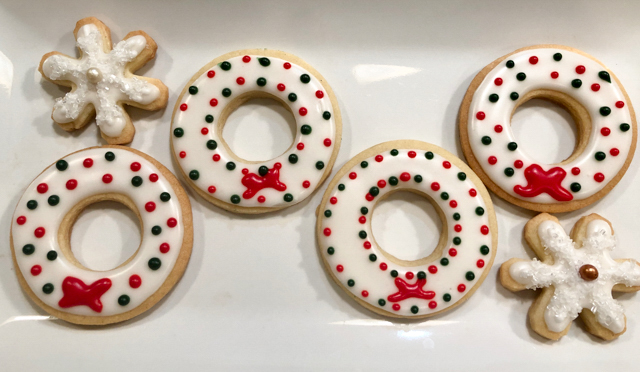
I used two cookie cutters, one for the basic shape, a smaller to cut a circle in the center, turning it into a wreath. From there, nothing fancy. Flooded with white, allowed to set for just 10 minutes and then a few green and red dots added on top. The little bow added in the very end. Yes, I realize that could be a lot better, and I intend to work on it.

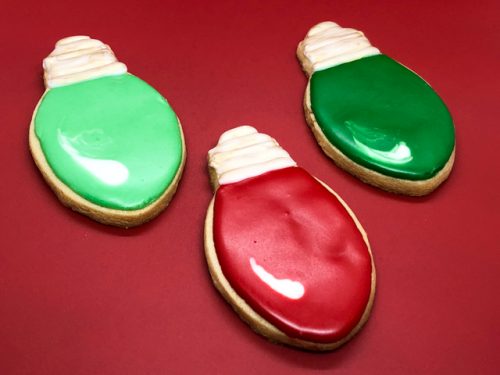
A new cookie cutter I got this year stole my heart. I find it so cute and a bit unusual. A Christmas light bulb, which once again can be made quite simply with only two colors of icing and if you like to gild the lily, some luster gold painted on the “metal” part next day.

By bringing one more color – black – you can expand a bit more the horizons, so that Mr. Snowman has a nice hat and black, profound eyes. The baby deer are also super easy, flooding with white, waiting until it sets a bit and piping the details. The little snowflakes were flooded with white and immediately showered with white sparkling sugar. And one day I will understand why I seem to always type “spanking” sugar before getting it correctly (sigh).

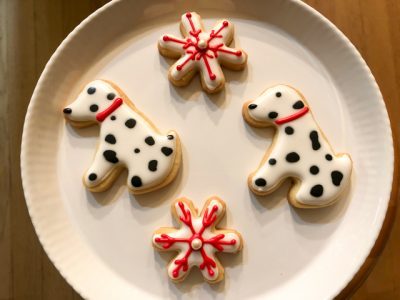
And since there was black Royal Icing around… why not immortalize one of our faithful companions, who has been with us every step of the way in this crazy year? The black dots were placed before the white set (wet-on-wet), then the nose and the red collar were added later, just to have a bit of a 3D effect. Same process went into the snowflakes.

Holiday Baking is not complete without Christmas Trees…

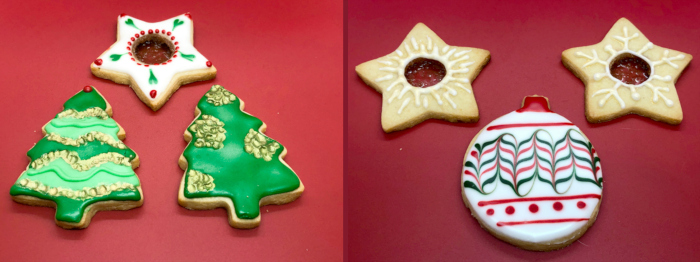
Some of the designs were again wet-on-wet, but then I did something new that blew my little mind when I saw it on a tutorial on youtube. A technique called “Crackled Gold” and you can visualize better in this picture:

It is so cool, I cannot quite believe how creative people can be, figuring these little tricks. What you do is flood the cookie with the base color and wait until it starts to crust. Average will be 15 minutes. Then you use the handle of a painting brush, or what I used: a fondant ball-shaper. I have a set of several sizes and picked one to make the indentations that seemed most appropriate for the size of the tree. Press the ball gently to make a mark on the icing. Let it dry completely and if desired you can add details with gold luster. Or you can leave it without the gold accent, for a simpler look.

To see exactly how that is made, you can check the wonderful tutorial by The Graceful Baker in youtube clicking here. The “crackled gold” starts at 33 min and 10 sec. I already anticipate the same approach in other styles, like crackled heart shapes for Valentine’s…. Wouldn’t that be awesome?

Moving on…. another technique I learned from Stephanie on youtube, and you absolutely MUST check her site. What I loved about this one is the clever use of a cookie cutter that most people have in their little treasure box: a gingerbread man, any size will do. If you turn it upside down you can use it to make a Reindeer!

Am I adorable or what?

I swear, I love this little guy! I admit his ears ended a bit pathetic, and if you watch her video you’ll realize I forgot to add the hair on top of his cute head, but overall I am thrilled with the way he turned out. I will make some more again in the near future, hoping to do a better job.

The final details (eyebrows and smile) are made with a very fine food pen but if you can also try royal icing, I don’t dare going for such fine details using it. Poor Reindeer, he would look like roadkill.

Please make sure you visit Little Cookie co. youtube channel. I already have three different techniques on my list of projects to try soon, in fact it is quite likely that by the time you read this I will be already working on one of them….

And finally… a technique I’ve been flirting with for the longest time: Stained Glass Window Cookies. First time I did it, I was not very happy with the outcome. I liked the overall design but the stained component was not as I expected.

To have the stained glass effect, many recipes will tell you to simply crush hard candy in the color you want and make a little pile in the cut out part right before you bake. I found it hard to time the full melting of the candy with the cookie baking, and also the candy shrinks quite a bit and gets cloudy. Just not the type of effect I had in mind. I consulted with Tanya about it, and she advised me to use a totally different method, her favorite. Essentially you make the sugar syrup yourself, dye any color you want or leave it plain, and spoon it gently in the cut out part after the cookies are already baked. The result is so much better! Nothing like getting advice from a pro…

Here is the recipe I used, it makes enough for many many cookies, but it is hard to scale it down, so I advise you to keep the amounts as written.

SYRUP FOR STAINED GLASS COOKIES
(from The Honey Blonde)

100g sugar (1/2 cup)
3 tablespoons corn syrup
1/4 cup water
gel food color, if desired

Combine sugar, corn syrup, and water into a small sauce pan. Place over medium high heat and bring to a boil. Do not stir sugar while boiling. Continue to boil until mixture reaches about 290-300 degrees. Remove from heat and gently stir gel food color.

Place the cookies on a foil lined baking sheet lightly sprayed with oil, or use a non-stick foil. Spoon the candy into the center of the cookie, using the spoon the spread the candy into the edges of the cut out region.

Let set for about 10 minutes, or until candy is completely hardened.

ENJOY!

to print the recipe, click here

I hope you enjoyed this little collection of Holiday-inspired sugar cookies. Next I will share macaron ideas also inspired by this festive season. Stay tuned!

ONE YEAR AGO: Just a few hours to go!

TWO YEARS AGO: Broccoli Souffle

THREE YEARS AGO: Panettone Time!

FOUR YEARS AGO: How the Mighty Have Fallen

FIVE YEARS AGO: Festive Night at Central

SIX YEAR AGO: The Perfect Boiled Egg

SEVEN YEARS AGO: Light Rye Sourdough with Cumin and Orange

EIGHT YEARS AGO: Homemade Calzones

NINE YEARS AGO: Plum-Glazed Duck Breasts

TEN YEARS AGO: Holiday Double-Decker

ELEVEN YEARS AGO: New York Deli Rye
COOKIES FOR THE HOLIDAYS: GINGERBREAD

December. This is the time for baking cookies in all shapes and forms, but some are definitely more strongly associated with the holiday spirit. This posts opens a series of four chapters. I start with gingerbread, using a recipe from Tanya, tent-baker extraordinaire, aka The Gingerbread Queen. Subsequent posts will cover Sugar Cookies, Macarons, and Springerle. Gingerbread Cookies are not too hard as far as baking project goes, as long as you keep them as cookies instead of components of 3D sculptures (sigh). Because their flavor is so intense, they can be enjoyed with no decoration whatsoever, or with a very simple white Royal icing. So simple that you can even get by using a tip-less piping bag. And of course, sprinkles are always welcome. Always.
GINGERBREAD COOKIES
(very slightly modified from Tanya’s blog)

640 grams all-purpose flour
3 teaspoons ground ginger
1 + 1/2 teaspoons ground cinnamon
1 teaspoon allspice
1/4 teaspoon cloves
1 teaspoon baking soda
1/2 teaspoon salt
226 grams unsalted butter, at room temp
200 grams granulated sugar
Zest of 1 orange
1 large egg, at room temperature
120 mL (1/2 cup) honey
120 mL (1/2 cup) molasses
2 Tablespoons distilled white vinegar

Whisk together the flour, spices, baking soda, and salt in a large bowl. Set aside. In the bowl of stand mixer add the sugar with the orange zest and rub them well with your fingers, until fragrant. Add the butter, fit the machine with the paddle attachment and mix until well combined. Add the egg and beat on medium-high speed until light and fluffy. Scrape down the sides of the bowl at least twice during mixing. Add the molasses, honey, and vinegar and mix well.

Turn off the mixer and add about half of the dry ingredients. Mix on low just to combine. Add the rest of the dry ingredients and mix just until combined. Gather the dough together into a ball and then flatten the dough into two disks. Wrap each disk in plastic and refrigerate for about 3 hours or until firm enough to roll without sticking.

Heat the oven to 375°F. Line cookie sheets with parchment paper or silicone baking mats.
Roll the dough on a lightly floured surface to a 3/16-inch thickness. Cut out shapes, carefully transfer the cookies to the prepared cookie sheets and freeze for 5 minutes.

Bake until the cookies are firm to the touch and lightly browned around the edges. A three-inch round cookie will take about 8 to 10 minutes. Cool completely before frosting and/or assembling with royal icing.

ENJOY!

to print the recipe, click here

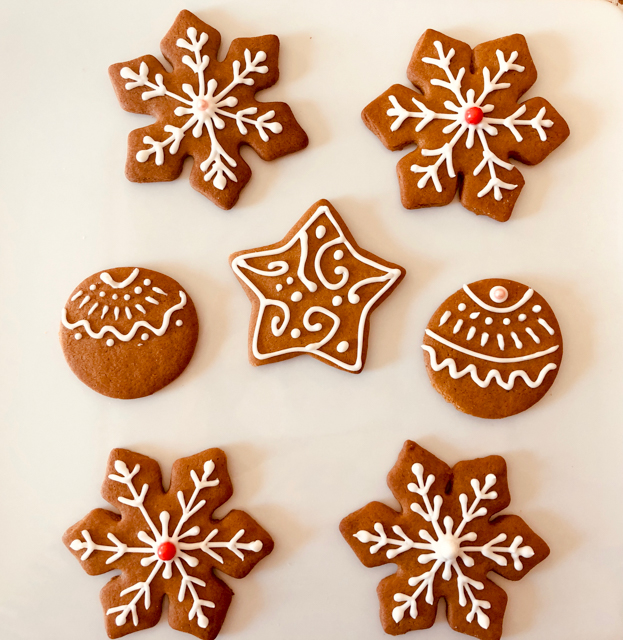
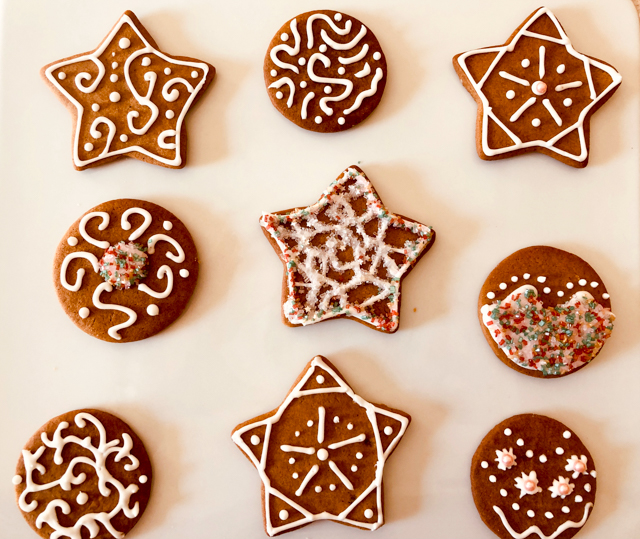
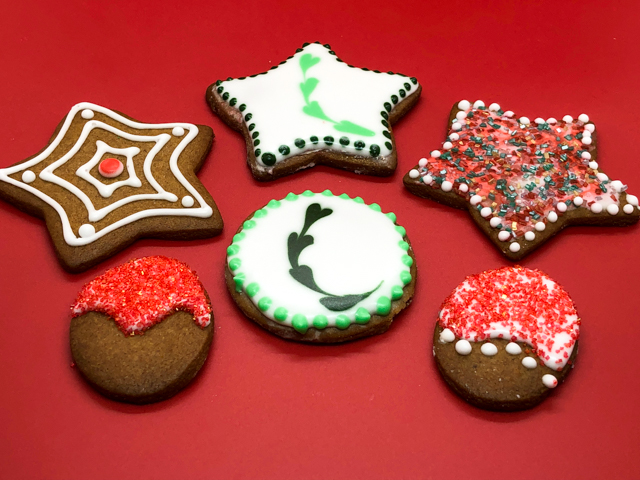
For most of my decorations, I used Tanya’s recipe for Royal Icing with very little water added. For gingerbread, I prefer not to fully cover the cookie, so instead of flooding them, I piped shapes and wanted them to stay firmly in place.

You can keep it all super simple….

or… while keeping it simple couple the design with some gold for a festive twist

The star was left fully white, the others were painted with gold luster diluted with lemon extract. It is a bit hard to see it in the middle ones, because the gold was just applied on the white decorations.

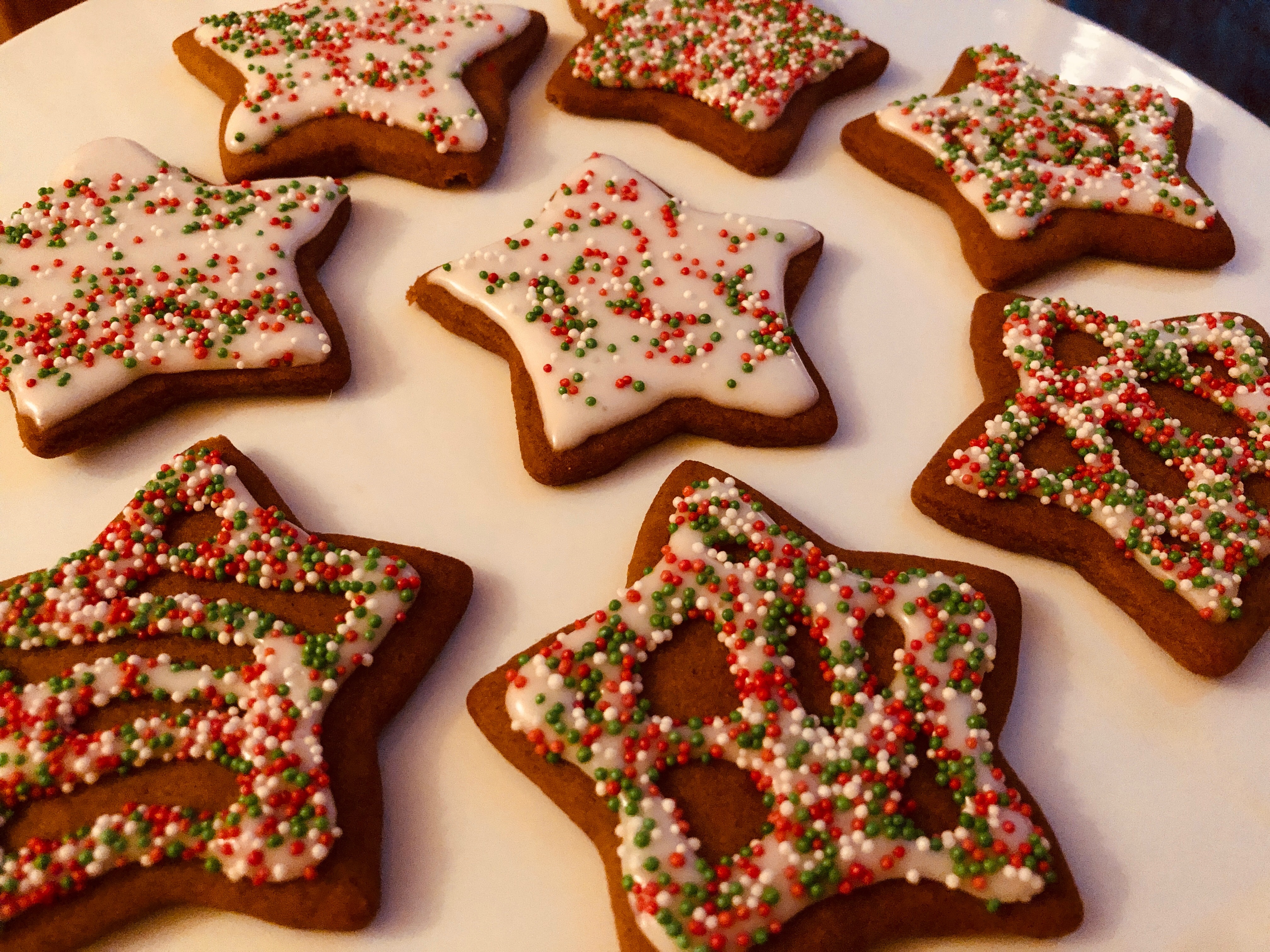
Even if I rather not completely cover a gingerbread cookie, sprinkles (in this case sparkling sugar) are hard to resist… Just add them before the icing hardens. Keep in mind that the thicker the icing, the faster it sets.

Now what if you dislike Royal icing with a passion? Here is a pretty sweet alternative (pun intended).

EASY NON-ROYAL ICING

1 cup powdered sugar
3 to 4 teaspoons milk
2 tsp corn syrup
1/4 tsp vanilla extract (or almond, or lemon)

Whisk whisk whisk whisk…. If it flows as a thick ribbon from a spoon, it will be ready to use. You can flood the surface or make thick ribbons. Leave as it is, or go crazy with….. SPRINKLES!!!!

to print the recipe, click here

This icing will crust well in a few hours, but just to be safe don’t mess too much with the cookies for 24 hours, especially if you are going to pack them for gifts or shipping.

Stay tuned for Sugar Cookies next….

ONE YEAR AGO: Incredibly Simple Times Four

TWO YEARS AGO: White Chocolate and Raspberry Mousse Cake

THREE YEAR AGO: Panettone Time!

FOUR YEARS AGO: Pistachio Creme Brulee

FIVE YEARS AGO: Fast and Furious Bison Chili

SIX YEARS AGO: In My Kitchen, December 2014

SEVEN YEARS AGO: Braised Fennel with Saffron and Tomato

EIGHT YEARS AGO: Revenge of the Two Derelicts

NINE YEARS AGO: Grilling Ribbons

TEN YEARS AGO: Peppery Cashew Crunch

ELEVEN YEARS AGO: Baked Shrimp and Feta Pasta


SARAH BERNHARDT’S COOKIES

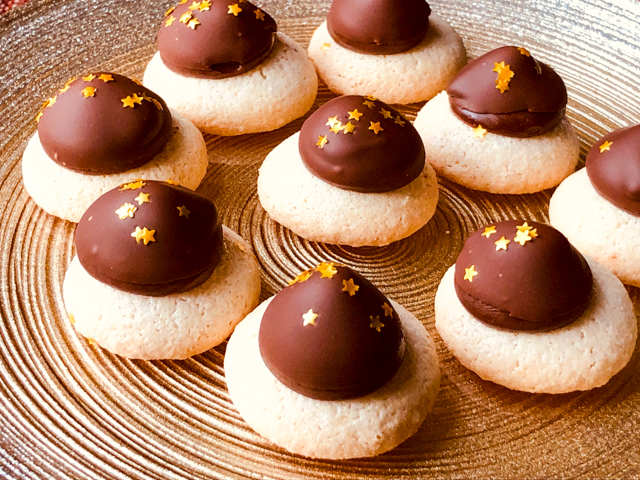
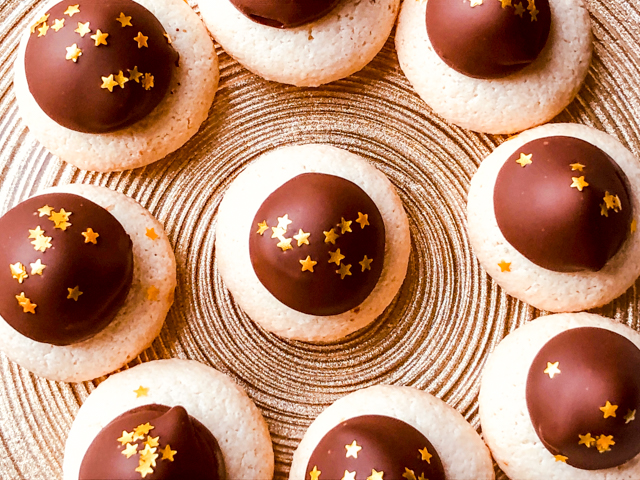
Don’t you love a cookie with a nice story behind it? Sarah Bernhardt was one of the greatest French actresses of the last century. During a trip to Denmark at the height of her career she had a cookie from an upscale bakery and fell totally in love. She was so passionate about that delicacy that in 1911, after her memoirs were published in Denmark, Chef Johannes Steen named this spectacular chocolate cookie after her. Read more about it here. You will find many versions around, but count on Helen Fletcher to bring you the authentic. The cookie joins an almond base, and a chocolate truffle enrobed in a chocolate shell. Many versions cover the whole thing in chocolate, but if you want to do the real thing, cover just the truffle. You should still see the cookie underneath and it will be much more elegant to eat. Worthy of a dame like Sarah Bernhardt.

SARAH BERNHARDT’S COOKIES
(from Pastries like a Pro)

for the cookie base:
100g almond flour
150g granulated sugar
2 large egg whites
1/2 teaspoon almond extract

for the chocolate truffle topping:
1/2 cup cream
2 tablespoons unsalted butter (28g)
2 tablespoons sugar (25g)
140g semisweet chocolate
1 teaspoon vanilla

to coat the truffle:
114g semisweet chocolate (114 grams)
1 tablespoon shortening
Gold Leaf, optional

Make the cookie base. Draw a template with 1 in diameter circles on parchment paper to pipe the cookies, flip the paper so that you can pipe on the back.

Combine the almond flour and sugar in the bowl of a food processor, and run it for a few seconds to combine. Add the egg whites and vanilla, process until a paste forms. Place the mixture in a piping bag fitted with a 1/2 in round tip. Pipe rounds of cookie batter on the parchment paper, going just to the circle drawn. They will puff up during baking. Leave the piped cookie sitting at room temperature while you heat the oven to 300F. Bake the cookies for 20 minutes or until they just start to get some color on the edges. Let cool completely on the paper before removing to a cooling rack.

Make the chocolate truffles. Heat cream, butter and sugar until the butter is melted and the sugar is dissolved. The mixture should be very hot, but not boiling. Submerge the chocolate under the cream and let sit for 4 or 5 minutes. Whisk gently until smooth. Add vanilla.

pour it into a rimmed baking sheet, cover the top with plastic wrap and let it sit at room temperature until it sets up. If it is too soft to pipe and hold a shape, refrigerate briefly until it can be piped.

If making up to a week ahead, pour into a container, cover the surface with film and chill store in the refrigerator. Bring to room temperature to pipe. Follow the instructions above if it gets too soft.

Fit a pastry bag with a 5/8 inch tip. Fill the bag the truffle mixture. Pipe a kiss shaped mound in the center on top of each macaroon about 1” high and within about 1/4″ from the edge. If there is a pointed tip, press it gently with your finger to smooth the surface out.

Place in the freezer to harden. If not finishing within a day or so, place these in a covered container and keep them frozen for a month or so until time to finish.

Finish the cookies. Combine the chocolate and shortening in a short, wide mouth glass or other small container and microwave at 50% power for 1 minute.  Stir to mix. If the chocolate isn’t completely smooth, microwave for 10 seconds at a time.  Do not let it get too hot.

Remove the cookies from the freezer. Dip them upside down to cover the kisses, just short of their bottoms. Let the excess chocolate drip off. The chocolate finish should cover the kiss but not touch the cookie base. The fact they are frozen will stop the chocolate from running. If the kisses start to warm, pop them back into the freezer. Right after coating, add golden leaf decoration or sprinkles.

Cookies should be kept in the fridge and be brought to room temperature for serving. They can sit at room temperature for a few hours.

ENJOY!

to print the recipe, click here

Comments: Helen’s post about these cookies is extremely detailed, so I recommend you visit her site if you’d like to bake a batch. She decorated them with gold leaf, I went the easier route and resorted to my trustworthy golden stars. You’ll need to work fast, because the chocolate coating sets almost immediately upon contact with the frozen truffle component.

These are festive and luscious, the type of cookie that will brighten up any holiday table. There is something about the contrast of the cookie base with the melt-in-your-mouth truffle that explains why Ms. Bernhardt went crazy for them.

ONE YEAR AGO: A Really Big Announcement

TWO YEARS AGO: Stir-Fried Chicken in Sesame-Orange Sauce

THREE YEARS AGO: Monday Blues

FOUR YEARS AGO: A New Way to Roast Veggies

FIVE YEARS AGO: Two Takes on Raspberries

SIX YEARS AGO: Spice Cake with Blackberry Puree

SEVEN YEARS AGO: Own Your Kitchen with Cappuccino Panna Cotta

EIGHT YEARS AGO: Chicken Parmigiana, the Thriller

NINE YEARS AGO: Wild Mushroom Risotto

TEN YEARS AGO: Tartine Bread:  Basic Country Loaf 

ELEVEN YEARS AGO:  Pugliese Bread