PIERRE NURY’S RUSTIC LIGHT RYE: BOUGNAT

I’ve browsed the pages of Leader’s “Local Breads” countless times over the past year, but taking part in “The Bread Baker’s Apprentice” challenge prevented me from indulging in many other bread books. Once the  challenge finished, I felt excited to attack other projects, but also somewhat paralyzed.   Not anymore: last weekend I dove into my first Local Breads recipe, a three-day project that led to a couple of delicious loaves of a rustic, toothsome bread.

PIERRE NURY’s RUSTIC LIGHT RYE
(from Local Breads)

Levain (sourdough starter)

45 g firm sourdough starter
50 g water
95 g bread flour
5 g whole wheat flour

Mix all the ingredients until they form a stiff dough, trying to incorporate all the flour into it. Place the dough in a container, marking its level with a tape or pen. Allow it to ferment at room temperature for 8 to 12 hours, until it doubles in volume. This recipe will make more levain than used in the bread.

Bread dough

400 g water
450 g bread flour
50 g rye flour
125 g levain
10 g salt

Pour the water into the bowl of a Kitchen Aid type mixer. Add the bread and rye flours, stir with a spatula until it begins to form a dough. Cover the bowl and let stand at room temperature for 20 minutes.

Uncover the bowl, add the levain (only 125 g of it) and the salt, and start kneading with the dough hook on medium speed for 12-14 minutes, or until you have good gluten development (do a windowpane test). Transfer the dough to a slightly oiled bowl and keep it at room temperature for 1 hour. Scrape the dough into a floured surface and fold it a couple of times to induce gluten development. You can see how to fold the dough by clicking here. Repeat the folding again after 1 more hour. After the second folding cycle, let the dough rise for 1 to 2 hours at room temperature until doubled in volume. Transfer to the refrigerator for 12 to 24 hours.

After 14 hours, my dough looked like this….

“Shaping” and baking
Remove the dough from the fridge 3 hours before baking. Heat the oven to 450F and place a baking stone (or tiles) on the middle rack.

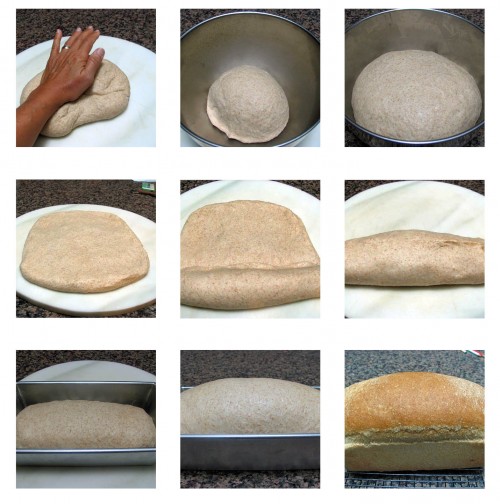
Heavily dust the counter with flour, scrape the dough onto the counter, and open it gently into a 10 inch square shape, trying not to deflate it too much. I like to mark the dimensions on the flour, to have an idea of how much to open the dough.

Transfer each piece to a rimless baking sheet covered with parchment paper, stretching the dough to about 12 inches long. Let it fall naturally, without worrying about a precise shape. If baking both loaves at the same time, separate them by at least 2 inches.

Bake with initial steam for 20 to 30 minutes, until a dark walnut color develops on the crust. Let the loaves cool on a rack for at least an hour before slicing.

ENJOY!

to print the recipe, click here

for a detailed discussion on this particular bread, visit this link

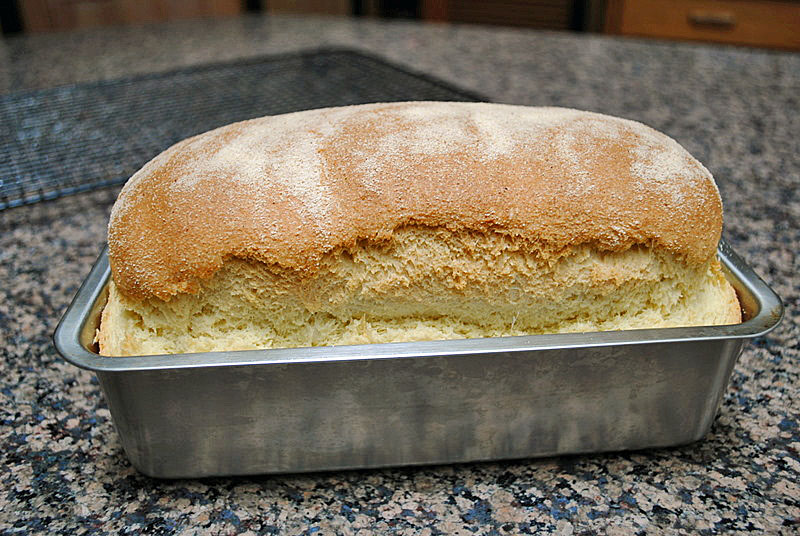
Comments: The recipe was quite involved and challenging, but the gods of Bread were on my side and things went smoothly.  A dough with this much water (in baker’s terms it’s called a high hydration ratio) is tricky to deal with, but extra flour on the work surface helps. As some of the bakers in The Fresh Loaf put it “it feels like you’re making pancakes” when transferring the “bread” to the baking sheet. It’s impossible to shape it, so don’t even try. Lift it, gently stretch it  (it will almost stretch itself as it’s lifted), place it on the baking sheet and transfer it to the oven.   It’s a delight to witness its impressive oven spring (yet another fancy term to indicate that the dough rises a lot during baking).

The crumb almost made me shed a few tears… I know, I know… it’s pathetic, but bread make’s me emotional!  (In a good way.)  😉

I am submitting this post to Yeastspotting….

Add to FacebookAdd to DiggAdd to Del.icio.usAdd to StumbleuponAdd to RedditAdd to BlinklistAdd to TwitterAdd to TechnoratiAdd to Yahoo BuzzAdd to Newsvine

MELLOW BAKERS: GRISSINI

The Mellow Bakers challenge scheduled three breads for May:  grissini, miche Point-a-Calliere, and cornbread.  Today I jump-started myself by baking the grissini, which I’ve  never made before.  It was  easy, in that I kneaded the ingredients  in my Kitchen Aid for a few minutes until they formed a smooth and supple dough.  After an hour at room temperature I divided, stretched and rolled the dough into sticks that went into the oven for 20 minutes.    Piece of cake…  😉

I only made half the recipe, because neither my husband nor I are too crazy about breadsticks.  I love bread, and I love crackers, but grissini have a personality conflict:  they’re not quite sure what they are, bread or crackers.   Still, I enjoyed the opportunity to learn a new method in bread baking.

Here’s the dough  at the end of rising…

Divided into 12 equal pieces….

… that are formed into sticks, some left plain, some rolled in parmiggiano-cheese with a little black pepper

After baking, they’ll keep for several days  in an air-tight container….

Comments: They were fun to make, but perhaps a bit too bland.  The variations proposed in the book might be better (roasted garlic or cheese in the dough, instead of just used to roll the sticks before baking).  If I make these again, I’ll use the alternative method of opening the full dough in a large rectangle and cutting the individual sticks  from it, which will considerably reduce the time to stretch and roll each stick.

You can see how some of my fellow Mellow Bakers made their grissini by following these links….

Abby, from Stir it! Scrape it!

Anne Marie, from Rosemary & Garlic

Steve, from Burntloafer

Looking forward to miche Point-a-Calliere, a close relative of the amazing Poilane bread….

Add to FacebookAdd to DiggAdd to Del.icio.usAdd to StumbleuponAdd to RedditAdd to BlinklistAdd to TwitterAdd to TechnoratiAdd to Yahoo BuzzAdd to Newsvine

GOLSPIE LOAF, from the Scottish Highlands

Different breads evolve around the world in harmony with the native cultures and environments:   flat breads like Indian naan and Ethiopian injera, French baguettes, English crumpets, and the salt-less Tuscan bread.   People everywhere bake bread with their local grains and flours, and according to their preferred diets.   If I had money and time I’d travel the world and experience each one in person.  Instead,  I take virtual trips by baking the world of bread in my own kitchen.  This past weekend I made a Golspie loaf from the Scottish highlands, based on an old grain called “bere“.    Of course, this grain isn’t easy to find, but in his masterpiece “The Handmade Loaf” Dan Lepard created a recipe that mimics the original, using rye sourdough starter and whole wheat flour. Don’t be put off by its looks:  Golspie is not the Jonny Depp of the Bread World, but it has the personality and charm of Sean Connery in his prime.

The Handmade Loaf is a must have book for bread bakers, and I highly recommend that that you get your own copy of Dan’s book.   Because I bake so many of its breads, it’s unfair to the author to post all the recipes, and for Golspie I’m just providing the the basic formula, which I slightly changed from the original to introduce a small amount of white flour.

GOLSPIE LOAF FORMULA
(adapted from Dan Lepard)

75% rye levain
62% water
100% flour (3/4 whole wheat + 1/4 white)
25% bread flour
2% salt
0.5% instant yeast
coarse oatmeal (enough for dusting the loaf)

Comments:  The dough is made with minimal kneading (a couple of 10 second-kneading cycles), allowed to rise for an hour, shaped into a circle, and placed in a springform pan (around 8 inches in diameter), coated with coarse oatmeal.   Just before baking,  score the dough  all the way to the bottom in a cross-pattern that  later allows cutting it into its characteristic quartered shape.

Some photos of the process of making Golspie….

The dough is rolled out in a circle..

Placed in the springform pan, and gently patted to fill it….

Once in the pan,  coarse oatmeal is sprinkled on top….

Do not be afraid to do the crosscut…

ENJOY!

I am thrilled to submit this post to Yeastspotting….

Add to FacebookAdd to DiggAdd to Del.icio.usAdd to StumbleuponAdd to RedditAdd to BlinklistAdd to TwitterAdd to TechnoratiAdd to Yahoo BuzzAdd to Newsvine

THOM LEONARD’S COUNTRY FRENCH BREAD

I live in a state of bread anxiety.  On Thursdays I revive my sourdough starters and begin the tortuous process of choosing the bread to bake on the weekend.  That evening you’ll find me on the sofa, surrounded by bread books,  notebooks, pens, pencils, stickers, and close to a  computer with multiple open tabs: The Fresh Loaf, Wild Yeast, Makanai, Dan Lepard, King Arthur, Northwest Sourdough… My beloved husband knows it’s useless to converse with with me when I’m in such a “bread daze,” and I can’t come out of it until I make my choice.

This weekend’s pick was an impressive loaf from Maggie Glezer’s book Artisan Baking. She ranks each of her recipes according to its level of difficulty, and this one forewarned  “advanced” at the top of the page.  But, that didn’t stop me, which ultimately resulted in quite a bit of pain  for this baker.

THOM LEONARD’s COUNTRY FRENCH BREAD
(from Maggie Glezer’s Artisan Baking)

Make the levain on the evening before baking by mixing:

25 g fermented firm sourdough starter

140 g lukewarm water

140 g bread flour

Allow it to sit at room temperature for 12 hours, or until it has expanded and just started to sink in the center.

(click to enlarge)

On baking day:

Prepare the whole wheat component, by measuring 350g whole wheat flour and sifting it with a  fine strainer. This will remove the large flakes of bran (you can use it to make muffins). Measure 250g of the sifted product, and start making the dough.

(click to enlarge)

250 g sifted whole wheat flour

750 g bread flour

30 g  rye flour

660 g water

23 g salt

all of the levain made the previous evening

Add the three types of flour to the bowl of a large KitchenAid type mixer. Mix the water with the levain to dissolve it, and add it to the flours. Using the dough hook, mix it for 10-15 minutes, until the dough is very smooth and almost cleans the bowl. Add the salt and continue mixing for 5 more minutes.

(click to enlarge)

Place the dough in a very large bowl and let it rise for 3 hours, folding three times (at 30, 60, and 90 minutes). After the final folding, just leave it undisturbed for the final 90 minutes. Remove the dough from the container, form it into a ball and let it rest for 10 minutes to relax the gluten (that makes it easier to shape).

(click to enlarge)

Shape it into a large round loaf, and place it in a suitable container for proofing, lining it with a heavily floured linen, with the smooth side down. Proof at room temperature for 4 hours, or until an indentation made in the dough will not bounce back right away.

(click to enlarge)

Carefully transfer the bread to a baking sheet lined with parchment paper, slash the surface and bake with an initial burst of steam, in a 450F oven. Bake it for 70 to 80 minutes, rotating the dough after 30 minutes, and reducing the temperature to 400F if it starts to get too dark. Allow it to cool on a rack for several hours before slicing it.

ENJOY!

to print the recipe, click here

Comments: I had high expectations for this bread, because once the kneading was over and the fun part started (the folding!), the elasticity of the dough surprised me:  gluten development at its best!   The shaping went smoothly and the dough rose beautifully in my improvised banneton: a pasta colander, lined with my improvised baker’s linen.  However, improvised is a dangerous word to use  twice in the same description.

At the end of 4 hours, the dough was all airy, absolutely perfect!  The oven was ready, with baking stones blazing hot,  and I was on top of the world!   As I inverted the dough on the parchment paper,  I could not help but day dream…  “When I submit this masterpiece to Susan for Yeastspotting, she’ll call me on the phone to personally compliment me!” ….  “The Fresh Loaf will feature this bread on their  front page, and leave it  there for a year or two“….  “I’ll have my own show on PBS: Bread Baking with Sally“….

Then, reality interfered.   The improvised baker’s linen  would not peel off.   It was stubbornly glued to my beautiful, airy, gorgeous dough.  I screamed and howled in pain!   As I was wrestling the fabric off,   my beautiful, airy, gorgeous round loaf began to spread sideways and collapse right before my eyes!    It was horrible:  no glory for me, no phone call from Susan, no highlight on The Fresh Loaf, and definitely no show on PBS.  Finally, with the dough threatening to slide off the baking sheet the linen came free and I rushed the loaf into the oven, without  slashing, without steam,  with just frantic moves and a few well chosen words that are unfit to print.

A major lesson learned:  a 4.6 pound dough demands a perfect proofing environment, particularly for a 4 hour rise.  Now, after helpful advice from the crowd at The Fresh Loaf, I’m seriously considering one of these.

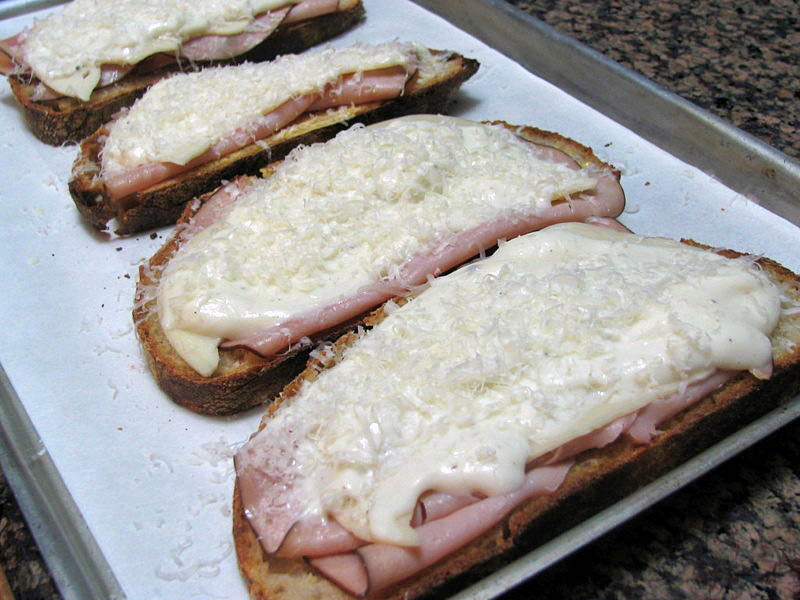
Back to Thom Leonard’s country loaf.  Aside from the top crust of my bread , which looked like the aftermath of Freddie Krueger,  the crumb was open and the bread was incredibly flavorful.   It’s a  bread that begs to be in a Croque Monsieur!  We shall comply shortly.

A bread that can survive the abuse I inflicted on this dough is worth saving in your personal repertoire.   Try it.  But do yourself a favor, and use the right tools for the job.   You might just get that phone call from Susan….

I am submitting this post to Yeastspotting

Add to FacebookAdd to DiggAdd to Del.icio.usAdd to StumbleuponAdd to RedditAdd to BlinklistAdd to TwitterAdd to TechnoratiAdd to Yahoo BuzzAdd to Newsvine

NQBWC92RPPUQ

BLACK OLIVE BIALY

I’ve never had a bialy until today.  But, ever since I first saw a picture of a bialy  in cookbooks and all over the net I wanted to try one, or even better, to make one!

Many weekends I was ready to give it a go, but things came up and… bialy was postponed until next week.   And the next… and the next…and the next.  Then I saw Dan Lepard’s recipe for black olive bialy and I couldn’t wait any more.   Black olive bialy.    Three simple words that made my heart jump with joy.  I’m a Kalamata-cheerleader…

BLACK OLIVE BIALY
(from Dan Lepard)

1/2 tsp instant dry yeast
150 g pitted Kalamata olives, diced
25 mL olive oil
1 tsp salt
550 g bread flour
1 medium onion, finely chopped
1 Tbs poppy seeds

Pour 250 mL warm water and yeast in a bowl then add the minced olives, olive oil and salt. Add the flour, mix forming a firm dough, and refrigerate for 24 hours or more (up to three days).

Dry fry the onion a few minutes on a non-stick skillet until soft but still pale, scrape into a bowl with the poppy seeds, and leave in the fridge.

Heat the oven to 450F.

Divide the dough into ten pieces (use a scale to get equal pieces) and shape into balls. Leave covered for an hour to rise at room temperature. Pat the balls out to about 4 inches diameter, and firmly indent the middle area, leaving a very thin and wide skin of dough in the center. Cover a tray with parchment paper, and lay five bialys on it, well spaced. Press 1 tsp of onion/poppy seed mixture in the center, with wet fingers.

Bake for 12 – 15 minutes until puffed and just beginning to get dark, then repeat with the remaining five pieces.

ENJOY!

Comments: If this recipe didn’t have Dan Lepard behind it, I probably wouldn’t have tried it, because it’s essentially a no-knead bread.  Quoting Seinfeld, “not that there’s anything wrong with that,”  but I prefer recipes that involve kneading and/or folding the dough.   This was one of the easiest breads I’ve ever made, that’s perfect for a dinner party or brunch:  once the dough is in the fridge it takes just a little over 1 hour to enjoy the fruits of your labor (i.e., the bread!).

Two important remarks:
1. Use Kalamata olives  or another good quality black olive that’s high in moisture.  Avoid the black olives sold in tins, that are brine-free and have almost no olive flavor.

2.  Don’t be shy when pressing your fingers into the dough to make the depressions.  Try to leave a very thin skin in the center. My second batch was better than the first, because I was too delicate in shaping the first five.

The flavor of the olives as you bite into the soft bread, mixed with the onion filling, is just dreamy!  I’ll revisit this bread again and again.

I am submitting this post to this week’s Yeastspotting….

Add to FacebookAdd to DiggAdd to Del.icio.usAdd to StumbleuponAdd to RedditAdd to BlinklistAdd to TwitterAdd to TechnoratiAdd to Yahoo BuzzAdd to Newsvine