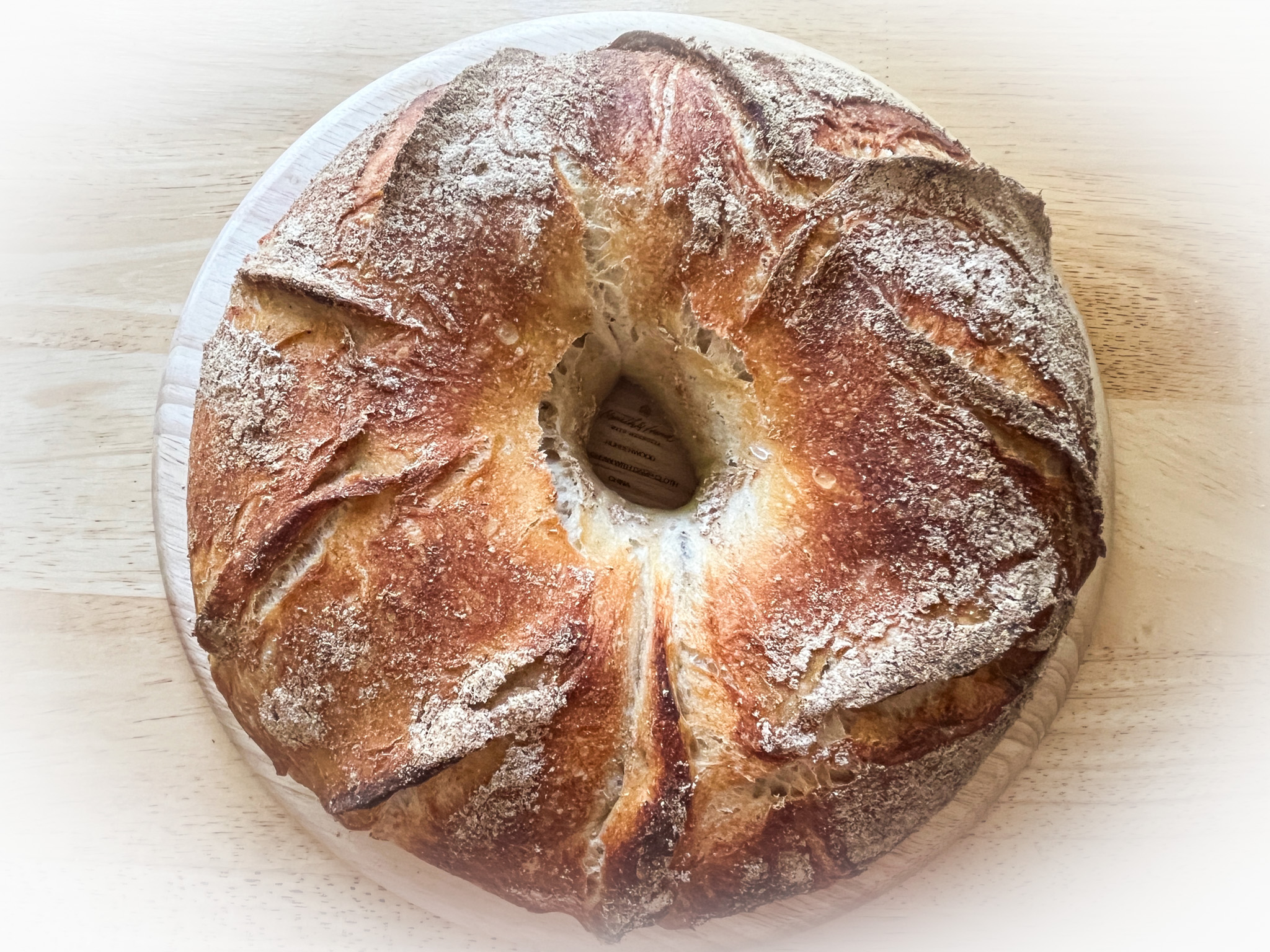
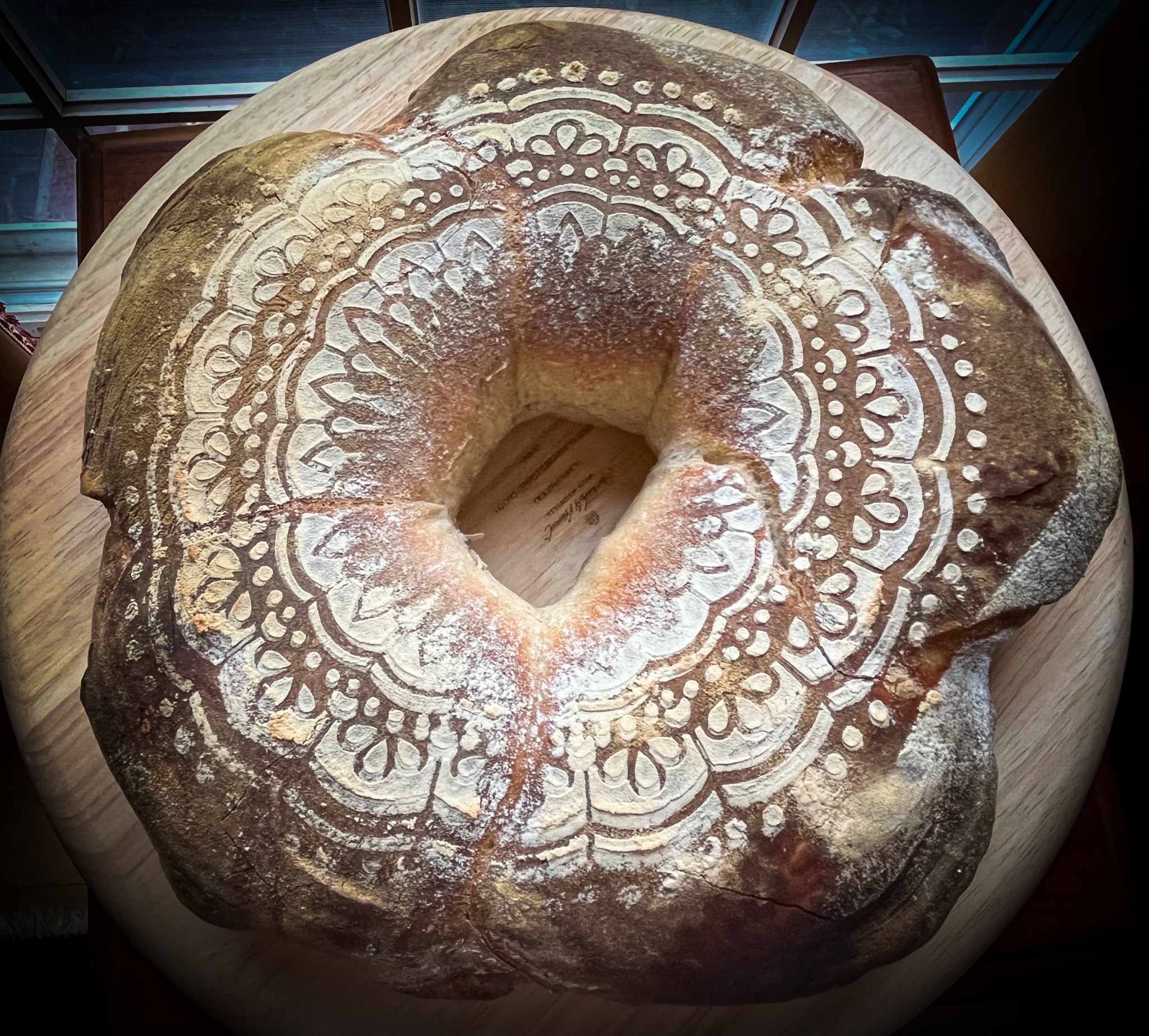
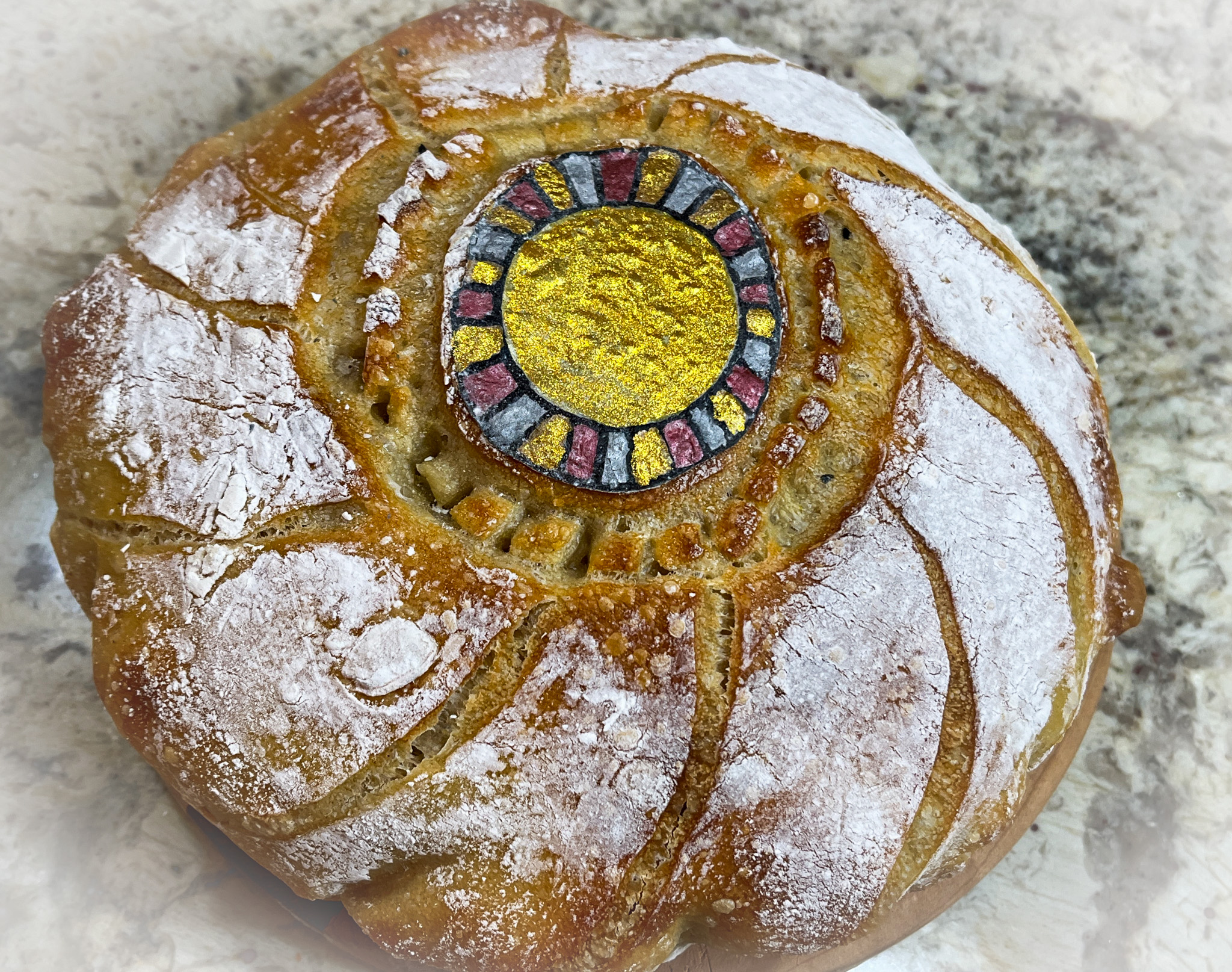
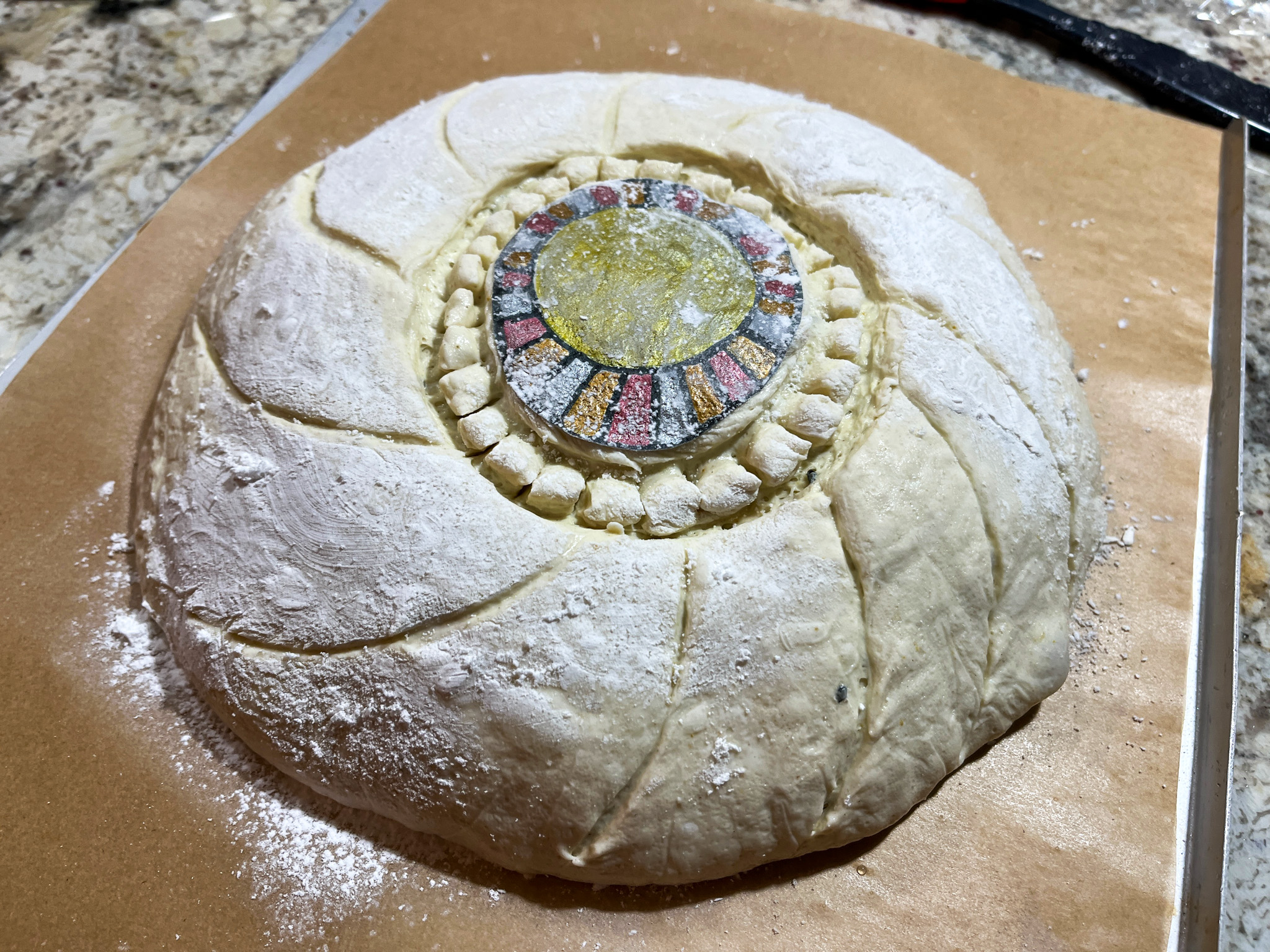
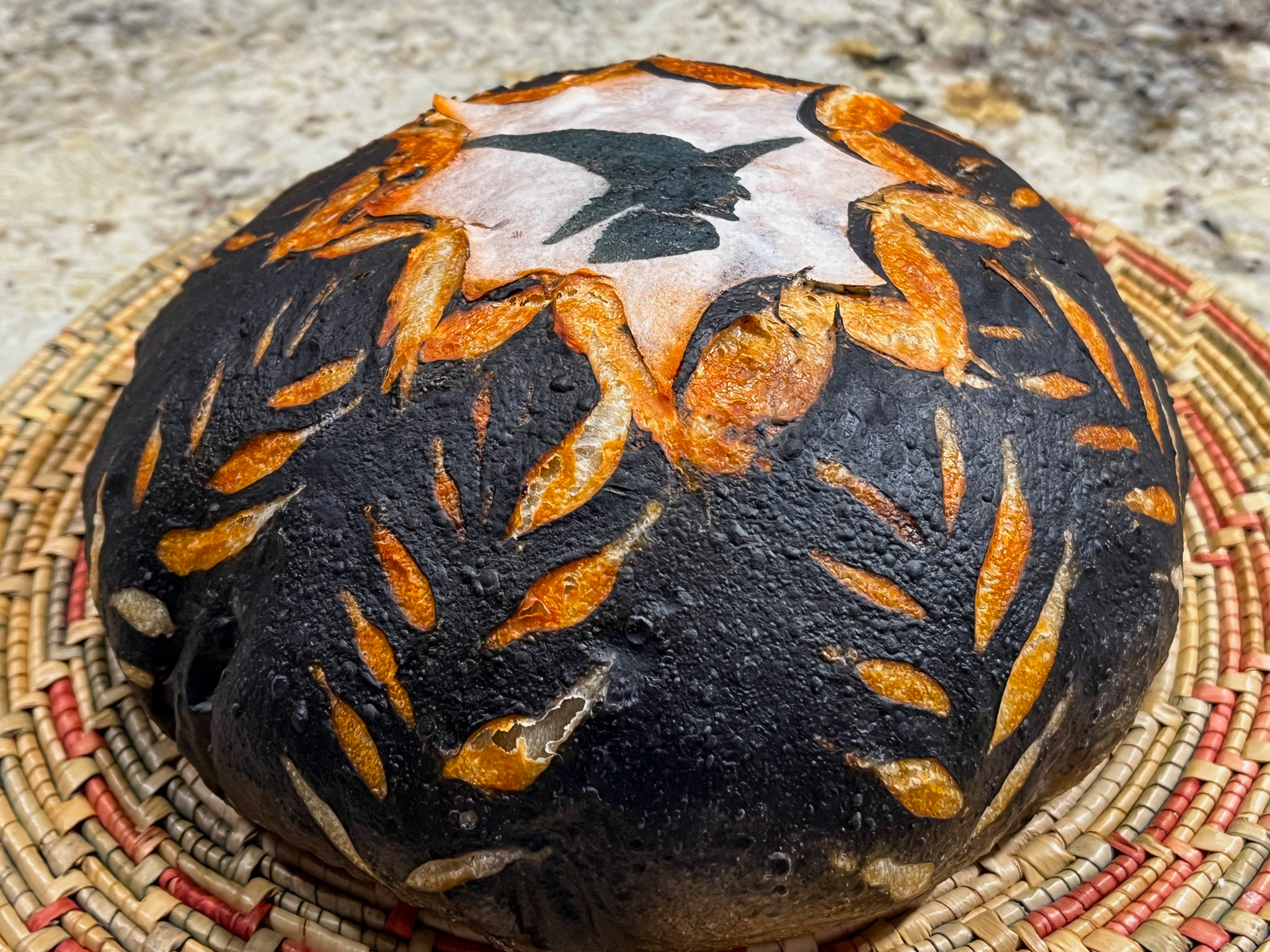
Once again I played with wafer paper to decorate sourdough bread, but this time I coupled it with a few strings to generate a cute shape, often used to turn the bread into pumpkin shape, but I opted for a more romantic outcome… Nothing personal against pumpkins, I do love them and honored them in the past (click here).
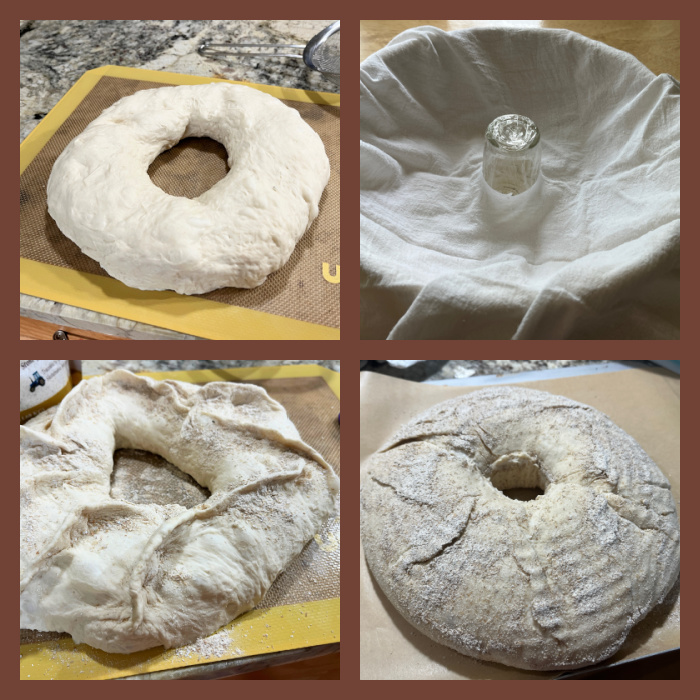
Start by cutting wafer paper in small heart shapes…. You will need three, and three long strings that you should rub very lightly with oil to facilitate removing later.
Place the strings equally spaced over the proofed dough, flip the dough over parchment paper, and tie the strings on the top, trying to hit the center as closely as possible. Gently insert the paper, coat the surface with flour and score the bread in any design you like. I used the Sonic blade and small scissors, as I often do.
Bake as you normally do, I keep the lid for 30 minutes and remove it for a final 15 minutes, all at 450F. Remove the strings, and allow the bread to cool completely before slicing.
You can use different patterns for the small hearts, or cut plain wafer paper and paint it yourself.
It is really amazing how well the colors in the wafer paper stay pretty much unchanged with baking, much better than air-brushed or gel colors. I hope you give this technique a try and have as much fun with it as I am having…
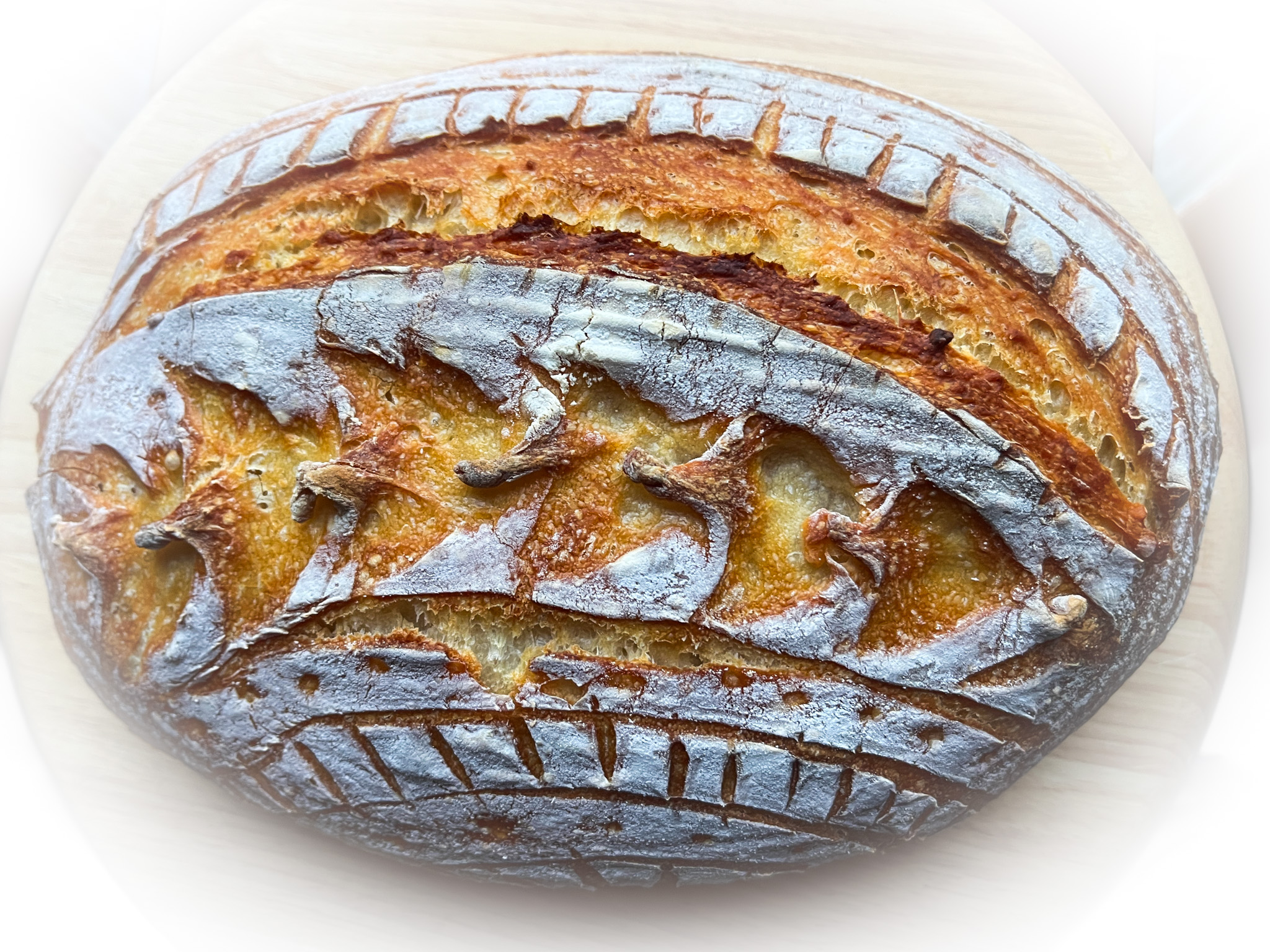
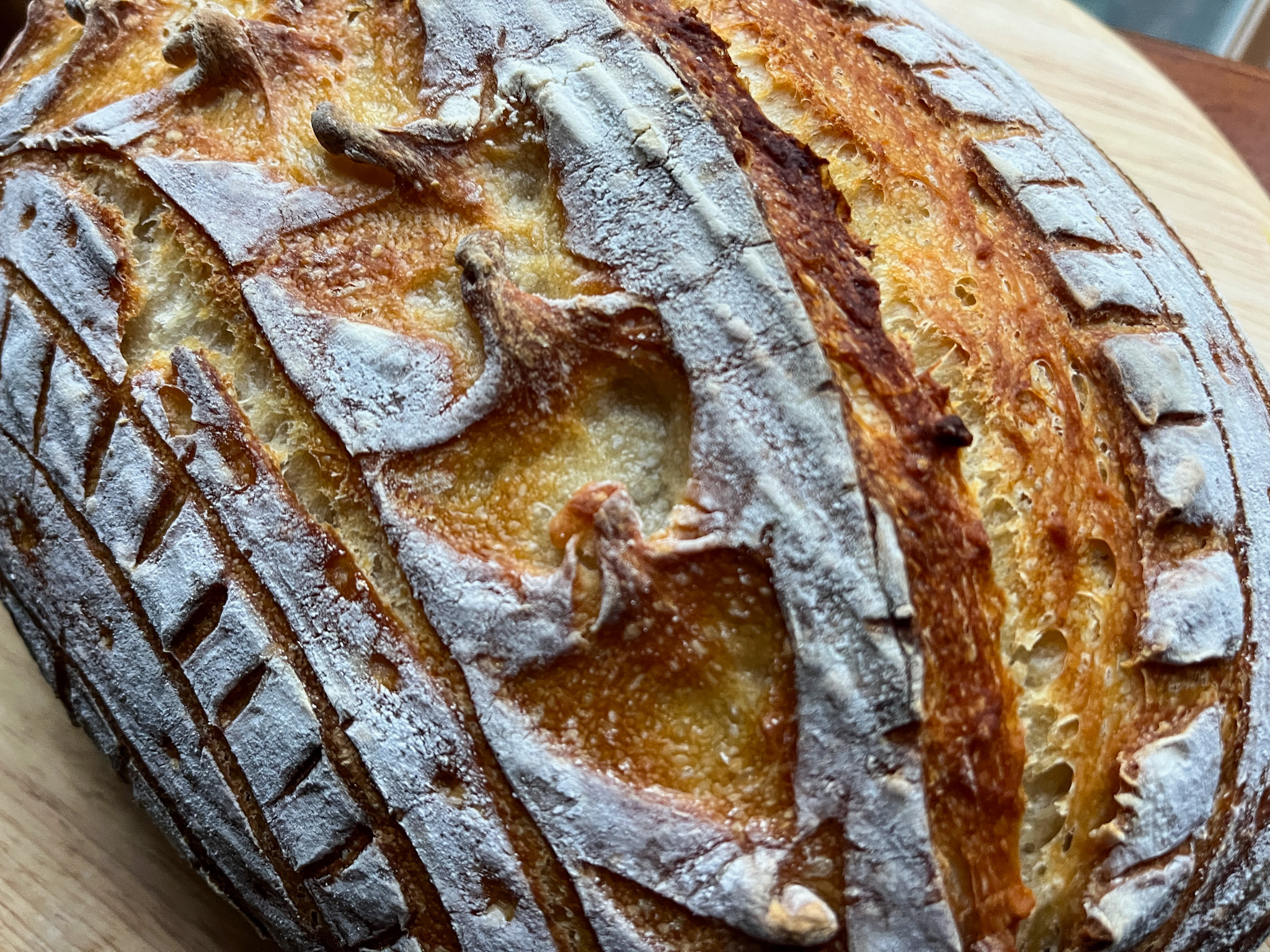
I am so excited to share this new method with you! Perhaps you’ve noticed that I talked about a little mysterious gadget in my previous post, and today I explain what it does. It is an adaptor for a razor blade to be used with a Sonic type toothbrush, You need to have the right model, in which the head is pushed into the toothbrush, not screwed in. I’ve had a Phillips Sonic toothbrush for many many years and was quite intrigued about using it to slash sourdough. Works like a dream. As one user described, “it is like having one of those lightsabers from Star Wars”. It does feel very smooth and efficiently goes through the surface without ripping the dough. You can read all about it here. Nicola, the person behind the invention is super nice and responsive, plus she is amazing at making all sorts of designs on her bread, available on youtube or IG. The website I linked has all the info to her social media.
Here is a little video of one of my recent adventures with Sonic scoring… It is 8X faster than real time. I followed one of the designs by Nicola to make this particular one.
As to the breads, I will share just one recipe because I used olive oil infused with fresh oregano to flavor it, and a little bit of dry oregano in the dough. It turned out absolutely delicious.
FRESH OREGANO SOURDOUGH (from The Bewitching Kitchen)
1/3 cup olive oil fresh oregano leaves, a big bunch 475 g bread flour 25 g spelt flour 60-70 g sourdough starter at 100% hydration 340 g water 10 g salt 1 tsp dried oregano
Make the infused olive oil by heating the oil in a small saucepan, adding the fresh oregano and simmering for a minute or so. Turn off the heat, cover the pan and let the oil sit for half an hour. Pass through a sieve to remove the leaves, pressing them well. Reserve the oil, allowing it to cool to room temperature or barely warm.
Mix all the ingredients and 2 to 3 tablespoons of the infused oil in a KitchenAid type mixer fitted with the dough hook.
Turn the mixer on with the hook attachment and knead the dough for 4 and a half minutes at low-speed all the time. If the dough is too sticky, add a little flour, you want the dough to start clearing the sides of the bowl, but still be sticky at the bottom.
Remove from the machine, and transfer to a container lightly coated with oil. Cover lightly with plastic wrap and allow it to ferment for 4 hours, folding every 45 minutes or so. After four hours bulk fermentation, shape the dough as a ball, and place, seam side up, in a lightly floured banetton. Leave at room temperature one hour, and then place in the fridge overnight, from 8 to 12 hours.
Next morning, heat the oven to 450F. Invert the dough over parchment paper, rub gently tapioca flour on the surface. Score with the pattern of your choice and bake at 450F for 45 minutes, preferably covered for the first 30 minutes to retain steam. Cool completely over a rack before slicing.
It is quite amazing to use that blade, you just need to be careful when placing it in the adaptor, for obvious reasons, it is sharp, very sharp. I like to add the adaptor to the toothbrush first, and then screw the bade in, because I find it safer to do it this way.
I love the clean cuts the blade does, and will be using it often in future breads, so stay tuned!
Of all the nuts out there, the peanut is the ugly duckling. Simple, humble, affordable, available everywhere. It does not have that majestic feel of a macadamia, or the sexy aura of a hazelnut. Most sourdough breads include walnuts or pecans, leaving them once again neglected. Not in my kitchen, though. This bread gets a double load of peanuts. Peanut butter, and roasted peanuts joined together with flour, salt and a wild bunch of yeast and bacteria aka sourdough starter.
DOUBLE PEANUT SOURDOUGH LOAF (from The Bewitching Kitchen)
370g water 70g active sourdough starter at 100% hydration 470g bread flour 20g spelt flour 10 g rye flour 30g peanut butter (smooth) 30g roasted peanuts, unsalted 10g salt
Place the water in the bowl of a KitchenAid type mixer and dissolve the starter in it, mixing with a spatula briefly, then add the three types of flour, the peanut butter and the salt.
Turn the mixer on with the hook attachment and knead the dough for 2 minutes at low-speed all the time. If the dough is too sticky, add 1/4 cup flour, you want the dough to start clearing the sides of the bowl, but still be sticky at the bottom.
Add the peanuts and continue kneading in low-speed for 2 and a half minutes more.
Remove the dough from the machine, and transfer to a container lightly coated with oil, cover lightly with plastic wrap and allow it to ferment for 4 hours, folding every 45 minutes or so.
After four hours bulk fermentation, shape the dough as a ball, and place, seam side up, in a lightly floured banetton. Leave at room temperature one hour, and then place in the fridge overnight, from 8 to 12 hours.
Next morning, heat the oven to 450F. Invert the dough over parchment paper, rub gently white flour on the surface. Score with any pattern you like.
Bake at 450F for 45 minutes, preferably covered for the first 30 minutes to retain steam. Cool completely over a rack before slicing.
Comments: If you follow my blog, you know that my default method for sourdough involves the Kitchen Aid initial kneading and never heating the Dutch oven before dropping the bread inside, over parchment paper. Those two details make life a lot easier in terms of clean up of bowls, hands, and lack of burning marks in forearms and fingers…
I add the peanuts after 2 minutes kneading with the KA, and run the machine for one additional couple of minutes or so. That is enough to incorporate the nuts in the dough, which will continue to happen during the subsequent foldings. You can slash the dough in patterns or just do a simple slash. Below I show you another type of pattern, a kind of geometric flower.
We loved the subtle peanut flavor of this bread, and biting into a little peanut here and there was also very nice. The peanuts will end up softer than other nuts normally used in breads.
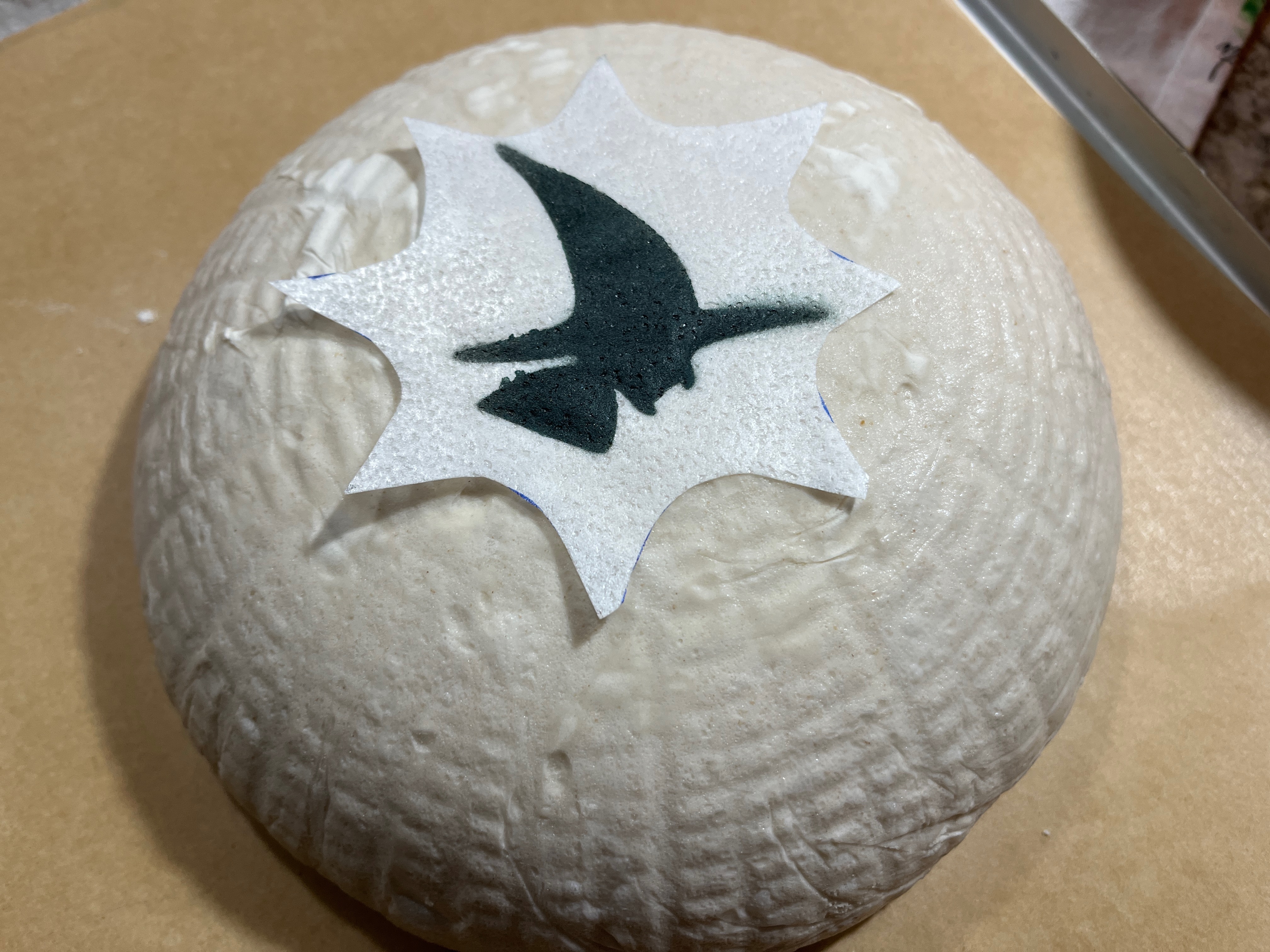
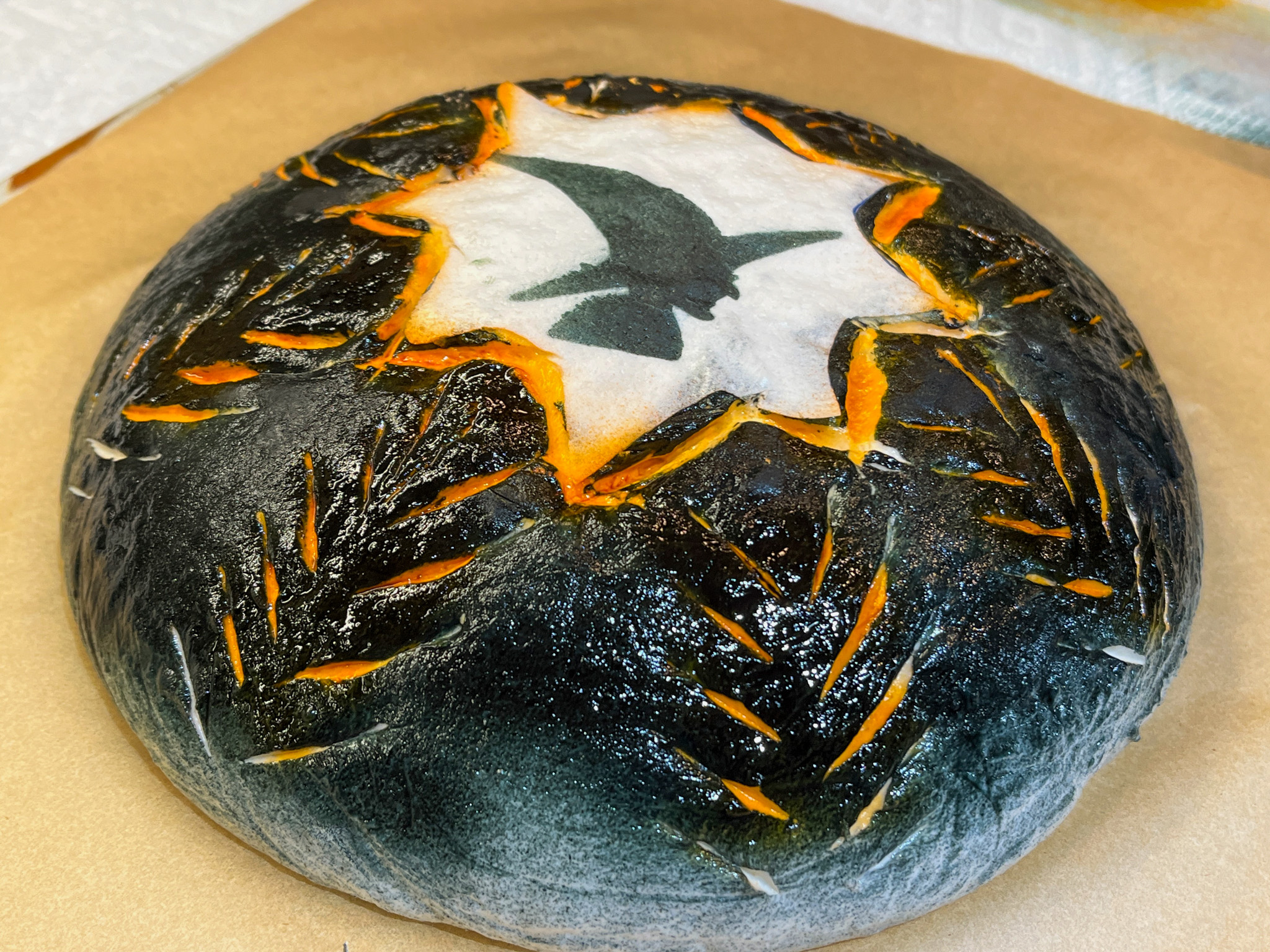
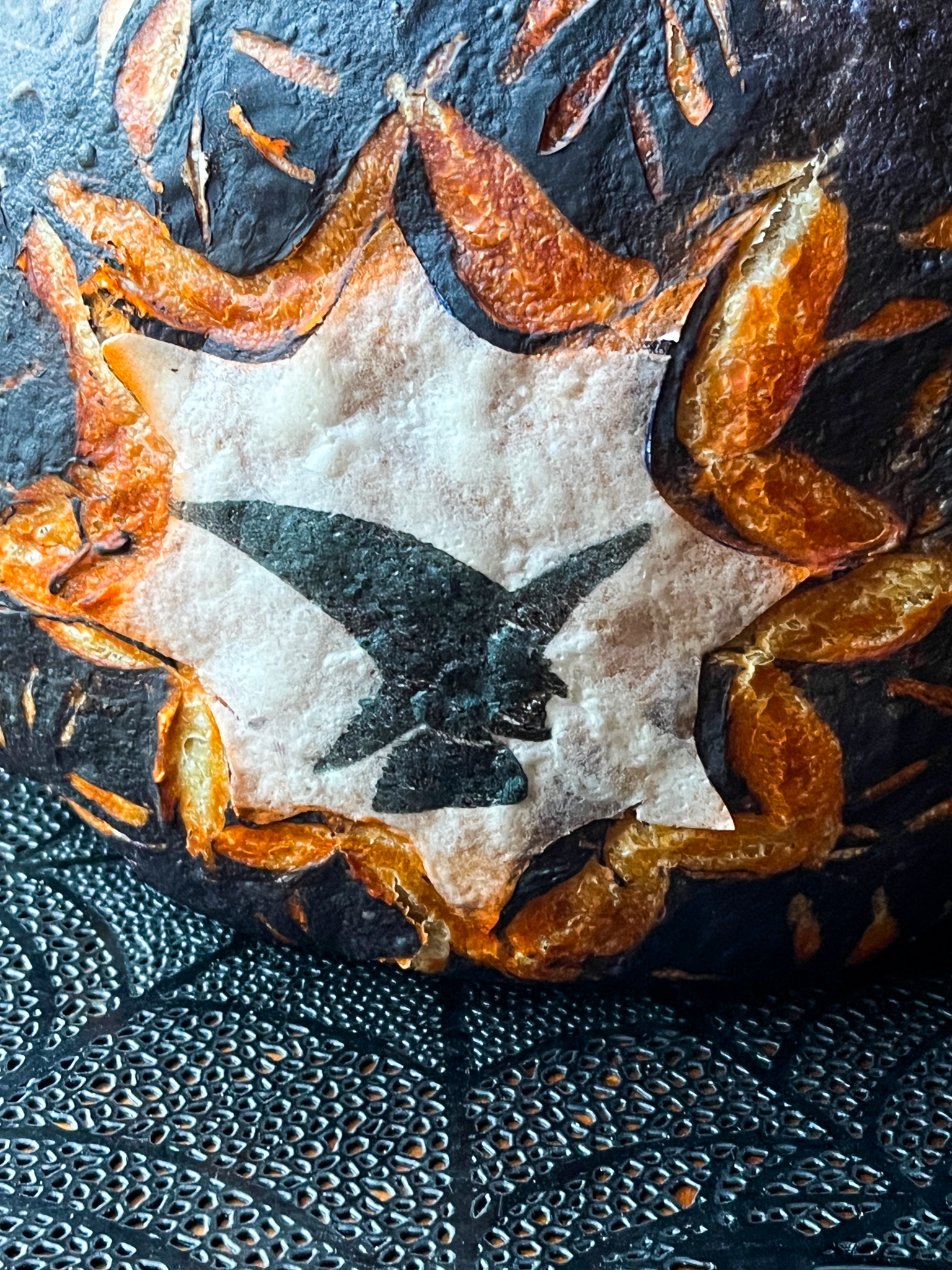
Something new that I’ve tried last week… Use any sourdough recipe you like, I am sharing my default version with a touch of spelt. Once the bread is ready to go into the oven, add some water to a little charcoal powder and brush the surface of the dough. While it’s still wet, place a stencil on top and shower it with white flour (all-purpose is fine). Rub it gently so that the design is as sharp as possible. Carefully lift the stencil, slash the bread and bake.
CHARCOAL PAINTED SPELT SOURDOUGH (from the Bewitching Kitchen)
480g bread flour 20g spelt flour 10g salt 370g water 80g sourdough starter at 100% hydration 1 tablespoon activated charcoal powder a little water all-purpose flour for stencil detail
Make the levain mixture about 6 hours before you plan to mix the dough. It should be very bubbly and active.
When you are ready to make the final dough, place the water in the bowl of a KitchenAid type mixer and dissolve the starter in it, mixing with a spatula briefly, then add the two types of flour, and the salt. Turn the mixer on with the hook attachment and knead the dough for 4 minutes at low-speed all the time. If the dough is too sticky, add 1/4 cup flour, you want the dough to start clearing the sides of the bowl, but still be sticky at the bottom.
Remove from the machine, and transfer to a container lightly coated with oil, cover lightly with plastic wrap and allow it to ferment for 4 hours, folding every 45 minutes or so. After four hours bulk fermentation, shape the dough as a ball, and place, seam side up, in a lightly floured banetton. Leave at room temperature one hour, and then place in the fridge overnight, from 8 to 12 hours.
Next morning, heat the oven to 450F. Invert the dough over parchment paper, make a paste with the charcoal powder and water, and paint over the surface. Immediately place a stencil on top, and shower white flour over it, rubbing it gently to get the design to stick well. Next, use a brand new razor blade to score around the design, to coach the bread into opening without ruining the pattern.
Bake at 450F for 45 minutes, preferably covered for the first 30 minutes to retain steam. Cool completely over a rack before slicing.
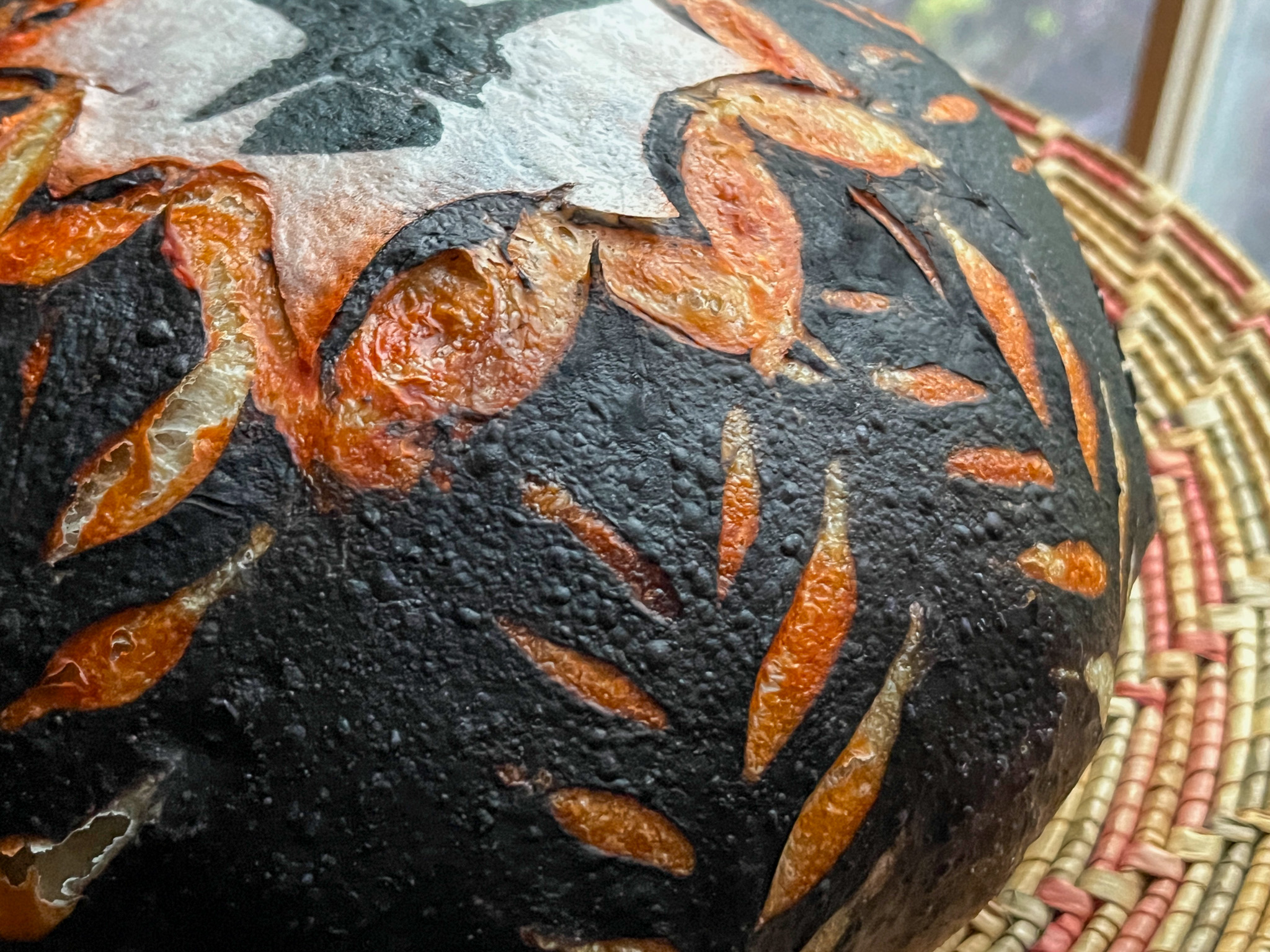
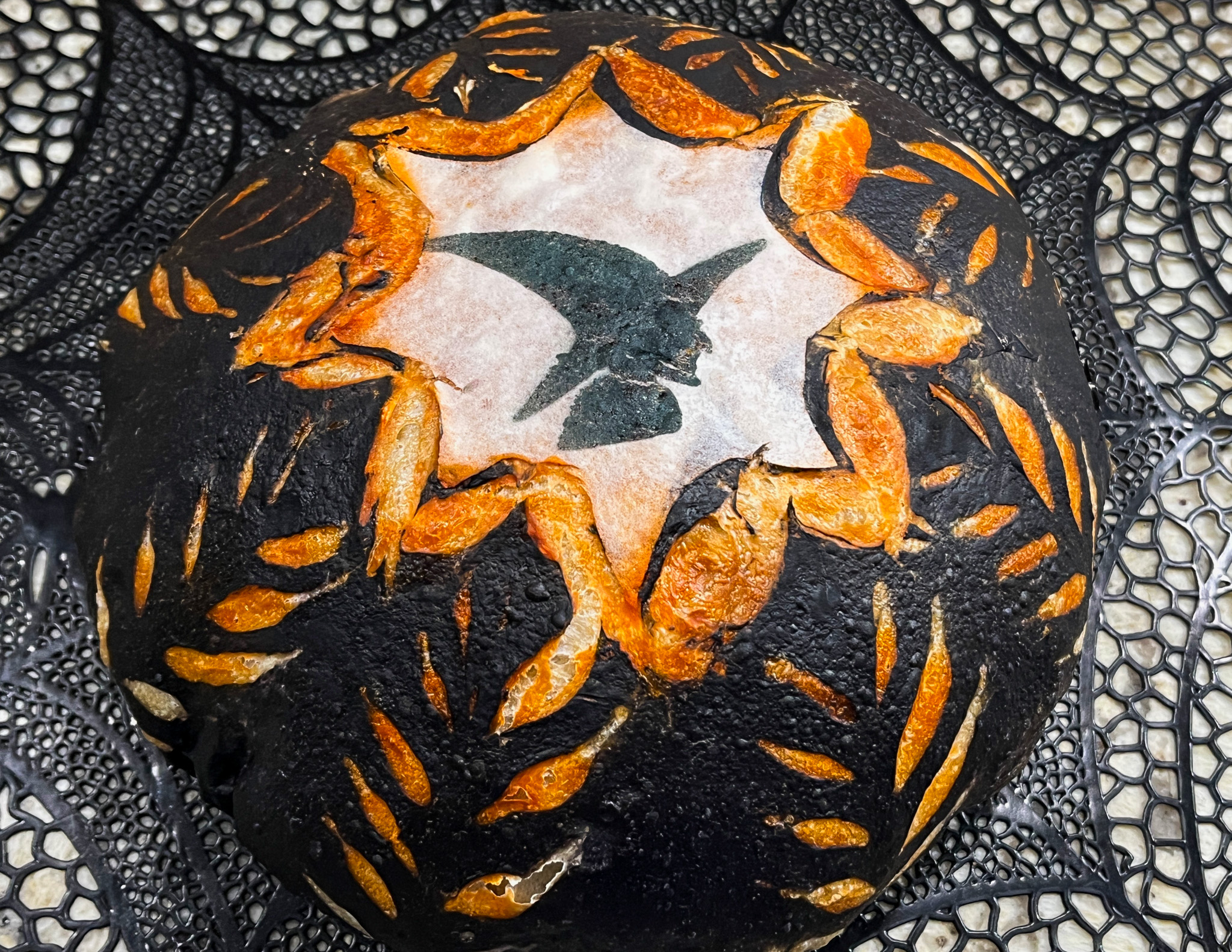
Comments: I know that one should never complain about excessive oven-spring when bread baking, but for some designs it would be better to have a less “explosive” loaf… I intend to play with formulas with higher whole-wheat content to try and tame the loaves with patterns and more elaborate scoring. Still I like the way this turned out, and it is much better than rubbing the powder over the loaf.
You can brush the excess flour once the bread is cold. I need to play a bit with the placement of the stencil and the amount of flour to add to it, but overall I am quite pleased with the overall look.
Today I share three recipes to put your sourdough starter to use. Opening with hamburger buns, moving on to a no-knead, no-fuss sandwich type bread (courtesy of Karen, from Karen’s Kitchen Stories), and wrapping the post with my favorite type, a rustic, spicy loaf.
SOURDOUGH HAMBURGER BUNS (from the Bewitching Kitchen)
80 grams bubbly, active sourdough starter at 100% hydration 240 grams whole milk, warm 1 egg 6g salt 20g sugar 430g all-purpose flour, divided 45g butter, softened egg wash (1 egg beaten with a little water) sesame seeds, black and white
In the bowl of an electric mixer with the paddle attachment, mix sourdough starter, milk, 1 egg, yeast, salt, sugar and 300 grams of flour on medium speed until a loose, shaggy dough is formed. Cover the dough with a damp cloth and let rest in the bowl for 30 minutes.
Change to the dough hook, knead the dough for 7-8 minutes, gradually adding an additional 130 grams flour and the butter in small amounts. The dough should be soft and slightly sticky, but pulling away from the edges of the bowl as it kneads. Transfer the dough to an oiled bowl and keep at room temperature for the bulk proof for 4 to 5 hours. It will not double in size, but it should expand and feel “lighter.
Divide the dough into six portions (about 120 g each). Form into tight little balls and allow to proof at room temperature for 2 to 3 hours. Heat the oven to 375F, brush the surface of the rolls with egg wash and sprinkle sesame seeds. Bake for about 20 minutes, until golden brown and internal temperature of 190F. Cool completely on a rack before slicing.
Comments: My only issue with the recipe is that the dough took a very long time to proof and did not seem to expand that much. The enrichment of the dough with added fat slowed things down a bit. However, they had excellent oven spring. I still want to do the tangzhong method with sourdough, so stay tuned for that. I see recipes that add a touch of instant yeast to speed things up, but I decided to go through a pure sourdough method this time.
Moving on, a recipe from my friend Karen, which I made right after she blogged about it, but as usual, it takes me a little time to make things show up in the blog. If you are in the initial steps of your sourdough journey, this is a very relaxing bake, I urge you to give it a try.
Sometimes it is nice to have a bread in the traditional loaf format, perfect for sandwiches and also to make croutons, if you so desire. I want to bake another loaf again very soon. Thank you, Karen!
Finally, a sourdough with a lot of flavor, thanks to Penzey’s, my favorite online source for all things spice…
SOUTHWEST SPICE SOURDOUGH LOAF (from The Bewitching Kitchen
385g white bread flour 16g whole-wheat flour 1 + 1/2 to 2 tsp Southwest Seasoning Mix (Penzey’s) 8g salt 280g water 65g sourdough starter at 100% hydration
Make the levain mixture about 6 hours before you plan to mix the dough. It should be very bubbly and active.
When you are ready to make the final dough, place the water in the bowl of a KitchenAid type mixer and dissolve the starter in it, mixing with a spatula briefly, then add the two types of flour, the spice mix and the salt. Turn the mixer on with the hook attachment and knead the dough for 4 minutes at low-speed all the time. If the dough is too sticky, add 1/4 cup flour, you want the dough to start clearing the sides of the bowl, but still be sticky at the bottom.
Remove from the machine, and transfer to a container lightly coated with oil, cover lightly with plastic wrap and allow it to ferment for 4 hours, folding every 45 minutes or so. After four hours bulk fermentation, shape the dough as a ball, and place, seam side up, in a lightly floured banetton. Leave at room temperature one hour, and then place in the fridge overnight, from 8 to 12 hours.
Next morning, heat the oven to 450F. Invert the dough over parchment paper, rub gently white flour on the surface. Score with the pattern of your choice using a brand new razor blade.
Bake at 450F for 45 minutes, preferably covered for the first 30 minutes to retain steam. Cool completely over a rack before slicing.
Comments: I often run into the “problem” of excessive oven spring ruining my scoring. But I admit, it is not a bad problem to deal with, it just means your starter is doing its job. This was such a great bread, you can use other mixes if you like, or make your own, paprika, cumin, oregano, garlic, onion, are some of the components of Penzey’s mix.
I hope you like this trio of sourdough options. Now that the weather is turning cooler, it’s definitely time to bring the starter to play more often.