LUCKY KAMUT BREAD

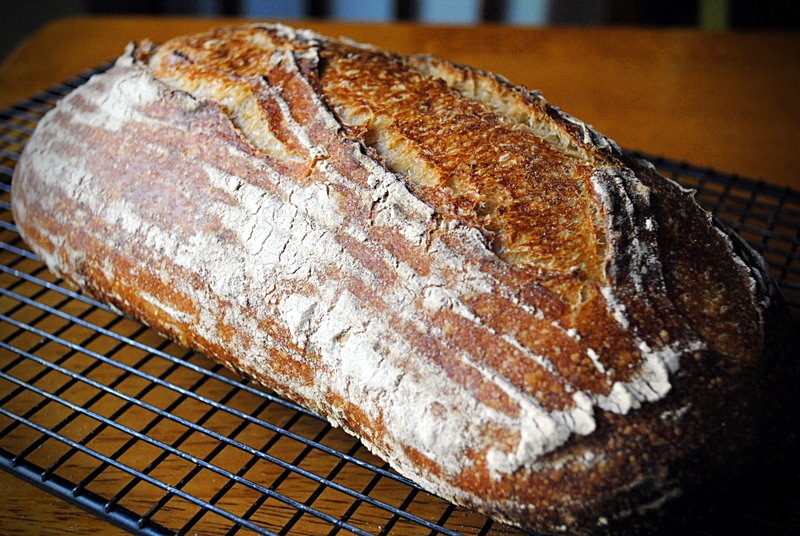
A few weeks ago I got smitten once more by a post on Farine’s blog  showcasing a bread made exclusively with whole wheat flour.  She used a mixture of spelt and kamut to bake a pavé style of bread that seemed perfect for a hearty sandwich.   I was quite curious about kamut flour, and thrilled to buy the last bag available in the only grocery store in town that carried it.  My adventure to procure kamut flour involved a phone call to the manager who personally held that bag for me until I could drive to the store later in the day.  That should clarify the title of this post. 😉

SPELT AND KAMUT BREAD
(from Farine’s blog, adapted from Thierry Delabre)
.
247 g whole kamut flour
247 g whole spelt flour
375 g water
148 g levain at 100% hydration
9 g salt
.
Mix both flours with all the water until no dry flour remains and let rest, covered, 20 to 40 minutes Add the sourdough starter and mix until incorporated Add the salt Cover the dough and let it rest, doing as many folds as necessary to obtain medium soft consistency.  I did five sets of folds, the first three 30 minutes apart, the last two 45 minutes apart.  At that point the dough was rising for 3 hours.  I let it rise undisturbed for 2 and a half hours more, by that time the dough was threatening to reach the top of the bowl.
.
Remove the dough from the bowl onto a floured surface and fold it once over itself lengthwise, forming a long, non-overlapping rectangle.  Cut the dough into two pieces, and let them proof over heavily floured parchment paper for about 45 minutes, loosely covered.   Heat your oven to 450F and bake the loaves (with initial steam) for 30 to 35 minutes, until golden brown.    Cool on a rack.
.
ENJOY!
.
to print the recipe, click here
.
.
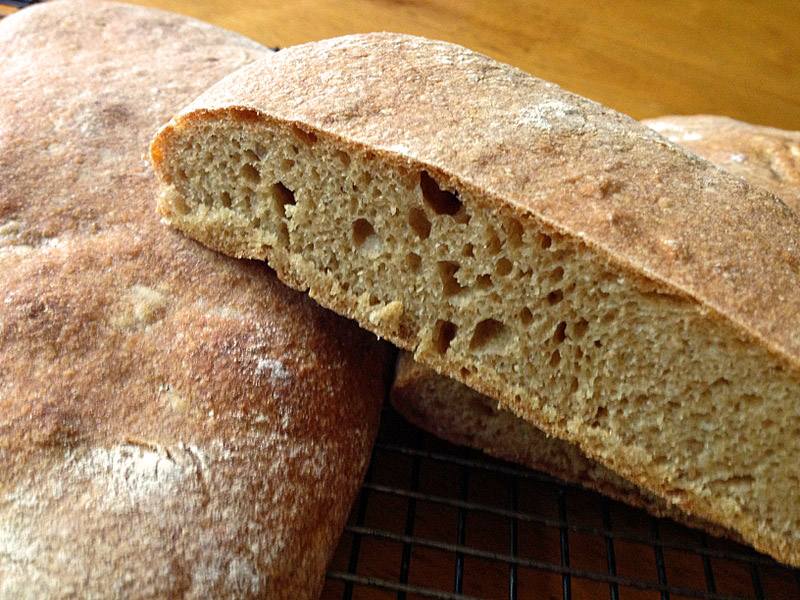
This is the kind of bread that makes you feel healthier with each bite.  It has that wholesome quality of a typical rustic loaf, but a texture with more moisture than you would expect from a bread made exclusively with whole wheat.  I  urge you to read Farine’s original post, as she describes her adaptations from the original recipe in great detail.  I always learn a lot reading her blog, she is an amazing bread baker!
.
The sourdough taste in this bread was stronger than usual, but the interesting thing is that next day the bread had mellowed down considerably.  Not sure why, but the world of bread leavened with wild yeast is mysterious. And fascinating!
.
.
Usually Phil is the master sandwich maker, but this time I hit a jackpot with my concoction:  chipotle-smoked turkey breast, provolone cheese, and a spread of tomatillo-avocado salsa.  A show-stopper!
.
Farine, thanks for the constant inspiration!  My list of breads to make from your blog only keeps growing and growing… 😉
.
I am submitting this post to Susan’s Yeastspotting event.
.

A SOURDOUGH EXPERIMENT

Would you like to bake bread with wild yeast, but the thought of   keeping a starter is too intimidating?  If that’s the case, I urge you to read this great post by Joanna, from Zeb Bakes. She will make you feel absolutely at ease with keeping the starter going, minimizing your work and the use of flour. She will also show you a simple schedule to bake bread on a weekly basis.  Awesome read! Sourdough baking made simple and easy, as it should be.

Now, time for some fun with it.  Remember the proofing bread box I gave myself for Christmas?   Well, I put it to the test, by making a batch of sourdough bread and dividing the dough in two.  Half went into the cozy environment of the box (78 F), half stayed outside in my kitchen kept (at this time of the year) at around 70F.  The recipe I chose for such a ground-breaking experiment comes from a great baker, who blogs at Breadcetera.  You can learn a ton of stuff from him, make sure to bookmark his site and visit often.   He developed this technique called “double flour addition,”  with the goal of maximizing the amount of air bubbles trapped in the dough from the very beginning of mixing.  These tiny air bubbles, created by whisking the very loose mixture of flour and water, later generates the pockets of air that every baker searches for in this type of rustic loaf.

SOURDOUGH BREAD WITH DOUBLE FLOUR ADDITION
(from Breadcetera)

680 g bread flour
90 g whole wheat flour
455 g water
15 g salt
300 g sourdough starter (at 100% hydration)

Combine the flours in a large bowl and lightly mix them with a whisk.

Add the water and the sourdough starter to the bowl of a Kitchen Aid mixer, and use the whisk attachment to work them together at the lowest speed for a minute or so.  At this point, you only need to combine them and have the starter dispersed through the water.    Add just 75g of the flour mixture, and increase the speed of the mixer to level 3. Whisk until the mixture seems quite aerated (about 3 to 4 minutes).

Remove the whisk attachment and place the dough hook in place. Add the rest of the flour, and knead for a couple of minutes, until the flour forms a shaggy mass.  Cover the bowl with plastic wrap and let it rest for 20 to 30 minutes.

Sprinkle the salt over the dough, and mix on speed 3 for 6 minutes.  Place the dough in an oiled bowl, cover and let it ferment for 2 hours, without any folding or kneading.  Divide the dough in two equal pieces, and lightly give it a round shape.   Let it rest for 15 minutes for the gluten to relax,  and do a final shaping, creating surface tension by pulling the sides of the dough up as you gather it all in the “boule” shape.   Place the balls of dough, seam side up, in a floured round container (such as a brotform), cover with plastic, and let it ferment for 3 hours at 78 F.

Invert the dough on a peel, score, and bake at 425 F for 40 minutes, with steam during the first 15 minutes.  Let it completely cool before slicing.

ENJOY!

to print the recipe, click here

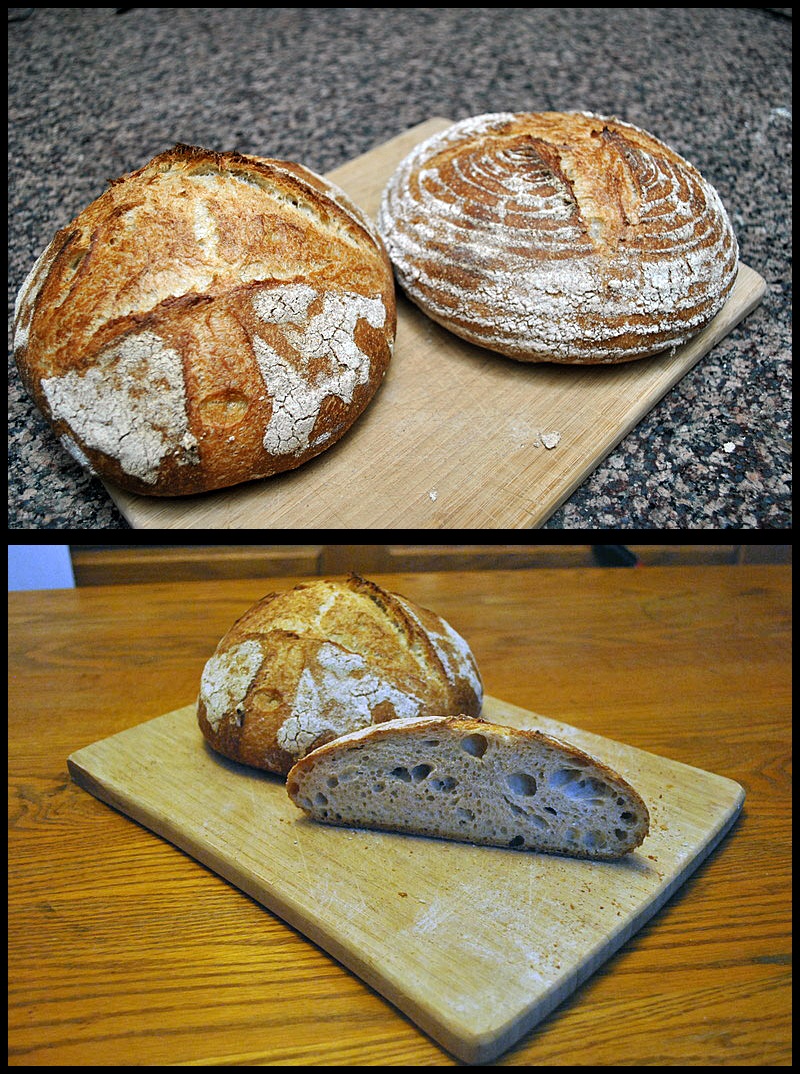
For my experiment, I divided the dough in two right before the first fermentation, and placed one half in the proofing box.   That dough stayed in the box until baking time, the other one stayed over the kitchen table, protected from drafts.  The difference in the dough itself was pretty dramatic, but I could not get a picture that was good enough to show it. However, once the bread was baked, the one from the proofing box had much better oven spring, the other one was a bit on the flattish side.   Both were delicious, and the crumb had a nice structure, but one bread looked a lot “healthier.”   Here they are…

You can see that the taller bread, with a more round shape, had better oven spring, bursting through the slashing with greater power. Sorry, no photos of the crumb, we froze that baby for later and by the time we got to enjoying it, I forgot to grab the camera.


The bread proofing box not only optimizes the temperature, but also provides the correct amount of humidity, thanks to the small dish that sits at the bottom of the box, with some water in it.  No need to worry about a skin forming on the loaf in the final proofing, no need to use plastic to cover it.  A very well designed machine, that is getting constant use in our home.

I am submitting this post to Susan’s Yeastspotting

ONE YEAR AGO: Shrimp and Fennel Casserole

TWO YEARS AGO:  Tuscan Bread

Add to FacebookAdd to DiggAdd to Del.icio.usAdd to StumbleuponAdd to RedditAdd to BlinklistAdd to TwitterAdd to TechnoratiAdd to Yahoo BuzzAdd to Newsvine

HOEGAARDEN BEER BREAD

I don’t regret that many things in my life, but if I could go back to the period  that I lived in Paris, I’d take some time to travel to Belgium.   I was so close to that beautiful country, but never saw it in person… it’s a shame and it’s sad. Plus, I’ve never met a person from Belgium who wasn’t super-nice!  All my Belgium friends have a great sense of humor, a great appreciation for the fun side of life, and many positive things to say about their home country, that excels in so many things.  Two of their special delicacies are chocolates and beer!  The very best of both are produced in small quantities and not exported,  but some excellent Belgium beer makes it all the way to the US, examples being Chimay, Leffe,  and Hoegaarden, the latter of which is a beer that brings fond memories of my days as a single woman in Paris…   😉

I don’t drink beer anymore, but I still like to cook with it, or include it in  breads- for a quick flash back, click here.  So, when I saw this post not too long ago, I changed all my baking plans for the weekend, to accommodate a little Hoegaarden sourdough, and take the Bewitching Kitchen on a virtual trip to Belgique!

HOEGAARDEN BEER BREAD
(adapted from Fab Food Blog)

For the sponge:
120 g 100% hydration sourdough starter
60 g bread flour
45 ml Hoegaarden white beer

For the final dough:
235 g bread flour
65 ml Hoegaarden white beer
40 ml lukewarm water
1 tsp salt
1 tsp fennel seeds
3 tsp fresh rosemary, chopped

Mix all the ingredients for the sponge in a small bowl, mix well and leave it overnight at room temperature.  It should be very bubbly and more than double in size.  If it rises too much and collapses, it’s fine.

Next morning, place the sponge, flour, beer and water in a large bowl. Mix for a few minutes until barely combined, then let it sit for 20 minutes undisturbed. Add the salt, fennel seeds, and rosemary, and mix by gentle kneading.  Let the dough rise for 30 minutes,  knead again (20 seconds cycle),  let the dough rise for about 40 minutes.  Do one more cycle of quick kneading  and let the dough rise for another 40 minutes.  Knead one final time and let the dough rise undisturbed for 1.5 to 2 hours, until almost doubled in size.  Shape as a ball, and place with the seam side  up inside a well floured banetton type container.

Let it rise undisturbed for 2 hours.  Heat the oven to 450 F with baking stones or tiles inside. Invert the dough on the tiles, quickly score the surface, and bake with initial steam. If covering the dough, remove the cover after 30  minutes, reduce the temperature of the oven to 425 F and bake for 10 to 15 minutes more, until golden brown.    Cool for at least 1 hour before slicing.

ENJOY!

to print the recipe, click here


Comments: 
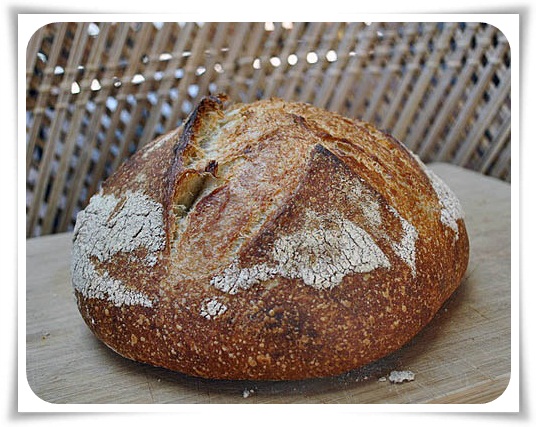
This recipe makes a  small boule, so if you want to serve it in a dinner party for several people, consider doubling the recipe and baking two loaves.  The bread smells wonderful during baking, and fennel is the dominant flavor.   As to the beer, it would be interesting to bake two loaves side by side, substituting water for beer in one of them – I imagine that there will be a slight difference in sourness and complexity of flavor, but it’s hard to know for sure with the competing taste of fennel and rosemary (which, by the way, I increased a bit from the original posted recipe).   In my experience, fresh rosemary has a tendency to lose its punch once it’s incorporated in bread dough, so I now use it with more abandon.

Fennel lovers:  pair this delicious bread with some hearty Italian type sausage, for a double-fennel kick…   Don’t like fennel?  Simply omit it, the bread will still be delicious with a nice crust and moderately open crumb.

I am submitting this post to Susan’s Yeastspotting event… stop by and visit her weekly showcase of breads.

ONE YEAR AGO: Ancho-Chile Marinade: Pleased to meat you!

TWO YEARS AGO:  The Handmade Loaf (the book that got me into sourdough baking!)

Add to FacebookAdd to DiggAdd to Del.icio.usAdd to StumbleuponAdd to RedditAdd to BlinklistAdd to TwitterAdd to TechnoratiAdd to Yahoo BuzzAdd to Newsvine

PISTACHIO-WALNUT SOURDOUGH BREAD

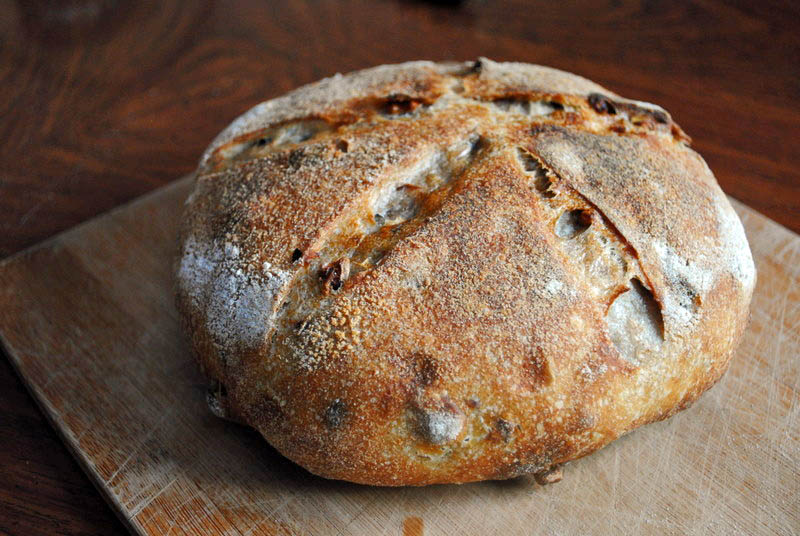
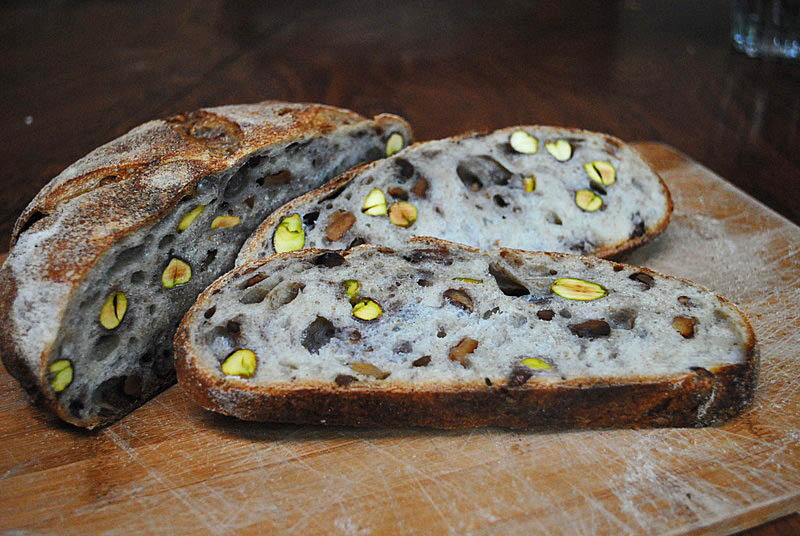
The goal: to make a sourdough bread loaded – and I mean loaded – with nuts, a crumb not as open as my usual loaves, to enjoy with an assortment of cheeses, from  French Brie to Italian Gorgonzola, passing by Spain with its awesome Manchego.  My starting point was a recipe from Maggie Glezer’s Artisan Baking, adapted to include whole pistachios, and small pieces of walnuts.  I wanted the pistachios to be the main textural component in the bread, and the walnuts to impart mainly their flavor throughout the crumb.  According to my dear husband, I hit the jackpot with this bread, he absolutely loved it. It reminded us of a bread we used to buy in a street market in Paris on Saturdays, except for the fact that the French version included a lot of sunflower seeds. Now, that’s an interesting idea for a future baking adventure… 😉

PISTACHIO-WALNUT SOURDOUGH BREAD
(from the Bewitching Kitchen)

Levain (you will use only half of it):
1 Tbs firm sourdough starter
45 g  warm water
75 g  bread flour

Dough:
300 g  bread flour
25 g  rye flour
25 g whole wheat flour
228 g  warm water
8 g salt
80 g walnuts, lightly toasted, in small dice
50 g whole pistachios, roasted

Make the levain by mixing all the ingredients and kneading lightly to form a smooth dough.  Keep at room temperature for about 12 hours (it should at least triple in size).

Make the dough by combining the three types of flour with the water.  Cover and let the mixture rest for 30 minutes. Add the salt and the levain (half of it only!) and knead a few times until it forms a shaggy mass.  Add the nuts and knead briefly to incorporate them.  Let it rest for 30 minutes, knead for about 10-20 seconds, and let the dough rest for another 30 minutes.  Knead (or fold) a few times, and let the dough rest for 1 hour.  Knead (or fold)  a few times, and let it rise undisturbed for 2 hours.

Pre-shape the dough as a round ball, let it rest for 15 minutes, then shape it in its final form, placing it in a banetton or another appropriate, well floured container, with the seam side up.   Cover and let it rise for 3 hours. Invert the dough on parchment paper, slash the surface, place on a baking stone on a 425 F oven, covered for 30 minutes, then uncover and bake for 15 minutes more, until dark brown and the internal temperature is at least 205 F.

Let the loaf cool over a rack  before cutting.

ENJOY!

to print the recipe, click here

Comments:  Making this bread was a labor of love, because I shelled the pistachios myself. My finger tips had quite a workout, so next time I will buy shelled pistachios to make life a little easier, and I advise you to do the same. At any rate, this bread is a nut-lover’s paradise.  The pistachios shine like little jewels, and the walnuts become almost sweet during baking.  I could not be happier with it, as it turned out exactly as I hoped.  Plus, it was another  successful performance by our Breville toaster oven!

Who could resist having a second slice?  😉

I am submitting this post to Yeastspotting

Add to FacebookAdd to DiggAdd to Del.icio.usAdd to StumbleuponAdd to RedditAdd to BlinklistAdd to TwitterAdd to TechnoratiAdd to Yahoo BuzzAdd to Newsvine

HOME IS WHERE THE HEARTH IS

We spent last week in Oklahoma, which gave me the opportunity to bake bread in a normal oven.  After some severe brainstorming over the recipe, I settled on a country rye from Tartine, one of my favorite bread books.  It calls for a sourdough starter with a 50:50 mixture of white and whole wheat flours, and the dough itself has a small amount of rye. Usually I’d retard the loaf overnight in the fridge (as recommended), but this time I baked it just 3 hours after the final shaping.   The oven rise was impressive, the bread almost exploded out of the slashes!  It’s a vision that makes me so happy…   😉

COUNTRY RYE
(adapted from Tartine)

For the leaven (8 hours before making the dough):
1 Tbs sourdough starter, very active
140ml water
70g white bread flour
70g whole wheat flour

For the dough:
100g of leaven (save the rest)
400ml water at 75 F
415g bread flour
85g rye flour
10g salt

Pour the water in a large bowl, add the leaven (only 100g of it) and mix to dissolve.  Add the two different flours, mix with your hands to form a shaggy mass. Cover and let it sit at room temperature for 40 minutes.  Sprinkle the salt on top of the dough and knead to mix it.

Let the dough go through a bulk rise of 3 hours, folding the dough at every 30 minutes.  Pre-shape the dough as a ball, let it rest undisturbed for 20 minutes, then shape it in its final round shape, place it in a round container with the seam up for 3 hours  (you can also retard the dough in the fridge for 12 to 16 hours).

Bake for 45 minutes in a 450 F oven,  with steam during the first 25 minutes.  Allow it to completely cool before slicing.

ENJOY!

to print the recipe, click here

Comments: For the first time I baked this type of bread without weighing the ingredients, because my balance stayed in the nano-kitchen.  I was a bit nervous, but I used a conversion table and it worked just fine. The more I bake with wild yeast, the more convinced I am that technique trumps the proportions of ingredients. For example, folding the dough enough times during fermentation, and creating proper surface tension in the final shaping have a huge impact on the final product.   My advice is to practice, practice, and practice some more. I still struggle with scoring the bread, never feeling confident with the razor blade in my hand. What bothers me is that the scoring is so… final!  Once you slash the surface, you can only hope you did it right.  😉

The crumb was a little less open than that of a bread exclusively made from white flour,  and the taste reminded me of a Poilane miche, but less dense.  It’s a bread for a ham sandwich, or one with which you can mop up the juices of a hearty pot roast, or perfect to toast and enjoy with a little Brie cheese.

I am submitting this post to Susan’s Yeastspotting event… make sure to stop by and amaze yourself with all the tempting breads.

ONE YEAR AGO: My New Favorite Tomato Sauce

Add to FacebookAdd to DiggAdd to Del.icio.usAdd to StumbleuponAdd to RedditAdd to BlinklistAdd to TwitterAdd to TechnoratiAdd to Yahoo BuzzAdd to Newsvine