TIDY SOURDOUGH

This bread closes a personal saga with a long-awaited happy ending.   Since we moved to LA I’ve been searching for a way to bake the bread we enjoy the most:  the rustic sourdough boule.  When you only have a small electric (toaster) oven, baking this bread becomes tricky,  to say the least.  After 11 unsuccessful attempts, I finally conquered my virtual Mt.Everest and stuck my flag  in the summit!

BREVILLE SOURDOUGH
(from the Bewitching Kitchen, adapted from several sources)

235 g active sourdough starter  (75% hydration)
275 ml water at room temperature
400 g bread flour
65 g whole wheat flour
10 g salt

Pour the water into a bowl, add the sourdough starter and dissolve it.  Add the flours and the salt, then roughly mix all the ingredients together to form a shaggy mass.  No need to incorporate it as a smooth dough at this point.  Cover the bowl and let it stand for 20 minutes at room temperature.  Remove the dough from the bowl and place it on a smooth surface rubbed with a small amount of vegetable oil.    Quickly knead the dough for 20-30 seconds, incorporating all the dried bits of flour that are clinging to it .   Wash the bowl or transfer to another, clean bowl, cover with a plastic wrap and leave at room temperature for 45 minutes.

Remove the dough from the bowl, add to the kneading surface (slightly coated with oil if needed), knead for 20 seconds (second kneading cycle).  Place the dough back in the bowl, leave it resting for 45 minutes more.  Proceed with a third kneading cycle, place the dough in the bowl for 1 hour.

Remove the dough from the bowl, shape roughly into a ball, let it rest 15 minutes, and form it into the final shape, making sure to generate good surface tension.  Place the ball, seam side up, in a well floured round basket and let it rise at room temperature for 3 hours.  Forty-five minutes before baking,  heat your oven to 450F with a round pizza stone inside.

Invert the dough over a piece of parchment paper on a peel or cookie sheet, slash the top with a razor blade, and place in the oven. Position a Dutch oven inverted on top of it (fill it with very hot water, then dump the water and use it to cover your bread).  Bake covered for 35 minutes, then CAREFULLY uncover the bread and bake for 25 to 30 minutes more (or until internal temperature is over 200F).  If the top browns too much lower the temperature to 425F, and cover the surface with aluminum foil.

Cool for at least one hour before slicing and…

ENJOY!

to print the full recipe, click here

to see my timetable for this bread, click here

to print your own timetable for future use, click here

Comments: I’ve baked many breads in the past 3 years, but none gave me the thrill of this one, because it was my very last attempt! I was ready to throw in the towel and conclude that a rustic sourdough cannot be done in the nano-kitchen. What made it possible was creating the correct enclosure to bake the bread for the first 30 minutes.  For our Breville, a round pizza stone and a Le Creuset-wannabe (found at a Ross store  a couple of months ago) served the purpose quite well.

Normally I’d add a small amount of rye flour to the dough, but I couldn’t  find it last weekend, so I used only regular whole-wheat.  This is probably the largest bread you can bake in a Breville, and I intend to try a slightly smaller version in the near future.  I used regular kneading for this bread, but made a second loaf a couple of days later folding the dough instead, with similar results.  You can use whatever technique you feel most comfortable with.

Variation: Follow this recipe to the point of the final shaping as a “boule,” then retard it in the fridge overnight.  Next day, bring it to room temperature 2 hours before baking.

I am excited to send this post to Susan’s Yeastspotting

ONE YEAR AGOVienna Bread

Add to FacebookAdd to DiggAdd to Del.icio.usAdd to StumbleuponAdd to RedditAdd to BlinklistAdd to TwitterAdd to TechnoratiAdd to Yahoo BuzzAdd to Newsvine

LOCAL BREADS: AUVERGNE RYE WITH BACON

Auvergne rye, also known as “baguette aux lardons” is, simply put, bread with bacon bits all through the crumb. Bread… and…. bacon. I know, I know… unless you are a very committed vegetarian you are salivating already.

The recipe comes from Daniel Leader’s Local Breads, and requires the preparation of a very stiff sourdough starter made with both whole wheat and regular flour, and a final dough with a small amount of rye, which, in my opinion, always gives a sourdough bread a touch of depth hard to achieve with any other flour.

Yes, those brown spots are pieces of bacon….  😉


AUVERGNE RYE WITH BACON

(Local Breads)

Sourdough starter build

45 g stiff sourdough starter
50 g water
95 g bread flour
5 g whole wheat flour

Mix everything together, forming a stiff dough.  Allow it to ferment at room temperature for 8 to 12 hours, until doubled in volume.


Final dough

280 g thick cut bacon
350 g water
450 g bread flour
50 g white rye flour
125 g starter (you will not use the full amount made)
10 g salt

Cut the bacon in 1/2 inch pieces and cook over medium heat.  Do not let it brown, just cook until most of the fat is released.  Drain over paper towels and dice finely.

Mix the water, bread flour, and rye flour in a large bowl, let it stand for 20 minutes.  Add the sourdough mix (remember: only 125 g of it!), bacon, and salt.  Knead with a Kitchen Aid type mixer on speed 4 for about 8 minutes.  Ferment the dough for 1 hour, fold it a couple of times, place it to rise for another 2 to 3 hours.

Cut the dough in 4 equal pieces, shape as baguettes, and retard them in the fridge for 12 to 24 hours.

Remove the baguettes from the fridge 3 hours before baking.  Heat the oven to 450F, slash the baguettes and bake them with initial steam, for 20 to 25 minutes.  Cool over a rack for a couple of hours before slicing them.

ENJOY!

to print the recipe, click here

Comments: The recipe makes 4 baguettes, but I chose to make two baguettes and a larger, batard-type loaf. I haven’t yet perfected the shaping of my baguettes, in part because I end up baking round loaves a lot more often, and rarely practice this elusive shape. But, what really matters – the taste – was superb! You would think that so much bacon in the dough could be overpowering, but quite the contrary, they had a very mellow taste.   I was pleasantly surprised by how copper-colored the crust turned out, probably due to the bacon fat playing its magic.   The smell was intoxicating, even our dogs were restless…    😉

Note to self:  This bread would be a very good match for a bowl of chili…

I am submitting this post to Susan’s Yeastspotting….

Add to FacebookAdd to DiggAdd to Del.icio.usAdd to StumbleuponAdd to RedditAdd to BlinklistAdd to TwitterAdd to TechnoratiAdd to Yahoo BuzzAdd to Newsvine

MELLOW BAKERS: VERMONT SOURDOUGH

This bread was my choice to begin the  month of June in the Mellow Bakers group project.  It’s also one of our favorite breads, that I bake several times per month.  Hamelman’s book has three variations for this recipe,  all  delicious and easy to make, as long as you are not sourdough-starter-phobic.    😉  One of the great things about this group project is its only rule:  be mellow.   At first, I was wondering  should we bake all  three variations plus the two other breads this month?   But Paul, the wise originator of the group,  reminded me that when in doubt, ask yourself “what’s the mellow thing to do?”     So, I picked one, the Vermont Sourdough with Increased Whole Grain, which is similar to a bread I’ve  already described here.      No matter how many times I make one of Hamelman’s Vermont sourdoughs,  whenever I open the oven and see the loaf, I feel like a teenager whose first boyfriend just rang  the front doorbell…

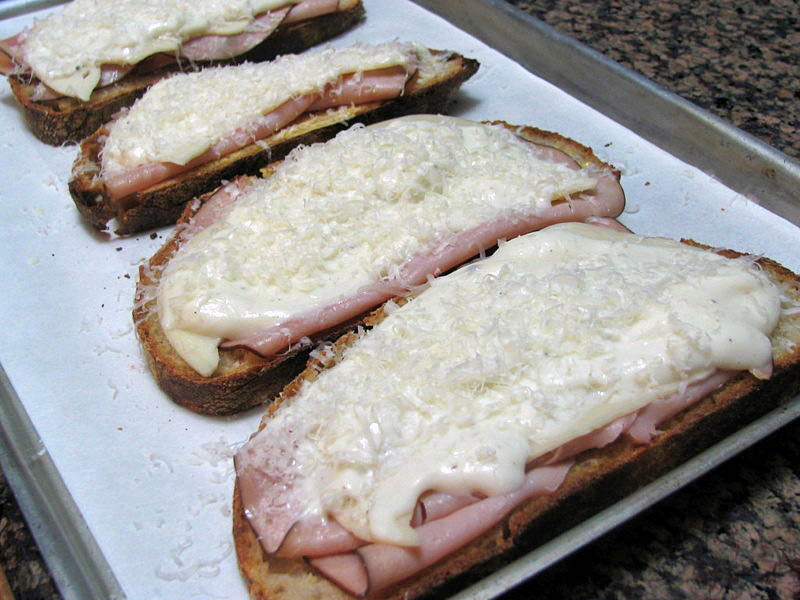
This type of bread is absolutely perfect for a Croque Monsieur….

But, complying with the mellow aspect of this post,  no photos were taken after the croque monsieur was ready…   we were too busy enjoying them and thinking about our times in Paris… Good memories!   I promise to post about my favorite Croque Monsieur & Croque Madame recipe in the near future, consider this just a teaser…

Check my friends’ take on Hamelman’s sourdough by following these links:

Oggi…..

Kuchelatein….

Paul

Joanna’s blog...

Steve’s blog

Anne Marie’s blog…

and Cathy’s site….

Add to FacebookAdd to DiggAdd to Del.icio.usAdd to StumbleuponAdd to RedditAdd to BlinklistAdd to TwitterAdd to TechnoratiAdd to Yahoo BuzzAdd to Newsvine

MELLOW BAKERS: MICHE POINT-A-CALLIERE

One more small step in the very long journey of the Mellow Bakers, working their way through Hamelman’s book Bread. I was looking forward to this one, a classic European-type bread, leavened exclusively by a whole-wheat sourdough starter.   The term “miche” means a very large, round loaf, and Point-a-Calliere  is its place of origin, the initial settlement that later would turn into Montreal.   To preserve the dimension of my waistline, I made mental apologies to Hamelman, and cut the recipe in half, turning it into a “demi-miche“…

Once a very stiff sourdough starter is prepared, the recipe is quite straightforward: mix high extraction whole-wheat flour with water, starter and salt, fold it two or three times over a 2.5 hour period, shape as a round loaf, let it rise for another 2.5 hours. It is a tricky dough to handle, very moist, it did not gain body until the last folding cycle.  The bread is then baked in a very hot oven, with steam during the initial stage of baking.

The recipe doesn’t mention anything about slashing the surface before baking, but I followed the footsteps of  my fellow bakers, and cut a few slashes on mine. However, they were barely noticeable when the loaf came out of the oven. This is a flattish bread, with reasonably open crumb – in fact, the crumb was a lot more airy than I expected from a bread with such a high proportion of whole wheat flour.

Great flavor, that should get better and better as the days go by. We shall put this statement to test in the next few days…. if my demi-miche can make it, that is… 😉

Check other Mellow Bakers’ take on this bread by following these links to Lien’s blog, Joanna’s, and our host Paul.

Add to FacebookAdd to DiggAdd to Del.icio.usAdd to StumbleuponAdd to RedditAdd to BlinklistAdd to TwitterAdd to TechnoratiAdd to Yahoo BuzzAdd to Newsvine

PIERRE NURY’S RUSTIC LIGHT RYE: BOUGNAT

I’ve browsed the pages of Leader’s “Local Breads” countless times over the past year, but taking part in “The Bread Baker’s Apprentice” challenge prevented me from indulging in many other bread books. Once the  challenge finished, I felt excited to attack other projects, but also somewhat paralyzed.   Not anymore: last weekend I dove into my first Local Breads recipe, a three-day project that led to a couple of delicious loaves of a rustic, toothsome bread.

PIERRE NURY’s RUSTIC LIGHT RYE
(from Local Breads)

Levain (sourdough starter)

45 g firm sourdough starter
50 g water
95 g bread flour
5 g whole wheat flour

Mix all the ingredients until they form a stiff dough, trying to incorporate all the flour into it. Place the dough in a container, marking its level with a tape or pen. Allow it to ferment at room temperature for 8 to 12 hours, until it doubles in volume. This recipe will make more levain than used in the bread.

Bread dough

400 g water
450 g bread flour
50 g rye flour
125 g levain
10 g salt

Pour the water into the bowl of a Kitchen Aid type mixer. Add the bread and rye flours, stir with a spatula until it begins to form a dough. Cover the bowl and let stand at room temperature for 20 minutes.

Uncover the bowl, add the levain (only 125 g of it) and the salt, and start kneading with the dough hook on medium speed for 12-14 minutes, or until you have good gluten development (do a windowpane test). Transfer the dough to a slightly oiled bowl and keep it at room temperature for 1 hour. Scrape the dough into a floured surface and fold it a couple of times to induce gluten development. You can see how to fold the dough by clicking here. Repeat the folding again after 1 more hour. After the second folding cycle, let the dough rise for 1 to 2 hours at room temperature until doubled in volume. Transfer to the refrigerator for 12 to 24 hours.

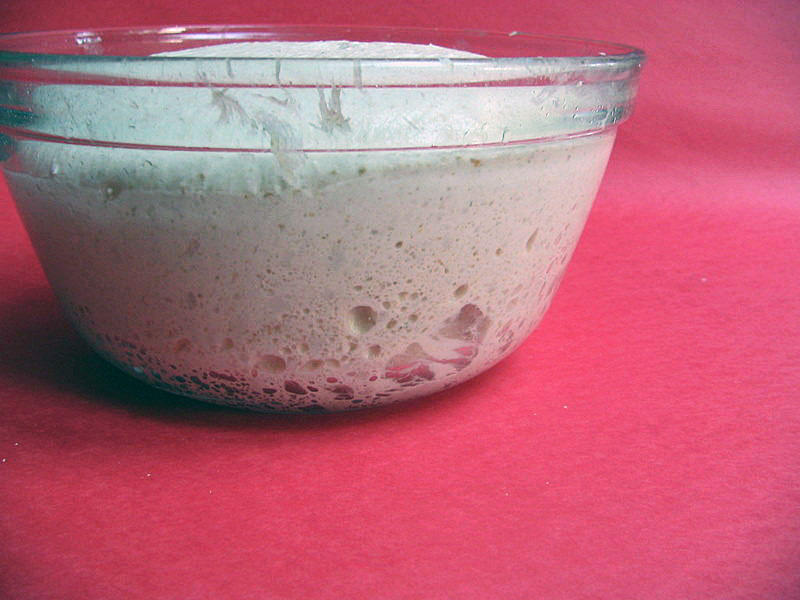
After 14 hours, my dough looked like this….

“Shaping” and baking
Remove the dough from the fridge 3 hours before baking. Heat the oven to 450F and place a baking stone (or tiles) on the middle rack.

Heavily dust the counter with flour, scrape the dough onto the counter, and open it gently into a 10 inch square shape, trying not to deflate it too much. I like to mark the dimensions on the flour, to have an idea of how much to open the dough.

Transfer each piece to a rimless baking sheet covered with parchment paper, stretching the dough to about 12 inches long. Let it fall naturally, without worrying about a precise shape. If baking both loaves at the same time, separate them by at least 2 inches.

Bake with initial steam for 20 to 30 minutes, until a dark walnut color develops on the crust. Let the loaves cool on a rack for at least an hour before slicing.

ENJOY!

to print the recipe, click here

for a detailed discussion on this particular bread, visit this link

Comments: The recipe was quite involved and challenging, but the gods of Bread were on my side and things went smoothly.  A dough with this much water (in baker’s terms it’s called a high hydration ratio) is tricky to deal with, but extra flour on the work surface helps. As some of the bakers in The Fresh Loaf put it “it feels like you’re making pancakes” when transferring the “bread” to the baking sheet. It’s impossible to shape it, so don’t even try. Lift it, gently stretch it  (it will almost stretch itself as it’s lifted), place it on the baking sheet and transfer it to the oven.   It’s a delight to witness its impressive oven spring (yet another fancy term to indicate that the dough rises a lot during baking).

The crumb almost made me shed a few tears… I know, I know… it’s pathetic, but bread make’s me emotional!  (In a good way.)  😉

I am submitting this post to Yeastspotting….

Add to FacebookAdd to DiggAdd to Del.icio.usAdd to StumbleuponAdd to RedditAdd to BlinklistAdd to TwitterAdd to TechnoratiAdd to Yahoo BuzzAdd to Newsvine