OAT AND SESAME SEED SOURDOUGH

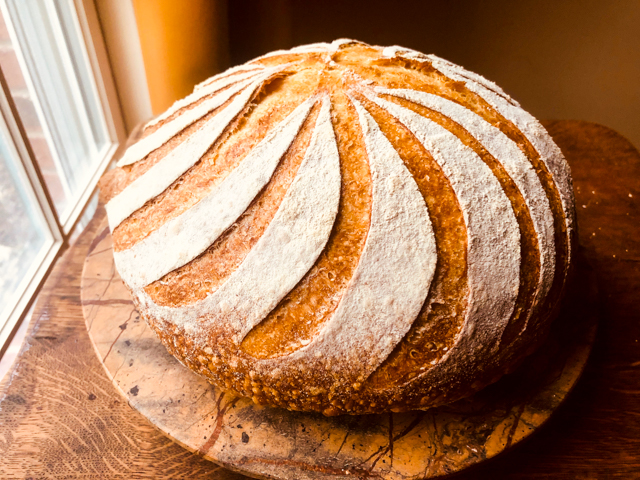
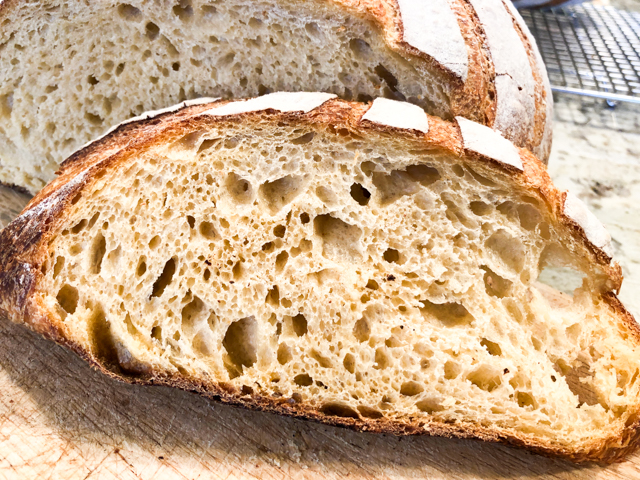
Some people find sourdough bread to be a bit “harsh” as far as texture goes. I am not part of that team, but I can understand where they are coming from. This bread retains the basic sourness of the classic, but the texture is so mellow that it reminded me of soft sandwich breads I enjoyed as a kid. It is the soaked oats and seeds that perform the magic. Absolutely delicious, I hope you’ll give it a try.

OAT AND SESAME SEED SOURDOUGH
(from The Bewitching Kitchen)

375g white bread flour (+ more to adjust consistency)
25g spelt flour
220g water
100g starter at 100% hydration
40g steel-cut oats
10g white sesame seeds
10g black sesame seeds (or 20g all one type)
10g salt

When you refresh your starter, maybe 6 hours before starting the bread, make the soaker: mix the oats and sesame seeds, and add enough water to just cover them. Cover the bowl with plastic wrap and leave at room temperature until it is time to mix the dough.

Add the soaked seeds ad all other components of the dough to the bowl of a Kitchen Aid mixer fitted with the dough hook. If there is too much water not absorbed by the seeds, leave it behind, but keep in mind that a lot of the moisture of the water in the formula should come from the soaker. Knead for about 4 minutes, paying attention to the texture of the dough. It should just start to clean the sides of the bowl. If necessary, add more flour at this point. I had to add about 1/4 cup flour to mine.

Remove the dough from the Kitchen Aid, transfer to any appropriate container lightly oiled and perform a series of stretch and folds every 45 minutes. Do it four to five times, which will take you up to 4 and half hours from initial bulk fermentation. Even if you fold it only 4 times, leave it fermenting until you reach 4 and a half hours.

Shape as a round ball and place in a floured banneton, seam side up. Leave 45 to 60 minutes at room temperature, then place in the fridge overnight.

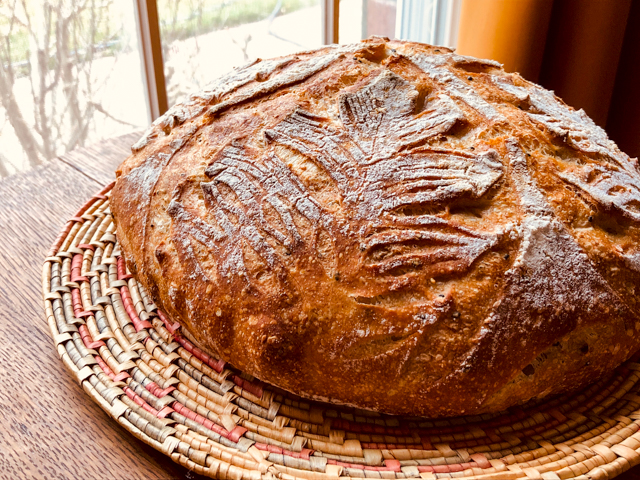
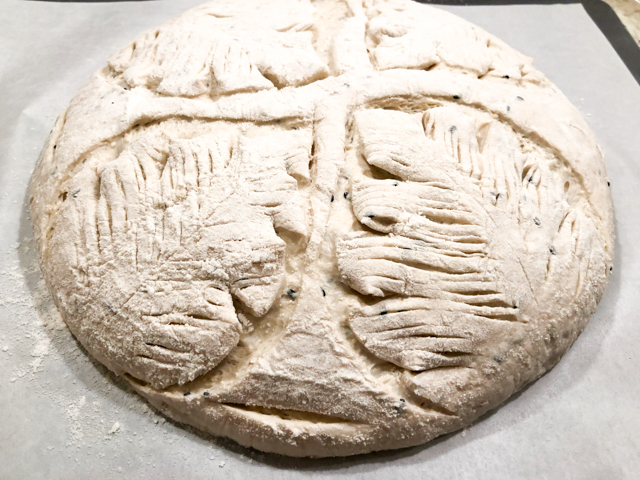
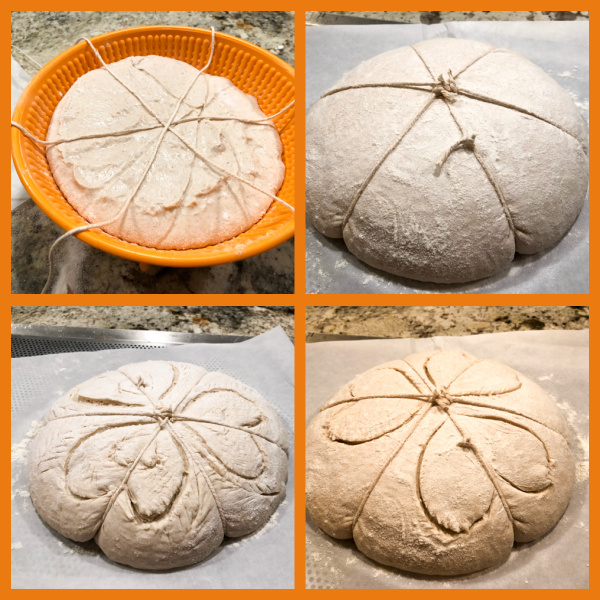
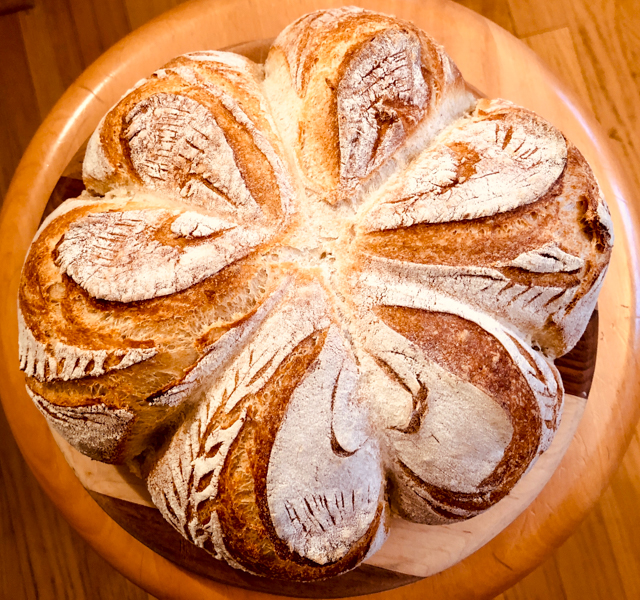
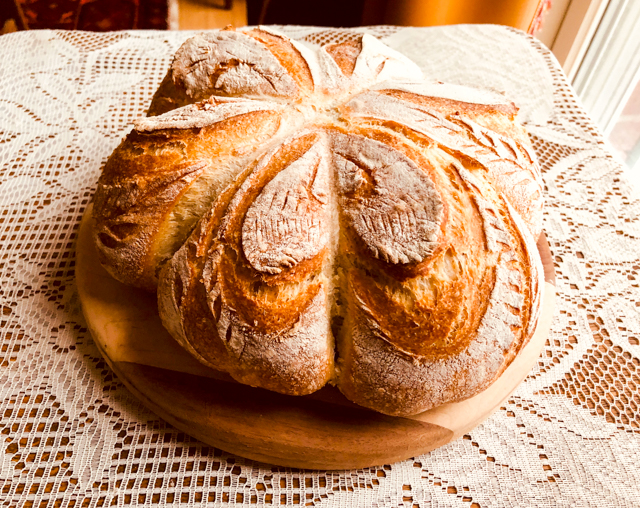
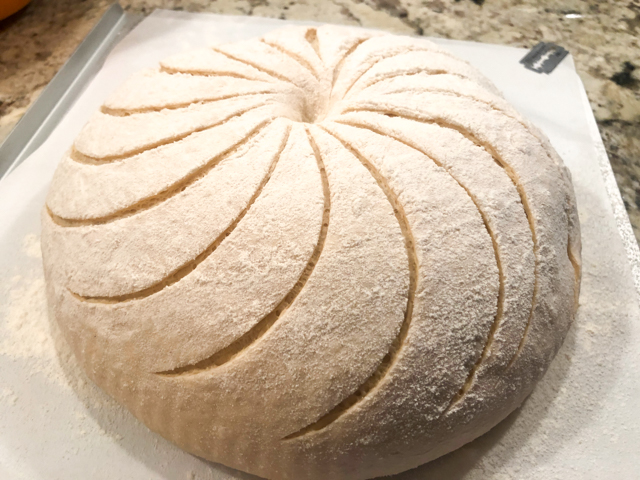
Remove the dough by inverting it on parchment paper, dust the surface with rice or white flour and slash any pattern you like. I used scissors coupled with a razor blade to get the leaf pattern.

Bake at 450F in a Dutch Oven, covered for 30 minutes, then remove the lid to brown the crust. Allow it to cool completely before slicing.

ENJOY!

to print the recipe, click here

Comments: I have included sesame seeds in my sourdough breads many times in the past, but don’t remember their flavor being as evident as in this loaf. I suppose the soaking step helps with it, which surprises me. Roasting them I could understand but just the soaking? Interesting. The texture of this bread is also remarkable, so I must repeat myself and tell you to try it and serve even to those who are a little uncomfortable with a rustic sourdough loaf in all its full glory.

ONE YEAR AGO: Moroccan Turkey Pie with Olive Oil Crust

TWO YEARS AGO: Another Twisted Sister of the Shepherd’s Pie 

THREE YEARS AGO: Cashew Chicken, My Way

FOUR YEARS AGO: Two Deliciously Simple Salads

FIVE YEARS AGO: In My Kitchen, April 2016

SIX YEARS AGO: Spring has Sprung with Suzanne Goin

SEVEN YEARS AGO: Chai Brownies

EIGHT YEARS AGO: Pomegranate-Molasses Glazed Carrots

NINE YEARS AGO: Braised Brisket with Bourbon-Peach Glaze

TEN YEARS AGO: The Real Vodka Sauce

ELEVEN YEARS AGO: Spring Rolls on a Spring Day


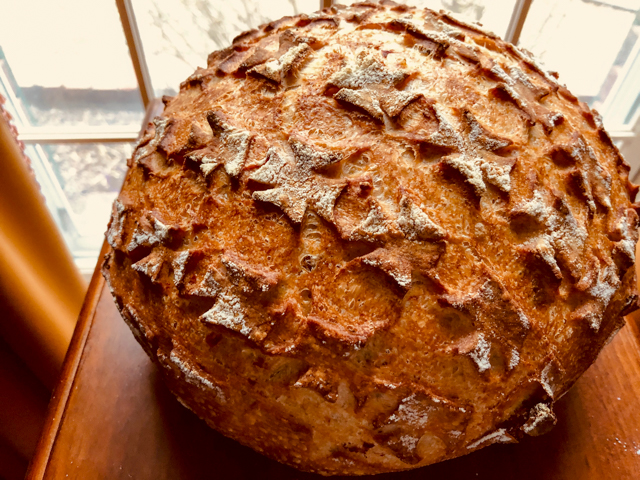
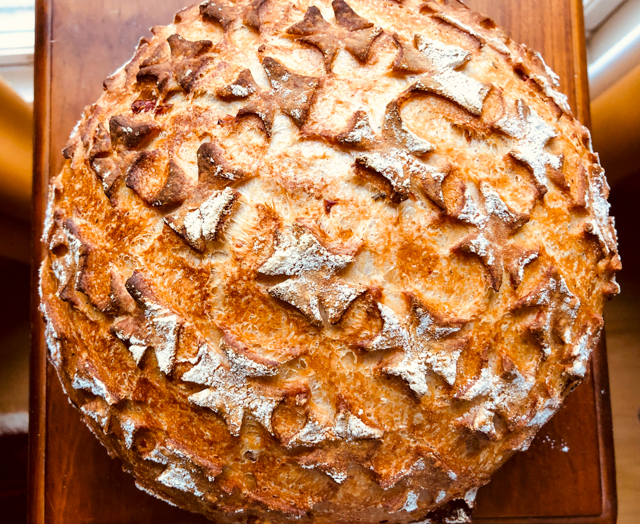
CHARCOAL PEANUT SOURDOUGH

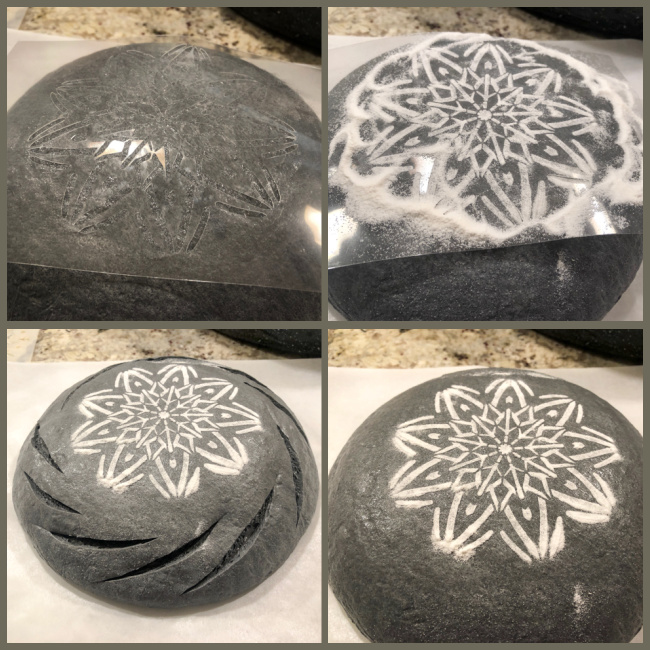
I’ve been struggling with bread stencils lately. My designs end up not as sharp as I hoped them to be, lack of contrast after baking, all sorts of annoying little disappointments. I finally figured out what I was doing wrong, after watching videos from bread guru Morgi. I will share a couple of tips today, in case you’d like to use this method to decorate your bread.

CHARCOAL PEANUT SOURDOUGH
(from the Bewitching Kitchen)

470g bread flour
20g spelt flour
10g peanut flour
7g charcoal powder
10g salt
370g water
100g sourdough starter at 100% hydration

Make the levain mixture about 6 hours before you plan to mix the dough. It should be very bubbly and active.

When you are ready to make the final dough, place the water in the bowl of a KitchenAid type mixer and dissolve the starter in it, mixing with a spatula briefly, then add the three types of flour, charcoal and salt. Turn the mixer on with the hook attachment and knead the dough for 4 minutes at low-speed all the time. You will notice the dough will gain quite a bit of structure even with just 4 minutes in the mixer. If the dough seems too soft, add a bit more bread flour. Remove from the machine, and transfer to a container lightly coated with oil, cover lightly with plastic wrap and allow it to ferment for 4 hours, folding every 45 minutes or so. Because the dough is already a bit developed from the initial time in the mixer, you should get very good structure after 3 and a half hours, or even sooner than that.

After four hours bulk fermentation, shape the dough as a ball, and place, seam side up, in a lightly floured banetton. Leave at room temperature one hour, and then place in the fridge overnight, from 8 to 12 hours.

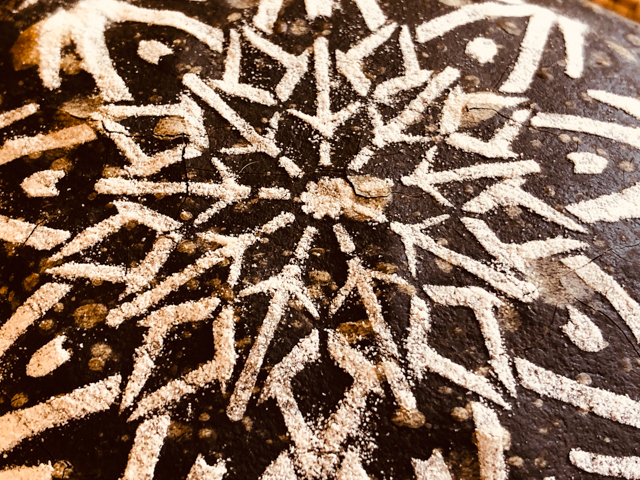
Next morning, heat the oven to 450F. Invert the dough over parchment paper, if the surface seems moist you can place the stencil right away on top of it. If it seems dry, spray lightly with water and position the stencil. Shower some white rice flour on the stencil and rub gently with the fingers of your right hand as you steady the stencil with your left hand (do the opposite if you are left-handed). The idea is to rub the flour on the surface through the openings of the stencil, so that you get a good pattern formed. Carefully lift the stencil and slash the bread around it, so that the bread will not open and compromise the image.

Bake at 450F for 45 minutes, preferably covered for the first 30 minutes to retain steam. Cool completely over a rack before slicing.

ENJOY!

to print the recipe, click here
Comments: If you use a banneton for the final rise of your shaped loaf and it glues to it when you try to invert it to bake, you know that can be VERY frustrating. Sometimes it even distorts the beautiful shape achieved slowly overnight in the fridge. I normally add quite a bit of flour to the banneton before the dough goes in, but when I want to do the stencil decoration, I prefer not to have too much flour on the surface to start with. My tip is simple: place a plastic wrap (like Saran-wrap or other brands) inside the banneton and THEN add your bread – it does not prevent the ridges from making that cute impression on the surface (although it will be slightly less evident) and you will have NO issues inverting the dough to bake.

For the image to be sharp and evident, the trick is to have a little moisture on the dough, and rub the flour, gently but firmly. Hold the stencil in place with one hand, and rub the flour with the other. Lift the stencil as delicately as humanly possible. Finally, whatever design you choose, slash the bread in ways that coach the opening away from the design. You can cut four deep slashes in a square shape with the design in the center, or do what I did, a circular series of small, deep cuts all around.

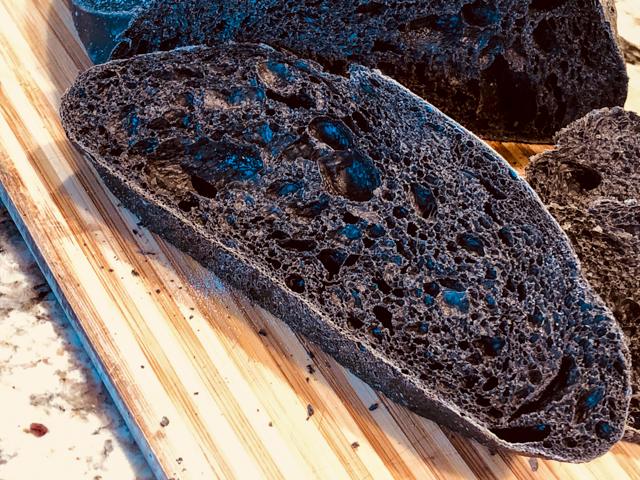
Peanut flour has no fat, but transfers the taste of peanuts quite well to the bread. It has a softer crumb than a straight sourdough with just bread and whole-wheat flours. And the charcoal contributes no taste. When we freeze slices after a couple of days, we like to cut one or two into croutons, because they look pretty amazing in that shocking black color.

ONE YEAR AGO: Chocolate Cake with Coconut Buttercream

TWO YEARS AGO: Berry Rebellion Tarts 

THREE YEARS AGO: Bergamot-Cherry Macarons

FOUR YEAR AGO: Roasted Veggies with Queso Cotija Dressing

FIVE YEARS AGO: Creamy Broccoli and Mushroom Casserole

SIX YEARS AGO: Maple Walnut Biscotti

SEVEN YEARS AGO: Barley Risotto with Peas

EIGHT YEARS AGO: Oatmeal Fudge Bars

NINE YEARS AGO: Cauliflower Steaks

TEN YEARS AGO: Soft Spot for Chevre

ELEVEN YEARS AGO: Quick sun-dried Tomato Crostini

BE MY VALENTINE SOURDOUGH BREAD

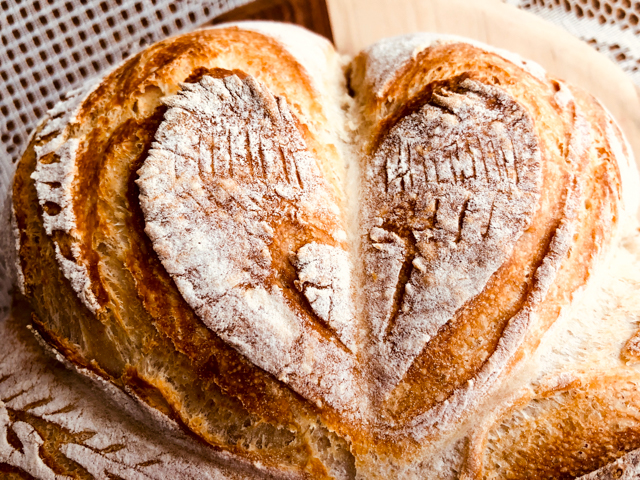
I had different plans for this post. It was going to be Kung Pao Chicken. Then it hit me. This is the last week before Valentine’s Day, so Kung Pao can wait. I shall dance to the romance. I have a special bread for you, decorated with a trio of hearts. Share it with someone who lives in your heart. If you are all alone in these crazy times, bake it for you. You deserve it.

BE MY VALENTINE SOURDOUGH
(from the Bewitching Kitchen)

450g bread flour
50g spelt flour
370g water
75g sourdough starter at 100% hydration
10g salt

Make the levain mixture about 6 hours before you plan to mix the dough. It should be very bubbly and active.

When you are ready to make the final dough, place the water in the bowl of a KitchenAid type mixer and dissolve the starter in it, mixing with a spatula briefly, then add the two types of flour, and salt. Turn the mixer on with the hook attachment and knead the dough for 4 minutes at low-speed all the time. You will notice the dough will gain quite a bit of structure even with just 4 minutes in the mixer. Remove from the machine, and transfer to a container lightly coated with oil, cover lightly with plastic wrap and allow it to ferment for 4 hours, folding every 45 minutes or so. Because the dough is already a bit developed from the initial time in the mixer, you should get very good structure after 3 and a half hours, or even sooner than that.

After four hours bulk fermentation, shape the dough as a ball, and place, seam side up, in a lightly floured banetton. Leave at room temperature one hour, and then place in the fridge overnight, from 8 to 12 hours.

Next morning, heat the oven to 450F.

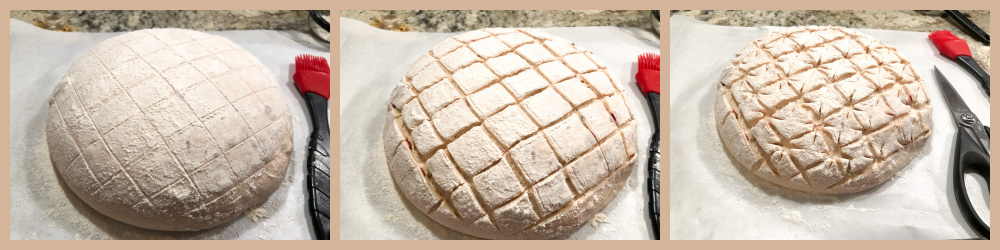
Place three strings over the dough nicely spaced, and touch the strings to glue them lightly to the bottom of the bread. Place a parchment paper on top, a flat baking sheet, and invert the dough, flipping it out of the banneton. Flour the surface of the dough, and tie the strings on top as shown in the composite picture. Score as desired, forming a heart pattern.

Bake at 450F for 45 minutes, preferably covered for the first 30 minutes to retain steam. I cut the strings quickly after 30 minutes when I open the pan, and moved them gently out of the bread. Don’t worry if some parts of the string stay glued to the bread, you can remove later. Cool completely over a rack before slicing.

ENJOY!

to print the recipe, click here

Comments: The other day I was chatting with my friend Dorothy from Shockingly Delicious and she suggested that I make a Valentine-inspired sourdough. I jumped on the idea right away. However, I cannot take credit for the look of this bread, I had seen the scoring months ago on youtube and simply followed more or less her method with a few minor differences because I found myself with less space for additional details around the hearts. I wanted to use beets and make a vibrant red concoction, but there was no way I would go to the store under the dreadful weather conditions of this past weekend. If you don’t know what Polar Vortex is, count yourself lucky. Enough said.

I’ve been a bit puzzled by the way my designs sometimes tend to disappear during baking, and just the other day saw a tip about it. Apparently if you bake it in a Dutch oven (as I do), cracking the lid open allows some of the moisture to escape and the flour rubbed on the surface of the dough is not incorporated into it, so the design will be more evident and crisp. Obviously I forgot all about it when I baked this loaf. I will try it next time for sure.

ONE YEAR AGO: Orange Streusel Cake

TWO YEARS AGO: Pink Praline Brioche

THREE YEARS AGO: A Spinach Salad to Write Home About

FOUR YEARS AGO: Karen’s Four Hour French Country Bread

FIVE YEARS AGO: The Siren’s Song of the Royal Icing

SIX YEARS AGO: Blog-worthy Roasted Butternut Squash

SEVEN YEARS AGO: Chocolate Currant Sourdough Loaf & Roasted Beet Hummus

EIGHT YEARS AGO: Sesame and Flax Seed Sourdough

NINE YEARS AGO: Spanakopita Meatballs

TEN YEARS AGO: Saturday Morning Scones

ELEVEN YEARS AGO: Pain de Mie au Levain

SUNBURST PUMPKIN SOURDOUGH

OCTOBER 16th: WORLD BREAD DAY!

It is that time of the year, when leaves turn orange and red, pumpkins pop up in every recipe (including many where they don’t belong, but let’s not get into a sour mood).  I share with you today a sourdough bread to celebrate Fall. It does have a little canned pumpkin in the formula, but I promise you the taste is very mild, it just contributes moisture and it slightly changes the final texture of the crumb. We loved this bread and hope you’ll also like it if you make it.

SUNBURST PUMPKIN SOURDOUGH
(from the Bewitching Kitchen)

475 g white bread flour
25 g whole wheat flour
120g starter at 100%
100 g canned pumpkin
340g water
10g salt

Add all ingredients to the bowl of a KitchenAid type mixer and using the dough hook, work the dough for 4 minutes at low speed. Adjust flour if necessary, it should still stick to the bottom of the bowl not cleaning it completely as the dough moves.

Remove from the bowl, knead briefly by hand and let it ferment for 3 and a half hours folding every 45 minutes. Shape as a round loaf, refrigerate overnight, seam side up.

Heat the oven to 450F, invert the dough on parchment paper, so that the smooth side is now up. Dust the surface with regular flour, lightly but uniformly. Score with a brand new razor blade, in concentric arcs from the center. Bake for 45 minutes in a Dutch oven, covered for 30 minutes, removing the lid for the final 15 min.  Let it cool completely before slicing.

ENJOY!

to print the recipe, click here

Comments: I’ve been really in love with this method of starting the kneading in the KitchenAid and finishing with foldings. It gets a nice jump start on gluten formation, and it has the advantage of being very “clean”.  When you do the whole incorporation by hand, the two initial foldings can be pretty messy, the dough gets on the fingers, sticks to the sides of the bowl… it’s not too big a deal, but allowing the KitchenAid to do that initial work makes clean up so much easier. I know bread baking purists will turn their noses but… it works for me.

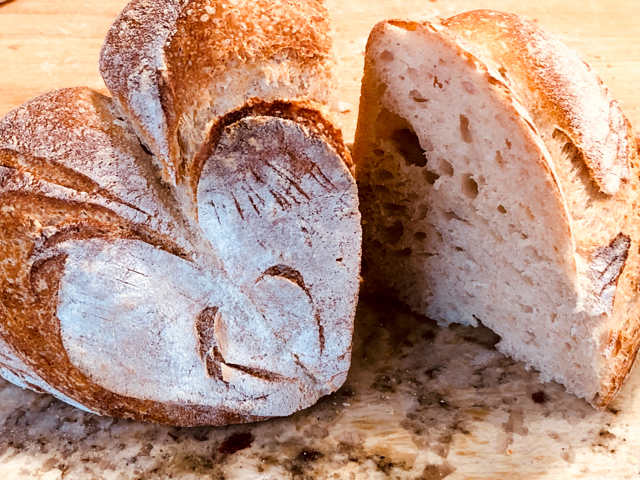
This bread was a loud, loud singer as it cooled down. And the crumb had the kind of structure we like. Not too open, not too tight.

As I mentioned, you cannot taste pumpkin, it is just a very mellow sourdough, with a creamy texture given by the pumpkin puree. If you like a more orange hint to the crumb, adding turmeric is a good option, but not too much, I’d say 1/2 tsp for this size loaf.

ONE YEAR AGO: Sourdough Four-Play

TWO YEARS AGO: World Bread Day 2018

THREE YEARS AGO: Slow-Roasted Tomatoes

FOUR YEARS AGO: Spicy Cotija and Black Olive Sourdough

FIVE YEARS AGO: Apple Cinnamon Oatmeal Cake

SIX YEARS AGO: Sourdough Rye Bread with Flaxseeds and Oats

SEVEN YEARS AGO: PCR and a Dance in the Mind Field

EIGHT YEARS AGO: October 16: World Bread Day

NINE YEARS AGO: The US Listeria Outbreak 2011

TEN YEARS AGO: 36 Hour Sourdough Baguettes

ELEVEN YEARS AGO: October 16 is World Bread Day


MARBLED CHARCOAL SOURDOUGH

Lately a dramatic, marbled sourdough keeps popping everywhere in the blogosphere and Instagram world. I find marbling pretty cool in cakes, cookies, icings. So, why not take it into bread territory?  Most bakers opt for laminating the two doughs together. I have tried the lamination process and found it a bit too convoluted. To make matters worse,  I never get as much structure and gluten development as I like, so I just took my normal default recipe and used it as a starting point. Read the comments after the recipe, if you are interested in the details. Without further ado, here is my first bi-color sourdough.

MARBLED CHARCOAL SOURDOUGH
(from The Bewitching Kitchen, inspired by many sources)

475g bread flour
25 g whole-wheat flour
100 g sourdough starter at 100%
10 g salt
2 g activated charcoal
375 g water

Mix everything (except the charcoal)  with a KitchenAid in low speed with dough hook for about 3 minutes. Adjust consistency with additional bread flour if the mixture seems too loose. Divide the two in two parts, add the charcoal to half of it, knead until fully incorporated (you can do it by hand or place it back in the KitchenAid for a minute or so).

Transfer the two doughs to individual oiled bowls and bulk ferment for 4 to 4.5 hours at room temperature, folding the dough at every 45 minutes to 1 hour. On folding cycle number 3, incorporate the two doughs together, and continue with the bulk proofing. Fold one last time, shape the bread as a round ball, place in a banetton heavily floured, sticking it in the fridge overnight.

Next morning, heat the oven to 450F. Invert the bread straight from the fridge on parchment paper, dust the surface with a small amount of flour, and slash it with a brand new razor  blade.

Bake inside a covered Dutch oven for 30 minutes, remove the lid, leave it in the oven for additional 15 to 20 minutes, if necessary lower the temp a bit in the final 5 minutes. Cool completely before slicing.

ENJOY!

to print the recipe, click here

Comments: As I mentioned, bakers often use a lamination process to marble different colors of dough, or even to add components such as herbs or nuts. One of my issues with the lamination is that the process tends to be quite a bit longer. When I do my initial mixing in the KitchenAid for 3 to 4 minutes, the dough starts with a solid kneading that not only advances the process of gluten formation, but makes the whole thing quite a bit “cleaner.” The dough, once out of the KitchenAid, already handles quite smoothly for the subsequent folding by hand. And I can tell right away if I need any adjustment, just by the way it behaves during this initial step of mixing.

Most recipes that use lamination rely on a long (3 hours or more) autolyse step,  in which you just mix water and flour, then another pretty long proofing after the starter is incorporated. The hydration level of the dough is often higher (you need to add more water to be able to stretch the dough nicely and laminate it), and that forces you to go through more cycles of folding. I sometimes had to do 5 cycles and still felt the dough a bit weak at the end, but by then it was getting so late I had to call it a day and shape it. If you like to try, search youtube, there are countless videos showing the process.

To achieve this level of mixing between the two types of dough, I joined them at cycle 3 out of 4 total foldings. If you prefer both colors to be more uniformly mixed, join them at folding cycle number 2 instead of 3, and be more aggressive with the way you handle it. I can see a Halloween version with pumpkin and charcoal on my horizon…

ONE YEAR AGO: Sundried Tomato and Feta Cheese Torte

TWO YEARS AGO: Blueberry and Mango Curd Macarons

THREE YEARS AGO: First Monday Favorite

FOUR YEARS AGO: In My Kitchen, August 2016

FIVE YEAR AGO: Ka’Kat, a Middle Easter Snack Bread

SIX YEARS AGO: Spinach and Chickpea Curry

SEVEN YEARS AGO: Sautéed Zucchini with Sun-dried Tomatoes and Basil

EIGHT YEARS AGO: Orzo with Heirloom Tomato Relish

NINE YEARS AGO:  Headed to Brazil!

TEN YEARS AGO: The Rhubarb Brouhaha: Revelation Compote

ELEVEN YEARS AGO: Love me tender…