COCONUT AND LIME MACARONS

So many macarons, so little time… These were made using my default recipe – French meringue, resting for about 30 minutes before baking (the macs, not the baker) – but with one small change in the method: I did most of the macaronage in the Kitchen Aid mixer with the paddle attachment. If you are new to making macarons, I don’t advise trying it on your first time, but as soon as you get a bit more familiar with the extent of mixing needed before piping, go for it. It is fast, a lot easier on your arms, and works like a charm. I must say these are fighting to sit in the position of Sally’s Favorite Macarons of All Times. Can you imagine that?

COCONUT AND LIME MACARONS
(from the Bewitching Kitchen)

for the shells:
198 g powdered sugar
113 g almond meal
113 g egg whites at room temperature
a pinch of cream of tartar
100 g granulated sugar
Green food gel from Chefmaster
1/8 tsp coconut extract

for the filling:
250 g white chocolate, chopped finely
50 g heavy whipping cream
50 g coconut milk (full-fat)
zest of 1 lime

to decorate:
melted white candy melts
sprinkles of your choice

Line 2 or 3 heavy baking sheets with parchment paper or Silpat mats. Layer the powdered sugar and almond meal   in a food processor. Pulse until the mixture looks like fine meal, about 15 seconds. Pass through a sieve and transfer to a small bowl. Set aside.

Place the egg whites and pinch of cream of tartar in the bowl of a stand mixer fitted with the whisk attachment. Make sure that the bowl and the whisk are impeccably clean. Starting on medium speed, whip the whites with the cream of tartar until they look like light foam. The whites should not appear liquid. The foam will be light and should not have any structure.

Slowly rain in the granulated sugar, trying to aim the stream between the whisk and the side of the bowl. Turn the speed up to medium-high. Continue to whip the meringue until it is soft and shiny. It should look like marshmallow creme. Add the gel color and the vanilla. Staying at medium-high speed, whip the egg whites until the mixture begins to dull and the lines of the whisk are visible on the surface of the meringue. Check the peak. It should be firm.

Switch to paddle attachment. Add half the almond meal mixture, turn the mixer on low and mix for about 3 seconds. Stop and add the rest of the almond mixture, turn the mixer on low, and process for about 5 more seconds. It should still be reasonably thick, but the grains of almond should be more or less disappearing in the batter.  Remove the bowl from the mixer, and finish the macaronage by hand.  Put the mixture in a piping bag fitted with one of the tips listed above. Pipe on the prepared baking sheets.

Slam each sheet hard four to six times on the counter. Then fist bump each end of the sheet’s underside twice. Let the unbaked macarons dry until they look dull but not overly dry. Drying time depends on humidity. Ina dry climate, the macarons can dry in 15 to 20 minutes; in a humid climate, it can take 35 to 40 minutes.

While the macarons are drying, heat the oven to 300 F. Bake one sheet at a time on the middle rack. Check in 11 minutes. If the tops slide, then bake for 2 to 3 more minutes. The macarons should release without sticking. Check one or two. If they stick, put them back in the oven for 1 to 2 more minutes. Let the macaroons cool for 10 minutes before removing from the pan.

Make the filling: Place the chopped white chocolate in a bowl. Warm up the heavy cream almost to boiling, add the lime zest and allow it to sit for 15 minutes, covered. Add the coconut milk, heat the mixture again to almost boiling, pour over the chocolate. Wait for a couple of minutes and gently mix the chocolate to dissolve it fully. White chocolate is very delicate, if you need to heat it in the microwave to fully dissolve it, do it in at most 10 second intervals using 50% power. Once it is fully dissolved, allow it to cool to room temperature and then whip it with a handheld mixer until fluffy. Do not do it for too long or the ganache will turn grainy.

Assemble the macarons: find two macarons similar in size and add a good amount of filling to the bottom of one of them. Place the other on top and squeeze gently to take the filling all the way to the edge.  Store in the fridge for 24 hours for perfect texture.

ENJOY!

to print the recipe, click here

Comments: Macarons inflict fear on bakers. Things can go wrong, and when they do, it’s pretty frustrating, although there are uses for ruined shells. Macawrongs, as some call them, can be crumbled and used to add texture in cake layers, can go over mousses or ice creams, no need to trash them. In fact, I have recently seen amazing macarons in which badly cracked shells turned into works of art. The clever baker simply used gold pearl dust dissolved in vodka and painted the cracks using a fine brush. The effect is stunning!  I’ve been hoping for cracked shells, but of course, once you want them, they don’t happen. Yeah, macarons. They know how to keep you on your toes. 

These macs delivered just what I wanted, a good taste of coconut with the delicate sourness of limes to go with it. The labor of love was separating the white and green sprinkles from the other colors, but it was worth it.  Since I used candy melts for the drizzle, I had to work fast because that tends to solidify quickly. So I drizzled four macarons at a time, decorated them and moved to the following set of four. I felt pretty fancy using tweezers to place the large sprinkles exactly where I wanted, but of course that slows things down. Baking: one of the most efficient ways to practice patience.

Summarizing what’s new about this post: you can do 90% of the macaronage in your Kitchen Aid, just change the whisk to the paddle, add the almond mixture in two installments. Beat 3 seconds after first addition, in low-speed, add the second half, and beat 5 seconds.  Finish by hand after that. And, to make a coconut flavored shell and filling, simply use coconut extract instead of vanilla in the shells, and a portion of coconut milk in place of heavy cream when you make the ganache with the white chocolate. You can use that as a basis for different flavors, maybe adding a touch of passion fruit, or mango instead of infusing the cream with lime zest.  Have fun with it… That’s what macs are for. Apart from sometimes driving you crazy.

ONE YEAR AGO: Flank Steak Carnitas

TWO YEARS AGO: Sesame and Poppy Seed Sourdough

THREE YEARS AGO: Pecan-Crusted Chicken from Southern at Heart

FOUR YEARS AGO: Lamb Shanks en Papillote with Cauliflower-Celeriac Purée

FIVE YEARS AGO: Chestnut Brownies and a Blog Award!

SIX YEARS AGO: Quinoa with Cider-Glazed Carrots

SEVEN YEARS AGO: Celebrate Wednesday: Heirloom Tomatoes Steal the Show

EIGHT YEARS AGO: Pain de Provence

NINE YEARS AGO: Golspie Loaf, from the Scottish Highlands
MACARONS FOR A LITTLE PRINCESS

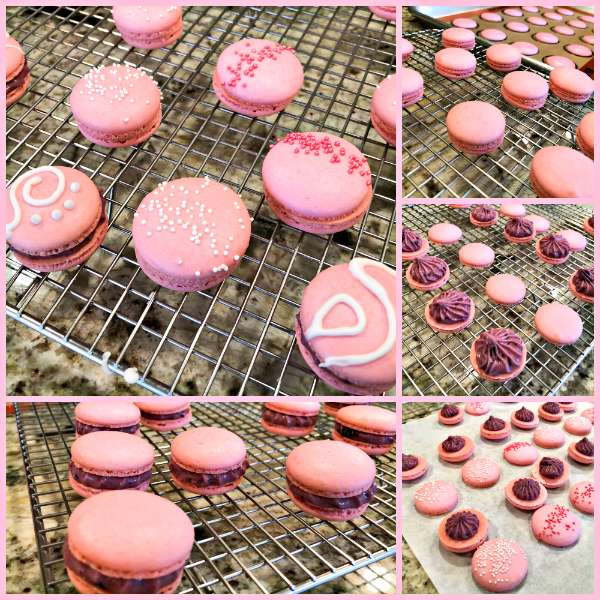
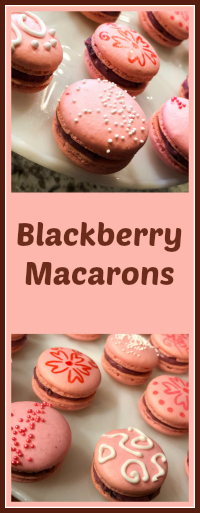
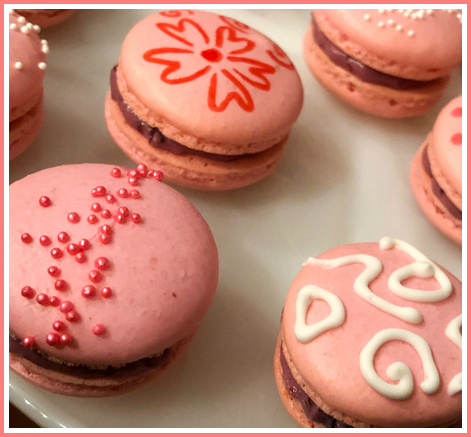
Time goes by way too quickly. Not too long ago we were thrilled with the idea we would be grandparents, and all of a sudden, that sweet little baby turned four years old!  To celebrate the occasion, we wanted to send her a box of pink macarons, as pink is her favorite color. I settled on blackberry filling, and decided to try a bunch of different decorations, so she could choose her favorite.

BLACKBERRY MACARONS
(from the Bewitching Kitchen)

for the shells:
198 g powdered sugar (I used Cherry Bakewell flavored)
113 g almond meal
113 g egg whites at room temperature
a pinch of cream of tartar
100 g granulated sugar
pink gel color from AmeriColor
2 drops vanilla extract

for the filling:
8 ounces white chocolate
1/2 cup blackberry jam
2 1/2 tablespoons heavy cream

to decorate:
Royal icing
sprinkles of your choice
edible marker drawings
melted white chocolate

Line 2 or 3 heavy baking sheets with parchment paper or Silpat mats. Layer the powdered sugar and almond meal   in a food processor. Pulse until the mixture looks like fine meal, about 15 seconds. Pass through a sieve and transfer to a small bowl. Set aside.

Place the egg whites and pinch of cream of tartar in the bowl of a stand mixer fitted with the whisk attachment. Make sure that the bowl and the whisk are impeccably clean. Starting on medium speed, whip the whites with the cream of tartar until they look like light foam. The whites should not appear liquid. The foam will be light and should not have any structure.

Slowly rain in the granulated sugar, trying to aim the stream between the whisk and the side of the bowl. Turn the speed up to medium-high. Continue to whip the meringue until it is soft and shiny. It should look like marshmallow creme. Add the gel color and the vanilla. Staying at medium-high speed, whip the egg whites until the mixture begins to dull and the lines of the whisk are visible on the surface of the meringue. Check the peak. It should be firm. Transfer the whites to a medium bowl.

Fold in the almond meal mixture in three increments. Paint the mixture halfway up the side of the bowl, using the flat side of a spatula. Scrape the mixture down to the center of the bowl. Repeat two or three times, then check to see if the mixture slides slowly down the side of the bowl. Put the mixture in a piping bag fitted with one of the tips listed above. Pipe on the prepared baking sheets.

Slam each sheet hard four to six times on the counter. Then fist bump each end of the sheet’s underside twice. If using sprinkles, add them now, before the shells dry. Let the unbaked macarons dry until they look dull but not overly dry. Drying time depends on humidity. In a dry climate, the macarons can dry in 15 to 20 minutes; in a humid climate, it can take 35 to 40 minutes.

While the macarons are drying, heat the oven to 300 F. Bake one sheet at a time on the middle rack. Check in 11 minutes. If the tops slide, then bake for 2 to 3 more minutes. The macarons should release without sticking. Check one or two. If they stick, put them back in the oven for 1 to 2 more minutes. Let the macaroons cool for 10 minutes before removing from the pan.

Make the filling: Place chocolate in a heatproof bowl and set over a pot of simmering water on low heat. Stir chocolate until melted. Remove from heat, and whisk in jam and heavy cream. Cover and chill 2 hours, or until cold. Whip it with a hand-held electric mixer until it reaches a good consistency for piping. Transfer ganache to a piping bag fitted with a 1/4-inch star tip.

Assemble the macarons: find two macarons similar in size and pipe a good amount of filling to the bottom of one of them. Place the other on top and squeeze gently to take the filling all the way to the edge.  Decorate any way you want. Store in the fridge for 24 hours for perfect texture.

ENJOY!

to print the recipe, click here

Comments: The logistics of gifting macarons to someone living a thousand miles away is a bit complicated, but of course doable. Where there is a will, there’s a way, right?  Keeping in mind that macarons need to sit overnight in the fridge to “mature”, you must start the process a couple of days early.  The maturation process is essentially absorption of moisture from the filling into the shells. Macaron shells start pretty dry and crumbly, as you’ll notice if you bite into them right after they cool down. Once you add buttercream or ganache, the moisture slowly permeates into the shells and turns the cookie into perfect little morsels of sweetness, with the exact amount of chewiness. But anyway, back to the issue of gifting macs.

Her birthday fell on a Thursday, so we had to ship it overnight on Wednesday. You can conceivably do a 2-day shipping to save considerable cash, but this was a special occasion, so we splurged. With that in mind, baking day was set for Tuesday after work. I had my fingers firmly crossed for the Macaron Gods to smile on me, because that was it, I needed them to be perfect, no time to try again. Stars were properly aligned: success! By 22:45hs  they  were  going  into the fridge, and the baker into a warm bed…   😉  

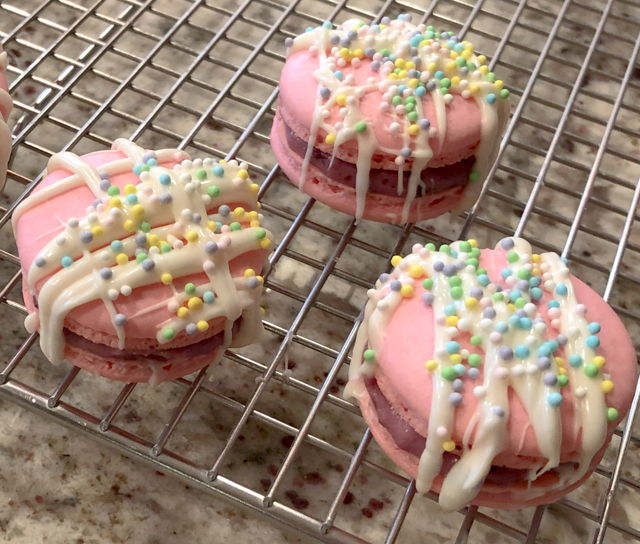
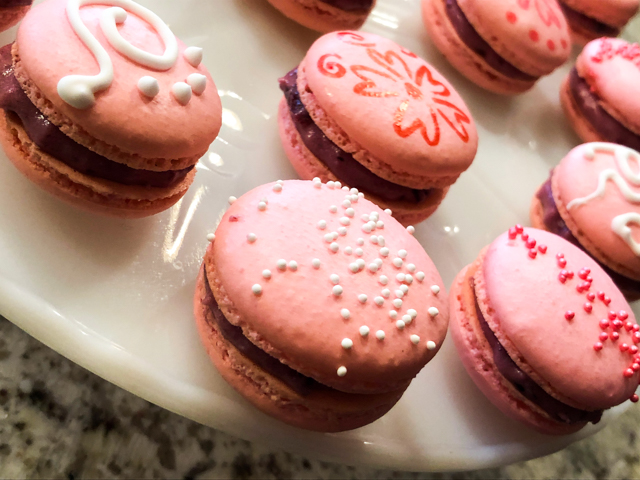
I used royal icing decoration in some of them, sprinkles in others, went Jackson Pollock in some, and even tried my hands at free drawing with edible markers (first time I dared doing it). The markers are from Chefmaster and have a very soft tip, you have to still use a light hand on the very delicate macaron shell, but trust me, if I could pull this, anyone can.

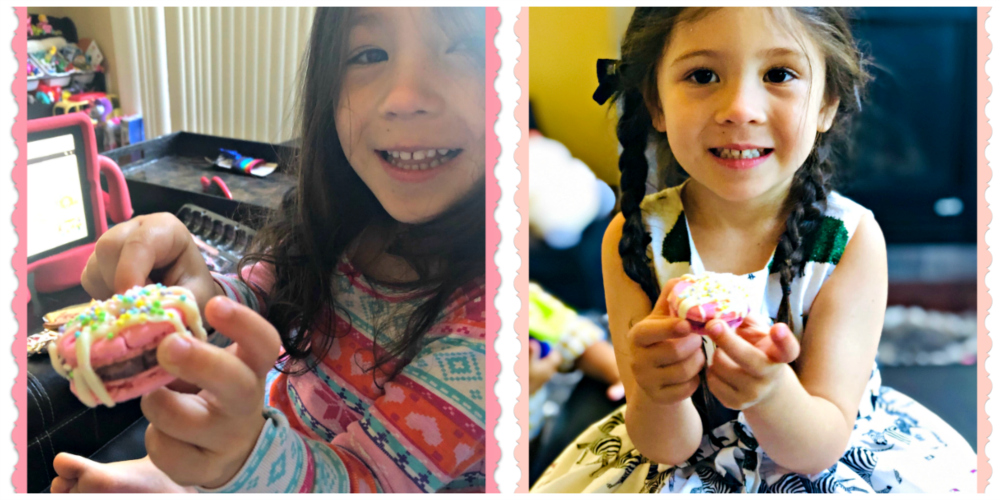
and her favorite….  DRUM ROLL!!!!!!!!!!


ONE YEAR AGO: Gilding the Sourdough Loaf

TWO YEARS AGO: Lolita Joins the Bewitching Kitchen

THREE YEARS AGO: Cashew Cream Sauce

FOUR YEARS AGO: Blood Orange Margaritas

FIVE YEARS AGO: Smoked Salmon Appetizer

SIX YEARS AGO: Clementine Cake

SEVEN YEARS AGO: Springtime Spinach Risotto

EIGHT YEARS AGO: The end of green bean cruelty

NINE YEARS AGO: Torta di Limone e Mandorle


CARROT CAKE MACARONS

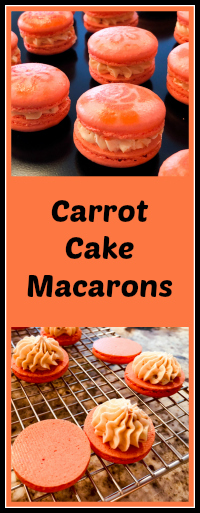
You read that right. Carrot Cake Macarons. I am a member of a Facebook group for Macaron-Baking-Addicts and a couple of months ago a very experienced baker raved about them. I am usually not that wild about store-bought products, but for some reason that recipe intrigued me enough to make me go for it. The product in question is a Carrot Cake Spread by Trader Joe’s. I added it as the main flavoring for a simple Swiss Meringue Buttercream, and that was the filling for coral-tone macarons. Living Coral, the Pantene color of 2019. I had to try and match it, just because macarons are by definition a celebration of color. At least in my mind they are…

CARROT CAKE MACARONS
(from the Bewitching Kitchen)

for the shells:
150 g almond flour
150 g powdered sugar
56 + 56 g egg whites
40 g water
150 g granulated sugar, super fine
1/4 tsp vanilla extract
gel food dye (2 parts red, 1 part yellow, 1 part pink)

for the Swiss meringue buttercream filling:
3 large egg whites, room temperature
1/2 cup sugar
2 sticks unsalted butter, softened but still cool, cut into 1/2-inch pieces
pinch salt
3 to 4 tablespoons carrot cake spread 

Make the shells: Add the almond flour and the powdered sugar to the bowl of a food processor and pulse it 10 to 12 times. You want to have it fine but not allow the oil in the almonds to seep out and turn it into a paste.  Immediately sieve it on a large bowl and reserve.

To a small bowl, add half of the egg whites (56 g), then add the food dyes and vanilla. Mix until it is all well incorporated, the dye sometimes resists mixing homogeneously into the egg white.

Now comes the fun part. You will add the other half of the egg whites to the bowl of a mixer and the granulated sugar and water into a small saucepan. Have an instant thermometer ready. Start beating the egg white in slow-speed, as you turn the heat and start bringing the sugar syrup to a boil, without stirring (this is important, or you risk crystallizing the sugar and having to start all over). When the sugar starts boiling, increase the mixer to medium-speed. You want it to be at the stage of soft peaks by the time the syrup reaches 244 F. Once that happens, slowly drizzle the syrup into the egg white-sugar, as you continue beating. Beat until the temperature cools down to around 115F, no need to bring it down all the way to room temperature. You don’t want to have a very stiff meringue at this point, or it will be too hard to incorporate into the almond flour.

The second fun part starts now, the famous macaronage. Add the dyed egg white and the meringue on top of the almond flour and mix gently but decisively. If you have never made macarons before, I advise you to watch some videos on youtube to familiarize yourself with the proper macaronage. You want the batter to flow from the spatula and form a figure eight on the surface as you allow it to drip, but it should not flow too rapidly. If you spoon some batter on parchment paper, it should smooth out in about 30 seconds or so.  Once you get to the right stage, fill a piping bag fitted with the piping tip of your choice (I like a 1/2 inch opening), and pipe on parchment paper or Silpat.

Bang the baking sheet a few times to release air bubbles, and allow it to dry at room temperature for 30 minutes or until the surface feels dry to the touch.

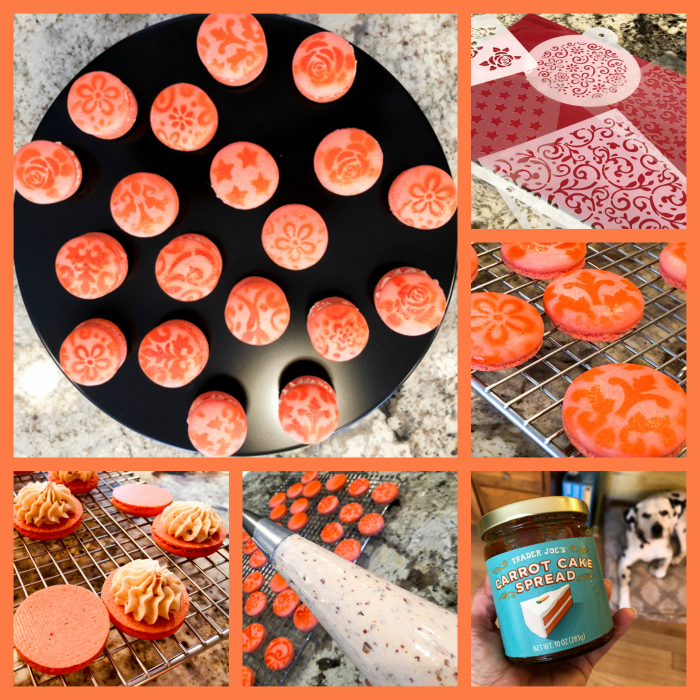
Bake at 300F for 10 to 12 minutes. Cool before peeling off the baking sheet. Decorate either before filling them or after, depending on the type of decoration you choose. I used an air-brush and stencils (see my composite picture), with the color Sunset Orange from Chefmaster.

 Make the filling. Place the egg whites and the sugar in a large metal mixing bowl set above a pot of simmering water. Whisk the mixture until the sugar melts and the mixture becomes warm and very thin in consistency, reaching a temperature of around 160F. 

Transfer the contents to a Kitchen Aid bowl and whisk on high-speed until stiff peaks form. Now, change the whisk to the paddle beater, add the butter and salt, mixing on low-speed.  Add the butter piece by piece and keep mixing. When the butter seems to be all incorporated, even if it looks a little curdled, increase the speed to high. The mixture will become smooth and totally creamy within a few minutes. 

Add the carrot cake spread and mix on low-speed. Taste and add more if you feel like it. Put the mixture in a piping bag fitted with an open star piping tip and fill your macarons.

Place them in the fridge overnight and bring to room temperature 15 minutes before serving.

ENJOY!

to print the recipe, click here

Comments: If you’ve been following my blog for a while, you know I have a lot of macaron recipes. They always involve the French meringue method because it is so simple and it has always worked for me. I had issues with the Italian meringue and several batches were a failure, but I know that many bakers find them better in terms of texture and reproducibility. Basically because the Italian meringue is much more stable and is less affected by humidity in the environment.

My main goal in macaron baking is maximize the proportion of feet, because I like them with bigger feet and a plump shell, so I like to try different methods and compare how they work for me. The Swiss meringue method should happen eventually, although for the time being I intend to play with the current recipe a few more times.  I am happy that this batch worked perfectly. The main thing I changed was adding the food dye to one half of the egg white component, and add that to the almond flour together with the Italian meringue. In the past, I followed recipes that instructed you to add the egg white to the almond flour first, forming a thick paste and allowing that to sit while the meringue is prepared. I found that this approach makes it pretty tough to incorporate the meringue and probably negatively affected the macaronage step that follows.

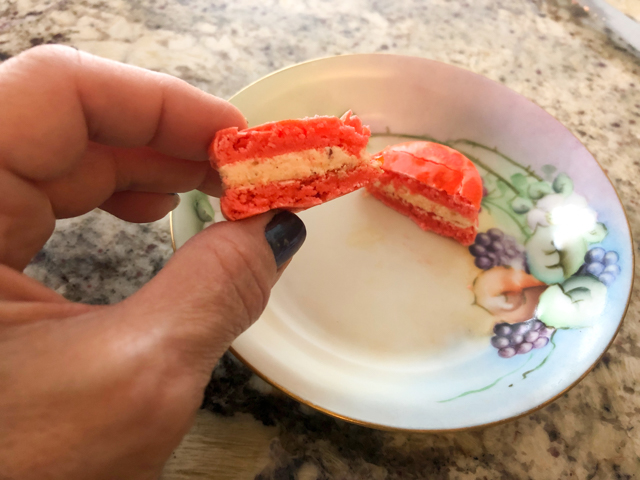
The filling. O. M. G. These macarons will be so unique, different from any macaron you’ll ever have, I guarantee it. It is sweet, perhaps sweeter than most fillings I enjoy, but it has that spicy characteristic of carrot cakes, the cinnamon-clove mixture, that breaks the sweetness a bit. If you don’t have a Trader Joe’s around, the product is available through amazon. The texture was perfect, no hollows, and with a nice “macaron-chew.”  I will play with this method on my next mac-adventure, that will involve more than one color of batter. Let’s hope that the stars will align properly at the time…

ONE YEAR AGO: Soup Saturday: Say Goodbye to Winter

TWO YEARS AGO: Manchego and Poblano Soup

THREE YEARS AGO: A Smashing Pair

FOUR YEARS AGO: Spinach and Mushroom Stuffed Pork Tenderloin

FIVE YEARS AGO: Crispy Chickpea and Caper Spaghetti

SIX YEARS AGO: Spring has Sprung!

SEVEN YEARS AGO: Chickpea and Fire Roasted Tomato Soup

EIGHT YEARS AGO: Double Asparagus Delight

NINE YEARS AGO:  Sun-dried Tomato and Feta Cheese Torte


RASPBERRY GANACHE MACARONS


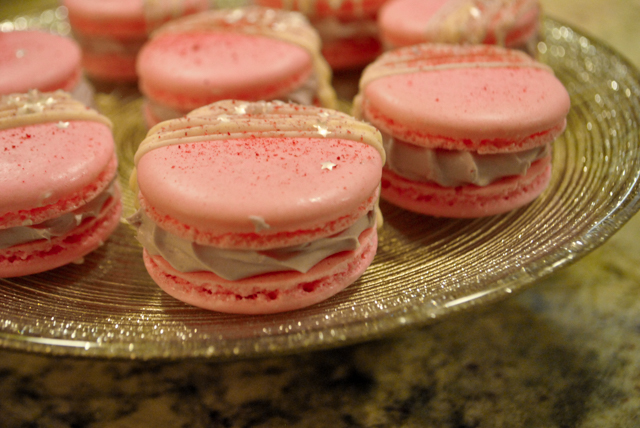
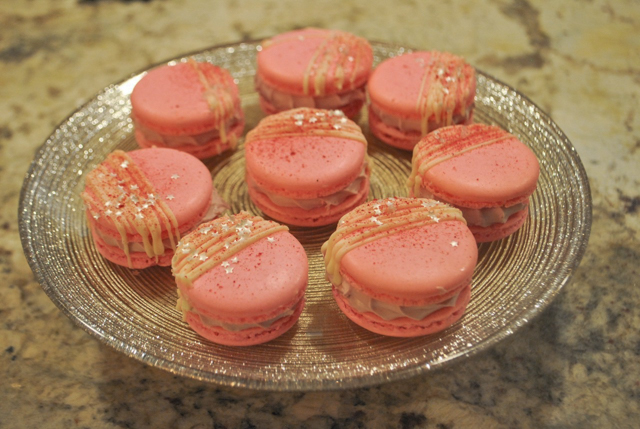
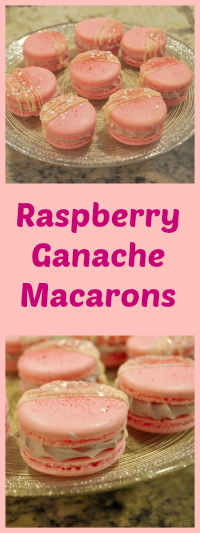
The first recipe of the year should be special. Special in the sense that it should involve something I love to make, something that turned out particularly delicious, and that I will be making again and again as the year goes by. Two options fought hard in my mind to be featured. Mirror-glazed cakes, and French macarons. If you’ve been around the Bewitching, you know that my obsession with macarons is several years old. Mirror glaze is a more recent adventure, but not less fascinating for me. What made me go for macarons? The fact that I have five macaron recipes not yet shared with you. Mirror-glaze cake? I only have one. Another factor that tipped the scale was that my last macaron post happened last August, whereas  shiny cakes were featured just a couple of weeks ago. So that pretty much settled it. I made this batch of pink macs to give to dear friends, which also made them much more special to me.

RASPBERRY GANACHE MACARONS
(from the Bewitching Kitchen)

for the shells:
198 g powdered sugar
113 g almond meal
113 g egg whites at room temperature
a pinch of cream of tartar
100 g granulated sugar
pink gel color from AmeriColor
2 drops vanilla extract

for the filling:
8 ounces white chocolate
1/2 cup raspberry jam
2 1/2 tablespoons heavy cream

to decorate:
drizzle of white chocolate
freeze dried-raspberries
sparkly sprinkles

Line 2 or 3 heavy baking sheets with parchment paper or Silpat mats. Layer the powdered sugar and almond meal   in a food processor. Pulse until the mixture looks like fine meal, about 15 seconds. Pass through a sieve and transfer to a small bowl. Set aside.

Place the egg whites and pinch of cream of tartar in the bowl of a stand mixer fitted with the whisk attachment. Make sure that the bowl and the whisk are impeccably clean. Starting on medium speed, whip the whites with the cream of tartar until they look like light foam. The whites should not appear liquid. The foam will be light and should not have any structure.

Slowly rain in the granulated sugar, trying to aim the stream between the whisk and the side of the bowl. Turn the speed up to medium-high. Continue to whip the meringue until it is soft and shiny. It should look like marshmallow creme. Add the gel color and the vanilla. Staying at medium-high speed, whip the egg whites until the mixture begins to dull and the lines of the whisk are visible on the surface of the meringue. Check the peak. It should be firm. Transfer the whites to a medium bowl.

Fold in the almond meal mixture in three increments. Paint the mixture halfway up the side of the bowl, using the flat side of a spatula. Scrape the mixture down to the center of the bowl. Repeat two or three times, then check to see if the mixture slides slowly down the side of the bowl. Put the mixture in a piping bag fitted with one of the tips listed above. Pipe on the prepared baking sheets.

Slam each sheet hard four to six times on the counter. Then fist bump each end of the sheet’s underside twice. Let the unbaked macarons dry until they look dull but not overly dry. Drying time depends on humidity. Ina dry climate, the macarons can dry in 15 to 20 minutes; in a humid climate, it can take 35 to 40 minutes. If using edible gold powder,  sprinkle a little with a brush and use a hand-held fan to spread it over like dust.

While the macarons are drying, heat the oven to 330 F (170 C/gas mark 3). Bake one sheet at a time on the middle rack. Check in 11 minutes. If the tops slide, then bake for 2 to 3 more minutes. The macarons should release without sticking. Check one or two. If they stick, put them back in the oven for 1 to 2 more minutes. Let the macaroons cool for 10 minutes before removing from the pan.

Make the filling: Place chocolate in a heatproof bowl and set over a pot of simmering water on low heat. Stir chocolate until melted. Remove from heat, and whisk in jam and heavy cream. Cover and chill 2 hours, or until cold. Whip it with a hand-held electric mixer until it reaches a good consistency for piping. Transfer ganache to a piping bag fitted with a 1/4-inch star tip.

Assemble the macarons: find two macarons similar in size and pipe a good amount of filling to the bottom of one of them. Place the other on top and squeeze gently to take the filling all the way to the edge.  Decorate any way you want, or leave them plain. Store in the fridge for 24 hours for perfect texture.

ENJOY!

to print the recipe, click here

Comments: I am very happy with this bake. I think the raspberry ganache worked very well as a filling, because the white chocolate is sweet, but the raspberry balances it all. I made this exact filling twice, first time I used raspberry jam with seeds, this time it was seedless. I liked them both, actually. Since seedless can be a bit harder to find, I advise you not to worry too much about it, either way it will be great.

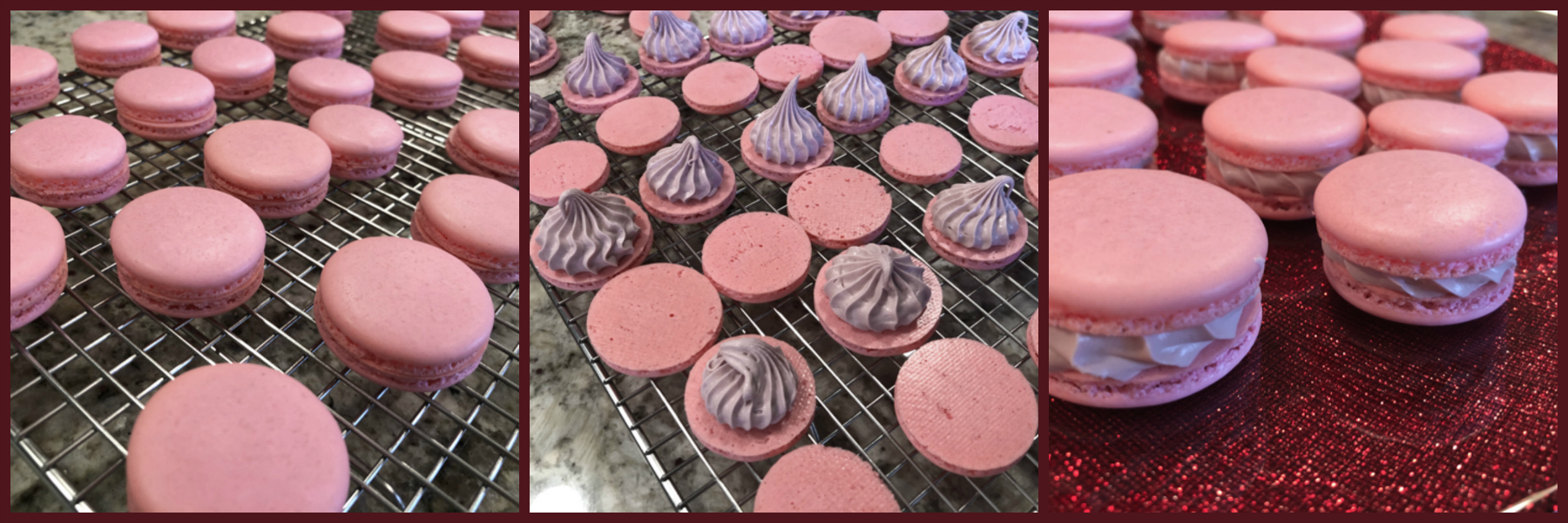
But what gave me the real thrill was finally getting a nice swirl pattern on the filling. I guess the secret is whipping the ganache once it’s cold and making sure it is the right texture for piping a nice star-shaped mound. Until this time the swirl would just be lost once I sandwiched the cookies together, the filling (be it buttercream or ganache) did not have the correct density to hold its shape.  I hope I can repeat it in the near future…

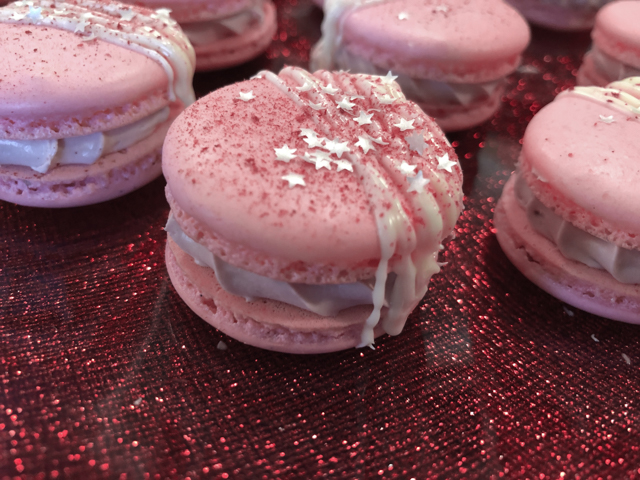
To get the raspberry dust, simply press a few freeze-dried raspberries through a small sieve on top of the chocolate drizzle before it sets. These little bits of powder pack intense sharp flavor and really pump up the raspberry component. Freeze-dried fruits last a long time, so I always make sure to keep a bag in the pantry.

On the chocolate drizzle: you don’t have to temper the chocolate for that. It will not be as shiny as if you go through the trouble of tempering, but with all the other sprinkles on top, I don’t think it makes much difference. You can conceivably use Candy Melts, but their taste does not compare with the real thing. And for great friends, how could I not use the very best?

Finally, I little comment about the pictures. The two initial photos were taken with my camera, all others with my cell phone. The difference in color is striking. Oddly enough, the cell phone depicted them more realistically as far as the shade of pink. I don’t know why that would be the case, it’s a bit frustrating, as I think overall the quality of the shots with a real camera is much better. Oh, well. If anyone has some input, drop me a line at sallybr2008 at gmail dot com. MERCI BIEN!

ONE YEAR AGO: Pain au Chocolat

TWO YEARS AGO: Two Unusual Takes on Roasted Veggies

THREE YEARS AGO: Kadoo Boranee: Butternut Squash Perfection

FOUR YEARS AGO: Creamy Broccoli Soup with Toasted Almonds

FIVE YEARS AGO:
 Fennel and Cheddar Cheese Crackers

SIX YEARS AGO: A Festive Pomegranate Dessert

SEVEN YEARS AGO: My First Award!

EIGHT YEARS AGO: A Message from WordPress

NINE YEARS AGO: Turkish Chicken Kebabs


BLUEBERRY AND MANGO CURD MACARONS

No, not together in the same filling. I am sharing two different takes on my favorite cookie. Curd can be a tricky filling for macarons because anything with moisture is a killer, so normally a buttercream or ganache-based preparation is the best option. But, if you intend to consume them within a day, maximum two, give curd a try. It has the best sharp, acidic flavor to stand against the sweetness of the shells. Since every batch I bake is shared with our departmental colleagues and more often than not they are inhaled within 3 hours of arrival… I never have to worry too much about the issue. The blueberry version is a pure curd, the mango was “tamed” with a bit of white chocolate ganache. They were both delicious, but I must say I haven’t quite hit the mango flavor with the intensity I want. I need more cowbell on that (Saturday Night Live lovers, anyone?).

Blueberry Macs first, scroll down for the Mango version.

BLUEBERRY CURD MACARONS
(from the Bewitching Kitchen)

for the shells:
see this post
use just a little vanilla to flavor the shells and add purple food color

for the filling:
1 cup sugar
1/4 cup butter
2 cups fresh blueberries
1 tablespoon water
zest of half a lime
2 large eggs, beaten slightly

Make the shells and bake them as described in the link.

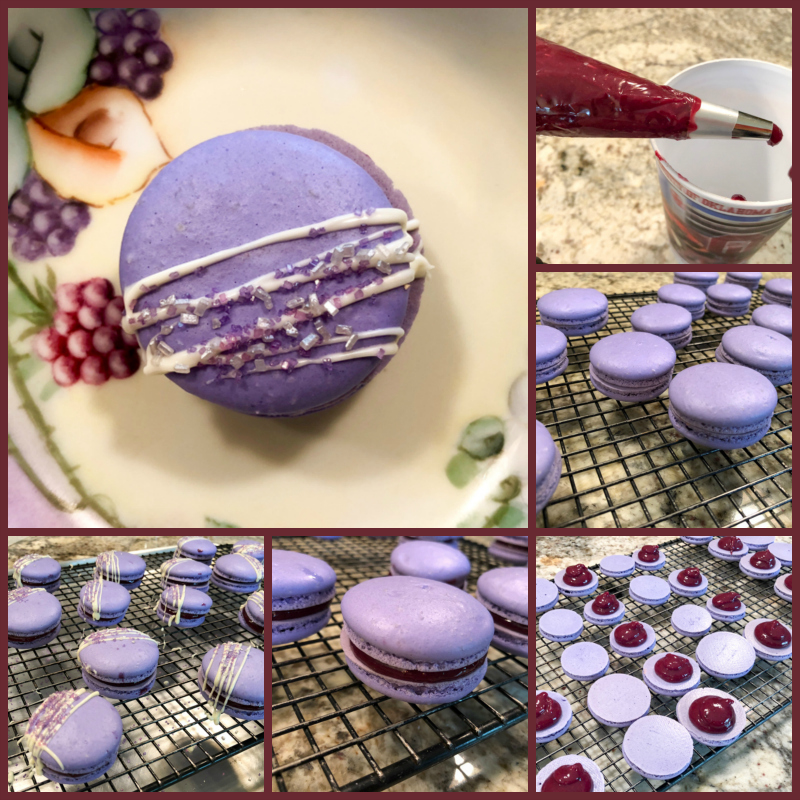
Make the filling: Place the blueberries and lime zest in a saucepan with 1 tablespoon water and cook gently, mixing occasionally until soft, 8 to 10 minutes.  Pass the mixture through a fine sieve, and place inside a glass bowl that will fit over a saucepan with a small amount of simmering water. Add the butter and sugar and cook until the sugar is fully dissolved and the butter is melted.

Add the eggs and continue to stir over gently simmering water until the curd thickens enough to coat the back of the spoon, and reach about 170 F.  The process can take a while, but I like to start it on the stove and if the temperature gets stuck in a certain level, I place the bowl in the microwave and give it a couple of 20 second bursts to make sure it is heated to 170 F. It is imperative to use a thermometer, so that you don’t risk going over the temperature goal.  You can always just baby-sit the curd on the stove full-time. Once it’s done, strain the curd, and let it cool completely before using it to fill the macaron shells.

Macarons are best enjoyed after 24 hours in the fridge.

ENJOY!

to print the recipe, click here

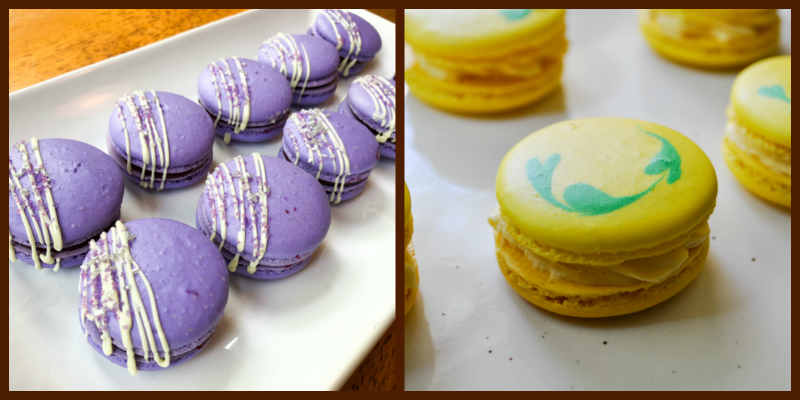
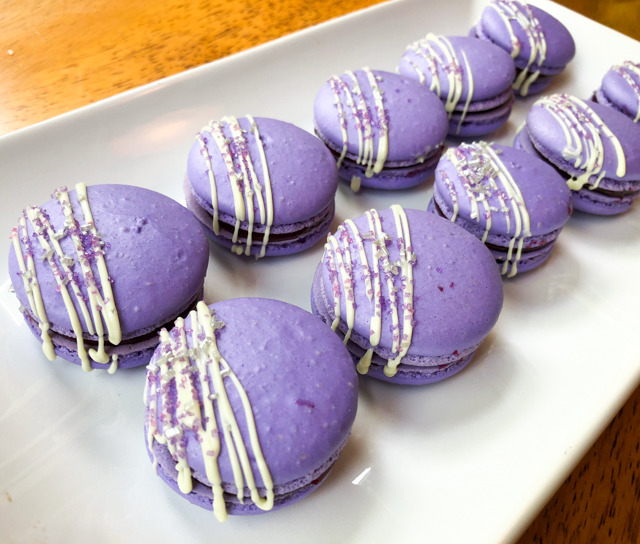
Comments: I cannot believe how beautiful the blueberry curd turned out. What amazing color! If you like tart-and-sweet stuff, you’ll fall in love with it. When I make the shells I always marry them to get as closely in size as possible (my piping is never too consistent, I’m afraid), then I open them side by side and add the filling to one of the partners. The decoration was very simple, a drizzle of candy melts white. Yes, I took a shortcut instead of tempering white chocolate, because when I made these, I was having quite a few issues with tempering chocolate. Since the drizzle is a minor component of the cookie, I decided that in the name of my mental sanity, I would use it. A sprinkle of decorating purple and pink sugar crystals closed the deal.  It is hard for me to pick a favorite macaron, but this version was very very tasty.

MANGO CURD MACARONS
(from the Bewitching Kitchen)

for the shells:
see this post
use just a little vanilla to flavor the shells
Separate a small amount of batter ( about 1/3 cup) and add green food color to it.
Add yellow color to the rest of the batter.

for the filling:
mango curd (you won’t need the full amount)
1 cup pureed mango flesh
1/3 cup sugar
3 tablespoons fresh lemon juice
4 teaspoons cornstarch
Pinch of salt
3 large egg yolks
3 tablespoons cold unsalted butter, cut into small pieces
white chocolate ganache:
115 g white chocolate, coarsely chopped
35 g heavy whipping cream
1 tbsp unsalted butter

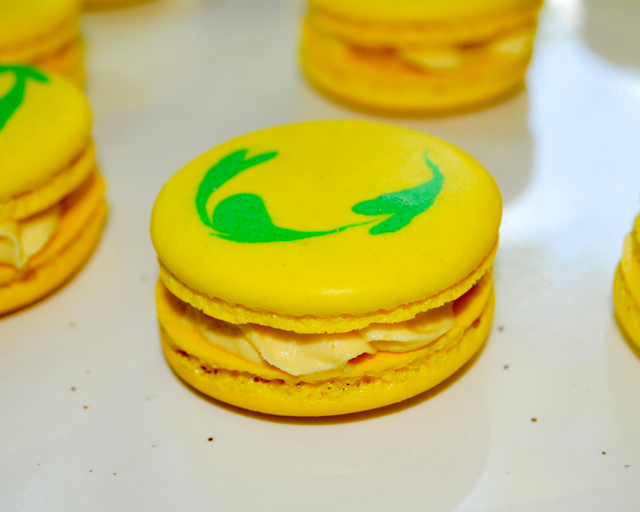
To decorate the shells with the heart-shaped swirls, place the small amount of green macaron batter inside a piping bag. No need to use a tip, you can cut a small opening so that it will release small drops.  Pipe the shells with the batter tinted yellow. Right after piping, drop three  dots of green batter on the edge of the shells, and run a line through them with a toothpick or a metal gadget for cookie design. Let the shells dry to form a skin and bake as you would normally do (see the link included).

Make the filling: Whisk the mango pulp, sugar, lemon juice, cornstarch and salt in a bowl.  Whisk in the egg yolks. Place in a double boiler with water simmering underneath. Cook stirring gently until thickened, it should take only about 5 minutes due to the cornstarch. Remove from the heat and whisk in the butter a few pieces at a time until incorporated.

Strain the mixture through a fine-mesh sieve into a small bowl, pushing it through with a rubber spatula. Press plastic wrap directly onto the surface to prevent a skin from forming. Refrigerate until completely set, at least 4 hours.

Make a white chocolate ganache by placing the chocolate in a bowl and pouring over it the heavy cream heated to almost boiling (bubbles forming at the edges of the pan). Let it sit for a few minutes, swirl gently to dissolve the chocolate, add the butter and mix. Let it cool to room temperature, then add to it 1/3 of a cup of the mango curd. Mix well and refrigerate for several hours before filling the shells. If desired, you can whip the mixture before doing so.

Macarons are best enjoyed after 24 hours in the fridge.

ENJOY!

to print the recipe, click here

Comments: You will notice that I had two different types of decoration in these macarons. The problem is that you need to work very fast to pipe the green batter into the shells and do the swirl. Ideally, this should be a two-persons job. Since I was doing it by myself, I quickly realized I would not be able to decorate them all before mixing one color in the other would become problematic. So, I adapted a Plan B, and used pearl dust in dark green, a little Everclear to dissolve it, and a brush with wide open bristles. The color must be dissolved in alcohol (some say lemon juice works too), but no worries if you serve the macarons to kids, the alcohol quickly evaporates without affecting the delicate shells.

Each shell, once baked and cold, gets a quick stroke of the brush dipped in the alcohol-dust mixture. No need to measure anything, the alcohol is there just to provide moisture. The more pearl dust, the darker the resulting color. Very easy and straightforward.

As to the flavor, both Phil and I felt that the mango flavor did not come through as much as we would like. I have some ideas for next time, while mangos are still around in the grocery store. If you have suggestions, please leave a comment and I’ll be very grateful. I wonder if a pure mango curd would have worked better.

Speaking of it, I got the recipe for the mango curd from FoodTV Network. I was a little puzzled by the denomination of curd when it’s thickened with cornstarch, but I decided to keep it this way, at the risk of offending some heavy-duty bakers. Gary, Jennifer, forgive me, for I have probably sinned.  I will try to behave better from now on…

ONE YEAR AGO: Michigan and Mackinac Island

TWO YEARS AGO: In My Kitchen, August 2016

THREE  YEARS AGO: Ka’kat, a Middle Eastern Snack Bread

FOUR YEARS AGO: Spinach and Chickpea Curry

FIVE YEARS AGO: Sautéed Zucchini with Sun-dried Tomatoes and Basil

SIX YEARS AGO: Orzo with Heirloom Tomato Relish

SEVEN YEARS AGO:  Headed to Brazil!

EIGHT YEARS AGO: The Rhubarb Brouhaha: Revelation Compote

NINE YEARS AGO: Love me tender…