PIERRE NURY’S RUSTIC LIGHT RYE: BOUGNAT

I’ve browsed the pages of Leader’s “Local Breads” countless times over the past year, but taking part in “The Bread Baker’s Apprentice” challenge prevented me from indulging in many other bread books. Once the  challenge finished, I felt excited to attack other projects, but also somewhat paralyzed.   Not anymore: last weekend I dove into my first Local Breads recipe, a three-day project that led to a couple of delicious loaves of a rustic, toothsome bread.

PIERRE NURY’s RUSTIC LIGHT RYE
(from Local Breads)

Levain (sourdough starter)

45 g firm sourdough starter
50 g water
95 g bread flour
5 g whole wheat flour

Mix all the ingredients until they form a stiff dough, trying to incorporate all the flour into it. Place the dough in a container, marking its level with a tape or pen. Allow it to ferment at room temperature for 8 to 12 hours, until it doubles in volume. This recipe will make more levain than used in the bread.

Bread dough

400 g water
450 g bread flour
50 g rye flour
125 g levain
10 g salt

Pour the water into the bowl of a Kitchen Aid type mixer. Add the bread and rye flours, stir with a spatula until it begins to form a dough. Cover the bowl and let stand at room temperature for 20 minutes.

Uncover the bowl, add the levain (only 125 g of it) and the salt, and start kneading with the dough hook on medium speed for 12-14 minutes, or until you have good gluten development (do a windowpane test). Transfer the dough to a slightly oiled bowl and keep it at room temperature for 1 hour. Scrape the dough into a floured surface and fold it a couple of times to induce gluten development. You can see how to fold the dough by clicking here. Repeat the folding again after 1 more hour. After the second folding cycle, let the dough rise for 1 to 2 hours at room temperature until doubled in volume. Transfer to the refrigerator for 12 to 24 hours.

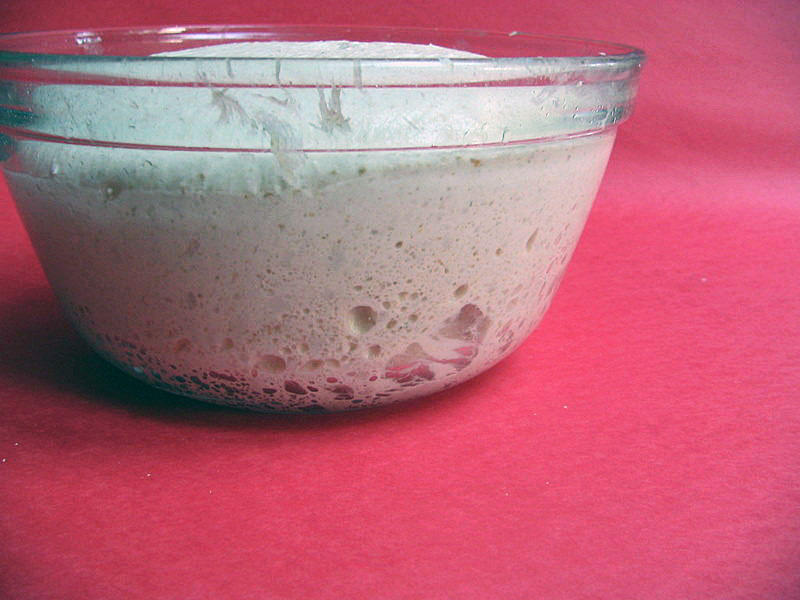
After 14 hours, my dough looked like this….
“Shaping” and baking
Remove the dough from the fridge 3 hours before baking. Heat the oven to 450F and place a baking stone (or tiles) on the middle rack.

Heavily dust the counter with flour, scrape the dough onto the counter, and open it gently into a 10 inch square shape, trying not to deflate it too much. I like to mark the dimensions on the flour, to have an idea of how much to open the dough.

Transfer each piece to a rimless baking sheet covered with parchment paper, stretching the dough to about 12 inches long. Let it fall naturally, without worrying about a precise shape. If baking both loaves at the same time, separate them by at least 2 inches.

Bake with initial steam for 20 to 30 minutes, until a dark walnut color develops on the crust. Let the loaves cool on a rack for at least an hour before slicing.

ENJOY!

to print the recipe, click here

for a detailed discussion on this particular bread, visit this link

Comments: The recipe was quite involved and challenging, but the gods of Bread were on my side and things went smoothly.  A dough with this much water (in baker’s terms it’s called a high hydration ratio) is tricky to deal with, but extra flour on the work surface helps. As some of the bakers in The Fresh Loaf put it “it feels like you’re making pancakes” when transferring the “bread” to the baking sheet. It’s impossible to shape it, so don’t even try. Lift it, gently stretch it  (it will almost stretch itself as it’s lifted), place it on the baking sheet and transfer it to the oven.   It’s a delight to witness its impressive oven spring (yet another fancy term to indicate that the dough rises a lot during baking).

The crumb almost made me shed a few tears… I know, I know… it’s pathetic, but bread make’s me emotional!  (In a good way.)  😉

I am submitting this post to Yeastspotting….

Add to FacebookAdd to DiggAdd to Del.icio.usAdd to StumbleuponAdd to RedditAdd to BlinklistAdd to TwitterAdd to TechnoratiAdd to Yahoo BuzzAdd to Newsvine

FLIRTING WITH ORZO

My Brazilian nature often predisposes me towards rice, but the more I cook orzo, the more I like it.   It might be more versatile than rice,  it cooks faster, and it’s  absolutely fool proof, all of which adds to its charm. The inspiration for this recipe came from an old Fine Cooking magazine, but I simplified it quite a bit  because the original seemed a tad too busy:  too many flavors fighting for attention.   This pared-down version was a winner!


ORZO WITH SHIITAKE MUSHROOMS AND SPINACH
(very loosely adapted from Fine Cooking magazine)

1 cup orzo
2 Tbs olive oil
1 shallot, finely diced
8 oz spinach leaves, stemmed, and coarsely chopped
4 oz fresh shiitake mushrooms, sliced (or dried, reconstituted with hot water)
1/2 lemon, juice and zest
salt and pepper
parmiggiano-reggiano (optional)

Start cooking the orzo on a large pot with salted water (it should take around 9 minutes).
Heat the olive oil on a large skillet and saute the shallots, lightly seasoned with salt and pepper.  Add the sliced shiitake mushrooms, saute until they start to get golden brown.   Add the chopped spinach, cook until it begins to wilt.  At this point, if the orzo is not cooked yet, turn the heat off and reserve.

When the orzo is almost cooked, remove 1/4 cup of the cooking water and reserve it.   Turn the heat back to medium on the skillet with the spinach mix, squirt lemon juice and zest, season with salt and pepper.  Drain the orzo and add it to the skillet, mixing well.  Add some of the pasta water if necessary.  Adjust seasoning with salt and pepper.  If desired, sprinkle parmiggiano-reggiano on top.

ENJOY!

to print the recipe, click here

Comments: For years I’ve made quick pan sauces for pasta with  the cooking water and some sauteed veggies.  Spinach is a constant player in such dishes, but this was the first time I chopped the leaves before sauteeing.   Voila‘:  it was much better!  Somehow, even with baby spinach, the whole leaves had a tendency to clump instead of reaching a nice distribution.   Live and learn.   😉

This was a quick dish to put together! It will drop into my regular rotation of meals for busy weeknights, keeping the orzo/spinach/lemon foundation and playing with other options: black olives, sundried tomatoes, roasted red bell pepper, artichoke hearts….

Add to FacebookAdd to DiggAdd to Del.icio.usAdd to StumbleuponAdd to RedditAdd to BlinklistAdd to TwitterAdd to TechnoratiAdd to Yahoo BuzzAdd to Newsvine

receita em portugues na proxima pagina….
proxima pagina

MELLOW BAKERS: GRISSINI

The Mellow Bakers challenge scheduled three breads for May:  grissini, miche Point-a-Calliere, and cornbread.  Today I jump-started myself by baking the grissini, which I’ve  never made before.  It was  easy, in that I kneaded the ingredients  in my Kitchen Aid for a few minutes until they formed a smooth and supple dough.  After an hour at room temperature I divided, stretched and rolled the dough into sticks that went into the oven for 20 minutes.    Piece of cake…  😉

I only made half the recipe, because neither my husband nor I are too crazy about breadsticks.  I love bread, and I love crackers, but grissini have a personality conflict:  they’re not quite sure what they are, bread or crackers.   Still, I enjoyed the opportunity to learn a new method in bread baking.

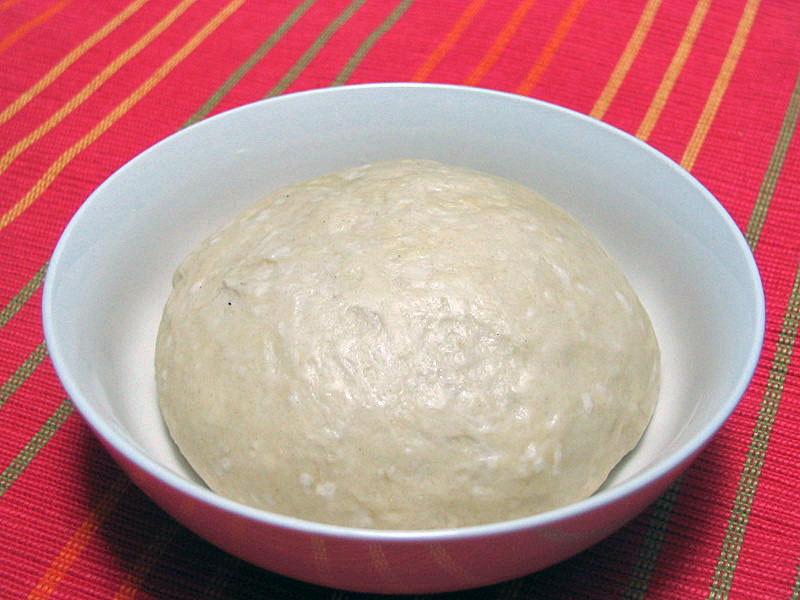
Here’s the dough  at the end of rising…

Divided into 12 equal pieces….

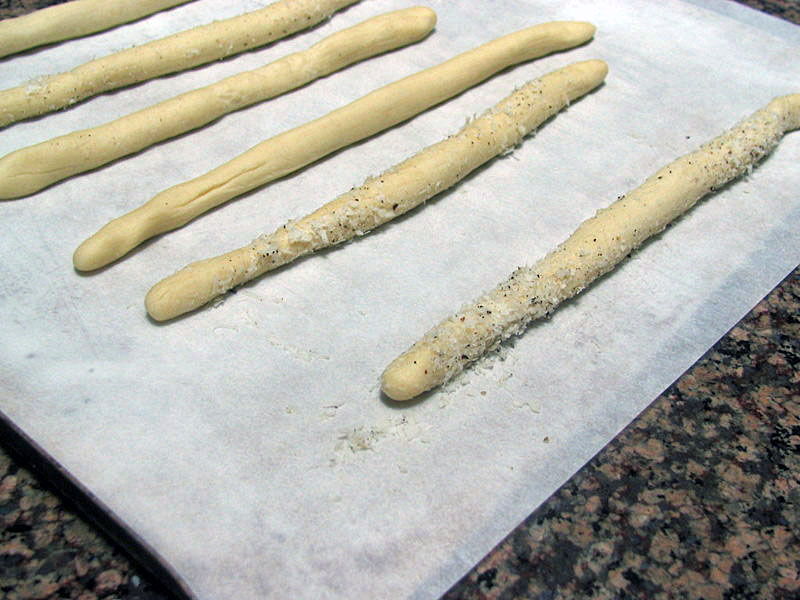
… that are formed into sticks, some left plain, some rolled in parmiggiano-cheese with a little black pepper

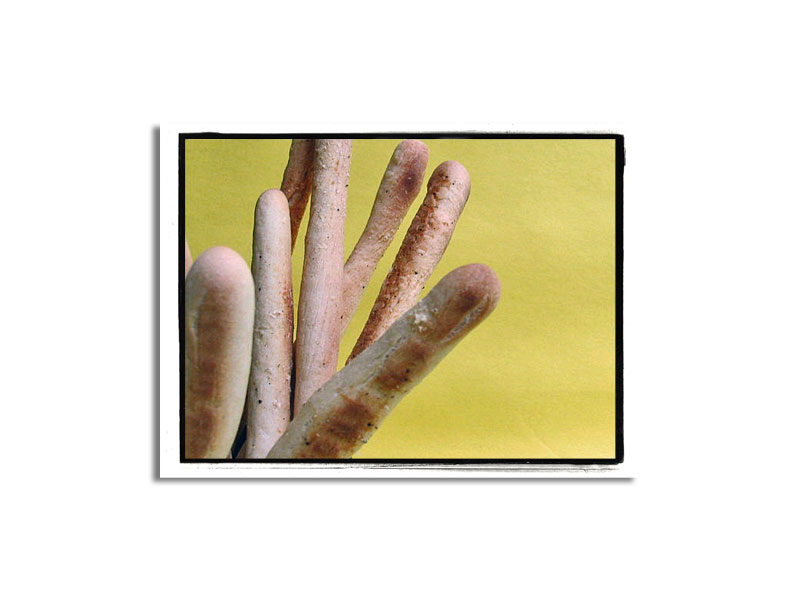
After baking, they’ll keep for several days  in an air-tight container….

Comments: They were fun to make, but perhaps a bit too bland.  The variations proposed in the book might be better (roasted garlic or cheese in the dough, instead of just used to roll the sticks before baking).  If I make these again, I’ll use the alternative method of opening the full dough in a large rectangle and cutting the individual sticks  from it, which will considerably reduce the time to stretch and roll each stick.

You can see how some of my fellow Mellow Bakers made their grissini by following these links….

Abby, from Stir it! Scrape it!

Anne Marie, from Rosemary & Garlic

Steve, from Burntloafer

Looking forward to miche Point-a-Calliere, a close relative of the amazing Poilane bread….

Add to FacebookAdd to DiggAdd to Del.icio.usAdd to StumbleuponAdd to RedditAdd to BlinklistAdd to TwitterAdd to TechnoratiAdd to Yahoo BuzzAdd to Newsvine

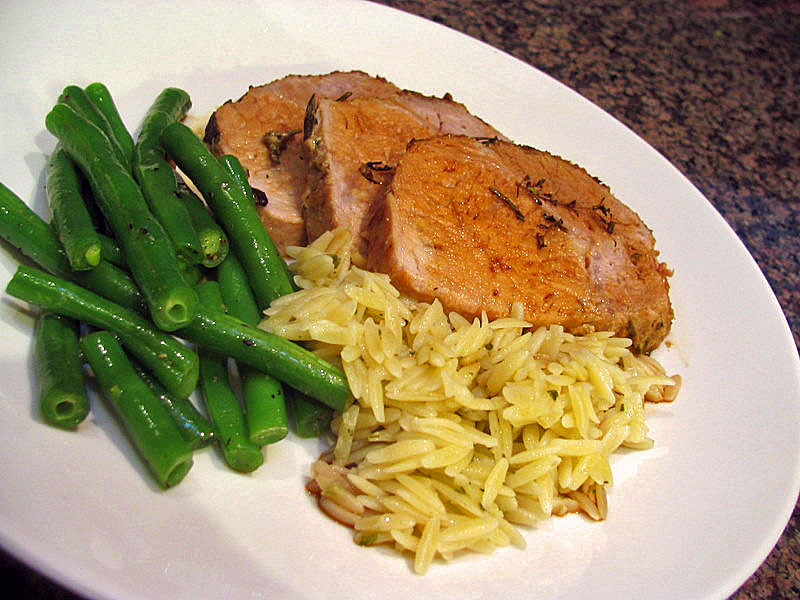
HERB AND MUSTARD PORK ROAST

Suzanne Goin’s cookbook “Sunday Suppers at Lucques”  is a collection of seasonal meals from her award-winning restaurant in Los Angeles.  It is not uncommon that cookbooks by chefs of her caliber become coffee table books, that are rarely put to use,  because either the recipes are too involved or the ingredients are too hard to find.  That’s not the case for Sunday Suppers.   Many of its recipes are uncomplicated, but their small details make them special.   In this recipe for pork roast the double application of a simple  mustard and herb marinade develops a delicious flavor.  It’s hard to improve a classic, but this method does it.

HERB-ROASTED PORK LOIN with MUSTARD BREADCRUMBS
(adapted from Suzanne Goin)

1/2 cup Dijon mustard
1 Tbs thyme leaves + 6 full sprigs
2 Tbs fresh parsley leaves, chopped
3 Tbs olive oil, divided
6 cloves garlic, smashed
pork loin (center cut, about 3 pounds)
3 sprigs rosemary
3 sprigs sage
6 Tbs butter, sliced
salt and pepper

for mustard breadcrumbs
2 Tbs butter
1 Tbs Dijon mustard
1 tsp thyme leaves
1 tsp chopped parsley

Whisk the mustard, thyme leaves, parsley, and 1 tablespoon of olive oil in a shallow baking dish. Stir the garlic, and brush the mixture all over the pork loin. Cover and refrigerate overnight (or at least 4 hours). Remove the pork from the fridge one hour before cooking, after 30 minutes season it well with salt and pepper. Reserve the marinade.

Heat the oven to 325 F. Heat 2 tablespoons of olive oil in a large skillet until it is almost smoking. Place the pork loin in the pan, sear it on all sides, until well browned (do not move the pork around too soon, you need to allow the browning to take place). The whole process should take 15 to 20 minutes. Transfer the pork to a roasting rack, and brush the reserved marinade all around it. Reserve the pan to make a sauce.

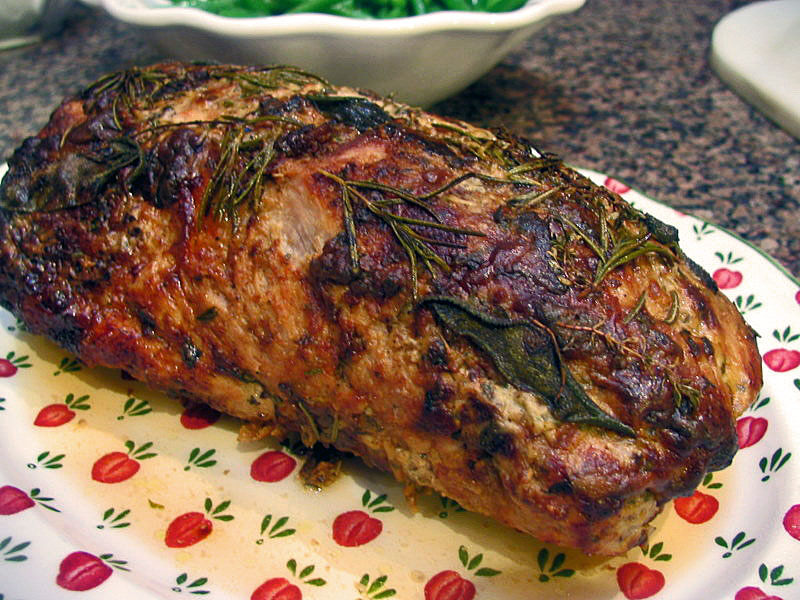
Arrange the rosemary, sage, and thyme sprigs on the roast and top with 3 tablespoons of butter. Roast the meat until a thermometer reads 120F – about 1 hour and 15 minutes. Let the pork rest at least 10 minutes before slicing.

The pan sauce….

While the pork is roasting make a sauce: heat the pan you used to sear the meat on medium,  add 1/2 cup water (or chicken stock if you prefer)and stir until it boils, also scraping the bottom of the pan. Reduce by boiling a few minutes, swirl 3 tablespoons of butter and reserve until time to serve.

The mustard breadcrumbs…
Heat the oven to 375F. Place the breadcrumbs in a bowl. Melt the butter in a small saucepan, whisk in the mustard, thyme, and parsley. Remove from the heat, let it cool slightly, and add to the breadcrumbs, tossing to coat. Transfer to a baking dish and bake for 10 to 12 minutes, until golden brown.

To serve, slice the meat, spoon the sauce over, and shower it with mustard breadcrumbs.

ENJOY!

to print the recipe, click here


Comments:
I’m picky about center cut pork loin, because it may become dry, even if I’m careful not to overcook it.  It is indeed difficult to overcome the lean nature of today’s pork. This recipe joins the two or three tried and true methods that I trust, and I imagine anyone who makes it will feel the same way.  With green beans, a little orzo on the side and my perfect match on the other side of the table…. life is good! 😉

Add to FacebookAdd to DiggAdd to Del.icio.usAdd to StumbleuponAdd to RedditAdd to BlinklistAdd to TwitterAdd to TechnoratiAdd to Yahoo BuzzAdd to Newsvine

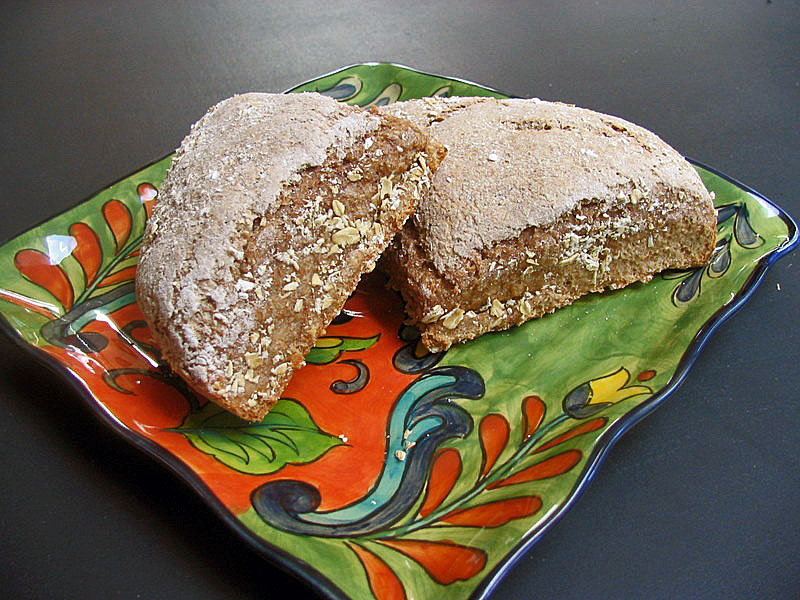
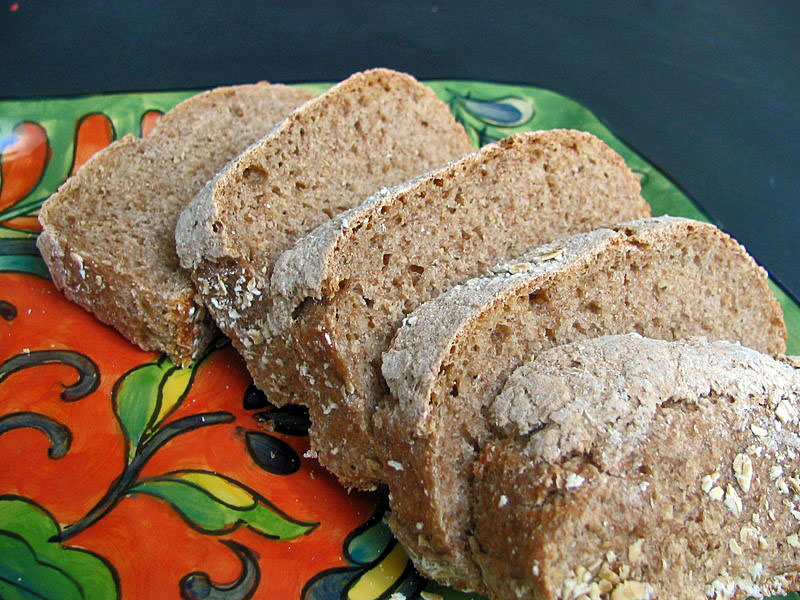
GOLSPIE LOAF, from the Scottish Highlands

Different breads evolve around the world in harmony with the native cultures and environments:   flat breads like Indian naan and Ethiopian injera, French baguettes, English crumpets, and the salt-less Tuscan bread.   People everywhere bake bread with their local grains and flours, and according to their preferred diets.   If I had money and time I’d travel the world and experience each one in person.  Instead,  I take virtual trips by baking the world of bread in my own kitchen.  This past weekend I made a Golspie loaf from the Scottish highlands, based on an old grain called “bere“.    Of course, this grain isn’t easy to find, but in his masterpiece “The Handmade Loaf” Dan Lepard created a recipe that mimics the original, using rye sourdough starter and whole wheat flour. Don’t be put off by its looks:  Golspie is not the Jonny Depp of the Bread World, but it has the personality and charm of Sean Connery in his prime.

The Handmade Loaf is a must have book for bread bakers, and I highly recommend that that you get your own copy of Dan’s book.   Because I bake so many of its breads, it’s unfair to the author to post all the recipes, and for Golspie I’m just providing the the basic formula, which I slightly changed from the original to introduce a small amount of white flour.

GOLSPIE LOAF FORMULA
(adapted from Dan Lepard)

75% rye levain
62% water
100% flour (3/4 whole wheat + 1/4 white)
25% bread flour
2% salt
0.5% instant yeast
coarse oatmeal (enough for dusting the loaf)

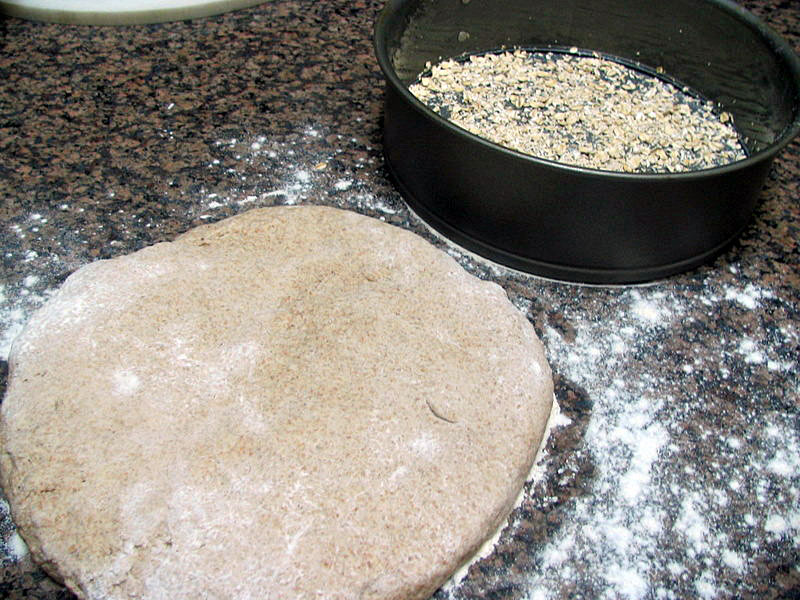
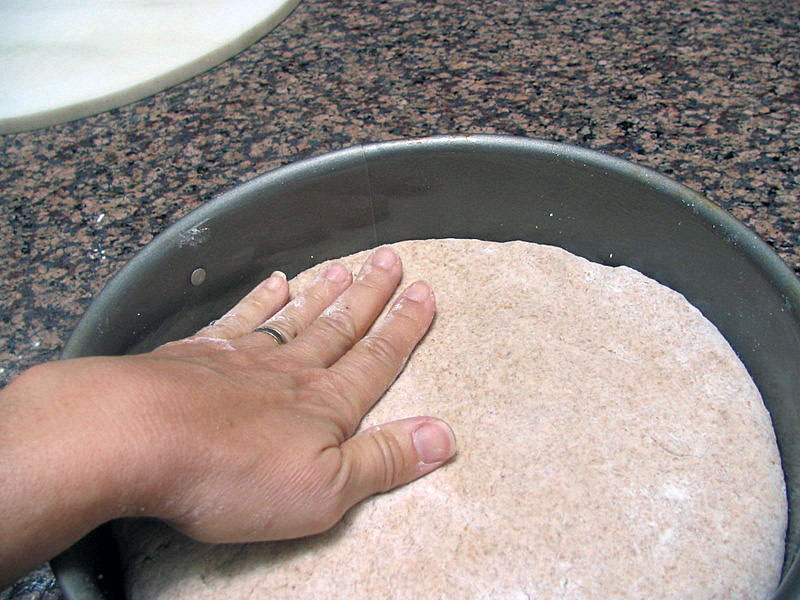
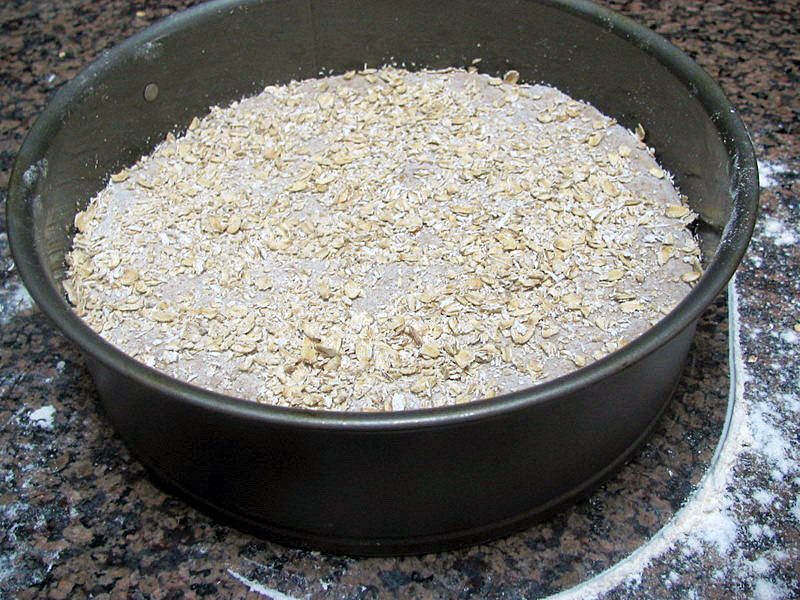
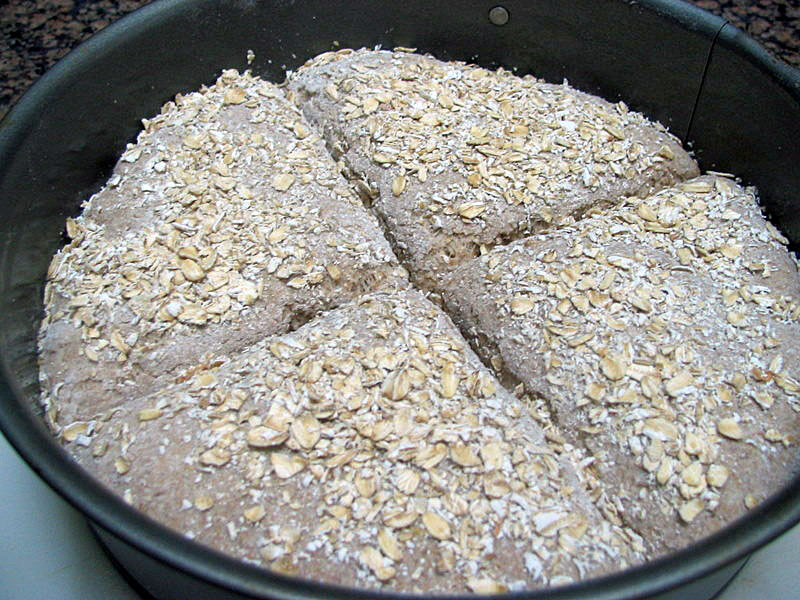
Comments:  The dough is made with minimal kneading (a couple of 10 second-kneading cycles), allowed to rise for an hour, shaped into a circle, and placed in a springform pan (around 8 inches in diameter), coated with coarse oatmeal.   Just before baking,  score the dough  all the way to the bottom in a cross-pattern that  later allows cutting it into its characteristic quartered shape.

Some photos of the process of making Golspie….

The dough is rolled out in a circle..

Placed in the springform pan, and gently patted to fill it….

Once in the pan,  coarse oatmeal is sprinkled on top….

Do not be afraid to do the crosscut…

ENJOY!

I am thrilled to submit this post to Yeastspotting….

Add to FacebookAdd to DiggAdd to Del.icio.usAdd to StumbleuponAdd to RedditAdd to BlinklistAdd to TwitterAdd to TechnoratiAdd to Yahoo BuzzAdd to Newsvine