BEETROOT SOURDOUGH FOR THE HOLIDAYS

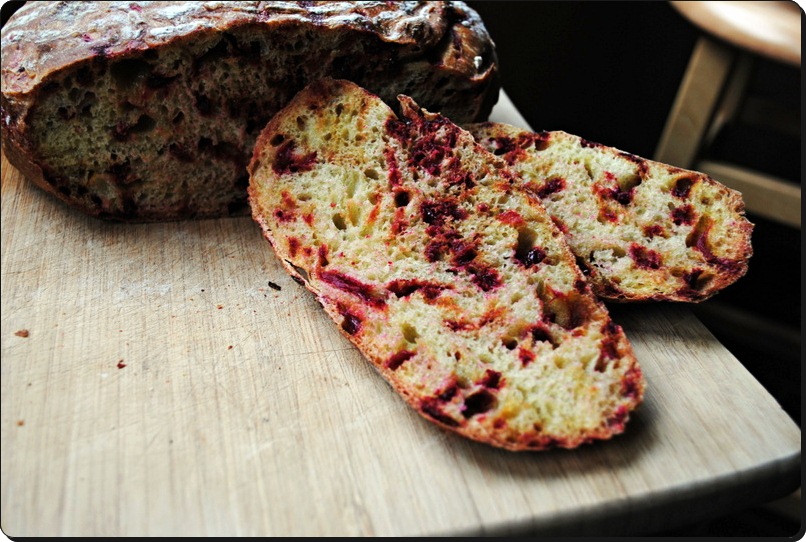
This gem of a recipe comes from one of my favorite bread books, which I reviewed in a not too distant past: How to Make Bread. Such a simple and straightforward title, but it says all that matters.  You will learn how to make great bread following the careful instructions of Emmanuel Hadjiandreou.    This bread is perfect for the holiday season, its crumb decorated with intensely red dots of beets, that are coarsely grated and incorporated raw in the dough.

You may wonder if the bread turns out too sweet or with a strong flavor of beets?  Not really. It is a sourdough still, but with a background of sweetness that is just enough to surprise your palate and act as the perfect supporting actor for a slice of Roquefort cheese.  Sharp cheeses,  eggplant relishes, anything with a nice bite and some saltiness will go extremely well with this bread.  I happen to like it all by itself, slightly toasted.

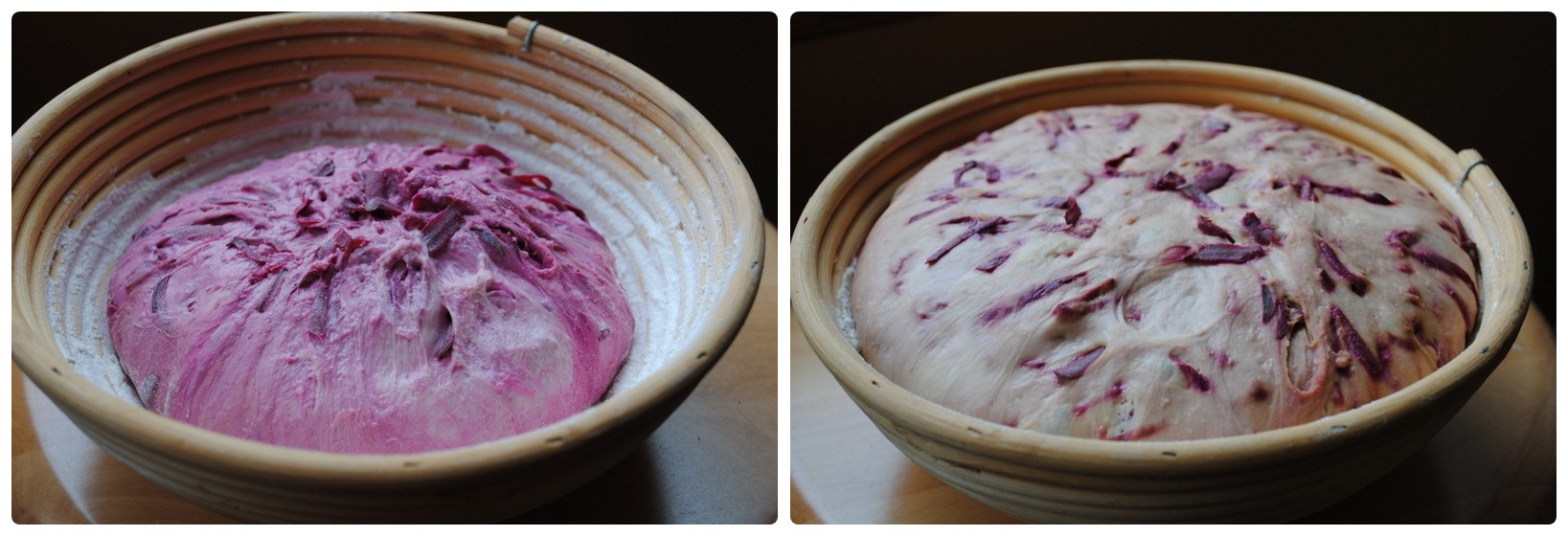
For this large boule I used two beets, one medium, one small.  One of the things I loved about this dough was the change in color as the dough proofed, starting with a gorgeous, intense purple, and getting more and more subtle as the fermentation went on.

The recipe for beetroot sourdough is very similar to the one I published with Emmanuel’s permission last May, except for the inclusion of grated, raw beets in the dough.  But a more detailed step by step photos of the full process of making this bread can be found with a quick jump to Garlic Buddha blog, a nice virtual spot!

I like a plain and simple sourdough, but every once in a while it is nice to explore different flavors and stretch the horizons a little.  Beets… who would imagine? 😉

I am submitting this post to Susan’s Yeastspotting

ONE YEAR AGO: Cod Filet with Mustard Tarragon Crust

TWO YEARS AGO: Soba Noodles: Light and Healthy

THREE YEARS AGO: Potato-Rosemary Bread

CINNAMON WREATH

What if I told you that this bread is one of the easiest breads I’ve ever made, and that it is ready in less than 2 hours from the time you grab your bag of flour?  Hard to believe, but true.   I first marveled at the recipe over at Baker Street, a blog I got to know earlier this year and now follow very closely, since it’s full of tempting recipes…

CINNAMON WREATH
(from Baker Street)

for the dough:
2 cups flour
½ tsp salt
½ cup lukewarm milk
1 envelope active dry yeast (2 + 1/4 tsp)
⅛ cup melted butter
1 egg yolk
1 tbsp sugar
for the filing:
¼ cup melted butter
4-5 tbsp sugar
3 tsp cinnamon
Mix the yeast and sugar with the lukewarm milk and let it sit a few minutes while the yeast bubbles and foams up.
.
Add the egg yolk, the melted butter, the flour and the salt, then knead the dough and shape into a ball. Place the dough in a large, greased bowl, then cover and place in a warm space and let rise until doubled in size (about 1 hour).
.
Heat the oven to about 400 degrees Fahrenheit. Roll the dough out to a thickness of 1cm (1/4 inch).  Spread the melted butter across all of the dough, then sprinkle the cinnamon and sugar mixture.  Reserve a small amount of melted butter for the top of the bread.
.
Roll up the dough, and using a knife, cut the log in half length-wise. Twist the two halves together, keeping the open layers exposed (see photos on Baker Street site). Give a round shape, then transfer to a lightly buttered baking tray.
.
Brush a little butter on top and sprinkle some sugar and cinnamon mixture. Bake for 30 to 35 minutes, until the bread is golden brown. Reduce the oven temperature to 350 degrees Fahrenheit after 5-10 minutes to stop it burning.
.
ENJOY!
.
to print the recipe, click here
.
Comments: This bread would be outstanding for a brunch. It’s almost like a cinnamon roll, but with a different texture.  Your whole house will smell like cinnamon while it bakes and later sits on the counter, cooling.   I don’t have photos of the bread after slicing, because I made it for a departmental potluck and in this type of event it’s better not to turn into a typical food blogger: the person who would snatch a slice of bread from the lips of a guest just because it shows the perfect crumb structure, and run away with it, camera in hand.  😉
.
Phil loved this bread, and already requested that I make it again on a Sunday morning, as it will be even better still warm from the oven.  I had to bake it in the evening and we only tried the bread at lunchtime next day.   Not the ideal situation, but when you must be  in the lab by 8am, some accommodations are in order.
.
Next time I will make sure to roll out the dough a bit thinner, and form the cylinder a little tighter, to have more layers.  I confess that I forgot the final step of adding butter, sugar and cinnamon on top.  In other words: I must make it again to perfect it!
.
Please stop by Baker Street to see her masterpiece, as well as a tutorial on rolling and slicing the dough.  By the way, this bread is also known as Estonian Kringel.  Whatever its name, it is worth having it in your bread repertoire.
.
I am submitting this post to Susan’s Yeastspotting.
.
ONE YEAR AGO:  Yeastspotting 11.11.11
.
TWO YEARS AGO: Oven-baked Risotto
.

OCTOBER 16: WORLD BREAD DAY!

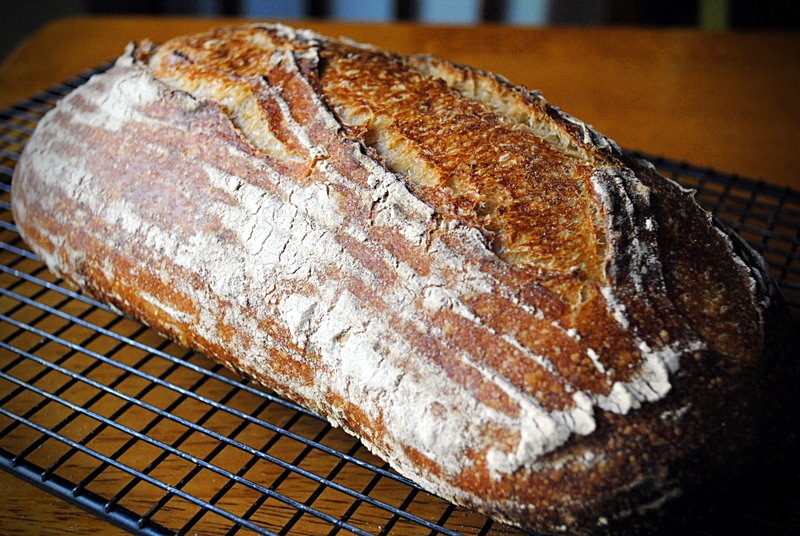
Six years ago, Zorra started an event called “World Bread Day“. Bakers from all over the world would bake a loaf of bread and blog about it.  This year I am thrilled to participate and chose my favorite type of bread to join the party.  The recipe comes from a very nice book, Artisan Baking, written by Maggie Glezer.  A country French-style loaf called Essential’s Columbia.   The formula comes from George DePasquale, from Seattle’s Essential Baking Company.

The perfect Sunday starts with a batch of sourdough starter all puffed up from getting fed 12 hours earlier.  Before I even have my morning capuccino, the kitchen still dark, I look at my ingredients waiting, and get all excited anticipating the thrill of getting a nice loaf of bread from our oven.   It does help a lot to weigh it all the night before, all you have to do is heat the water in the microwave for 30 seconds or so,  and you are ready to go…

In Glezer’s book, this bread is listed as “advanced”, but it’s actually quite simple to prepare.  It calls for all purpose flour, bread flour, whole wheat, and a little rye.  Also in the formula a small amount of toasted wheat germ, and barley malt syrup.   It uses a very firm starter, probably the firmest I’ve ever seen in a recipe, it is actually more like a dough that ferments for 12 hours and then is incorporated in the mixture of flours, salt, and water.    A very slow and long fermentation, with the help of my bread proofing box.  Amazing how the two banettons fit just right inside!

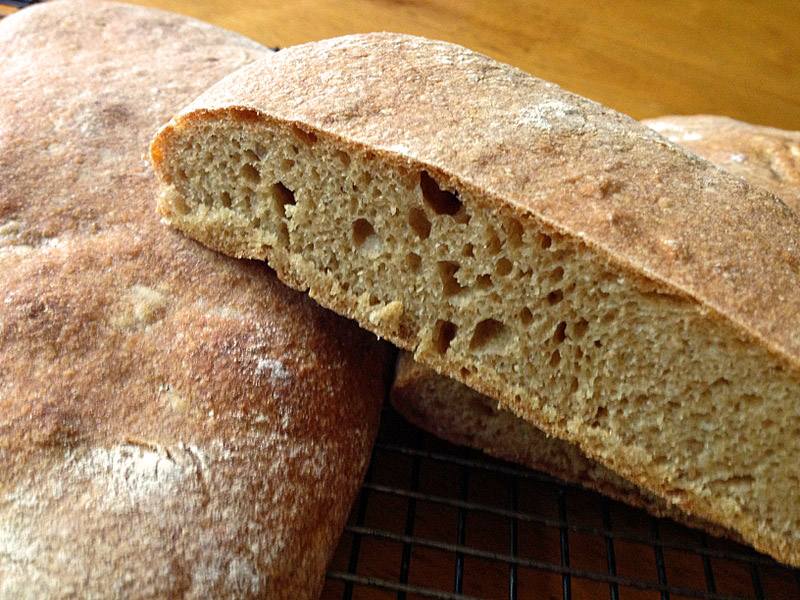
After shaping, the oblong loaf proofed for 3 hours, and the round one for almost 4 hours, as I could not bake them at the same time.  Not much difference in the crumb, which was a bit surprising to me. I expected the round loaf to have a slightly more airy inner structure.  But bread is bread,  its temperamental nature one of the things I love the most about it.

I could not find a way to contact Maggie Glezer to get her official ok to publish the full recipe, but it is available online in a couple of blogs, so you can find it.  But the book is a must-have for anyone with a passion for wild yeast, so consider providing that little boost on the economy.

My batard shaping was a little better than usual, but still needs improvement… gotta keep going at it!

The perfect Sunday ends with a couple of loaves resting on the counter….

and the perfect Monday starts with a small gift to the Department!   😉

I am submitting this post to Susan’s Yeastspotting…    and I invite you to visit the roudup of breads at Zorra’s site!

ONE YEAR AGO: The US Listeria Outbreak 2011

TWO YEARS AGO: 36 Hour Sourdough Baguettes

THREE YEARS AGO: October 16 is World Bread Day

LUCKY KAMUT BREAD

A few weeks ago I got smitten once more by a post on Farine’s blog  showcasing a bread made exclusively with whole wheat flour.  She used a mixture of spelt and kamut to bake a pavé style of bread that seemed perfect for a hearty sandwich.   I was quite curious about kamut flour, and thrilled to buy the last bag available in the only grocery store in town that carried it.  My adventure to procure kamut flour involved a phone call to the manager who personally held that bag for me until I could drive to the store later in the day.  That should clarify the title of this post. 😉

SPELT AND KAMUT BREAD
(from Farine’s blog, adapted from Thierry Delabre)
.
247 g whole kamut flour
247 g whole spelt flour
375 g water
148 g levain at 100% hydration
9 g salt
.
Mix both flours with all the water until no dry flour remains and let rest, covered, 20 to 40 minutes Add the sourdough starter and mix until incorporated Add the salt Cover the dough and let it rest, doing as many folds as necessary to obtain medium soft consistency.  I did five sets of folds, the first three 30 minutes apart, the last two 45 minutes apart.  At that point the dough was rising for 3 hours.  I let it rise undisturbed for 2 and a half hours more, by that time the dough was threatening to reach the top of the bowl.
.
Remove the dough from the bowl onto a floured surface and fold it once over itself lengthwise, forming a long, non-overlapping rectangle.  Cut the dough into two pieces, and let them proof over heavily floured parchment paper for about 45 minutes, loosely covered.   Heat your oven to 450F and bake the loaves (with initial steam) for 30 to 35 minutes, until golden brown.    Cool on a rack.
.
ENJOY!
.
to print the recipe, click here
.
.
This is the kind of bread that makes you feel healthier with each bite.  It has that wholesome quality of a typical rustic loaf, but a texture with more moisture than you would expect from a bread made exclusively with whole wheat.  I  urge you to read Farine’s original post, as she describes her adaptations from the original recipe in great detail.  I always learn a lot reading her blog, she is an amazing bread baker!
.
The sourdough taste in this bread was stronger than usual, but the interesting thing is that next day the bread had mellowed down considerably.  Not sure why, but the world of bread leavened with wild yeast is mysterious. And fascinating!
.
.
Usually Phil is the master sandwich maker, but this time I hit a jackpot with my concoction:  chipotle-smoked turkey breast, provolone cheese, and a spread of tomatillo-avocado salsa.  A show-stopper!
.
Farine, thanks for the constant inspiration!  My list of breads to make from your blog only keeps growing and growing… 😉
.
I am submitting this post to Susan’s Yeastspotting event.
.

THERE WILL BE BREAD


Drum roll, please…  

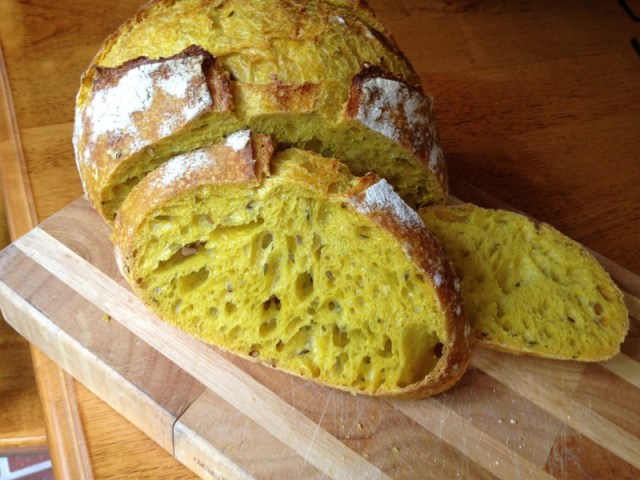
This post officially inaugurates the new kitchen in The Little Apple!  What better than a loaf of bread to start things on a nice track?  So, let me share with you a golden bread perfumed with the special saffron I received as a gift from our friend Steve. The bread looked like a blast of sunshine sitting on the black granite, and it made nice cracking noises as it cooled, the promise of a nice crumb underneath a hearty crust.

GOLDEN SAFFRON & FENNEL LOAF
(from the Bewitching Kitchen, inspired by Flo Makanai)

125 g  sourdough starter (at 100% hydration)
250 g water (divided)
large pinch of saffron
375 g bread flour
7 g salt
1 tsp fennel seeds

Heat 50 ml (no need to be precise) of water in a microwave until almost boiling, add the saffron and let it sit until it cools to almost room temperature, stirring every now and then.  Strain the saffron water through a fine mesh colander, and add to the rest of the water for a final volume of 250ml. Reserve.

Add the active starter to a large bowl, mix it with the water until it dissolves more or less smoothly. Add the flour and the fennel seeds, and briefly do a few kneading moves to form a shaggy mess.  Cover loosely with plastic wrap for 20 minutes.

Sprinkle the salt over the dough and incorporate by kneading lightly and folding the dough on itself.  You can keep the dough in the bowl, or transfer to a surface.  After 20-30 seconds of kneading/folding, cover the dough again and let it sit for 40 minutes (total rising time up to this point: 1 hour).

Repeat cycles of quick kneading/folding two more times, spacing them 40 to 50 minutes.   After the third and final kneading cycle, let the dough sit for 20 to 30 minutes, shape it as a round or oval loaf, and leave it at room temperature  30 minutes longer.  Total rising time from beginning to end: about 3 and a half hours.  Place it in the fridge overnight.

Remove the dough from the fridge 2 hours before baking (see my comments). Heat the oven to 450F. If using a clay pot, place it in the cold oven as you turn it on. Bake the bread covered for 30 minutes, remove cover, and allow it to fully bake (reducing the temperature to 425F if the bread seems to be browning too fast) for 12 to 15 minutes longer.  Remove to a rack to cool completely before slicing.

ENJOY!

to print the recipe, click here

Comments:  It’s been a while since I baked a loaf of bread that made me as happy as this one! I’d been refreshing my starter for weeks in a row, but placing it back in the fridge, unable to squeeze bread baking in our crazy schedule.  My cookbooks are not unpacked yet, so I decided to go with the simple but very efficient method devised by Flo Makanai years ago: her famous 1, 2, 3 recipe.   One part starter, 2 parts water, 3 parts flour.  You can adapt and use any liquid or flour, but that’s the basic formula.   I wanted to incorporate saffron in the dough, and fennel seemed like a good match too.  Considering that it was not a tried and true recipe, and that it would be my first time using the oven in our new home, I admit I was  pushing the envelope. Interesting expression, by the way, I learned its origin not too long ago, and was a bit surprised. No Post Office material was used in its making.  Live, and learn.

Live, learn, and bake!  😉
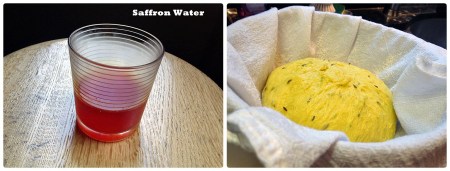
To add a bit more emotion to the adventure, I could not find my banettons to proof the dough after shaping.  I actually have two, one round, and one oval, but they are both MIA, probably hidden inside one of the unpacked boxes.  I ended up using a copper colander, lined with a white cloth.

Necessity is the mother of invention.

I pushed the envelope once more by removing the dough from the fridge only 30 minutes before placing it in the 450F oven, trying to minimize the time our kitchen would be exposed to such insanely high temperature. Still, the bread had an impressive oven spring, and the beautiful, golden open crumb I hoped for.  It would be amazing with paella or a bowl of bouillabaisse, but until the weather cools enough for those dishes, we’ll enjoy it with fresh, juicy tomatoes and a sprinkle of Maldon salt.   Simple pleasures. Golden pleasures.
A final remark: I wish I could take credit for the title of this post, but my beloved husband was the genius behind it…  Sorry, ladies, he’s mine, all mine!

I am submitting this post to Susan’s Yeastspotting.

ONE YEAR AGO: In My Kitchen, July 2011

TWO YEARS AGO: Heavenly Homemade Fromage Blanc

THREE YEARS AGO: A Perfect Sunday Dinner