CIDER-MARINATED PORK KEBABS

large

I’ve been on an apple cider kick, as this region of the US brags the right to make top quality cider.  One sip of  this brand  was all it took me to become addicted. Phil and I always buy a huge bottle and before it gets half-empty, we get another one, just to be on the safe side.  We keep wondering for how long cider will be available at our grocery stores, and hope the feast won’t end anytime soon.  So far, so good.  I used some of this wonderful apple cider in a marinade for pork tenderloin.  Coupled with a few spices that seemed right to play with the cider, voila’: a very simple and tasty main dish was served!

CIDER-MARINATED PORK KEBABS
(from the Bewitching Kitchen)

2 pork tenderloin filets
1/2 cup apple cider
1/8 cup olive oil
zest and juice of 1 lemon
1 Tbs agave nectar
1 tsp fennel pollen
1/2 tsp pimente d’Espelette
salt to taste

Remove the silver skin of the pork tenderloin, and cut the meat in large cubes.  Make a marinade by whisking all ingredients (except salt) until fully combined.   Place the pieces of pork in a large bowl and add the marinade, coating all pieces well with it.   Leave it in the fridge, covered, for a few hours or overnight.

Remove the meat from the marinade, thread it into skewers (if using wooden skewers, soak them in cold water for a few hours). Season with salt, and grill to your liking, turning the skewers once during grilling.

Serve with slices of lemon to squeeze over the meat.

ENJOY!

to print the recipe, click here

At first, my idea was to include a fennel bulb and a red bell pepper that were laying in the fridge to make a more colorful kebab with the pork.  But, the day was long, and the patience was short.  I kept it ultra simple and the meat went to the grill all by itself.   Still, this was a great weeknight dinner!  The meat was juicy and the addition of agave nectar gave that extra dark grill mark that I find a must…   We had the pork with a little orzo and green beans, simple and delicious.   Leftovers were still quite juicy next day, even when subjected to microwave torture.

Of course, I think fresh slices of fennel would be perfect in these kebabs, echoing the fennel pollen in the marinade, so if your day is shorter and the patience longer, go for it!  😉

ONE YEAR AGO: Golden Age Granola

TWO  YEARS AGO: Mushroom Souffle for Two

THREE YEARS AGO: Stollen

AUVERGNE COURONNE FROM LOCAL BREADS

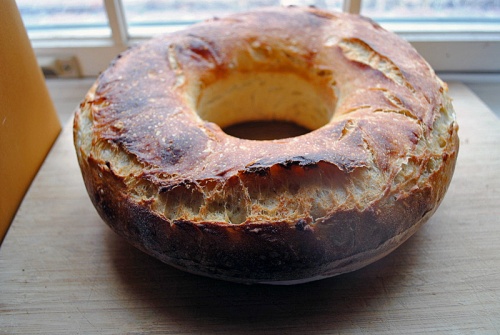
First bread post of 2013!
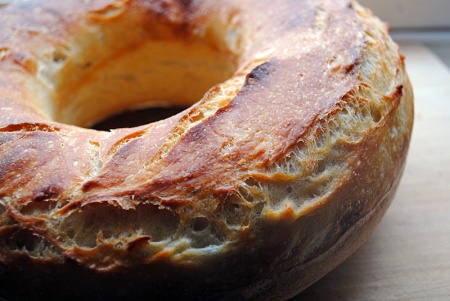
closeup

A change from the usual boule or batard, this bread is fun to make, beautiful to look at, and a pleasure to eat!   The recipe comes from Local Breads, by Daniel Leader (with Lauren Chattman), a book that any serious bread baker should own.  I actually have his first book too, Bread Alone, and keep both volumes together on the shelf as lovely siblings.  Bread Alone is an excellent starting point for beginner bread bakers as well as those who want to try their hands at baking with wild yeast. Local Breads is perhaps slightly more “advanced”,  lots of sourdough, with formulas that  focus on regional recipes that Leader collected through his  travels around Europe. Reading his books is like having a master bread baker giving you a private lesson, going through the details that make a difference between a so-so loaf of bread and one that makes you dream.

I wanted my first bread post for 2013 to be special, and this loaf surpassed my expectations. It is surprisingly simple, no special flours, no grains, no seeds.  Just a well-fed sourdough starter, the best quality flour you can find, and a little tender loving care to shape the dough and bake it.
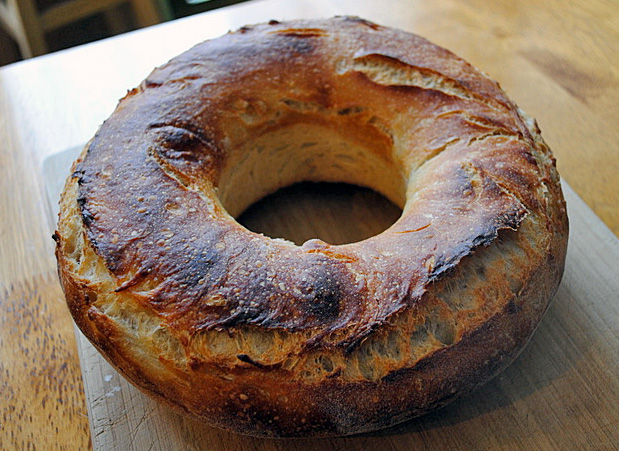
bread2AUVERGNE CROWN
(formula from  Local Breads, published with permission from Daniel Leader)

Levain Starter (you will not use the full amount prepared):
45g levain starter, firm (about ¼ cup)
95g unbleached all-purpose flour
5g stone-ground whole wheat flour
50 g tepid water

for the bread:
500g  unbleached all-purpose  flour
340g water
125g levain (less than the amount prepared above)
10g sea salt

Prepare the levain: Pinch ¼ cup of your stiff levain and place in a bowl with 50 mL water.  Mash the levain with a whisk  until it dissolves, then add both types of flour and stir.  Turn the mixture onto a work surface and knead to fully incorporate the flour.  Place the levain in a covered container and let it sit at room temperature (70 to 76°) for 8-12 hours or until it has doubled in volume and the surface is domed.

Make the bread: Pour the water into a large mixing bowl or the bowl stand mixer. Combine the flours until all the ingredients are incorporated. Cover and let it rest for 20 minutes, while the flour hydrates.Uncover the dough, add the salt and the levain and incorporate with your hands or a spatula using a fw firm strokes.  Knead the dough with the dough hook by mixing on low-speed (2 on a KitchenAid) for a minute.  Increase speed to medium (4 on a KitchenAid) and knead until smooth and muscular; an additional 8 to 9 minutes. Transfer the rounded dough to a lightly oiled container, preferably clear, so you can mark the level of the dough with a masking tape.  Let the dough ferment until doubled in size, 3 to 4 hours at a temperature of 70 to 75 F.

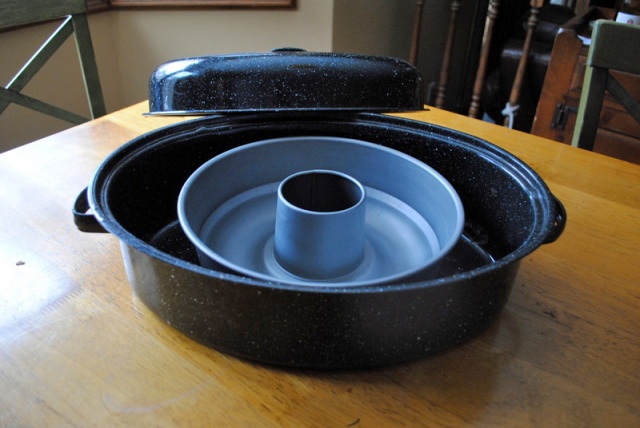
Shape the crown.  Cover a surface with a little flour.  Place the risen dough over the counter and roll it very gently into a long fat rope, about 8 inches long and 3 inches wide. Connect the ends of the rope overlapping by about 4 inches. Press the ends together to seal. Dust a ring baking pan with flour and carefully drop the shaped dough inside.  Allow it to proof at 70 to 75 F until it looks “pillowy”,  1 to 1 and a half hours. When you press your finger tip into the dough, it should spring back slowly.  As the bread proofs, heat your oven to 425 F and place a large roasting pan, without the lid, inside.

Bake the bread. Once the bread is proofed, slash the outer edge of the round with a razor blade, and place the ring pan inside the roasting pan, and close with the lid slightly moist with tap water.   Bake covered for 30 minutes, uncover, remove the ring pan from the oven, carefully invert it to remove the bread, and finish baking the bread sitting on the oven rack, for 15 to 20 more minutes.

Let it cool completely on a rack before slicing through.

ENJOY!

 to print the recipe, click here
bread1
Comments: In the past, I’ve made a few loaves of ring-shaped breads, and had problems moving the bread to the oven after the final rise. I ended up deflating the dough too much and also messing its shape.  This time, I tried something a little different: after shaping the loaf, I placed it in a well-floured ring baking pan, and let the dough go through the final proofing in the pan.  When it was time to bake, I quickly scored the outside edge of the dough, and placed the pan and all inside a pre-heated, large roasting pan.   The next couple of photos should help explain my strategy, which, I am thrilled to inform, worked quite well!
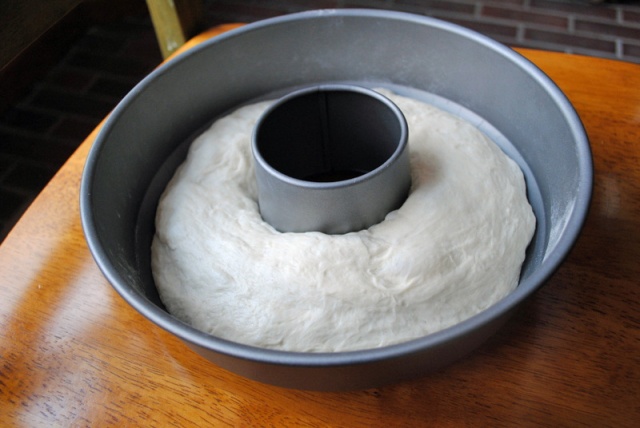
doughbakingpan
After 30 minutes baking with the lid closed, I removed the lid, took the ring pan carefully out, inverted it quickly over the counter to release the bread, and placed the bread on the oven rack, without any baking sheet underneath, so that the crust would get a final roasting free of constraints.   I like to bake my bread until it’s really dark, because that’s when the taste of the crust delivers the punch I like, the one that transports me to a Parisian bakery…

ABOUT LOCAL BREADS: Ten years passed between Leader’s publication of his first book, Bread Alone, and Local Breads. During that period, he worked with many master bakers in Germany, Italy, and Eastern Europe. In the first chapter of his book, he talks about his bread journey and how he’s gained a special respect for simple but crucial details such as the choice of flour. After a couple of chapters devoted to general lessons on equipment and technique (a must read, by the way), he shares his many recipes in sections divided  according to region. He will take you from France to Italy, stop in Germany, Poland, Austria, and the Czech Republic, sampling some of their unique yeast concoctions.

If you enjoy baguettes, you’ll be happy to know that Leader offers recipes for French, Italian, and German baguettes, so you can bake them all and compare their “personalities”. He also shares his recipe for the famous miche from Pain Poilane in France, as well as German Rye Sourdough, two examples of bread that, in my humble opinion,  can be quite intimidating.  With his detailed instructions, you’ll feel ready to tackle any project, Pain Poilane included!  So, if you don’t have Local Breads on your shelf, correct this severe cookbook handicap with a simple click here.  😉

I would like to thank Dan Leader for his permission to publish this great recipe. This post goes straight to Susan’s Yeastspotting!

ONE YEAR AGO: Orange-Pomegranate Chicken

TWO YEARS AGO: The Getty Museum

THREE YEARS AGO: Crowd-Pleasing Pulled Pork

A FESTIVE POMEGRANATE DESSERT

If you are looking for a dessert that is elegant, feels quite special, but is surprisingly light, you must try this one. I saw it over at Chucrute com Salsicha, hosted by Fer, the Brazilian blogger who lives in California and was my main inspiration to start the Bewitching.  Anyway, after following her blog for so many years, it is clear that when she raves about a recipe, I better get to work. She served this pomegranate gelee’ for her Christmas dinner, and I immediately decided to make it for our New Year’s Eve dessert, closing the year in a very festive mood! 😉

served1

POMEGRANATE GELEÉ WITH SAFFRON-YOGURT CREAM
(adapted from Deborah Madison, via Culinate) 

for the gelee:
2 cups pure pomegranate juice
1 package gelatin
1 Tbsp sugar
2 tsp rose-water

for  the yogurt cream:
2 Tbsp milk
small pinch of saffron threads
½ cup Greek-yogurt
1 Tbsp honey

for garnish:
2 Tbs pistachio nuts, finely chopped
fresh pomegranate seeds

Pour ½ cup of the pomegranate juice into a bowl, sprinkle the gelatin on top, and let stand for 5 minutes. Meanwhile, heat half the remaining juice (¾ cup) just to the boiling point. Stir it into the gelatin, add the sugar, and stir until the gelatin is completely dissolved. Gradually stir in the rest of the juice, then add the orange-flower water. Divide among 4 to 6 small glasses and refrigerate until set, allowing at least 6 hours or overnight.

Lightly heat the milk with the saffron threads and let cool. Stir the yogurt and honey together. Blend the saffron-milk mixture into the yogurt. Refrigerate until needed.

To serve, spoon the yogurt cream over each glass of pomegranate jelly. Garnish with the pistachio nuts and pomegranate seeds.

ENJOY!

to print the recipe, click here

Comments:  One of the things I love the most about Fer, is that she is not afraid of improvisation in the kitchen.  If she doesn’t have an ingredient, she comes up with a substitution, and moves on, always with a happy ending!  She is also a wizard with her ice cream machine, often designing her own recipes,  all quite creative and unique. This dessert gave me opportunity to improvise too:  it originally called for orange flower water, which I did not have, and also had no idea where to get it in town.  Plus, there’s no way this Brazilian would drive around the Little Apple with snow everywhere.

I had a bottle of rose-water, acquired months ago, and decided to try it in this recipe. It seemed to me that pomegranate and rose-water could not end in litigious divorce.   To be on the safe side, I reduced the amount, using one teaspoon instead of two.  Worked like a charm!  If you don’t divulge what’s in the gelee, your guests won’t be able to detect the rose flavor, but once you know it’s there, the palate gets a subtle awareness of it, quite wonderful…

I used non-fat yogurt because again that’s what I had in the house, but go full-fat if you prefer.  This dessert had everything I enjoy: a light and refreshing feel, a luscious creamy topping, and the crunch of pistachios mixed with the slightly softer crunch of the pomegranate seeds.   Heaven, my friends, heaven!

Fer, thanks for another gem of a recipe, this one will be on our menu again and again!

ONE YEAR AGO: My First Award!

TWO YEARS AGO: A Message from WordPress

THREE YEARS AGO: Turkish Chicken Kebabs

A TACO FOR NOAH

munching2 With the tragedy in Newtown, 2012 could not have ended on a sadder note.  That Friday I returned home  early to wait for friends who were driving from Oklahoma to visit, and when I turned on the TV  I couldn’t believe my eyes.  But nothing prepared me for the email I received shortly thereafter from my friend Farine, saying that her grandson Noah was among the young victims.  I was folded in two,  as if someone had punched me in the stomach.  I know the same feeling hit thousands and thousands of people around the world, but it’s nothing compared to the pain of the families who lost their loved ones.  It was such a senseless and cruel action.

Farine mentioned that in his young life Noah struggled with an important decision: whether to become an astronaut or a taco store manager.  He loved tacos so much.  I’d have probably advised him to first become an astronaut and then set up his taco shop on a beautiful, peaceful planet around some distant star…    😉    Today I share a recipe that I’m sure would please Noah.  It’s found in “Just Tacos“, a book by Shelley Wiseman, who works in Newtown and was devastated by the catastrophe.  Shelley not only gave me permission to print her  recipe, she also asked me to dedicate it to Noah and his family.

The tacos are ultra-special, as a result of their corn tortillas tinted with hibiscus flowers.  The pork cooked in tomatillo sauce is simply amazing!

tortillas

HIBISCUS-FLAVORED CORN TORTILLAS
(from Just Tacos,  reprinted with permission from Shelley Wiseman)

1/2 cup hibiscus flowers
2 + 1/2 cup water
1/4 cup sugar
2 cups masa harina
1/2 teaspoon salt

Bring the water to boil, add the hibiscus flowers and sugar, mix and simmer for 5 minutes.  Let it cool until it is just a bit warm.  You will not use all the tea for the dough.

In a large bowl,  mix the masa harina and salt.  Add one and a half cups of the warm hibiscus tea to the flour, incorporate to form a soft, still moist dough.  If necessary, add more tea.   Let the dough rest for 5 minutes, than pinch small portions to make tortillas using a tortilla press.    Cook the tortillas on a hot griddle or cast iron pan.   Keep them warm in a low oven, covered with a damp cloth.

to print the recipe, click here

compositedough
porksauce

TACOS WITH PORK IN GREEN SAUCE
(from Just Tacos, reprinted with permission from Shelley Wiseman)

1 + 1/2 pounds tomatillos, husked and rinsed
2 Serrano peppers, stemmed
1 teaspoon cumin seed
3 allspice berries
1 whole clove
3 garlic cloves, peeled
1/2 cup coarsely chopped cilantro
1 + 1/2 teaspoons salt (divided)
3 pounds pork shoulder, cut in 1-inch pieces
2 Tablespoons vegetable oil

Cover the tomatillos and Serrano chiles with cold water in a saucepan, and bring to a boil. Reduce the heat and simmer uncovered, until the tomatillos are tender but still intact, about 15 minutes. Reserve the cooking liquid.

Heat the cumin, allspice berries, and clove in a small, dry skillet, shaking the pan until the spices are fragrant, about 1 minute. Put the spices in a blender along with 1 cup of the tomatillo cooking water and blend until the spices are ground. Using a slotted spoon, lift the tomatillos and chiles out of the remaining cooking water and put them in the blender along with the garlic, cilantro, and 1/2 teaspoon of salt. Blend until fully smooth. Reserve.

Pat the pork dry and season with the remaining teaspoon of salt.  Heat the oil  in a heavy pot over medium-high heat and brown the pork in batches, without crowding, until brown on all sides.  Return all the meat to the pan and add the tomatillo sauce.  Bring to a simmer, then reduce the heat. Simmer the pork, covered, stirring occasionally, until the meat is tender and the sauce is thickened, one and a half to two hours.  Shred the meat with two forks, return to the sauce and make tacos with the accompaniments of your choice.

ENJOY!

to print the recipe, click here

quaduple

Comments:  This dinner could very well be a special on Noah’s Taco House! The pork in tomatillo sauce was probably one of the tastiest fillings for tacos I ever had!  You can adjust the level of heat by leaving some of the Serrano chile out of the sauce, but for our taste the full amount had a nice kick.  It is a perfect make-ahead dinner, as the flavors of the pork sauce intensify while sitting in the fridge.

Just Tacos is a must-have cookbook, by the way.  Many variations of corn tortillas are included in the book, as well as countless versions for taco fillings.  In fact, the book cover says it all: 100 Delicious Recipes for Breakfast, Lunch, and Dinner. I give you a few tasty examples: Duck Legs Braised in Chipotle-Tomatillo Sauce, Tacos with Grilled Shrimp in Adobo, Creamy Poblano Chile and Corn Tacos, Swiss Chard and Potato Tacos, Yucatecan Pulled Pork Tacos...

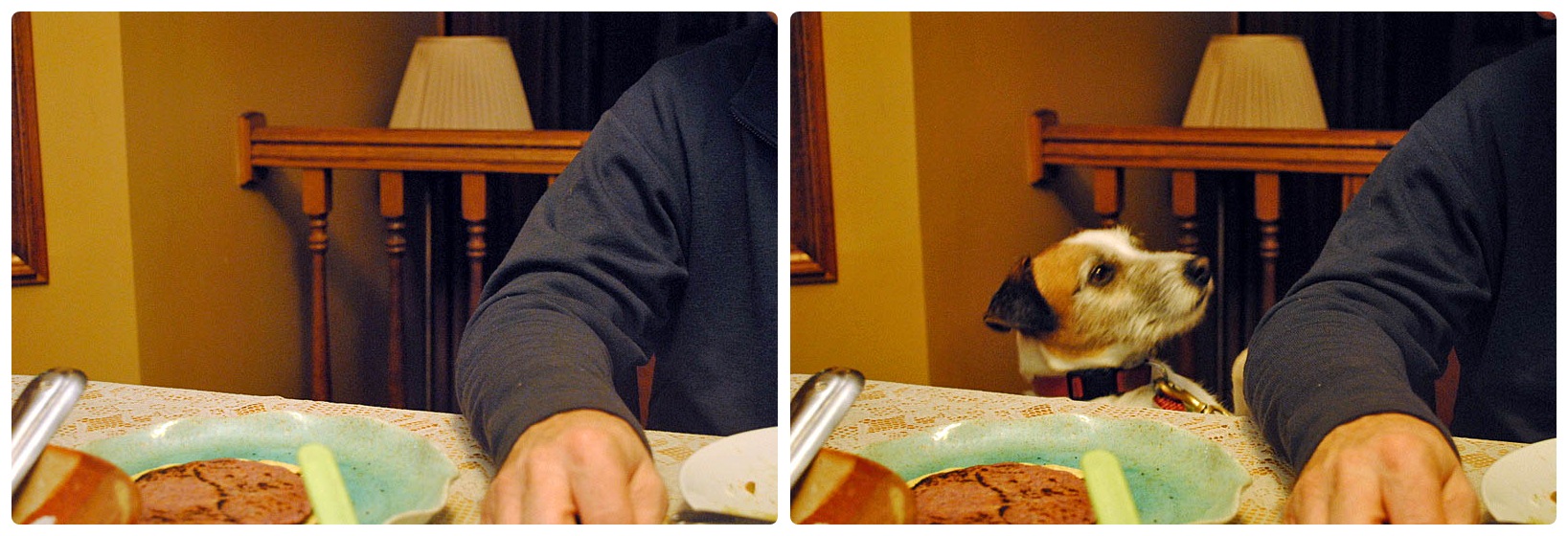
I close this post with a picture that I imagine would bring a huge smile to Noah. One of our dogs, Buck, always lays by Phil’s chair at the  dining table and is usually  very well-behaved.  Somehow the smell of this dinner got to him, and every minute or so he would make his presence a little more obvious, standing up and touching Phil’s arm as delicately as possible with his paws.

  “Hello, Daddy, here I am!  Got a piece of meat to spare?”
compositeBuck

ONE  YEAR AGO:  Maui New Year!

TWO YEARS AGO: Natural Beauty

THREE YEARS AGO: Sunflower Seed Rye