FESENJAN & THE NEW PERSIAN KITCHEN

newpekMany, many years ago, when I lived in California with my first husband, we would often go to a Persian restaurant located in Palo Alto. The food was simply outstanding, and the atmosphere perfect.  A quiet place, beautifully decorated, and with a menu full of dishes that sounded magical to us, two Brazilians with no experience in that type of food.   We would usually ask the waiter to pick something for us. One day he served us a braised lamb over rice with fava beans that completely awed our taste buds.  I remember the fresh dill sprinkled all over it. And I also remember that I hated fava beans, but would gladly spend each day of my life enjoying that rice.  Persian cooking can perform miracles.  In those days, I had no way of knowing that the man I would marry many years later was also under the spell of Persian food.  Phil had a friend from Iran who often invited him for dinner and prepared tahdig, best described as “rice with a crust”.  Like my lamb dish with fava beans, that rice stayed forever in Phil’s memory as one of the best things he’s ever had!  With all that in mind, when I read this review on Louisa Shafia’s book it took me 95 seconds to order it.

plated

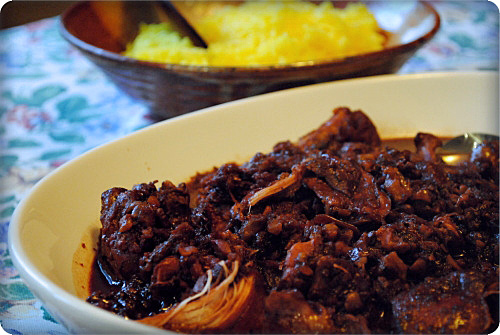
FESENJAN (WALNUT POMEGRANATE STEW)
(reprinted with permission from Louisa Shafia – The New Persian Kitchen)

1 tablespoon grapeseed oil
2 pounds skinless chicken legs or breasts
2 teaspoons salt, plus more, to taste
2 yellow onions, finely diced
1 cup walnuts, coarsely ground
½ cup pomegranate molasses
2 cups chicken stock, vegetable stock, or water
1 cup peeled and grated red beets
Pomegranate seeds and fresh mint leaves for garnish

.
Heat a large, deep skillet over medium-high heat and add oil. Lightly season chicken with salt and sear until well browned, 6-7 minutes per side, then transfer to a plate.

In the same skillet, sauté onions over medium heat for about 15 minutes, until lightly browned. Add walnuts, pomegranate molasses and 2 teaspoons salt. Stir to coat the onions. Add stock and bring to a boil. Reduce heat to a simmer and return chicken to stew. Cover and cook 25 minutes.

Stir in beets and cook, uncovered, until stew is thick and beets are tender, 15-20 minutes. Adjust salt to taste.  Pull out chicken pieces with tongs and cut into halves or thirds, if you like. Put a few pieces of chicken on each plate, along with plenty of sauce. Garnish with pomegranate seeds and mint.

ENJOY!

to print the recipe, click here
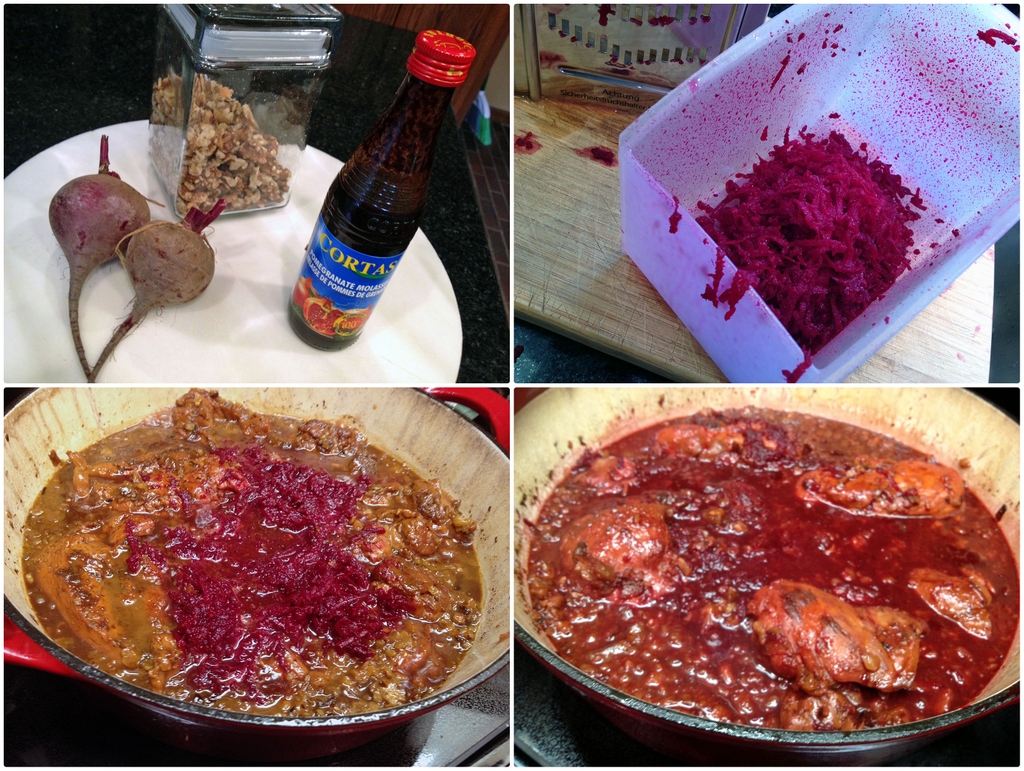
composite-001It was not easy to choose a recipe to highlight this great cookbook. You’d think I would pick either that magical lamb or a tahdig from our past, but I could not find fava beans, and tahdig is a bit intimidating for a first timer.  Indeed, according to Louisa herself, tahdig is the type of dish that requires practice. Your first won’t be your best. So, I opted for this amazing chicken concoction. Once you make it, you’ll realize why it is usually reserved for special occasions.  The intensity of flavors is hard to describe – it is sweet, sour, the walnuts give it body and texture, and the beets offer the most gorgeous color ever!   Don’t even think about omitting the beets, by the way. First, you won’t detect their taste. Second, remember that Persian cooking perform miracles…  😉  I could not find fresh pomegranate seeds to sprinkle on top, but the dish was festive enough without it.
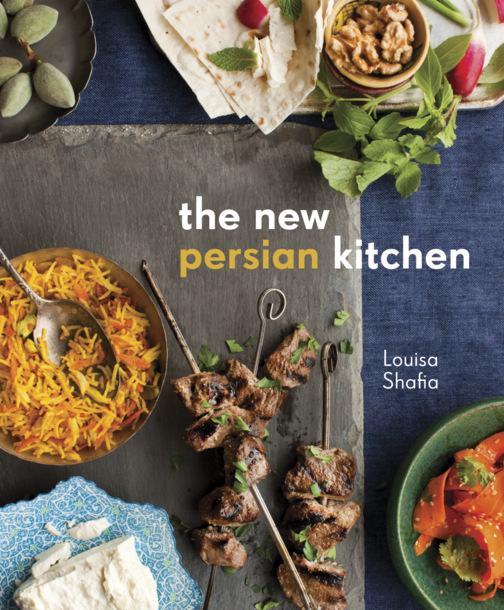
bookcoverTo order, click here

A little review of Louisa Shafia’s book.  Some cookbooks capture you from the moment you open the first page.  I started reading it late at night, and could not put it down for a couple of hours.  Louisa starts the book answering the simple question “What exactly is Persian food?” – and from there she takes the readers through a beautiful journey that covers not only its exotic flavors (sour cherries, rose petals, pomegranate molasses, dried limes, sumac, tamarind) but also the history of a fascinating region of the world and how it influenced the gastronomy of other places.  You will learn a lot more than cooking through Louisa’s words. Even Persian poetry will be there for you…

Reading her book, I learned the correct way to deal with saffron (so now I am on a quest to find a small mortar made of brass ;-)), and also opened my horizons to using dried mint. Louisa states that dried mint in many instances is better than the fresh herb, and recommends searching for Egyptian mint. I followed her advice, and she is right, it delivers great flavor.

The book has 80 recipes, divided in courses.  I will list a couple of recipes I found particularly tempting from each course just to give you an idea of what to expect.

Starters and Snacks:  Winter Squash Fritters with Rose Petals & Turkish Roasted Tomato and Red Pepper Dip

Soups: Saffron Corn Soup & Oat and Mushroom Soup (her description of this soup made me dream…)

Salads: Shaved Celery Root and Pomegranate Salad & Vinegar Carrots with Toasted Sesame Seeds

Vegetable and Egg Entrees:  Herb Frittata with Walnuts and Rose Petals  & Sweet and Smoky Beet Burgers (click here for Louisa’s own blog post about it)

Meat and Fish Entrees: Grilled Shrimp with Lime Powder and Parsley-Olive Oil Sauce & Turmeric Chicken with Sumac and Lime (both of these dishes plus Fesenjan were my final contenders to cook for this post)

Main Dish Stews and Casseroles:  Fesenjan (the featured recipe) & Persian Gulf-Style Spicy Tamarind Fish Stew

Rice and Grains:  Jeweled Brown Basmati Rice and Quinoa (hard to resist this one…) & Rice with Favas and Dill (the rice of my past…)  Several of her rice recipes can be turned into tahdig, and she does a great job advertising this spectacular take on rice.

Sweets: Rhubarb and Rose Water Sorbet with Rice Noodles (I simply HAVE to try this at some point) & Nutty Chocolate Bark with Cardamon and Coffee.

Beverages: Salty Mint Yogurt Soda & Watermelon, Mint, and Cider Vinegar Tonic

Pickles and Preserves: Fig Mustard (wow!) & Sour Cherry and Rose Preserves

You probably noticed that Louisa is one of those chefs who is in top shape, and that definitely influences her cooking style.  She always offers variations that make a classic dish lighter and better for you. If you are particularly interested in cooking with whole grains and healthy oils and sweeteners, this book covers it all. Her chapter on ingredients closes with a wonderful list of grains and gluten-free flours and tips on how to cook with them.  Can you tell I love her book?

Louisa, thank you for allowing me to publish a recipe from “The New Persian Kitchen”. I intend to cook a lot from it, and that includes tahdig…  😉

ONE YEAR AGO: Quinoa Salad with Roasted Beets

TWO YEARS AGO: Pasta Puttanesca

THREE YEARS AGO: Miche Point-a-Calliere

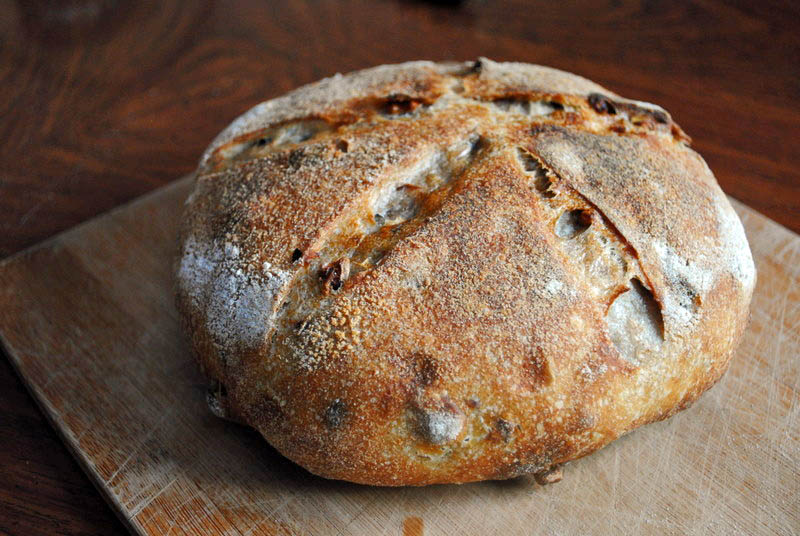
SOURDOUGH BREAD WITH WALNUTS AND DATES

Another example of inspiration coming from The Fresh Loaf.  David is a regular contributor to the forum, and every bread he makes is a work of art. He is the type of baker comfortable enough around sourdough starter to  devise his own recipes, having recently come up with a fig and walnut concoction.   David had access to fantastic figs, but when I went to the store I was not particularly impressed with what was available.  Since I am no longer afraid to improvise ;-), I used dates instead.   This bread is perfect to practice mindful eating. Don’t devour it. Instead, savor each bite as slowly as you can. Awesome bread, very complex taste.

crumbSAN FRANCISCO-STYLE SOURDOUGH WITH WALNUTS AND DATES
(adapted from David, at The Fresh Loaf forum)

for the stiff levain
41 g water
66 g sourdough starter
78 g all-purpose flour
4 g rye flour

for the final dough
337 g water
416 g all-purpose flour
46 g whole wheat flour
11 g salt
189 g levain
98 g dates, diced fine
98 g walnuts, diced and lightly toasted

Dissolve the starter in the water. Add the flour and mix thoroughly until the flour has been completely incorporated and moistened. Ferment at room temperature for 16 hours.

In a stand mixer, mix the flour and water at low-speed until it forms a shaggy mass. Cover and autolyse for 30 minutes. Coarsely chop or break apart the walnut pieces and toast them for 8 minutes in a 300ºF oven. Allow to cool. Coarsely chop the dates, rinse in cool water, drain and set aside.

Add the salt and levain to the autolyse, and mix at low-speed for 1-2 minutes, then increase the speed to medium (Speed 2 on a KitchenAid) and mix for 5 minutes. Add flour and water as needed. The dough should clean the sides of the bowl but not the bottom. Add the walnuts and the figs to the dough and mix at low-speed until well-distributed in the dough. (About 2 minutes).

Transfer to a lightly floured board, do a stretch and fold, and form a ball. Place the dough in a lightly oiled bowl and cover tightly. Ferment at 76º F for 2 1/2 to 3 hours with a stretch and fold at 50 and 100 minutes.  Shape as a large ball (or divide the dough in two and shape as two smaller loaves)  and place in banneton. Proof at room temperature (68-70º F) for 1-2 hours. Cold retard the shaped dough overnight.

The next morning, proof the dough at 85º F for 2-3 hours. Heat the oven to 480º F. Score the bread as desired, and bake with initial steam, reducing the oven to 460 F when the bread goes in. Bake for 40 to 45 minutes, and cool completely on a rack before slicing.

ENJOY!

to print the recipe, click here

boule1

I am still having issues with our oven, the temperature shoots up and down, making it hard to control proper baking.  At some point in the future we’ll change our kitchen appliances, but for the time being we dance according to the music. That’s the proper Zen attitude. Or so I am told…  😉

I am submitting this post to Susan’s Yeastspotting.

ONE YEAR AGO: Braised Brisket with Bourbon-Apricot Glaze

TWO YEARS AGO: The Real Vodka Sauce

THREE YEARS AGO: Pork Tenderloin and Blue Cheese

POMEGRANATE WALNUT DELIGHT

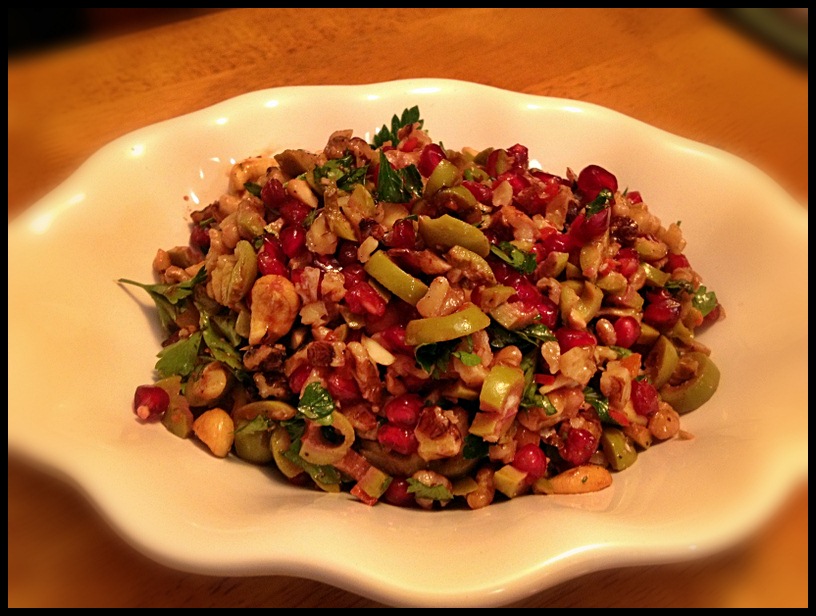
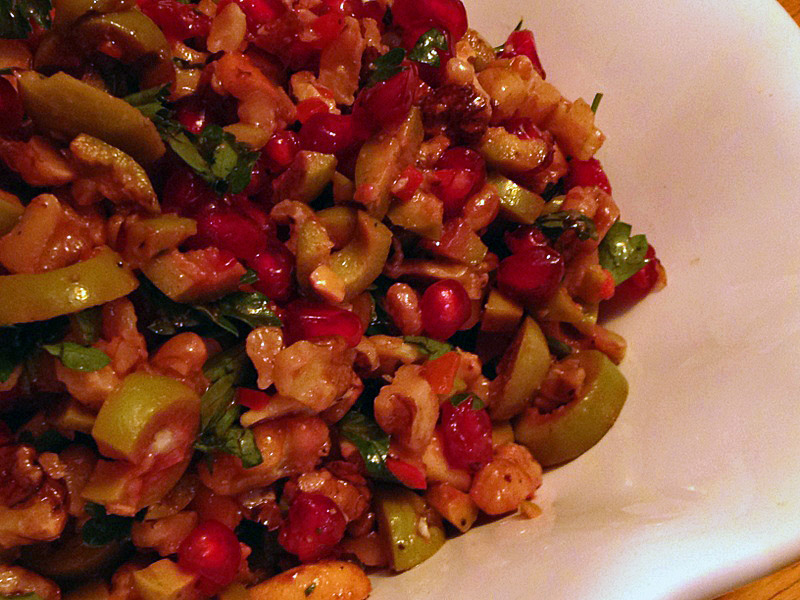
This unusual salad will take the center spot in any meal with its intense flavors and contrast of textures. I spotted the recipe around Thanksgiving last year, saved it to my Pinterest cooking board, and finally made it.  Please, don’t drag your feet like I did, make it sooner rather than later. Green olives, walnuts, pomegranate seeds… What a treat!
served111

GREEN OLIVE, WALNUTS & POMEGRANATE SALAD
(adapted from Alexandra’s Kitchen,  original recipe at Turquoise)   

3/4 cup shelled walnuts
1/2 cup pitted green olives, coarsely chopped
1/4 cup roasted cashews, coarsely chopped
3/4  cup pomegranate seeds
1 red Serrano chile, seeded and finely minced
shredded flat-leaf parsley to taste
1 tablespoon walnut oil
splash of pomegranate molasses
juice of ½ lemon
sea salt
freshly ground black pepper

Heat the oven to 350⁰F. Scatter the walnuts onto a jelly-roll pan and roast for 5-10 minutes, until deep golden brown.  Chop the walnuts coarsely and toss in a sieve to remove any remaining skin or dust.

Combine all the ingredients in a large bowl and toss gently. Leave to stand for 5 minutes or so before serving to allow flavors to meld. Taste and adjust seasoning. I ended up adding more lemon juice.

ENJOY!

to print the recipe, click here

closeup
Confession: I tend to be salad-lazy.  I don’t mind making a recipe that involves plenty of steps, be it reducing a sauce, braising for hours, or as you probably know, bake a loaf of bread that took 12 hours to proof.  But, ask me to make a multi-ingredient salad and I am invaded by a sense of pure exhaustion.  Washing the greens, cutting all ingredients, preparing the dressing…  However, this salad never left my mind from the day I saw it at Alexandra’s site, which, by the way, is a site worth subscribing to.  And, did you notice?  No greens to wash. Yeaaaaaah!   😉

Everything works in this recipe. I am a lot more fond of black Kalamata type olives than green, but trust me, they taste unbelievably good here.  Together with the unique heat that only a Serrano pepper delivers, you’ll enjoy the sweet and sour taste of pomegranate molasses, the toasty walnuts, the herby parsley, the lemon, and last but not least the pomegranate seeds!  Like little pine nuts dressed for a gala party…
We love them!

Three words for you: Make this salad.

ONE YEAR AGO: Romanian Flatbreads

TWO YEARS AGO: Ziti with Artichokes and Meyer Lemon Sauce

THREE YEARS AGO: Blasted Broccoli, Stove-top version

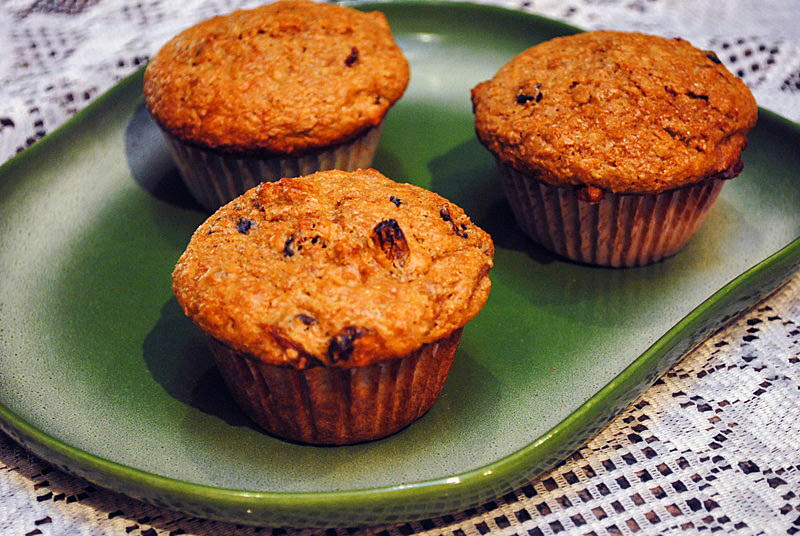
INA GARTEN’S BANANA BRAN MUFFINS

I don’t cook Ina Garten‘s recipes that often because they tend to be way too rich (says she who recently baked a cake with a few hundred calories per bite..  ;-)).   But these muffins have just the right amount of indulgence, well balanced by all their healthy components: unprocessed bran, fruits, and nuts.   I am always happy when I find a good recipe for bran muffins, Phil’s favorite ways to start the day: one of these babies, warmed up slightly in the oven, next to a steaming cup of cappuccino.

CHUNKY BANANA BRAN MUFFINS
(adapted from Ina Garten, FoodTV Network)

1 cup unprocessed wheat bran
1 cup buttermilk (shaken)
4 tablespoons unsalted butter, at room temperature
1/4 cup light brown sugar, lightly packed
2 + 1/2 large eggs, at room temperature
3 tablespoons molasses
2 tablespoons agave nectar
1 teaspoon grated orange zest
1/2 teaspoon pure vanilla extract
1 + 1/2 cups all-purpose flour
3/4 teaspoon baking powder
1/4 teaspoon baking soda
1/2 teaspoon kosher salt
1 cup mixed dried raisins, blueberries, cranberries
1 cup large-diced bananas
1/2 cup chopped walnuts

Preheat the oven to 350 degrees F. Place paper liners into a muffin tin.

Combine the bran and buttermilk and set aside. Cream the butter and sugar in the bowl of an electric mixer for about 5 minutes, until light and fluffy. With the mixer on low, add the eggs, one at a time. Scrape the bowl and then add the molasses, agave nectar, orange zest, and vanilla. (The mixture will look curdled.) Add the bran/buttermilk mixture and combine.

In a separate bowl, sift together the flour, baking powder, baking soda, and salt. With the mixer on low speed, slowly add the flour mixture to the batter just until combined.  Fold in the dried fruits, bananas and walnuts with a rubber spatula.

Fill the muffin cups to the top and bake for 25 to 30 minutes, until a cake tester comes out clean.

ENJOY!

to print the recipe, click here

Comments:  Most recipes of this type call for over-ripe bananas, all brown and mushy.  In this recipe, Ina used bananas that were good enough to eat as a fruit, ripe, but not falling apart at all.  I was a bit intrigued, but followed her lead.  Verdict:  not only it works, but it’s probably what makes these muffins quite special, the little morsels of concentrated banana flavor.

Phil gave his seal of approval to the recipe, so all you bran muffin lovers can go ahead and give it a shot.  😉

ONE YEAR AGOBeer Bread with Roasted Barley

TWO YEARS AGO:  Tomato Confit with Arugula and Zucchini

Add to FacebookAdd to DiggAdd to Del.icio.usAdd to StumbleuponAdd to RedditAdd to BlinklistAdd to TwitterAdd to TechnoratiAdd to Yahoo BuzzAdd to Newsvine

PISTACHIO-WALNUT SOURDOUGH BREAD

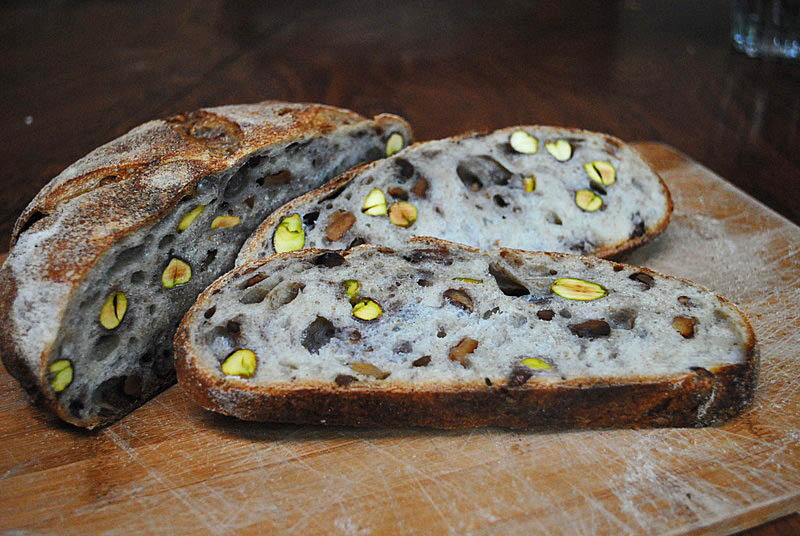
The goal: to make a sourdough bread loaded – and I mean loaded – with nuts, a crumb not as open as my usual loaves, to enjoy with an assortment of cheeses, from  French Brie to Italian Gorgonzola, passing by Spain with its awesome Manchego.  My starting point was a recipe from Maggie Glezer’s Artisan Baking, adapted to include whole pistachios, and small pieces of walnuts.  I wanted the pistachios to be the main textural component in the bread, and the walnuts to impart mainly their flavor throughout the crumb.  According to my dear husband, I hit the jackpot with this bread, he absolutely loved it. It reminded us of a bread we used to buy in a street market in Paris on Saturdays, except for the fact that the French version included a lot of sunflower seeds. Now, that’s an interesting idea for a future baking adventure… 😉

PISTACHIO-WALNUT SOURDOUGH BREAD
(from the Bewitching Kitchen)

Levain (you will use only half of it):
1 Tbs firm sourdough starter
45 g  warm water
75 g  bread flour

Dough:
300 g  bread flour
25 g  rye flour
25 g whole wheat flour
228 g  warm water
8 g salt
80 g walnuts, lightly toasted, in small dice
50 g whole pistachios, roasted

Make the levain by mixing all the ingredients and kneading lightly to form a smooth dough.  Keep at room temperature for about 12 hours (it should at least triple in size).

Make the dough by combining the three types of flour with the water.  Cover and let the mixture rest for 30 minutes. Add the salt and the levain (half of it only!) and knead a few times until it forms a shaggy mass.  Add the nuts and knead briefly to incorporate them.  Let it rest for 30 minutes, knead for about 10-20 seconds, and let the dough rest for another 30 minutes.  Knead (or fold) a few times, and let the dough rest for 1 hour.  Knead (or fold)  a few times, and let it rise undisturbed for 2 hours.

Pre-shape the dough as a round ball, let it rest for 15 minutes, then shape it in its final form, placing it in a banetton or another appropriate, well floured container, with the seam side up.   Cover and let it rise for 3 hours. Invert the dough on parchment paper, slash the surface, place on a baking stone on a 425 F oven, covered for 30 minutes, then uncover and bake for 15 minutes more, until dark brown and the internal temperature is at least 205 F.

Let the loaf cool over a rack  before cutting.

ENJOY!

to print the recipe, click here

Comments:  Making this bread was a labor of love, because I shelled the pistachios myself. My finger tips had quite a workout, so next time I will buy shelled pistachios to make life a little easier, and I advise you to do the same. At any rate, this bread is a nut-lover’s paradise.  The pistachios shine like little jewels, and the walnuts become almost sweet during baking.  I could not be happier with it, as it turned out exactly as I hoped.  Plus, it was another  successful performance by our Breville toaster oven!

Who could resist having a second slice?  😉

I am submitting this post to Yeastspotting

Add to FacebookAdd to DiggAdd to Del.icio.usAdd to StumbleuponAdd to RedditAdd to BlinklistAdd to TwitterAdd to TechnoratiAdd to Yahoo BuzzAdd to Newsvine