HOEGAARDEN BEER BREAD

I don’t regret that many things in my life, but if I could go back to the period  that I lived in Paris, I’d take some time to travel to Belgium.   I was so close to that beautiful country, but never saw it in person… it’s a shame and it’s sad. Plus, I’ve never met a person from Belgium who wasn’t super-nice!  All my Belgium friends have a great sense of humor, a great appreciation for the fun side of life, and many positive things to say about their home country, that excels in so many things.  Two of their special delicacies are chocolates and beer!  The very best of both are produced in small quantities and not exported,  but some excellent Belgium beer makes it all the way to the US, examples being Chimay, Leffe,  and Hoegaarden, the latter of which is a beer that brings fond memories of my days as a single woman in Paris…   😉

I don’t drink beer anymore, but I still like to cook with it, or include it in  breads- for a quick flash back, click here.  So, when I saw this post not too long ago, I changed all my baking plans for the weekend, to accommodate a little Hoegaarden sourdough, and take the Bewitching Kitchen on a virtual trip to Belgique!

HOEGAARDEN BEER BREAD
(adapted from Fab Food Blog)

For the sponge:
120 g 100% hydration sourdough starter
60 g bread flour
45 ml Hoegaarden white beer

For the final dough:
235 g bread flour
65 ml Hoegaarden white beer
40 ml lukewarm water
1 tsp salt
1 tsp fennel seeds
3 tsp fresh rosemary, chopped

Mix all the ingredients for the sponge in a small bowl, mix well and leave it overnight at room temperature.  It should be very bubbly and more than double in size.  If it rises too much and collapses, it’s fine.

Next morning, place the sponge, flour, beer and water in a large bowl. Mix for a few minutes until barely combined, then let it sit for 20 minutes undisturbed. Add the salt, fennel seeds, and rosemary, and mix by gentle kneading.  Let the dough rise for 30 minutes,  knead again (20 seconds cycle),  let the dough rise for about 40 minutes.  Do one more cycle of quick kneading  and let the dough rise for another 40 minutes.  Knead one final time and let the dough rise undisturbed for 1.5 to 2 hours, until almost doubled in size.  Shape as a ball, and place with the seam side  up inside a well floured banetton type container.

Let it rise undisturbed for 2 hours.  Heat the oven to 450 F with baking stones or tiles inside. Invert the dough on the tiles, quickly score the surface, and bake with initial steam. If covering the dough, remove the cover after 30  minutes, reduce the temperature of the oven to 425 F and bake for 10 to 15 minutes more, until golden brown.    Cool for at least 1 hour before slicing.

ENJOY!

to print the recipe, click here


Comments: 
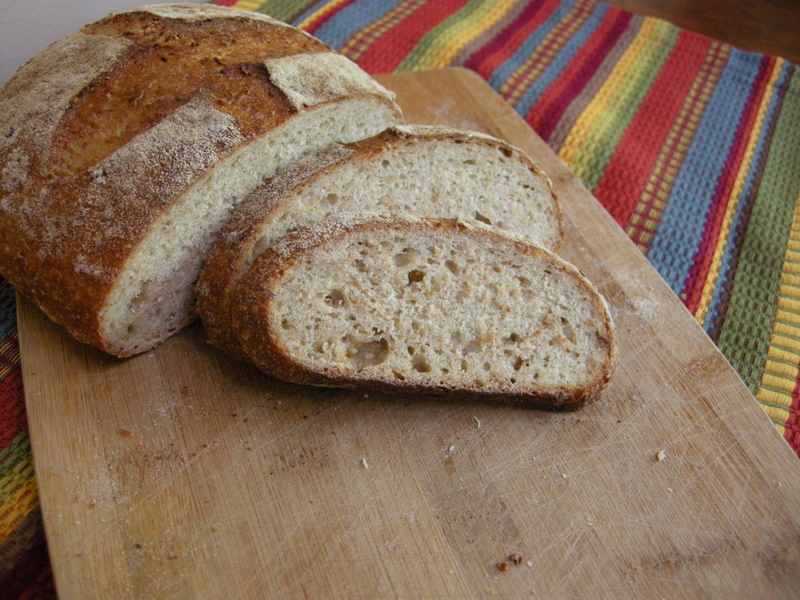
This recipe makes a  small boule, so if you want to serve it in a dinner party for several people, consider doubling the recipe and baking two loaves.  The bread smells wonderful during baking, and fennel is the dominant flavor.   As to the beer, it would be interesting to bake two loaves side by side, substituting water for beer in one of them – I imagine that there will be a slight difference in sourness and complexity of flavor, but it’s hard to know for sure with the competing taste of fennel and rosemary (which, by the way, I increased a bit from the original posted recipe).   In my experience, fresh rosemary has a tendency to lose its punch once it’s incorporated in bread dough, so I now use it with more abandon.

Fennel lovers:  pair this delicious bread with some hearty Italian type sausage, for a double-fennel kick…   Don’t like fennel?  Simply omit it, the bread will still be delicious with a nice crust and moderately open crumb.

I am submitting this post to Susan’s Yeastspotting event… stop by and visit her weekly showcase of breads.

ONE YEAR AGO: Ancho-Chile Marinade: Pleased to meat you!

TWO YEARS AGO:  The Handmade Loaf (the book that got me into sourdough baking!)

Add to FacebookAdd to DiggAdd to Del.icio.usAdd to StumbleuponAdd to RedditAdd to BlinklistAdd to TwitterAdd to TechnoratiAdd to Yahoo BuzzAdd to Newsvine

SPICY KALAMATA SOURDOUGH

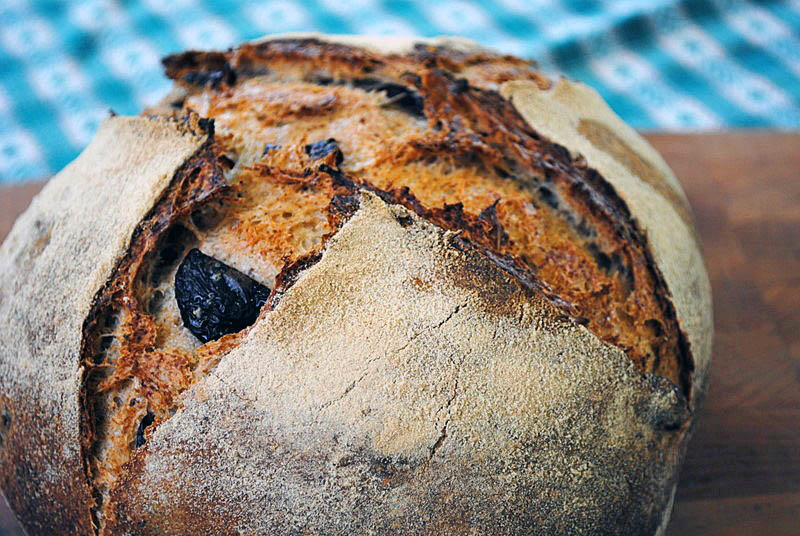
I cannot think of a better way to re-open the Bewitching Kitchen than a loaf of sourdough bread!  My sourdough starter was refreshed the day before we left L.A., and a small amount came with us in the car.  One more refreshment once we arrived, and I was back in business. Instead of using a recipe from a book, I adapted a basic formula, adding three ingredients that remind me of our times in L.A.

1. Kalamata olives, because we went through countless bottles of the very affordable and delicious  Trader Joe’s pitted Kalamatas.  We brought a bottle with us, it will be a sad day when it’s finished now that we don’t have a Trader Joe’s 3 miles from home.

2. Red pepper flakes, because quite a few of our friends in L.A. were heavy into hot and spicy food (and drinks!).  The more we hang out with them, the more we got into pepper ourselves.

3. Fresh rosemary,   because it grew wild around our neighborhood.  In fact, on our second week in L.A., I was staring at a huge plant near our house, when the owner of the home came out and said hello.  I asked, in disbelief – “Is this rosemary”?  – she smiled, and told me to get some whenever I wanted, as evidently the plant was threatening to overtake her property!  😉

So, here is my take on a sourdough to bring a little of L.A. into our kitchen.


SPICY KALAMATA SOURDOUGH
(from the Bewitching Kitchen)

200g (ml) water at room temperature
142g  sourdough starter (at 100% hydration)
1/4 tsp instant yeast
280g bread flour
85g dark rye flour
9 g salt
3/4 cup kalamata olives (cut in half)
1 tsp red pepper flakes
2 Tbs fresh rosemary leaves, chopped

Dissolve the starter and the instant yeast in the water in a large bowl.  Add the flour, mix to incorporate (or use a Kitchen Aid type mixer for a couple of minutes on low speed), then cover with a plastic wrap and allow it to sit for 20 minutes undisturbed.

Sprinkle the salt on top, and mix by gentle kneading or with the mixer for a few more minutes.  Once the salt is incorporated, add the olives, red pepper, and rosemary, and knead by hand or with the mixer (again in low speed).

Let the dough rise for 3 hours, with quick kneading cycles at 40 min, 1h 20 min, and 2 hours (timing is pretty flexible, no need to pay too close attention to it).  Shape the dough into a round, place in a banetton or other appropriate container with the seam up.  Let it rise for 3 hours, until almost doubled in size, and with an airy feeling as you gently press the surface of the dough.

Bake in a 450F oven,  covered for the first 30 minutes, then uncover and lower the temperature to 425F for the remaining time.  If you have a favorite method to create steam, use it in the initial baking. I prefer to use a roasting pan previously filled with water, emptied of the water and quickly inverted on top of the loaf as my steam source.

Let the bread completely cool on a rack before slicing.

ENJOY!

to print the recipe, click here

Comments:  Wild yeast purists, forgive me, because I cheated.  Yes, I admit, I added commercial yeast to this bread.  It turns out that I baked it the day after arriving home, and my schedule for that day was a bit iffy.  I wanted to make sure the bread would be ready to bake before too late.  Also, I was hoping for a crumb  a little more tight, to use the bread for sandwiches, so I proofed a little less and reduced the number of kneading cycles.


The bread has intense olive flavor, and a nice hint of heat every now and then.   The rosemary flavor was not as strong as I had hoped for,  so next time I’ll increase that amount.   A delicious bread, fantastic as an open face sandwich with a slice of ham, cheese, tomato slices, and a run under the broiler.

I am submitting this post to Susan’s Yeastspotting event…

and you can also see it on Tastespotting

Add to FacebookAdd to DiggAdd to Del.icio.usAdd to StumbleuponAdd to RedditAdd to BlinklistAdd to TwitterAdd to TechnoratiAdd to Yahoo BuzzAdd to Newsvine

MAPLE-OATMEAL SOURDOUGH BREAD

Two of my favorite bread baking sites are Wild Yeast and The Fresh Loaf.  Every Friday, I look forward to Susan’s Yeastspotting event,  that showcases  breads baked during the previous week by folks all over the world.  And The Fresh Loaf is a discussion forum with help and advice for beginners as well as experienced bakers.  Through my visits to both sites over several years,  I got to know – virtually, at least  –  some amazing bread bakers like MC, who runs the blog with the cute name “Farine.”   Not too long ago she raved about a bread from Orchard Hill Breadworks, a bakery in New Hampshire owned by Noah Elbers.  During her visit to the bakery, she learned how to make one of their signature breads, with two flavors I am quite fond of:  oatmeal and maple syrup.

I won’t lie to you, the preparation is a bit involved: the day before you’ll need to bake the oatmeal, refresh your sourdough starter, and make a poolish with commercial yeast. But your hard work will pay off, big time…   😉

NOAH ELBERS’ MAPLE-OATMEAL BREAD
(reprinted from Farine‘s blog, with permission from Noah Elbers)

447 g all-purpose unbleached flour
151 g whole-wheat flour
151 g steel-cut oatmeal, baked
328 g water
151 g liquid starter
151 g poolish
121 g pure maple syrup
16 g salt
 
The day before baking the bread:
1. Refresh your sourdough starter, to make sure it is bubbly and active when you make the dough next morning. I do that about 12 hours before mixing the dough, by mixing 2 tsp of mature starter with 150g water and 150g flour.  Next morning remove the amount you need and keep the rest in the fridge.

2. Make the poolish by mixing 100g flour + pinch of instant yeast + 100 g/ml water recipe: Leave to ferment overnight. You will not use it all, weigh what you need for the recipe.

3. Bake the oatmeal.  Boil water, then mix it with the oatmeal in a baking dish (200g oatmeal + 200g/ml boiling water).  Cover the dish with aluminum foil and bake in a 400F oven for 40 minutes.  The mixture will turn into a brick.  Once it cools, break the bits of oatmeal with your fingers, and weigh the amount needed for the dough.

On baking day:
Mix all the ingredients in a large bowl (except the salt),  kneading briefly to form a shaggy mass.  Let the mixture resting for 30 minutes.    Add the salt and incorporate by gentle kneading.

Let the dough rest for 40 minutes.  Knead by folding the dough in itself 4-6 times.  Let the dough rest for 40 minutes more.  Knead it again by folding.
Let the dough rise for 40 minutes, do one final cycle of kneading, then allow it to sit undisturbed for a full hour  (total bulk fermentation will be about 3 hours).

Shape the dough as a large batard, or divide in two and shape as a small round (that’s what I did).  Let the shaped bread rise for 1 hour at room temperature, then retard it in the fridge for 12-15 hours.

Bring the bread to room temperature for 2 hours before baking in a 450F oven for 45 minutes (25 minutes under steam, covered, 20 minutes uncovered).  Cool the bread for at least one hour before indulging in it.

ENJOY!

to print the recipe, click here

Comments: Even though this bread takes oatmeal and maple syrup, it is not sweet.  I think its sourdough nature creates a nice counterpart to the sweetness, so that the bread is quite versatile:  you can enjoy it with peanut butter and jelly (like my husband did), or go for a bit of Brie or Camembert (my favorite take).

I highly recommend that you visit Farine website, and click on the video made in the bakery during the preparation of this bread.  It is amazing to see how those talented bakers handle a huge amount of dough, from mixing to shaping.   And while you are net-surfing, make sure to stop by the bakery website and read about how it all started, a fascinating story told by Noah himself.

I am submitting this post to Susan’s Yeastspotting

ONE YEAR AGO: Black Trumpet-Coffee Crusted Pork Tenderloin (one of my personal favorites!)

Add to FacebookAdd to DiggAdd to Del.icio.usAdd to StumbleuponAdd to RedditAdd to BlinklistAdd to TwitterAdd to TechnoratiAdd to Yahoo BuzzAdd to Newsvine

PISTACHIO-WALNUT SOURDOUGH BREAD

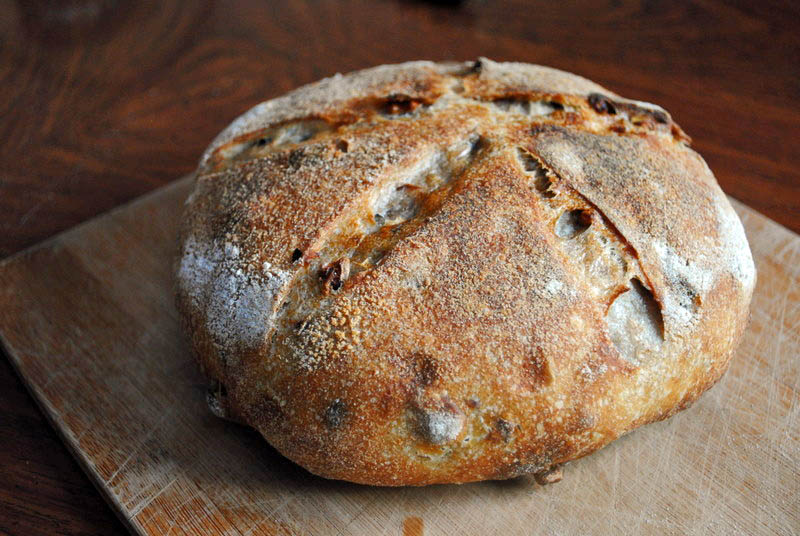
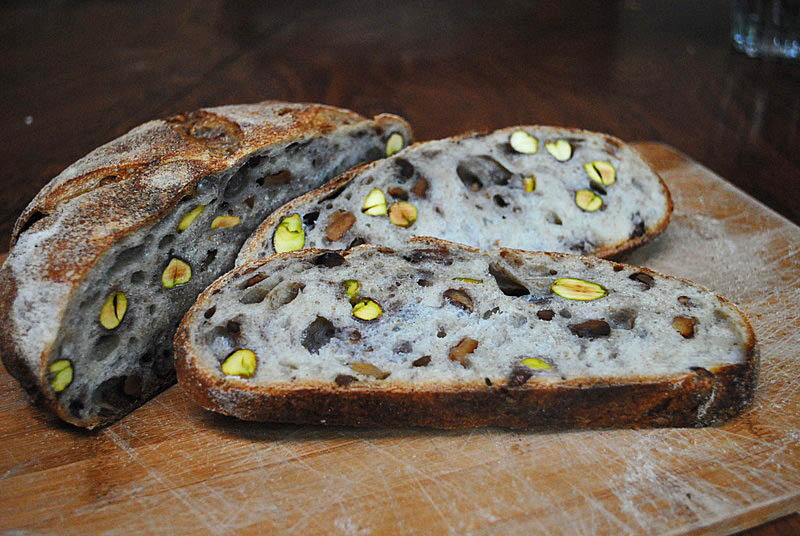
The goal: to make a sourdough bread loaded – and I mean loaded – with nuts, a crumb not as open as my usual loaves, to enjoy with an assortment of cheeses, from  French Brie to Italian Gorgonzola, passing by Spain with its awesome Manchego.  My starting point was a recipe from Maggie Glezer’s Artisan Baking, adapted to include whole pistachios, and small pieces of walnuts.  I wanted the pistachios to be the main textural component in the bread, and the walnuts to impart mainly their flavor throughout the crumb.  According to my dear husband, I hit the jackpot with this bread, he absolutely loved it. It reminded us of a bread we used to buy in a street market in Paris on Saturdays, except for the fact that the French version included a lot of sunflower seeds. Now, that’s an interesting idea for a future baking adventure… 😉

PISTACHIO-WALNUT SOURDOUGH BREAD
(from the Bewitching Kitchen)

Levain (you will use only half of it):
1 Tbs firm sourdough starter
45 g  warm water
75 g  bread flour

Dough:
300 g  bread flour
25 g  rye flour
25 g whole wheat flour
228 g  warm water
8 g salt
80 g walnuts, lightly toasted, in small dice
50 g whole pistachios, roasted

Make the levain by mixing all the ingredients and kneading lightly to form a smooth dough.  Keep at room temperature for about 12 hours (it should at least triple in size).

Make the dough by combining the three types of flour with the water.  Cover and let the mixture rest for 30 minutes. Add the salt and the levain (half of it only!) and knead a few times until it forms a shaggy mass.  Add the nuts and knead briefly to incorporate them.  Let it rest for 30 minutes, knead for about 10-20 seconds, and let the dough rest for another 30 minutes.  Knead (or fold) a few times, and let the dough rest for 1 hour.  Knead (or fold)  a few times, and let it rise undisturbed for 2 hours.

Pre-shape the dough as a round ball, let it rest for 15 minutes, then shape it in its final form, placing it in a banetton or another appropriate, well floured container, with the seam side up.   Cover and let it rise for 3 hours. Invert the dough on parchment paper, slash the surface, place on a baking stone on a 425 F oven, covered for 30 minutes, then uncover and bake for 15 minutes more, until dark brown and the internal temperature is at least 205 F.

Let the loaf cool over a rack  before cutting.

ENJOY!

to print the recipe, click here

Comments:  Making this bread was a labor of love, because I shelled the pistachios myself. My finger tips had quite a workout, so next time I will buy shelled pistachios to make life a little easier, and I advise you to do the same. At any rate, this bread is a nut-lover’s paradise.  The pistachios shine like little jewels, and the walnuts become almost sweet during baking.  I could not be happier with it, as it turned out exactly as I hoped.  Plus, it was another  successful performance by our Breville toaster oven!

Who could resist having a second slice?  😉

I am submitting this post to Yeastspotting

Add to FacebookAdd to DiggAdd to Del.icio.usAdd to StumbleuponAdd to RedditAdd to BlinklistAdd to TwitterAdd to TechnoratiAdd to Yahoo BuzzAdd to Newsvine

HOME IS WHERE THE HEARTH IS

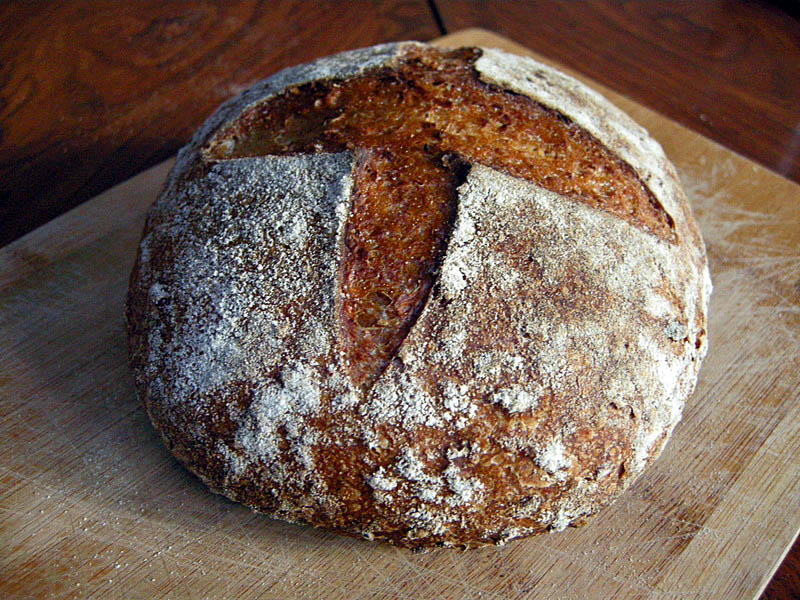
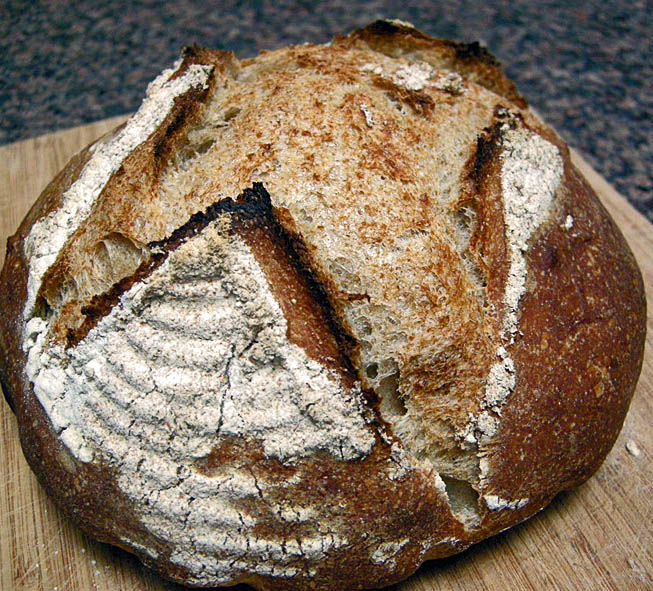
We spent last week in Oklahoma, which gave me the opportunity to bake bread in a normal oven.  After some severe brainstorming over the recipe, I settled on a country rye from Tartine, one of my favorite bread books.  It calls for a sourdough starter with a 50:50 mixture of white and whole wheat flours, and the dough itself has a small amount of rye. Usually I’d retard the loaf overnight in the fridge (as recommended), but this time I baked it just 3 hours after the final shaping.   The oven rise was impressive, the bread almost exploded out of the slashes!  It’s a vision that makes me so happy…   😉

COUNTRY RYE
(adapted from Tartine)

For the leaven (8 hours before making the dough):
1 Tbs sourdough starter, very active
140ml water
70g white bread flour
70g whole wheat flour

For the dough:
100g of leaven (save the rest)
400ml water at 75 F
415g bread flour
85g rye flour
10g salt

Pour the water in a large bowl, add the leaven (only 100g of it) and mix to dissolve.  Add the two different flours, mix with your hands to form a shaggy mass. Cover and let it sit at room temperature for 40 minutes.  Sprinkle the salt on top of the dough and knead to mix it.

Let the dough go through a bulk rise of 3 hours, folding the dough at every 30 minutes.  Pre-shape the dough as a ball, let it rest undisturbed for 20 minutes, then shape it in its final round shape, place it in a round container with the seam up for 3 hours  (you can also retard the dough in the fridge for 12 to 16 hours).

Bake for 45 minutes in a 450 F oven,  with steam during the first 25 minutes.  Allow it to completely cool before slicing.

ENJOY!

to print the recipe, click here

Comments: For the first time I baked this type of bread without weighing the ingredients, because my balance stayed in the nano-kitchen.  I was a bit nervous, but I used a conversion table and it worked just fine. The more I bake with wild yeast, the more convinced I am that technique trumps the proportions of ingredients. For example, folding the dough enough times during fermentation, and creating proper surface tension in the final shaping have a huge impact on the final product.   My advice is to practice, practice, and practice some more. I still struggle with scoring the bread, never feeling confident with the razor blade in my hand. What bothers me is that the scoring is so… final!  Once you slash the surface, you can only hope you did it right.  😉

The crumb was a little less open than that of a bread exclusively made from white flour,  and the taste reminded me of a Poilane miche, but less dense.  It’s a bread for a ham sandwich, or one with which you can mop up the juices of a hearty pot roast, or perfect to toast and enjoy with a little Brie cheese.

I am submitting this post to Susan’s Yeastspotting event… make sure to stop by and amaze yourself with all the tempting breads.

ONE YEAR AGO: My New Favorite Tomato Sauce

Add to FacebookAdd to DiggAdd to Del.icio.usAdd to StumbleuponAdd to RedditAdd to BlinklistAdd to TwitterAdd to TechnoratiAdd to Yahoo BuzzAdd to Newsvine