WAFER PAPER AND SOURDOUGH BAKING

This post is dedicated to Eha, a lover of butterflies

I am so excited to share this new technique with you today! I first saw it on Instagram (check this page) and decided to give it a try. The possibilities are simply endless, of course. Basically, you make a design using wafer paper painted by hand or with a stencil, add that to the shaped, fully proofed dough right before baking, score around it with a razor blade. Isn’t that the coolest thing since….. sliced bread?
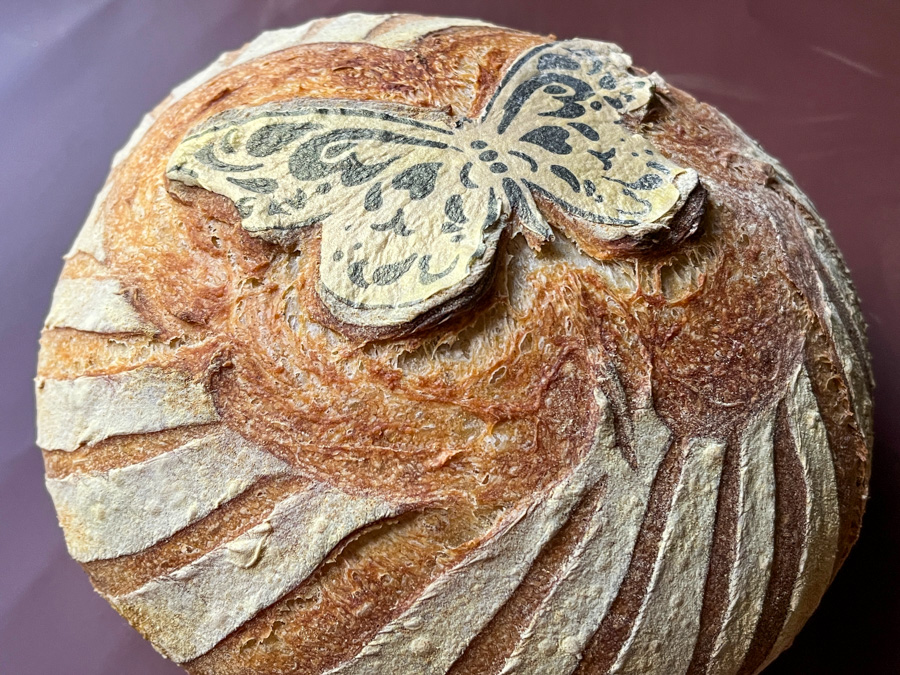

You can use any sourdough formula you want, in this particular loaf I re-visited the Ras-El-Hanout of my past, because I love that combination of flavors. Below you see the preparation of the wafer paper and the way I scored it (using my Sonic blade).
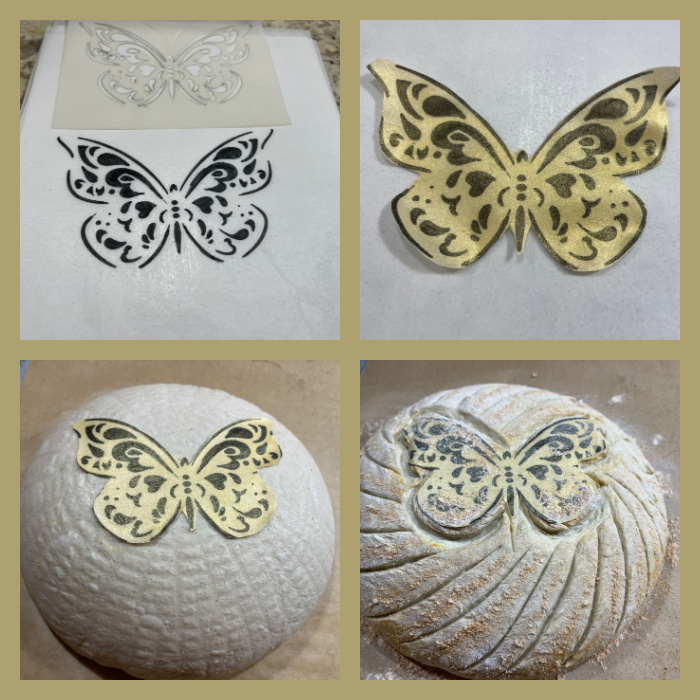
I used a stencil and painted the black portion with a food safe pen. Then I sprayed the whole surface with air-brush gold. That has to dry completely, so I advise you to make the wafer paper decoration the day before you intend to bake the bread. Or even several days in advance, it stays perfect, no issues.
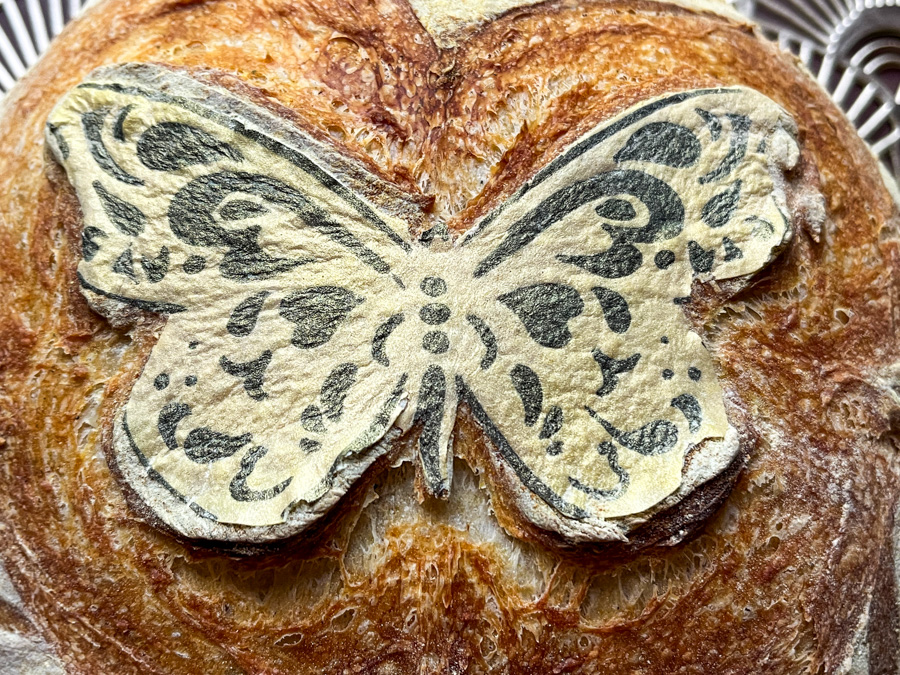
My dough had enough moisture for the paper to stick to the surface without problem, if your dough is too dry, spray it lightly with water. VERY lightly. After the paper is on the surface, dust the surface of the loaf lightly with tapioca or all-purpose flour. In my case, I mixed tapioca flour with a little turmeric to re-inforce the golden color and the taste of the bread. Slash around the paper and all over the bread with the pattern of your choice.
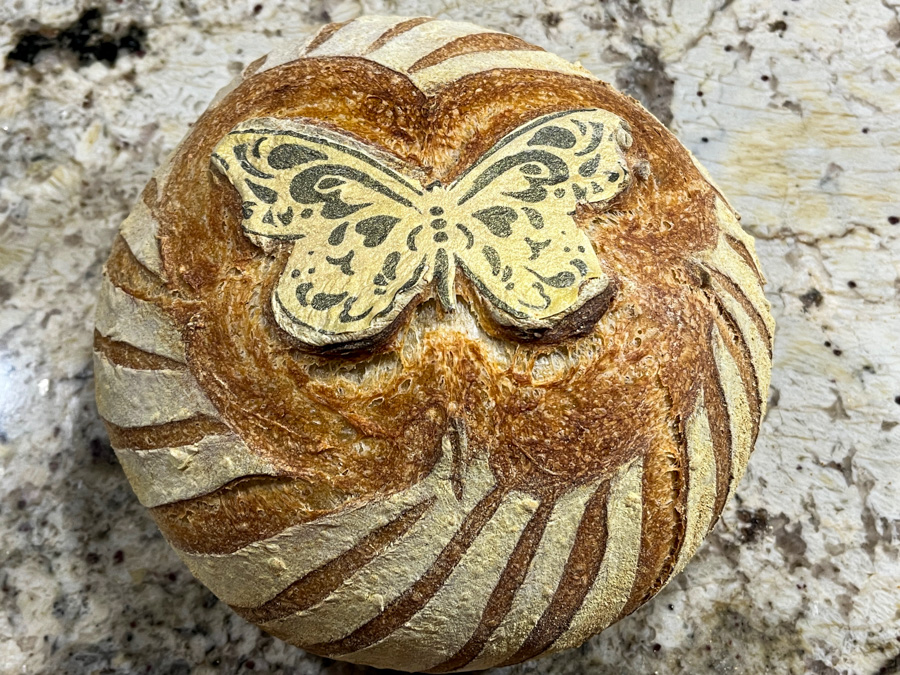
Another important point – do not forget this – after the bread has been in the oven for 5 to 7 minutes, go back and slash AGAIN only around the design. That will make it lift and look much better. Try not to forget this step.

My first attempt making this type of decoration did not work as well for two reasons: I was too focused on the paper and did not plan carefully the scoring, so it did not turn out very good. Second, I forgot to go back and slash the design again after 5 minutes into the bake. That made the paper stay glued to the bread and the design did not have the right impact. Anyway, it is the type of thing that you learn the more you do it.
I know I will be playing with this quite often in the future, and I hope you consider this fun technique also. The paper does not darken in the oven, which surprised me a bit, and the air-brush colors also seem to hold up well. If you are the artistic type, you can paint flowers, landscapes, whatever your imagination desires!
.

ONE YEAR AGO: Banana Bread from the Experts

TWO YEARS AGO: Shrimp Stir-Fry with Snow Peas and Cashews

THREE YEARS AGO: Pickled-Roasted Chickpeas with Cashew Cream

FOUR YEARS AGO: Twice-Baked Goat Cheese Souffle

FIVE YEARS AGO: A Star from England in the Bewitching Kitchen

SIX YEARS AGO: Hommage to the Sun

SEVEN YEARS AGO:The Fabulous Three
.
EIGHT YEARS AGO: Turkey-Chorizo Burger with Green Chile Dressing
.
NINE YEARS AGO:Taco Salad
.
TEN YEARS AGO: Semolina Sourdough Boule
.
ELEVEN YEARS AGO:Forgive me, for I have sinned
.

TWELVE YEARS AGOCracked Wheat Sandwich Bread
.
THIRTEEN YEARS AGO:  Au Revoir, my Bewitching Kitchen
.
FOURTEEN YEARS AGO:French Bread

VALENTINE’S SOURDOUGH, THREE WAYS

You can use any formula for your sourdough bread, it is all about the scoring, or scoring & painting, if you are so inclined. I offer a simple recipe, that you can flavor with different spices or leave plain.

BE MY VALENTINE SOURDOUGH
(from the Bewitching Kitchen)

475g bread flour
25g spelt flour
365g water
70g sourdough starter at 100% hydration
10g salt
1 tsp spice flavoring (Garam masala, Ras-El-Hanout, Za’atar)

Make the levain mixture about 6 hours before you plan to mix the dough. It should be very bubbly and active.

When you are ready to make the final dough, place the water in the bowl of a KitchenAid type mixer and dissolve the starter in it, mixing with a spatula briefly, then add the two types of flour, and salt. Turn the mixer on with the hook attachment and knead the dough for 4 minutes at low-speed all the time. You will notice the dough will gain quite a bit of structure even with just 4 minutes in the mixer. Remove from the machine, and transfer to a container lightly coated with oil, cover lightly with plastic wrap and allow it to ferment for 4 hours, folding every 45 minutes or so. Because the dough is already a bit developed from the initial time in the mixer, you should get very good structure after 3 and a half hours, or even sooner than that.

After four hours bulk fermentation, shape the dough as a ball, and place, seam side up, in a lightly floured banetton. Leave at room temperature one hour, and then place in the fridge overnight, from 8 to 12 hours.

Next morning, heat the oven to 450F.

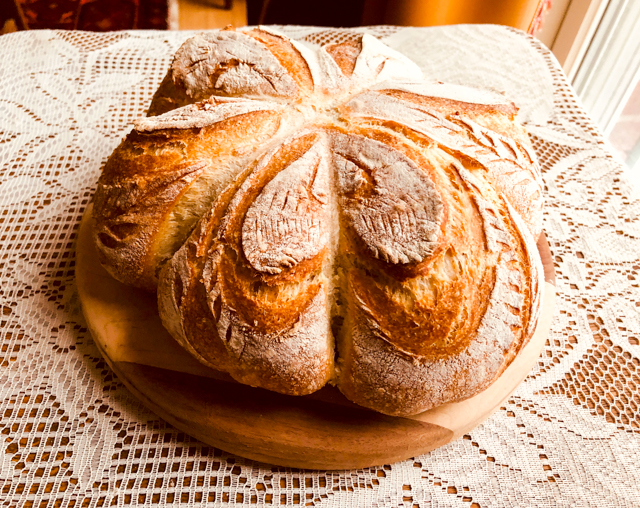
Place three strings over the dough nicely spaced, and touch the strings to glue them lightly to the bottom of the bread. Place a parchment paper on top, a flat baking sheet, and invert the dough, flipping it out of the banneton. Flour the surface of the dough, and tie the strings on top as shown in the composite picture. Score as desired, forming a heart pattern. You can paint with an air-brush, if desired.

Bake at 450F for 45 minutes, preferably covered for the first 30 minutes to retain steam. I cut the strings quickly after 30 minutes when I open the pan, and moved them gently out of the bread. Don’t worry if some parts of the string stay glued to the bread, you can remove later. Cool completely over a rack before slicing.

ENJOY!

to print the recipe, click here

The first bread is a flash-back from a couple of years ago, and you can read all the details here.

If you like to add some color to this basic scoring, here’s how to do it…

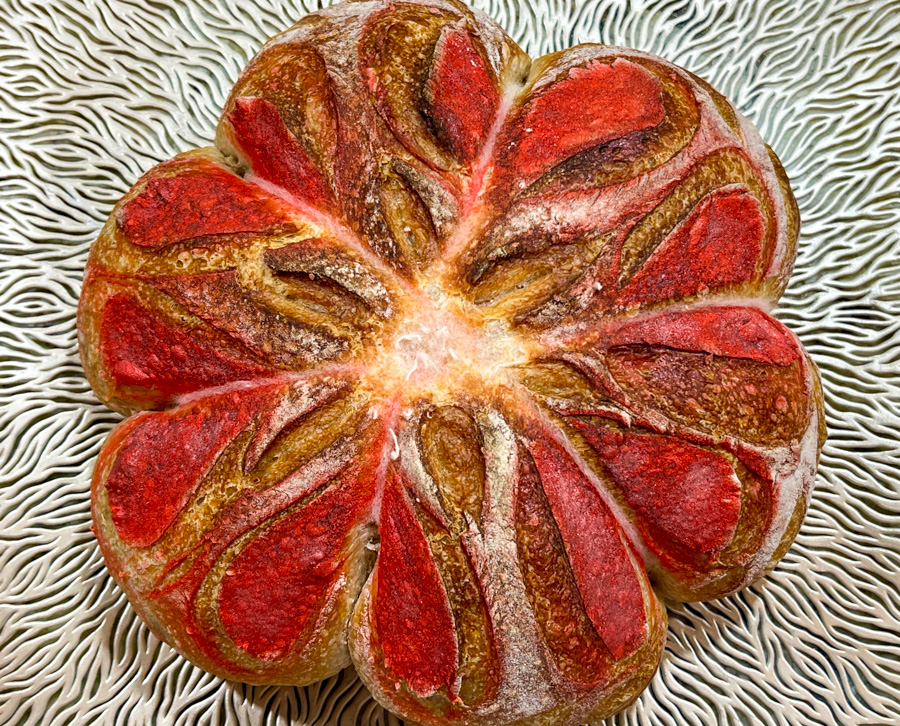
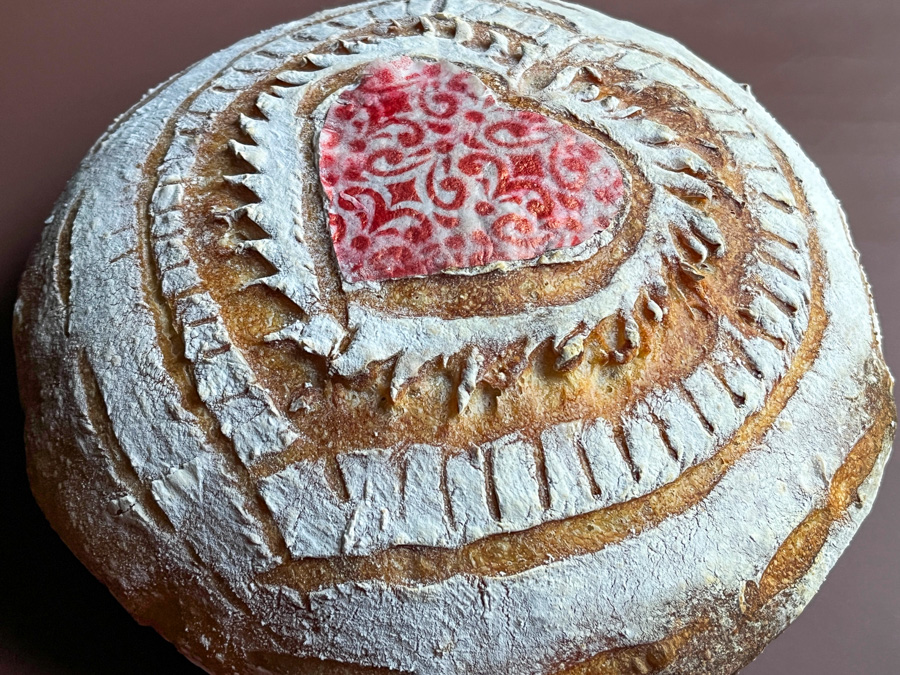
Simply tie the bread as explained in the recipe, score the heart shapes, and carefully air-brush the design with red. This particular loaf was smaller (400g total flour instead of 500g), so I did not have much space to work on additional details with the razor blade. But I still like the end result…

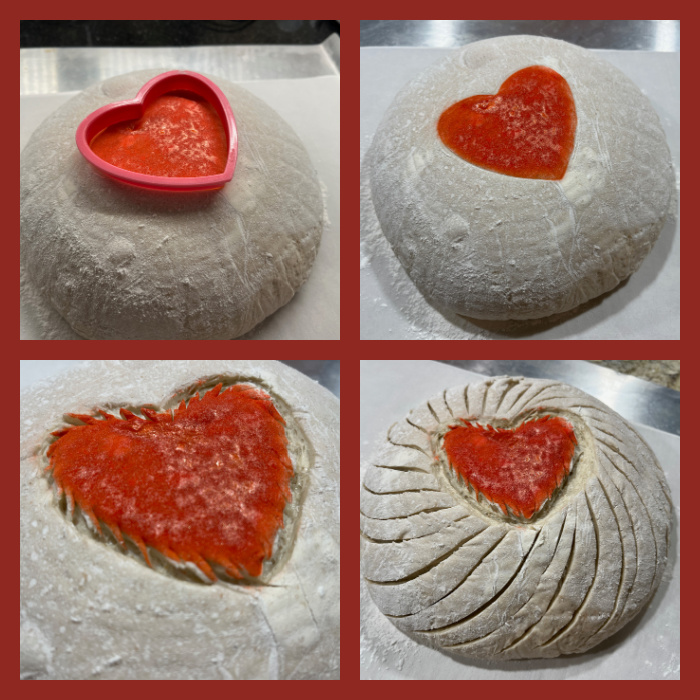
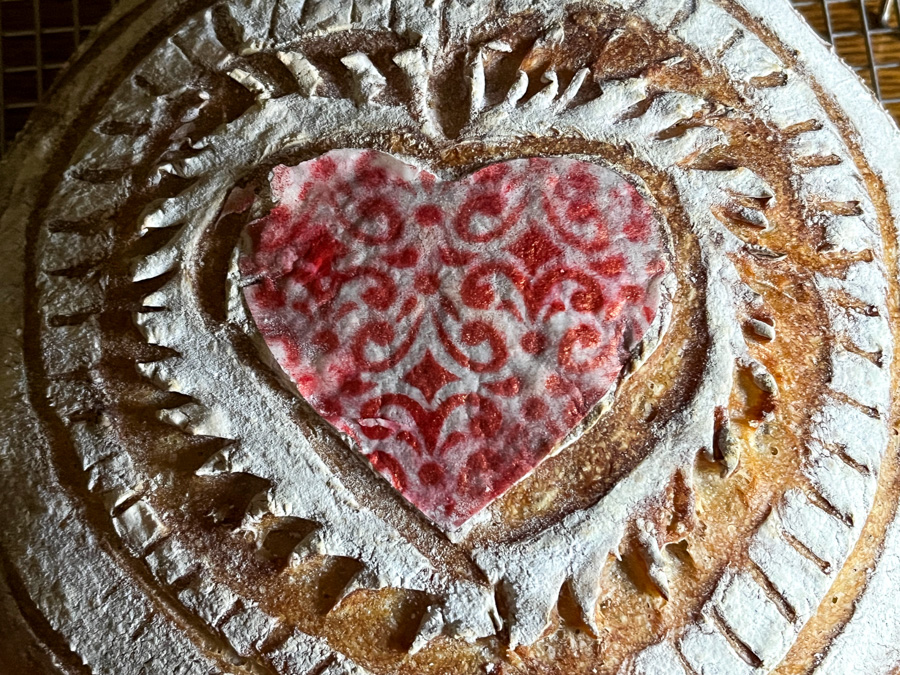
And the third design, might be the simplest, as you won’t need to tie strings around the shaped dough before baking.

I floured the top of the bread, placed a cookie cutter on top, air-brushed the inside with red dye, removed the cookie cutter and cut the heart with a razor blade first, then used the scissors to clip all around it. A little spiral scoring all around, and that was all!

Comments: I am not sure which design is my favorite, maybe the last one, although the bread had such strong oven spring that the spiral scoring ended up a bit removed from the heart design on top. If you don’t have an air-brush, you can paint with a regular brush, diluting the food dye with a little vodka or water, depending on how fast you want the paint to dry (vodka or any other alcohol will dry faster than water). You can also just score the heart and leave it plain.

ONE YEAR AGO: Embossed Chocolate-Cherry Sourdough Loaf

TWO YEARS AGO: Springerle Painting 101

THREE YEARS AGO: Mincemeat Pies, when the third time is a charm

FOUR YEARS AGO: Shibari Bread]

FIVE YEARS AGO: Incredibly Simple Times Four – January 2018 

SIX YEARS AGO: Two Salads and a Blog Award!

SEVEN YEARS AGO: When Three is Better than Two

EIGHT YEARS AGO: Somebody Stop Me!

NINE YEARS AGO: Zucchini Pasta with Cilantro-Cashew Pesto

TEN YEARS AGO: Bran Muffins, Take Two

ELEVEN YEARS AGO: Brown Butter Chocolate Chip Cookies

TWELVE YEARS AGO: Mogo Mojo

THIRTEEN YEARS AGO: Slow-Roasted Chicken Thighs: an Ice-Breaker

PAINTED SOURDOUGH

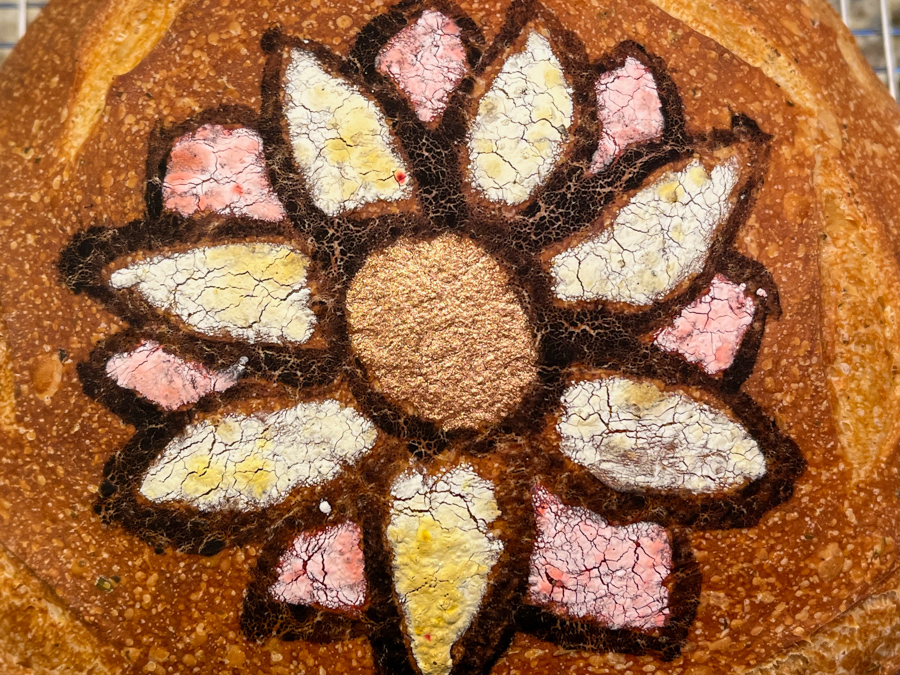
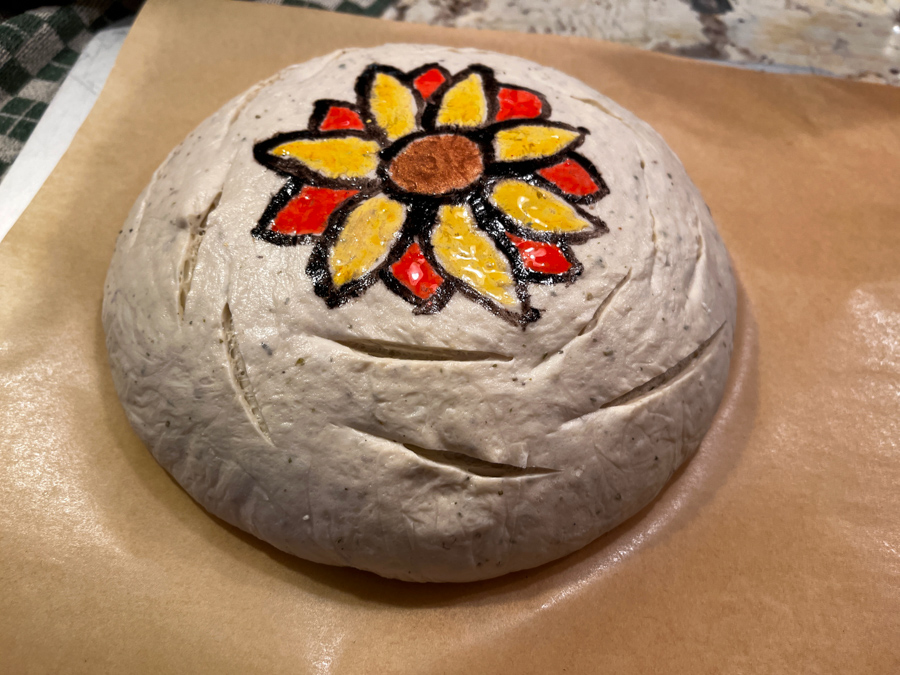
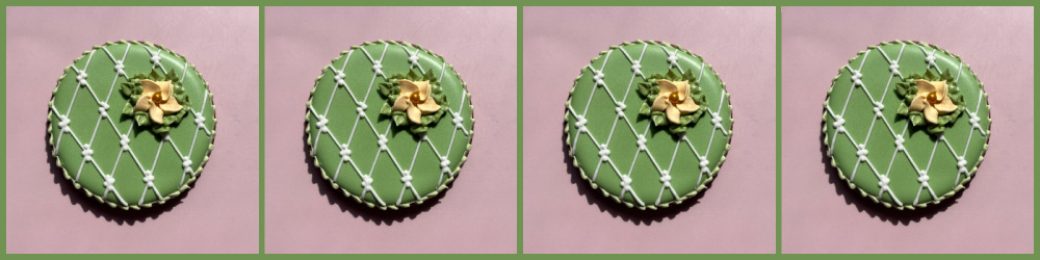
I consider this bread a work in progress, as the color is fading a bit during baking. Sugarprism stays very well on cookies (as I showed in the first cookie from this post), but I suppose 450F is a different story. However, this was only my second time doing it, and I already saw some improvement from the first attempt. Any sourdough recipe you are fond of will work. I opted for Elaine’s Herb and Olive Oil Sourdough, which I used as a teaser recipe in my recent review of her wonderful book (click here to read it, in case you’ve missed it). I like the way the olive oil in the dough seemed to tame a bit the crust explosion, and that worked well to keep the design untouched.

Basic things to consider when painting… minimize the amount of flour on the surface. When we do stenciling or even artistic slashing, a coating with flour is super important. In painting the dough, it makes things difficult and interferes negatively with the color. In today’s bread, for the outline I used black cocoa diluted with water. For the petals, Sugarprism in yellow and red. For the center of the sunflower, bronze luster powder diluted with vodka. As you can see, from the before pictures the bronze luster powder was the champion as far as keeping the color during baking. Black cocoa will always stay well, but if your goal is color, that cannot really help you much…

Just in case you are curious, below you see my first attempt painting sourdough. Two small issues happened: the dough had so much oven-spring that it lifted the design in ways that were not ideal. And I coated the surface with flour, which made the Sugarprism color interact with it and fade even more. The flour also gave a rough texture that made it impossible to spread the color nicely with a brush. In this case, I re-painted the bread the moment it came out of the oven to bring the color back. But my goal is to not have to do that, and get some method that retains the color during baking. Stay tuned then for my next adventure, in which I will use exclusively luster powder + vodka, hoping for a happy, very colorful ending…

ONE YEAR AGO: Over-the-Moon Blueberry Lemon Macarons

TWO YEARS AGO: Springtime Macarons Bake-Along

THREE YEARS AGO: Macarons for a Little Princess

FOUR YEARS AGO: Gilding the Sourdough Loaf

FIVE YEARS AGO: Lolita Joins the Bewitching Kitchen

SIX YEARS AGO: Cashew Cream Sauce

SEVEN YEARS AGO: Blood Orange Margaritas

EIGHT YEARS AGO: Smoked Salmon Appetizer

NINE YEARS AGO: Clementine Cake

TEN YEARS AGO: Springtime Spinach Risotto

ELEVEN YEARS AGO: The end of green bean cruelty

TWELVE YEARS AGO: Torta di Limone e Mandorle