SOURDOUGH STENCIL FUN


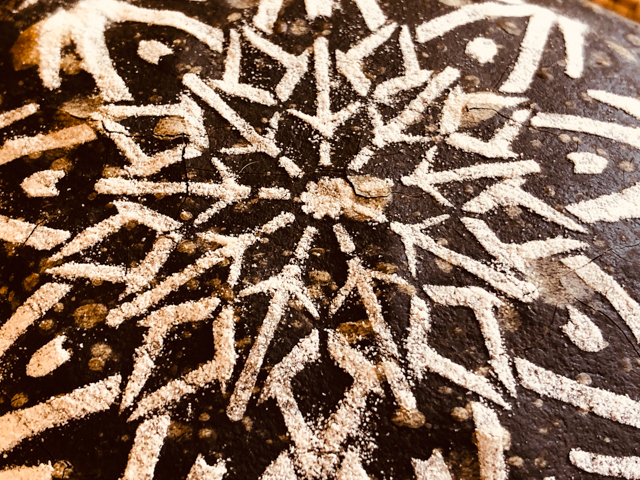
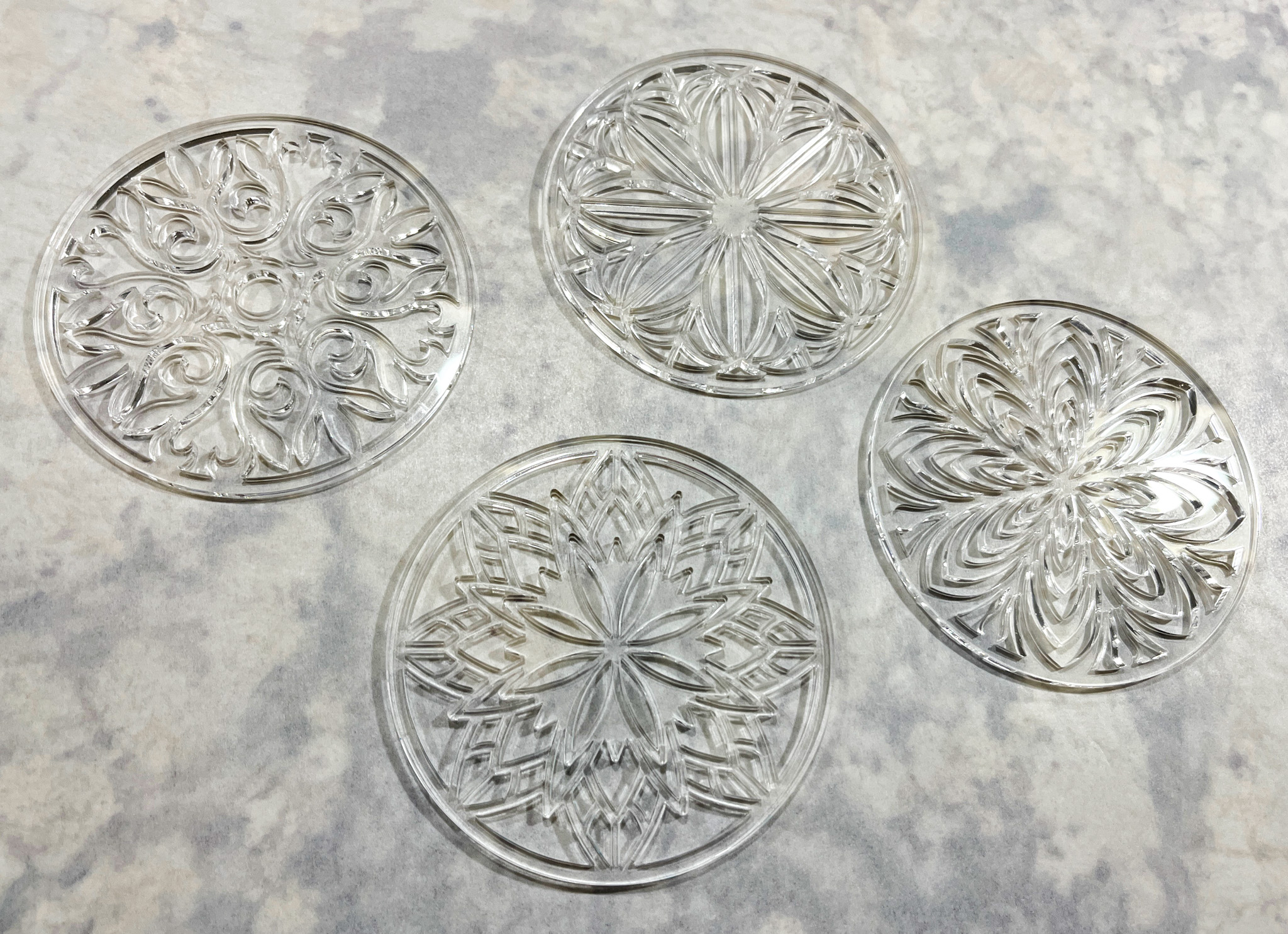
I got a new gadget, in fact a set of four cute gadgets to help decorate sourdough bread. It comes from Sourdough Fever, and you can get your own set here. Three different sets with four stencils included. I must say the set with heart shaped pattern ones is calling my name, and I might get it at some point. Before Valentine’s Day says hello.
SMALL BOULE SOURDOUGH BREAD
(from The Bewitching Kitchen)

240g water
70g starter at 100% hydration
7g salt
270g white bread flour
80g whole wheat flour

Make the levain mixture about 6 hours before you plan to mix the dough. It should be very bubbly and active.

When you are ready to make the final dough, place the water in the bowl of a KitchenAid type mixer and dissolve the starter in it, mixing with a spatula briefly, then add the two types of flour, and the salt. Turn the mixer on with the hook attachment and knead the dough for 4 minutes at low-speed all the time. If the dough is too sticky, add a maximum of 1/4 cup flour, you want the dough to start clearing the sides of the bowl, but still be sticky at the bottom.

Remove from the machine, and transfer to a container lightly coated with oil, cover lightly with plastic wrap and allow it to ferment for 2 hours, folding every 30 minutes or so. After the fourth folding cycle, let the dough sit at room temperature for another 2 hours. Shape the dough as a ball, and place, seam side up, in a lightly floured banetton. Place in the fridge overnight, from 8 to 12 hours or even longer, if you prefer.

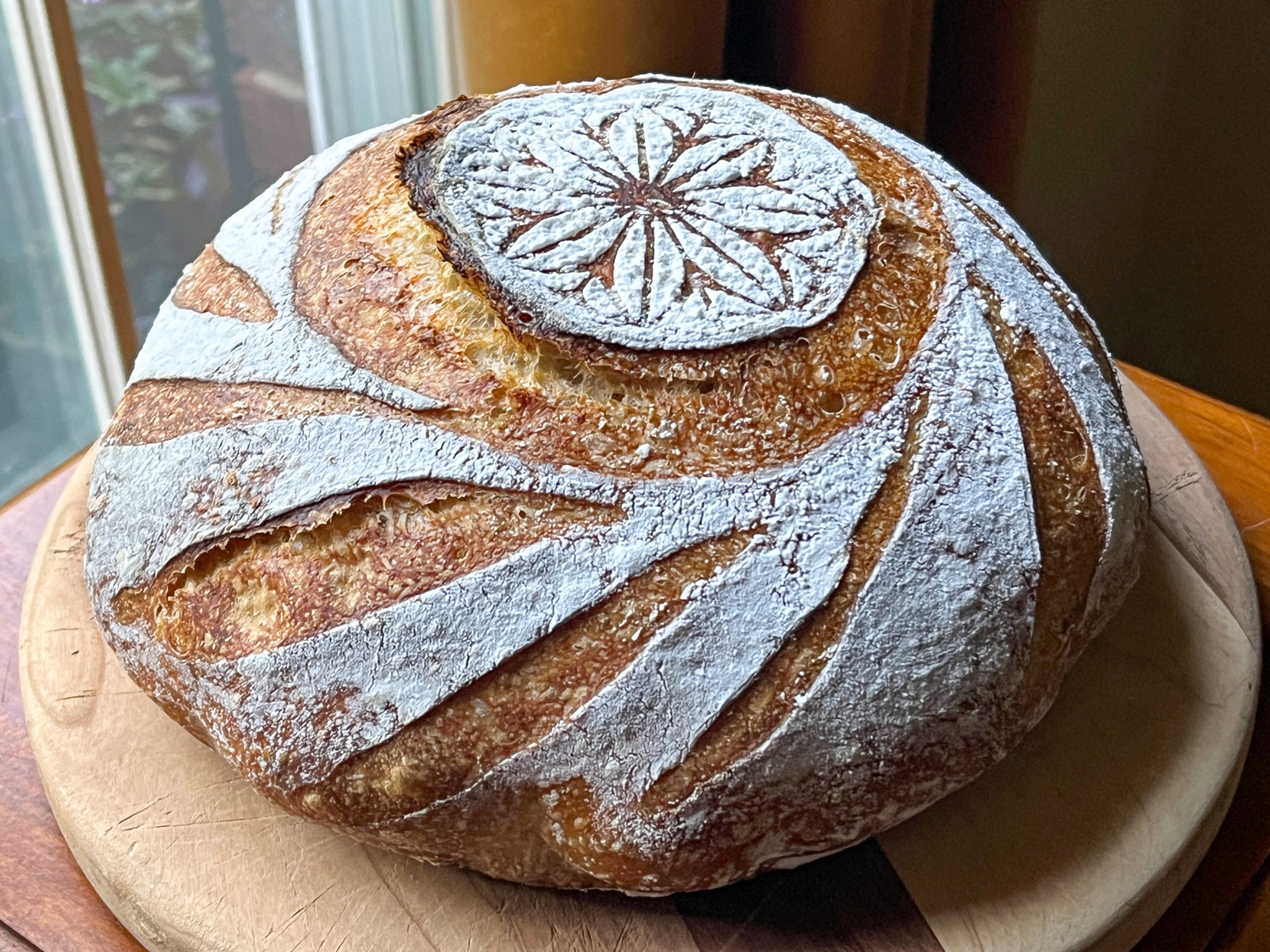
Next morning, heat the oven to 450F. Invert the dough over parchment paper, carefully place the stencil on top, and dust with flour. Make sure to rub the flour well into the design, a small brush is helpful. Lift the stencil and place the dough in a Dutch oven.

Bake at 450F for 45 minutes, preferably covered for the first 30 minutes to retain steam. Cool completely over a rack before slicing.

ENJOY!

to print the recipe, click here
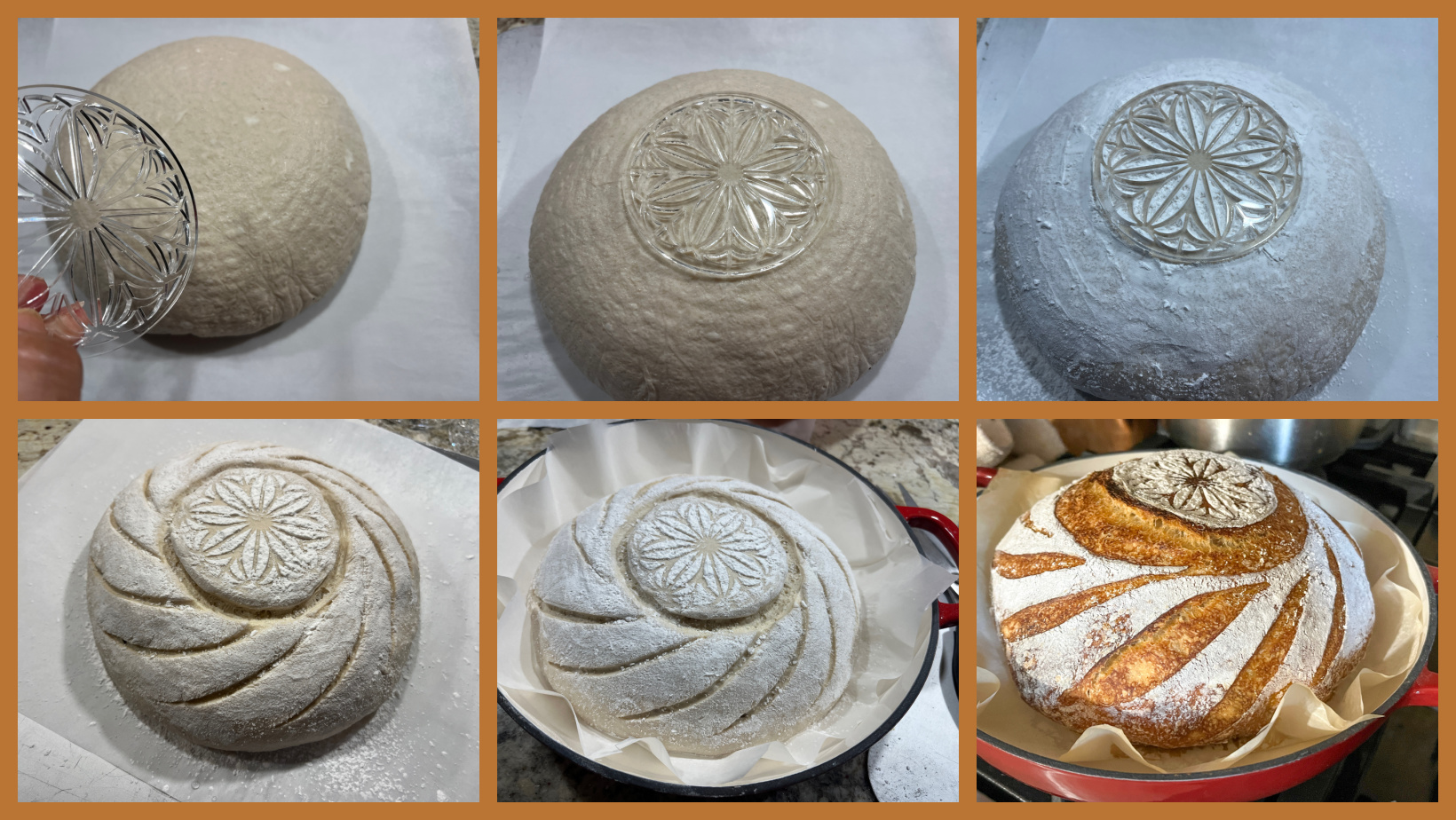
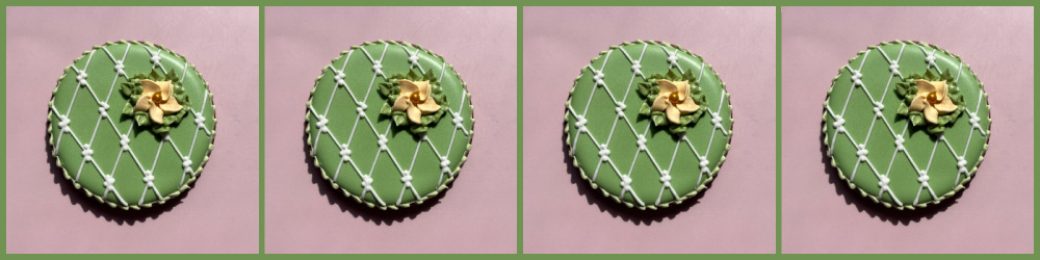
Comments: I love the way these stencils work. They lay nicely on the surface of the bread, but do not stick too badly, so you can easily lift it and preserve a nice image. In the set I got, you can have the four styles shown below.
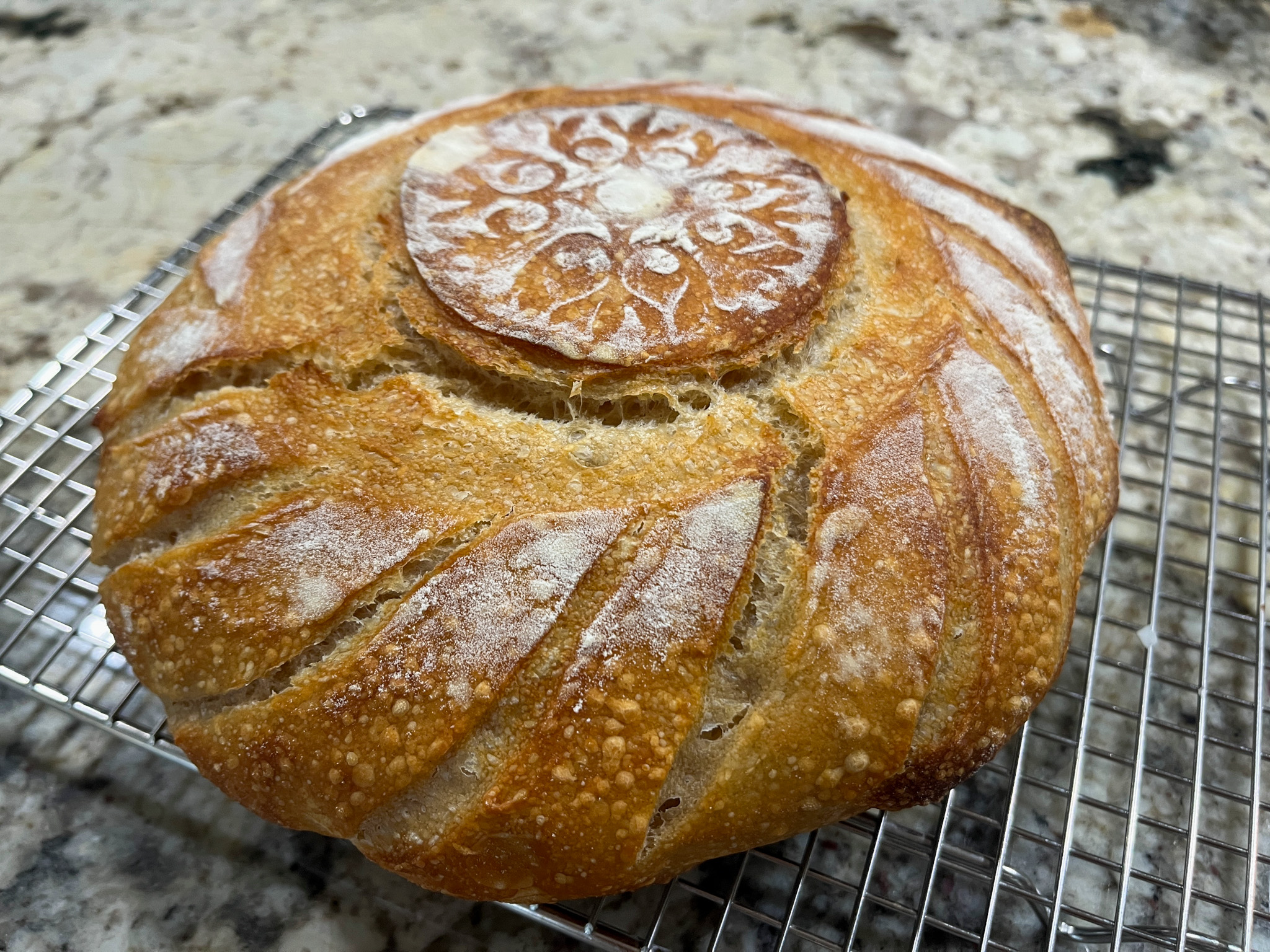
For my second loaf, I used the same recipe, but sprinkled regular white flour instead of tapioca on the surface. The contrast is a little less dramatic, but still visible.
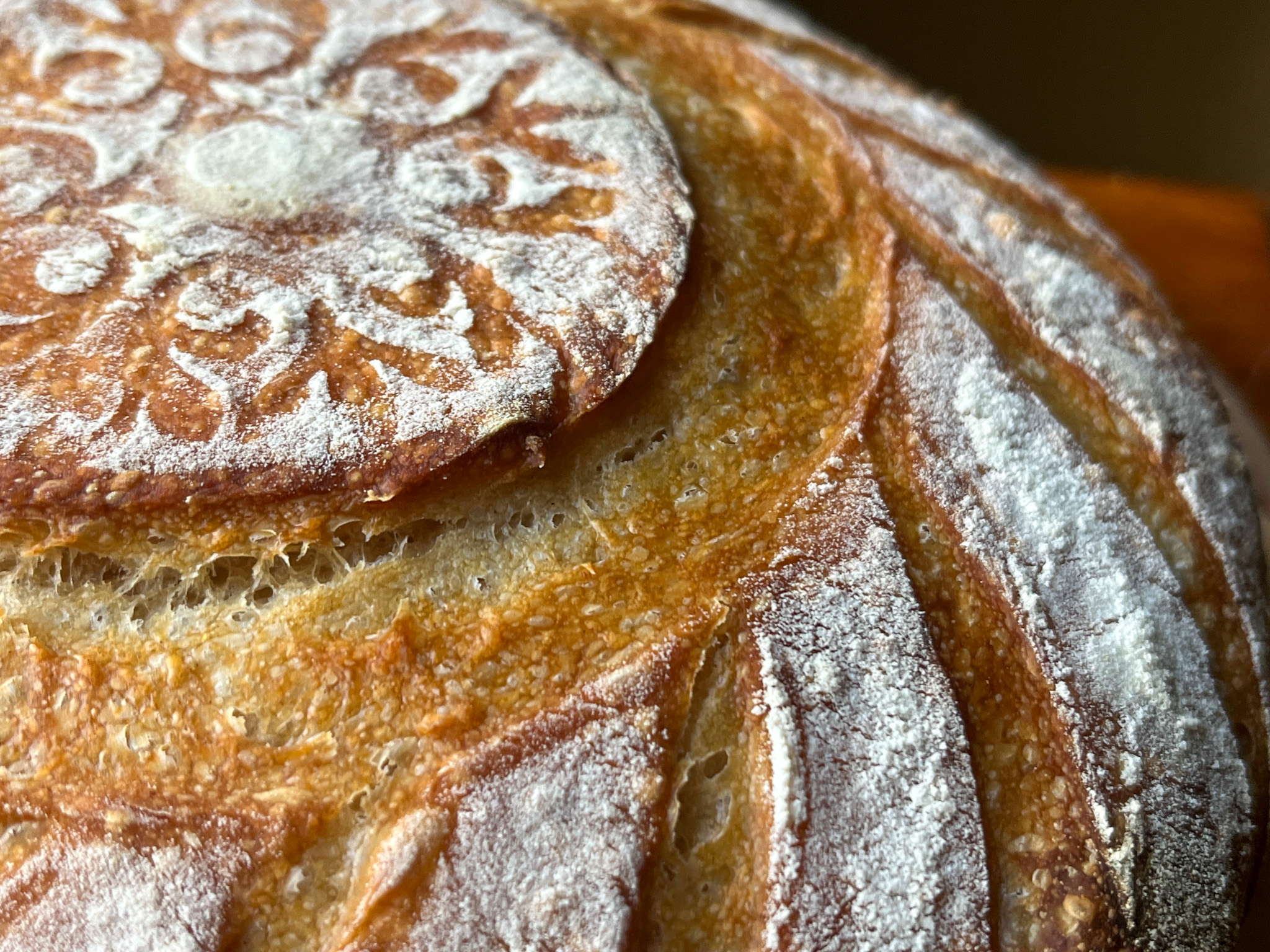
If you like to decorate your sourdough loaves, consider these plastic stencils as a nice option. The company is locate in the UK. I bought them long before the tariffs were in place, so I am not sure how things are working at the present time.
ONE YEAR AGO: Il Pane de Vincenza

TWO YEARS AGO: Gruyere Cheese Biscuits

THREE YEARS AGO: Incredibly Simple Korean Chicken Thighs

FOUR YEARS AGO:  Zucchini with Quick-Pickled Vegetables and Peanut Sauce

FIVE YEARS AGO: Nha Benta (Brazilian candy)

SIX YEARS AGO: The Best, The Very Best Hummus

SEVEN YEARS AGO: Chicken Katsu

EIGHT YEARS AGO: Whole-Lemon Marinade: Long Overdue

NINE YEARS AGO: Tomato and Cucumber Salad with Almond Vinaigrette

TEN YEARS AGO: Eggplant Tomato Stacks

ELEVEN YEARS AGO: The Couscous that Wasn’t

TWELVE YEARS AGO: Apple-Cinnamon Bread

THIRTEEN YEARS AGO: Blueberry Galette

FOURTEEN YEARS AGO: In My Kitchen, August 2011

FIFTEEN YEARS AGO: Journey to a New Home

SIXTEEN YEARS AGO: Friday Night Dinner

LA COURONNE LYONNAISE, TWO WAYS

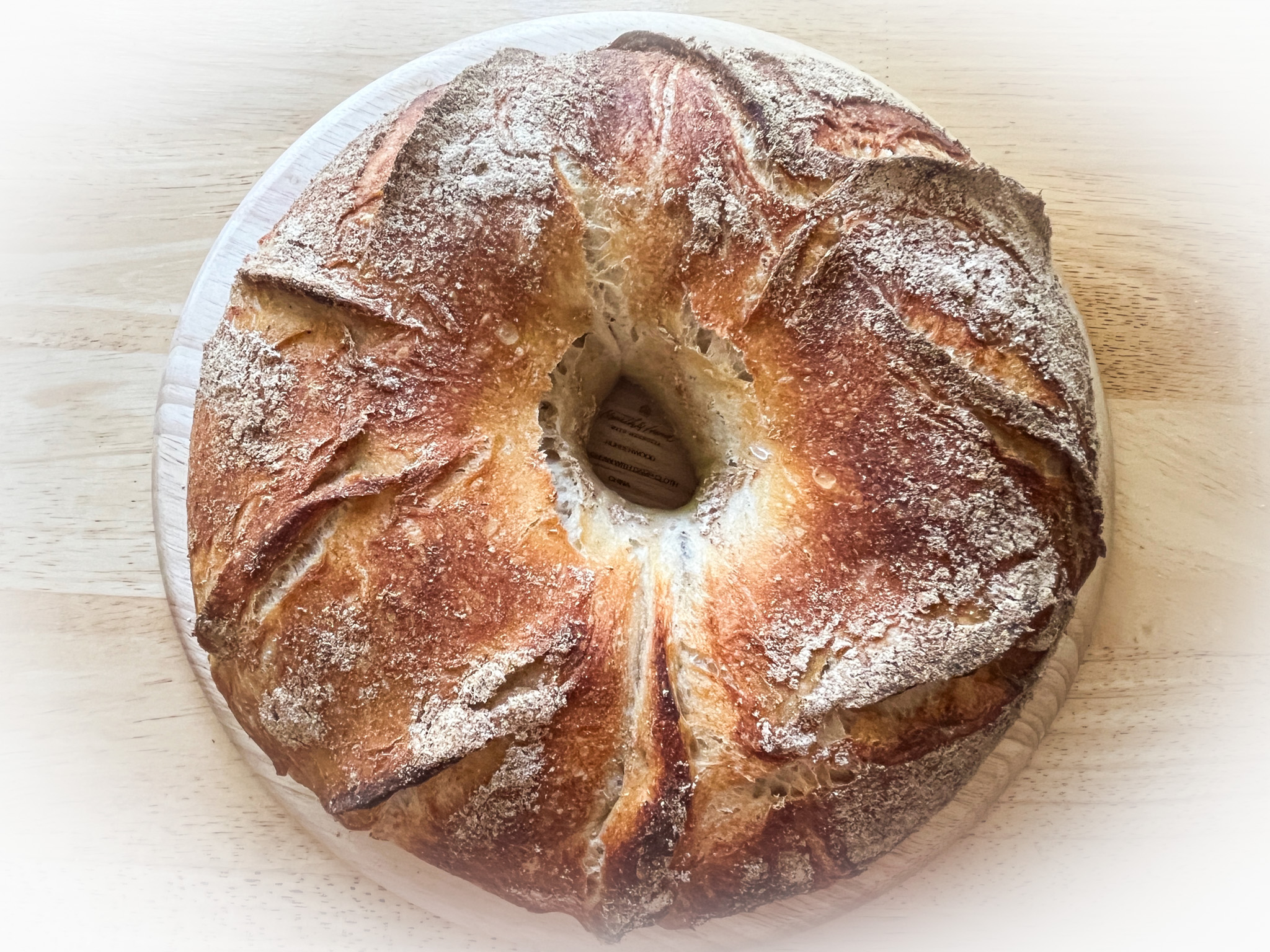
This bread originates in Lyon, and is shaped as a crown, therefore the name “couronne”. However, there are several ways to gild this lily. I am sharing two methods, the first one worked exactly the way I hoped, the second I consider a work in progress. So, yes, I will be back, hopefully with improvements on the second version…

.

METHOD ONE
A SIMPLE COURONNE


LA COURONNE LYONNAISE
(adapted from Henri-Luc’s blog)

530g bread flour
10g salt
160g sourdough starter at 100% hydratioin
300g water
rye flour for dusting

Mix sourdough starter in water and whisk to distribute well. Add bread flour and salt, incorporate either by hand or with a KitchenAid type mixer fitted with a hook dough for a few minutes. Proof at room temperature for 4 to 5 hours with folds at every 45 minutes.

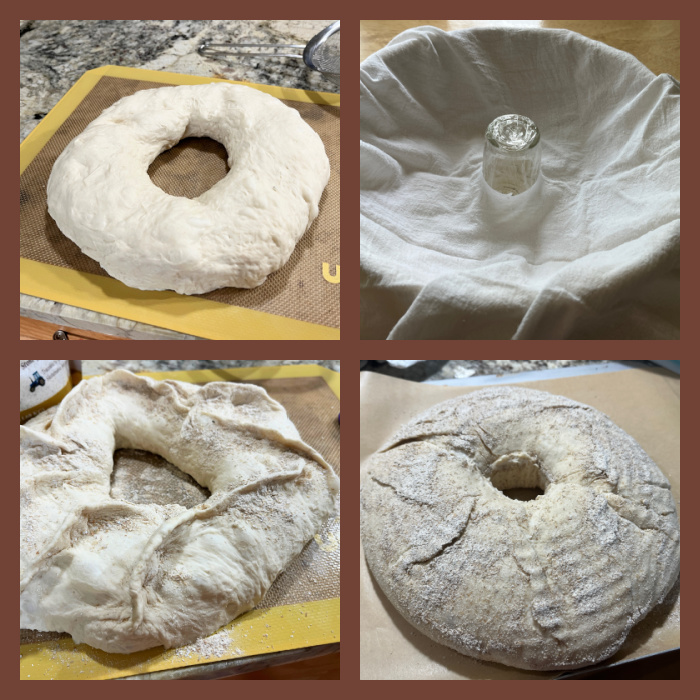
Prepare your round banetton to proof a crown, by placing a small glass or plastic container in the center. Cover with a cloth and flour it lightly with rye flour.

Pre-shape the dough as a round ball. Allow it to relax for 15 minutes. Make a hole in the center (traditionally bakers use their elbow, do what you feel is right…). Enlarge the whole until you get to the size of your round banetton. Now grab some rye flour with your fingers and pinch a series of alternating straight lines on the surface. Pinch the dough well to make a super sharp line of dough raising up. Then flour the surface lightly again and invert the dough on the banetton. Side with the ridges should go down. Proof at room temperature for 2 hours. Place a parchment paper on top, invert the bread over it and slide into the hot oven right away.

Bake at 450F over a stone with steam for 20 minutes, then remove the steam (I used a large roasting pan inverted over the stone as a lid). Bake for 20 to 25 minutes longer. If the bread darkens too much cover it with foil. Internal temperature should be around 210F.

Cool completely before slicing.

ENJOY!

to print the recipe, click here

Comments: This was such a fun bread baking adventure! I loved making the ridges and the way they gave the bread that incredibly nice rustic look once it baked. Make sure to use rye flour to dust the surface, it is going to make a big difference if you skip it. White flour won’t have the same effect.

.

METHOD TWO
COURONNE WITH FLAPS

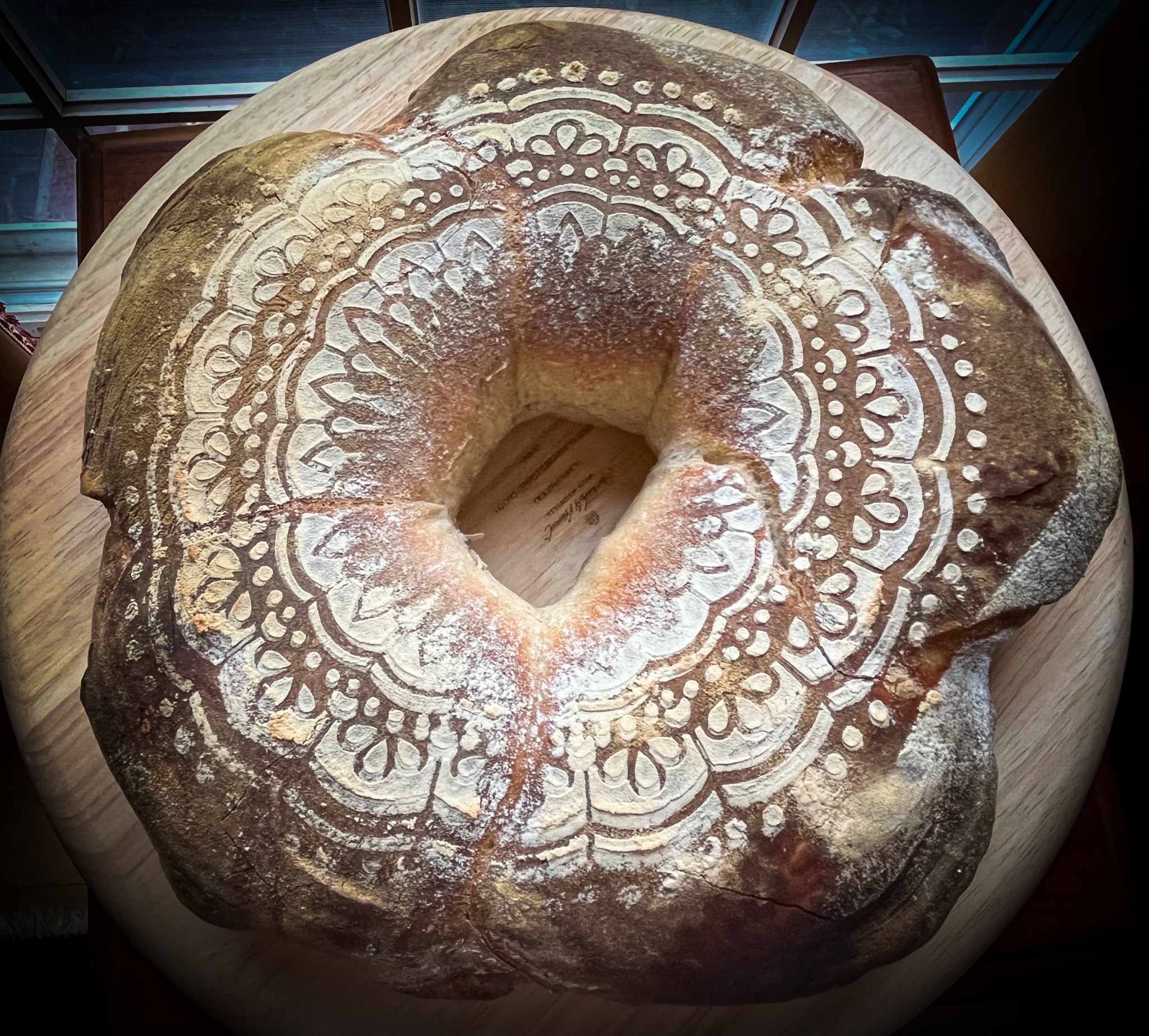
The flaps were a big flop. What can I say? The real beautiful version would have them all lifted up from the surface of the bread, mine stayed more or less glued to the surface. This was my second attempt, the first one was worse, so you won’t be seeing that (wink, wink). The shaping is quite a bit more elaborate. You form pieces of dough that are about 200g in weight, then roll a flap coming out of it, and roll the ball into it. Place to proof with the flap down, open side to the edge of the banetton. Before closing the flap over the ball of dough, a little olive oil is used to brush the edge, so the dough won’t stick and will instead lift during baking. Pictures below give you a general idea of the shaping method.

I had several issues, including the fact that 200g per ball of dough was probably too much. I will revise the whole thing and try again, because I really REALLY want to make it work right. I love the stencil decoration made right before baking (I will share info on the stencil and banetton in my upcoming In My Kitchen post, on October 1st).

I hope you enjoyed this post, and maybe you can give this method a try. If you get your flaps not to flop, let me know your secret!

ONE YEAR AGO: Have a Heart

TWO YEARS AGO: Chocolate-Hazelnut Tartlets

THREE YEARS AGO: Turkey Taco Salad

FOUR YEARS AGO: Cheese and Pesto Emmer Roll-ups and Elaine’s Cookbook Review

FIVE YEARS AGO: Mango-Hazelnut Entremet Cake

SIX YEARS AGO: Lebanese Lentil Salad and a Cookbook Review

SEVEN YEARS AGO: Cottage Loaf

EIGHT YEARS AGO: Sourdough Loaf with Cranberries and Walnuts

NINE YEARS AGO: Sichuan Pork Stir-Fry in Garlic Sauce

TEN YEARS AGO: Our Green Trip to Colorado

ELEVEN YEARS AGO: Ditalini Pasta Salad

TWELVE YEARS AGO: Celebrate Wednesday with a Thai Seafood Curry

THIRTEEN YEARS AGO:  Post-workout Breakfast

FOURTEEN YEARS AGO: Semolina Barbecue Buns

FIFTEEN YEARS AGO: Lavash Crackers

CHARCOAL PEANUT SOURDOUGH

I’ve been struggling with bread stencils lately. My designs end up not as sharp as I hoped them to be, lack of contrast after baking, all sorts of annoying little disappointments. I finally figured out what I was doing wrong, after watching videos from bread guru Morgi. I will share a couple of tips today, in case you’d like to use this method to decorate your bread.

CHARCOAL PEANUT SOURDOUGH
(from the Bewitching Kitchen)

470g bread flour
20g spelt flour
10g peanut flour
7g charcoal powder
10g salt
370g water
100g sourdough starter at 100% hydration

Make the levain mixture about 6 hours before you plan to mix the dough. It should be very bubbly and active.

When you are ready to make the final dough, place the water in the bowl of a KitchenAid type mixer and dissolve the starter in it, mixing with a spatula briefly, then add the three types of flour, charcoal and salt. Turn the mixer on with the hook attachment and knead the dough for 4 minutes at low-speed all the time. You will notice the dough will gain quite a bit of structure even with just 4 minutes in the mixer. If the dough seems too soft, add a bit more bread flour. Remove from the machine, and transfer to a container lightly coated with oil, cover lightly with plastic wrap and allow it to ferment for 4 hours, folding every 45 minutes or so. Because the dough is already a bit developed from the initial time in the mixer, you should get very good structure after 3 and a half hours, or even sooner than that.

After four hours bulk fermentation, shape the dough as a ball, and place, seam side up, in a lightly floured banetton. Leave at room temperature one hour, and then place in the fridge overnight, from 8 to 12 hours.

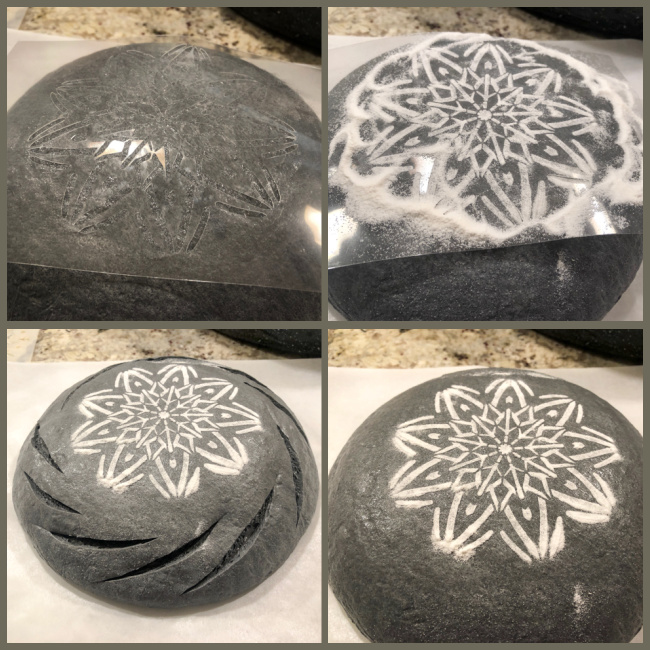
Next morning, heat the oven to 450F. Invert the dough over parchment paper, if the surface seems moist you can place the stencil right away on top of it. If it seems dry, spray lightly with water and position the stencil. Shower some white rice flour on the stencil and rub gently with the fingers of your right hand as you steady the stencil with your left hand (do the opposite if you are left-handed). The idea is to rub the flour on the surface through the openings of the stencil, so that you get a good pattern formed. Carefully lift the stencil and slash the bread around it, so that the bread will not open and compromise the image.

Bake at 450F for 45 minutes, preferably covered for the first 30 minutes to retain steam. Cool completely over a rack before slicing.

ENJOY!

to print the recipe, click here

Comments: If you use a banneton for the final rise of your shaped loaf and it glues to it when you try to invert it to bake, you know that can be VERY frustrating. Sometimes it even distorts the beautiful shape achieved slowly overnight in the fridge. I normally add quite a bit of flour to the banneton before the dough goes in, but when I want to do the stencil decoration, I prefer not to have too much flour on the surface to start with. My tip is simple: place a plastic wrap (like Saran-wrap or other brands) inside the banneton and THEN add your bread – it does not prevent the ridges from making that cute impression on the surface (although it will be slightly less evident) and you will have NO issues inverting the dough to bake.

For the image to be sharp and evident, the trick is to have a little moisture on the dough, and rub the flour, gently but firmly. Hold the stencil in place with one hand, and rub the flour with the other. Lift the stencil as delicately as humanly possible. Finally, whatever design you choose, slash the bread in ways that coach the opening away from the design. You can cut four deep slashes in a square shape with the design in the center, or do what I did, a circular series of small, deep cuts all around.

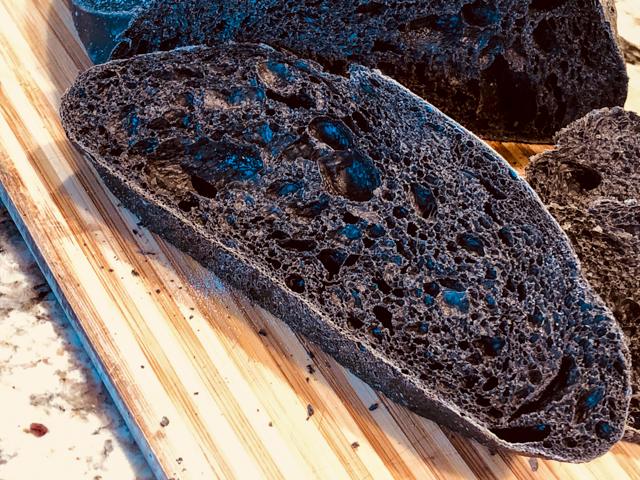
Peanut flour has no fat, but transfers the taste of peanuts quite well to the bread. It has a softer crumb than a straight sourdough with just bread and whole-wheat flours. And the charcoal contributes no taste. When we freeze slices after a couple of days, we like to cut one or two into croutons, because they look pretty amazing in that shocking black color.

ONE YEAR AGO: Chocolate Cake with Coconut Buttercream

TWO YEARS AGO: Berry Rebellion Tarts 

THREE YEARS AGO: Bergamot-Cherry Macarons

FOUR YEAR AGO: Roasted Veggies with Queso Cotija Dressing

FIVE YEARS AGO: Creamy Broccoli and Mushroom Casserole

SIX YEARS AGO: Maple Walnut Biscotti

SEVEN YEARS AGO: Barley Risotto with Peas

EIGHT YEARS AGO: Oatmeal Fudge Bars

NINE YEARS AGO: Cauliflower Steaks

TEN YEARS AGO: Soft Spot for Chevre

ELEVEN YEARS AGO: Quick sun-dried Tomato Crostini