WATERMELON SORBET

A few weeks ago I inaugurated my Cuisinart ice cream maker by making chocolate sorbet. Not my best performance, the texture was off, a bit grainy. I guess I didn’t melt the chocolate well enough before chilling the base.  I must try another recipe, as it is Phil’s favorite flavor, but in the meantime I picked his second favorite flavor and went to work. Watermelon sorbet was a lot more forgiving, refreshing and light, perhaps a tad too sweet. Next time I’ll up the lemon juice and reduce the sugar slightly.

WATERMELON SORBET
(from Culinary Philosopher)

1 + 1/4 cup sugar
1+ 1/4 cup water
1 quart cubed watermelon (seedless)
4 Tbs fresh lemon juice

In a medium saucepan, bring the sugar and water to a boil. Reduce the heat and simmer  without stirring until the sugar is completely dissolved.. Place in a bowl to cool to room temperature.

Put the watermelon chunks and the lime into a blender or food processor. Pulse about 20 times to chop the melon, then process until the watermelon is completely pureed. Press the watermelon through a mesh strainer,  and combine with the cooled sugar syrup. Chill in the refrigerator for at least one hour.

Pour the mixture into the frozen bowl of your ice cream maker and mix it for 25 to 30 minutes, or according to the instructions on your machine.  The sorbet will have soft serve texture. You can enjoy right away or put the sorbet into an airtight container and place in the freezer until firm for about 2 hours to firm it up.

ENJOY!

to print the recipe, click here

Comments:  I am in love with our Cuisinart ice cream maker!  The watermelon mixture seemed VERY liquid to start with,  I wasn’t sure it would ever turn into a sorbet, but the machine kept churning, the crystals started forming, and in a little less than 30 minutes I had a delightful batch of watermelon goodness!  A little liquid stayed at the bottom of the machine, I am not sure if one should open it midway through the churning and scrape the bottom, but it did not compromise the results.

Watermelon is by nature very sweet, so next time I’ll  use 3/4 of the amount of sugar, perhaps even half, and see how it goes.

If you are over the fence about getting an ice cream maker, don’t debate with yourself for 3 years as I did.  Get one while Summer is still smiling at you!  😉

ONE YEAR AGO: Under the Spell of Lemongrass

TWO YEARS AGO: Greens + Grapefruit + Shrimp = Great Salad

Add to FacebookAdd to DiggAdd to Del.icio.usAdd to StumbleuponAdd to RedditAdd to BlinklistAdd to TwitterAdd to TechnoratiAdd to Yahoo BuzzAdd to Newsvine

CHOCOLATE AND CHESTNUT TERRINE

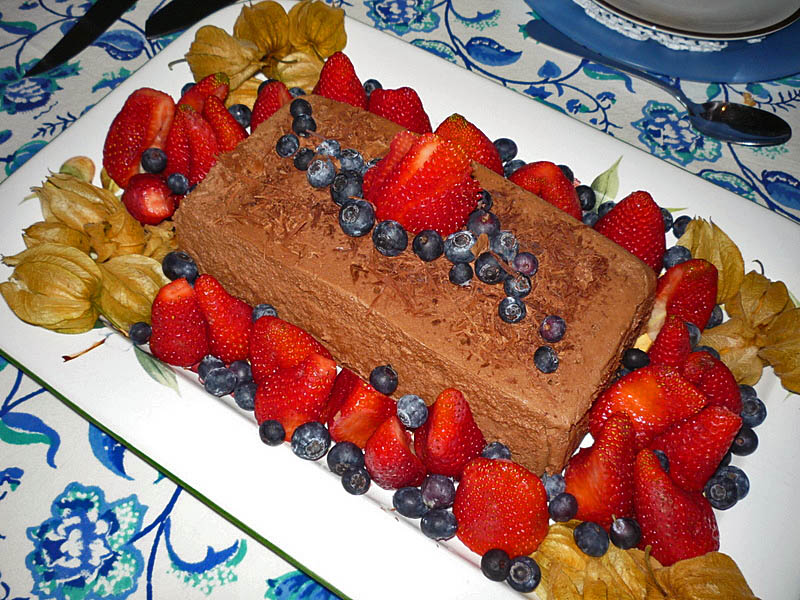
This delicacy deserves THE spotlight on the Hall of Fame of Desserts, perfect for closing with a golden key a very special dinner.  It is classy, looks absolutely gorgeous, and according to Claudio, our dear friend who prepared it, it’s not too complicated to make.  Granted, Claudio is a fantastic cook, so I wasn’t quite sure what to expect until he showed me the recipe.  In this case, I must agree with him: if you have access to canned pureed chestnuts, this will be one of the simplest desserts you’ll ever make, but even if you don’t,  making the puree is worth the effort, so you can taste this masterpiece and swoon with each bite.

TERRINE OF CHOCOLATE AND CHESTNUT PUREE
(from Le Cordon Bleu – Receitas Caseiras)

185 g  (6.5 oz) semisweet chocolate, chopped
90 g  (3.2 oz) butter, at room temperature
90 g (3.2 oz) granulated sugar
400 g (14 oz) canned chestnuts puree
¼ tsp instant coffee, diluted in 1 tsp warm water
¼ tsp vanilla
30 ml  (1/8 cup) rum
shaved semisweet chocolate
fresh fruits of your choice (strawberries, blueberries, aguaymantos)

Lightly grease a loaf type pan with oil, cover the bottom with parchment paper, and oil the paper.

Melt the chopped chocolate in a bowl over simmering water (without letting the water touch the bottom of the bowl), stirring often.  Once it is completely melted and smooth, allow it to cool for 5 minutes.

Beat the butter with the sugar in a KitchenAid type mixer until creamy.  Incorporate the chestnut puree, and the melted chocolate.  When the mixture is very smooth, add the vanilla, coffee, and rum.  Pour into the prepared loaf pan, smooth the surface with the back of a spoon or a small icing spatula, cover with plastic wrap and place in the fridge for at least 12 hours.

To unmold, carefully run a spatula around the edges, invert the terrine on a serving platter, and decorate with fresh fruits of your choice, shaving chocolate all over.

Cut in slices, and serve.  Count the seconds until the first compliment!   😉

ENJOY!

to print the recipe, click here

Comments:  This recipe is from a Brazilian edition of a Le Cordon Bleu publication from many years ago. I could not find a link to the specific book, but if you click here, you’ll be directed to the huge LCB  collection available at amazon.com.

Both Phil and I were blown away by this dessert!  It is creamy, rich, and even though I was firm on my intention of having a very small slice after the great dinner they had served us, I was powerless, unable to resist a second (bigger) slice.  It melts in your mouth, with the fresh fruits balancing the intense chocolate flavor.  The aguaymantos (fisalias in Portuguese) were a terrific touch, with their slightly tart taste and exotic look, they added extra pizazz to the dessert.
That’s what their garden looks like at winter time…  a tropical paradise indeed!

ONE YEAR AGO: Bewitching Farro Salad

TWO YEARS AGO: From sea to table: sushi

Add to FacebookAdd to DiggAdd to Del.icio.usAdd to StumbleuponAdd to RedditAdd to BlinklistAdd to TwitterAdd to TechnoratiAdd to Yahoo BuzzAdd to Newsvine

A TROPICAL STREET MARKET

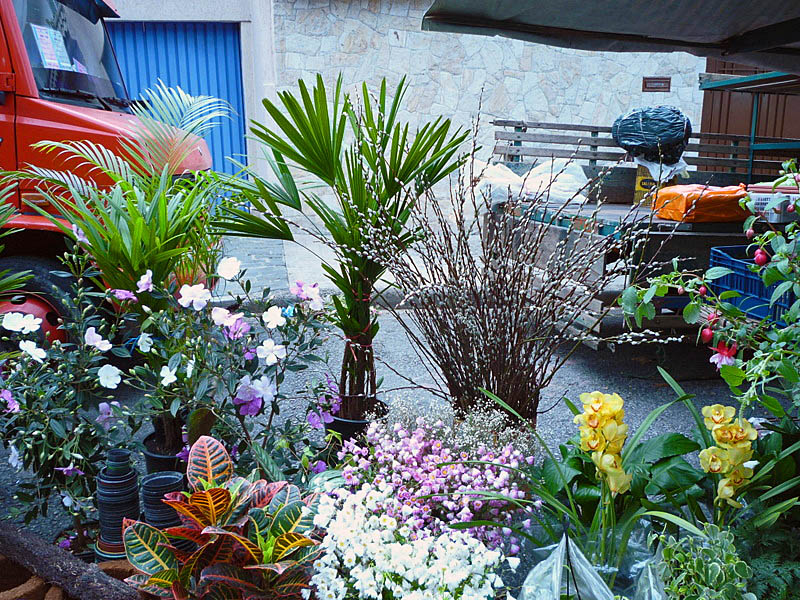
From fruits to flowers… a little bit of everything!
Street markets – or “feiras” in Portuguese – are a big tradition in Sao Paulo.  Each neighborhood has its own weekly market, with the same vendors arriving early in the morning to set up their shops, with their voices getting louder and prices getting smaller as the hours pass.  Usually it’s over by 1 or 2 pm.  Near my Mom’s house the street market happens on Wednesdays, and she recalls that  when she moved from Rio to Sao Paulo back in 1953, the feira was only a few years old, and only had a handful of stands. Last Wednesday our stroll through the market left us both amazed by the variety of vendors and the quality of their produce.  Keep in mind that this trip took place during the dead of the Brazilian winter, which means the thermometers might drop to about 60F.  These temps drive paulistas to heavy scarves and jackets, and then they still walk around shivering and chattering their teeth…  We couldn’t believe our eyes when we were jogging in the park early that morning, and saw a few dogs wearing jackets to protect them from the cold (a bone-chilling 61F. ;-))

But, back to the important stuff.  Each market, no matter the location, has two mandatory stands by the main entrance:  one selling freshly made pasteis (for a flashback click here) and right next to it, one selling “garapa,”  a refreshing,  sweet drink made from pressed sugar cane.  The vendor has a machine that literally presses the sweet juice from the sugar cane.  It’s incredibly delicious! When I was a child, garapa was just that, pure cane juice, served over ice. Nowadays, one finds many variations, with fresh pineapple juice, lime or lemon juice, sometimes mint leaves.  Each glass is made to order, and in the Summer the trucks selling garapa are surrounded by bees, going  crazy by the scent of sugar, often trying to land on your glass to steal a taste.  Here you see a garapa truck waiting for customers…

Pasteis also changed substantially from my youth, from two kinds (meat or cheese), to the many  variations found today: three cheeses, hearts of palm, chicken, spicy sausage, shrimp, pizza, portuguesa (spicy sausage, hard-boiled egg and cheese) …  the imagination is the limit.  They even sell tiny pasteis with nothing inside, called quite appropriately “pasteis de vento”, or “wind-filled pasteis.”   They are often served as appetizers at cocktail parties,  and each is gone in one or two small bites, leaving crumbs all over your lips.  They are messy to eat, but oohh so very tasty!  You can see pasteis de vento in the photo below, they are inside big plastic bags, each holding a few dozen of these delicacies.

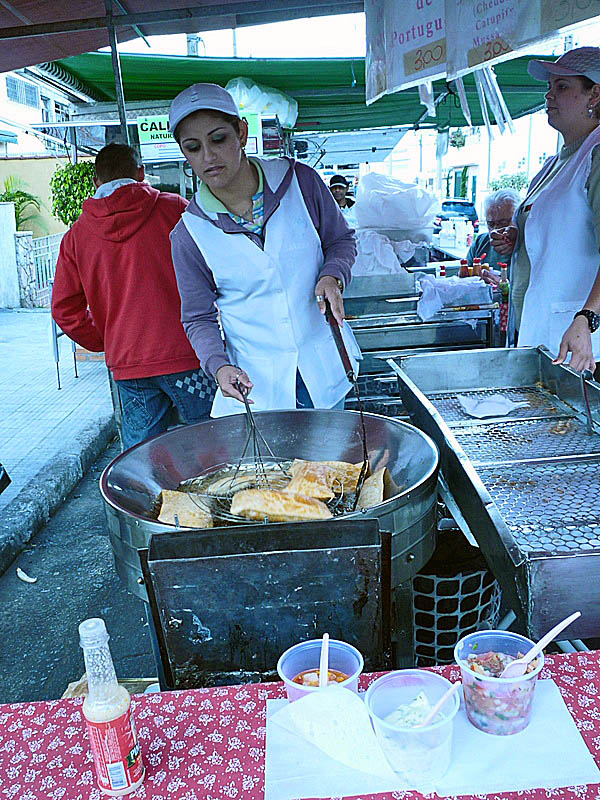
and here you see the real pasteis, fried as the customer waits, with the filling of his/her choice…

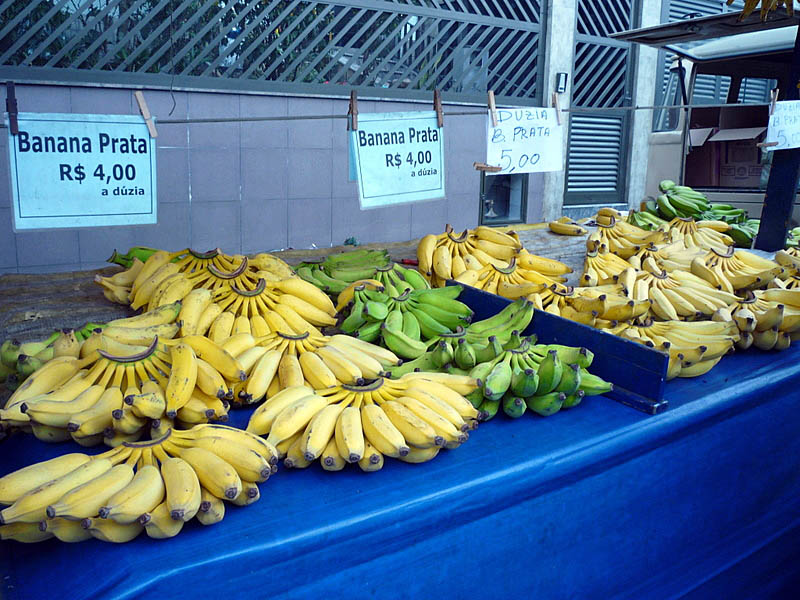
Then, the fun begins!  Take a look at the fruits and veggies, all available at this time of the year in my hometown (each photo can be enlarged by clicking on it).

Butchers are ready to prepare special cuts for you, or do jobs like cleaning livers – slivered liver sauteed with onions is a popular dish in Brazil, by the way. My Mom used to make it every Wednesday for my Dad to profit from the extra fresh liver always available at the street market.

If you want to see more, please take a look at the slideshow I set up at Picasa by clicking here.  And if the photos got you wondering about cara’-moela,  thanks to the help of my dear sister Norma you can learn about it here.

All I can say is that it was hard to be just an observer at the street market, as I had no opportunity to cook during our stay in Brazil.  We were very spoiled guests for the whole 10 days: many wonderful home cooked meals with family and friends, home-made pizzas cooked in a wood-oven, desserts galore!

But the best of course, was spending time with my Mom, who even made pot roast for us, something she had not cooked in more than 5 years.  Didn’t I say we were spoiled guests?   😉

ONE YEAR AGO:  Groceries

TWO YEARS AGO:  A Souffle to Remember…. Julia Child

Add to FacebookAdd to DiggAdd to Del.icio.usAdd to StumbleuponAdd to RedditAdd to BlinklistAdd to TwitterAdd to TechnoratiAdd to Yahoo BuzzAdd to Newsvine

A YUMMY BRAZILIAN CAKE: BOLO DE FUBA’

I often say that I don’t care  much for sweets, and visitors to the Bewitching likely realize that for me, savory stuff tops the sweets by a long, long margin.  But,  for many years I heard comments about my youngest niece’s cake skills (a gene that must have skipped my generation!), and now, finally, I had a chance to savor one of her specialties: a traditional Brazilian cornmeal cake, called “bolo de fuba’.”  Her recipe has two interesting additions:  a farmer’s type cheese and shredded coconut.  Together, they produce a cake that´s moist, with just the right sweetness.  If I had to describe it in a single word, that word would be irresistible.

RAQUEL’s BRAZILIAN CORNMEAL CAKE
(adapted from Na Cozinha com Carolina)

a little butter and flour to prepare the pan
4 eggs
3 cups of milk
1 + ½ cups sugar
2 Tbs butter
2 Tbs flour
1 cup cornmeal
100 g (4 oz) sweetened, shredded coconut
1 cup farmers type fresh cheese, coarsely grated
1 Tbs baking powder

Heat the oven to 350F. Prepare a round, medium size, ring cake type pan by buttering the inside and adding a small amount of flour, tapping off the excess.

Add all ingredients to a blender and mix until they form a smooth batter. Pour the batter into the prepared pan, and bake for 45 to 50 minutes, until a cake tester or toothpick comes out clean.

Let the cake cool for 10 to 15 minutes before unmolding. Serve it warm or cold.  

ENJOY!

to print the recipe, click here

Comments:  Bolo de fuba´ originates in Africa, in fact the name fubá  means flour in kimbundu (spoken in Angola),  but in Brazil it is used exclusively for what in the US is known as cornmeal.  The Portuguese, main colonizers of Brazil, expanded the use of cormeal into all kinds of sweet and savory concoctions, including breads, as their famous “broa.” 

Bolo de fuba´ is the type of cake one would expect to be served with a nice cup of coffee or tea in the middle of the afternoon, or at breakfast to start the day on a good vibe.  As you can see from the photo below, this cake bakes in three distinct layers, a cornmeal cakey component on top, a creamy center, and the coconut flakes in the base.

Raquel´s version is the best I´ve ever had, making me lose all my composure and restraint, going back for another tiny sliver, and another, and another, until she could not take it anymore and said “why don´t you just cut a real slice and get it over with?”   Wisdom comes in many forms.  Lesson learned. 😉

ONE YEAR AGO:  Hidden Treasure

TWO YEARS AGO: Avocado Three Ways

Add to FacebookAdd to DiggAdd to Del.icio.usAdd to StumbleuponAdd to RedditAdd to BlinklistAdd to TwitterAdd to TechnoratiAdd to Yahoo BuzzAdd to Newsvine

HEADED TO BRAZIL!

A quick announcement, today we jump on a jet plane once more, and head to Brazil, to see family and friends.   The Bewitching should go on, depending on internet connections, but we’ll be back to our regular spot on this beautiful planet on the 15th.