GRILLING TOMATOES

Our friends and neighbors who are also ultra-prolific gardeners went away on a trip and gave us a load of tomatoes before their departure. Some were big, heavy, and seemed very juicy, others were on a smallish side. I wanted to do something special with our gift, and went on a road never traveled before by making a grilled tomato sauce.  A final touch was wilting some arugula in it.  I will be traveling around this road on a regular basis from now on, this was a tasty sauce, and so simple to put together!
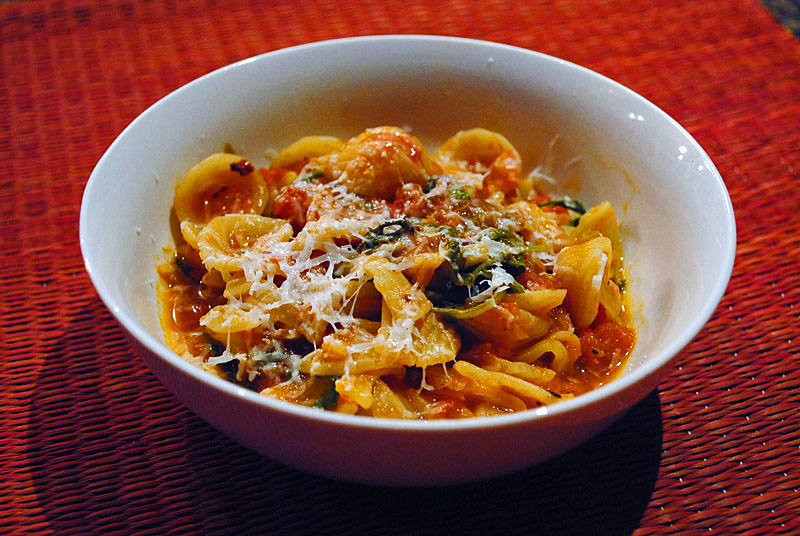

ORECHIETTE WITH GRILLED TOMATO SAUCE AND ARUGULA

(from the Bewitching Kitchen)

8 to 10 tomatoes, preferably from a friend’s garden
a little olive oil
salt and pepper
1 shallot, finely diced
2 cups of arugula
Orechiette pasta
Parmigiano Reggiano cheese, grated

Rub the tomatoes with a little olive oil, sprinkle salt and pepper, and place on a hot grill until the skin gets nicely charred. Turn them every few minutes to get grill marks on all sides.   Different sizes of tomatoes will be ready at different times (obviously), so remove them from the grill accordingly.  Take the stem and central core out, place the flesh, skin, and seeds in a food processor and process until smooth, or retaining some chunks, if you prefer.

Saute the diced shallot in olive oil with a little salt and pepper until golden.  Add the processed tomatoes, and cook for 5 to 10 minutes, until it gets the consistency  you like.  Season with more salt and pepper if needed, and in the final couple of minutes add the arugula, cooking gently until it wilts.

Meanwhile, cook the orechiette pasta according to the package instructions, drain, and mix with the sauce, warming everything together for a few minutes.  Add to a serving bowl, and shave some Parmigiano on top.

ENJOY!

to print the recipe, click here
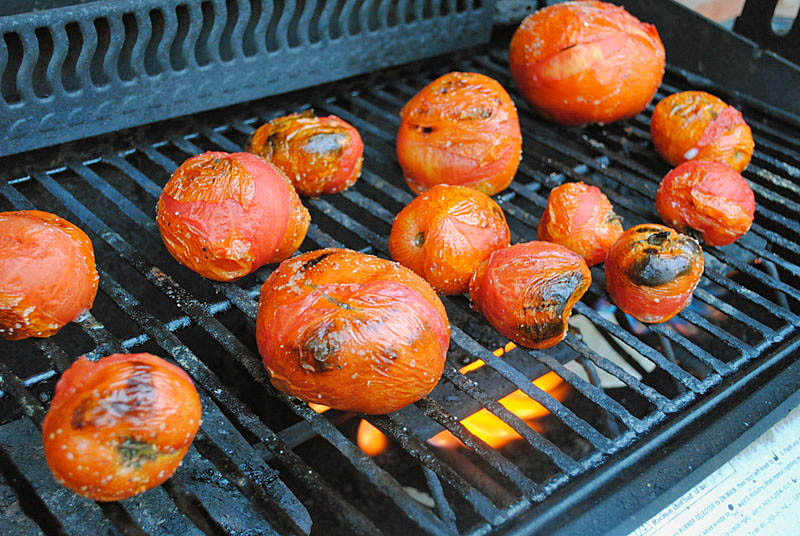
Comments: All modesty aside, this sauce was a perfect use for tomatoes that were not uniform in size and type, all I had to do was pay attention to the grill and remove each one as they got done. Grilled tomato sauce would work well on many venues: as a topping for pizza, bruschetta, over a mild, grilled fish, or as a basis for pasta sauces with different herbs and/or greens.   Not bad as a starting point for soup, I suppose, although the idea of soup with the heat wave we are having is not very appealing.  I never quite got the taste for cold soups, maybe next year I’ll explore that untraveled road.  😉

ONE YEAR AGO Twice-baked goat cheese souffles

TWO YEARS AGO:  Hearts of Palm Pie

Add to FacebookAdd to DiggAdd to Del.icio.usAdd to StumbleuponAdd to RedditAdd to BlinklistAdd to TwitterAdd to TechnoratiAdd to Yahoo BuzzAdd to Newsvine

SALMON TACOS

I’ve always twisted my nose at seafood tacos, considering them an abnormality of the gastronomic world.  But,  life has its own way of teaching important lessons and during our stay in Los Angeles, we sampled some fish tacos that made me reconsider my opinions. What can I say? I loved them, as well as the particularly incredible array of tasty salsas that place has to offer.

Since we came back, I wanted to make some type of fish tacos at home, and this recipe that I adapted from Food and Wine magazine was a perfect starting point.
CHIPOTLE-RUBBED SALMON TACOS
(adapted from Food and Wine)

2 tablespoons yogurt
1 teaspoon fresh lime juice
2 teaspoons chipotle chile powder
2 teaspoons finely grated orange zest
2 teaspoons sugar
1 pound skinless wild Alaskan salmon fillet, cut into 4 pieces
1 tablespoon plus 1 teaspoon extra-virgin olive oil
8 corn tortillas
Salt
1 Hass avocado, mashed with a squeeze of lime juice
salt and pepper
1 cup finelly shredded cabbage

for salsa:
1 Granny Smith apple, cut into 1/4-inch dice
1/2 English cucumber, cut into 1/4-inch dice
1 ripe tomato, cut into 1/4-inch dice
1/2 small red bell pepper, cut into 1/4-inch dice
1/2 small red onion, finely diced (optional)
1 + 1/2 tablespoons white wine vinegar
1 + ½  teaspoons sugar
salt to taste

Prepare the salsa by mixing in a bowl the apple, cucumber, tomato, bell pepper, and onion (if using).  Add the vinegar and sugar, season with salt, and reserve.  It can be prepared hours in advance to intensify the flavors.

In a small bowl, mix the yogurt with the lime juice, season with salt and pepper and reserve. In another small bowl, combine the chipotle powder with the orange zest and sugar. Rub each piece of salmon with 1 teaspoon of the olive oil and then with the chipotle–orange zest mixture. Let stand for 5 minutes.

Heat the tortillas either in a low oven, wrapped in foil, or on top of a flame (my method of choice), until they are softened and heated through.

Meanwhile, heat a grill pan. Season the salmon with salt and grill over high heat until nicely browned and just cooked through, about 3 minutes per side.
Gently break each piece of salmon in half. Spread the mashed avocado on the warm tortillas and top with the salmon, Apple-Cucumber Salsa and the cabbage. Drizzle each taco with the lime yogurt and serve right away.

ENJOY!

to print the recipe, click here

Comments:  This simple recipe is like a symphony of flavors – the salsa has it all: spicy, hot, sweet, the green apple is the key ingredient.  As to the cabbage, I’ve got a tip for you. If you love it in its raw state but the crunch factor seems a bit excessive,  put the shredded/julienned cabbage in a small bowl, add very hot or boiling water to cover, count to 5 seconds and quickly drain it, rinsing it with plenty of cold water.  This simple step softens it just enough, but won’t cook it. Perfect texture to top your tacos.

This type of meal is a favorite of ours: all the ingredients spread on the kitchen island, and we can enjoy them whichever way we like, very relaxed, very Summerish!
I sometimes go for a tortilla-less version, lighter but just as flavorful….

….but it’s nice to go for the full treatment with a bit of rice to round the meal

Whatever your preference, this meal is a winner!  If you are not sold on the idea of a fish taco, please, try this one, you will be very pleasantly surprised.

ONE YEAR AGO: Cinnamon-Turban Bread

TWO YEARS AGO: Summertime Gratin

Add to FacebookAdd to DiggAdd to Del.icio.usAdd to StumbleuponAdd to RedditAdd to BlinklistAdd to TwitterAdd to TechnoratiAdd to Yahoo BuzzAdd to Newsvine

A TALE OF TWO CRUMPETS

I’ve wanted to make crumpets from scratch for the longest time! I love the fact that they are full of tiny holes, smoother and creamier than regular bread, perfect to slather with butter or jam, or top with a poached egg and indulge…   Recently  I took a major step in the right direction, by getting crumpet rings (remember?).  And tried not one, but two recipes, one leavened by sourdough starter, and the second a more authentic version, with commercial yeast and baking soda.  Both methods produced completely different types of crumpets, and I favored the non-sourdough version.  I know, who could imagine that?   😉
                                                      (click to enlarge)

TRADITIONAL CRUMPETS
(From Andy’s blog at The Fresh Loaf forum)

250 g bread flour
5 g salt
15 g yeast
275 g water
0.75 g bicarbonate of soda
70 g water

Add the flour and the salt to the bowl of an electric mixer, and mix on first speed for a minute.  Dissolve the yeast in lukewarm water.  Combine the yeast with the flour/salt and beat on first speed for 2 minutes.  Scrape the bottom and the sides of the bowl, and beat on second speed for 6 minutes.   Cover the bowl and let it sit on a warm place for 1 hour.

Heat a griddle to 390F (200 C).  Dissolve the bicarbonate in the cold water and mix this solution to the batter.  Use right away, pouring a small amount of batter in well greased crumpet rings.   Cook for about 8 minutes on the first side, until bubbles form and the batter seems almost dry on top.   Remove the rings – carefully, they are hot! – and flip the crumpets, cooking for no more than 2 minutes on the second side.   Cool on a rack, and enjoy!

to print the recipe, click here

SOURDOUGH CRUMPETS
(from The Sourdough Companion)

Preferment
125 g all purpose flour
175 g water
12.5 g sourdough starter

Batter
125 g all purpose flour
175 g milk
300 g preferment (all the amount made)
5 g salt
5 g bicarbonate of soda

Make the preferment and let it sit at room temperature for 12 to 24 hours.

Next day, mix all the ingredients for the batter, and let if sit for 4 hours undisturbed at room temperature.  Heat a griddle to 390 F (200 C).  Pour small amounts of the batter in greased crumpet rings, and cook for 8 minutes on the first side, remove the rings carefully, and flip them to cook on the second side for a couple of minutes.  Cool on a rack, and enjoy…

to print the recipe, click here

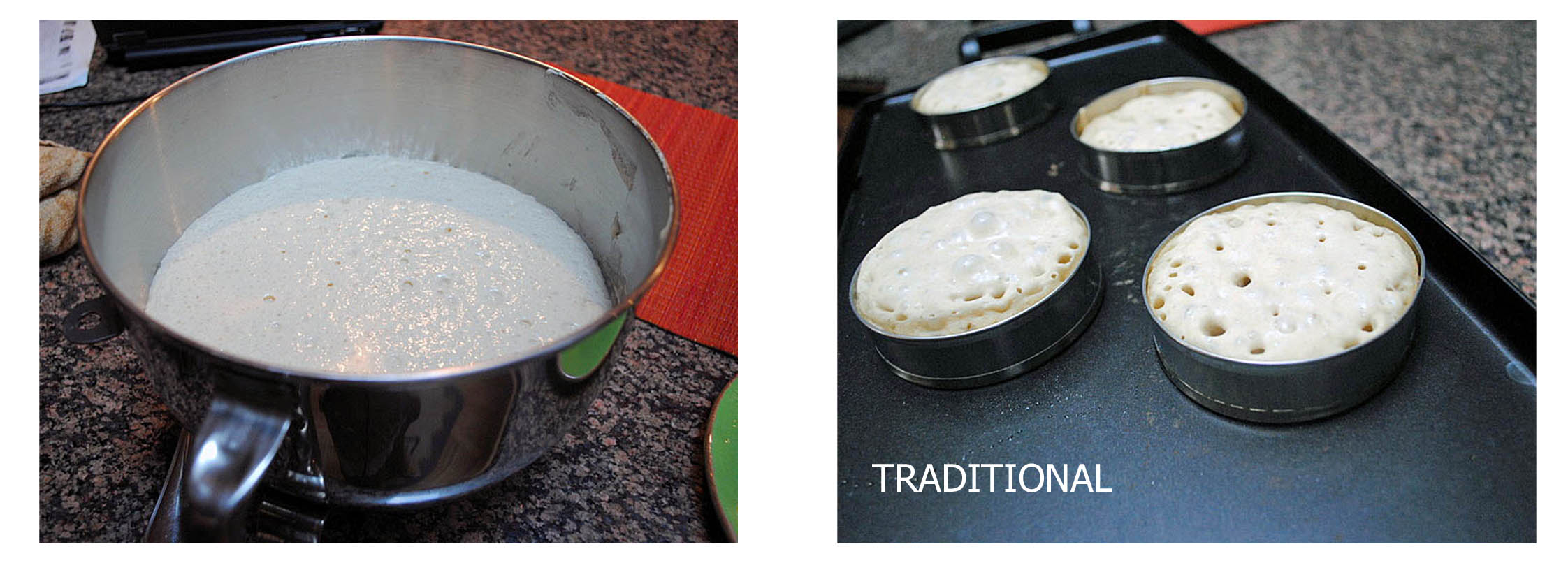
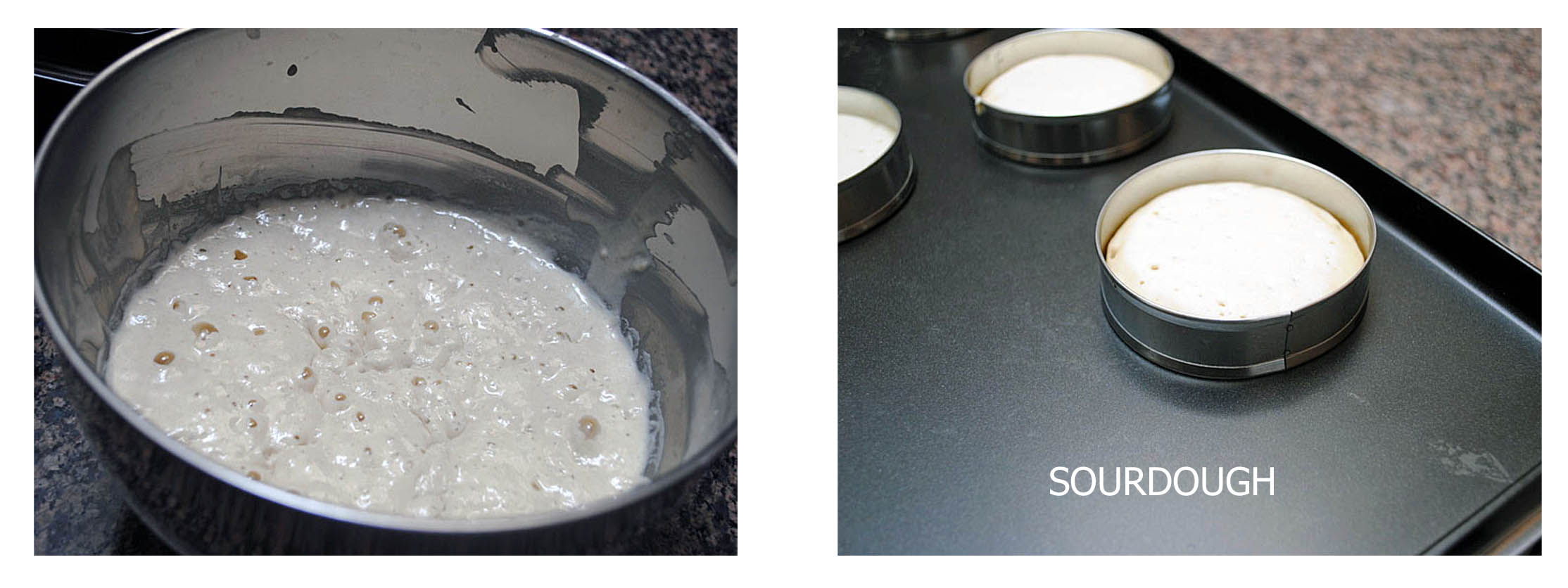
Comments:  Both recipes are pretty straightforward, with little hands-on time required. The traditional method allows you to have crumpets ready in about 1.5 hours, versus a little over 4 hours for the sourdough variation (not counting the pre-ferment prepared the day before).   The next sets of photos give you an idea of how different the batters looked right before cooking, and how the authentic version gave a more hole-y texture in the crumpets already during cooking.

A few pointers for success:

1. Do not fill the rings more than halfway, because if you do, the holes will close when you flip the crumpets.  It is tempting to add more batter, but resist the urge to do so.  Also, it will be harder to cook them through if they are too thick.

2. Do not cook them on a griddle that is too hot, or you will have a hard crust at the bottom and the crumpets won’t cook uniformly. Better to keep a lower temperature and cook longer.

3. Do not cook the second side longer than 2 minutes, or you might end up with an English muffin!   😉

4. Grease the rings again for each batch of crumpets, so that they are easily removed.  Crumpets are fragile, if they stick to the ring their shape can be compromised.

5. The rings are hot, and stay hot for a while once you remove them from the griddle.  It is easy to forget about it as the second batch gets going (sigh).

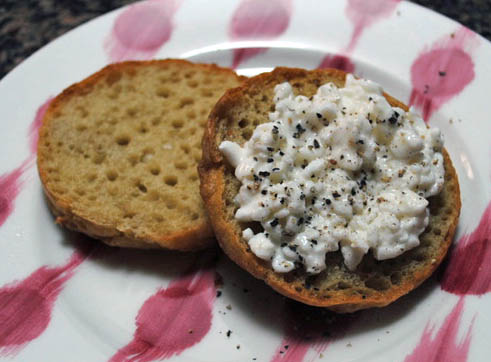
In my second attempt – the traditional recipe – things worked a lot better, and even the crumpets that were a bit too thick and “lost the holes” on the surface after flipping, revealed a wonderful crumb structure…

You don’t need rings to cook English muffins because they hold their shape well, but they are a must-have for crumpets.  You can of course improvise using empty, clean cans of appropriate diameter.  This would be a fun weekend project, kids would love to help you out…

I am submitting this post to Susan’s Yeastspotting

ONE YEAR AGO: Sweet Emergency

TWO YEARS AGO: The Bread We Love

Add to FacebookAdd to DiggAdd to Del.icio.usAdd to StumbleuponAdd to RedditAdd to BlinklistAdd to TwitterAdd to TechnoratiAdd to Yahoo BuzzAdd to Newsvine

GOT BEEFSTEAK TOMATOES?

Got 10 minutes to spare?  Here’s a side dish to awe your taste buds.  The latest  Fine Cooking magazine has a full article about tomatoes, perfectly timed when farmers markets are overflowing with those in all shapes and sizes.  Normally I don’t buy beefsteaks, favoring smaller types  like Campari, grape, and cherry.  But this recipe called my name loudly.
GRATIN OF BEEFSTEAK TOMATOES
(slightly modified from Fine Cooking, August 2011)

3 beefsteak tomatoes
1/4 cup Panko bread crumbs
1/4 cup grated Asiago cheese
2 Tbs fresh parsley, minced
1 tsp Herbes de Provence
slight drizzle of olive oil
salt and pepper to taste

Cut the tomatoes in 1/4 inch thick slices, and place them with a little overlap on a broiler-safe type of dish.

Mix the bread crumbs with the cheese and the herbs and sprinkle all over the tomatoes.  Season them with salt and pepper (Asiago cheese is salty, use less salt than you normally would);  drizzle a small amount of olive oil over the tomatoes (use a spray bottle if you prefer), place the dish under the broiler for 3 minutes or until it starts to get golden on top.    Serve right away.

ENJOY!

to print the recipe, click here

Comments:  This recipe may very well change my mind about keeping beefsteak tomatoes around the house.  They stand up to the broiler nicely, and the salty/cheese crust on top is a nice complement to the juiciness of the tomatoes underneath.   Phil  said that he could imagine this dish on the menu of an American steakhouse, next to a substantial T-bone steak, grilled medium rare.   We took a more humble route, and served them with flank steak, and grilled zucchini slices.   Summer dining: simple, light, and quick to put together.

ONE YEAR AGO: Tour de France Final Stage: PARIS

TWO YEARS AGO: Snickerdoodles with a Twist

Add to FacebookAdd to DiggAdd to Del.icio.usAdd to StumbleuponAdd to RedditAdd to BlinklistAdd to TwitterAdd to TechnoratiAdd to Yahoo BuzzAdd to Newsvine

ISRAELI COUSCOUS SALAD

For a long time Israeli couscous was hard to find, and I only enjoyed it in restaurants, or by placing special orders online.  Now it’s available almost everywhere!   Even one store in our small town carries it in bulk, so I buy as little or as much as I want.  Heads up: when you  buy Israeli couscous in bulk, make sure to tie the plastic bag very well, and handle it with loving care.  Those cute little balls of semolina flour travel long distances when spilled on the floor. It’s amazing the lessons a cook learns! 😉

Israeli couscous has an interesting history. It indeed originated in Israel,  in the 50’s,  with the name of “ptitim.”  It was conceived in a time of austerity, as an attempt to deal with the scarcity of food, including the almost complete disappearance of rice.  Back in Israel it remains a popular food item for kids, available in all sorts of cute shapes, like stars and hearts, to please the young audience.  Abroad, Israeli couscous became a trendy gourmet ingredient, as we all know well.  It’s versatile and has less tendency to form lumps than regular couscous. It can be dressed up in countless ways and it’s equally tasty warm or cold, as in this delicious salad, adapted from a recent issue of Food and Wine.

ISRAELI COUSCOUS SALAD WITH ARUGULA PESTO
(adapted from Food and Wine magazine)

6 cups packed arugula (6 ounces)
2 cups Israeli couscous (12 ounces)
2 Tbs extra-virgin olive oil
1/3 cup full fat yoghurt  (or low fat if you prefer)
1/4 cup pine nuts
1 garlic clove, chopped
1/4 cup freshly grated Parmigiano-Reggiano cheese
Salt and freshly ground pepper
1 cup red cherry tomatoes, halved
1 English cucumber, peeled and diced

Bring a large saucepan of salted water to a boil. Add the 6 cups of arugula and blanch for 10 seconds. With a slotted spoon, transfer the arugula to a colander. Rinse under cold water to stop the cooking, drain well and reserve.

Add the couscous to the boiling water and cook over moderately high heat, stirring occasionally, until al dente, 8 to 10 minutes.  Taste to make sure you don’t overcook it.  Drain, and spread on a large baking sheet, drizzling with a very small amount of olive oil (use a spray bottle if you have it) to prevent the little balls from sticking. Let it cool to room temperature.

In a small skillet, toast the pine nuts over moderate heat, tossing, until golden brown, about 2 minutes. Let cool.

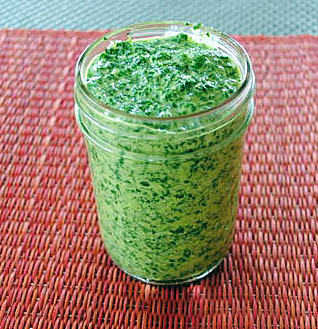
Squeeze the excess water from the arugula, coarsely chop it, and place it in the bowl of a food processor. Transfer the arugula to a food processor. Add the pine nuts, garlic, cheese and the 2 Tbs of olive oil, processing until the arugula and pine nuts are chopped. Immediately add the yogurt, process until smooth, and season with salt and pepper to taste.

Transfer the couscous to a large serving bowl and stir in some of the pesto, using as much or as little as you like.  Gently fold in the tomatoes and cucumber pieces.  Adjust seasoning, and….

ENJOY!

to print the recipe, click here

Comments:  We loved this recipe!   And I’m especially happy about my modifications of the arugula pesto.  Purists may roll their eyes, but I reduced the fat content of this baby to levels previously unknown to mankind!  Imagine my audacity, going from 1/2 cup of olive oil in the original recipe to 2 Tbs  olive oil  + 1/3 cup of yogurt!  That, my friends, is a drop from 954 calories down to 175.   I am not a fat-o-phobe, but I’ve played with yogurt and buttermilk long enough to learn that they often substitute well for oil, as illustrated in this example: the acidity in the yogurt kept the arugula bright and it added an interesting sharpness to the pesto.   Of course, you may also ignore my adaptation and use the full amount of olive oil. As Emeril Lagasse says, “…you won’t hurt  my feelings.”   😉

Olive oil is one of the healthiest options among fats, but any fat packs a huge load of calories.  If you struggle with weight issues (who doesn’t?), then be attentive to the amount of olive oil in your recipes and restaurant foods.  Salads are deceptively high in calories. Consider asking for dressing on the side, and use it sparingly.  Another dangerous option that seems healthy and light:   buffet platters of grilled veggies, such as eggplant and zucchini. They are  prepared with a substantial amount of olive oil, and eggplant in particular soaks it up like a sponge.  Be aware, make the right choices, and exercise portion control.  When you’re cooking at home try my low-cal pesto and see what you think.  It’s good to splurge with the real thing sometimes, but it’s also wonderful to find an alternative that makes you feel good when you leave the table.  😉

ONE YEAR AGO:  Heavenly Home-made Fromage Blanc

TWO YEARS AGO:  Pasta with Fresh Tomato Sauce

Add to FacebookAdd to DiggAdd to Del.icio.usAdd to StumbleuponAdd to RedditAdd to BlinklistAdd to TwitterAdd to TechnoratiAdd to Yahoo BuzzAdd to Newsvine