MISO IT UP

Green beans show up at our dinner table once a week, most of the time in a quick preparation with slivered, toasted almonds.  It’s nice to have some recipes that you can almost pull on your sleep.  This version from Bon Appetit is almost as simple, but feels a lot more special because it uses miso.  I suppose it’s the funk factor, that umami component that adds extra flavor. Try this recipe, even if you don’t normally use this Japanese gem in your cooking. You’ll love it, I am sure.

GREEN BEANS WITH MISO AND ALMONDS
(adapted from Bon Appetit)

2 + 1/2 pounds green beans
salt
1/4 cup white miso (may use less if you are a miso newbie)
3 tablespoons  rice vinegar
2 tablespoons mustard
2 tablespoons grapeseed oil
1 tablespoon sugar
1/4 cup slivered almonds, toasted

Cut green beans in pieces 1 to 1.5 inches long. Cook them in a large pot of boiling salted water until crisp-tender (less than 5 minutes). Transfer to a large bowl of ice water to cool. Drain well. 

Whisk miso,  vinegar, mustard, oil, and sugar in a small bowl. Season with salt, but very lightly because miso is already salty. Place green beans in a large bowl. Pour dressing over; toss to coat. Garnish with almonds.

ENJOY!

to print the recipe, click here

I always have miso in the fridge. It keeps for a long time, and shows up more and more in recipes everywhere. I often add it to sauteed mushrooms, but green beans match equally well with the sweet-saltiness of miso.  Yin and Yang.  Gotta love it!

This dish is a great side for chicken, salmon, steak, or pork. And leftovers are excellent even at room temperature.

ONE YEAR AGOZiti with Fresh Artichokes and Meyer Lemon Sauce

TWO YEARS AGO: Chicken Soup on a Chilly Evening

Add to FacebookAdd to DiggAdd to Del.icio.usAdd to StumbleuponAdd to RedditAdd to BlinklistAdd to TwitterAdd to TechnoratiAdd to Yahoo BuzzAdd to Newsvine

PROJECT 2012: ROMANIAN FLATBREADS

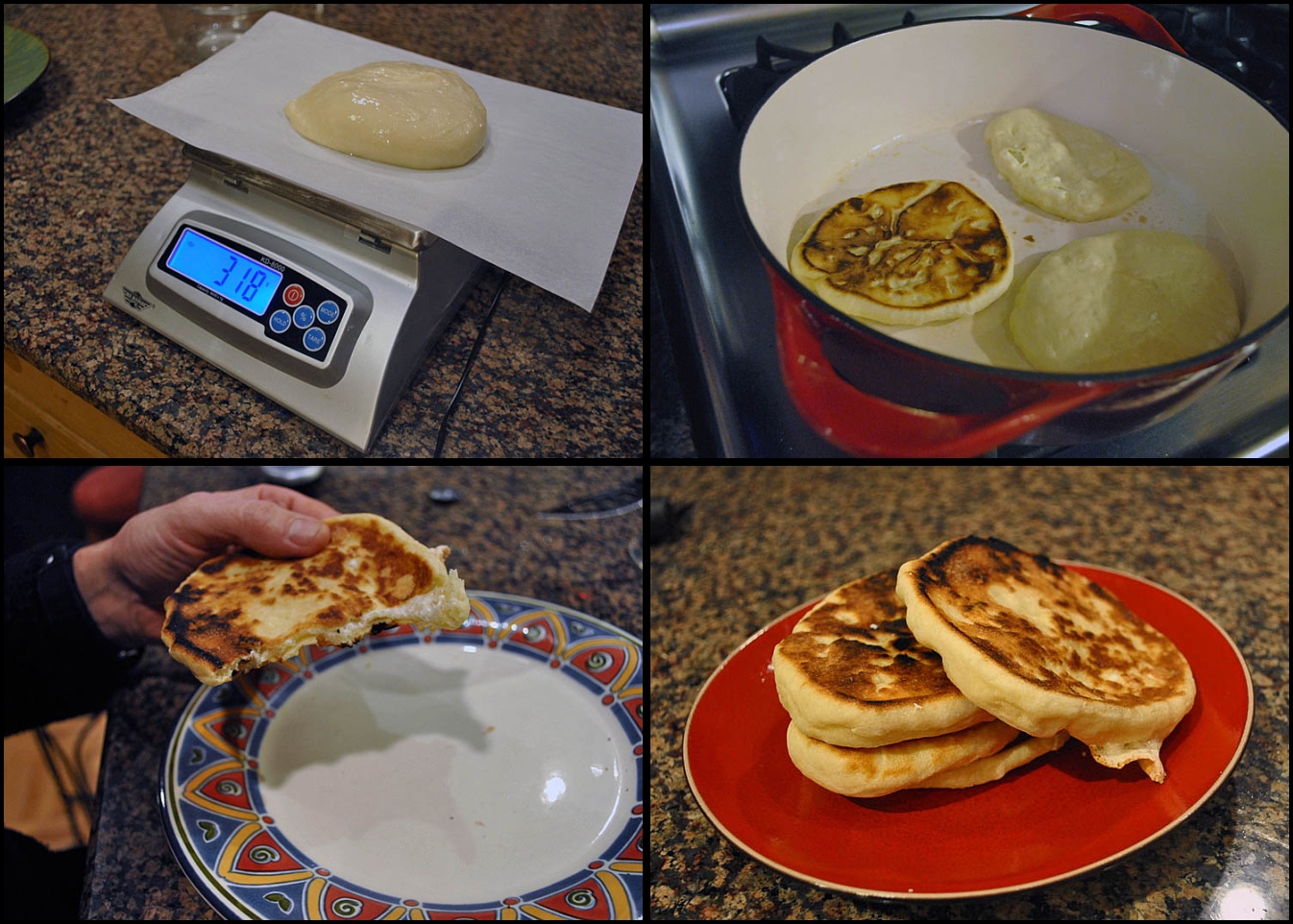
Last month I posted a few of the culinary projects I had in mind for the near and not so near future.   The first one I tackled was Codruta’s flatbreads, made with a sourdough base, and filled with cheese.  One bite is all it takes to fall in love with them.

The story behind the bread is the stuff of fairy tales you maybe read as a kid, and the images stayed with you forever.  Picture yourself as a young boy, going for a hike in the forest with a group of buddies and a few supervising adults. Their goal is to visit breathtakingly beautiful caves in Romania.  But, his guide  decided to wander apart from the rest of the group, and the two of them took what was supposed to be a shortcut to the caves.   You see where this is going… 😉  They got hopelessly lost.  They walked, and walked some more.  They searched around for hours, through a dense fog that unexpectedly came down, and made everything much worse.  It got cold, rainy, and dark.  The boy was wearing just a light t-shirt and ended up shivering, all wet from the rain. They finally stumbled upon a little house in the middle of the woods, and decided to take a risk and knock on the door, having no idea who could be living in such a place.   A nice couple welcomed them inside. The old woman was cooking flatbreads, they smelled amazing.  She offered some to the boy, and that was by far the best thing he’d ever tasted in his almost 10 years of life!  And they told them exactly how to get to the caves and reunite with their group…

Pestera Scarisoara - Sala Biserica

(Pestera Scarisoara Cave, image from Wikimedia Commons)

Thirty years went by.  The boy is now a grownup man, and his girlfriend a gorgeous woman, whose passion for cooking lead her to try and recreate the flatbread of her partner’s childhood.   And I am lucky enough to take a ride on their journey, and sample the delicious cheesy bread that warmed a little  boy’s heart and soul.

CODRUTA’S CHEESE FLATBREAD
(from Apa. Faina. Sare)

60 g  (2.1 oz) sourdough starter (100% hydration)
70 g  (2.5 oz)    water
60 g  (2.1 oz) yoghurt
2 eggs (about 100g / 3.5 oz)
315 g all purpose flour
6 g  (0.2 oz) salt
30 g (1 oz) sunflower oil

Dissolve the sourdough starter in the water, mixing gently.  Add the yoghurt and beat well, then whisk the eggs in the mixture.   Add the flour, stir, and let the dough sit for 20 minutes at room temperature.

Add salt and knead with an electric mixer until the gluten starts to develop (about 6 minutes).  If the dough seems to soft, add a tablespoon of flour.  Add the oil in small amounts, continuing to mix, until the dough absorbs all the oil.   At this point, the gluten must be very well developed, and the dough quite elastic and smooth.

This amount of dough is enough for 12 to 15 flatbreads. If you want to make fewer, simply store in the refrigerator the dough not used. Next day it will have even better flavor.   Place the dough you want to use on the same day it is made in a warm place and let it rise for 4 to 5 hours.

Pick the fillings of your choice: crumbled sheep’s cheese with herbs, or sautéed cabbage, or go for a sweet version using grated apples and cinnamon sugar.

When you want to make the flatbreads,  tear pieces of 45-50 g of dough and stretch over a surface lightly coated with oil (a smooth plate works great, or a granite countertop) until it forms a circle about 15 cm  (6 inches) in diameter.   Place the filling in the center, and fold all edges over the filling, sealing well and making sure no big air bubbles are trapped inside.  Carefully roll the circle as thin as you are able to, without tearing the surface.  You can try and make it around 20-22 cm (8 inches) in diameter, but it takes a bit of practice.

As you roll each one, place it on a skillet coated with a light spray of oil (well seasoned cast iron, or non-stick), and fry each flatbread until nicely browned on both sides.  Transfer it to a plate and proceed to cook the next one.   Or, if you roll them a little smaller, fry as many as you can fit in your pan, but don’t allow them to touch.

ENJOY!

to print the recipe, click here
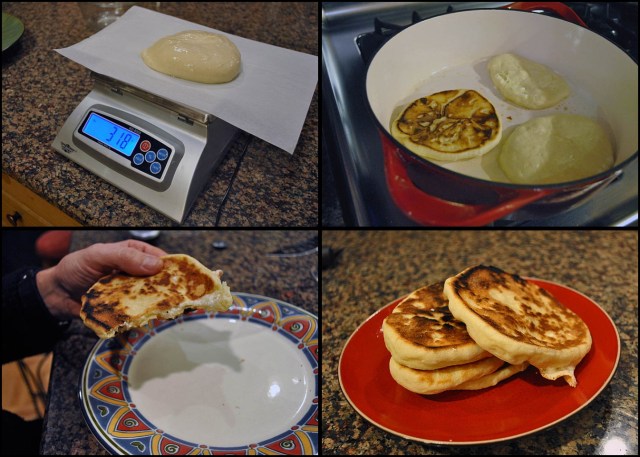
Comments:  When Phil took the first bite of the bread, he immediately remembered the cheese breads from Brazil, and the feeling he had the first time he had one: pure bliss!   We can testify that you won’t need to be lost in a forest to appreciate these babies, they are awesome!

Now, please go to Codruta’s blog, and check her photos to see how she made them a lot thinner than mine.  I was afraid to do it, but I know next time I’ll be more daring.  The dough is very forgiving, there’s enough fat in it to make it pliable.   I used a Mexican type cheese (Cotija),  but next time I’ll crumble it in smaller pieces, that will help stretching the dough thinner too.  Because it was just the two of us enjoying the flatbreads, I halved the recipe and used a food processor to do the kneading, as the amount of dough was too small for my Kitchen Aid.  Simply put the dough in the bowl of the processor and turn it on for about 20 seconds.  See if it’s smooth and maybe process 10 more seconds.  The dough will feel warm, don’t worry about it.  It will be fine.  😉

Next time I want to make these flatbreads filled with sauteed shredded cabbage, as Codruta told me it’s one of her favorite flavors.  But, the possibilities are endless, you can even make them without any filling, and just sprinkle some spices on the dough before enclosing and stretching.   A great use for your sourdough starter!

Note added after publication:  I apologize for spelling Romania incorrectly at first.  My Brazilian nature interfered, and I used the spelling from Portuguese. It’s all corrected now, but if you happened to catch the first version, sorry!  😉

I am sending this post to Susan Yeastspotting

ONE YEAR AGO: When Life gives you (Meyer) Lemons

TWO YEARS AGO:  Blasted Broccoli, Stove-top version

Add to FacebookAdd to DiggAdd to Del.icio.usAdd to StumbleuponAdd to RedditAdd to BlinklistAdd to TwitterAdd to TechnoratiAdd to Yahoo BuzzAdd to Newsvine

BROWN BUTTER MAGIC

I got to know  “Beautiful Disasters” through The Secret Recipe Club, when Casey,  a very fit and active high school student, made a recipe from my blog.  She hit the jackpot: her post was the most popular of our group!   I always look forward to her articles, not only for the recipes, but for the “Random fact of the day“.  Did you know that the average shoe size of a gorilla is 17?  Well, I didn’t, but learned on her site.  😉

Recently Casey wrote this enticing post about her favorite chocolate chip cookie, and the description and photos got my immediate attention.   At first glance, the recipe seems pretty straightforward, using the usual suspects for this traditional American favorite: butter, sugar, baking soda, walnuts, and chocolate chips.  But, what sets it apart is the browning of the butter, and the toasting & grinding of the walnuts.  Brown butter. Ground walnuts. Who would imagine they could make a simple cookie so decadent and delicious?
BROWN BUTTER CHOCOLATE CHIP COOKIES
(from Beautiful Disasters)

1 stick (1/2 cup) butter
1/2 cup granulated sugar
1/2 cup brown sugar
1 egg
1  + 1/2 teaspoons vanilla
1/2 teaspoon baking soda
1 +  1/2 cups all-purpose flour
1/2 teaspoon salt
1  + 1/2 cups chocolate chips
1 cups walnuts, toasted and ground
1-2 teaspoons of milk, as needed

The day before (or at least 3 hours before making the cookies), heat the butter over low heat in a small saucepan.  It will foam and bubble, slowly acquiring a tan color.  Keep stirring, watch it carefully so that the solids won’t burn.  Cook until the butter is a deep caramel color (it took me over 12 minutes).  Pour into a pyrex type dish, and refrigerate until  solid.

Heat the oven to 300 degrees F, and toast the walnuts on a baking sheet for 12 minutes, or until fragrant and starting to get some color.  Transfer to a small food processor and turn it on and off a few times, to grind the nuts.  Reserve.   (You can also finely chop them by hand, but it’s a bit cumbersome).

Cut the brown butter in small cubes, place it in the bowl of an electric mixer, and cream it with both sugars.   Beat in the egg, vanilla, and baking soda. Add the flour and salt, mixing gently.  Finally add the ground i nuts and chocolate chips. If the dough is too crumbly, add a couple of teaspoons of milk.

Scoop the dough onto cookie sheets lined with parchment paper, and bake in a 300 F oven for 18 minutes.  Let cool on wire rack.

ENJOY!

to print the recipe, click here

These are some amazing cookies!  Hot from the oven, they were simply irresistible…  I had THREE cookies.  Now, keep in mind that when I make a batch of cookies I eat one, and  that is pretty much it for me.  I had three.  One, then another.  And then another. (sigh)

My moment of pure joy, on a Sunday afternoon…

A cup of steaming spiced almond milk….  (for recipe, click here)

With bites of insanely good chocolate chip cookies…

Thank you, Casey!  

ONE  YEAR AGO: Tidy Sourdough

TWO YEARS AGO: Vienna Bread

Add to FacebookAdd to DiggAdd to Del.icio.usAdd to StumbleuponAdd to RedditAdd to BlinklistAdd to TwitterAdd to TechnoratiAdd to Yahoo BuzzAdd to Newsvine

CITRUS CRUSTED TILAPIA FILETS

Citrus and fish, unbeatable combo!  Until now, I accepted the idea that one of my favorite preparations for delicate fish filets came with a small tax to pay for the fat used to fry it. But, when I saw this recipe on How Sweet It Is, I hoped it would be my ticket to a lighter version of the classic.  To be completely honest, I had my doubts, because not too long ago I tried a similar method for pork schnitzel  (from Everyday Food) and it was a huge disappointment.   I am glad to report NO disappointment here, quite the contrary, this recipe is a keeper!

CITRUS CRUSTED TILAPIA
(adapted from How Sweet It Is)

4 fresh (or thawed) tilapia filets
1/2 teaspoon salt
1/2 teaspoon freshly ground pepper
3/4 cup panko bread crumbs
1/4 cup whole wheat flour
1/3 cup bread crumbs
1 teaspoon Herbes de Provence
zest of 2 oranges, 1 lime and 1 lemon
2 egg whites, lightly beaten with a pinch of salt

Heat oven to 425 degrees F. Line a baking sheet with aluminum foil, place a wire rack on top, and spray the wire rack with nonstick spray. In a large bowl, add bread crumbs, flour, citrus zest and a pinch of salt. In another bowl, lightly beat the egg whites, add a teaspoon of water to make it looser.

Season each piece of tilapia with salt and pepper. Dip each piece of fish in the beaten egg whites, allow the excess to drip, then coat with your mixture of breadcrumbs, pressing well to adhere. Place on the wire rack and spray lightly with olive oil spray.

Bake for about 18 minutes, or until breadcrumbs are golden. Depending on how thick your filets are, it could take slightly longer.  Test with a knife to see if the fish flakes easily, then it’s done.

ENJOY!

to print the recipe, click here

Jessica  served her fish filets with a beautiful blood orange salsa,  perfect complement to the dish, but this time I took a more austere route, went with white rice and stove top blasted broccoli (a favorite side dish of ours).

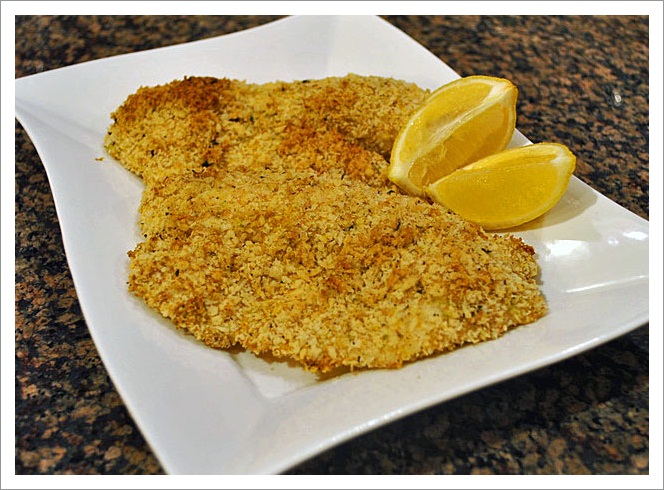
This recipe was a breeze to put together, the fish turned out moist, perfectly cooked, with the crust delivering a burst of citric flavor.  The secret for success is spraying the olive oil over the coating before baking the filets.  That ensures just the right amount of fat to moisten the crumb layer and give it a hint of color.   Much lighter than the usual method with a frying pan, but without skimping on flavor.  I am not at all interested in reducing calories if it will hurt my food.   This is  a perfect example of a make-over that is worth adding to your repertoire of meals.

I highly recommend you stop by How Sweet It Is to get her full recipe, including the blood orange salsa.  It will be on our table next time, all I need is to find that elusive orange for sale.  😉

ONE YEAR AGO: Bran Muffins: not just for hippies!

TWO YEARS AGO: Chocolate Flourless Cake

Add to FacebookAdd to DiggAdd to Del.icio.usAdd to StumbleuponAdd to RedditAdd to BlinklistAdd to TwitterAdd to TechnoratiAdd to Yahoo BuzzAdd to Newsvine

A SOURDOUGH EXPERIMENT

Would you like to bake bread with wild yeast, but the thought of   keeping a starter is too intimidating?  If that’s the case, I urge you to read this great post by Joanna, from Zeb Bakes. She will make you feel absolutely at ease with keeping the starter going, minimizing your work and the use of flour. She will also show you a simple schedule to bake bread on a weekly basis.  Awesome read! Sourdough baking made simple and easy, as it should be.

Now, time for some fun with it.  Remember the proofing bread box I gave myself for Christmas?   Well, I put it to the test, by making a batch of sourdough bread and dividing the dough in two.  Half went into the cozy environment of the box (78 F), half stayed outside in my kitchen kept (at this time of the year) at around 70F.  The recipe I chose for such a ground-breaking experiment comes from a great baker, who blogs at Breadcetera.  You can learn a ton of stuff from him, make sure to bookmark his site and visit often.   He developed this technique called “double flour addition,”  with the goal of maximizing the amount of air bubbles trapped in the dough from the very beginning of mixing.  These tiny air bubbles, created by whisking the very loose mixture of flour and water, later generates the pockets of air that every baker searches for in this type of rustic loaf.

SOURDOUGH BREAD WITH DOUBLE FLOUR ADDITION
(from Breadcetera)

680 g bread flour
90 g whole wheat flour
455 g water
15 g salt
300 g sourdough starter (at 100% hydration)

Combine the flours in a large bowl and lightly mix them with a whisk.

Add the water and the sourdough starter to the bowl of a Kitchen Aid mixer, and use the whisk attachment to work them together at the lowest speed for a minute or so.  At this point, you only need to combine them and have the starter dispersed through the water.    Add just 75g of the flour mixture, and increase the speed of the mixer to level 3. Whisk until the mixture seems quite aerated (about 3 to 4 minutes).

Remove the whisk attachment and place the dough hook in place. Add the rest of the flour, and knead for a couple of minutes, until the flour forms a shaggy mass.  Cover the bowl with plastic wrap and let it rest for 20 to 30 minutes.

Sprinkle the salt over the dough, and mix on speed 3 for 6 minutes.  Place the dough in an oiled bowl, cover and let it ferment for 2 hours, without any folding or kneading.  Divide the dough in two equal pieces, and lightly give it a round shape.   Let it rest for 15 minutes for the gluten to relax,  and do a final shaping, creating surface tension by pulling the sides of the dough up as you gather it all in the “boule” shape.   Place the balls of dough, seam side up, in a floured round container (such as a brotform), cover with plastic, and let it ferment for 3 hours at 78 F.

Invert the dough on a peel, score, and bake at 425 F for 40 minutes, with steam during the first 15 minutes.  Let it completely cool before slicing.

ENJOY!

to print the recipe, click here

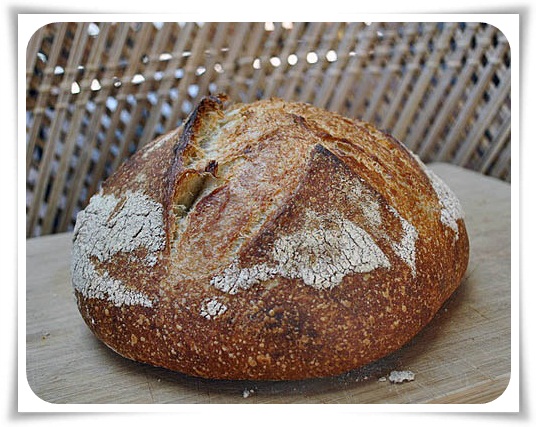
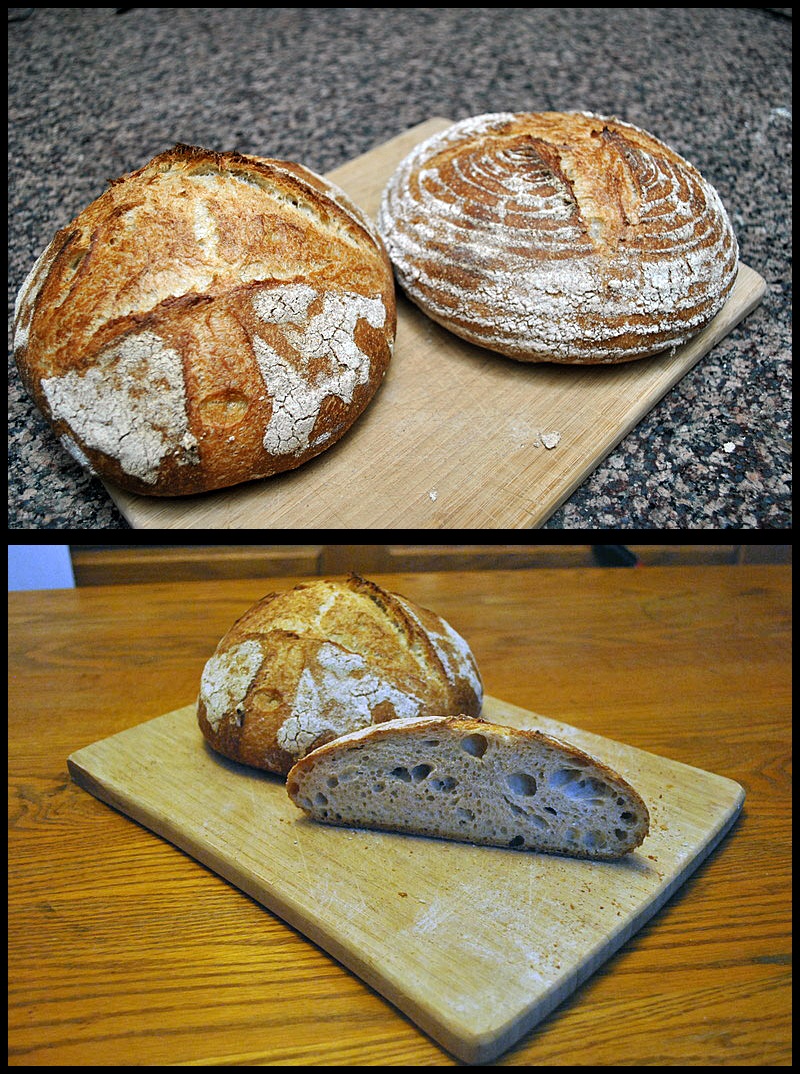
For my experiment, I divided the dough in two right before the first fermentation, and placed one half in the proofing box.   That dough stayed in the box until baking time, the other one stayed over the kitchen table, protected from drafts.  The difference in the dough itself was pretty dramatic, but I could not get a picture that was good enough to show it. However, once the bread was baked, the one from the proofing box had much better oven spring, the other one was a bit on the flattish side.   Both were delicious, and the crumb had a nice structure, but one bread looked a lot “healthier.”   Here they are…

You can see that the taller bread, with a more round shape, had better oven spring, bursting through the slashing with greater power. Sorry, no photos of the crumb, we froze that baby for later and by the time we got to enjoying it, I forgot to grab the camera.


The bread proofing box not only optimizes the temperature, but also provides the correct amount of humidity, thanks to the small dish that sits at the bottom of the box, with some water in it.  No need to worry about a skin forming on the loaf in the final proofing, no need to use plastic to cover it.  A very well designed machine, that is getting constant use in our home.

I am submitting this post to Susan’s Yeastspotting

ONE YEAR AGO: Shrimp and Fennel Casserole

TWO YEARS AGO:  Tuscan Bread

Add to FacebookAdd to DiggAdd to Del.icio.usAdd to StumbleuponAdd to RedditAdd to BlinklistAdd to TwitterAdd to TechnoratiAdd to Yahoo BuzzAdd to Newsvine