THRILLING MOMENTS

June 2006: crossing the finish line in my first (and only) marathon…

March, 2009:  cutting a slice of my first (but not only) successful sourdough loaf,  and marveling at the open, airy crumb…

April 2012: making croissants that finally brought an important bit of Paris to our home!

I am not sure how many times I’ve tried to make croissants, perhaps five or six, but each and every occasion left me disappointed and  frustrated.  I didn’t  throw in the towel, though, and you may remember that I included croissants as one of my cooking projects for this year.   Since January,  I assembled all the recipes, tips (thanks once more, Gary!), and blog posts on the subject, finally settling on the recipe from Peter Reinhart‘s Artisan Breads Every Day. I couldn’t be happier, aren’t they cute?

Without further ado, here’s the full recipe, with photos that walk you through  the process.

CROISSANTS
(published with permission from Peter Reinhart,
recipe from  his book Artisan Bread Every Day)

for the “detrempe
4 + 2/3 cup all purpose flour (21 oz / 595 g)
1  + 3/4 tsp. salt (0.4 oz / 11 g)
1/4 cup sugar (2 oz / 56.5 g)
1 Tbs  instant yeast (0.33 oz / 9 g)
3/4 cup + 2 Tbs milk (7 oz / 198 g)
1 cup cool water (8 oz / 227 g)
2 Tbs melted butter (1 oz / 28.5 g)

for the butter block:
1 + 1/2 cups cold butter (12 oz / 340 g)
2 Tbs flour (0.57 oz / 16 g)

Make the dough (detempre) by whisking the flour, salt, sugar and yeast in a mixing bowl. Pour in the milk and water, then add the butter. Mix with the paddle attachment on the lowest speed for about 1 minute, stop, and check that the dough is shaggy.  It should not be too firm as you’d expect from a bread dough.  Adjust with a little water or a little flour if too wet.  Mix again for a couple of minutes, transfer to a board, form into a ball  and refrigerate overnight (or up to 2 days) inside an oiled bowl.

Make the butter block on baking day.  Cut the cold butter in 16 pieces, and place them in the bowl of an electric mixer together with the flour. Use the paddle attachment for 1 minute to incorporate the flour into the butter, without allowing it to melt.  Transfer the butter/flour to a piece of parchment paper (spray the surface of the paper with a little oil), and form into a 6 x 6 in square, about 1/2 inch thick.  Be as precise as you can with the measurement, and try to form it into a neat, straight-edged little package.  Cover the square with a plastic wrap and refrigerate for 10 minutes (or longer, if convenient).

Transfer the dough from the fridge to a floured work surface, sprinkle more flour on top, and roll the dough to a rectangle 12.5 inches wide and 6.5 inches long.  Square off the edges, try to keep it all straight.   The dough should be about 1/2 inch thick.  Place the butter block on the left side of the rolled out dough, check that only a border of 1/4 inch is left between the butter and the edge of the dough.  If necessary, roll the dough out a little more.  Lift the right side of the dough and cover the butter, stretch the dough to cover it all well, and pinch the edges to fully enclose the butter.

Lift each side of the package of dough/butter gently, toss more flour underneath, flour the top again, and gently tap the surface of the package with a rolling pin, to distribute the butter evenly into the four corners.  Roll the dough to a rectangle 16 inches wide and 9 inches long.  Again you should aim for a 1/2 inch thick dough.   Square off the edges as nicely as possible, and fold the dough as a letter in an envelope: fold the right one-third to the left, and the left one-third of the dough to the right.  Transfer the dough to a floured baking sheet, and place in the fridge for 20 minutes.

Place the dough again on a floured surface, with the open seam facing away from you and the closed side facing you.  Gently roll the dough again to the same dimensions (16 x 9 inches).  Fold again in thirds.  Let it rest in the fridge for another 20 minutes, and repeat this exact rolling and folding procedure one more time.  Let the dough rest 20 minutes more, and get ready for the final rolling and cutting of croissants.

If working the full dough at once, you will need to roll it as a rectangle 24 to 28 inches wide, and 9 inches long. If you prefer, cut the dough in half, and roll it to 12 to 14 inches wide, 9 inches long.  Once the dough is fully rolled (about 1/4 inch thick), make marks starting at the left side of the bottom part of the dough, placing a small notch at 4-inch intervals. Repeat the same on the top part of the dough, but start at the 2 inch mark from the left.  Use a pizza cutter to cut a line from the left bottom corner of the dough to first notch on the top part of the dough (at the 2 inch point).  Go on connecting the marks to cut triangles.  When all pieces are separated, cut a 1 inch notch into the bottom center of the triangle base of each piece (that helps the croissant get its curved shape).  Spread the bottom as wide as the notch will allow to create wing-like flaps. Start with the flaps and begin rolling up the dough as you would roll a rug.  Stretch the pointed end of the triangle as you roll, trying to elongate the dough.  Make sure the end of the croissant stretches all the way under it, so that it remains rolled as it rises and bakes.

Place the croissants on a baking sheet lined with parchment paper, and let them rise at room temperature for 2 and a half to 3 hours. Brush the surface with egg wash if desired.  Heat the oven to 450 F F (232 C), place the croissants inside, and reduce the temperature immediately to 375 F (190 C). Bake for 15 minutes, rotate the pans, and bake for an additional 15 to 20 minutes, until golden brown on all sides.

Allow the croissants to cool on a rack for 45 minutes to 1 hour.

ENJOY!

to print the recipe, click here

Now, allow me to show you a few photos of the process, which seems intimidating at first, but if you pay attention to a few details, it will be quite doable.
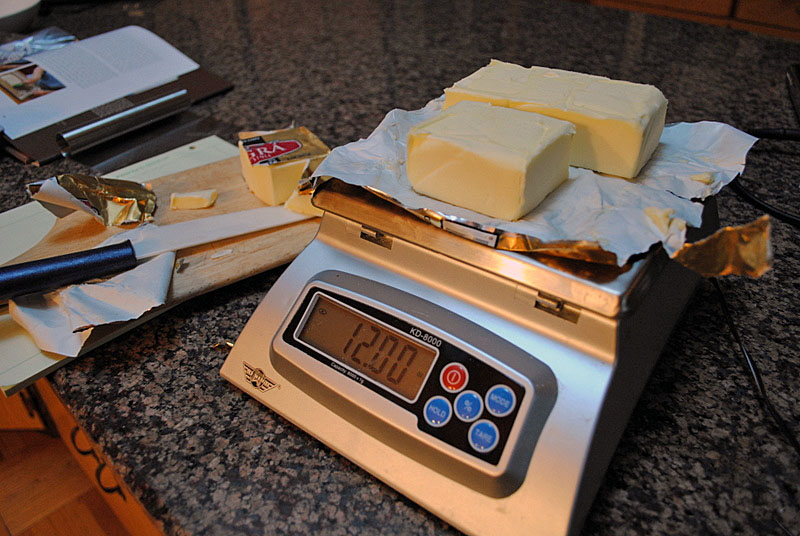
Use good quality butter, I recommend getting Plugra if you can find it, and measure the amount with a scale, no eye-balling here.  We are talking croissants, let’s make them pretty!   😉

After its rest in the fridge overnight, the dough will have risen quite a bit, and will be all puffy and nice to work with.  Working with it straight from the fridge will make it much easier to handle.

Be as precise as possible with the measurement,  each step matters, a little liberty here, a little liberty there, and your croissants will suffer.  Let’s make them pretty!   😉

The dough is rolled out  and the butter square is placed on one side, then all you have to do is fold the dough over it and pinch the edges, enclosing the butter completely inside the dough.

And the fun begins, rolling the dough to the right dimension (16 x 9 inch rectangle), then folding it in three, like a letter to be mailed to a dear  long-distance friend…  The package goes to rest in the fridge for 20 to 30 minutes, and the whole thing is repeated two more times (two additional series of rolling and folding in three).  Please notice my rolling pin, a gift Phil gave me for my Birthday. It is an antique piece that handles any dough extremely well.  Plus, I find it  very beautiful!

If you have a loooooong surface to roll the final dough out, go ahead and do the whole thing in one step.  I found it easier to cut the dough in half,  roll it, mark the spots to cut the triangles, and form the croissants from that half.  Place them on a baking sheet for the final rise, and move to the second portion of the dough.  Easy as pie!  One telling sign of the quality of your dough is how much can you stretch it without tearing it.  In my previous attempts, I could barely stretch it at all, but this recipe made the most elastic and forgiving dough ever!

Once they rise for a couple of hours, they will be noticeably bigger and plumper.

Brush them with egg wash (I think it makes for  beautiful croissants, with a nice shinny surface), and place in the oven, resisting the temptation to peek too often.  A little peek every once in a while is ok, particularly if you are a food blogger overly excited by your first good looking batch of croissants and anxious to get just one more photo…

And then, once they are all baked, allow them to cool for 45 minutes minimum. One full hour is even better, so that the butter sets in and gives you the best texture as you bite through the croissant.

In the end, all your hard work will be rewarded, I promise!

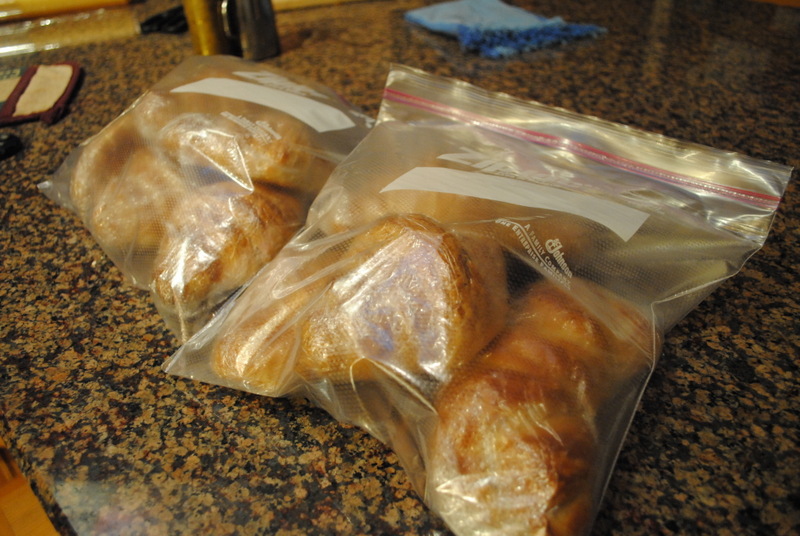
With all that in mind, is it feasible to have freshly baked croissants for breakfast?  Honestly, I find that a bit tricky.  Even if you retard the final proofing in the fridge, you will still have to let them come to room temperature to bake, and that will take about 1 hour, half an hour more to bake, and the gruesome wait of 45 minutes to attack them.  Maybe it would be possible to bake a batch for an 11am brunch,  but other than that, I think it’s much better to bake them, let them cool, and wrap each one individually to freeze.  You can see  here the results of my labor, ready to be enjoyed in the near future. Once you wake up with that unstoppable urge to have a warm-from-the-oven croissant,  simply unwrap them, leave at room temperature 10 minutes, and place in a 300 F oven for 5 minutes.  Voila’, mes amis:  great croissants whenever you feel like it!

I am grateful to Peter Reinhart for writing a great tutorial for croissants in his book, and of course for allowing me to publish his recipe on my blog. Thank you!

I am submitting this post to Susan’s Yeastpotting event…

ONE YEAR AGO: Maple-Oatmeal Sourdough Bread

TWO YEARS AGO: Pork Trinity: Coffee, Mushrooms, and Curry

Add to FacebookAdd to DiggAdd to Del.icio.usAdd to StumbleuponAdd to RedditAdd to BlinklistAdd to TwitterAdd to TechnoratiAdd to Yahoo BuzzAdd to Newsvine

SPRINGTIME SPINACH RISOTTO

Because there’s no such thing as too many risotto recipes, I share with you this version, made more special because I used spinach freshly harvested by our  friends and neighbors (the ones with the green thumb).    I took one small shortcut by using a frozen bag of  peas and carrots. We always have those in the freezer  because they are handy additions to rice, pasta, and soups.  And I wanted a bit of orange color to add contrast to the dish.  SPRINGTIME SPINACH RISOTTO
(inspired by Martha Stewart‘s Everyday Food)
.
3  cups chicken broth
2 cups water
2 tablespoons olive oil
1 shallot, finely chopped
salt and ground pepper
1 cup Arborio rice
1/2 cup dry white wine
10 ounces of spinach, finely chopped
8 ounces frozen carrots and peas, thawed
1 tablespoon butter
.
Combine chicken broth and water in a saucepan, bring to a boil and keep at a low simmer (you may not need to use the full amount of liquid).  In a medium saucepan, preferably wide and with round edges, heat the olive oil and add the minced shallot. Season with salt and pepper, cook until soft and translucent.   Add the rice, and cook until it starts to get a little color, about 4 minutes, stirring constantly so the grains don’t stick to the bottom of the pan and burn.  Add wine; cook, stirring, until absorbed, about 2 minutes.  Add 2 big ladles of hot chicken broth, and cook until absorbed, stirring occasionally.  Continue adding broth mixture, 1 cup at a time, waiting for liquid to be absorbed before adding more, stirring occasionally, until rice is just tender and creamy with a little liquid remaining in the pan, about 25 minutes. Stir in the spinach, peas, carrots, and finish with the butter.  Adjust seasoning if needed.
.
ENJOY!
.
to print the recipe, click here
.
This risotto could be a meal in itself, but we enjoyed it with grilled boneless chicken breasts. We do like some meat with our dinner, even if risotto-purists disagree.  I thought about making risotto cakes with the leftovers, but ran out of gas and simply re-warmed it in the microwave.  Not a real risotto anymore, but still a pretty tasty side dish!  😉
I used frozen peas and carrots for this recipe, but would not use frozen spinach – you need the texture of the fresh leaves that get barely cooked in the final moments of the preparation.  A squeeze of lemon juice, and a dusting with lemon zest would not hurt it either…
.
.
.

Add to FacebookAdd to DiggAdd to Del.icio.usAdd to StumbleuponAdd to RedditAdd to BlinklistAdd to TwitterAdd to TechnoratiAdd to Yahoo BuzzAdd to Newsvine

BLOOD ORANGE DUCK: A WORK IN PROGRESS

For the longest time I admired photos of blood oranges, without being able to find any around.  Now that they are available on a regular basis, I am a happy camper, bringing a few home with me whenever I spot them at the grocery store.  What I love about blood oranges the most is their mysterious nature: you never know how red they will be inside.  The skin tries to give you a hint, but… it can be very deceiving.  For this particular recipe from Donna Hay, I needed a fairly large amount of their juice, so I went to work on my oranges, each with their unique shade of red. Gorgeous!

I had a few problems with the recipe, explaining why the “work in progress”. To start with, the orange juice must be reduced by boiling (together with orange marmalade, sugar and vinegar), for what Donna says it will be 12 to 15 minutes, until thickened. Since you must brush the skin of the duck with the resulting sauce, trust me: 15 minutes simply doesn’t do the trick. It took me over 35 minutes, and I had to watch the pan like a hawk, because it boiled over quite quickly.

In preparation for roasting, the duck’s skin is pricked with a skewer, and the bird is dropped in boiling water for 10 seconds. Think carefully about the whole strategy, because you will be placing a reasonably large piece of meat in boiling water, and removing it 10 short seconds later. The duck will have a very high tendency to slide. Boiling water. Slippery bird.  Not a good match.  Be prepared. Once that part is taken care of, you’ll brush its surface with the blood orange reduction sauce, placing it over a rack on a baking dish protected with foil, as you see here.

My next problem with the instructions was the roasting temperature and time.  According to the recipe, roast at 350 F for about 1 hour, then cover the duck with foil and roast for a further 20 to 30 minutes.  The photo in her book is a mouth-watering masterpiece of golden brown crispy skin. Not sure how she would get there in those conditions, I had to increase the temperature and cook my duck a lot longer, even though my duck was almost exactly the weight she recommends in her recipe.  In the end, the meat was not very flavorful, and definitely not tender the way I would like it to be.

The best part of the meal was the side dish I chose to go with it: shredded Napa cabbage, very simply dressed with lime juice, olive oil, salt, and pepper, prepared 15 minutes before serving. Very refreshing, perfect to cut through the fatty duck.

So, it’s back to the drawing board on this one. I liked the flavor of the sauce, and feel that the recipe has the potential to be a winner. Knowing myself, though, I know it will take me a while to try it again. If anyone has suggestions, advice, tried and true methods, please post them in the comments or send them to me by email. I am all ears!

ONE YEAR AGO: Mahi-Mahi

TWO YEARS AGO: Memories of Pasteis (one of my favorite blog posts…)

Add to FacebookAdd to DiggAdd to Del.icio.usAdd to StumbleuponAdd to RedditAdd to BlinklistAdd to TwitterAdd to TechnoratiAdd to Yahoo BuzzAdd to Newsvine

IN MY KITCHEN, APRIL 2012

.

Following Celia’s footsteps once more, I share with you what is going on in our kitchen this month.

In My Kitchen….  A little celery miracle!

Did you know that if you cut the base of celery and place it in water for a few days a new celery plant will grow from it? All you have to do is plant it in your garden. Thanks to a tip from my friend Cindy, I have my own celery experiment going on, and this baby is now outside (fingers crossed for a long, productive life!)

In My Kitchen…
Homemade pain de mie, recipe from The Bread Bible, by Rose Levy Beranbaum, perfect to spread with any of the tasty concoctions by American Spoon, from Michigan. (I don’t work for the company and have not received any freebies to evaluate and/or promote).

In My Kitchen….  one of my favorite bowls, made in Italy,  with a nice image of Tuscany.  Just looking at it makes me happy!

.
In My Kitchen…. two special gifts from our friends and neighbors, the super-gardeners V & M

Romaine lettuce, picked from their garden just a couple of hours earlier!


Amazing spinach, very flavorful, that went into a spinach risotto, soon to be blogged about! 😉

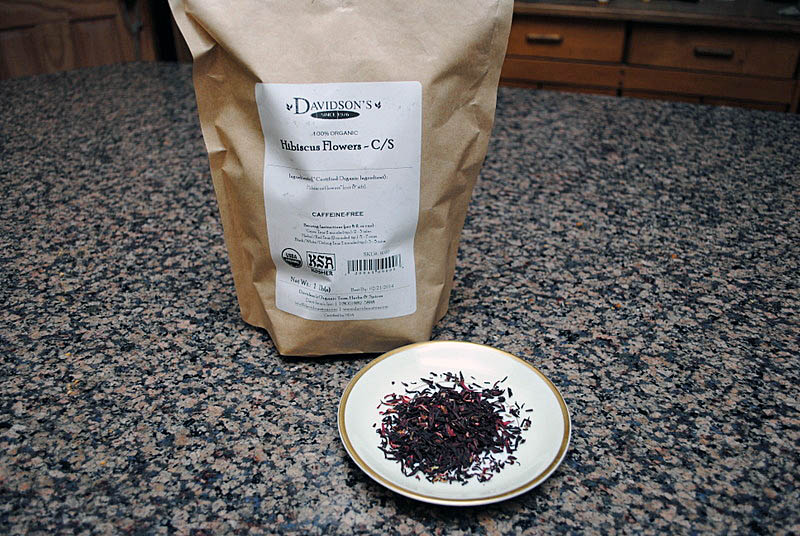
In My Kitchen…. A new passion, hibiscus flower tea!

I was intrigued by this post and could not rest until I got some hibiscus flowers to play with. The color of this tea is amazing… stay tuned to hear more about it.

In My Kitchen…

A bundt cake tester with a probe that changes color when the cake is perfectly cooked in the center. Yeah, I need all the help I can get as far as cake baking is concerned.

In My Kitchen…

Normally our pepper grinder is full of black Tellichery pepper, but I could not resist getting this bag of colorful peppercorns, to shake things up a little

In My Kitchen….

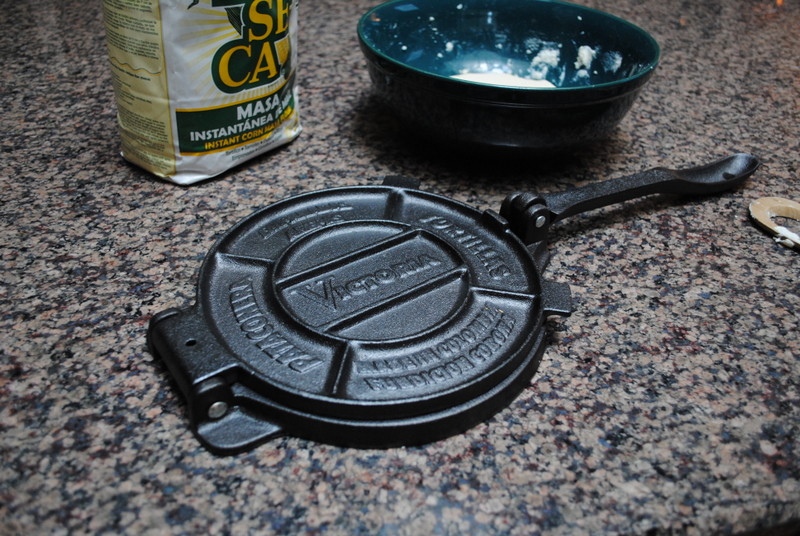
My newest toy, a tortilla press! Corn tortillas from scratch are infinitely better than store-bought, and a good quality press makes all the difference. A blog post about it is in the works…

In My Kitchen… especially for Codruta & Smidgen….
THE BREAD KNIFE!

and, finally… from the backyard, two cool dudes  wanted to say hello and hope that you enjoyed this little tour through their favorite spot in the house!

Oscar + Buck =  Double Trouble on the horizon…   😉

ONE YEAR AGO: A Dutch Tiger

TWO YEARS AGO Banana Bread

Add to FacebookAdd to DiggAdd to Del.icio.usAdd to StumbleuponAdd to RedditAdd to BlinklistAdd to TwitterAdd to TechnoratiAdd to Yahoo BuzzAdd to Newsvine

CODRUTA’S ROLLED OAT SOURDOUGH BREAD

I can read Portuguese, English, and French.  Stretching my brains a little I can get by in blogs written in Italian or Spanish, as the grammar and many words are similar to those from my native language.  Reading Romanian is another story altogether, but Codruta’s blog is on my blogroll list and will not be leaving anytime soon! Through Google Translate and a few email exchanges with her, I can profit from the bread masterpieces she regularly posts on “Apa. Faina. Sare”.   Agua. Farinha. Sal.  Water. Flour. Salt.  The basic ingredients for great bread, once you add the magic of wild yeast.

When she posted her own formula for a sourdough bread with flaky oats in the dough, I wanted to make it right away, as it involved a technique new to me: cold fermentation of the starter and dough until final proofing of the shaped bread.  Plus, it combined two different starters, one made with rye flour.  Indeed, not a bread for beginners, but I decided to take a leap of faith and play with the grownups. 😉   What do you think?

CODRUTA’S ROLLED OAT SOURDOUGH
(reprinted with permission, from Apa. Faina. Sare)

Makes one very large loaf or two medium-sized loaves.

for pre-ferment:
50 g very active starter made with regular flour (100% hydration)
50 g very active starter made with rye flour (100% hydration)
100 g bread flour
50 g water

for final dough:
all pre-ferment (250g)
450 g white bread flour
150 g whole wheat flour
130 g rolled oats (rolled thick is better)
470 g cold water
17 g salt

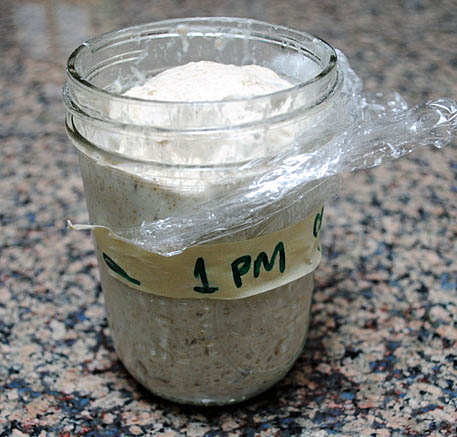
Prepare the pre-ferment by dissolving both types of starters in water, then add the flour. Stir and cover the container, placing it immediately in the refrigerator.  It is better to use a tall and narrow pot, transparent, so you can mark the level of your starter mixture as you place it in the fridge. Let it sit there 18-24 hours, until the yeast bubble grows up. You have a margin of a few hours to use for the yeast bubble will remain within, then begins to collapse.  Ideally, you should catch it when it’s almost doubled in bulk, as you can see in this photo.

When the starter is ready to be used, mix in a bowl the flours, rolled oats and cold water, let it sit 40 to 60 min (the autolyse step). Sprinkle salt on top, add the fermented starter straight from the fridge. Blend all ingredients together. Knead by folding directly into the bowl, a few minutes, until the dough comes off the fingers and the vessel walls. The dough will be quite dense, but do not add more water. Cover the pot, wait 15 minutes, and repeat the kneading by folding (one complete rotation of the vessel is sufficient). Cover and wait 15 minutes.

Transfer the dough in a greased rectangular dish with oil, make a set of stretch and fold (SF), wait 45 minutes, repeat the set of SF and place dough in the refrigerator.  Let dough in refrigerator for 15 to 18 hours.

Remove dough from refrigerator and leave it at room temperature for 1 hour. Divide the dough in two, and shape each half as a round or oval loaf.  Place the shaped loaves in a banetton or another appropriate container, with the seam up. Cover the pot with a light fabric, and then with plastic wrap. Let the dough proof at room temperature for 2 hours and 30 minutes.

Heat your oven 45 minutes before baking time. Have a baking stone inside and your method to generate steam planned. Bake at 460 F  for 45 min, with steam for the initial 15 min. Reduce temp to 440 F  if the bread seems to be browning too much.

Cool it completely before slicing.

ENJOY!

to print the recipe, click here

With this bread, I tried to work on shaping a batard, but next time I will divide the dough in uneven portions, making a slightly smaller batard and bigger “boule”.  I need a bit more practice with this shape of bread, but I feel I’m slowly making progress…  I was hoping for a shorter bread, with more pointed ends.  It will happen.  I know it will…  😉

The bread was absolutely delicious! The oats, although not previously soaked, more or less disappear into the dough, contributing flavor and a very slight hint of texture. Perfect! More and more I lean towards bread with whole wheat flour and grains or seeds inside, I find that they are very satisfying and more flavorful than white bread.

Unfortunately, I had a small problem with my camera – pilot error – and lost all my photos of the crumb.   Mine was not as perfect as Codruta’s bread, but no one who tried the bread seemed to mind…  Make sure to stop by her blog and marvel at the structure of her bread,  with a beautiful pyramidal shape, which is a sign of perfect handling of the dough.

Codruta, thanks for a great recipe,  I now only have about 8 others from your blog waiting in line!   😉

I am submitting this post to Susan’s Yeastspotting event…

ONE YEAR AGO:  Roasted Corn and Tomato Risotto

TWO YEARS AGO: Light Rye Bread

Add to FacebookAdd to DiggAdd to Del.icio.usAdd to StumbleuponAdd to RedditAdd to BlinklistAdd to TwitterAdd to TechnoratiAdd to Yahoo BuzzAdd to Newsvine