FARFALLE WITH ZUCCHINI AND RICOTTA

Last week, after one particularly hectic day in the lab,  I had no desire to stop at the grocery store on my way home.  Instead, I improvised, using a few things in the fridge leftover from past culinary adventures:  one reasonably large zucchini,  half a container of ricotta cheese, and a Meyer lemon abandoned inside the fruit drawer.

FARFALLE WITH ZUCCHINI AND RICOTTA
(from the Bewitching Kitchen)

farfalle pasta (or other favorite shape, enough for two)
1 Tbs olive oil
1 shallot, finely diced
1 large zuchinni, ends removed, shredded
zest of half a Meyer lemon
juice of Meyer lemon
3/4 cup ricotta cheese
salt
coarsely ground black pepper to taste (don’t be shy!)

Cook the pasta according to the package instructions.

Heat the olive oil in a large saute pan, add the shallot, season with salt, and cook until translucent.  Increase the heat to high, and add the zucchini in a single layer. Do not touch it, allow it to cook undisturbed for a couple of minutes.  Add the lemon zest, and stir the zucchini around.  Add the black pepper,  the ricotta cheese, stirring gently to form a sauce. Add the lemon juice, keep warm until the pasta is cooked al dente.

Add the cooked pasta to the skillet, reserving some of the cooking water. If necessary, add some of it to the farfalle/zucchini mixture.   Heat everything together in low heat for a minute.  Serve, with the optional grating of good parmigiano-reggiano on top.

ENJOY!

to print the recipe, click here

Comments:  I love zucchini and ricotta cheese together (and a Meyer lemon will always be welcome), but I must say what really made this dish was…. the cracked black pepper!   Italians know a thing or two about cooking, and their “cacio e pepe” pasta is a classic for excellent reasons. This dish reminded me of it, even with the other components fighting for attention with the “Piper nigrum“.  😉

Use as much pepper as you’ll be able to enjoy, and keep it on the coarse side. The little bits of peppery heat will make this simple meal quite special.

ONE YEAR AGO:  Anchovies, the final frontier!

TWO YEARS AGO:  Miche Point-a-Calliere

Add to FacebookAdd to DiggAdd to Del.icio.usAdd to StumbleuponAdd to RedditAdd to BlinklistAdd to TwitterAdd to TechnoratiAdd to Yahoo BuzzAdd to Newsvine

RED THEME FOR A SALAD

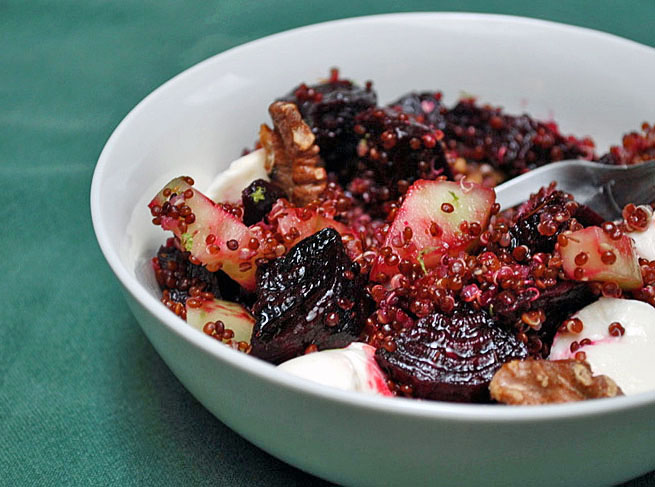
As the weather gets warmer, I opt for a light lunch whenever possible. However, after a workout session with  Tony Horton, I need a lot more than a serving of lettuce with some parsley sprinkled all over it.   😉 Last week I prepared a salad based on red quinoa with a bit more substance, but still compatible with the 90F day.  It turned out delicious!  It lasted a couple of days in the fridge, and got even better.  If you do that, just bring it to room temperature half an hour or so before lunch time.

QUINOA SALAD WITH ROASTED BEETS
(from the Bewitching Kitchen)

for ginger-orange vinaigrette
1/8 cup rice vinegar
1/8 cup fresh orange juice
1 tsp orange zest
1 Tbs sugar (or less, if you prefer)
1 Tbs grated ginger
1/4 cup grapeseed oil
salt and pepper to taste

for salad:
1 cup red quinoa, rinsed
2 medium beets, peeled and cut in large chunks
olive oil
salt and pepper
2 celery stalks. diced
fresh mozzarella cheese. diced
walnut pieces, toasted

Place the rinsed quinoa in a rice cooker, add 2 cups of water and a little salt.  Cook, adding a little more water if when the machine turns off you think the quinoa is too crunchy for your taste.   It should be ready in 15 to 20 minutes.  Fluff the quinoa with a fork, and let it cool.   Reserve.

In a medium bowl, place the pieces of beets, add a little olive oil just enough to coat the pieces, season with salt and pepper.  Transfer the pieces to a baking sheet, and place in a 400 – 420 F oven to roast until done (about 40 minutes, depending on the size).  Reserve.

Prepare the vinaigrette by mixing the vinegar, orange juice and zest and the sugar, until the sugar dissolves.  Add the oil slowly to form an emulsion, and season with salt and pepper.   You won’t need to use it all, save the leftover in the fridge, it keeps for about 1 week.

Assemble the salad by mixing all the ingredients and adding as much dressing as you like.  Adjust seasoning, and serve.

ENJOY!

to print the recipe, click here

My little rice cooker does a great job cooking all sorts of grains (and seeds, like quinoa).  I usually don’t bother with precise amounts of water, I try to add less rather than too much.  In case the cooker turns off but the grains are not exactly how I want them, I add a small amount of water and switch it back on for a few minutes.

I wanted to have this salad over a bed of baby spinach, but forgot all about it when I first made it.   On the following day, with the spinach, the salad looked really nice, but then I forgot to take pictures.   Such is life.  But, please feel free to  use your imagination!    😉

ONE YEAR AGO: Couscous Salad with Zucchini and Pine Nuts

TWO YEARS AGO:  A Simple Salad a la Jacques Pepin

(that proves that three years in a row I’ve got salad in my mind! ;-))

Add to FacebookAdd to DiggAdd to Del.icio.usAdd to StumbleuponAdd to RedditAdd to BlinklistAdd to TwitterAdd to TechnoratiAdd to Yahoo BuzzAdd to Newsvine

A BEWITCHING MOVE AHEAD

.
“There’s no place like home”
(Dorothy Gale,  The Wizard of Oz, 1934)

My life has been an amazing journey.  I’ve lived in different countries, worked in different labs, and changed my line of research quite a bit over the years.  The last drastic move was from Paris, France to Norman, Oklahoma, in what was classic “culture shock.”   However,  the past 18 years in this small town were the happiest of my life.   It’s always great to go back to Paris, or visit New York,  to spend time in California, or chill out with my folks in Sao Paulo, but life in a college town has unique appeal.  And because we’ve had such a great time living and working here, we expected to call Norman our home forever.

But it was not meant to be.  A new, exciting adventure lies ahead: Phil accepted the position of the Head of the Department of Biochemistry at Kansas State University, so we’ll move our home (and our lab) to another college town!   About the same size of Norman when we first arrived here almost 20 years ago, Manhattan seems like a great place.  We are ready to face this  challenge together.   If it all goes according to plan, we will move around the last week of June, and then move the lab a couple of months after that.

Home is wherever I’m with you.
(Edward Sharpe and The Magnetic Zeroes,  2009)

THE DEVIL MADE ME DO IT

Things were going well, perhaps too well.   My decision of not buying a single cookbook during the year of 2012 had me strong and confident until April 19th. The date is a personal record, as in the past 5 years I caved before sunset on the last day of February.   But, reading this passionate review by Farine set the stage for my demise.   How could I possibly resist a book called “How to Make Bread?”    I succumbed. I got it.  And, you know what?  I LOVE IT!

TOMATO SOURDOUGH
(from “How to Make Bread“, published with permission from Emmanuel Hadjiandreou)

400 g (3 + 1/2 cups) bread flour
10 g (2 tsp) salt
2 + 1/2 Tbsp chopped rosemary leaves
6 g (1 + 1/4 tsp) nigella seeds
40 g (2 Tbsp) tomato paste
200 g (3/4 cup) warm water
300 g (1 + 1/2 cups) sourdough starter (100% hydration)
2 tsp olive oil

Add into one bowl the flour, salt, seeds, and rosemary. This is your dry mixture.

In another, larger bowl, mix the tomato paste, water, sourdough starter, and olive oil. This is  your wet mixture.

Add the dry mixture to the wet mixture and mix until it all comes together. Cover with a plastic wrap and let it stand for 10 minutes.  After 10 minutes, knead the dough in the bowl, by pulling one portion of the dough from the side and pressing it down in the middle.  Repeat it turning the bowl slightly at each kneading, doing this kneading motion about 8 times and covering the full circumference of the ball of dough. The whole process should take about 20 seconds.   Cover the dough again and leave it resting for 10 minutes.

Repeat this kneading cycle three more times, 10 minutes apart.  Cover the bowl and let it rest for one hour.

Turn the dough onto a floured surface, and shape it either as a round ball, or an oblong format, place it in a suitable container for the final rise.  Let the dough rise until doubled in size, which should take from 3 to 6 hours, depending on how active your starter was.

Heat the oven to 475 F, and have your method to generate steam ready.   Slide the bread on a parchment paper or a wooden peel, slash it, and place it in the oven.  I like to bake it over tiles, and place an inverted roasting pan moist with hot water over it for about 30 minutes, then remove it.   Once the bread is in the oven, reduce the temperature to 425 F.  Bake for a total of 40 minutes, or until the internal temperature is over 200F.

Let the bread cool completely on a rack before slicing.

ENJOY!

to print the recipe, click here

About the book:  if you are into bread baking and think you’ve got enough books on the subject, think again.  You need this one.  Your library won’t be complete without it, no matter what is your skill level.  Emmanuel is a natural teacher, and the step by step photos arranged in a single page will give you a very clear idea of how to handle the dough at the different stages of fermentation and shaping.

One of the things I love the most about the book is how it makes me want to design my own recipes, using his basic method.  He simplifies the instructions by describing each recipe as “this is your dry mixture”“this is your wet mixture”“mix one with the other”.  Basically, that is what bread baking is all about, and you can customize and be creative  if you keep this basic formula in mind follow his minimalist approach to kneading.  Plus, he will expand your horizon on ingredients to add to a bread.  A few examples are his beetroot sourdough, fig, walnut and anise sourdough,  chocolate and currant sourdough…   Emmanuel’s book made me want to experiment, and that is the mark of a great cookbook.  It shows you a path without restricting you to it.

You can tell that a lot of dedication and attention to detail went into the making of this book.  From photos to text, a real masterpiece!

Emmanuel, thank you for giving me permission to feature your recipe in my blog…

I am submitting this post to Susan’s Yeastspotting

ONE YEAR AGO: A Focaccia Experiment

TWO YEARS AGO: Pierre Nury’s Bougnat

Add to FacebookAdd to DiggAdd to Del.icio.usAdd to StumbleuponAdd to RedditAdd to BlinklistAdd to TwitterAdd to TechnoratiAdd to Yahoo BuzzAdd to Newsvine

A GUEST POST!

I am so excited this Sunday morning!  Jenni, from “The Gingered Whisk” had me over at her great virtual spot as a guest blogger!

And, believe it or not, I decided to bake a cake for the special occasion… and you’ll also find a little extra to go with it.  Please jump there to see the post, and browse through her  blog, she loves to bake bread, particularly sourdough, so you see we are pretty much virtual sisters!