AWESOME BROCCOLINI

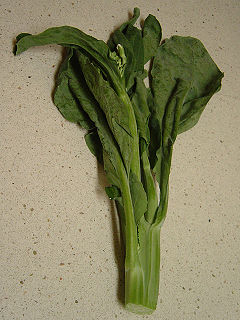
Ah, the bliss, the joy, the thrill of a stove with hot burners!  Stir frying, and any  other cooking style that imparts a wonderful, golden brown color – promises of great flavor ahead – just can’t materialize without intense heat.  I look at the powerful flame on our stove, and discreetly wipe a tear from my eye … Some things get to me.  A big sink to wash dishes.  An oven with three racks and the capability of 500 F.  Stuff like that.  But, back to food.  I found  some organic broccolini at the grocery store.  It’s a great veggie, a perfect side dish for anything from poultry to seafood.  BTW, it’s not baby broccoli,  but a cross between broccoli and  kai-lan, a Chinese leafy cabbage.  The cross mellows the broccoli character, almost yielding the flavor of asparagus, which explains one of its alternative names: asparation (I’m glad this name didn’t stick!  ;-))

My take on broccolini is a slight departure from the stove-top version of broccoli that I posted a year ago.
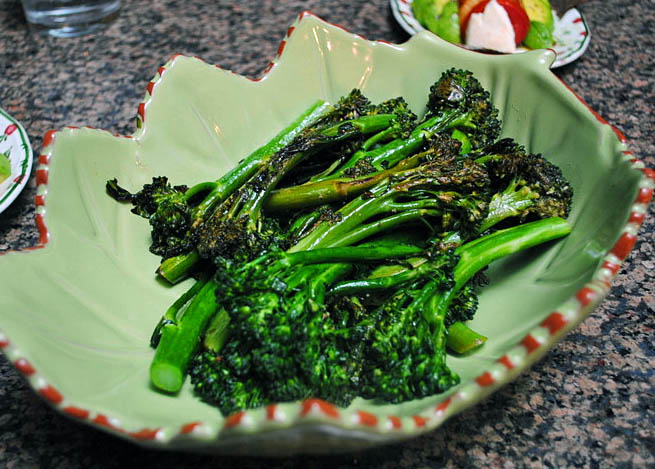
BROCCOLINI WITH GINGER AND LEMON
(from the Bewitching Kitchen)

2 small bunches of broccolini, preferably organic
2 tsp olive oil
red pepper flakes
1 tsp grated ginger
zest and juice of half a lemon
salt and pepper
splash of water (if needed)

Heat the olive oil in a large stainless steel skillet (that will hold the veggies without crowding), when smoking hot add the red pepper flakes, swirl for a couple of seconds and immediately add all the broccolini. Do not move them around, let them get a nice brown color at the bottom. Season with salt and pepper. After a couple of minutes, add the ginger and lemon zest, and shake the pan to move the broccolini and coat well all sides with the ginger, lemon zest, and oil.

Cover the pan, let it cook for 2-3 minutes more, then add the lemon juice – test the broccolini with a fork to see if it’s done to your liking.  If it’s not, and the pan is too dry, add a splash of water and cover the pan again, checking after a minute.  Once it’s cooked al dente, transfer to a serving dish and…

ENJOY!

to print the recipe, click here

Comments:  If you are anti-broccoli and think broccolini resembles it too much, please reconsider!  There’s absolutely none of the broccoli flavor/smell that many object to.  Avoid over cooking it, and buy young broccolini, with a bright green color and a firm flesh. This recipe is low in carbs and fat, but sky-high in flavor!  Lemon, ginger & red pepper flakes might very well be my favorite flavor mix right now: good on everything!

ONE YEAR AGO: Pizza! Pizza!

TWO YEARS AGO:  From Backyard to Kitchen

Add to FacebookAdd to DiggAdd to Del.icio.usAdd to StumbleuponAdd to RedditAdd to BlinklistAdd to TwitterAdd to TechnoratiAdd to Yahoo BuzzAdd to Newsvine

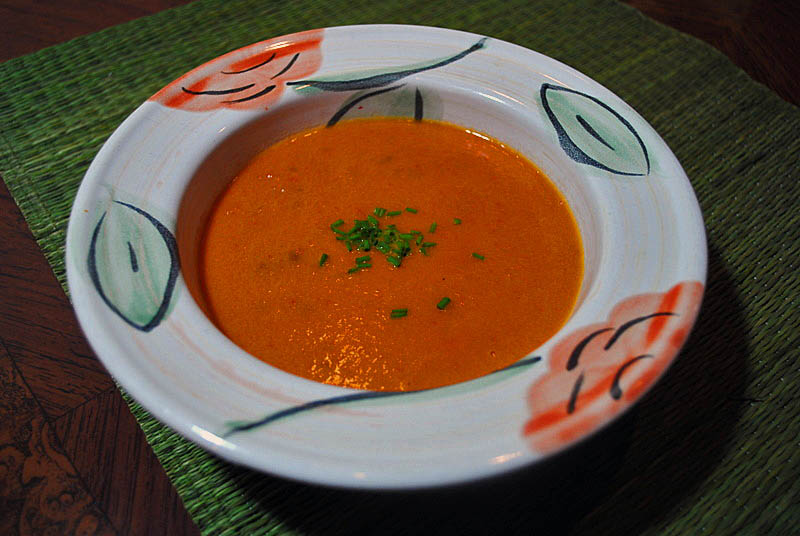
ROASTED TOMATO SOUP

This post is a bit nostalgic, as this was the last recipe I made in the nano-kitchen, but we left L.A. before I had a chance to write it up. A very simple recipe designed with the idea of using ingredients hanging around before our departure from California. It turned out so delicious! Plus, it was a nice match for the weather we were having then. Now that the thermometers are wonderfully stuck in the high 90’s, the thought of soup is not particularly appealing, but this one would work equally well chilled.

ROASTED TOMATO SOUP
(from the Bewitching Kitchen)

8-12 ounces of grape and/or cherry tomatoes, cut in half
2 shallots, cut in half
1 garlic clove, unpeeled
kalamata olive oil (or another olive oil of your choice)
splash of balsamic vinegar
salt and pepper
vegetable stock (or water)
2 Tbs orange juice
1 tsp orange zest
chives for garnish

Place the tomatoes, shallot pieces and garlic in a bowl and add enough olive oil to just coat them lightly. Transfer them to a baking sheet covered with aluminum foil or parchment paper, set the tomatoes with the cut size down. Sprinkle some salt and pepper all over, and a splash with balsamic vinegar.

Roast in a 425F oven for 20-25 minutes, until the tomato skins and the edges of the shallots start to get brown. Remove from the oven, let it all cool slightly, and using gloves peel off the skin of the tomatoes (you can leave them on if you don’t mind their texture in the soup). Squeeze the garlic out of its peel, and transfer it together with the tomatoes, shallots and any liquid accumulated in the pan to a food processor. Process it until smooth, pour into a sauce pan over medium heat, and add enough vegetable stock to give a consistency you like. Let it come to a gentle boil, add the orange juice, orange zest, taste for seasoning, and serve with chives sprinkled for garnish.

ENJOY!

                             to print the recipe, click here

Comments: I had a mixture of grape and cherry tomatoes that needed to be used, and a couple of yellow grape tomatoes went into the mix too. Feel free to improvise, nothing can go wrong with this soup: add different types of herbs, or go for a cumin or cayenne blast. I had planned to make some parmiggiano crisps to serve with the soup, but the electric burners in the nano-kitchen failed, and I was left with a big lump of cheesy mess. Once the weather cools, I’ll revisit this soup – cheese crisps included – and add some mushrooms to the roasting pan. I bet a roasted tomato & mushroom soup will be very flavorful.

ONE YEAR AGO: Turkey Meatballs

TWO YEARS AGO: Focaccia

Add to FacebookAdd to DiggAdd to Del.icio.usAdd to StumbleuponAdd to RedditAdd to BlinklistAdd to TwitterAdd to TechnoratiAdd to Yahoo BuzzAdd to Newsvine

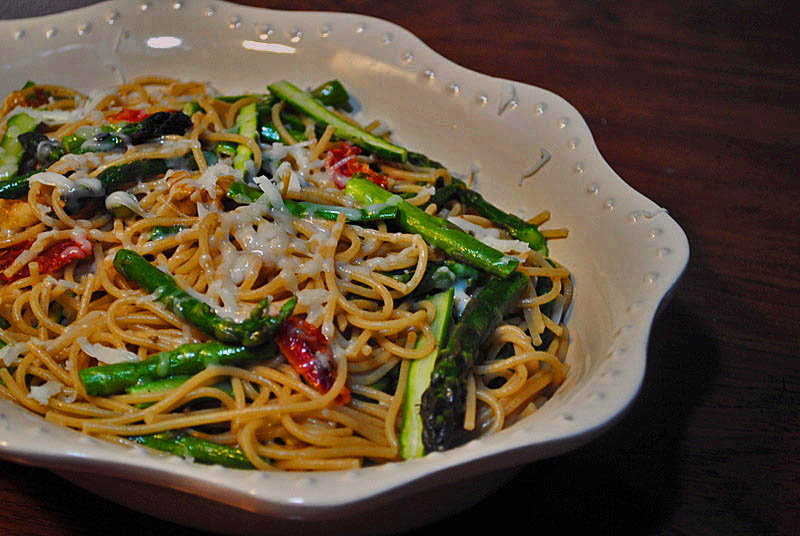
SPRING PASTA

Proving that there’s no such thing as too many recipes using asparagus, here is one more: a very tasty and healthy pasta dish to celebrate Spring, even if the season is already waving goodbye.  However, here in L.A. the warm weather is dragging its feet, temperatures barely hit the mid 70’s, and I still have to resort to long sleeves shirts.  It’s preposterous!

I got this recipe from a new food blog: Inspired Edibles, hosted by Kelly, where you’ll also find all sorts of articles related to nutrition and fitness, two topics I’m quite fond of.   Kelly got the recipe from  from Ellie Krieger, cookbook author and Food TV host. I made just a few changes to accommodate what I had around the kitchen.

SPRING PASTA
(adapted from this post in Inspired Edibles)

whole-wheat spaghetti (or pasta of your choice)
1 bunch of asparagus
1/2 cup walnuts, toasted and coarsely chopped
3 Tbs olive oil, divided
1 garlic clove
1/4 cup sun dried tomatoes, coarsely chopped
salt and pepper to taste
1/4 cup chicken stock (or water)
fresh parsley, chopped
Iberico cheese, grated (or Parmiggiano Reggiano)

Heat oven to 375 F.   Cut the tough stems off the asparagus and discard.  Cut the stems in half, and unless the stems are very thin, slice the lower half in half lengthwise.  Place them in a baking dish, coat lightly with 1 Tbsp olive oil, sprinkle salt, and bake for 12-15 minutes, until barely soft.

Start cooking the pasta according to the package instructions. Meanwhile, heat 2 Tbs olive oil on a large non-stick skillet and saute the garlic and the sun dried tomatoes for a couple of minutes, until the garlic is fragrant and the tomatoes start to soften up.  Season with a little salt and pepper. If the pasta is not cooked yet, reserve the sauteed mixture over very low heat.   Once the pasta is cooked, add it to the skillet together with the chicken stock, reserved asparagus, 3/4 of the walnuts, parsley and grated cheese.  Mix well, and warm it all together in medium-high heat for a couple of minutes.

Serve with the remaining walnuts and additional grated cheese on top.

ENJOY!

to print the recipe, click here

Comments:  The more I eat whole-wheat pasta the more I like it. Barilla is my top choice, but this time I used a Trader Joe’s alternative and found that its beautiful brownish color faded quite a bit upon cooking.  Not quite sure why that would happen, but it tasted fine, maybe a little less “toothsome” than Barilla.

Surprisingly,  there was no Parmiggiano in our home, so I used Iberico, a delicious Spanish cheese, similar to Manchego.  Since it’s not a hard, grating type cheese, it melted almost instantaneously in contact with the pasta.  Nothing wrong with that, actually, we loved it!  But it is a bit messy to grate, next time I’ll stick with the classic Parmiggiano.

Kelly, thanks so much for the inspiration,  you obviously picked a perfect name for your blog!   😉

ONE YEAR AGO:  Ice cream melts for mango


Add to FacebookAdd to DiggAdd to Del.icio.usAdd to StumbleuponAdd to RedditAdd to BlinklistAdd to TwitterAdd to TechnoratiAdd to Yahoo BuzzAdd to Newsvine

COUSCOUS SALAD WITH ZUCCHINI AND PINE NUTS

From one of the latest issues of Food and Wine magazine, this recipe was the only bright spot on a day in which everything that could go wrong (in the lab) went wrong.  But, as we were driving through intense Los Angeles traffic that Thursday, I knew that getting home and making dinner would improve my mood.  It always does, actually.  Especially if I already have it all planned and laid out in my mind, which was the case that day.

COUSCOUS SALAD WITH ZUCCHINI AND PINE NUTS
(adapted from Food and Wine, May 2011)

1 cup diced zucchini
2 Tbs olive oil
salt and pepper

1 cup couscous
1 cup boiling water

3/4 cup frozen peas
1/2 cup water
2 Tbs lemon juice
2 Tbs olive oil
1/2 cup pine nuts, lightly toasted
fresh mint and parsley, minced
salt and pepper to taste

Heat the olive oil in a non-stick skillet and sautee the zucchini until golden.  Season lightly with salt and pepper. You can prepare it in advance and keep it in the fridge.

Pour 1 cup of boiling water over the couscous in the bowl you intend to serve the salad. Cover with plastic wrap and let it sit at room temperature for 5-10 minutes as you prepare the rest of the recipe.

Boil the peas for 2 minutes, drain, reserving 1/4 cup of the water.  Add the lemon juice and olive oil, a little salt, to the reserved pea water, and whisk well.  Fluff the couscous with a fork, pour this dressing over it, mixing it well.  Gently mix in the cooked peas, reserved zucchini, toasted pine nuts, and fresh herbs.  Taste, adjust seasoning with salt and pepper, and serve.

ENJOY!

to print the recipe, click here

Comments:  Next time, I will dice the zucchini in slightly larger pieces, because I’d like their presence in the salad to be a little more obvious, not only visually, but also in texture.   I love the popcorn-y taste of pine nuts, but you can use almonds (as in the original Food and Wine version), or walnuts.  Make sure to toast them first.

It is crucial to let the zucchini get some color, so I like to leave it undisturbed in the sautee pan for a couple of minutes, before moving the pieces around.

This could be a nice vegetarian entree, as couscous is very filling, but we enjoyed it next to a juicy, grilled chicken breast.    And that was a perfect antidote for  the “lab-blues.”  😉

ONE YEAR AGO:  A Simple Salad a la Jacques Pepin

Add to FacebookAdd to DiggAdd to Del.icio.usAdd to StumbleuponAdd to RedditAdd to BlinklistAdd to TwitterAdd to TechnoratiAdd to Yahoo BuzzAdd to Newsvine

SPRINGTIME SALAD

The moment I saw this recipe in the latest issue of Fine Cooking, I knew I had to make it right away.  First, because it involves asparagus.  Secondly, because they are prepared in a novel way  – the spears are shaved as ribbons.    I am already quite fond of thinly sliced raw asparagus as in this farro salad, so I looked forward to trying this new (to me, anyway ;-)) method to serve them.

SHAVED ASPARAGUS SALAD
(adapted from Fine Coking magazine)

for the vinaigrette:
3 tablespoons rice vinegar
2 tablespoons lemon juice
2 tablespoons extra-virgin olive oil
2 teaspoons agave nectar  (or 1 Tablespoon honey)
1 tablespoon finely chopped shallots
salt and  black pepper to taste

for the salad:
1/2 lb. thick asparagus, trimmed
2 cups baby arugula
1/3 cup toasted cashew nuts
2 oz. thinly shaved aged Gouda

Make the vinaigrette by whisking together the vinegar, lemon juice, olive oil, agave nectar, shallots in a small bowl. Season with salt and pepper.  Refrigerate if not using right away.

Remove the tips of the asparagus and put them in a large bowl. Using a vegetable peeler, shave a stalk discarding the first shaving, which will contain only the thick outer layer.  When shaving the first side becomes awkward, turn stalk over and repeat. Add all shavings to the bowl with the tips. Repeat with remaining stalks. Toss asparagus with 1/4 cup of vinaigrette and let sit for 10 to 15 minutes.  Add arugula and toss, adding more dressing if needed to coat the leaves.  Top with the shaved cheese and cashews, adjust seasoning and serve right away.

ENJOY!

to print the recipe, click here

Comments:  This salad dressing is very close to perfection.  The original recipe used honey, but I’m so fond of agave nectar that whenever I have the opportunity, I use it instead.  Once you add the dressing to the shaved asparagus, the transformation is quite obvious: within a few minutes the ribbons start to soften up.   Don’t do it too early, or they will get mushy.   For obvious reasons, the salad won’t keep at its best for very long, so if you are serving it at a dinner party, keep that in mind.    The asparagus tips will retain most of their bite, adding a nice texture together with the cashew nuts.

At first, I thought about substituting parmiggiano or ricotta salata for the cheese component of this recipe. Aged Gouda is not a cheese we normally buy, but its slightly smoked taste worked surprisingly well with the arugula and asparagus.  We gave it two thumbs up!

I can see many variations of this recipe during Spring and Summer months.  And, I was not the only one who enjoyed it: browsing through “One Perfect Bite” the other day, I noticed that Mary also loved it.  Check it out by jumping here.

ONE YEAR AGO:  Indonesian Delight

Add to FacebookAdd to DiggAdd to Del.icio.usAdd to StumbleuponAdd to RedditAdd to BlinklistAdd to TwitterAdd to TechnoratiAdd to Yahoo BuzzAdd to Newsvine