SILKY CAULIFLOWER PUREE WITH ALMOND MILK

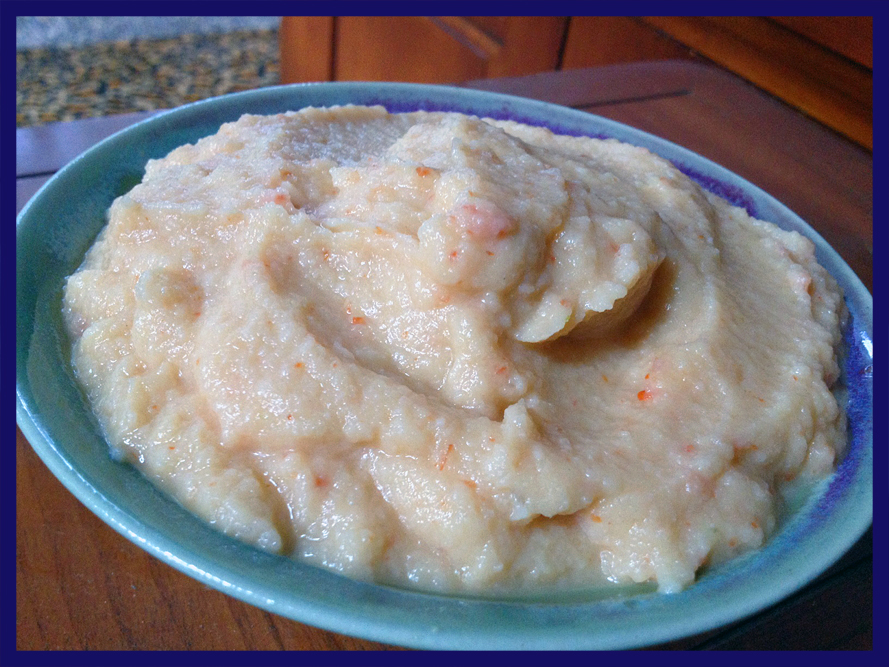
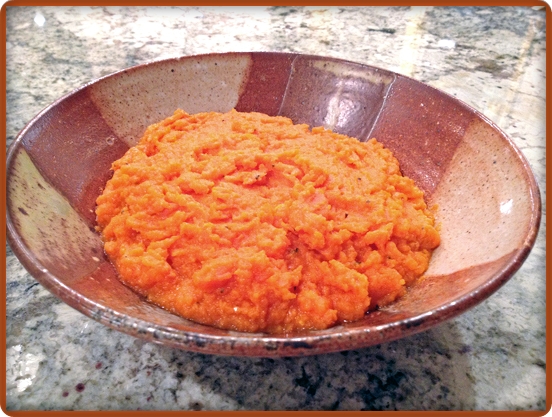
I am not sure why it took me so long to try almond milk, but  I fell in love with it the moment I tasted it.  This one is my favorite, the plain and lighter version made by Silk.   It is part of my daily routine now, half a glass of almond milk right before going to work, and another half after lunch.  Shockingly cold is best, by the way.   Phil used it in his lunch smoothies in place of  yogurt and loved it too. My passion for almond milk started me on a virtual expedition in the internet chasing for recipes using it in cooking.   I was pleasantly surprised to find quite an extensive number of possibilities.  My first adventure with Silk was a winner:  cauliflower puree.  I share with you the recipe,  inspired by Food and Wine.

AlmondCauliPuree1

SILKY CAULIFLOWER PUREE WITH ALMOND MILK
(from the Bewitching Kitchen)

1 medium-sized head of cauliflower
1 tbsp grapeseed oil
1 celery stalk, diced
1/2 red bell pepper, diced
1 shallot, diced
Half gallon Light Almond Milk (or slightly less)
salt and pepper

Prepare the cauliflower by removing the outer leaves and the central core.  Cut the florets off, slicing the large ones in two or three pieces.

Heat the oil on a skillet. Saute the celery, onion, and red bell pepper until the onion is golden, and the mixture is very fragrant. Season with a little salt and black pepper.   Add the cauliflower to the skillet and cook it on high heat for a couple of minutes, stirring often.  Transfer the mixture to a saucepan so that the cauliflower fill it no more than halfway up.   Add almond milk to the saucepan and bring the mixture to a boil.   Reduce the heat, cover the pan keeping the lid slightly ajar, and simmer for 15 to 20 minutes, until the cauliflower is tender.

Transfer the cooked cauliflower to the bowl of a food processor, keeping the almond milk in the pan.  No need to drain it completely, the amount of liquid that stick to the florets will help ensure a nice texture.   Process until smooth.  If necessary, add a little more warm almond milk.   Test for seasoning.   Serve warm.

ENJOY!


to print the recipe, click here
As I said, my first adventure with almond milk in cooking won’t be the last. In fact, I have this recipe on my “to try soon” folder, and hope I can actually switch it into the “tried and true”  in the near future.  One store in town normally carries Marcona almonds, which is the only tricky ingredient to find. With that in hand, I should be good to go.

Probably because I used light almond milk instead of full fat, the liquid seemed to separate a little as the cauliflower cooked. It definitely did not harm the dish, so if you use the light version, ignore its looks.  It will all come together in a silky happy ending!

dinner

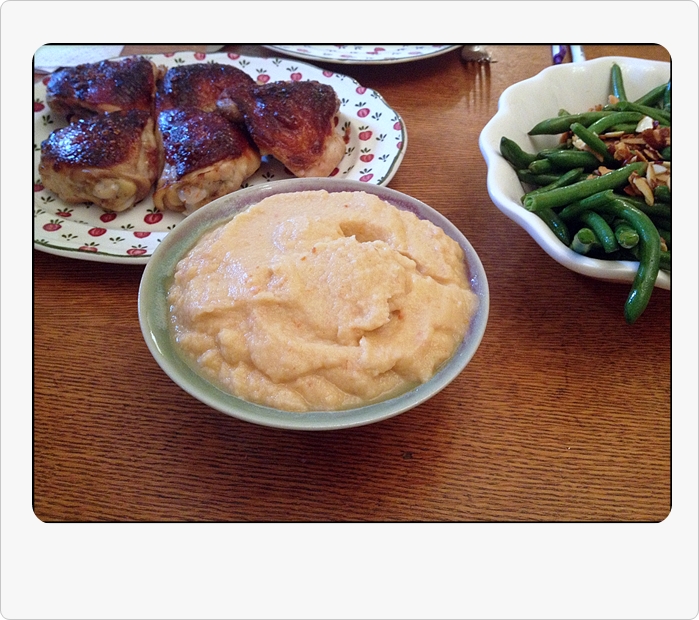
Our dinner felt quite special, considering it took place at the height of our kitchen renovation. Here is the full menu for that evening:  roasted chicken thighs marinated in beer-soy-orange (marinade to be blogged about soon), green beans with almonds, and the cauliflower puree.  Mr. Hamilton roasted the chicken thighs, Mr. Breville broiled the skin for a couple of minutes, and our single burner induction stove took care of the rest.  A few sautéed almonds on top of the puree tied both side dishes together quite nicely… even if I say so myself…   😉

plate

.
THREE YEARS AGO:
Popeye-Pleasing Salad
.
FOUR YEARS AGO: Summer’s Finale

DITALINI PASTA SALAD

I am not at all fond of pasta salads that are loaded with oily dressing, or the dreadful mayo to weigh things down even further. I like a salad that leaves me feeling refreshed and light. Ditalini is a shape normally used in soups, but I thought it would work well in this type of recipe. It has slightly more body than orzo, and is not as “slippery” . Rather than a strict recipe, this is all about flexible amounts, so play with it, and make it shine!

IMG_0320

DITALINI PASTA SALAD
(from the Bewitching Kitchen)

Ditalini pasta, cooked all dente and rinsed in cold water
1/4 cup grape seed oil
1/8 cup red wine vinegar
1 Tbs lemon juice
Dried oregano to taste
Dried mint to taste
Red pepper flakes, a pinch or two
Cherry tomatoes, red and yellow
Green onions, sliced thin
Salt and pepper to taste

Place the cooked and cooled ditalini pasta on a large bowl.

Make the vinaigrette by mixing and whisking well the grape seed oil, vinegar, lemon juice, oregano, mint, and red pepper flakes.

Cut the cherry tomatoes in half, and season lightly with salt and pepper.

Add the vinaigrette to the pasta and mix well.  Incorporate the cherry tomatoes, add the green onions, adjust seasoning with salt and pepper.  Keep cold…  and….

ENJOY!
.

to print the recipe, click here

.

Comments:  Feel free to use fresh mint instead of dried, as well as fresh oregano, although I find fresh oregano too overpowering and always use dried instead.  I kicked myself for not thinking about adding capers, so keep that in mind, this salad begs for a handful of those.   We like our vinaigrette to be more about the vinegar than the oil. We also prefer the milder taste of grape seed compared to olive oil, so grape seed was my choice.  You should make it the way you prefer, more oil, olive oil, a little mustard, maybe some garlic.  As you may have noticed, we are not garlic people.  It is quite possible that if they sequence our genome, a few vampire genes might be found here and there.  But, nothing to worry about, we are usually very well-behaved, your neck is safe with us.   😉

VP
Are you familiar with Vincent Price’s cookbook?  A classic, a real classic….

.

ONE YEAR AGO: Celebrate Wednesday with a Thai Seafood Curry

TWO YEARS AGOPost-workout Breakfast

THREE YEARS AGO: Semolina Barbecue Buns

FOUR YEARS AGO: Lavash Crackers

SEA SCALLOPS WITH PEA PUREE & CILANTRO GREMOLATA

Preparing this dinner was not easy.  It was probably not very wise to make it during the kitchen hellnovation, but I was craving a nicer meal to make our Sunday evening feel special.  It can be very stressful to be in a house undergoing renovation, so having a slightly fancier meal seemed like a good idea.  However, what used to be a kitchen is now an almost empty space with no finished floors or appliances.  We are lucky to be able to keep the fridge turned on in our garage, and to have improvised two cooking areas: one in the laundry room, another in our enclosed patio.  Still, pantry items are in boxes, a few dishes are piled in the dining room for our daily use, a few pans at close reach, but not that many.  I wish you could see a video of me preparing this meal.  Actually, I am very glad there is no video documenting the process.  It involved me dashing a few times across rooms, forgetting that some passages are blocked by heavy plastic.  It involved a mildly twisted ankle while balancing scallops on a baking dish and “almost” losing them all to a floor covered in rough concrete bits. It also involved a scorched pan,  but the pea puree, even after subjected to torture tasted absolutely awesome!  So, allow me to share with you one of the toughest meals I prepared in the past year, a recipe that I first saw on a favorite food blog of mine, Taste Food.  Yes, I cooked from Lynda’s blog before…  😉

served1

SEA SCALLOPS WITH GINGERED PEA PUREE AND CILANTRO GREMOLATA
(adapted from Taste Food)

for the scallops:
12 sea scallops
salt and pepper to taste
sprinkle of Mycryo

for the pea puree:
2 cups shelled English peas
salt
1 tablespoon freshly grated ginger
2 tablespoons extra-virgin olive oil
2 tablespoons freshly squeezed lemon juice
freshly ground black pepper
pinch of cayenne

for the gremolata:
1 cup cilantro leaves, chopped
1 garlic clove, minced
2 tablespoons finely grated lemon zest
1/2 teaspoon salt
1/2 teaspoon freshly ground black pepper

Make the gremolata by combining the cilantro, garlic, lemon zest, salt and pepper in a small bowl. Set aside.

Bring 4 cups water to a boil in a large saucepan. Add 2 teaspoons salt and the peas. Cook until peas are tender. Remove from heat and drain peas, reserving 1 cup cooking liquid.

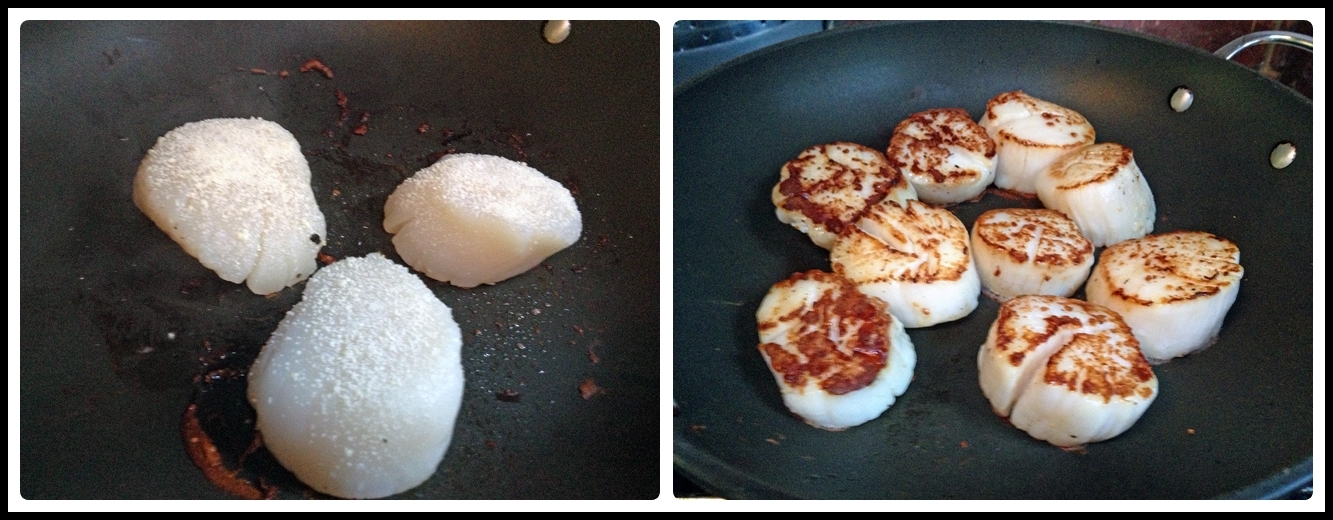
Combine peas, ginger, olive oil, lemon juice, 1 teaspoon salt, 1 teaspoon black pepper and cayenne in bowl of food processor. Purée until smooth. Add some of the reserved water (approximately 1/4 cup) to thin to desired consistency; the purée should not be too thin. Discard remaining water. Transfer purée to a bowl and keep warm. Pat scallops dry and sprinkle all over with salt and pepper. Add a sprinkle of Mycryo right before cooking. Heat a non-stick skillet over medium-high heat. Add half of the scallops, taking care not to overcrowd the pan. Cook, turning once, until brown on both sides and just cooked through, about 4 minutes. Transfer to plate and keep warm. Repeat with remaining scallops.  No need to add any oil to the pan, just the sprinkle of Mycryo will be enough.

To assemble, spoon pea purée on serving plates. Top with scallops. Sprinkle scallops and purée with gremolata.  Serve immediately.

ENJOY!

to print the recipe, click here

peapuree

Comments:  Mycryo is a great product with a poorly chosen name, if you ask me.  The word –  Mycryo – makes me think of tears, sadness, despair.  But that could not be farther from the truth:  they gave sea scallops THE most perfect brown ever, even though they were prepared in THE most rudimentary cooking conditions available to a cook (the Drama Queen says hello). I even conducted a small experiment by preparing two batches of sea scallops.  One cost a small fortune, they were the ultra-special, huge dry sea scallops.  The other was a frozen type that while thawing released a gallon of white milky liquid.  No bueno.   With a light sprinkle of Mycryo (and no oil added to the non-stick pan), all scallops browned like a Brazilian under the tropical sun!   We could not tell the difference in texture or taste between the two types, which was quite amazing to me.   Great product! You can order here, they shipped very quickly, contrary to what I heard from customers who got it through amazon.com.

composite11

The pea puree competed heavily with the scallops to win the spotlight of this meal.   Bright flavor with the ginger and just a slight heat from the cayenne.  Lynda really came up with a perfectly balanced side dish.

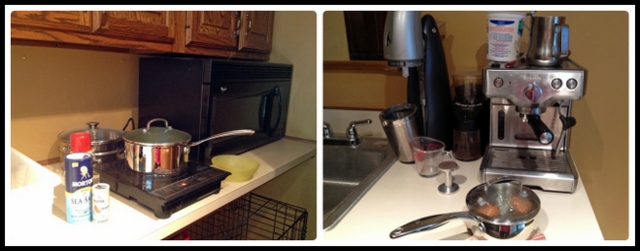
I close this post with a little snapshot of our laundry room.  In one side we installed the induction cooktop + microwave. On the other side, where we do have a large sink, we stuffed together the coffee machine, coffee grinder, and our beloved Penguin Sodastream.  It’s cozy in there, folks. Cozy.

cookingcomp

ONE YEAR AGO: Mediterranean Skewers with Balsamic Dressing

TWO YEARS AGO: Five Grain Sourdough Bread

THREE YEARS AGO: The Nano-Kitchen

FOUR YEARS AGO: Kaiser Rolls

FAROFA BRASILEIRA

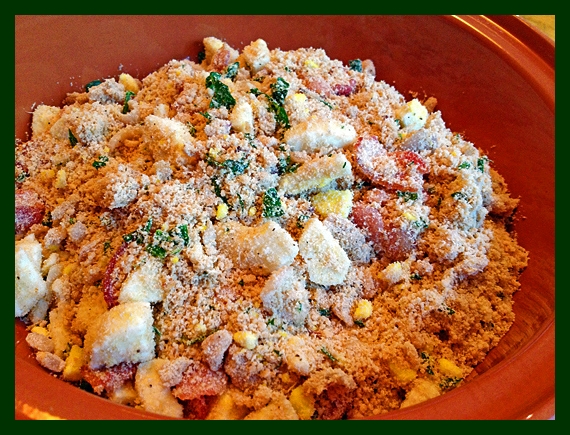
farofa
Many of the classic recipes of Brazilian cooking have a counterpart  in other cuisines, be it French, Italian, or American. For instance, feijoada,  the  famous Brazilian concoction,  could be described as a type of cassoulet using different kinds of meat, and black beans instead of the French Tarbais.  Other dishes are a bit hard to “explain” for those who are not familiar with it.  Farofa is one perfect example.  The closest culinary item that I can use to describe farofa would be the toasted rice powder used on larb.  It’s about texture.   Just like Bolognese sauce and chili, each Brazilian family will swear by their recipe.  I will give you my own family version, the one that Phil fell in love with the first time he’s tried it.

FAROFA BRASILEIRA
(from the Bewitching Kitchen)

4 strips of bacon, center-cut, diced
2 Tablespoons butter
1 onion, diced
1 clove garlic, minced
2 cups manioc flour (see comments)
salt and pepper to taste
3 hard-boiled eggs, coarsely diced
parsley leaves, minced

Cook the bacon on low heat on a large, non-stick skillet. No need to add any oil, the bacon will release its own fat.  Once the fat starts to accumulate in the pan, increase the heat slightly and allow the bacon to get some color.  Add the butter and the diced onion, cook over medium-heat stirring often until the onion gets light golden. Add the garlic, cook for a minute, then dump all the manioc flour.  Season with salt and black pepper, and keep stirring until the flour starts to get toasted.  Make sure to stir the flour from the top to the bottom of the pan, so that the whole amount gets cooked.

Remove the pan from the heat, add the hard-boiled eggs and the parsley. Serve warm or at room temperature, preferably over a nice helping of white rice and beans.

ENJOY!

to print the recipe, click here

served1
Comments: If you want to make this Brazilian delicacy, it’s absolutely essential to find the right type of manioc flour.  It is NOT the fine powder used to bake items such as Brazilian cheese bread.  The manioc flour used for farofa is coarse, and sold in two different forms: white and toasted.  You can use either one for this recipe. If you start with the toasted flour your farofa will have a slight more intense flavor. To order some online, click here.  I really like Yoki brand, you can get “cruda/crua” (white) or “torrada” (toasted).  For a delicious farofa variation that includes corn, visit Angela’s blog (in Portuguese). I intend to make her recipe soon.

Farofa is best enjoyed over black beans and rice, or a nice moqueca.  Anything with a spicy sauce only gets better with a nice coating of farofa.  But, I must say that once you get hooked on it, you will find yourself reaching for the bowl with a spoon and enjoying it all by itself.  Gotta tell a little story here.  My Dad was the utmost farofa-lover.  He developed a very interesting skill to enjoy it, in which he grabbed a fork, balanced a big load of farofa on it, then launched it up in the air, catching it all with his mouth! Believe it or not, not a single crumb would fall on the floor…  It’s really too bad in those days cell phones with camera did not exist or he could have been be a super-star on youtube.  It’s ok, though.  He was and will always be a super-star for me.

ONE  YEAR AGO: Thai-Inspired Pork Tenderloin

TWO YEARS AGO: A yummy Brazilian cake: Bolo de Fuba’

THREE YEARS AGO:  Summer’s Tomatoes

FOUR YEARS AGO: Leaving on a jet plane… 

SAUTEED ZUCCHINI WITH SUN-DRIED TOMATOES AND BASIL

zucchinifc11
I’m always trying to find different ways to prepare zucchini, as we both love it so much. One of my favorite recipes is a simple stir-fry like this one, but the timing (and the size of your pan) must be just right, as a slight variation will result in overcooked, limp zucchini, with no bite whatsoever.  This recipe from Fine Cooking follows a totally different path to the stir-fry happy-ending.  Pieces of zucchini are lightly salted and sit for 10 minutes, a process that will draw out a lot of moisture and the bitterness that might turn some people off.  After that, you will be on your way to a tasty side dish.

SAUTEED ZUCCHINI WITH SUN-DRIED TOMATOES AND BASIL
(adapted from Fine Cooking magazine #65)

2 medium zucchini
1/2 tsp. Kosher salt + more for seasoning
2 Tbs. extra-virgin olive oil
1 clove garlic, smashed and peeled
3 oil-packed sun-dried tomatoes, drained and finely diced
6 fresh basil leaves, torn into large pieces
Freshly ground black pepper
1/2 lemon, juiced

Wash the zucchini and dry them with paper towels. Trim off the ends and quarter the zucchini lengthwise. Arrange the zucchini, cut side up, on a baking sheet lined with paper towels. Sprinkle with the salt and set aside for 10 minutes. Blot the quarters dry with the paper towels. Cut each quarter on the diagonal into 3/4-inch-thick pieces.

Heat a large skillet over medium-high heat for 1 minute. Pour in 2 Tbs. of the oil. When the oil is hot, add the zucchini and garlic, and sauté, stirring occasionally, until the zucchini browns and softens enough that you can cut through it with the side of a fork, about 5 min. Take the pan off the heat, toss in the sun-dried tomatoes and basil, and season generously with salt and pepper. Drizzle with the lemon juice and  serve immediately.

ENJOY!

to print the recipe, click here

composite111
Comments:  I have a bit of a troubled relationship with sun-dried tomatoes.  The ones that come packed in oil are often too greasy for my taste, but their texture is much better than the dry-packed ones. My approach is to buy the ones in oil, and before incorporating in the dish let them rest on a piece of kitchen paper to blot the excess oil away.

Fresh tomatoes would not deliver the same punch of flavor.  Sun-dried tomatoes are similar to red pepper flakes, instead of having their flavor uniformly diluted across the dish, they give you little spikes of heat.  Perfect!

This was a delicious way to prepare zucchini, yet another recipe that can be adapted in many ways.  Try adding roasted red bell pepper in place of sun-dried tomatoes, cilantro instead of basil, a bit of mint…  Don’t omit the lemon juice, though.  It is a must!

ONE YEAR AGO: Orzo with Heirloom Tomato Relish

TWO YEARS AGO:  Headed to Brazil!

THREE YEARS AGO: The Rhubarb Brouhaha: Revelation Compote

FOUR YEARS AGO: Love me tender…