FAROFA BRASILEIRA

farofa
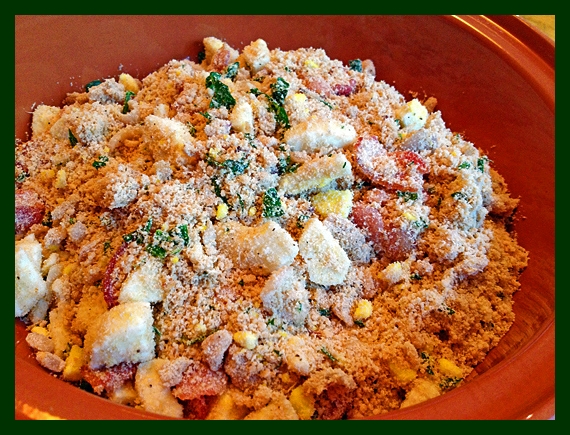
Many of the classic recipes of Brazilian cooking have a counterpart  in other cuisines, be it French, Italian, or American. For instance, feijoada,  the  famous Brazilian concoction,  could be described as a type of cassoulet using different kinds of meat, and black beans instead of the French Tarbais.  Other dishes are a bit hard to “explain” for those who are not familiar with it.  Farofa is one perfect example.  The closest culinary item that I can use to describe farofa would be the toasted rice powder used on larb.  It’s about texture.   Just like Bolognese sauce and chili, each Brazilian family will swear by their recipe.  I will give you my own family version, the one that Phil fell in love with the first time he’s tried it.

FAROFA BRASILEIRA
(from the Bewitching Kitchen)

4 strips of bacon, center-cut, diced
2 Tablespoons butter
1 onion, diced
1 clove garlic, minced
2 cups manioc flour (see comments)
salt and pepper to taste
3 hard-boiled eggs, coarsely diced
parsley leaves, minced

Cook the bacon on low heat on a large, non-stick skillet. No need to add any oil, the bacon will release its own fat.  Once the fat starts to accumulate in the pan, increase the heat slightly and allow the bacon to get some color.  Add the butter and the diced onion, cook over medium-heat stirring often until the onion gets light golden. Add the garlic, cook for a minute, then dump all the manioc flour.  Season with salt and black pepper, and keep stirring until the flour starts to get toasted.  Make sure to stir the flour from the top to the bottom of the pan, so that the whole amount gets cooked.

Remove the pan from the heat, add the hard-boiled eggs and the parsley. Serve warm or at room temperature, preferably over a nice helping of white rice and beans.

ENJOY!

to print the recipe, click here

served1
Comments: If you want to make this Brazilian delicacy, it’s absolutely essential to find the right type of manioc flour.  It is NOT the fine powder used to bake items such as Brazilian cheese bread.  The manioc flour used for farofa is coarse, and sold in two different forms: white and toasted.  You can use either one for this recipe. If you start with the toasted flour your farofa will have a slight more intense flavor. To order some online, click here.  I really like Yoki brand, you can get “cruda/crua” (white) or “torrada” (toasted).  For a delicious farofa variation that includes corn, visit Angela’s blog (in Portuguese). I intend to make her recipe soon.

Farofa is best enjoyed over black beans and rice, or a nice moqueca.  Anything with a spicy sauce only gets better with a nice coating of farofa.  But, I must say that once you get hooked on it, you will find yourself reaching for the bowl with a spoon and enjoying it all by itself.  Gotta tell a little story here.  My Dad was the utmost farofa-lover.  He developed a very interesting skill to enjoy it, in which he grabbed a fork, balanced a big load of farofa on it, then launched it up in the air, catching it all with his mouth! Believe it or not, not a single crumb would fall on the floor…  It’s really too bad in those days cell phones with camera did not exist or he could have been be a super-star on youtube.  It’s ok, though.  He was and will always be a super-star for me.

ONE  YEAR AGO: Thai-Inspired Pork Tenderloin

TWO YEARS AGO: A yummy Brazilian cake: Bolo de Fuba’

THREE YEARS AGO:  Summer’s Tomatoes

FOUR YEARS AGO: Leaving on a jet plane… 

SAUTEED ZUCCHINI WITH SUN-DRIED TOMATOES AND BASIL

zucchinifc11
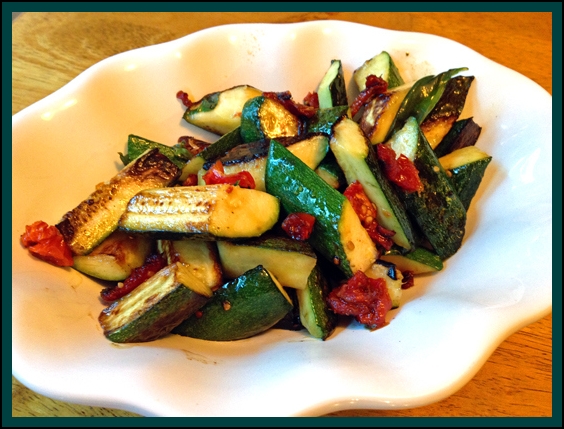
I’m always trying to find different ways to prepare zucchini, as we both love it so much. One of my favorite recipes is a simple stir-fry like this one, but the timing (and the size of your pan) must be just right, as a slight variation will result in overcooked, limp zucchini, with no bite whatsoever.  This recipe from Fine Cooking follows a totally different path to the stir-fry happy-ending.  Pieces of zucchini are lightly salted and sit for 10 minutes, a process that will draw out a lot of moisture and the bitterness that might turn some people off.  After that, you will be on your way to a tasty side dish.

SAUTEED ZUCCHINI WITH SUN-DRIED TOMATOES AND BASIL
(adapted from Fine Cooking magazine #65)

2 medium zucchini
1/2 tsp. Kosher salt + more for seasoning
2 Tbs. extra-virgin olive oil
1 clove garlic, smashed and peeled
3 oil-packed sun-dried tomatoes, drained and finely diced
6 fresh basil leaves, torn into large pieces
Freshly ground black pepper
1/2 lemon, juiced

Wash the zucchini and dry them with paper towels. Trim off the ends and quarter the zucchini lengthwise. Arrange the zucchini, cut side up, on a baking sheet lined with paper towels. Sprinkle with the salt and set aside for 10 minutes. Blot the quarters dry with the paper towels. Cut each quarter on the diagonal into 3/4-inch-thick pieces.

Heat a large skillet over medium-high heat for 1 minute. Pour in 2 Tbs. of the oil. When the oil is hot, add the zucchini and garlic, and sauté, stirring occasionally, until the zucchini browns and softens enough that you can cut through it with the side of a fork, about 5 min. Take the pan off the heat, toss in the sun-dried tomatoes and basil, and season generously with salt and pepper. Drizzle with the lemon juice and  serve immediately.

ENJOY!

to print the recipe, click here

composite111
Comments:  I have a bit of a troubled relationship with sun-dried tomatoes.  The ones that come packed in oil are often too greasy for my taste, but their texture is much better than the dry-packed ones. My approach is to buy the ones in oil, and before incorporating in the dish let them rest on a piece of kitchen paper to blot the excess oil away.

Fresh tomatoes would not deliver the same punch of flavor.  Sun-dried tomatoes are similar to red pepper flakes, instead of having their flavor uniformly diluted across the dish, they give you little spikes of heat.  Perfect!

This was a delicious way to prepare zucchini, yet another recipe that can be adapted in many ways.  Try adding roasted red bell pepper in place of sun-dried tomatoes, cilantro instead of basil, a bit of mint…  Don’t omit the lemon juice, though.  It is a must!

ONE YEAR AGO: Orzo with Heirloom Tomato Relish

TWO YEARS AGO:  Headed to Brazil!

THREE YEARS AGO: The Rhubarb Brouhaha: Revelation Compote

FOUR YEARS AGO: Love me tender…

SECRET RECIPE CLUB: CARROT FLAN WITH GREENS AND LEMON VINAIGRETTE

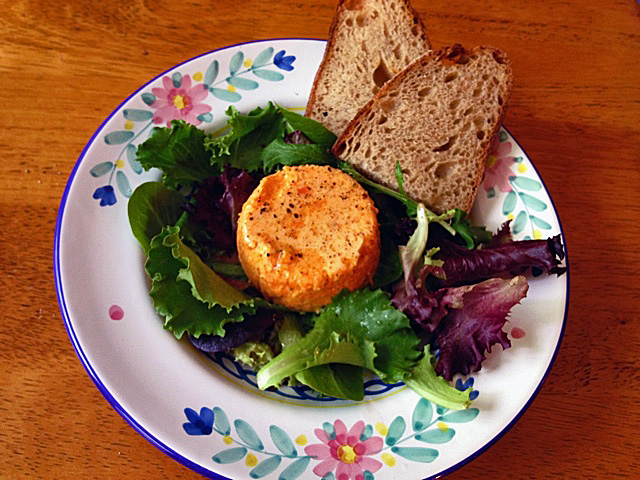
flanJune, folks. We are in June. That means half of this amazing year is pretty much over.  Carpe diem. The months always end on a nice note for me, because the last Monday brings Reveal Day of The Secret Recipe Club.  I was paired this month with Dena from Oh! You Cook!”. Dena describes herself as a librarian by day, recipe blogger by night, except on nights in which she works as a librarian…  Not only she works around books, but she is an author herself, having published last year “The Everything Kosher Slowcooker Cookbook”.  Check it out here.  Reading her blog is a lot of fun! She is quite witty, and often opens her articles with remarks that will bring a smile to your face.  For instance, the recipe I chose, carrot flan, is under a post entitled “Go Forth on the Fourth…”  I quote straight from her blog:

Go Forth on the Fourth…  and barbecue, of course! 

Steaks… check!

Skewered chicken… check!  

Carrot flan… huh?   🙂

So there you go. Whether you are making this dish as a side for a barbecue or as a light meal, it will turn your day into something unique. Elegant, light, sophisticated, and the best part: it’s actually quite simple to make.

top

CARROT FLAN WITH GREENS AND LEMON VINAIGRETTE
(adapted from “Oh! You Cook!”)

Makes 6 individual servings.

for the flans:
12 ounces carrots (enough to make 2 1/2 cups of chopped pieces)
4 eggs
4 ounces (1/2 cup) heavy cream
1/2 teaspoon sea salt
1/4 teaspoon ground black pepper
pinch of grated nutmeg

for the vinaigrette:
1/4 cup olive oil
3 tablespoons fresh lemon juice
1 teaspoons Dijon mustard
1/2 teaspoon grated lemon peel
1/2 teaspoon honey

Make the flans: Heat the oven to 325 degrees F. Butter 6 ramekins (3/4-cup size). Cook the pieces of carrots in boiling salted water until tender, about 8 minutes. Drain and puree in a food processor or blender until smooth, and let cool slightly.

Whisk the pureed carrots together with the eggs, heavy cream, salt, pepper, and nutmeg. Divide the mixture among the buttered ramekins, and place the ramekins in a baking pan. Add enough hot water to the baking pan so that the water goes halfway up the sides of the ramekins. Cover the pain with foil and bake until the custards are set and a knife inserted near the middle of one comes out clean. (In my pathetic oven it took almost 1 hour, but you should start checking it at 40 minutes, normally it should take around 45 minutes). Remove the ramekins from the baking dish and let cool slightly before unmolding.

For the vinaigrette:  whisk together the lemon juice, lemon peel, mustard, and honey. Stream in the olive oil, whisking constantly, until an emulsion forms. Season well with salt and pepper,  and store in the refrigerator.

Final assembly of the dish:  Place a handful of salad greens of your choice for each serving of flan in a large bowl. Drizzle some vinaigrette over the greens, season with coarse salt and freshly ground black pepper, and toss to dress. Run a knife around the inside of the ramekins to loosen the flans, then invert them over a plate to unmold. Serve the flans with the salad  and an additional drizzle of the vinaigrette.

ENJOY!

to print the recipe, click here

composite-001
Comments: This might be a bold statement, but I’ll go ahead with it: I think this was my favorite recipe of all the “Secret Ones” I’ve made in the year and a half participating in the event.  Phil raved about it from the first bite, and said that these flans could be served on the best bistrots of Paris. How’s that for a compliment?  The leftover flans were warmed in a microwave for 40 seconds, and they unmolded perfectly then.  So, this recipe is a wonderful option for a dinner party.

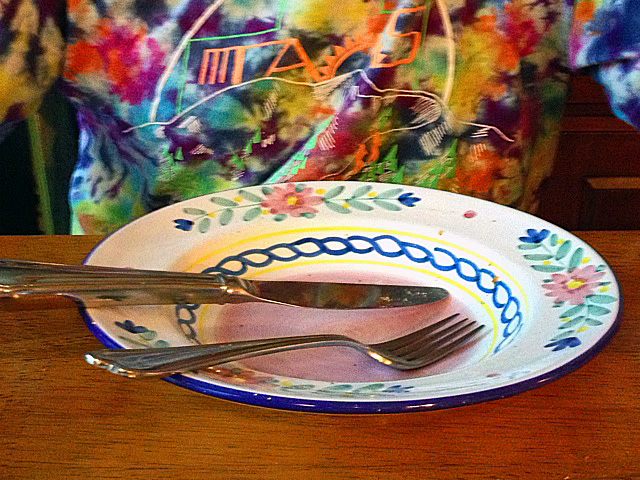
tiediePolishing off the meal with non-stop compliments: Nice! Wearing a tie-die shirt with more colors than the dinner plate? Optional, but so very cool… 😉

If you want to see what my friends from Group D cooked up for this Reveal Day, click on the blue frog at the bottom of the post…. have fun!

ONE YEAR AGO: The Secret Recipe Club: Granola Bars

TWO YEARS AGO:  Awesome Broccolini

THREE YEARS AGO:  A Twist on Pesto

FOUR YEARS AGO: Ciabatta: Judging a bread by its holes


KINPIRA GOBO AND JAPANESE HOME COOKING

burdock2_opt

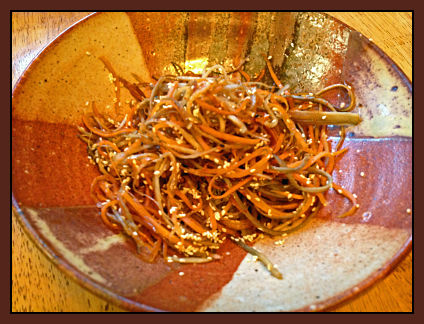
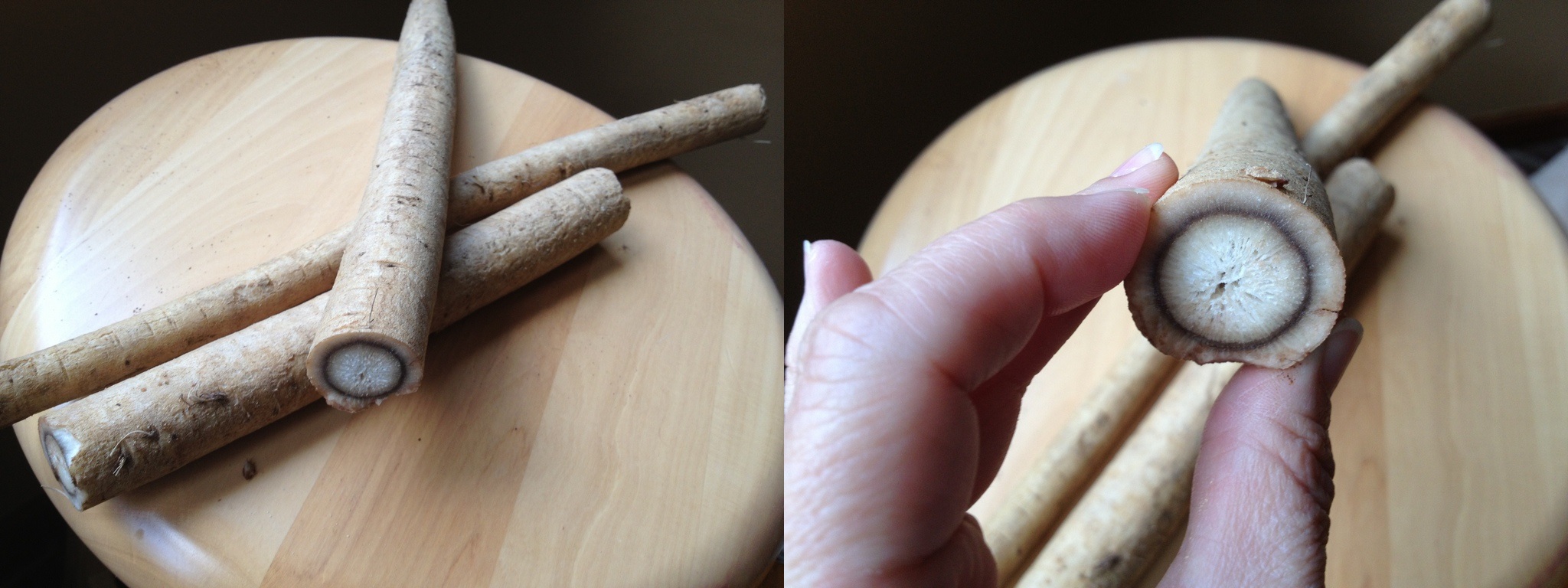
Of all types of cuisine, Japanese is the one that intimidates me the most. Making sushi at home is out of the question for me, but even other types of Japanese cooking give me pause.  In a recent trip to California, we met a wonderful couple who takes a different approach: they are both Americans, but mostly cook Japanese food at home and are really serious about it.  Their bookshelves are loaded with cookbooks devoted to Oriental (and vegetarian) cooking, their pantry stocked with the most exotic ingredients.  They mentioned a dish they love so much that it’s not uncommon to have it twice in the same week.   It uses a strange-looking root called “gobo“, also known as “burdock“.   They gave me the perfect spice mix to season this traditional Japanese dish (see my previous post) and wished me luck finding gobo in Manhattan, KS.   I was very optimistic, though. It turns out “The Little Apple” is home to one of the most amazing food stores I’ve ever been to, called quite simply “Asian Market“.    I could not wait to get there to search for the elusive root.  Not only they had a ton of it, but the owner said it’s always in stock.   Call me a happy camper. And call this dinner one of the healthiest meals I’ve ever put together.   And very delicious too!
served1

KINPIRA GOBO (Sautéed Burdock)
(adapted from Hiroko Urakami Japanese Family-Style Recipes)

1 medium gobo root
2 carrots
1 Tablespoon sesame oil
1/2 Tablespoon grape seed oil
2 Tablespoons mirin (or sake)
1 + 1/2 Tablespoons sugar
2 Tablespoons soy sauce
1 + 1/2 Tablespoons sesame seeds, toasted
Nanami togarashi to taste

Set up a large bowl with cold water. Peel the carrots and cut in julienne strips. Peel the outer dark skin of the gobo root, and working quickly, cut it in julienne strips.  Soak the gobo and the carrots in water for 10 to 20 minutes.  Drain well, and dry the strips using a kitchen towel.

Heat the sesame and grape seed oil on a large skillet.  Add the carrots and gobo root, and sautée them together for about 4 minutes, until they are tender.  Add the mirin, sugar, and soy sauce, and cook over medium heat until all the liquid has been absorbed.  Transfer to a serving bowl, add the sesame seeds and the nanami togarashi right before serving.

ENJOY!

to print the recipe, click here

composite

I have a bit of  trivia about gobo for you:  in the 40’s, a Swiss inventor called George de Mestral was walking his dog through some woods and noticed that the seeds of a particular plant glued to everything, from his clothes to his dog’s fur. He collected some seeds, and inspected them under the microscope. He was amazed by its hooks and loops, and thought that it could be the basis of a new material. From that observation, Velcro was born.  The plant was burdock. Apart from its technological impact, gobo is considered by the Japanese as one of the healthiest types of food, that they claim to “purify the blood”.   It contains a lot of minerals (including iron),  it is high in fiber, low in calories, and has a very unique taste.  The soaking in water is necessary to get rid of tannins that can give it a harsh taste.
soakingI love to find a new ingredient to play with!   Our kinpira gobo was served as a side dish for boneless chicken thighs on the grill (marinated with yogurt and a few spices), snow peas, and brown rice.  It was the type of meal that makes you feel healthier with each bite.  I hope you can find some gobo and give this recipe a try, it’s a keeper…  😉

ONE YEAR AGO: Walnut Sourdough

TWO YEARS AGO: Thai Chicken Curry

THREE YEARS AGO: Zen and the art of risotto

EVERYBODY LOVES CARROTS!

And to prove my point, a photo straight from one of my favorite websites, Dogshaming.com (published with permission)

Carrots Phil and I try to eat a varied diet.  We don’t exclude fats or  carbs, only moderate the intake of overly caloric stuff. Over the years we made some changes in our nutrition that we follow as strictly as possible.  We do the seafood at least once a week, often more.  We limit red meat to once a week. We save desserts for special occasions. Recently we decided to increase our consumption of carrots. Our goal is to have them as a side dish twice/week. Carrots are a fantastic source of beta-carotene, a compound that is metabolized into vitamin A and retinal in humans and other vertebrates. Retinal (vitamin A-aldehyde), is a key compound in the vision process.  Interestingly, carotenes are poorly absorbed from raw carrots. For optimal absorption, the carrots should be cooked, and preferably consumed with a little oil, as carotenes are oil-soluble.  I am sure the cute dog above compensates the poor absorption by maximizing uptake and grabbing each root available in the backyard…   😉  This recipe solves the problems for H.sapiens, as the carrots are roasted with a bit of olive oil. Plus, to pump the “good-for-you” index even further, they are mixed with pomegranates, themselves chock full of nutrients.  Interestingly enough, did you know that both carrots and pomegranates originated in Afghanistan?  That may be why they go so well together!

served1

POMEGRANATE MOLASSES GLAZED CARROTS
(adapted from Bon Appetit)

8 carrots (any color), halved lengthwise, cut crosswise into 2-inch pieces
1 tablespoons olive oil
Salt and freshly ground black pepper
1 tablespoon honey
1 tablespoon pomegranate molasses

Heat oven to 425°. Combine carrots and oil in a medium bowl. Season with salt and pepper and toss to coat. Transfer to a rimmed baking sheet, spreading out in an even layer. Clean any excess oil left in the bowl and reserve it. Roast carrots, turning occasionally, until just tender, 12-15 minutes. Meanwhile, whisk honey and pomegranate molasses to blend in reserved bowl.

Transfer carrots to bowl with honey mixture; toss to coat well and spread out on baking sheet, scraping out any remaining glaze from bowl. Roast  until glaze is reduced and sticky and beginning to brown in spots, 5-8 minutes longer.

ENJOY!

to print the recipe, click here

I loved this recipe not only for its flavor, but also its simplicity.  At first, I thought that the honey would make it overly sweet, because molasses sound sweet enough to start with. Not the case. The pomegranate component of the molasses wins the battle and the honey is needed to compensate its sharpness.  Since the final roasting takes less than 10 minutes, you can pre-roast the carrots in advance, and finish the dish right before sitting down to eat. I am all for easy during weeknights.

Note to self: make a lot more carrots than you think you’ll need. Yeah, they are that good…  😉

Note to readers:  if you are a dog lover and have not been introduced to Dogshaming.com,  make sure to stop by.  My day is not complete without a visit!

ONE YEAR AGO: Codruta’s Rolled Oat Sourdough Bread

TWO YEARS AGO: Roasted Corn and Tomato Risotto

THREE YEARS AGO: Light Rye Bread