PASTEIS DE NATA


March, 2003. While living in Paris we took a few days break in Lisbon where we met a couple of great friends from the US who were vacationing in Europe (Sally waves hello to M & V). It was also a trip to celebrate our 3rd wedding anniversary. Portugal, the home country of my maternal grandparents, was a place I had always wanted to visit. The country is charming, people absolutely adorable, and the food? The food does not get the respect and admiration it deserves, in my opinion. As it is mandatory for anyone visiting Lisbon, we stopped by the birth place of Pastéis de Belém, also known as Pastéis de Nata. You can read all about it here.

But first, would you like to say it as a native?  let’s try it…

When  you bite into your first one, the skies open, angels start singing, and you wonder how would you ever leave Portugal and that indescribable pleasure behind. Yes, they are that wonderful. For almost 15 years I’ve been dreaming of making them at home, even though I am fully aware they would not compare to the original ones. Then I watched an episode of the latest season of The Great British Bake Off, and pastéis de nata were requested as one technical challenge. Sally said to herself… if they can do it, perhaps I could too?

PASTÉIS DE NATA
(slightly modified from  Leite’s Culinaria)

for the dough:
2 cups minus 2 tablespoons all-purpose flour (227 grams)***  (see my notes)
1/4 teaspoon sea salt (1 gram)
3/4 cup plus 2 tablespoons cold water (208 ml)
8 ounces unsalted butter (2 sticks), room temperature, stirred until smooth

for the custard:
3 tablespoons all-purpose flour (23 grams)
1 1/4 cups milk (297 ml), divided
1 1/3 cups granulated sugar (264 grams)
1 cinnamon stick
2/3 cup water (158 ml)
1/2 teaspoon vanilla extract (3 ml)
6 large egg yolks, whisked

for the garnish:
confectioners’ sugar
cinnamon

Make the dough: In a stand mixer fitted with a dough hook, mix the flour, salt, and water until a soft, pillowy dough forms that pulls away from the side of the bowl, about 30 seconds. I needed to add quite a bit more flour than the recipe called for, at least 1/4 cup more, perhaps more. 

Generously flour a work surface and pat the dough into a 6-inch square using a pastry scraper. Flour the dough, cover with plastic wrap, and let it rest at room temperature for 15 minutes. Roll the dough into an 18-inch square. As you work, use the scraper to lift the dough to make sure the underside isn’t sticking to your work surface.

Brush the excess flour off the top of the dough, trim any uneven edges, and, using a small offset spatula, dot and then spread the left 2/3 portion of the dough with a little less than 1/3 of the butter being careful to leave a 1 inch plain border around the edge of the dough. Neatly fold the unbuttered right 1/3 of the dough (using the pastry scraper to loosen it if it sticks) over the rest of the dough. Brush off any excess flour, then fold over the left 1/3 of the dough.

Starting from the top, pat down the dough with your hand to release any air bubbles, and then pinch the edges of the dough to seal. Brush off any excess flour. Turn the dough 90° to the left so the fold is facing you. Lift the dough and flour the work surface. Once again roll it out to an 18-inch square, then dot the left 2/3 of the dough with 1/3 of the butter and smear it over the dough. Fold the dough as directed in the previous steps.

For the last rolling, turn the dough 90° to the left and roll out the dough to an 18-by-21-inch rectangle, with the shorter side facing you. Spread the remaining butter over the entire surface of the dough. Using the spatula as an aid, lift the edge of dough closest to you and roll the dough away from you into a tight log, brushing the excess flour from the underside as you go. Trim the ends and cut the log in half. Wrap each piece in plastic wrap and chill for 2 hours or preferably overnight.

Make the custard: In a medium bowl, whisk the flour and 1/4 cup milk until smooth. Bring the sugar, cinnamon, and water to a boil in a small saucepan and cook until an instant-read thermometer registers 220°F (100°C). Do not stir.

Meanwhile, in another small saucepan, scald the remaining 1 cup milk. Whisk the hot milk into the flour mixture. Remove the cinnamon stick and then pour the sugar syrup in a thin stream into the hot milk-and-flour mixture, whisking briskly. Add the vanilla and stir for a minute until very warm but not hot. Whisk in the yolks, strain the mixture into a bowl, cover with plastic wrap, and set aside. The custard will be thin.

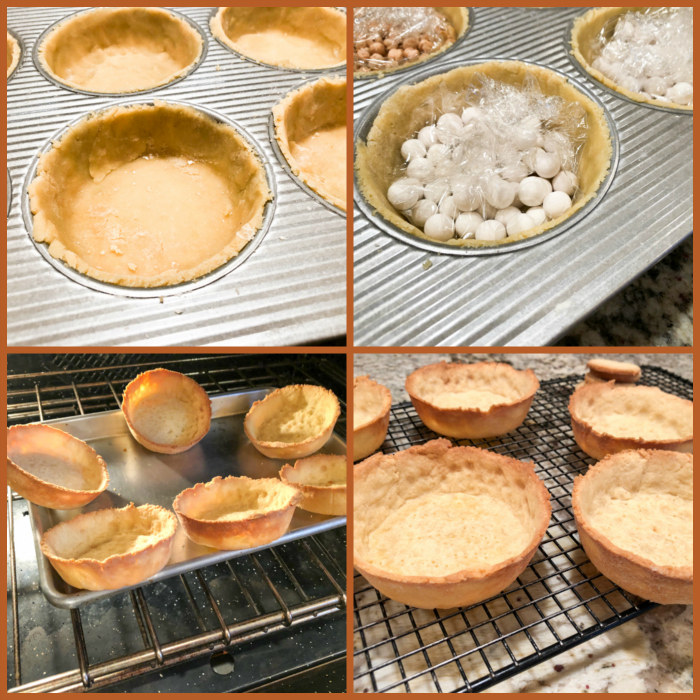
Assemble and bake the pastries:  Place an oven rack in the top third position and heat the oven to 500°F.  Remove a pastry log from the refrigerator and roll it back and forth on a lightly floured surface until it’s about an inch in diameter and 16 inches long. Cut it into scant 3/4-inch pieces. Place 1 piece pastry dough, cut side down, in each well of a nonstick 12-cup mini-muffin pan (2-by-5/8-inch size). Allow the dough pieces to soften several minutes until pliable.

Have a small cup of water nearby. Dip your thumbs in the water, then straight down into the middle of the dough spiral. Flatten it against the bottom of the cup to a thickness of about 1/16 inch, then smooth the dough up the sides and create a raised lip about 1/8 inch above the pan. The pastry sides should be thinner than the bottom. Fill each cup 3/4 full with the slightly warm custard. Bake the pasteis until the edges of the dough are frilled and brown, about 8 to 9 minutes.

Remove from the oven and allow the pasteis to cool a few minutes in the pan, then transfer to a rack and cool until just warm. Sprinkle the pasteis generously with confectioners’ sugar, then cinnamon and serve. Repeat with the remaining pastry and custard.

ENJOY!

to print the recipe, click here

Comments: I will not lie to you, this is a labor of love. It is time-consuming, and the first time you make it, you’ll feel quite insecure about each step. Did I roll out the pastry thin enough? Is the butter melting too much into the dough? And the insecurities get more intense when it comes time to shape each little shell, because it’s a bit of an unusual process. After rolling the pastry as a long sausage, small bits are cut cross-wise and placed in each mini-muffin tin, like this:

Then, very gently you will push down with the finger right in the center of the cylinder, making the pastry stretch to the sides. Instructions tell you to make the base thicker than the sides. That is easy to understand but not that easy to achieve. Plus, the idea is to work as quickly as possible so the butter won’t melt with the heat of your fingers. If you do it perfectly right, after baking the base of the pastry should show a nice rolling pattern.

Not quite there yet… but I guess not too bad…

The amazing thing is that I did two batches of these Portuguese delicacies, two days in a row. Why? Because I am married to Phil. Puzzled?  Let me explain. A dialogue, that happened as we arrived home from work, went more or less like this:

“What are you going to do with all this leftover custard in the fridge?

I have no clue, maybe pour over some fruit? You can have it, by the way…

(A bit of a pause)

Why don’t you make a second batch of pastéis de nata?

(pause due to sheer shock)

Are you totally out of your mind? Do you realize what it takes to make these?

C’mon, it cannot be that bad…

(my reply was not fit to print)

Ok, ok, OK, I get it.. BUT what if I help you? We make it together, how about that?

And that’s how a second batch of Pastéis de Nata was made after work on a weeknight. He did help me, first sitting by the countertop making small conversation as I prepared the dough, and then shaping a batch of shells.  He even made a little video while I was working hard with dough and butter. I guess he got bored! 😉 Anyway, here is the mercifully short video.

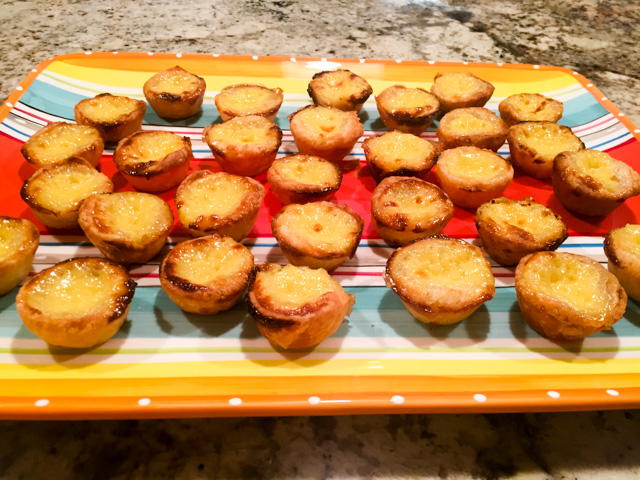
Even though they turned out very delicious, there is room for improvement. I guess baking them closer to the heat source would be better, ideally you want them all to have the very dark spots I showed you in the first photo.  Interestingly enough, those had been baked in my small electric oven, where the tray was placed a lot closer to the top heating element. That’s something to keep in mind if you try them yourself.  I also made a small batch with commercial puff pastry, and must admit home-made from scratch turns out a lot better. Something about the way the custard and the shell join in a more homogeneous way. The store-bought puff pastry had a harsher texture. Still, if that’s the only option for you to bake a batch of Pastéis de Nata, go for it. It will still be amazing, I promise. I must stress again the fact that as written, the recipe from Leite’s Culinaria posed me problems. I find that the amount of flour called for has got to be wrong. Maybe it has to do with the brand he’s used, but keep that in mind. You need a dough that you can work comfortably with.

Hard to believe that my first encounter with Pastéis de Nata was almost 15 years ago!

Getting ready to leave for our anniversary dinner, in a restaurant with great seafood and live “fado”, a music that speaks straight to the human soul. 

I hope you enjoyed my adventure with this delicacy of my past. I am so glad I finally decided to go for it. Now I need to face another dream of mine, éclairs. Stay tuned!

ONE YEAR AGO: New Mexico Pork Chile, Crockpot Version

TWO YEARS AGO: Chocolate on Chocolate

THREE YEARS AGO: Double Chocolate and Mint Cookies

FOUR YEARS AGO: The Story of my first Creme Brulle’

FIVE YEARS AGO: Sourdough Mini-rolls

SIX YEARS AGO: Focaccia with Sun-dried Tomatoes and Gorgonzola

SEVEN YEARS AGO: Mediterranean Skewers

EIGHT YEARS AGO Fettuccine with Shrimp, Swiss Chard, and Tomatoes

SaveSave

SaveSave

SaveSave

SaveSave

SaveSave

SaveSave

SaveSave

SaveSave

SaveSave

SaveSave

SaveSave

SaveSave

SaveSave

SaveSave

SaveSave

SaveSave

SaveSave

SaveSave

SaveSave

SaveSave

CHOCOLATE CRANBERRY CURD TART


If you are tired of pumpkin pie for Thanksgiving, may I offer the perfect alternative? The color of the cranberry curd as you cut through the pie is enough to make your heart miss a beat. Plus, if you prefer a dessert that is not cloying sweet, look no further.  Tartness in the center, subtle chocolate sweetness on top and bottom. Oddly enough, I’ve had this recipe in my files to try soon ever since Helen published it in her blog. We are talking November 2014. I know, what’s wrong with me?  (Please, refrain from answering, it is a purely rhetorical question).

CHOCOLATE CRANBERRY CURD TART
(from Helen’s Pastries like a Pro)

Chocolate Press-in Shell
1 cup all-purpose flour
1/2 cup cake flour
1/4 cup cocoa
1/2 cup sugar
1/2 teaspoon baking powder
1 stick butter, cold and cut into small pieces
1 egg
1 egg yolk

Heat oven to 350 degrees. Spray the bottom of an 11”x1” quiche pan with removable sides in the center only. Set aside. Combine flours and cocoa in bowl of mixer. Mix briefly to combine. Add butter and cut in until very fine. Add sugar and baking powder. Mix to combine. Add egg and egg yolk; mix until it balls up and rides the blade. Remove from the processor and divide in half.

Divide one half into 2 pieces.  Roll one piece into a rope and press it in evenly along one side of the pan. Repeat with the second half of dough.  Overlap the seams and seal well so no seam shows. Press the remainder of the dough into the bottom of the pan. Seal the edges very well so no line shows. Prick the shell before baking.

Bake approximately 10 to 12 minutes or until completely baked. Cool completely.

Cranberry Curd
12 ounce bag fresh or frozen cranberries picked over
1 cup sugar (7 ounces or 200 grams)
2 tablespoons water
5 egg yolks (3 ounces or 85 grams)
1 tablespoon lemon juice
1 stick unsalted butter, cold and cut into pieces (4 ounces or 114 grams)

Place the cranberries in a rimmed baking sheet and pick over.  Shake the tray to move the berries around.

Place the  cranberries in a saucepan with sugar and water over low heat until the cranberries are very soft and some of them have popped.   Stir frequently as this will be very thick and can scorch. Immediately, puree them in a food processor (by batches if necessary). Puree for several minutes to get the skins as fine as possible. There will be tiny specs of red which is as it should be. If you prefer to remove the skins, strain the puree before proceeding. Add the yolks and lemon juice to the processor and process briefly.

Place the cranberry mixture in the top of a double boiler and add the butter. Bring the water underneath to a boil.   Stir the curd constantly until an instant read thermometer reads 170 degrees. Immediately pour into the cooled crust. Smooth the top. Cover directly with film and refrigerate for several hours or preferably overnight.

Chocolate Cream Glaze
2/3 cup heavy cream
2 1/2 ounces semisweet chocolate, cut into small pieces

Bring the cream to a simmer. Submerge the chocolate. Allow to sit for 4 to 5 minutes then whisk gently to smooth the chocolate completely. Remove the film from on top of the cranberry curd. Pour the glaze in the center and move it out to the edge of the curd with an offset spatula.

Refrigerate if using within a day or two. Freeze for up to a month for longer storage.

ENJOY!

to print the recipe, click here

Comments: First of all, I urge you to visit Helen’s site because as is always the case for her blog posts, you will find a step by step tutorial that will guide you through the process. Even if you’ve never baked a tart in your life, her explanations will take you to a happy – and tasty – ending. This was my first time making this type of press-in crust. I normally delegate all things crust (pies and tarts) to Phil, but not this time. My pan was a little smaller than the one she used, so the crust turned out a bit thick at the bottom. With my inexperience, I was a bit insecure to use less crust, not knowing exactly what to expect.  Next time I’ll make sure it’s thinner. Anyway, if you have the right size pan, just follow the recipe exactly.

The color of the cranberry curd is something! I shared a few photos on my Facebook page, and some of my friends were wondering how to get the finalized tart to show the curd, maybe reducing the glaze to a zig-zag drizzle, or putting the glaze underneath the curd instead.  Having tasted it, I think the tartness of the curd really benefits from a nice layer of ganache on top. So the striking beauty of it will have to be appreciated only after slicing. Gastronomic compromise.

This is a perfect recipe for those who don’t like overly sweet desserts. The colors scream end of the year festivities, so I hope you consider making it if not for Thanksgiving, before 2017 says goodbye.

Helen, thanks once again for a fantastic recipe and tutorial…
I am a bit ashamed it took me so long to get to this tart, but better late than never!

ONE YEAR AGO: Slow-Cooker Pork Ragu with Fennel

TWO YEARS AGO: Pimp your Veg, a Guest Post

THREE YEARS AGO: Cooking Light Pan-Charred Veggies 

FOUR YEARS AGO: Pomegranate Chicken Thighs and Carrot Mash

FIVE YEARS AGO: The Many Faces of Kale

SIX YEARS AGO:  Short and Sweet 

SEVEN YEARS AGO: Ciabatta, a Classic Italian Bread

EIGHT YEARS AGO: Magical Lamb Stew


SaveSave

SaveSave

SaveSave

SaveSave

SaveSave

SaveSave

SaveSave

RASPBERRY ALMOND BRUNCH CAKE FOR A SWEET MONDAY

Almost exactly three years ago I reviewed The Global Pastry Cookbook, a cookbook that is very dear to my heart, as I’d been following Gayle’s blog for a very long time. Today I share with you one more recipe from the book, which Gayle gave me permission to publish in full. It is a delicious cake, easy to prepare, with a soft crumb, intense raspberry flavor, and the perfect textural topping given by sliced almonds. Perfect. Just perfect. As it’s often the case, this cake was a Sunday baking project to be shared with our departmental colleagues next day. My goal? To turn the least appreciated day of the week into… something sweet…

RASPBERRY ALMOND BRUNCH CAKE
(from Gayle Gonzales’ Global Pastry Table)

6 oz fresh raspberries
2 tablespoons (26 grams) sugar
1 teaspoon lemon juice
1 cup (5 oz) flour
1/ 2 teaspoon baking powder
1/ 4 teaspoon baking soda
1/ 4 teaspoon salt
1 egg at room temperature
1/ 2 cup + 2 tablespoons (4 1/ 2 oz) sugar
1/ 2 cup (4 oz) buttermilk at room temperature
3 oz (6 tablespoons) butter, melted
1 teaspoon vanilla
1/ 4 cup (3/ 4 oz) sliced almonds

Heat oven to 350ºF. Lightly grease an 8” x 2 1/ 2” cake pan and line the bottom with parchment.

Combine raspberries, sugar and lemon juice and set aside to macerate. In a separate bowl, whisk together the flour, baking powder, baking soda and salt. In another bowl, whisk the egg, sugar, buttermilk, melted butter and vanilla. Use a fork to stir in the flour mixture and mix until moistened and there are no streaks of flour.

Spoon a little over half of the batter into the prepared pan, making sure to cover the entire bottom surface. Top with the raspberry mixture. Dollop the remaining batter over the raspberries and spread out in an even layer. There will be some raspberries exposed and that’s fine. Sprinkle with sliced almonds.

Bake until a tester comes out clean, about 30 minutes. Cool on a wire rack for 10 minutes. Run a thin knife around the edges and gently turn out the cake. Invert again and cool.

ENJOY!

to print the recipe, click here

It’s hard to find a more beautiful color than that of fresh raspberries…  I always catch myself smiling at the bowl, feeling it’s almost rude to cook them or hide them in a cake batter. But it’s for a great cause. They melt down into a single layer, topped by the moist cake and crowned with the almonds and their delicate crunch. Almonds and raspberries, at the risk of repeating myself, it is one of those perfect matches. This is a cake you can make with kids, very easy and it will be a hit with anyone who tries a slice. Or three…

Before I leave you, let me invite you to re-visit my old post and get a tour of Gayle’s book. Hard to believe it’s been three years. When I wrote her to ask permission to publish this recipe, I though the review was maybe a year old, 18 months tops. Almost fell off my chair when I realized it was written in November 2014.  This type of time-shock happens to me quite often these days. I wonder why… (sigh)

ONE YEAR AGO: Paalak Paneer, a Farewell Post

TWO YEARS AGO: In My Kitchen, November 2015

THREE YEARS AGO: Helen Fletcher’s Oatmeal Cookies

FOUR YEARS AGO: Thai-Style Pesto with Brown Rice Pasta

FIVE YEARS AGO: Shrimp with Spicy Orange Sauce

SIX YEARS AGO:  A Simple Appetizer (Baked Ricotta)

SEVEN YEARS AGO: Sour Cream Sandwich Bread

EIGHT YEARS AGO: Pasta with Zucchini Strands and Shrimp

SaveSave

SaveSave

SaveSave

SaveSave

SaveSave

SaveSave

SaveSave

SaveSave

SaveSave

SaveSave

SaveSave

CHOCOLATE CHIP COOKIES FROM NATURALLY SWEET

Does the universe need another recipe for Chocolate Chip Cookies?  

Let me think about that for a second….

The answer is obviously YES!

A few months ago I ordered the book Naturally Sweet from America’s Test Kitchen. “Bake all your classics with 30 to 50% less sugar.”  I do trust them to develop recipes that do not lack in taste. They definitely test all variables tirelessly, and I’ve never had a bad outcome. Yes, sometimes every single pot and pan in the kitchen gets dirty, but… if you don’t mind doing dishes – I definitely do not – it’s not that big a deal.   My first adventure with the book, a real American classic: chocolate chip cookies. And no, you won’t dirty a ton of dishes. Surprisingly enough, it is a one-bowl adventure.


OVERVIEW OF THE RECIPE

Butter is creamed with sucanat, a type of sugar that I mentioned recently in my In My Kitchen post. As you open the bag, the smell is enough to make you dream. Think brown sugar with benefits. The texture is different from any other sugar I’ve played with. Coarse, a bit harsh-looking. It will not cream the same way white or brown sugar will, it offers a bit more resistance to the blade of the mixer. Do not worry about it, just keep beating for 3 minutes or so.

One egg and one egg yolk are added, then the other regular suspects, flour, leavening agents, vanilla, and finally Ghirardelli 60% cocoa in pieces, not too small, you need to go for those assertive pieces as you bite into these babies.

America’s Test Kitchen is quite reluctant to give permission to share recipes online, and I gave up on that waiting game.  If you don’t have the book, the recipe is available online here.  By the way, Sally’s site is a must-visit, and her cookbooks great too.


Comments: I really like these cookies. Phil defined them pretty well:

They have this texture that at first you think it’s crunchy, then you think it’s chewy,
and then you realize it’s in a perfect spot in between…

Got it?  Well, I think the cookies will please both camps, although I am partial to the Chewy Cheerleading Team. The sucanat gives a very nice sweetness, reminding me of some cookies that call for brown butter to be incorporated in the dough. That type of added complexity.  It makes about 16 cookies (I actually managed to get 17).  I don’t think it’s a good idea to try and make them smaller, they will have the perfect texture baked exactly as ATK suggests. Indeed, those guys test their formulas. Extensively. And we all profit from their work. I took them to the department and was considering grabbing one mid-morning, but found the empty platter staring at me. It was 9:48am. That is the sign of a good batch of cookies.

ONE YEAR AGO: Little Bites of Paradise

TWO YEARS AGO: Maple-Glazed Pumpkin Bread

THREE YEARS AGO: In My Kitchen, October 2014

FOUR YEARS AGO: Grilled Steelhead Trout

FIVE YEARS AGO: Brown Butter Tomato Salad

SIX YEARS AGO:  Spelt and Cornmeal Rolls

SEVEN YEARS AGO: Roasted Potato and Olive Focaccia

EIGHT YEARS AGO: Multigrain Bread Extraordinaire

SaveSave

SaveSave

SaveSave

SaveSave

ELDERFLOWER MACARONS AND MUSINGS ON THE SUBJECT

My last macaron post was on August 15th, so the clock was ticking for another batch of these babies I am still obsessed with. Keep in mind I have two more batches ready to blog about. so if you are also a macaron-lover, stick around.  Once again, I used my default recipe from Craftsy although I’ve been playing with the formula from Philip (at Baking Fanatic) that has calls for less sugar. For this batch I used a lavender gel color, and something called Egyptian gold dust, which I talked about before. I also added a little bit of yellow color in the elderflower buttercream, to have a nice effect with the gold details. Very happy with this batch, which we enjoyed while my stepson Alex was visiting us from New York.

ELDERFLOWER MACARONS
(adapted from Craftsy.com)

for the shells:
198 g powdered sugar
113 g almond meal
113 g egg whites at room temperature
a pinch of cream of tartar
100 g granulated sugar
Purple Gel color from AmeriColor
2 drops vanilla extract

for the filling:
120 g softened butter
200 g confectioner’s sugar
1/2 teaspoon elderflower syrup
tiny amount of yellow gel food coloring

to decorate:
gold dust (optional)

Line 2 or 3 heavy baking sheets with parchment paper or Silpat mats. Layer the powdered sugar and almond meal   in a food processor. Pulse until the mixture looks like fine meal, about 15 seconds. Pass through a sieve and transfer to a small bowl. Set aside.

Place the egg whites and pinch of cream of tartar in the bowl of a stand mixer fitted with the whisk attachment. Make sure that the bowl and the whisk are impeccably clean. Starting on medium speed, whip the whites with the cream of tartar until they look like light foam. The whites should not appear liquid. The foam will be light and should not have any structure.

Slowly rain in the granulated sugar, trying to aim the stream between the whisk and the side of the bowl. Turn the speed up to medium-high. Continue to whip the meringue until it is soft and shiny. It should look like marshmallow creme. Add the gel color and the vanilla. Staying at medium-high speed, whip the egg whites until the mixture begins to dull and the lines of the whisk are visible on the surface of the meringue. Check the peak. It should be firm. Transfer the whites to a medium bowl.

Fold in the almond meal mixture in three increments. Paint the mixture halfway up the side of the bowl, using the flat side of a spatula. Scrape the mixture down to the center of the bowl. Repeat two or three times, then check to see if the mixture slides slowly down the side of the bowl. Put the mixture in a piping bag fitted with one of the tips listed above. Pipe on the prepared baking sheets.

Slam each sheet hard four to six times on the counter. Then fist bump each end of the sheet’s underside twice. Let the unbaked macarons dry until they look dull but not overly dry. Drying time depends on humidity. Ina dry climate, the macarons can dry in 15 to 20 minutes; in a humid climate, it can take 35 to 40 minutes. If using edible gold powder,  sprinkle a little with a brush and use a hand-held fan to spread it over like dust.

While the macarons are drying, heat the oven to 330 F (170 C/gas mark 3). Bake one sheet at a time on the middle rack. Check in 11 minutes. If the tops slide, then bake for 2 to 3 more minutes. The macarons should release without sticking. Check one or two. If they stick, put them back in the oven for 1 to 2 more minutes. Let the macaroons cool for 10 minutes before removing from the pan.

Make the filling:  Cream the butter with the powdered sugar in a KitchenAid type mixer until it reaches the correct consistency for piping. Add the elderflower syrup and beat for a few seconds longer to incorporate.

Assemble the macarons: find two macarons similar in size and add a good amount of filling to the bottom of one of them. Place the other on top and squeeze gently to take the filling all the way to the edge.  Store in the fridge for 24 hours for perfect texture.

ENJOY!

to print the recipe, click here

Comments: I had two goals with this recipe. First, to make a filling using elderflower flavor because the thought of it made me dream. Elderflower… even the name is musical! Second goal, to use a gold dust powder that I featured back in July in my In My Kitchen post. Small problem. I do not have an air-brush thingie, so decided to search for improvised ways to turn the powder into dust. A small, hand-held fan could potentially work, but we do not own one. Then I remembered the air-compressed can that we sometimes use to clean computer keyboards and small crevices in all sorts of gadgets and equipments. Here it is, in case you don’t know what I’m talking about.

I don’t know if you can read the name of my file by clicking on it, but it doesn’t matter. I will tell you right now. I called it not_the_right_tool. Yeap. Capisci?  It is way too strong, even if you try to  maneuver very delicately the little gun, it will spray air with too much enthusiasm. Which led to Sally having golden eyebrows two months before Halloween. Quite inappropriate. I don’t see an air-brush thingie in my future (pretty expensive little gadget), so I might search for a more well-behaved hand-held fan before I attempt using the powder dust again.  The effect is pretty nice, once you get it correctly. Live and learn. Even if my decorative effect did not have the exact look intended, the macarons were delicious.  The elderflower buttercream worked very well, and I imagine it would be perfect to ice cupcakes too. 


And now, I share a few thoughts on macarons, probably one of the most-feared concoctions by bakers everywhere. So many things can go wrong when you prepare the batter and then bake them. All recipes involve three basic ingredients, egg whites, almond flour, and sugar (usually in two different forms).  Basically egg whites are beaten to form a stable meringue that is next mixed with almond flour and, if desired, food coloring and flavoring agents. The method to form the meringue will range from French (egg whites are beaten with sugar at room temperature), Swiss (sugar is dissolved in egg whites gently warmed up and then whipped into meringue), to Italian (most stable meringue, formed by beating a simple syrup at the exact right temperature into egg whites).

The fact that macarons are so finicky would make one think that the proportions of ingredients are set in stone. Any variation, and you are doomed for failure. Well, that’s really not the case. In the table below, I offer you a few formulas, the first uses a Swiss meringue, all others are for the basic French method. You will immediately notice that the variation is not trivial. Particularly the amount of total sugar left me a bit surprised. Each of these recipes have many people who swear by them. They are often described as ‘my default recipe’ because “it never fails.”  I’ve tested two of them, Craftsy and Philip’s, and yes they both worked great. I like Philip’s formula because the shells are less sweet, and complement better some fillings like caramel and chocolate ganache.

All amounts given in grams.Original sources for above formulas, keep in mind my table normalized them all to 100 g egg whites:

Broma: Broma Bakery Craftsy: Craftsy online  tutorial Philip: Baking Fanatic Mimi: Indulge with Mimi Sue: You can do it… at home!  J.O.B. Joy of Baking Tiffany Macarons by Tiffany

The take-home lesson is: focus on technique. The ingredients are a lot more forgiving than we would think. As to aging the egg whites, trust me on this: you can bake a perfect batch of macarons with egg whites brought to room temperature without any need for aging.  I did the experiment myself, and others did too. I know many experts will swear it makes a difference. I would love to have them do a blind experiment baking a batch with aged whites another with room temperature eggs, no aging, and tell me which is which.  If you want to bake a batch of macarons on a whim, go for it. Technique trumps everything else for these finicky babies.  Watch videos showing proper macaronnage, and you will be on your way to success. And, of course use a scale so that you know how many grams of egg whites you are starting with, and adjust the proportions accordingly.

From my friend G.P.E. (Gary Patissier Extraordinaire) I got this nice lesson on macaron basics:

The important ratio in macarons is the sugar to egg ratio. At a 1:1 sugar/egg ratio, the meringue will bake up soft – think lemon meringue pie topping. At a 2:1 ratio, the meringue will bake up crisp – think meringue cookies. So for macarons, you are looking at a 2:1 ratio. Extra sugar ( > 2:1) will make the surface shinier and crisper and, of course, sweeter.  Note how there are two separate additions of sugar – one combined with the eggs and the other combined with the almond flour. That is intentional. Sugar stabilizes the meringue which is good. Stabilizing also means it inhibits formation of the foam. So to optimize stability versus volume, the maximum amount of sugar you want to add with the eggs is 1:1. Furthermore, you add the sugar late in the whipping process; I was taught to gently add the sugar when the egg whites are 75% done. Once you finish whipping the eggs, additional sugar (in this case, that mixed with the almond flour) can be added without affecting volume.


So there you have it, mine and Gary’s  little musings on a subject very dear to my heart: French Macarons… love making them, love thinking about making them, imagining colors and flavors together. Love bringing them to our department when maybe they make it easier to face that experiment that refuses to work, the upcoming exam, the preparation of that grant proposal…


or sharing with a very handsome (and very tall) stepson!

ONE YEAR AGO: A Duet of Sorbets

TWO YEARS AGO: Sobering Peach Sorbet

THREE YEARS AGO: Spiralizer Fun

FOUR YEARS AGO: Beer-Marinated Grilled Skirt Steak

FIVE YEARS AGO:  Secret Recipe Club: Corn Chowda

SIX YEARS AGO: Page-A-Day Calendar (Pits and Chief 5 minutes of fame…)

SEVEN YEARS AGO: Home Sweet Home (our beloved Pits in one of his last photos)

EIGHT YEARS AGO: Marbled Rye


SaveSave

SaveSave

SaveSave

SaveSave

SaveSave

SaveSave

SaveSave

SaveSave

SaveSave

SaveSave

SaveSave

SaveSave

SaveSave

SaveSave

SaveSave

SaveSave

SaveSave

SaveSave

SaveSave

SaveSave

SaveSaveSaveSave

SaveSave